Vol.58, n.1: pp. 54-60, January-February 2015 http://dx.doi.org/10.1590/S1516-8913201502762
ISSN 1516-8913 Printed in Brazil
BRAZILIAN ARCHIVES OF BIOLOGY AND TECHNOLOGY
A N I N T E R N A T I O N A L J O U R N A L
Detection of
Streptococcus mutans
using Padlock Probe
Based on Rolling Circle Amplification
(RCA)
Mônica Moreira
1, Douglas Adamoski
3, Jiufeng Sun
4, Mohammad Javad Najafzadeh
5,
Mariana Machado Fidelis do Nascimento
2, Renata Rodrigues Gomes
2, Dicler de Sant'Anna
Barbieri
2, Chirlei Glienke
3, Débora do Rocio Klisiowicz
2and Vânia Aparecida Vicente
1,2*1Programa de Pós Graduação em Engenharia de Bioprocessos e Biotecnologia; Universidade Federal do Paraná;
Curitiba - PR - Brasil. 2Programa de Pós Graduação em Microbiologia, Parasitologia e Patologia; Universidade Federal do Paraná; Curitiba - PR - Brasil. 3Departamento de Genética; Universidade Federal do Paraná; Curitiba - PR - Brasil. 4Instituto Provincial de Saúde Pública de Guangdong; Centro Provincial para o Controle e Prevenção de Doenças de Guangdong, Escola de Ciências da Vida e Tecnologia; China e Universidade Farmacêutica; Nanjing - China. 5Departamento de Parasitologia e Micologia; Faculdade de Medicina; Universidade Mashhad de Ciências Médicas; Mashhad – Iran
ABSTRACT
The aim of this study was to develop and evaluate a padlock probe based on the Rolling Circle Amplification (RCA), which targeted to 16S-23S rDNA region of S. mutans. The specificity of developed padlock probe was tested for DNA within a panel strains, including S. mutans isolated from the saliva and reference strains of the genus
Streptococcus, as well as total DNA samples of biofilm and saliva. The results were positive either for DNA samples of S. mutans or DNA samples recovered from the biofilm and saliva revealing the specificity of designed padlock probe. The padlock probe based on the RCA was proved to be an effective, reproducible method for
S. mutans detection and demonstrated the possibility of a rapid detection and accurate identification of S. mutans
infection.
Key words: Padlock probe,RCA, Streptococcus mutans
*Author for correspondence: [email protected]
INTRODUCTION
Oral diseases related to dental biofilms still afflict the majority of the worldwide population. Among them, dental caries is the single most prevalent and costly oral infectious disease (Marsh 2003; Dye et al. 2007) resulted from the interaction of a specific bacterium with the constituents of the diet within a dental biofilm (Koo et al. 2010; Hsu et al. 2010) and host endogenous factors. Among hundreds of bacterial species in the human oral
cavity, Streptococcus mutans plays a key role on
the development of virulent biofilms of dental caries (Beighton 2005). However, the classical
microbiological cultures method limits the studies about the identification of specific populations of
S. mutans, due to over 100 recognized species in
the genus Streptococcus (Nobbs et al. 2009).
In conventional studies, the streptococci
groups, but its widespread application is hindered by the fact of a group-specific antigens for other species, which may be absent or shared between distinct taxa.
The streptococci may be organized into six groups based on 16S rRNA gene sequences: Mitis, Anginosus, Pyogenic, Bovis, Salivarius and Mutans. Mutans in conjunction with a range of bacteria colonize the oral cavities of humans
(S. mutans and S. sobrinus), macaques (S.
downei), rats (S. ratti) and hamsters (S. criceti),
which are all associated to the development of dental caries (Nobbs et al. 2009). Clinical
laboratories use serological grouping by
Lancefield, haemolytic reactions and phenotypic
tests for the identification of various
Streptococcus isolates. However, these Lancefield
groups are not species-specific and haemolytic activity differs within the species and depends on incubation procedures. Strains within a given species may differ for a common trait and even the same strain may exhibit biochemical variability (Lal et al. 2011). Thus, genetic methods
have been used to differentiate the isolates of S.
mutans and S. sobrinus, the oral Streptococcus
associated with dental plaque. PCR is currently being applied in a wide range of diagnosis and research involving the species of the genus
Streptococcus (Al-Ahmad et al. 2006) due to its
high specificity and sensibility.
A number of DNA-based probes and primers have been developed (Chen et al. 2004). Many of the specific probes or primers were targeted to
specific genes associated with virulence in S.
mutans, such as glucosyltransferases (Oho et al.
2000; Yano et al. 2002), fructosyltransferases (Smorawinska and Kuramitsu 1992), dextranase (Igarashi et al. 1996), glucan-binding protein B (Smith et al. 2003) or cell surface protein (Lee and Boran 2003). Several other sets of primers for PCR were designed to amplify the specific
regions of the 16S rRNA genes of S. mutans
(Wang et al. 2002; Yano et al. 2002; Yoshida et al. 2003; Hoshino et al. 2004). All of them have been developed on the basis of cultured material and require a fully equipped molecular laboratory. However, there still is a need for a rapid and simple technique, which is able to deliver an unambiguous identification within a single day. In 1994, Nilson et al. discovered the use of a padlock probe to circularize oligonucleotides that were useful to the detection of nucleic acids specific for application in Rolling Circle Amplification (RCA).
This padlock probe is a circularizable
oligonucleotide consisting of two segments complementary to the 3’ and 5’ ends of the target and a linker sequence. When the 3’ and 5’ terminal regions of the oligonucleotide probes are juxtaposed to the sequence of interest, the probe ends can be joined by a DNA ligase to form a circular DNA molecule that can be amplified by RCA. Since then, this technique has been used for diagnosis and research, such as subtyping of
Streptococcus agalactiae, serotype III (Tong et al.
2007); molecular identification of Penicillium
marneffei (Sun et al. 2011), and for rapid molecular
identification of black yeast like fungal pathogens (Najafzadeh et al. 2011). It is generally believed that RCA is a practicable option to discriminate the closely related species or single nucleic acid difference within the species (Sun et al. 2011). Therefore, this study aimed to develop species-specific padlock probes used in combination with
rolling circle amplification for the S. mutans
detection.
MATERIALS AND METHODS
Strains and specimens
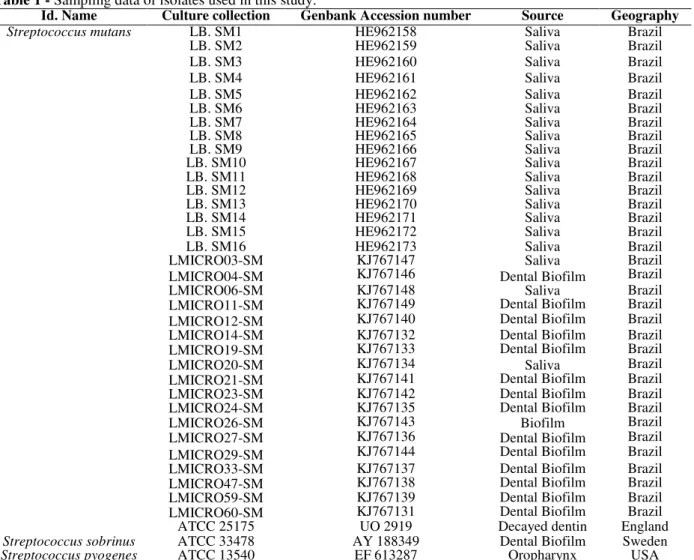
Sixteen S. mutans strains isolated from the saliva
from the individuals with cavity caries by sequence analysis of the 16S-23S ribosomal DNA spacer region (Chen et al. 2004) and three reference strains (Table 1) were used in this study. In addition, five samples of saliva and five samples of dental biofilm were tested.
DNA extraction and IGS region amplification
All Streptococcus isolates were cultivated in brain
heart infusion (BHI) broth and incubated at 37ºC
for 24 h. The obtained cultures had 1 x 10⁸
cells/mL and were centrifuged at 49,000 g for 2 min. The precipitate was transferred to a mixture of powder silica and celite in CTAB buffer, and the DNA was extracted according to the methodology described by Moreira et al. (2010). The DNA samples of saliva and dental biofilm were obtained by using the same proceedings. The 16S-23S intergenic
region was amplified from S. mutans isolates for
total DNA from saliva DNA total or biofilm DNA
total, using primers 13BF (5’
Table 1 - Sampling data of isolates used in this study.
Id. Name Culture collection Genbank Accession number Source Geography
Streptococcus mutans LB. SM1 HE962158 Saliva Brazil
LB. SM2 HE962159 Saliva Brazil
LB. SM3 HE962160 Saliva Brazil
LB. SM4 HE962161 Saliva Brazil
LB. SM5 HE962162 Saliva Brazil
LB. SM6 HE962163 Saliva Brazil
LB. SM7 HE962164 Saliva Brazil
LB. SM8 HE962165 Saliva Brazil
LB. SM9 HE962166 Saliva Brazil
LB. SM10 HE962167 Saliva Brazil
LB. SM11 HE962168 Saliva Brazil
LB. SM12 HE962169 Saliva Brazil
LB. SM13 HE962170 Saliva Brazil
LB. SM14 HE962171 Saliva Brazil
LB. SM15 HE962172 Saliva Brazil
LB. SM16 HE962173 Saliva Brazil
LMICRO03-SM KJ767147 Saliva Brazil
LMICRO04-SM KJ767146 Dental Biofilm Brazil
LMICRO06-SM KJ767148 Saliva Brazil
LMICRO11-SM KJ767149 Dental Biofilm Brazil
LMICRO12-SM KJ767140 Dental Biofilm Brazil
LMICRO14-SM KJ767132 Dental Biofilm Brazil
LMICRO19-SM KJ767133 Dental Biofilm Brazil
LMICRO20-SM KJ767134 Saliva Brazil
LMICRO21-SM KJ767141 Dental Biofilm Brazil
LMICRO23-SM KJ767142 Dental Biofilm Brazil
LMICRO24-SM KJ767135 Dental Biofilm Brazil
LMICRO26-SM KJ767143 Biofilm Brazil
LMICRO27-SM KJ767136 Dental Biofilm Brazil
LMICRO29-SM KJ767144 Dental Biofilm Brazil
LMICRO33-SM KJ767137 Dental Biofilm Brazil
LMICRO47-SM KJ767138 Dental Biofilm Brazil
LMICRO59-SM KJ767139 Dental Biofilm Brazil
LMICRO60-SM KJ767131 Dental Biofilm Brazil
ATCC 25175 UO 2919 Decayed dentin England
Streptococcus sobrinus ATCC 33478 AY 188349 Dental Biofilm Sweden
Streptococcus pyogenes ATCC 13540 EF 613287 Oropharynx USA
LB - Labmicro-Biomol of Federal University of Paraná State; HE - European Nucleotide Archive; ATCC – American Type Culture Collection
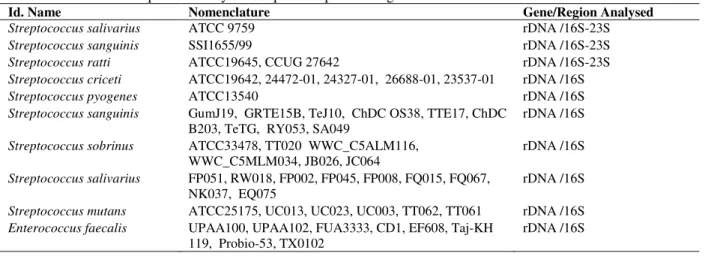
Padlock probe and primers
Padlock probe was design based on the intergenic
region sequences 16S-23S of Streptococcus and
Enterococcus genus in GenBank or Molecular
Biology Laboratory data bank – Labmicro-Biomol, UFPR (Table 2).
The probe was designed as previously described by Wang et al. (2005). To ensure the efficiency of padlock probe binding, the padlock probes were designed with minimum secondary structure and
with the Tm of the 5′ end probe binding arm close
to or above the ligation temperature (60°C). To
increase its discriminative specificity, the 3′ end
binding arm was designed with a Tm 10°C–15°C below ligation temperature. The genetic linker region was designed to minimize any similarity to potentially cross-reacting sequences after BLAST search. The primers used to amplify the specific
padlock probe signal during RCA were designed specifically to bind to the linker regions with a Tm of about 55°C. The relevant primers and probe are given in Table 3. The probe was synthesized by IDT (Integrated DNA Technologies).
Ligation of padlock probe
The ligation reaction was as previously described by Wang et al. (2005). One pmol of purified amplicons from16S-23S intergenic was mixed with 2 U of pfu DNA ligase (Stratagene,
Integrated Sciences) and 0.1 µm padlock probe in
20 mM Tris–HCl (pH 7.5), 20 mM KCl, 10mM
MgCl2, 0.1% Igepal, 0.01mM rATP, 1mM DTT
with total reaction volume of 10 µL. Multiple
Table 2 - Nucleotide sequences analysed for padlock probe design.
Id. Name Nomenclature Gene/Region Analysed
Streptococcus salivarius ATCC 9759 rDNA /16S-23S
Streptococcus sanguinis SSI1655/99 rDNA /16S-23S
Streptococcus ratti ATCC19645, CCUG 27642 rDNA /16S-23S
Streptococcus criceti ATCC19642, 24472-01, 24327-01, 26688-01, 23537-01 rDNA /16S
Streptococcus pyogenes ATCC13540 rDNA /16S
Streptococcus sanguinis GumJ19, GRTE15B, TeJ10, ChDC OS38, TTE17, ChDC
B203, TeTG, RY053, SA049
rDNA /16S
Streptococcus sobrinus ATCC33478, TT020 WWC_C5ALM116,
WWC_C5MLM034, JB026, JC064
rDNA /16S
Streptococcus salivarius FP051, RW018, FP002, FP045, FP008, FQ015, FQ067,
NK037, EQ075
rDNA /16S
Streptococcus mutans ATCC25175, UC013, UC023, UC003, TT062, TT061 rDNA /16S
Enterococcus faecalis UPAA100, UPAA102, FUA3333, CD1, EF608, Taj-KH
119, Probio-53, TX0102
rDNA /16S
Rolling circle amplification (RCA) reaction and visualization of amplicons
RCA reactions were performed in a 50 µL volume
containing 8 U of Bst DNA polymerase (New
England Biolabs), 400 µM deoxynucleoside
triphosphate mix, 10 pmoL of each RCA primer. Circularized probe signals were amplified by incubation at 65°C for 60 min. The accumulation of dsDNA products was visualised on a 1.0% agarose gel to verify the specificity of probe-template binding. Positive reactions showed
ladder-like pattern, whereas negative reactions
demonstrated a clean background.
RESULTS
The padlock probe species-specific based on intergenic region sequences 16S-23S gene of
cariogenic bacteria S. mutans was designed (Table
3).
Table 3 - Padlock probe sequences and primers used.
Probe/primers Sequences (5′-3′)
Probe-SM 5PO4'
GTAAAAGCCCTATAGCGCAGATCATGCT TCTTCGGTGCCCATGAGGTGCGGATAGC
TCGCGCAGACACGATAGTCTAGTTCATTG
ACAATTGAATAGCTA
Primer-1 ATGGGCACCGAAGAAGCA Primer-2 CGCGCAGACACGATA
- The bold sequences are the binding arms of the padlock probes. Padlock probes are joined by the non-specific linker region. - RCA primer-1 binds to the padlock probe, generating a long ssDNA. Its sequence is the same as the underlined segments, in reverse.
- RCA primer-2 binds to the nascent ssDNA as their binding sites become available. Each bound reverse primer extends and displaces the downstream primers and their extended products. Its sequence is the same as that of the segments shown in italics.
The padlock probe was evaluated within different
strains of Streptococcus isolated from the saliva
(n=20) from dental biofilm (n=15) obtained from the patients with a high historic of caries; one strain obtained from decayed dentin and one from oropharynx (Table 1). The results were positive
for all the DNA samples of S. mutans and negative
for S. sobrinus (ATCC33478 strain) and S.
pyogenes (ATCC13540 strain) evidencing the
specificity of designed padlock probe (Fig. 1).
Figure 1 - Analysis of RCA products by agarose gel electrophoresis 1.0%: 01- Molecular Marker 100 bp; 02 to 11- DNA sample of S. mutans
LB.SM2 to LB.SM11; 12 Molecular Marker 100 bp; 1- Blank control; 14 and 15 – DNA sample of S. mutans LB.SM1 and LB.SM12;
16- Total biofilm DNA sample; 17– Total DNA saliva sample; 18– DNA sample S. mutans (ATCC 25175 strain); 19- DNA sample S. sobrinus (ATCC33478 strain); 20- DNA sample S. pyogenes (ATCC13540 strain).
DISCUSSION
The most cariogenic bacteria in dental biofim and
Common methods of detection and characterization of bacteria from the oral cavity, especially culture methods, are limited in their sensitivity and specificity. Therefore, molecular biology methods have been developed to overcome culture limitation. Species specific sequences of the 16S rRNA gene has been used for the identification of streptococcal species (Igarashi et al. 1996; Igarashi et al. 1998; Hassan et al. 2001; Hassan et al. 2003; Al-Ahmad et al. 2006). Several sets of primers for PCR have been designed to amplify specific regions of
the 16S rRNA genes of S. mutans (Yano et
al. 2002; Yoshida et al. 2003; Chen et al. 2004) or closely species (Tung et al. 2007). In order to explore the use of molecular biology, 16S and 23S rRNA genes have been used as the targets for identification of microorganisms at the species, genus or family level. These genes contain both conserved regions and areas of variability sufficient for specific identification of bacteria (Hassan et al. 2003).
In this study, in order to discriminate S. mutans
from the other oral Streptococcus, both regions
were analysed the 16S and 16S–23S rDNA intergenic spacer regions (ISR). Among the regions examined (Table 2), the 16S–23S rDNA-ISR showed nucleotide changes compatible with the proposed method that was chosen as a target region. The padlock probe based on the rolling circle amplification assay was developed for
highly specific and sensitive detection of S.
mutans. The results were positive for all the 35
DNA samples of S. mutans strains evaluated
(Table 1), including S. mutans ATCC 25175 (Fig.
1), which demonstrated the specificity of designed padlock probe. Furthermore, different samples
were tested, including DNA of S. mutans isolates
from the saliva, from dental biofilm obtained from patient with high historic of caries. The
DNA samples of the S. sobrinus ATCC33478
strain and S. pyogenes ATCC13540 strain were
used as negative control (Fig. 1). Results showed that this RCA padlock probe was useful for
discrimination of S. mutans in biological samples.
The RCA technique has been widely used, with various applications based on this method, such as DNA detection and genotyping (Zhao et al. 2008). This is due the fact that unlike normal PCR, this technique is characterized by an isothermal DNA amplification method and does not need any special equipment for the amplification reaction, being cost-effective and with a low risk of
cross-contamination from amplicons associated to highly sensitivity. Therefore, the use of padlock probes based on RCA techniques pose a great potential in clinical diagnosis (Tong et al. 2007; Najafzadeh et al. 2011; 2013; Lackner et al. 2012; Zou et al. 2012; Feng et al. 2013; Hamzehei et al. 2013). This also has been demonstrated the use to identify target nucleic acid sequences, with high specificity down to the single nucleotide polymorphism level- SNPs (Tong et al. 2007). The use of padlock probes offers advantages over other techniques for detecting the species. A
padlock probe comprises two sequences
complementary to the 5′ and 3′ termini of the
target sequence joined by a genetic linker region. When they hybridize, head to tail, to the target, the
5′ and 3′ ends of the probe are juxtaposed, forming
a closed, circular molecule following incubation with a DNA ligase (Nilsson et al. 2006). The ability of padlock probes to accurately identify the sequence target has been demonstrated and the intensity of the signal generated by the circularized probe can be increased exponentially by rolling the circle amplification (RCA) (Nilsson et al. 2006; Tong et al. 2007).
Among hundreds of bacterial species in the human
oral cavity, S. mutans plays a key role in the
development of virulent biofilms of dental caries
(Beighton 2005). However, the classical
microbiological cultures method limits the studies
on the identification of specific populations of S.
mutans due to over 100 recognized species in the
genus Streptococcus (Nobbs et al. 2009).
Therefore, the development of species-specific padlock probes used in combination with rolling
circle amplification for S. mutans can be used for
a rapid and effective identification of this species, helping towards epidemiologic and diagnostic studies. This Padlock probes developed based on the genetic variability encountered in the flanking regions of the 16S rRNA and 23S rRNA gene
seemed to be an appropriate tool to distinguish S.
mutans strains. Furthermore, this technique could
be applied to differentiate the strains and serotypes with different virulence potential favoring the studies about caries disease epidemiology.
In summary, this work revealed that the padlock probe based on the rolling circle amplification assay was highly specific, accurate and useful
method for S. mutans detection using either DNA
would be the detection of specific DNA in clinical samples without preceding the isolation of the bacteria concerned. This was the first report on
padlocks probes for S. mutans, which appeared
potential and promising screening tool for the
specific identification of S. mutans.
ACKNOWLEDGMENTS
The authors are grateful for the support from Universidade Federal do Paraná (UFPR). The authors also wish to thank the Brazilian agencies Coordenação de Aperfeicoamento de Pessoal de Nível Superior CAPES/Ministério da Educação-Brazil; Conselho Nacional de Desenvolvimento Científico e Tecnológico (CNPq), Brasília, Brazil; and Fundação Araucária, Paraná, Brazil for financial support.
REFERENCES
Al-Ahmad A, Auschill TM, Braun G, Hellwig E, Arweiler NB. Over estimation of Streptococcus mutans prevalence by nested PCR detection of the 16S rRNA gene. J Med Microbiol. 2006; 5: 109-113. Beighton D. The complex oral microflora of high-risk individuals and groups and its role in the caries process. Community Dent Oral Epidemiol. 2005; 33: 248-255.
Chen CC, Teng LJ, Chang TC. Identification of clinically relevant viridians group Streptococci by sequence analysis of the 16S-23S ribosomal DNA spacer region. J Clin Microbiol. 2004; 42: 2651-2657.
Dye BA, Tan S, Smith V, Lewis BG, Barker LK, Thornton-Evans G, et al. Trends in oral health status: United States, 1988–1994 and 1999–2004.
Vital Health Stat. 2007; 11: 1-92.
Feng P, Klaassen CHW, Mels JF, Najafzadeh MJ, Gerrits Van Den Ende AHG, et al. Identification and typing of isolates of Cyphellophora and relatives by use of amplified fragment length polymorphism and rolling circle amplification. J Clin Microbiol. 2013; 51: 931-937.
Hamzehei H, Yazdanparast SA, Davoudi MM, Khodavaisy S, Golehkheyli M, Ansari S, et al. Use of rolling circle amplification to rapidly identify species of Cladophialophora potentially causing human infection. Mycopathologia. 2013; 175: 431-438.
Hassan AA, Khan IU, Abdulmawjood A, Lämmler C. Evalution of PCR methods for rapid identification and differentiation of Streptococcus uberis and
Streptococcus parauberis. J Clin Microbiol. 2001; 39: 1618-1621
Hassan AA, Khan IU, Abdulmawjood A, Lämmler C. Inter and intraspecies variations of the 16S-23S rDNA intergenic spacer region of various Streptococcal Species. Syst Appl Microbiol. 2003; 26: 97-103.
Hoshino T, Kawaguchi M, Shimizu N, Hoshino N, Ooshima T, Fujiwara T. PCR detection and identification of oral streptococci in saliva samples using gtf genes. Diagn Micr Infec Dis. 2004; 48: 195–199. Hsu KLK, Osgood RC, Cutter GR, Childres NK.
Variability of two plaque sampling methods in quantitation of Streptococcus mutans. Caries Res.
2010; 44: 160-164.
Igarashi T, Yamamoto A, Goto N. Rapid identification of mutans Streptococcal species. Microbiol Immunol.
1996; 40: 867-871.
Igarashi T, Yamamoto A, Nobuichi G. Polymerase chain reaction for identification of oral streptococci:
Streptococcus mutans, Streptococcus sobrinus,
Streptococcus downei and Streptococcus salivarius. J Microbiol Meth. 1998; 34: 81-88.
Koo H, Xiao J, Klein MI, Jeon JG. Exopolysaccharides produced by Streptococcus mutans
glucosyltransferases modulate the establishment of microcolonies within multispecies biofilms. J Bacteriol. 2010; 192: 3024-3032.
Lackner M, Najafzadeh MJ, Sun J, Lu, Q, De Hoog, GS. Rapid identification of Pseudallescheria and
Scedosporium Strains by Using Rolling Circle Amplification. Appl Environ Microb. 2012; 78: 126-133.
Lal D, Verma M, Lal R. Exploring internal features of 16S rRNA gene for identification of clinically relevant species of the genus Streptococcus. Ann Clin Microbiol Antimicrob. 2011; 10: 1-28.
Lancefield RC. A serological differentiation of human and other groups of hemolytic streptococci. J Exp Med. 1933; 57: 571-595.
Lee SF, Boran TL. Roles of sortase in surface expression of the major protein adhesin P1, saliva-induced aggregation and adherence and cariogenicity of Streptococcus mutans. Infect Immun. 2003; 71: 676- 681.
Marsh PD. Are dental diseases examples of ecological catastrophes? Microbiology. 2003; 149: 279-294. Moreira M, Noschang J, Neiva IF, Carvalho Y, Higuti
IH, Vicente VA. Methodological variations in the isolation of genomic DNA from Streptococcus
Najafzadeh MJ, Sun J, Vicente VA, De Hoog GS. Rapid identification of fungal pathogens by rolling circle amplification using Fonsecaea as a model.
Mycoses. 2011; 54: 577-582.
Najafzadeh MJ, Dolatabadi S, Saradeghi KM, Naseri A, Feng P, De Hoog GS. Detection and identification of opportunistic Exophiala species using the rolling circle amplification of ribosomal internal transcribed spacers J Microbiol Meth. 2013; 94: 338-342. Nilsson M, Malmgren H, Samiotaki M, Kwiatkowski
M, Chowdhary BP, Landegren U. Padlock probes: circularizing oligonucleotides for localized DNA detection. Science. 1994; 265: 2085-2088.
Nilsson M. Lock and roll: single-molecule genotyping in situ using padlock probes and rolling-circle amplification. Histochem Cell Biol. 2006; 126: 159-164.
Nobbs AH, Lamont RJ, Jenkinson HF. Streptococcus
adherence and colonization. Microbiol Mol Biol R. 2009; 73: 407-50.
Oho T, Yamashita Y, Shimazaki Y, Kushiyama M, Koga T. Simple and rapid detection of Streptococcus mutans and Streptococcus sobrinus in human saliva by polymerase chain reaction. Oral Microbiol Immun. 2000; 5: 258-62.
Rosan B. Antigens of Streptococcus sanguis. Infect Immun.
1973; 7: 205-211.
Smith DJ, King WF, Barnes LA, Peacock Z, Taubman MA. Immunogenicity and protective immunity induced by synthetic peptides associated with putative immunodominant regions of Streptococcus mutans glucan-binding protein B. Infect Immunol. 2003; 71: 1179-1184.
Smorawinska M, Kuramitsu HK. DNA probes for detection of cariogenic Streptococcus mutans. Oral Microbiol Immun. 1992; 7: 177-181.
Sun J, Najafzadeh MJ, Zhang J, Vicente VA, Xi L, De Hoog GS. Molecular identification of Penicillium marneffei using rolling circle amplification. Mycoses.
2011; 54: 751-759.
Tong Z, Kong F, Wang B, Zeng X, Gilbert GL. A practical method for subtyping of Streptococcus agalactiae serotype III, of human origin, using rolling circle amplification. J Microbiol Meth. 2007; 70: 39-44.
Tung SK, Teng LJ, Vaneechoutte M, Chen HM, Chang TC. Identification of species of Abiotrophia, Enterococcus, Granulicatella and Streptococcus by sequence analyses of the ribosomal 16S-23S intergenic spacer region. J Med Microbiol. 2007; 56: 504-513.
Wang B, Potter SJ, Lin Y, Cunningham AL, Dwyer DE, Su Y, et al. Rapid and sensitive detection of severe acute respiratory syndrome coronavirus by rolling circle amplification. J Clin Microbiol. 2005; 43: 2339-2344. Wang J, Li C, Xiao B, Liu J. Detection of cariogenic
Streptococcus mutans by quantitative polymerase chain reaction. Chinese J of stomatology. 2002; 37: 281-283.
Yano A, Kaneko N, Ida H, Yamaguchi T, Hanada N. Real-time PCR for quantification of Streptococcus mutans. FEMS Microbiol Lett. 2002; 217: 23-30. Yoshida A, Suzuki N, Nakano Y, Kawada M, Oho T,
Koga T. Development of a 5 nuclease-based real-time PCR assay for quantitative detection of cariogenic dental pathogens Streptococcus mutans
and Streptococcus sobrinus. J Clin Microbiol. 2003; 41:4438-4441.
Zhao W, Ali MM, Brook MA, Li Y. Rolling Circle Amplification: Applications in Nanotechnology and Biodetection with Functional Nucleic Acids. Angew Chem Int Edit. 2008; 47: 6330-6337.
Zou B, Ma Y, Wu H, Zhou G. Signal amplification by rolling circle amplification on universal flaps yielded from target-specific invasive reaction. Analyst. 2012; 137: 729-734.