PLANTING TIME FOR MAXIMIZATION OF YIELD OF
VINEGAR PLANT CALYX (
Hibiscus sabdariffa
L.)
1Época de plantio para maximização daprodução de cálices de vinagreira (
Hibiscus sabdariffa
L.)
Nilmar Eduardo Arbex de Castro2, José Eduardo Brasil Pereira Pinto3, Maria das Graças Cardoso4, Augusto Ramalho de Morais5, Suzan Kelly V. Bertolucci6, Fabiano Guimarães da Silva7, Nelson Delú Filho8
ABSTRACT
The objective of this work was to evaluate the yield of calyxes of Hibiscus sabdariffa L, a medicinal plant, at four
planting times in Lavras MG. The treatments were four planting times (October 18th, November 15th, December 18th 2001 and January 15th 2002) and a harvest was proceeded when practically there were no developing calyxes, almost at the end of the plant cycle. The numbers of calyxes per plant, the fresh and dry biomasses of calyxes and quality were taken into account. It follows that planting time influenced yield per plant and the fresh and dry biomasses of calyxes, differing from each other by Tukey test at 5%. In October planting, there was a higher yield (2,522kg/ha) with a yield 5.24 as high relative to the planting of the month of January (481 kg/ha). The planting s in the month of November to December showed yields of 1,695 and 1,093 kg/ha of dry calyxes, respectively and in relation to the same months of January, yield was of 3.52 to 2.27 times more. Harvest must be done as soon as the calyxes are ripe in order to preserve quality.
Index Terms: Organic farming, calyx, medicinal plant, yield, vinegar plant.
RESUMO
Objetivou-se avaliar a produtividade de cálices de Hibiscus sabdariffa L., planta medicinal, em quatro épocas de
plan-tio em Lavras M.G. Os tratamentos foram quatro épocas de planplan-tio (18 de outubro; 15 de novembro; 18 de dezembro de 2001 e 15 de janeiro de 2002) e realizada uma colheita quando praticamente não existiam cálices em desenvolvimento, quase no final do ciclo da planta. Foram considerados os números de cálices por planta, as fitomassas frescas e secas dos cálices e a qualidade. Concluiu-se que a época de plantio influenciou o rendimento por planta e as fitomassas frescas e secas dos cálices, diferindo en-tre si pelo teste de Tukey a 5%. No plantio de outubro, houve maior rendimento (2.522 kg/ha), com produção de 5,24 vezes a mais em relação ao plantio do mês de janeiro (481 kg/ha). Os plantios nos meses de novembro e dezembro tiveram produções de 1.695 e 1.093 kg.ha-1 de cálices secos, respectivamente, e em relação ao mês de janeiro, a produção foi 3,52 e 2,27 vezes a mais. Deve-se realizar a colheita assim que os cálices estiverem maduros, a fim de preservar a qualidade.
Termos para indexação:Agricultura orgânica, cálice, planta medicinal, produtividade, vinagreira.
(Recebido para publicação em 28 de julho de 2003 e aprovado em 12 de setembro de 2003)
INTRODUCTION
A native to Tropical Eastern Africa, Hibis-cus sabdariffa L. family Malvacea, was introduced in Europe in the late XIX and today is present in the formulation of most aromatic teas consumed in that continent (MARTINS et al., 1994). It is known in England as roselle , l oiselle in France,
jamaica in Spain, karkade in Switzerland and Arabia among others (MCCLALEB, 1998).
Introduced in Brazil by the slaves, popularly known by rosele (a), vinagreira, pampola, pampulha, flor da jamaica, azedinha, caruru-azedo, carruru da guiné, quiabo azedo, quiabo-rosco or roxo, joão bento among others (PANIZZA, 1997).
1. Parte da dissertação apresentada à Universidade Federal de Lavras/UFLA Caixa Postal 37 37200-000 Lavras, MG, pelo primeiro autor, para
ob-tenção do grau de mestre em Agronomia, área de concentração Fitotecnia/Plantas Medicinais. 2003. 2. Engenheiro Agrônomo, MSc, Departamento de Agricultura da UFLA, [email protected]
3. Professor, PhD, DAG/UFLA.
4. Professora, Drª, Departamento de Química da UFLA. 5. Professor, Dr, Departamento de Ciências Exatas da UFLA. 6. Professora, MsC, DAG/UFLA.
7. Doutorando, DAG/UFLA.
Planting time for maximization of yield of vinegar plant... 543
Out of the 100 plants of interest by the pharmaceutical industries, the vinegar plant stands out by its therapeutic efficacy as a diuretic, soft laxative, stomatic, calmative, antiscorburtic (VIEIRA, 1992).
It is used also against abscesses, biliary problems, coughs, fevers, hang-overs, heart diseases, hypertension and neurosis (ROVESTI, 1936; LECLERC, 1938; VIEIRA, 1992; PANIZZA, 1997).
Perry (1980) quotes a study performed by Rovesti (1936) with recommendations in arteroscheriose as intestinal antiseptic. It is a food supplement utilized against anemia; its seeds and leaves are ground, powered and served as a nutrient-enriched flour.
Its laxative effect is due to the organic acids pre-sent in the calyxes, the most important constituent being hibiscic acid, in addition to lactic, citric, malic and tarta-ric acids. Also, potassium oxalate, carbohydrates, pig-ments, glycosides, mucilages, flavonoids (hibiscine and hibiscetine) and anticyanic derivatives (gossipetine and glycoside) which act by decreasing blood viscosity, re-ducing pressure and stimulating digestion are present. It contain proteins, fibers, calcium, iron, carotenes and vi-tamin C in leaves (LECLERC, 1938; TESKE and TRENTINI, 1995).
Annual cycle shrub, it reaches up to 1.80 m high, little branched stem, cup-shaped, glabrous and red tona-lity (MCCALEB, 1998). Appropriate for the planting in tropical climates with a good rainfall distribution, from 1,500 to 2,000 mm yearly and altitudes close to 600m. Frost and shading - susceptible sensitive to photoperiod, which influences directly growth and flowering, decrea-sing yield as days shorten, which implies in cultivation according to photoperiod (DUKE, 1978).
The flower, single, sessile and axillary possesses its corolla made up of five petals with an average dia-meter of 5.0 cm when opened. Five sepals of intense and bright red coloration in a conical shape form the calyx, first floral verticil. At the base of the calyx, the epicalyx or calycle, arranged in circle, giving the im-pression of a supplementary calyx, is formed by bracts also red. The term calyx in this work involves the pro-perly said calyx and the calycle.
The fruit is an oval dehiscent capsule, 2.0 cm long, where are inserted seeds and stays involved by the calyx developing after fecundation, which in addition to persistent, it develops and surrounds the fruit in the manner of the juá-de-sapo (Physalis sp) (DUKE, 1978; VIDAL and VIDAL, 1990).
The calyx is the part of greatest interest, for fresh or dehydrated, they are utilized in teas or refreshments
of special flavor and taste (TESKE and TRENTINI, 1995), as well as jams (GAMAL et al., 1984), liqueurs, vines, syrups, ice-creams, sauces, pies, vinaigrettes, desserts, dyes and flavorers (SAMBAMURTHY, 1953).
The present work aimed to establish planting ti-me in the obtaining the highest yield of vinagre plant calyxes in Lavras MG.
MATERIAL AND METHODS
The experiment was conducted in the Vegetable Sector of the Department of Agriculture of the Federal University of Lavras (UFLA), Minas Gerais State, si-tuated at the geographic coordinates of 21o 14 of South latitude and 45o 00 of West longitude with altitude of 920 m. the climate of the local is of the type Cwb by the international climatic classification of Koppen, charac-terized by rainy summers and dry winters and average annual rainfall of 1,411mm, the annual average tempe-rature being of 19.3C.
Physical-chemical analyses of soil were accom-plished in the Soil Analysis laboratory of the Soil Sci-ence Department of the UFLA in characterizing the composition of the soil in the experimental area.
The experimental design was the completely randomized with four replicates in order to evaluate the effects of four planting times (November 18th; October 15ht; December 18th 2001 and January 15th 2002) of the vinegar plant (Hibiscus sabdariffa) as regards fresh and dried calyx yields per area, only one harvest being per-formed at the end of fructification.
The conduction of the experiment was achieved according to the precepts of organic farming for medi-cinal plants (SARTÓRIO et al., 2000).
The spacing utilized at planting was 1.00 m inter plant by 0.60 cm inter row with an average density of 16,500 plants/ha. Fertilization utilized was cattle manu-re (1.0kg/ linear meter) in the planting furrow.
In the planting lines were placed three seeds e-very 0.60 m at the average depth of 2 to 3 cm. These se-eds were obtained from plants grown in the 2000/2001 crop, which were submitted to germination tests. The amount of seeds per hectare was estimated around 1.20 kg. Thinnings were done in the plots when the plants rea-ched the 5 to 6 definitive leaf stage (35 to 40 days), lea-ving only one plant at the indicated spacing.
yi-CASTRO, N. E. A. de et al. 544
eld per plant, fresh and dry biomass of the calyxes (in grams) and the dry calyx yield in kg/ha.
The data obtained in the evaluations were submitted to the analysis of variance and the effects of planting times were compared by Tukey test and the regression analysis was done (FERREIRA, 200b). Sistema de Análise de Variância (Variance Analysis System) Sisvar, according to Ferreira (2000a) was utilized.
RESULTS AND DISCUSSIONS
The soil in the area of the experiment was cha-racterized as a distroferric Red Latosol = LVdf (EMBRAPA, 1999), analysis of particle size Very Cla-yey , pH of 5,5.
Germination test accused 85% of the seeds via-ble and good cultural vigor.
In the field, the germination, emergence, deve-lopment and growth of the plants were similar in all the treatments up to 60 to 70 days, when they were 0.50 to 0.60 m high. From 70 days up to the end of the cycle, in the plants sown in October and November, increased growth, 1.57 and 1.54 m high, respectively was found and outgrowing those sown in December (1.48 m) and January (1.19 m) and were statistically different from one anther (Figure 1).
According to the F test at the level of 5% proba-bility, for plants height, there were no significant diffe-rences between the plantings of the months of October and November, which presented increased heights relati-ve to the months of December and January, pointing out that there is a decrease in the plants height as planting is delayed from October, becoming marked further in January (Figure 2).
The cycle of plants, viz, the number of days from planting to harvest (DAP) was different at plan-ting times. October enabled a longer cycle (203) days. November provided a 192 day cycle, December, 161 days and January only 149 days. The longest cy-cles occurred in the plantings of October and Novem-ber, presupposing that vegetative period is to
oc-cur on days where there is greater number of hours light, supporting increased growth of plants and hence higher yields. Vargas (1960), grown at Tingo Mara (Peru), the species Hibiscus cannabinus L and H. sabdariffa, planted in August and Septem-ber. Harvest of the former species was done at 135 to 160 (DAP) with growth faster than the latter, even the region being inadequate for growing.
The flowering of plants started at 100 to 105 DAP in the four times. Nevertheless, as the cycles of plants shortened from the first to the last planting ti-me, flowering was also reduced. The maximum flo-wering (number of flowers per plant and number of flowered plants) occurred around 140 to 145 DAP in October and November. In the plants of December, this period was shorter (125 to 140 DAP), in the plants of January was still shorter (120 to 125 DAP) (Figure 3).
Duke (1978) reports that photoperiod influen-ces directly growth and flowering. Flowering occur-red up to the end of the cycle of the plants, always decreasing in the four seasons of planting. Flowers remained open by morning and in the afternoon clo-sed, till next morning when they open again, repea-ting that every day till fecundation, this being was of 12 to 15 days. After fecundation, petals fell off and the growth of calyxes started at the start 1.0 to 1,5 cm and when matures of 5.0 to 5,5 cm, after 18 to 23 days. The period of the start of flowering till comple-te maturation of calyxes ranged from 30 to 38 days in the four times.
Planting time for maximization of yield of vinegar plant... 545
FIGURE 1 Graphical representation of plant height (m) at planting times of vinegar plant. (UFLA, Lavras Mg, 2003. Means followed by the same letter do not differ from each other for the characteristics by Tukey´s test at 5%).
1,57 1,54
1,48
1,19 y = -0,065x2 + 0,205x + 1,42
R2 = 0,978
0,8 1 1,2 1,4 1,6 1,8
October November December January
Planting Time
P
la
n
t'
s
H
e
ig
h
t
(m
)
FIGURE 2 Scatter diagram of plant height (m) at planting times of vinegar plant. UFLA, Lavras Mg, 2003. (Sig-nificant at the level of 5% by F test).
1,57 1,54
1,48
1,19 0,0
0,4 0,8 1,2 1,6 2,0
Octobe r Novembe r De ce mbe r January Pla nting Time
P
la
n
t'
s
H
e
ig
h
t
(m
)
C
B
AB
CASTRO, N. E. A. de et al. 546
FIGURE 3 Schematic representation of flowering period, fructification and cycles of the vinegar plants at days after planting (DAP) at planting times. UFLA, Lavras-MG, 2003.
FIGURE 4 Plates of Hibiscus sabadariffa L. calyxes. A - at 140 days after planting (DAP) and already ripe; B - Calyx (external 5.0 cm long from the top to the base of the calycle or epicalyx) and capsule (internal 2.5 cm long) UFLA, Lavras MG, 2003.
The calyxes with the peduncles were harvested by hand by making use of pruning scissors. All the har-vests were done at 8hs and at 12hs and harhar-vests in the rainy period were avoided.
The number of calyx per plant was significant in planting times. In October, 441 calyxes per plant were found, there being 4.41 as many calyxes per plant as Ja-nuary planting (100 calyxes per plant). November plan-ting yielded 350 calyxes per plant and was as many 3.5 as productive than in January (Figure 5).
According to F test at the level of 5% of probability, there was significant difference among planting times for number of calyxes per vinegar plant, showing that there was a reduction in yield of calyxes per plant as planting is delayed from Oc-tober, which was the most productive month (Figure 6).
It was noticed that many of the calyxes past from harvest point and went into senescence, after capsule dehiscence, in addition to favoring the occurrence of
calyx
capsule
calycle
P
la
nt
in
g
T
im
e
October 18
thNovember 15
thDecember 18
thJanuary 15
th203 days
161 days
192 days
149 days
End of the plants cycle
Period of flowering and fructification
DAP
1150
Planting time for maximization of yield of vinegar plant... 547
fungi (Botrytis and Oidio), with losses of quality, they being unsuitable to consumption.
This loss was 20% of calyxes harvested on October, 40% November, 30% December and 10% January plants. Therefore, harvest should be performed at least 15 days before relative to those non-performed or as soon as calyxes become ripe.
McCaleb (1998) quoted the importance of har-vest before capsules drying and opening, for in addition to making handling difficult, drying does not become uniform, undervaluing the quality of calyxes.
The removal of the capsules of the calyxes was done with extractors built aiming at the operation (Figu-re 7).
FIGURE 5 Graphical representations of the numbers of calyxes per vinegar plant at planting times. UFLA, La-vras MG, 2003. (Means followed by the same letter do not differ from each other for the characteristics by Tukey´s test at 5%).
100 441
350
207
y = -116,6x + 566
R2 = 0,9934*
0 100 200 300 400 500
October November December January
Planting Time
C
a
ly
c
e
s
N
u
m
b
e
r
P
e
r
P
la
n
t
FIGURE 6 Spread diagram of the number of calyxes per vinegar plant at planting times (*Significant at the level of 5% by F test).
100 207
441
350
0 100 200 300 400 500
October November December January
Planting Time
C
a
ly
x
e
s
N
u
m
b
e
r
P
e
r
P
la
n
t
C
D
B
CASTRO, N. E. A. de et al. 548
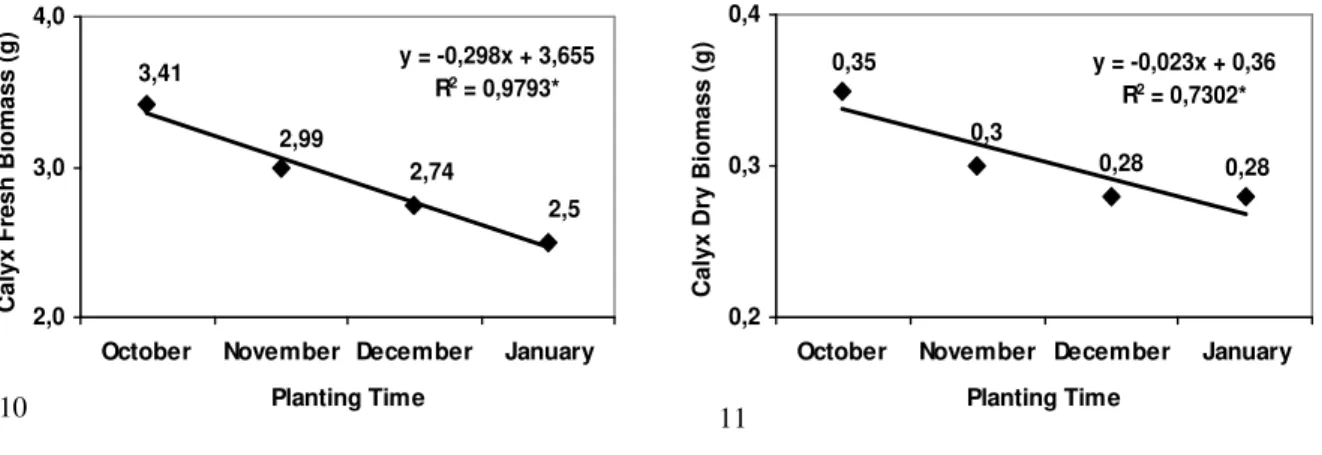
The fresh biomass of the calyx of October plants was of 3.41 g and did not differ statistically from the fresh biomass of the November calyx (2.99g). On the other hand, these ones were superior to those of De-cember (2.74 g) and January (2.50g) plants. In the Oc-tober plants, the fresh biomass of the calyx was 1.36as large relative to January. Respectively, November and December presented fresh biomasses of calyxes 1.20 and 1.09 as large as in January (Figure 8).
For October calyx s dry biomass (0.35g), the diffe-rence was significant and 1.25 as largerelative to January (0.28 g). I the plantings from November to December, the dry biomasses were 0.30 and 0.28 g, respectively and did not differ statistically from January (Figure 9).
By F test at the level of 5% of probability, there was a significant difference between planting times for
the fresh and dry biomasses of the vinegar plant calyx, pointing that there is a reduction of the calyx biomasses from the month of October, which presented the greatest biomasses (Figures 10 and 11).
The greatest fresh and dry biomass of calyx of the October plants with longer cycles may be ascribed to the longer permanence of the calyxes on the plant, for they grew further, hence they weighted more.
The highest yield of dry biomass of calyxes, in kg/ha, was on the October plants (2.522 kg/ha) and it was 5.2 as large as in January (480kg/ha). In the November planting, it was 1,695 kg/ha, it being 3.5 as large relative to January. In the December planting, yield was 1,093 kg/ha, it being 2.3 as large as in January (Figure 12).
FIGURE 7 Plates of the extraction of the capsules of vinagreira; A Extracting the capsule (3) of the calyx and calycle (1); B Calyx with a calycle (1), capsule already removed (3) and extractor (4), UFLA, Lavras MG, 2003.
FIGURES 8 and 9 Graphical representations: 8 - fresh biomass of the vinegar plant calyx; 9 - dry biomass of the vinegar plant calyx at planting times, UFLA, Lavras-MG, 2003.
1
2
3
3
1
4
0,35
0,30
0,28 0,28
0 0,1 0,2 0,3 0,4
October Novem ber Decem ber January Planting Tim e
C
a
ly
x
D
ry
B
io
m
a
s
s
(g
)
3,41
2,99
2,74
2,5
0,0 1,0 2,0 3,0 4,0
October Novem ber Decem ber January Planting Tim e
C
a
ly
x
F
re
s
h
B
io
m
a
s
s
(g
)
B B
A B
A
B B
Planting time for maximization of yield of vinegar plant... 549
According to F test at the level of 5% of probabi-lity, there was significant difference between planting times for dry biomass of vinegar plant calyxes in kg/ha,
pointing out that there is a yield reduction as planting was delayed in relation to the month of October, which presented the highest yield (Figure 13).
FIGURES 10 and 11 Spread diagrams of the: 10 fresh biomass of vinagreira; 11 dry biomass of the vinegar plant calyx at planting seasons. UFLA, Lavras MG, 2003. (*Planting time Significant at the level of 5% by F test).
FIGURE 12 Graphical representation of the dry mass plant yields of vinegar plant calyxes in Kg/ha at planting seasons. UFLA, Lavras MG, 2003.
3,41
2,99
2,74
2,5 y = -0,298x + 3,655
R2 = 0,9793*
2,0 3,0 4,0
October November December January Planting Time
C
a
ly
x
F
re
s
h
B
io
m
a
s
s
(g
)
0,35
0,3
0,28 0,28 y = -0,023x + 0,36
R2 = 0,7302*
0,2 0,3 0,4
October November December January Planting Time
C
a
ly
x
D
ry
B
io
m
a
s
s
(g
)
10 11
2522
1694
1093
480 0
1000 2000 3000
October November December January
Planting Time
Y
ie
ld
(K
g
/h
a
)
A
B
C
CASTRO, N. E. A. de et al. 550
480 2522
1694
1093
y = -672,7x + 3129 R2 = 0,9937*
0 1000 2000 3000
October November December January Planting Time
Y
ie
ld
(k
g
/h
a
)
FIGURE 13 Spread diagram of vinegar plant dry calyx yield in kg/ha, at planting times. UFLA, Lavras Mg, 2003. (*Significant at the level of 5% by F test).
CONCLUSIONS
The planting of Hibiscus sabdariffa L. in Lavras, MG, Brazil, may be done in the month of Oc-tober, under lowland conditions, aiming at increa-sed yield, for in this time, better quality calyxes are obtained. The adequate harvest time avoids quality loss by calyxes senescence or by pathogen attack.
Further studies are necessary as to the sort of harvest (in scale and single) in order to preserve the quality of the calyxes as well as to evaluate the yield and quality of the organic compounds present in the vi-negar plant calyxes.
ACKNOWLEDGEMENTS
To the Coordenação de Aperfeicoamento de Pessoal de Nível Superior CAPES, by the grant of scholarship to the first author.
BIBLIOGRAPHICAL REFERENCES
DUKE, J. A. The quest for tolerant germplasm. In: ______. Crop tolerance to suboptimal land conditions. Madison: American Society of Agronomy, 1978. p. 1-61. (ASA Special System, 82).
EMPRESA BRASILEIRA DE PESQUISA AGROPE-CUÁRIA. Centro Nacional de Pesquisa de Solos. Sis-tema brasileiro de classificação de solos. Brasília, 1999. 412 p.
FERREIRA, D. E. Análise estatística por meio do sisvar para windows: versão 4.0. In: REUNIÃO ANUAL DA REGIÃO BRASILEIRA DA SOCIEDADE INTERNACIONAL DE BIOMETRIA, 45., 2000, São Carlos. Anais São Carlos: UFSCar, 2000a. p. 255-258. FERREIRA, P. V. Estatística experimental aplicada à agronomia. 3. ed. Maceió: EDUFAL, 2000b. 422 p. GAMAL, S. A. El; OMAR, F. A.; MAHMOUD, M. M. Effect of nitrogen fertilization on the grouwth and yield of the Hibiscus sabdariffa L. Acta Horticulture, Cairo, n. 144, p. 135-144, 1984.
LECLERC, H. (Sida sabdariffa L.). Presse Médicale, Paris, v. 46, p. 1060, 1938.
MARTINS, E. R.; CASTRO, D. M.; CASTELLANI, D. C.; DIAS, J. E. Plantas medicinais. Viçosa: UFV, 1994. 220 p.
McCALEB, R. S. Hibiscus production manual. [S.l.: s.n.], 1998.
PANIZZA, S. Plantas que curam: cheiro de mato. 18. ed. São Paulo: IBRASA, 1997. p. 69-70.
PERRY, L. M. Medicinal plants of east and southeast Asia. Cambridge: MIT, 1980.
Planting time for maximization of yield of vinegar plant... 551
SAMBAMURTHY, K. A note on rosele: a useful e-conomic plant. Madras Agricultural Journal, Madras, v. 40, n. 11, p. 503-505, Nov. 1953.
SARTÓRIO, M. L.; TRINDADE, C.; RESENDE, P.; MACHADO, J. R. Cultivo orgânico de plantas medi-cinais. Viçosa: Aprenda Fácil, 2000. 260 p.
TESKE, M.; TRENTINI, A. M. M. Compêndio de fi-toterapia. 3. ed. Curitiba: Herbarium Laboratório Botâ-nico, 1995. 317 p.
VARGAS, M. J. Abaca y kenaf: dos cultivos para nuestro oriente. Bolletin Estacion Experi-mental Agricola de Tingo Maria, Huanucu, p. 6, 1960.
VIDAL, W. N.; VIDAL, M. R. R. Organografia botâ-nica. 3. ed. Viçosa: UFV, 1990.