www.scielo.br/aabc
Delineating shallow Neogene deformation structures in
northeastern Pará State using Ground Penetrating Radar
DILCE F. ROSSETTI
Museu Paraense Emílio Goeldi, Coordenação de Pesquisas e Pós-Graduação Cx. Postal 399, 66077-530 Belém, PA, Brasil
Manuscript received on March 26, 2002; accepted for publication on March 7, 2003; presented byAlcides N. Sial
ABSTRACT
The geological characterization of shallow subsurface Neogene deposits in northeastern Pará State using Ground Penetrating Radar (GPR) revealed normal and reverse faults, as well as folds, not yet well documented by field studies. The faults are identified mostly by steeply-dipping reflections that sharply cut the nearby reflections causing bed offsets, drags and rollovers. The folds are recognized by reflections that are highly undulating, configuring broad concave and convex-up features that are up to 50 m wide and 80 to 90 ns deep. These deformation structures are mostly developed within deposits of Miocene age, though some of the faults might continue into younger deposits as well. Although the studied GPR sections show several diffractions caused by trees, differential degrees of moisture, and underground artifacts, the structures recorded here can not be explained by any of these “noises”. The detailed analysis of the GPR sections reveals that they are attributed to bed distortion caused by brittle deformation and folding. The record of faults and folds are not widespread in the Neogene deposits of the Bragantina area. These GPR data are in agreement with structural models, which have proposed a complex evolution including strike-slip motion for this area from the Miocene to present.
Key words:Neogene, northeastern Pará State, Ground Penetrating Radar, tectonics, sedimentary rocks.
INTRODUCTION
There are numerous works illustrating the applica-tion of Ground Penetrating Radar (GPR) to increase stratigraphic and facies data collection in shallow surface throughout the world (e.g., Bridge et al. 1995, Stephens 1994, Bristow 1995, Van Heteren et al. 1998, Dagallier et al. 2000). In particular, this methodology has been successfully applied for mapping of facies and stratigraphic surfaces of Neo-gene deposits in northeastern Pará State, providing more detailed information to reconstruct the
deposi-Correspondence to: Dilce F. Rossetti E-mail: [email protected]
reflec-tions, representing a major problem during GPR in-terpretation. The reflection distortions observed in the study area can not be attributed to noises, but reflect more probably tectonic deformation. The record of faults and fractures in Cenozoic deposits of the Bragantina Zone is not new (Katzer 1933, Ack-ermann 1964). Tectonic models combining normal and strike-slip faults have been proposed for this area (Igreja et al. 1990, Costa et al. 2001). These studies are mostly based on the analysis of drainage systems and morphological aspects of coastal cliffs, while geological field evidence remains inadequate to test the models. Actually, the available outcrops, mostly including isolated coastal cliffs and limestone quar-ries, show dominantly horizontal deposits, though bed tilting in the order of 20◦to 60◦has been also reported (Costa et al. 1993). The GPR revealed to be a technique of great use to prospect subsurface fault and fracture segments in Neogene deposits of the Bragantina Zone. It also helped to reveal features that suggest the presence of folds, not yet recorded in these deposits. Based on the results obtained in this investigation, the use of GPR provides an al-ternative technique for imaging large-scale defor-mation structures in shallow Neogene deposits in northeastern Pará State, improving the knowledge of its tectono-sedimentary history.
MATERIALS AND METHODS
The GPR operates with emission of high frequency (10 to 2500 Mhz) electromagnetic waves in the ground for detecting material variations. Several pa-pers discuss in detail the basic theory of GPR (e.g., Moffat and Puskar 1976, Fisher et al. 1992, Asprion 1998). The GPR system used in this field survey was a Geophysical Survey Systems, Inc. Model SIR-2, with monostatic antenna of 200 Mhz frequency and slow walking pace. The system uses a 12-V battery, and it was run in a continuous recording mode, with a two-way travel time setting averaging 150 ns with 512 samples per scan. Although Common Mid Point tests were not carried out in the study area, calibra-tion with outcrop data led to an estimated depth
in-vestigation of 12 m. Horizontal surface control was made by the addition of markers every 50 m dur-ing data acquisition. The sections presented in this paper did not require topographic correction, given the flat nature of the study area at the sea level. To improve the image quality, the GPR profiles were analyzed using a RADAN software with the least processing including gain correction and application of filters with Finite Impulse Response to remove bands of ringing and high frequency (“snow”) noises and to enhance low frequency reflections. The same filters were used in all GPR profiles illustrated in this paper in order to allow a comparison of GPR facies characteristics.
GEOLOGICAL BACKGROUND
The Bragantina Zone is located in an area that has been undergone to a complex tectonic deformation since the initial continental break up in the Early Cretaceous that culminated with the origin of the South Atlantic Ocean. The area is bounded by the Marajó Graben System to the northwest and west, the Bragança-Viseu and São Luís-Grajaú Basin to the southeast, and the Pará-Maranhão Platform to the north. Although it represents a stable area com-pared to the strongly extended and strike-slip de-formed adjacent areas, studies have shown that the Bragantina Zone had also a complex tectonic evolu-tion through the Tertiary and on (Igreja et al. 1990, Costa et al. 1993). According to these authors, two sets of features characterize this area: northeast dipping normal faults developed during Late Ter-tiary; and northeast-southwest and east-west strike-slip faults linked by northwest-southeast normal faults of Pleistocene to Holocene age.
depo-BRAZIL
Bragança-Vizeu Basin
Intracratonic Parnaíba Basin Amazonas
Basin
Tocantins Arch
São Luís-Grajaú Basin
São Luís Shield Pará-Maranhão
Platform
Atlantic Ocean
Macapá
Marajó Gr
aben S
ystem Study Area
Pre-Cambrian Basement Fault
Salinópolis
Bragantina Platform Outeiro Island
Belém
Fig. 1 – Location map of the study area in northeastern Pará State, Brazil. The two boxes indicate the areas of the Bragantina Zone where shallow Neogene deposits have been imaged using GPR.
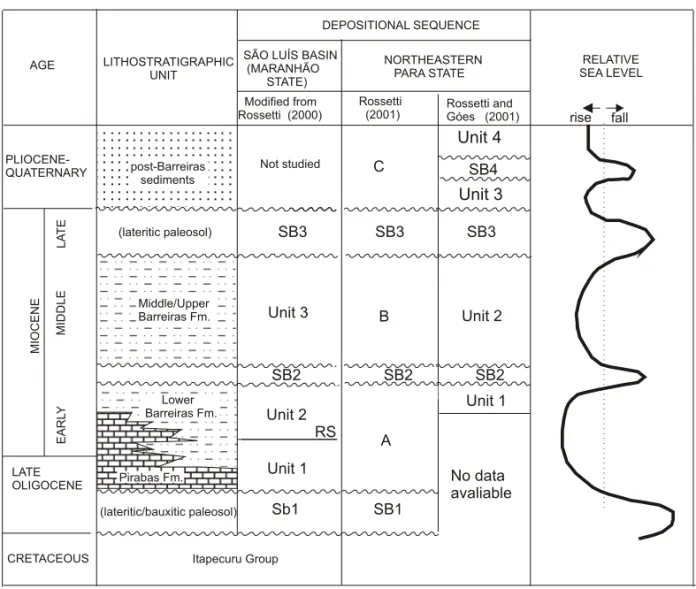
sitional sequences for these deposits (Rossetti 2001, Fig. 2). Sequence A (corresponding to the Pirabas Formation and lowermost portion of Barreiras For-mation) consists of a mixed carbonate-siliciclastic unit of late-Oligocene to early Miocene age, and include gray to yellowish, massive limestones (bio-calcirudite, biocalcarenite, biohermite, (bio-calcirudite, micrite) interbedded with black, gray and greenish, laminated mudstones, and minor calcareous sand-stones. These deposits were deposited in environ-ments ranging from transitional marine to restricted shelf. Sequence B (middle to upper portions of the Barreiras Formation) consists of variegated, non-fossiliferous, siliciclastic deposits including con-glomerate, sandstone and claystone, which were formed in an estuarine setting during the Middle Miocene (e.g., Rossetti 2001). Sequence C (Post-Barreiras Sediments), of an uncertain age younger than Pliocene, consists of fine-grained, mas-sive sandstones and mudstones attributed to eolian coastal dunes and embayments. Recent studies have led to propose that the latter might include at least
three stratigraphic units that record a complex his-tory of sedimentation versus erosion during the latest Neogene (Rossetti et al. 2003).
Correlation between late Cenozoic units from northeastern Pará State and temporally equivalent deposits located approximately 600 km of distance in the São Luís-Grajaú Basin, Maranhão State, has led to a refined history of sea level changes for north-ern Brazil (Rossetti 2000). According to this recon-struction, successive drops in relative sea level have produced unconformities that bound second-order depositional sequences formed mainly during peri-ods of transgression to highstand (Fig. 2). Whether by eustasy or tectonic movement, or by a combina-tion of the two, the cause of these sea level fluctua-tions remains open.
RADAR STRUCTURES
AGE
DEPOSITIONAL SEQUENCE
LATE OLIGOCENE
Lower Barreiras Fm.
Pirabas Fm. Middle/Upper Barreiras Fm. post-Barreiras
sediments
Itapecuru Group
MIDDLE
LA
TE
EARL
Y
MIOCENE
PLIOCENE-QUATERNARY
(lateritic paleosol)
(lateritic/bauxitic paleosol)
CRETACEOUS
LITHOSTRATIGRAPHIC UNIT
Rossetti (2001) Modified from
Rossetti (2000)
Sb1 RS SB3
SB2
Unit 1 Unit 2 SÃO LUÍS BASIN (MARANHÃO
STATE)
NORTHEASTERN PARA STATE
Rossetti and Góes (2001)
SB3
SB2
SB1 C
B
A
fall rise
RELATIVE SEA LEVEL
Unit 4
Unit 3
Unit 2
Unit 1
No data avaliable Unit 3
SB2 SB4
SB3 Not studied
Fig. 2 – Summary of the stratigraphic framework during the Cenozoic of the Bragantina Zone, State of Pará, and its correlation with the units exposed in northern São Luís-Grajaú Basin, Maranhão State. The last column to the right illustrates the suggested relative sea level history proposed for the north of Brazil. (Modified from Rossetti et al. 2003).
volume of data collected in these places reaches now up to 15 km of continuous profiling, which has been crucial to provide a 3-dimensional view of facies architecture and stratigraphic framework at shallow depths up to 15 m. A discussion about these issues is beyond the objective of this study and those inter-ested should refer to references presented elsewhere (Rossetti and Góes 2001 a,b, c, Rossetti et al. 2003). In addition to help understanding the stratig-raphy and paleoenvironments, the available GPR sections have allowed the identification of several styles of reflection distortions. Among these, hy-perbolic reflections, for instance caused by under-ground artifacts, pebbles or large rock fragments, are common, as are reflection distortions due to the
correlation of reflectors across a fault plane; and loss of coherency beneath a fault plain or distorted dips seen through the fault plane. The GPR signature of folds is scarce, but an example has been recorded from Quaternary of west Cumbria, UK (Meschede et al. 1997, Busby and Merritt 1999). Similar features were identified in the Neogene deposits prospected in the shallow surface of northeastern Pará, as de-scribed in the following.
Faults and Fractures in GPR Sections
Numerous reflection distortions were identified in the GPR images collected in the Bragantina Zone, which are better related to faults and fractures. Fig-ures 3 A-D show two laterally correlatable profiles located approximately 15 m apart with several in-clined reflection segments. These show an apparent high angle, which is due to the vertical exaggera-tion of the radar secexaggera-tions. Some of these inclined segments consist of white, reflection-free lines de-fined by sharp interruptions of the surrounding flat lying beds. These dipping lines may separate flat ly-ing reflections that show offsets. This is particularly well illustrated between 20 and 40 m of horizon-tal distance, where the reflections step down to the right as it passes through a steeply dipping reflec-tion. The reflections in both sides of this feature are bent, forming convex and concave-up features in the left and right side of it, respectively. Two concave shapes between 40 and 80 ns of depth are mantled by downlapping sigmoidal reflectors. Noteworthy is the progressive downward increase in reflection offset, which reaches up to 40 ns (estimated 3 m, considering calibration with outcrops) at the base of the section (arrows). In the right section, there is a discontinuity surface bounding underlying, steeply dipping reflections and overlain by sharp reflections that terminate against it in onlap. Deciphering the nature of all the steeply dipping reflections is not so simple as they may record different situations. For instance, the reflections bounded by the discontinu-ity surface in the right section could be interpreted as bed deformation at the edge of a cliff. Corre-lation of this discontinuity surface throughout
de-160 0
TWT
(ns)
? ?
?
? ? ?
fault/fracture Interpreted fault/fracture Diffraction ?
? ?
A
B
E W
0 10 20 30 40 50 60 (m)
0 10 20 30 40 50 60 (m)
80 40
120
160 0
TWT
(ns)
80 40
120
13 0
Estimated
depth
(m)
?
D
E 0 10 20 30 40 50 60 (m) W
0 1010 20 30 40 50 60 (m)
0
80 40
0
80 40
120
7.5
13 0
Estimated
depth
(m)
7.5
C
13 0
Estimated
depth
(m)
7.5
13 0
Estimated
d
epth
(m)
7.5
120
160
160
TWT
(ns)
TWT
(ns)
NE
SW
0
35
TWT
(ns)
75
125
4
approximate
d
epth
(m)
8
12
parallel-laminated mudstones
DS2
DS1 0
35
TWT
(ns)
75
125
UNIT 4 UNIT 4
UNIT 3
UNIT 3 UNIT 3
UNIT 2
UNIT 2
UNIT 1
0
4
approximate
depth
(m)
8
12
?
? ? ?? ? ?
? ?
0 50 100 150 200 (m)
b
b
b
0 50 100 150 200 (m)
0
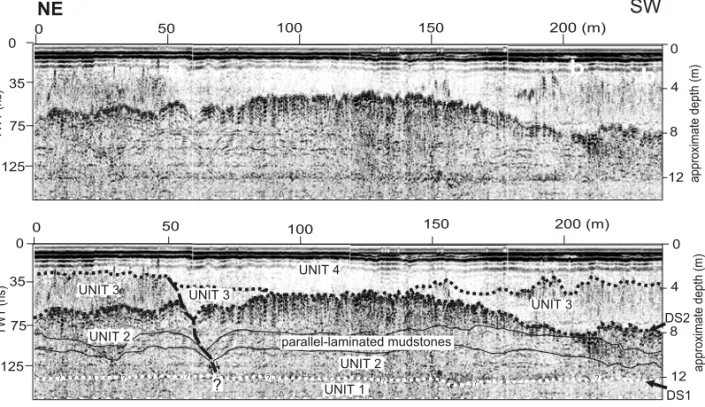
Fig. 4 – Non-annotated (upper) and annotated (lower) GPR section from the Outeiro Island area, illustrating four stratigraphic units (units 1 to 4) bounded by unconformities (hatched lines) that are locally displaced by a steeply-dipping normal fault (inclined black line). Note the drag of parallel reflections attributed to laminated mudstones from stratigraphic unit 2. Radar resolution does not allow determining the continuity of this fault down into unit 1, neither its upper boundary. The white dotted line indicates a trace that looks like ground water table, but outcrop data in the cliff face indicates this to match with a transgressive surface at the top of heterolithic deposits from unit 1. Units 1 and 2 = Miocene age (Barreiras Formation); Units 3 and 4 = Pliocene and younger (post-Barreiras sediments). See text for further explanations.
posits of Unit 1 (Rossetti 2001). The outcrop data at this place also show several strata deformation features, which is consistent with the GPR interpre-tation provided in this paper.
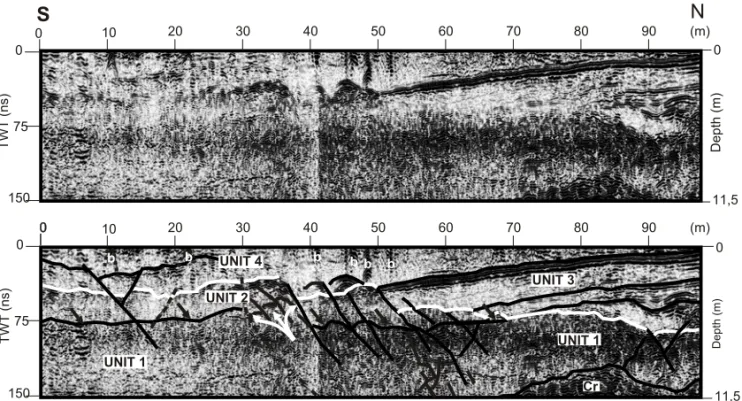
The sections illustrated in figure 5 help to sup-port the presence of faults and fractures in the Neo-gene of the Bragantina Zone. Four stratigraphic units are present, which correspond to the Pirabas/ Barreiras succession (two lower ones, with chaotic reflections) and the post-Barreiras (Pliocene and younger deposits with relatively more discontinu-ous parallel reflections). A strong reflector in the lower, right corner of the section is possibly due to calcareous rocks, typical of the Pirabas Forma-tion. Based on comparisons with field data (Rossetti 2000, 2001), the strong reflectors that mark the top of the lowermost unit (indicated by a set of black
0 0
Depth
(m)
150 11,5
0 10 20 30 40 50 60 70 80 90 (m)
0
Depth
(m)
11,5
0 10 20 30 40 50 60 70 80 90 (m)
TWT
(ns)
b b
b b b b
S
N
75
0
150
TWT
(ns)
75
Cr UNIT 1
UNIT 1 UNIT 3 UNIT 4
UNIT 2
Fig. 5 – Non-annotated (upper) and annotated (lower) GPR section from the Atalaia Beach area, illustrating deposits correlatable to the Miocene (below white line) with reflections strongly disrupted by faults (continuous inclined black line = fault; hatched inclined black line = possible fault; white arrow = inverse fault; set of arrows above unit 2 = possible paleosoil horizon cemented by iron; b = large boulder/cobble or man artifacts; Cr = calcareous rocks). See text for further explanations.
both normal and reverse faults. As the beds were disrupted, the faulted blocks moved down toward the right side of the section, increasing subsidence and thus creating space to accommodate sediments that are not present in the left side of the section. The more pronounced depressed segment at the right cor-ner seems to record a sector with relative increased subsidence caused by fault activity, where the post-Barreiras sediments have the largest thickness.
Folds
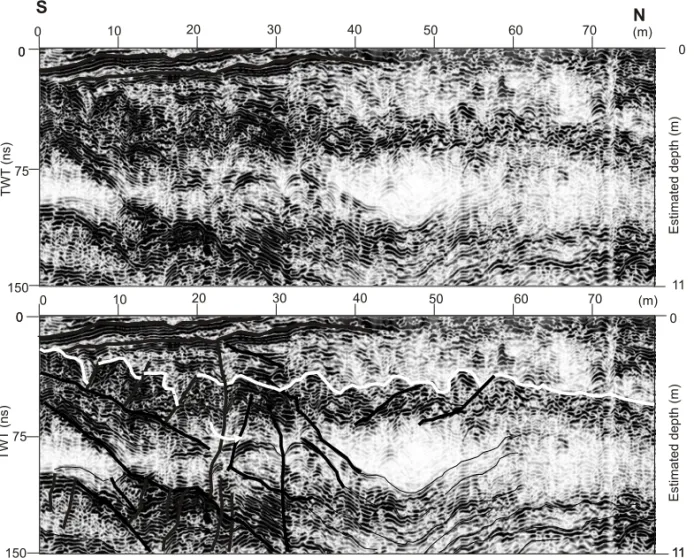
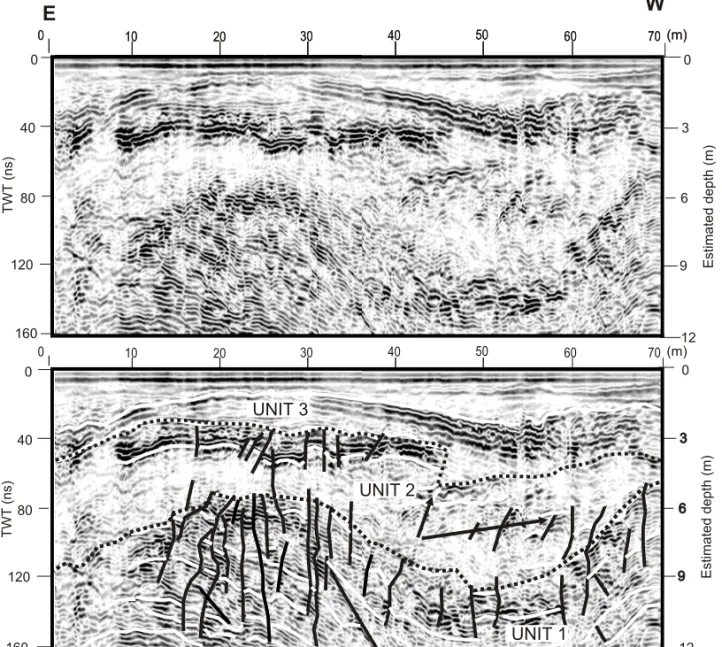
In addition to faults and fractures, a complex type of reflection distortion is observed in the GPR sec-tions studied in the northeastern of Pará State. This includes reflections that appear strongly undulating, forming broad concave and convex up shapes that are up to 50 m wide and 80 to 90 ns deep. These features bound a series of internal reflections that are also undulating, conforming with the external con-cave and convex up shapes. Three figures were se-lected to illustrate these structures. Figure 6 shows
a syncline and an anticline in the right side of the section. The left margin of the syncline, which shows several inclined reflections attributed to frac-tures and faults, ends abruptly forming a wedge that pinches out around 40 ns of depth. In addition, the lower boundary of the wedge is a sharp inclined re-flection that truncates all the underlying rere-flections. The undulated interval is sharply bounded upward (between 65 and 75 ns of depth) by a package of high frequency, chaotic reflections that are in sharp con-trast with the overlying lower frequency reflections that terminate in onlap against it. The top chaotic reflections are correlatable with an unconformity at the top of the Miocene deposits in the study area, which is marked by a paleosol with lateritic concre-tions that probably justify the distinguished high fre-quency interval. Noteworthy is that the strata above this unconformity are almost not deformed.
150 0
11 0
Estimated
depth
(m)
0
TWT
(ns)
0 10 20 30 40 50 60 70 (m)
75
150 0
11 11 0
Estimated
depth
(m)
0
0 10 20 30 40 50 60 70 (m)
75
TWT
(ns)
S N
Fig. 6 – Non-annotated (upper) and interpreted (lower) GPR sections from the Atalaia Beach, where deposits of Miocene age (below white line) are strongly deformed by both folds and faults. Normal and reverse (white arrow) faults are present. Note that the degree of deformation decreases substantially upward, where only a few faults can be distinguished.
the previous figure, the undulating reflections occur below this level, being particularly well developed in units 1 and 2 where two anticlines with an as-sociated syncline are observed in the pattern. The overlying unit 3 was not affected by deformation, showing some parabolae, attributed to the presence of large boulders or cobbles. It is interesting to no-tice the sharp contact between unit 3 and the under-lying convex anticline in the left side of the section, which suggest erosional truncation.
A horizon with highly undulating reflections configuring concave and convex shapes is also well illustrated in the lower portion of figure 8. As seen in the previous figures, the internal reflections clearly follow the external shapes. In this instance, the
un-dulations reach up to 90 ns in height (nearly 7 m) and have a wavelength of up to 50 m of horizontal distance. A number of faults, mostly sub-vertical to vertical disrupt the internal reflections, particularly at the anticline apex. Some of these faults continue upward. Noteworthy is that the reflections overlying these undulating reflections show a different pattern, grading upward from low frequency, discontinuous to chaotic reflections, then to more horizontal reflec-tions that are also highly disrupted by faults. Only the uppermost reflections that are also parallel show a slightly undulation right over the anticline between 10 to 50 m of horizontal distance.
defor-? ?
160 0
12 0
TWT
(ns)
Estimated
depth
(m)
0 30 60 90 120 150
0 30 60 90 120 150 (m)
0 30 60 90 120 150 (m)
S
N
80 40
120
160 0
TWT
(ns)
80 40
120
6 3
9
12 0
Estimated
depth
(m)
6 3
9
Fig. 7 – GPR (upper) and line drawing (lower) of a section from the Atalaia Beach showing Miocene deposits (dotted and toned intervals) strongly deformed by folds and steeply-dipping normal faults, respectively.
mation that would have taken place sometime during the Miocene. To release the stress during folding, the beds were locally disrupted by faults and frac-tures, as revealed by the presence of features similar to the ones described in the two previous figures.
CONCLUDING DISCUSSION
Although the Neogene deposits in northeastern Pará State appear to be preferentially horizontal in the
0 10 20 30 40 50 60 70(m)
0
0 10 20 30 40 50 (m)
160
TWT
(ns)
60 70
0
0 10 20 30 40 50 (m)
12
Estimated
depth
(m)
60 70
UNIT 1 UNIT 2
UNIT 3
E
W
80 40
120
0
160
TWT
(ns)
80 40
120
6 3
9 0
12
Estimated
depth
(m)
6 3
9
Fig. 8 – Non-annotated (upper) and interpreted (lower) GPR sections from the Atalaia Beach, showing a strongly deformed horizon at the base, forming two anticlines with an associated syncline (unit 1). The anticline apex shows numerous faults and fractures (indicated by the black vertical to inclined lines). Some of these continue upward into unit 2, but do not affect the youngest strata of unit 3. In particular the parallel reflections over the anticline to the left is strongly disrupted by normal and reverse faults. The white continuous lines indicate pronounced beds. The white dotted lines show the interpreted discontinuity surfaces that mark unit boundaries. The arrows point to places where beds on unit 2 could have been strongly disrupted by faults. See text for further explanations.
However, the data presented here allows to clearly state that tectonics had a strong control on the local deformation of these deposits. These data conform to structural studies, which have proposed a complex evolution for this area, including the development of sets of NW/SE and NNW/SSE-oriented normal faults cut by NE/SW and E/W-oriented strike-slip faults (Igreja et al. 1990, Costa et al. 2001).
in-dicating compression. The deformation structures interpreted in the GPR sections are consistent with strike-slip regime, as proposed for the study area. Areas with strike-slip deformation are characterized by the co-existence of folds and faults with normal and reverse separation, as a reflex of simultaneous shortening and extension (Christie-Blick and Biddle 1985). Zones experiencing extension may display gaps in surface ruptures, which could have produced depositional sites for the Plio-Pleistocene strata dur-ing strike-slip tectonism. Tectonics might have also been the main mechanism to create space and ac-commodate the post-Miocene deposits, as revealed by the presence of thicker deposits of this age in subsiding areas where faults were more pronounced. Therefore, the features recorded here are highly ex-pected considering the structural style proposed to the study area.
Considering the data recorded in this paper, it is concluded that the GPR might be an important tool to help prospecting and analyzing shallow fea-tures in the Neogene deposits of northeastern Pará State. This procedure might significantly contribute to provide additional field data to improve the tec-tonic models available in this area.
ACKNOWLEDGMENTS
This work was supported by a grant from the CNPq (PNPPG/2000). For logistical support, the author is grateful to the Goeldi Museum. Special thanks are due to Cláudia Cristina de Melo, Heloísa Maria Santos, Lena Barata e Leandro Miranda for the assis-tance with the equipment operation during the field-work.
RESUMO
A caracterização geológica de depósitos neógenos
ocor-rentes em sub-superfície rasa no nordeste do Estado do
Pará, usando Radar de Penetração no Solo (GPR), revelou
a presença de falhas normais e reversas, bem como dobras,
ainda não documentadas em estudos de campo prévios. As
falhas são identificadas por reflexões inclinadas que
cor-tam bruscamente reflexões vizinhas, causando freqüentes
deslocamentos de camadas. As dobras são reconhecidas
por reflexões fortemente ondulantes, configurando feições
côncavas e convexas que medem até 50 m de amplitude
e 80 a 90 m de profundidade. Estas estruturas
defor-macionais desenvolvem-se, principalmente, em
depósi-tos de idade miocênica, embora algumas falhas possam
estender-se, também, a depósitos mais jovens.
Embo-ra as seções de GPR estudadas mostrem várias difEmbo-rações
causadas por árvores, umidade do solo, e objetos
enter-rados, as estruturas registradas aqui não podem ser
expli-cadas por nenhum destes “ruídos”. A análise detalhada
das seções de GPR revelou que as feições deformacionais
estudadas estão relacionadas com distorções de camadas
causadas por deformações rúptil e dúctil. Embora falhas
e dobras não sejam amplamente registradas em
depósi-tos neógenos da Zona Bragantina, os dados aqui
apre-sentados são consistentes com modelos estruturais, que
propõem uma evolução complexa incluindo
movimen-tações transcorrentes para esta área, do Mioceno até o
presente.
Palavras-chave: Neógeno, nordeste do Estado do Pará,
Radar de Penetração no Solo, tectônica, rochas
sedi-mentares.
REFERENCES
Ackermann FL.1964. Geologia e fisiografia da região Bragantina-Estado do Pará. Cadernos da Amazônia 21: 1-90.
Asprion U. 1998. Ground-penetrating radar (GPR) analysis in aquifer-sedimentology: case studies, with an emphasis on glacial systems of SW Germany. Tübinger Geowissenschaftliche Arbeiten 43: 1-105.
Bano M, Marquis G, Niviére B, Maurin JC and Cushing M. 2000. Investigating alluvial and tec-tonic features with ground-penetrating radar and an-alyzing diffractions patterns. J Applied Geophysics 43: 33-41.
Bridge JS, Alexander J, Collier REL, Gawthorpe RL and Jarvis J.1995. Ground-penetrating radar and coring used to study the large-scale structure of point-bar deposits in three dimensions. Sedimentol-ogy 42: 839-852.
Lon-don 152: 591-598.
Busby JP and Merritt JW.1999. Quaternary defor-mation mapping with ground penetrating radar. J Applied Geophysics 41: 75-91.
Christie-Blick N and Biddle KT. 1985. Deforma-tion and basin formaDeforma-tion along strike-slip faults. In:
KT Biddle and N Christie-Blick(Eds.), Strike-slip deformation, basin formation, and sedimenta-tion, S.E.P.M. Special Publication 37: 1-34.
Costa JBS, Borges MS, Bemerguy RL, Fernan-des JMG, Costa Júnior PS and Costa ML.
1993. Evolução cenozóica da região de Salinópo-lis, nordeste do Estado do Pará. Bol Geoc USP, 12: 373-396.
Costa JBS, Memerguy RL, Hasui Y and Borges MS.
2001. Tectonics and paleogeography along the Ama-zon river. J South American Earth Sci 14: 335-347.
Dagallier G, Laitinen AI, Malartre F, Van Camp-enhout IPAM and Veeken PCH.2000. Ground-penetrating radar: application in a shallow marine Oxfordian limestone sequence located on the eastern flank of the Paris Basin, NE France. Sed Geol 130: 149-165.
Fisher E, McMechan GA and Annan AP.1992. Ac-quisition and processing of wide-aperture ground penetrating radar data. Geophysics, 57: 495-504.
Igreja HLS, Borges MS, Alves RJ, Costa Júnior PSC and Costa JBS.1990. Estudos neotectônicos nas Ilhas de Outeiro e Mosqueiro, NE do Estado do Pará. In:Congresso Brasileiro de Geologia, 36. Natal. Anais, Natal: SBG, 1990, 5: 2110-2123.
Katzer G.1933. Geologia do Estado do Pará (Brasil). Bol Mus Par Emílio Goeldi Hist Nat Etnog 9: 1-269.
Meschede M, Asprion U and Reicherter K.1997. Visualization of tectonic structures in shallow-depth high-resolution Ground Penetrating Radar (GPR) profiles. Terra Nova 9: 167-170.
Moffat DL and Puskar RJ.1976. A subsurface elec-tromagnetic pulse radar. Geophysics 41: 506-518.
Overgaard T and Jakobsen PR.2001. Mapping of glaciotectonic deformation in an ice marginal envi-ronment with ground penetrating radar. J Applied Geophysics 47: 191-197.
Roberts R, Daniels JL and Vendl M.1991. Seasonal variations and ground penetrating radar repeatability.
In:Annual Meeting of the Society for Explo-ration Geophysicists, 61. Tulsa. Abstract Book, Tulsa: Soc Exploration Geophysicists 1: 486-489.
Rossetti DF. 2000. Influence of low amplitude/high frequency relative sea-level changes in a wave-dominated estuary (Miocene), São Luís Basin, north-ern Brazil. Sed Geol 133: 295-324.
Rossetti DF.2001. Late Cenozoic sedimentary evolu-tion in northeastern Pará, within the context of sea level changes. J South Am Earth Sci 14: 77-89.
Rossetti DF and Góes AM.2001a. Ground Pene-trating Radar: Application in Cenozoic Deposits at the Outeiro Island, PA. In: Simpósio de Geolo-gia da Amazônia, 7. Belém. CD-ROM..., Belém: SBG, 2001.
Rossetti DF and Góes AM.2001b. Análise rasa de subsuperfície na Praia do Atalaia, município de Sa-linópolis (PA), com radar de penetração no solo. In:
Simpósio de Geologia da Amazônia, 7. Belém. CD-ROM, Belém: SBG, 2001.
Rossetti DF and Góes AM.2001c. Imaging Upper Tertiary to Quaternary deposits from northern Brazil applying ground penetrating radar. Rev Bras Geoc 31: 195-202.
Rossetti DF, Truckenbrodt W and Góes AM.1989. Estudo paleoambiental e estratigráfico dos Sedimen-tos Barreiras e Pós-Barreiras na região Bragantina, nordeste do Pará. Bol Mus Paraense Emílio Goeldi, Sér Ciênc Terra 1: 25-74.
Rossetti DF, Góes AM and Truckenbrodt W.1990. A influência marinha nos Sedimentos Barreiras. Bol Mus Paraense Emílio Goeldi, Sér Ciênc Terra 2: 17-29.
Rossetti DF, Góes AM and Souza LSB.2003. Estrati-grafia da sucessão sedimentar Pós-Barreiras (Zona Bragantina, Pará) com base em radar de penetração no solo. Rev Bras Geof. In press.
Smith DG and Jol HM.1995. Wasatch Fault (Utah), detected and displacement characterized by ground penetrating radar. Environ Eng Geosci 1: 489-496.
Stephens M. 1994. Architectural element analysis within the Kayenta Formation (Lower Jurassic) using ground-probing radar and sedimentological profiling, southwestern Colorado. Sed Geol 90: 179-211.
Soon-awala NM.1995. The application of ground pene-trating radar for mapping fractures in plutonic rocks within the Whiteshell Research Area, Pinawa, Man-itoba, Canada. J Applied Geophysics 33: 125-141.
Toshioka T, Tsuchida T and Sasahara K.1995. Ap-plication of GPR to detecting and mapping cracks in rock slopes. J Applied Geophysics 33: 119-124.
Van Heteren S, Fitzgerald DM, McKinlay PA and Buynevich IV. 1998. Radar facies of paraglacial barrier systems: coastal New England, USA. Sedi-mentology 45: 181-200.