¹Instituto de Geociências, Universidade de São Paulo – USP, São Paulo (SP), Brazil. E-mail: [email protected], [email protected]
²Instituto de Energia e Ambiente, Universidade de São Paulo – USP, São Paulo (SP), Brazil. E-mail: [email protected], [email protected] ³Departamento de Ciências do Mar, Universidade Federal de São Paulo – UNIFESP, Santos (SP), Brazil. E-mail: [email protected]
*Corresponding author.
Manuscript ID: 20150031. Received in: 09/04/2015. Approved in: 01/13/2016.
ABSTRACT: One key factor for the advance in the study of lu-vial deposits is the application of geophysical methods, being the Ground Penetrating Radar one of special value. Although applied to active rivers, the method is not extensively tested on the rock record, bearing interest for hydrocarbon reservoir analogue mo-dels. he São Sebastião and Marizal formations were the subject of previous studies, which made possible the comparison of Ground Penetrating Radar survey to previous stratigraphic studies in or-der to identify the best combination of resolution, penetration and antenna frequency for the studied subject. Eight radar facies were identiied, being six of them related to luvial sedimentary environments, one related to eolian sedimentary environment and one radar facies interpreted as coastal sedimentary environ-ment. he Ground Penetrating Radar data showed compatibility to sedimentary structures in the outcrops, like planar and trough cross-stratiied beds. It is noted that the obtained resolution was eicient in the identiication of structures up to 0.3 m using a 100 MHz antenna. In this way, the Ground Penetrating Radar survey in outcrops bears great potential for further works on lu-vial depositional architecture.
KEYWORDS: radar facies; Ground Penetrating Radar; luvial system; São Sebastião Formation; Marizal Formation.
RESUMO: Um fator-chave para o avanço no estudo de depósitos luviais é a aplicação de métodos geofísicos, e o Radar de Penetração no Solo é um método de especial valor. Embora amplamente aplicado em ambientes de rios ativos, em ambientes luviais consolidados esse tipo de estudo é mais escasso, em con-trapartida há uma grande importância em mais estudos de modelos análogos de hidrocarboneto. Por essa motivação, o presente trabalho aplicou o Radar de Penetração no Solo em aloramentos já estudados estratigraicamente nas Formações São Sebastião e Marizal e comparou ambos os resultados, além de deinir se a resolução, a penetração e a frequência da antena foram adequadas na área de estudo. Por meio dos resultados, é possível identiicar oito radar fácies diferentes, dos quais seis estão relacionadas a ambientes luviais, uma a ambiente eólico, e a última a ambiente costeiro. Observou-se que houve compatibilidade entre os reletores encontrados nas seções Radar de Penetração no Solo e as estruturas sedimentares observadas em aloramento, como con-juntos de estratos cruzados preenchidos por estruturas planares ou acanaladas. Nota-se que a resolução do método foi muito eiciente e identiicou estruturas decimétricas de até 0,3 m com uma antena de 100 MHz, porém com menor penetração de sinal em comparação com trabalhos de rios ativos. Dessa forma, o Radar de Penetração no Solo mostrou-se de grande potencial para estudos futuros sobre a arquitetura deposicional das unidades investigadas. PALAVRAS-CHAVE: radar fácies; Radar de Penetração no Solo; sistema luvial; Formação São Sebastião; Formação Marizal.
Ground Penetrating Radar investigation of
depositional architecture: the São Sebastião
and Marizal formations in the Cretaceous
Tucano Basin (Northeastern Brazil)
Arquitetura deposicional investigada por Radar de Penetração
no Solo: Formações São Sebastião e Marizal das Sub-bacias do Tucano
Sul e Central, Cretáceo (Nordeste do Brasil)
Larissa Natsumi Tamura¹*, Renato Paes de Almeida¹,²,
Fabio Taioli¹,², André Marconato¹, Liliane Janikian³
INTRODUCTION
he Ground Penetrating Radar (GPR) is a geophys-ical method that uses high frequency electromagnetic waves to create high resolution imagery, making it possi-ble to recognize sedimentary structures through patterns and terminations of relectors (Neal 2004). As a result, the interpretation of radar facies from GPR data is fre-quently used in the interpretation of sedimentary struc-tures in active river deposits (e.g. Gawthorpe et al. 1993, Best et al. 2003, Skelly et al. 2003, Wooldridge & Hickin 2005, Sambrook Smith et al. 2006, 2009), being respon-sible for substantial advances in the characterization of the internal structure of bars.
Studies that used GPR as a tool to interpret sedimen-tary structures in luvial deposits date back to Gawthorpe
et al. (1993), which introduced the concept of radar facies in luvial environments through the use of inter-pretation techniques similar to seismic surveys. Recent works (e.g. Best et al. 2003, Sambrook Smith et al. 2009) use an approach based on the combination of a series of survey lines in active rivers, parallel and perpendicular to the river low, in order to build depositional models of luvial bars.
Notwithstanding the importance of this technique, it has being seldom applied on ancient luvial deposits. One of the few studies that used GPR on outcrops was carried by Corbeanu et al. (2001), who surveyed luvial channel depos-its from the Coyote Basin, USA. he authors determined four radar facies based on the termination of relectors and signal amplitude, which enabled further classiication of the sedimentary units.
The target study area includes outcrops of the São Sebastião and Marizal formations, Barremian and Aptian (respectively) of the Tucano Basin, Northeastern Brazil, which were previously studied in regard to the depositional architecture of the deposits (Figueiredo 2013, Freitas 2014, Figueiredo et al. 2015, Carrera 2015). he quality of the exposures and the existence of previous sedimentological studies make the area an ideal target for studies regarding the applicability of geophysical surveys to the investigation of luvial depositional architecture in sedimentary rocks, with implications for hydrocarbon reservoir analogue stud-ies (Tatum & Francke 2012).
he main goal of this study was to enhance the inter-pretation tools of radar facies through the comparison of GPR data to sedimentary structures and architectural ele-ments visible in outcrops of the same beds, considering the resolution and limitations of the method, so that it can be assessed if GPR surveys can be securely used in locations deprived of outcrop exposure.
GEOLOGICAL SETTING
he Tucano Basin is located at the Brazilian northeast, and is the main basin in the Recôncavo-Tucano-Jatobá (RTJ) rift, with an exposed area in excess of 45,000 km². he onset of the basin is related to early stages of the South Atlantic opening, at the beginning of the Cretaceous (Magnavita
et al. 2003). he rift can be subdivided in the north, cen-tral and south sub-basins, bounded by the Vaza-Barris and Itapicuru structural highs. Shifts in the position of the mas-ter faults between the north and central sub-basins caused shifting of depocenters (Milani & Davison 1988; Fig. 1).
he sedimentary succession deposited throughout the evo-lution of the RTJ rift reaches a total thickness near 10,000 m, deposited between the Neocomian and the Barremian. The basin encompasses alluvial fan deposits (Salvador Formation), lacustrine deposits (Candeias Formation), deltaic deposits (Ilhas Group), and luvial deposits (São Sebastião Formation) (Magnavita 1992, Magnavita et al. 1994, Costa
et al. 2007a, 2007b), covered by the Marizal Formation, a thin succession of luvial deposits with a record of marine incursion (e.g. Arai 2014, Amaral & Brito 2012), deposited during a late reactivation of the rift (Figueiredo et al. 2015).
Among the sedimentary units found in the rift, the São Sebastião and Marizal formations have the best exposures, encompassing essentially sandstone and conglomerate, with limited siltstone and carbonate, interpreted as luvial, allu-vial fan and lacustrine depositional systems (e.g. Magnavita & Cupertino 1988, Milani & Davison 1988, Costa et al. 2007a, 2007b, Freitas 2014).
he São Sebastião Formation has limited exposures at the basin border and at the Vaza-Barris River valley. he sed-imentary succession is laterally interingered to the Salvador Formation (Viana et al. 1971), has a transitional contact to Ilhas Group at the base (Santos et al. 2010), and bears conglomeratic sandstone, with subordinate mudstone and heterolithic beds, reaching a thickness up to 3,000 m (e.g. Costa et al. 2007a, 2007b, Santos et al. 2010, Figueiredo et al. 2015). he age of the succession ranges from the Barremian to the early Aptian, according to its ostracode content (Viana
et al. 1971). he majority of the deposits represent luvial bars, formed by tabular beds with inclined, meter scale cross-sets, often with convoluted beds, which locally are covered by ine-grained sandstone, siltstone and heterolithic beds, interpreted as bar top and small channel deposits, with rare record of large scale cross-stratiied sandstone, interpreted as eolian dunes deposits (Figueiredo 2013).
8°39’S
12°44’S
39°W 37°45’W
Atlantic Ocean Vaza Barris
River São Francisco
River
36°W Costeira Province
Borborema Province
12°S
0 300 km
São Francisco (Craton)
Salvador RTJ
N
Recent alluvium
Outcrop locations
0 25 50 75 km
Major lineaments Major faults
Cambrian and Proterozoic basement rocks
Older sedimentary rocks of the RTJ (Paleozoic to Early Cretaceous) São Sebastião Fm.
Marizal Fm. Younger sedimentary rocks
Basin (Magnavita et al. 2003, Costa et al. 2007a, 2007b, Silva et al. 2007, Santos et al. 2010). he sedimentary suc-cession is Aptian in age, determined by its fossil content of palinomorphs, ish and ostracode (Almeida Filho et al., 2002; Reis et al., 2007; Alvarado-Ortega & Brito, 2010; Amaral & Brito, 2012). he base of the Marizal Formation records a large scale river, bearing sandstone deposits with large-scale inclined cross-sets, with subordinate mudstone and heterolithic beds (Freitas, 2014, Almeida et al., 2015), which is covered by a marine incursion, represented by mud-stone and heterolithic beds, with renown fossil assemblage (Almeida Filho et al., 2002; Reis et al., 2007; Alvarado-Ortega & Brito, 2010; Amaral & Brito, 2012). he upper part of the Marizal Formation records unconnected luvial channel deposits isolated by proximal and distal loodplain deposits, with the larger channel deposits being similar to the sandstone deposits found at the base of the succession (Freitas 2014).
Composition of the siliciclastic rocks of the Marizal Formation is notably less mature than the São Sebastião Formation, with sandstone tending to be richer in feldspar and lithic fragments, which is also relected in the richer variety of lithotypes found in the conglomerates of the Marizal Formation in comparison to the quartz rich con-glomerates of the São Sebastião Formation (Freitas 2014, Figueiredo et al. 2015).
METHODOLOGY
Ground Penetrating Radar
he GPR is a non-destructive geophysical method that uses high frequency electromagnetic waves, in the 10 MHz to 2.5 GHz range. Pulses of electromagnetic waves are gener-ated by a transmitting antenna into the ground and relected waves are captured by a receiver antenna also placed on the surface (Gawthorpe et al. 1993). Such setting allows the GPR to achieve high resolution images of the shallow subsurface. he data are simultaneously displayed at a control station and recorded in hard drive (Porsani 2011).
he chosen setup for this study is the Common Ofset, which used a pair of 100 MHz RIS antennas, manufactured by IDS. he starting parameters were inserted in the acquisition software K2, with record length of 250 ns, 512 samples/scan, and an ofset of 4.8 cm. he antenna ofset remained con-stant, which enabled real time visualization of the proiles.
he velocity values were obtained from the hyperboles found in the proiles (v = 0,11m/ns). he obtained values were also concordant with values found in the literature for sandstones (Jol & Bristow 2003).
he data was later processed in the Relexw software, which included the correction of the zero time, dewow, adjustment of gain, ilters (bandpass and f-k, frequency wavenumber), topographic correction.
Interplay between resolution, signal
penetration and antenna frequency
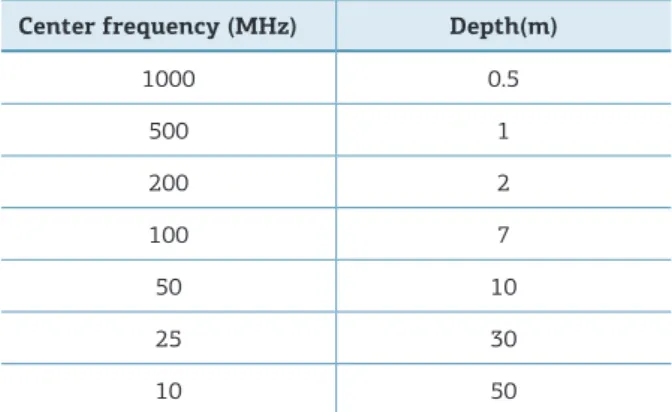
One relevant feature arises from the interplay between the penetration depth and frequency employed for each situation. he depth of penetration and the proile image resolution are inversely proportional and dependent on the employed frequency. In this way, it is necessary to delimit the size of the targeted subject in order to determine the most suitable frequency for a given survey.
When using high frequency antennas, the obtained resolution will be high, however with shallow penetration, while when using low frequency antennas, the result will be opposite (Tab. 1). he depositional environment and pore saturation might as well impair the signal penetration (Tab. 2).
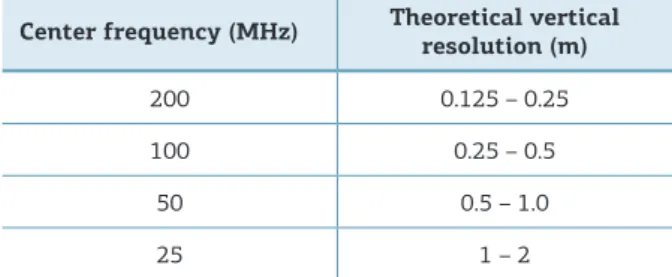
he vertical resolution is the property related to the dis-tinction of two signals adjacent in time, which is directly related to the antenna frequency (Reynold 1997). he ideal theoretical vertical resolution is described as a quarter of wavelength. Inside such vertical length some relections will
Table 1. Interplay between antenna frequency and
depth of penetration (Annan 2001).
Center frequency (MHz) Depth(m)
1000 0.5
500 1
200 2
100 7
50 10
25 30
10 50
Table 2. Speed and signal attenuation relative to
changes in lithology and pore saturation for antennas
with frequencies in the 80 to 120 MHz range (adapted from Neal 2004).
Lithology Velocity (m/ns) Attenuation (dB/m)
Unsaturated sand 0.1 – 0.2 0.01 – 0.014
Saturated sand 0.05 – 0.08 0.03 – 0.05
Unsaturated clay 0.09 – 0.12 0.028 – 300
constructively interfere with each other, resulting in one sin-gle observable relector (Tab. 3; Neal 2004).
he vertical resolution of the radar relection proile has a relevant implication for sedimentological interpretation, as the property determines the scale of observable sedimen-tary structures. Considering that each laminated bed has a thickness below 0.01 m, and that a high frequency antenna surveying a material with low signal loss, such as sand, will reach a maximum resolution in the 0.02 to 0.08 m range, it is possible to determine only the main surfaces or a set of laminated beds, and not each discrete laminated bed (Neal 2004).
Radar facies interpretation
he concept of radar facies is based on the methodology applied to seismic stratigraphy surveys. he interpretation techniques are the same for both methods, even with such diferent relectors scales. he main reason behind this is that for clastic sedimentation the contrasting physical prop-erties that produce relectors are the same irrespectively of the scale of the survey. Also, the geometrical behavior of hierarchical features is similar both for very small scales (such as lamination) and sedimentary basin scales. hus, the terminology used for radar facies is similar to the ter-minology used for seismic stratigraphy surveys, with minor modiications. According to Neal (2004) and Gawthorpe
et al. (1993), the features can be classiied based on the shape of the relection, the dip of the relection, the ampli-tude of the relection, and the relation between the relec-tions and their continuity.
Considering the resolution applied for GPR surveys, it is possible to interpret sedimentary facies and facies associations through the relection proile of the radar, which are useful for the interpretation of depositional environments (Neal 2004). In the present study, structures directly observable in outcrops were imaged with GPR in order to access the interpretation potential and of the technique when applied to the rock record, and to compare the results with pub-lished data on unconsolidated deposits from similar depo-sitional environments.
RESULTS
Comparison between radar facies and
sedimentary structures found on outcrops
he GPR surveys were obtained at the South- and Central-Tucano sub-basins, with locations summarized in the Figure 1. In order to assess the reliability of the radar facies inter-pretations, a set of outcrops was surveyed (Fig. 1), which were the subject of previous studies regarding the sedimen-tology and architecture of the deposits (Figueiredo 2013, Freitas 2014, Figueiredo et al. 2015, Carrera 2015), so that the direct comparison to the GPR data were possible.
Point A
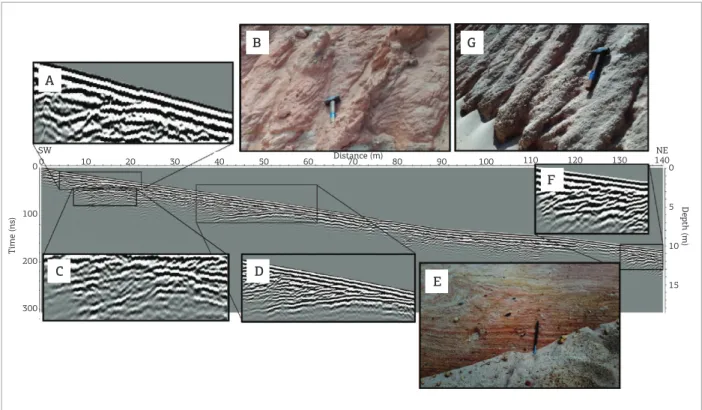
his outcrop is a fresh road cut of the BR-235 road, located near the locality of Brancos, at the municipality of Jeremoabo, Bahia, with its medium- to coarse-grained sand-stone deposits attributed to luvial bars of the São Sebastião Formation (Figueiredo 2013). hree GPR proiles were obtained right beneath the outcrop walls, two of them nearly parallel to the paleocurrent direction, while the third one was obtained in an oblique direction. he western part of the outcrop is dominated by medium-grained sandstone with sparse granules, organized in trough cross-sets 15 to 35 cm thick, with paleocurrent approximately parallel to the sur-vey. he structures were detected by the GPR as relectors representing inclined and sub-horizontal bounding surfaces. Towards the eastern side of the outcrop, the proile (Fig. 2) shows sets of planar cross-stratiied sandstone, with discrete segregation of very coarse-grained sandstone at the cross-bed-ding, which shifts laterally to very coarse-grained sandstone arranged in cross-sets thicker than 1.5 m. he GPR survey was successful at detecting radar facies that could be directly correlated to outcrop structures, in this case the large-scale cross-sets. However, it was also suggested sedimentary struc-tures that could not be correlated to the nearby outcrop, which include relectors interpreted as inclined and paral-lel bounding surfaces of planar cross-sets (Fig. 3). he last proile, obtained in an oblique direction between the two previous proiles, reveals medium- to coarse-grained sand-stone, with sparse granules and pebbles, with strong grain segregation. he cross sets are at least 2 m thick, with planar cross-stratiication marked by strong grain sorting (Fig. 4).
he proiles have suiciently high resolution to make possible the identiication of sedimentary beds and their internal structures, like trough and planar features. here was reasonable penetration of the radar signal, which reached 4.5 m depth in the irst proile. In a few small segments of the proile, the radar signal is absent, which can be explained by the roughness of the rocky surface.
Table 3. Antenna frequencies and their corresponding
vertical resolution (Porsani 2011).
Center frequency (MHz) Theoretical vertical resolution (m)
200 0.125 – 0.25
100 0.25 – 0.5
50 0.5 – 1.0
Point B
The next outcrop is located at the municipality of Canudos, Bahia, in the Vaza Barris river valley, which are attributed to the São Sebastião Formation, interpreted by Figueiredo (2013) as deposits of luvial bars. he survey was undertaken right on top of the outcrop, which shows medium- to coarse-grained sandstone with inclined pla-nar cross-sets 20 cm thick. At the upper half of the pro-ile a laterally continuous surface, positioned less than 1 m from the top, separates a series of inclined cross-sets from
an overlying series of cross-sets with low-angle bounding surfaces. he GPR proile (Fig. 5) depicts the same surface as a continuous, slightly concave upwards relector, above which other relectors onlap. he majority of the relectors represents cross-sets bounding surfaces, with a few recogniz-able low amplitude relectors, which suggest that the imaged cross-strata are near the limit of detection of the survey.
he signal penetration was shallow, reaching up to 2 m, and the resolution was also poor, although some low ampli-tude trough structures are still visible between low angle
SW
T
ime (ns)
Depth (m)
0 10
0
100
200
300
20 30 40 50 60 Distance (m)70 80 90 100 110 120 130 140
NE
0
5
10
15
A
B G
F
E D
C
Figure 2. Ground Penetrating Radar survey at Point A, Proile I. Four diferent patterns of relectors are ascribed to sedimentary structures: (A – B) trough cross-strata sets with inclined set boundaries; (C) not exposed, which is interpreted as inclined set boundaries between planar strata; (D – E) boundaries of large scale planar cross-stratiied beds; (G – F) coarse-grained sandstone, with bed thickness in excess of 1.5 m.
Distance (m) 0
0 20 40 60 80 100
10 20 30 40 50 60 70 80 90 100
0 1 2 3 4 5 W E
T
ime (ns)
Depth (m)
A
B
relectors. he shallower signal penetration combined to the loss of resolution in the acquisition can be the result of water saturation of the substrate, due to precipitation during the Ground Penetrating Radar survey.
Point C
his is outcrop is located at the municipality of Jeremoabo, Bahia, bearing sandstone and conglomeratic sandstone from the São Sebastião Formation, interpreted as the record of lu-vial bars by Figueiredo (2013). he survey was made parallel to the outcrop depicted in Figure 6, at a distance of about 15 m from the outcrop walls, at the other side of the road.
The outcrop bears 20 to 35 cm thick sets of planar cross-stratiied sandstone, bounded by gently inclined sur-faces. A number of these bounding surfaces can be seen at the GPR proile, although the interval between the inter-preted surfaces is larger than what is observed at the out-crop. his could be an artifact of insuicient resolution of the survey, which resulted also in a lack of detection of any cross-strata. he truncation found among relectors and the onlapping against meter sized concave-upwards relec-tors were interpreted as the inilling of channelized features, which were in turn compatible to channels illed by lami-nated and cross-stratiied sandstone found at the outcrop.
Distance (m)
0 0
20
40
60
80
100
10 20 30
0
1
2
3
4
5
NE SW
T
ime (ns)
Depth (m)
A B
C
Figure 4. Ground Penetrating Radar survey at the Point A, Proile III. Two diferent patterns of relectors can be identiied: (A) not exposed plane-bedding bounding surfaces to planar cross-stratiied beds; (B) high angle inclined relectors, correspondent to outcrop in Fig. 4c; (C) planar cross-stratiied beds at least 2 m thick, with strong grain
segregation on the foresets.
Distance (m)
0 0
20
40
60
80
100
120
10 20
0
1
2
3
4
NE SW
T
ime (ns)
Depth (m)
Both the signal penetration and the resolution were poor, failing to sample sedimentary structures at the centimeter scale, like cross-bedded stratasets, with only metric scale channelized geometries being imaged. his proile was the only one obtained on a dirt road, in contrast to the proiles obtained directly over the rocky surface.
Point D
he outcrop is located at environmental protected area Toca Velha das Araras, at the vicinity of the municipality of Canudos, Bahia. he outcrop consists of ine-grained sandstone cemented by iron oxide and large scale cross-strata, from the São Sebastião Formation and interpreted as eolian dune deposits by Figueiredo (2013). he ine-grained sandstone is well sorted, with cross-stratiied bed thickness ranging from 2 to 6 m, predominantly planar, with reac-tivation surfaces and pin-stripe lamination. In addition of the large scale cross-strata, plane-bedding ine-grained sand-stone is also present, indicating preservation of interdune deposits. he main sedimentary structures, namely the large
scale cross-stratiication of the eolian dunes and the nearly horizontal, planar bedding of the interdune deposits, can be identiied in the GPR proile (Fig. 7). he sedimentary structures are depicted by large amplitude relectors in steep angles with 5 m spacing, while the onlap relectors repre-sent interdune intervals.
his proile had the deepest penetration of the radar sig-nal, reaching depths up to 5.0 m. One possible explanation lay on the fact that this is the only proile on eolian deposits, which has better sorting and lower content of clay matrix and detritic feldspar grains. In spite of that, there is a segment with a complete loss of signal, in a topographic low, which might have been water saturated due to previous day rain.
Point E
his outcrop is found near the locality of Raso, at the South Tucano sub-basin, and is positioned in the Marizal Formation, with its ine-grained sandstone deposits inter-preted as wave dominated coastal deposits by Freitas (2014). he medium- to large-scale geometry of the deposits is
Distance (m) 0
0
100
200
10 20 30 40 50 60 70 80 90 100 110 120 130 140 150 220 0
5
10
15
N S
T
ime (ns)
Depth (m)
A B
C
D
Figure 6. Ground Penetrating Radar proile at the Point C, with details of two of the main channel forms (A and C) and their corresponding outcrop (B and D, respectively), showing truncations among the relectors and onlap terminations against concave-up relectors (Figueiredo 2013).
Distance (m) 0
0
100 80 60 40 20
10 20 30 40 50 60 70 80 90 100
0 1 2 3 4 5 6
NE SW
T
ime (ns)
Depth (m)
A
assessable at the outcrop, which is dominated by sandstone with low-angle cross-stratiication, planar-bedding, and cross-laminated sandstone. he GPR proile (Fig. 8) depicts undulated relectors with low-angle truncations, which are interpreted as correspondent to the main bounding surfaces of the deposits. Sedimentary structures of centimeter scale, like the cross-laminations, are below the resolution of the survey, and thus are not present in the proile.
he penetration of the radar signal was relatively shallow, with low resolution. As a result, only the bounding surface of cross-laminated beds was imaged. he relectors were identi-ied as wavy relectors with low-angle truncations. his was the only proile in the Marizal Formation where the GPR had enough resolution to identify sedimentary structures, which was also the only proile in this study interpreted as deposited in a coastal environment, which would result in better sorting and mineral maturity than in a luvial deposit.
Radar facies
Eight radar facies were described, some of which have the same environmental interpretation since they are set together in the outcrop, although they may bear particular angle and relector termination, which were used as criteria for their distinction.
1 – Low angle inclined reflectors or 2 – Well-defined continuous horizontal reflectors with internal low amplitude inclined reflectors
Description: 1 – Sets of high amplitude relectors with low-angle inclination or 2 – sets of well-deined continuous horizontal relectors, with spacings close to 0.5 m (Tab. 4). hese relectors bound sets of low amplitude relectors, which have steeper inclination and decimeter spacing. he depth of investigation was below 4 m.
Interpretation: he high amplitude relectors repre-sent surfaces bounding sets of planar cross-stratiied beds, which in turn are related to the low amplitude relectors. he bounding surfaces are interpreted as the result of migra-tion of subaqueous dunes, while the cross-sets are the result of partial preservation of the lee side of 2D subaqueous dunes. 1 – he inclination of the bounding surfaces to the same direction as the cross-sets indicates migration of dunes on the downstream lanks of a luvial bar, with downstream accretion. 2 – he parallel setting of the set boundaries indi-cates the dune migration orthogonal to the GPR proile.
3 – Low angle inclined reflectors or 4 – Sub-horizontal, high amplitude reflectors with internal low amplitude concave up discontinuous reflectors
Description: Sets of high amplitude relectors and spa-cings between relectors around 0.5 m 3 – inclined at low--angles or 4 – showing sub-horizontal inclination (Tab. 4). he high amplitude relectors bound low amplitude relec-tors with discontinuous concave-up shape, and lateral con-tinuity of 1 to 2 m. he depth of penetration of the radar signal was close to 4 m.
Interpretation: he high amplitude relectors represent low-angle set boundaries, which bound trough cross-sets, represented by the low amplitude, discontinuous, concave-up relectors. he set boundaries are interpreted as the result of dune migration, while the trough cross-sets are the record of the lee side of 3D dunes. 3 – he subtle inclination of the set boundaries in the same direction as the trough cross-sets is suggestive of migration on the downstream lanks of luvial bars. 4 – he parallel setting of the high amplitude relectors indicates also that the GPR proile is orthogonal to the paleolow.
Distance (m) 0
0 10 20
100 110 120 130 140 150 160 30 40 50 60 70 80 90
10 20 30 40 50 60 70 80 90
0 1 2 3 4 5 6
NE SW
T
ime (ns)
Depth (m)
A
Radar facies Description Interpretation
1(a) Distance (m)
0 10
0
1
2
Depth (m)
Low-angle inclined relectors with internal
lower amplitude inclined relectors
1(b) 0Distance (m)6
0
1
2
Depth (m)
Plane-parallel relectors with internal lower
amplitude inclined relectors
Compound cross-stratiied beds with even bounding surfaces,
in view parallel to straight crested dune migration.
2(a) Distance (m)
0 10
0
1
Depth (m) Low-angle inclined
relectors with internal lower amplitude relectors with concave
upward shape
Compound cross-stratiied beds with
inclined bounding surfaces, in view perpendicular to sinuous crested dune migration
2(b) 0 Distance (m)10
0
1
2
Depth (m) Slightly undulated
relectors, with internal lower amplitude relectors with concave
upward shape
Compound cross-stratiied beds with
slightly undulated bounding surfaces, in view parallel to sinuous
crested dune migration
30Distance (m)6
0
1
Depth (m)
High- angle inclined relectors with decimeter spacing, with
each set of relectors thickness above 1 m
The inclined relectors are large scale
strata, with cross-stratiication angles and scale compatible to avalanche facies of
unit bars
40 10 Distance (m) 20 30
0
1
Depth (m)
Concave upward relectors covered by
horizontal relectors with onlap terminations
Cut and ill structures with channel forms illed by plane-parallel beds, or by cross-strata
below survey
5 0 Distance (m)10 20
0 1 2 3 4 5
Depth (m) High angle, high
amplitude relectors, wit toplap terminations
on sub-horizontal high amplitude relectors
The high angle relectors are large scale
cross-sets formed by eolian dunes. Sub-hozizontal relectors
are plane-parallel laminated deposits
from interdunes
6 0 Distance (m)
0 20 40 60
10 20
0 1 2 3
T
ime (ns)
Depth (m)
Discontinuous, slightly undulated relectors,
with low-angle truncations
Sub-horizontal surfaces bounding plane-parallel and rippled lamination
below the survey resolution Each radar facies has a Ground Penetrating Radar proiles combined with line drawing of the correspondent
5 – High angle inclined
reflectors disposed in meter sets
Description: Sets of high amplitude relectors inclined at a steep angles and with decimeter spacing, which is often more than 1 m thick (Tab. 4). Discontinuous and smaller relectors can be found locally, with onlap terminations on the high amplitude continuous relectors. he depth of the signal reached 2.5 m.
Interpretation: he high amplitude inclined relectors are interpreted as large-scale cross-bedding. he steep angle and the thickness of the cross-sets, in excess of 1 m, are com-patible with avalanche foresets in unit bars. he smaller and discontinuous relectors are attributed to subtle variations in the direction or inclination of the bar faces, thus associ-ated to reactivation surfaces.
6 – Slightly undulated concave-up reflectors covered by horizontal reflectors with onlap terminations
Description: Sets of relectors with concave-up shape, often discontinuous, that have a lateral extent larger than 2 m (Tab. 4). Inside the concave-up relectors there are series of pla-nar relectors with onlap terminations and spacing of approx-imately 0.3 m. his depth of the proiles was close to 2 m.
Interpretation: he concave-up shapes are interpreted as cut-and-ill channel-shaped structures, while the inter-nal relectors with onlap terminations are the inilling of the channel scours by deposits with plane-bedding, or cross-sets that have thickness below the method resolu-tion. hus, this radar facies is interpreted as abandoned small channels, illed by sandstone or mudstone, in a lu-vial bar top setting.
7 – Meter-scale high amplitude high angle inclined reflectors
Description: Sets of high amplitude relectors with high angle inclined relectors. he spacing between high ampli-tude relectors is up to 0.5 m (Tab. 1). he high ampliampli-tude relectors have toplap terminations against a set of sub-hor-izontal relectors with decimeter spacing. he depth of the survey was slightly over 5 m.
Interpretation: he inclined relectors are interpreted as the result of large-scale cross-strata formed by aeolian dunes. he sub-horizontal relectors are interpreted as even, paral-lel laminated deposits of interdune settings. he toplap ter-mination of the high amplitude relectors indicates erosive surfaces at the base of interdunes.
8 – Slightly undulated
reflector with low-angle truncations
Description: Sets of continuous undulated relectors, with some of the relectors presenting low-angle truncations,
and spacing between the relectors of nearly 0.5 m (Tab. 4). he depth of penetration of the radar signal did not surpass the 2.5 m mark.
Interpretation: he undulated relectors are interpreted as sub-horizontal surfaces bounding cross strata with thick-ness below the resolution of the survey. hese sandstones were interpreted as wave dominated coastal deposits by Freitas (2014).
DISCUSSION
Previous contributions in the ield indicate that the most used antenna on the study of luvial deposits are the 100 MHz antennas (Best et al. 2003, Sambrook Smith et al. 2006, 2009). his device provides an intermediary frequency that balances good resolution and reasonable signal penetration (Tab. 1), noting that this relation is dependent on the sur-veyed depositional environment (Tab. 2). In addition to the 100 MHz antenna, it was also employed a 200 MHz antenna. However, it did not result in an expected higher resolution and had more hyperboles. As the 200 MHz failed to provide usable proiles, this study favored the use of 100 MHz antennas, which provide a resolution better suited for the comparison to known sedimentary features in the studied area.
he study of outcrops of the São Sebastião and Marizal formations in the Tucano Basin share some characteristics in common with previous surveys in active rivers, particularly the sedimentary structures interpreted in part of the radar facies. In fact, the main radar facies found in the Tucano Basin are frequently described in active luvial systems else-where: inclined planar and trough cross-stratiied sets, iso-lated channels, and high-angle cross strata in unit bars (e.g. Best et al. 2003, Skelly et al. 2003, Wooldridge & Hickin 2005, Sambrook Smith et al. 2006 e 2009). he main difer-ence regarding the study of outcrops concerns the depth of penetration. he literature shows signal penetration depths ranging from 6 m, with a 200 MHz antenna, in a survey at the Saskatchewan River (Sambrook Smith et al. 2006), up to 15 m, in a survey at the Jamuna River with a 100 MHz antenna (Best et al. 2003). he present study, on its turn, reached a depth of 4.5 m in lithiied luvial deposits with a 100 MHz antenna. he penetration of the radar signal in eolian deposits was slightly deeper, reaching 5 m with the use of a 100 MHz antenna, while a survey in eolian active sys-tems reached the depth of 40 m, with the use of a 30 MHz antenna (Tatum & Francke 2012).
attenuation of the radar signal in sedimentary rocks. In a previous study, Daniels (2004) pointed that penetration of high frequency electromagnetic signals can be imparted by clayeyness, which can be a product of diagenetic processes, such as growth of clay minerals in pores or the alteration of detritic feldspar. he investigated deposits bear detritic feldspar in the framework of the sandstones, and the degree of weathering of the rocks is variable.
On the other hand, the resolution of some of the proiles was noticeably high, allowing the identiication of sedimen-tary structures at a scale of 0.4 m in the case of cross-strat-iication. Previous studies (e.g. Best et al. 2003, Sambrook Smith et al. 2009), although using antennas with the same frequency, did not acquire resolution better than 1.0 m.
he diference in penetration depths between eolian and luvial deposits can be attributed to the higher heterogeneity of sedimentary facies in luvial deposits, with frequent alter-nation of sandstone and mudstone beds, thus with higher clayeyness interfering with the radar signal, which contrasts to the eolian deposits, with better grain selection and lower clay and detritic feldspar content.
he same efects can explain diference in the answer to GPR between Marizal and São Sebastião formations. he Marizal Formation, with the exception of one outcrop, was particularly problematic regarding the acquisition of GPR data, due to low penetration of the radar signal in the outcrop or to low resolution of the signal. On the other hand, all the stud-ied outcrops of São Sebastião Formation yielded GPR proiles where sedimentary structures could be recognized. According to previous studies (Figueiredo 2013, Freitas 2014, Figueiredo
et al. 2015), the Marizal Formation sandstone has a more feld-spathic composition than the São Sebastião Formation rocks, combined with the presence of immature conglomeratic com-position in the former. As a result, the near surface weathering or previous diagenetic alteration of the investigated rocks could result in a higher content of neoformed clay minerals in the deposits of the Marizal Formation. In fact, the only outcrop of the Marizal Formation that was successfully imaged is inter-preted as coastal deposits (Freitas 2014), which bears higher mineralogical maturity than the luvial deposits.
CONCLUSIONS
Eight radar facies were recognized in the South and Central Tucano sub-basins in the São Sebastião and Marizal formations. Seven radar facies were recognized in the luvial and eolian depos-its attributed to the São Sebastião Formation, while one was cor-related to a discrete marine interval of the Marizal Formation. he comparison between the studied outcrops and the proiles obtained through GPR survey attested the success
of the GPR survey, with strong compatibility between the GPR proiles and the nearby outcrops. One of the most remarkable features of the GPR survey was the high res-olution obtained in the study of the deposits, which were superior in resolution to what has been obtained in previous GPR surveys in unconsolidated sediments (e.g. Best et al. 2003, Sambrook Smith et al. 2009). Nevertheless, the GPR depth of survey did not penetrate beyond the mark of 5.0 m with 100 MHz antennas, restricting the application of the methods and equipment to investigations to a depth that, despite being relatively shallow, are still on par to the scale of outcrop investigation.
he limitations imposed to the use of the GPR on con-tinental siliciclastic rocks are directly related to amount of mudstone or clay minerals in the deposits. his limitation is the reason why the deposits of the Marizal Formation enabled proiles with very poor resolution or a too shallow penetration, in spite of the similarities between the deposits of the Marizal and São Sebastião formations.
hus, given the satisfactory results obtained for the out-crops of the São Sebastião and Marizal formations, the use of GPR survey and radar facies interpretation as a tool for subsurface investigations has great potential for future strati-graphic and sedimentological studies in similar successions. However, it is important that the targeted sedimentary rocks do not record frequent interbedding of ine-grained deposits, appreciable content of clay cementation, or that the weath-ering of feldspathic and lithic fragments, if present, are not intense enough to result in strong clay mineral neoforma-tion on the exposed outcrops. he use of 100 MHz anten-nas for the study of sandstone deposits proved to be a good compromise between depth of investigation and resolution, allowing the investigations to reach decimeter scale detail, while maintaining a depth of penetration of the radar signal that is comparable to most outcrop investigations.
ACKNOWLEDGEMENTS
Almeida R.P., Turra B.B., Figueiredo F.T., Marconato A., Janikian L. 2015. Reconstructing luvial bar surfaces from compound
cross-strata and the interpretation of bar accretion direction in large river deposits. Sedimentology (online). doi: 10.1111/sed.12230.
Almeida Filho R., Miranda F.P., Yamakawa T., Bueno G.V., Moreira F.R., Camargo E.G., Bentz C.M. 2002. Data integration for a geologic model of hydrocarbon microseepage areas in the Tonã Plateau region, North Tucano basin, Brazil. Canadian Journal of Remote Sensing,
28(1):96-107.
Alvarado-Ortega J. & Brito P.M. 2010. A new ichthyodectiform (Actinopterygii, Teleostei) from the Lower Cretaceous Marizal Formation, northeast Brazil. Paleontology, 53:297-306.
Amaral C.R.L & Brito P.M. 2012. A new Chanidae (Osthariophysii:
Gonorynchiformes) from the Cretaceous of Brazil with Ainities
to Laurasian Gonorychiforms from Spain. PLos One, 7(5)e37247. doi:10.1371/journal.pone.0037247.
Annan A.P. 2001. Ground Penetrating Radar Workshop Notes.
Sensors & Sotware Inc, 192 p.
Arai M. 2014. Aptian/Albian (Early Cretaceous) paleogeography of the South Atlantic: a paleontological perspective. Brazilian Journal of Geology, 44(2):339-350.
Best J.L., Ashworth P.J., Bristow C.S., Roden J. 2003. Three-dimensional sedimentary architecture of large, mid-channel sand braid bar, Jamuna River, Bangladesh. Journal Sedimentary Research, 73(4):516-530.
Carrera S.C. 2015. Arquitetura deposicional e proveniência da Formação Marizal nas sub-bacias Tucano Sul e Central, BA. MS Dissertation, Instituto de Geociências, Universidade de São Paulo, 147 p.
Corbeanu R.M., Soegaard K., Szerbiak R.B., Thurmond J.B., McMechan G.A., Wang D., Snelgrove S., Forster C.B., Menitove A. 2001. Detailed
internal architecture of a luvial channel sandstone determined from
outcrop, cores, and 3-D ground-penetrating radar: Example from the middle Cretaceous Ferron Sandstone, east-central Utah. American Association of Petroleum Geologists Bulletin, 85(9):1583-1608.
Costa I.P., Milhomem P.S., Bueno G.V., Silva H.S.R.L., Kosin M.D. 2007a. Sub-bacias de Tucano Sul e Central. Boletim de Geociências da Petrobras, 15(2):433-443.
Costa I.P., Milhomem P. S., Bueno G.V., Silva H.S.R.L., Kosin M.D. 2007b. Sub-bacia de Tucano Norte e Bacia de Jatobá. Boletim de Geociências da Petrobras, 15(2):445-453.
Daniels D. 2004. Properties of materials. In: Daniels D. (eds) Ground Penetrating Radar. 2 ed. Institution of Engineering and Technology, 73-246 p.
Figueiredo F.T. 2013. Proveniência e arquitetura de depósitos luviais
das Sub-Bacias Tucano Central e Norte, Cretáceo (BA). PhD. Thesis, Instituto de Geociências, Universidade de São Paulo, São Paulo, 193 p.
Figueiredo F.T., Almeida R.P., Freitas B.T., Marconato A., Carrera S.C., Turra B.B. 2015. Tectonic activation, source area stratigraphy, and
provenance changes in a rit basin: the early Cretaceous Tucano
Basin (NE- Brazil). Basin Research, 1-13. doi 10.1111/bre.12115.
Freitas B.T. 2014. A Formação Marizal (Aptiano) na Bacia do Tucano (BA): Contribuições à análise da arquitetura de depósitos
luviais e implicações paleobiogeográicas. PhD Thesis, Instituto de Geociências, Universidade de São Paulo, São Paulo, 175 p.
Gawthorpe R.L., Collier R.E., Alexandre J., Bridge J. S., Leeder M.R. 1993. Ground penetrating radar: application to sandbody geometry and heterogeneity studies. In: North C.P. & Prosser D.J. (eds). Characterization of Fluvial and Aeolian Reservoirs. Geological Society Special Publication 73:421-432.
Jol H.M. & Bristow C.S. 2003. GPR in sediments: advice on data collection, basic processing and interpretation, a good practice guide. In: Bristow C.S. & Jol H.M. (eds.). Ground Penetrating Radar in Sediments. Geological Society Special Publications, 9-27 p.
Magnavita L.P & Cupertino J.A. 1988. A new approach to the
geological coniguration of the Lower Cretaceous Tucano and Jatobá
Basins. Revista Brasileira de Geociências, 18:222-230.
Magnavita L.P. 1992. Geometry and kinematics of the
Recôncavo-Tucano-Jatobá rit, NE Brazil. PhD Thesis, University of Oxford, Oxford, 493 p.
Magnavita L.P., Davison I., Kusznir N.J. 1994. Riting, erosion, and uplit history of the Recôncavo-Tucano-Jatobá Rit, northeast Brasil.
Tectonics, 13:367-388.
Magnavita L.P., Destro N., Carvalho M.S.S., Milhomem P.S., Souza-Lima W. 2003. Bacias Sedimentares Brasileiras: Bacia Tucano. Fundação Paleontológica Phoenix, Ano 5, Série Bacias Sedimentares, número 52.
Milani E. & Davison I. 1998. Basement control and transfer
tectonics in the Recôncavo-Tucano-Jatobá rit, Northeast Brazil.
Tectonophysics, 154:41-70.
Neal A. 2004. Ground-penetrating radar and its use in sedimentology: principles, problems and progress. Earth-Science Reviews, 66:261-330.
Porsani J.L. 2011. Método GPR: Aplicações. Escola de Verão de Geofísica Aplicada, Instituto de Astronomia e Geofísica, Universidade de São Paulo, 27 p.
Reis M.A.F., Dino R., Pereira, E., Antoniolli, L. 2007. Dados palinológicos da
Formação Marizal da Bacia do Recôncavo, Nordeste do Brasil. In: Carvalho, I. S., Cassab, R. C. T., Schwanke, C., Carvalho, M. A., Fernandes, A. C. S., Rodrigues, M. A. C., Carvalho, M. S. S., Arai, M., Oliveira, M. E. Q. (Orgs.). Paleontologia: Cenários de Vida. 1ed. Rio de Janeiro. Editora Interciência, 229-573.
Reynold J.M. 1997. Ground Penetrating Radar. In: Reynolds J.M. (eds). An introduction to applied and environmental geophysics. Chichester John Wiley, p. 682-745.
Sambrook Smith G.H., Ashworth P.J., Best J.L., Woodward J., Simpson G.J. 2006. The sedimentology and alluvial architecture of sandy braided South Saskatchewan River, Canada. Sedimentology, 53:413-434.
Sambrook Smith G.H., Ashworth P.J., Best J.L., Orfeo O., Parsons D.R. 2009. The sedimentary and alluvial architecture of large braid bar, Rio Paraná, Argentina. Sedimentary Research Journal, 79:629-642.
Santos C.C., Reis C., Pereira A.J. 2010. Projeto Bacia do Tucano Central. Salvador: Companhia de Pesquisa de Recursos Minerais, 88 p.
Silva O.B., Caixeta J.M., Milhomem P.S. 2007. Bacia do Recôncavo.
Boletim de Geociências da Petrobras, 15(2):423-431.
Skelly R.S., Bristow C.S, Ethridge F.G. 2003. Architecture of channel-belt deposits in an aggrading shallow sandbed braided river: the lower Niobrara Rives, northeast Nebraska. Sedimentary Geology, 158:249-270.
Tatum D.I. & Francke J. 2012. Constructing hydrocarbon reservoir analogues of aeolian system using ground penetrating radar. Applied Geophysics Journal, 81:21-28.
Viana C.F., Gama Junior E.G., Simões I.A., Moura J.A., Fonseca J.R., Alves R.J. 1971. Revisão estratigráica da Bacia do Recôncavo/
Tucano. Boletim Técnico da Petrobras, 14(3-4):157-192.
Wooldridge C.L & Hickin E.J. 2005. Radar architecture and evolution of channel bars in wandering gravel-bed Rivers: Fraser and Squamish rivers, British Columbia, Canada. Sedimentary Research Journal, 75:844-60.