Morphological Alterations of Corn (
Zea mays
L.) Plants in
Response to Aluminum Toxicity in the Soil
José Roberto Pinto de Souza
1*, Maria Fátima de Guimarães, Marcelo Marques Lopes
Muller and Carlos Henrique dos Santos
1 Universidade Estadual de Londrina / Centro de Ciências Agrárias / Departamento de Agronomia, Caixa Postal
6.001, CEP 86.051-990, Londrina - PR, Brazil
ABSTRACT
The objective of the experiment was to identify the morphological alterations in corn genotypes in response to aluminum toxicity in the soil. A complete randomized block design with five replications was used. The a factorial scheme was composed of two corn genotypes (C525M - tolerant, and HS701B - sensitive) and two neutralization levels (0% and 100% of aluminum saturation). The evaluations were performed at six leaf and 10-11 leaf growth stages, emergence of the “stigma-style”, and the physiological maturity. The presence of toxic aluminum didn’t significantly reduce diameter and height of stem, leaf area, dry matter of aerial parts, total dry matter and yield. Stem diameter, leaf area, dry matter of root, dry matter of aerial parts, total dry matter and yield did not allow the separation of genotypes in relation to aluminum toxicity in the soil.
Key words: Plant physiology, maize, soil acidity, plant growth
* Author for correspondence
INTRODUCTION
Soils with pH from 4.0 to 7.0 are distributed throughout the tropical and subtropical regions of the world (Dudal, 1979). The presence of aluminum in acid soils harms both crop growth and yield (Olmos & Camargo, 1976; Foy et al., 1978; Foy, 1983). However, there are no reports of field studies to differentiate sensitive corn genotypes from tolerant ones to aluminum toxicity in the soil. According to Foy et al. (1978) and Alam & Adams (1979), aluminum toxicity symptoms are easily identified. Leaf symptoms of aluminum toxicity in some plants were considered similar to phosphorous deficiency or calcium induced deficiency in other plants (Foy, 1983). Foy & Flemming (1978) observed that aluminum interferes in plant cell division, reduced root respiration, and oxydative phosphorilation and interfered with the translocation, transport and use of various nutrients and water by the plants. Foy (1983) observed that the presence of aluminum in solutions caused the appearance of short, fragile, thick and bronze colored roots. Taylor (1988) found that the inhibition of root lengthening by aluminum was faster than the effect of aluminum
toxicity on plant growth. The problem is aggravated on the sub-surface of acid soils because of the absorption of nutrients and water by the roots (Foy, 1983; Ritchley et al., 1983).
Experimental evidences indicated that aluminum tolerance differed among and within species (Brenes & Pearson, 1973; Furlani & Hanna, 1984; Furlani et al., 1986). These researchers found that sensitive and tolerant genotypes to soil acidity had different root system development. Studies by Lafever (1977), Camargo (1984), Mascarenhas et al. (1984), Lopes et al. (1987) and Llugany et al. (1995) showed irregular growth in the root systems in Hordeum vulgare (L.), Oryza sativa
(L.), Glycine max (L.) Merril and Zea mays (L.) when cultivated in acid soils.
Sherchan et al. (1983), Mascarenhas et al. (1984) and Lopes et al. (1987) showed that seedling primary root length was a better indicator to assess varietal tolerance to the increase in the aluminum concentration in the nutritive solution than the accumulation of dry matter of the aerial part and roots.
characterize the sensitivity of the corn crop and of corn genotypes to toxic aluminum in field soils.
MATERIAL AND METHODS
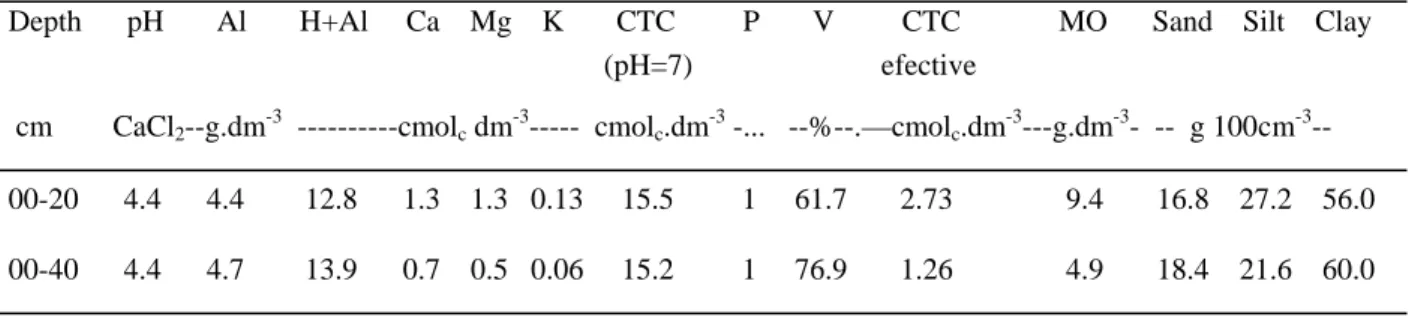
The experiment was carried out in a Dark Red Latossol with a clay texture at the Piraquara Experimental Farm of the Federal University of Paraná, State of Paraná, Southern Brazil, during the 1994/95 growing season. A randomized complete block design, with five replications was used in the experiment. The treatments were disposed in a factorial arrangement of two cultivars [C525M acid tolerant and HS701B -susceptible to acidity, according to Llugany et al. (1995)] and two aluminum saturation levels 100% (no liming) and 0% (10.5 t/ha of lime). The amount of lime applied was determined by chemical soil analysis (Table 1) to reach saturation of 70% base. Calcitic-type lime was applied in 1993.
Each experimental plot was composed of seven 10m lines, with 0.90m interspaces. The central 5.0m lenght of the third, fourth and fifth line of each plot were used for the assessments. From each sampling row, two plants were randomly collected, totaling six plants per plot. The plants were collected by removing a 0.20m deepblock of soil. The following parameters were assessed: stem diameter, plant height, leaf area, root dry matter, aerial part dry matter, total dry matter and yield. The samples were collected at the following
stages: 1) six leaves; 2) 10-11 leaves; 3) emergence of the stigma-style; and 4) physiological maturity. Stem diameter and plant height were determined by paquimeter and measuring tape, respectively. The stem diameter was measured at soil level. The plant height was considered as the distance between the soil surface and the last visible leaf sheath. The leaf area was determined by using a leaf area gauge LICOR, model LI 3.1000. After these data collection, the leaf blades, roots and other parts of the plants were separately transferred to paper bags and allowed to dry in an air circulating chamber, at 60°C, until constant weight was achieved. Yield data were assessed at harvest.
All data were submitted to ANOVA and the F test was applied for significance. The means were compared by the Tukey test at 5% probability level.
RESULTS AND DISCUSSION
Liming resulted in a significant increase in the stem diameter of the corn plants. Although no significant differences were found between the two genotypes within each dosage (Table 2). Neutralization of soil acidity resulted in greater plant height. The HS701B genotype benefited most from the aluminum neutralization of the soil and remained the tallest up to the “stigma-style” stage (Table 3).
Table 1. Physical and chemical characteristics of the soil used to carry out an aluminun toxicity experiment in corn, at the Piraquara Experimental Farm of the Federal University of Paraná, State of Paraná, South Brazil, during the 1994/95 growing season.
Depth pH Al H+Al Ca Mg K CTC P V CTC MO Sand Silt Clay (pH=7) efective
cm CaCl2--g.dm-3 ---cmolc dm-3--- cmolc.dm-3 -... --%--.—cmolc.dm-3---g.dm-3- -- g 100cm-3
--00-20 4.4 4.4 12.8 1.3 1.3 0.13 15.5 1 61.7 2.73 9.4 16.8 27.2 56.0
Table 2. Stem diameter (mm) of two corn genotypes (H1= C525M and H2= HS701B), grown in soils with 0% (D0) and 100% (D1) neutralization of toxic aluminum measured at four growth stages. Piraquara, PR. 1994/95.
Stages
Treatments 6 10-11 Stigma- Physiologica
Leaves Leaves Style Maturity D0 11,74 b1 15,55 b 14,70 b 14,99 a D1 14,21 a 17,93 a 16,38 a 16,63 a H1 x D0 11,50 a 15,52 a 15,00 a 14,78 a H2 x D0 11,98 a 15,58 a 14,40 a 15,20 a H1 x D1 13,65 a 17,22 a 16,45 a 16,92 a H2 x D1 14,78 a 18,65 a 16,30 a 16,35 a m.s.d.2 D 0,84 1,84 1,529 2,14 m.s.d. HxD 1,19 2,61 2,15 3,03 c.v. (%) 5,75 9,73 8,64 11,98
1
- Means followed by the same letter are not statistically different by the Tukey test, at a level of 5% probability.
2
- l.s.d. Least Significant Difference.
Leaf area significantly increased with the neutralization of soil acidity (Table 4). No significant differences were found between the two genotypes within each lime dose, except for plants at six leaf stage. At this growth stage, soil acidity neutralization significantly reduced root dry matter (Table 5). No further significant differences were found in root dry matter from the 10-11 leaf stage onwards in the areas with and without lime (Table 5). Significantly lower values were found for root dry matter for the C525M genotype at the 10-11 leaf stage in the areas without lime. In contrast, the C525M tolerant genotype had a greater ability to overcome the adverse soil conditions, with greater deepening of theroot system and area of light capture (Tables 4 and 5). The methodology used to assess the root system of the C525M genotype became faulty after the second assessment, but for the HS701B genotype, the methodology used was shown to be adequate
Table 3. Plant height (cm) of two corn genotypes (H1= C525M and H2= HS701B) grown in soils with 0% (D0) and 100% (D1) neutralization of toxic aluminum measured at four growth stages. Piraquara, PR. 1994/95.
Stages
Treatments 6 10-11 Stigma- Physiologica
Leaves Leaves Style Maturity D0 12,61 b1 24,74 b 126,98 b 128,45 b D1 20,20 a 54,79 a 183,16 a 178,91 a H1 x D0 11,07 b 22,55 a 126,80 a 116,00 a H2 x D0 14,15 a 26,92 a 127,15 a 140,90 a H2 x D1 18,10 b 44,40 b 167,47 b 158,65 a H2 x D1 22,30 a 65,17 a 198,85 a 199,17 a m.s.d. 2 D 1,98 3,62 21,06 31,27 m.s.d. HxD 2,80 5,12 29,78 44,22 c.v. (%) 10,68 8,05 12,0 17,99
1
- Means followed by the same letter are not statistically different by the Tukey test at a level of 5% probability.
2
- l.s.d. Least Significant Difference.
Table 4. Leaf area (dm2) of two corn genotypes (H1= C525M and H2= HS701B) grown in soils with 0% (D0) and 100% (D1) neutralization of toxic aluminum, at four growth stages. Piraquara, PR. 1994/95.
Stages
Treatments 6 10-11 Stigma- Physiologica
l
Leaves Leaves Style Maturity D0 2280 b1 3274 b 8472 b 10254 a D1 4245 a 7180 a 10434 a 11916 a H1 x D0 2548 a 3089 a 9222 a 11302 a H2 x D0 2012 a 3458 a 7723 a 9207 a H1 x D1 4697 a 6862 a 10616 a 13055 a H2 x D1 3793 b 7498 a 10252 a 10776 a m.s.d. 2 D 448 702 1401 2000 m.s.d. HxD 821 1015 2142 3395 c.v. (%) 12 12 13 16
1
- Means followed by the same letter are not statistically
diferent by the Tukey test at a level of 5% probability.
2
– l.s.d. Least Significant Difference
According to Mascarenhas et al (1984), the length of the seedling primary roots is a better parameter than the accumulation of the root dry matter to assess soybean crop tolerance to toxic aluminum. The result of the experiments showed that the accumulated root dry matter can be used to differentiate genotypes sensitive to toxic aluminum in the field up tothe 10-11 leaf stage
.
Table 5. Root dry matter weight (g) of two corn genotypes (H1= C525M and H2= HS701B) grown in soils with 0% (D0) and 100% (D1) neutralization of toxic aluminum, at four growth stages. Piraquara, PR. 1994/95.
Stages
Treatments 6 10-11 Stigma- Physiologica
Leaves Leaves Style Maturity D0 43,6 a1 31,0 a 93,4 a 96,2 a D1 38,3 b 31,7 a 79,5 a 97,4 a H1 x D0 46,1 a 26,1 b 90,4 a 89,6 a H2 x D0 41,1 a 35,9 a 96,2 a 102,7 a H1 x D1 39,0 a 30,0 a 86,5 a 125,6 a H2 x D1 37,6 a 33,3 a 72,6 a 69,2 b m.s.d. 2 D 4,5 5,4 39,01 30,5 m.s.d. HxD 6,3 7,6 55,1 43,1 c.v. (%) 9,6 15,2 39,9 27,8
1
- Means followed by the same letter are not statistically
different by the Tukey test at a level of 5% probability.
2
– l.s.d. Least Significant Difference
Neutralization of toxic aluminum in the soil promoted a significant increase in dry matter of the aerial part of the maize plants for all the growth stages assessed (Tables 6 and 7). In areas without lime the genotypes C525M and HS701B did not show significant differences in dry matter accumulation for the total or aerial part of the plants during the whole crop development cycle (Tables 6 and 7). The neutralization of the toxic aluminum caused a significant increase in the accumulation of dry matter of the aerial and total plant parts in the C525M and HS701B
genotypes, respectively, at the six and 10-11 leaves stages.
Table 6. Aerial part dry matter weight (g) of two corn genotypes (H1= C525M and H2= HS701B) grown in soils with 0% (D0) and 100% (D1) neutralization of toxic aluminum, at four growth stages. Piraquara, PR. 1994/95.
Stages
Treatments 6 10-11 Stigma-Physiologica
Leaves Leaves style Maturity D0 71,2 b1 75,7 b 194,0 b 492,9 b D1 84,5 a 133,8 a 263,6 a 709,3 a H1 x D0 73,0 a 72,7 a 206,8 a 551,0 a H2 x D0 69,5 a 78,8 a 181,2 a 434,8 a H1 x D1 88,6 a 114,9 b 260,5 a 723,8 a H2 x D1 80,3 b 152,7 a 266,8 a 694,9 a m.s.d. 2 D 2,5 16,8 35,6 207,5 m.s.d. HxD 3,6 23,8 50,3 293,5 c.v. (%) 2,9 14,2 13,7 30,5
1
- Means followed by the same letter are not statistically diferent by the Tukey test at a level of 5% probability.
2
- l.s.d. Least Significant Difference.
Table 7. Total dry matter weight (g) of two corn genotypes (H1= C525M and H2= HS701B) grown in soils with 0% (D0) and 100% (D1) neutralization of toxic aluminum, at four growth stages. Piraquara, PR. 1994/95.
Stages
Treatments 6 10-11 Stigma- Physiological
Leaves Leaves style Maturity D0 114,9 b1 107,0 b 299,8 a 589,0 b D1 122,8 a 165,6 a 343,2 a 806,7 a H1 x D0 119,1 a 99,0 a 297,2 a 640,6 a H2 x D0 110,6 a 115,0 a 302,3 a 537,5 a H1 x D1 127,7 a 145,0 b 347,3 a 849,4 a H2 x D1 117,9 b 186,2 a 339,1 a 764,1 a m.s.d. 2 D 6,3 20,5 60,5 213,5 m.s.d. HxD 9,0 29,0 85,5 301,9 c.v. (%) 4,7 13,3 16,6 27,0
1
- Means followed by the same letter are not statistically different by the Tukey test at a level of 5% probability.
2
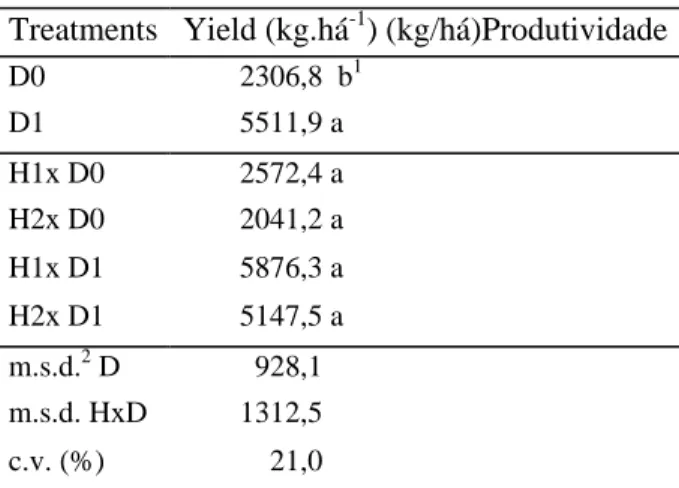
A significant 139% increase was found in corn grain yield with the neutralization of the toxic soil aluminum (Table 8). The C525M genotype yielded 26% higher than the HS701B one in areas without lime, but this difference was not statistically significant. The negative effects on crop development and yield caused by the presence of toxic levels of Al in the soil were also reported by Olmos & Camargo (1976), Foy et al. (1978) and Foy (1983).
Table 8. Grain yield (kg/ha) of two corn genotypes (H1= C525M and H2= HS701B) grown in soils with 0% (D0) and 100% (D1) neutralization of toxic aluminum, obtained at harvest. Piraquara, PR. 1994/95.
Treatments Yield (kg.há-1) (kg/há)Produtividade
D0 2306,8 b1 D1 5511,9 a H1x D0 2572,4 a H2x D0 2041,2 a H1x D1 5876,3 a H2x D1 5147,5 a m.s.d.2 D 928,1 m.s.d. HxD 1312,5 c.v. (%) 21,0
1
- Means followed by the same letter are not statistically different by the Tukey test at a level of 5% probability.
2
- l.s.d. Least Significant Difference.
Sherchan et al (1983), Mascarenhas et al. (1984) and Lopes et al. (1987) showed that corn seedling primary root length was the best toxic plants were the most sensitive parameters to asses the presence of Al in the soil. The presence of toxic aluminum in the soil reduced the development of the corn plants in the field for the stem diameter, height, leaf area, accumulation of aerial part dry matter, total and yield. These parameters should not be used to identify germoplasm sensitive to toxic aluminum in the soil.
RESUMO
O presente experimento teve por objetivo de identificar as alterações morfológicos nos genótipos de milho em resposta a toxicidade do alumínio a campo. O delineamento experimental
utilizado foi o de blocos casualizados com cinco repetições. O arranjo experimental foi um fatorial 2 x 2, dois genótipos de milho (C525M - tolerante e HS701B - sensível) e dois níveis de neutralização (0% e 100% de saturação de alumínio). As avaliações foram realizadas nos estádios de desenvolvimento de 6 folhas e 10-11 folhas, emergência do “estilo-estigma” e maturidade fisiológica das plantas de milho. A presença do alumínio tóxico não reduziu significativamente o diâmetro e a altura do colmo, área foliar, matéria seca de parte aérea, matéria seca total e produção. O diâmetro do colmo, área foliar, matéria seca de raiz, matéria seca de parte aérea, matéria seca total e produção são características que não podem ser empregadas para diferenciar genótipos de milho com relação a presença de alumíniotóxico nosolo.
REFERENCES
Alam, S. M. & Adams, W. A. (1979), Effects of aluminum on nutrient composition and yield of oats.
J. Pl. Nutr. 1: 365-75
Brenes, E. & Pearson, R. W. (1973), Root responses of three gramineae species to soil acidity in an oxisol and an ultisol. Soil Sci. 116: 295-302
Camargo, C. E. O. (1984), Tolerância de cultivares de arroz à dois níveis de alumínio em solução nutritivas contendo diferentes concentração de sais. Bragantia,
43: 381-388
Dudal, R. (1976), Inventory of major soils of the world with special reference to mineral stress hazards. In:
Plant adaptation to mineral stress in problem soils,
ed. Wright, M.J., Proc. Workshop, Beltsville. 3-14 Foy, C. D. (1983), The physiology of plant adaptation
to mineral stress. Iowa State Journal of Research.
57: 355-391
Foy, C. D.; Charney, R. L. & White, M. C. (1978), The physiology of metal toxicity in plants. Annu. Rev. Plant Physiol.29: 511-566
Foy, C. D.; Flemming, A L. (1978), The physiolosy of plant tolerences to excess available Al and Mn in acids soils. In: Crop tolerence to suboptimal land conditions,. ed. Jung, G., Am. Soc. of Agron. 301-328
Furlani, P. R. & Hanna, L. G. (1984), Avaliação da tolerância de plantas de arroz e milho ao alumínio em solução nutritiva. R. Bras. Ci. Solo.8: 205-208 Furlani, P. R.; Lima, M. Miranda, L. T.; Miranda, L. E.
Lafever, H. N.; Campbell, L. G. & Foy, C.D. (1977), Differential response of wheat cultivar to Al. Agron. J. 69: 563-568
Lopes, M. A.; Magnavaca, R.; Bahia Filho, A. F. C. & Gama, E. E. G. (1987), Avaliação de populações populações de milho e seus cruzamentos para tolerância à toxidez de alumínio em solução nutritiva.
Pesq. Agropec. Bras.22: 257-263
Llugany, M.; Poschenrieder, C. & Barceló, J. (1995), Monitoring of aluminum-induced inhibition of root elongation in four maize cultivars differing in tolerence to aluminium and proton toxicity. Physiol. Plantarum. 3: 265-271
Mascarenhas, H. A. A.; Camargo, C. E. O. & Falivense, S. M. P. (1984), Efeito do alumínio sobre o crescimento de raízes de diferentes cultivares de soja.
Bragantia.43: 191-200
Olmos, J. I. L. & Camargo, M. N. (1976), Ocorrência de alumínio tóxico nos solos do Brasil , sua caracterização e distribuição. Ci. e Cult. 28: 171-180
Ritchey, K. D.; Silva, J. E. & Souza, D. M. G. (1983), Lixiviação de cálcio e magnésio em solos. In: Acidez e calagem no Brasil,ed. Raij, B. V.; Bataglia, O. C. & Silva, N. M., Sociedade Brasileira da Ciência do Solo. 109-125
Sherchan, K.; Ellis Jr., R.; Whitney, D. A. & Wassom, C. E. (1983), Response of several genetic sources of corn to acidic soil. Agron. J.75: 993-996
Taylor, G.L. (1988), The physiology of aluminum phytotoxicity. In: Metal ions in biological systems,
ed. Sigel, H., Sigel, A. Marcel Decker, Inc., New york. 24: 123-163