Original Article
SCREENING PELVIC FLOOR DYSFUNCTION BETW EEN NORM AL
AN D OVER W EIGHT M EN OPAU SE W OM EN U SIN G CASCO
SPECULAM , SIM S SPECULAM AND LAYCOCK PALPATION M ETHOD
Humaira Khanam*
* Department of Physical Therapy, Prince Sattam bin Abdulaziz University, Alkharj, Saudi Arabia.
Pelvic floor dysfunction affects the female urinary genital faecal and is responsible for storing and evocat ing urine and st ool, Physiot herapy helps in t he t reat ment of pelvic floor dysfunct ion and Kegel exercise is recommended fir women having problems of t his dysfunction. In this study the standard method like casco speculum , sims speculum and laycock palpation method. This study proves the use of Kegel’s exercise in the treatment of pelvic floor dysfunction. There is marked decreased in muscle testing which shows the subject with high score of body mass index are reliable to get pelvic floor muscle dysfunction.
KEY W ORDS: Pelvic floor, Kegel exercise, Physiotherapy. Dysfunction, BM I.
ABSTRACT
INTRODUCTION
Address for correspondence: Dr.Humaira Khanam, Department of Physical Therapy, Prince Sattam
bin Abdulaziz University, Alkharj, Saudi Arabia. E-M ail: [email protected]
DOI: ht t p:/ / dx.doi.org/10.16965/ ijpr.2015.134
Quick Response code
Access this Article online
International Journal of Physiotherapy and Research ISSN 2321- 1822
w w w.ijm hr.org/ ijpr.htm l
DOI: 10.16965/ ijpr.2015.134
Received: 14-04-2015 Peer Review: 14-04-2015 Revised: None
Accepted: 05-05-2015 Published (O): 11-06-2015 Published (P): 11-06-2015
The pelvic floor is the part of muscular skeletal capsule surrounding the abdominal and pelvic organs t hat cont ribut e t o cot enanciespelvic organ function, generation of intra abdominal pressure anti gravity support and lumbo pelvic st abilit y. The pelvic floor is a dome shaped muscular sheet that contains the bladder, uterus and rectum. Anatomy of pelvic floor is the levator ani or pelvic diaphragm is subdivided into four muscles, these are Pubococcygeus, Iliococcy-geus, Cocygeus and Puborectalis [1]. Pelvic floor is responsible (with bladder and anorectum) for storing and evacuating urine and stool [1]. Pelvic floor dysfunction can be describe as a condition which affect the female urinary, genital faecal, Colo rect al syst em adversely.In effect ive functioning of the pelvic floor muscle can be a factor in urinary incontinence, vaginal prolapsed
obstructed defecation and low back pain, body position has marked effect on the pelvic floor muscle activit y, w hich increases from line t o sit ting. M any women experience pelvic floor dysfunction during the delivery and later in life. The factors such as pregnancy, child birth, aging, over w eight and abdom inal surgery such as caesarean section, often result in the weakening of the pelvic floor muscles [2]. PFD is a major health issue for women as shown by 11% life time risk under going surgery for prolapse or urinary incontinence [3].
M ETERIALS AND M ETHODS
relat ed t o pelvic pain, revit alise and sexual health.
Pelvic floor exercise, or Kegel exercise consists of repeat edly cont ract ing and relaxing t he muscles that form part of the pelvic floor, now sometimes colloquially referred to as the “ Kegel muscles” [2]. Exercises are usually done t o
reduce urinary incontinence [4], reduce urinary
incont inence aft er childbirth [5]. Pelvic floor exer cises ar e recom m ended f or w om en
with urinary incontinence of the stress, urge, or
mixed types [6]. Kegel exercises are said to be good for t reat ing vaginal prolapse [7] and
preventing uterine prolapse [8] in women. Kegel
exer cises m ay be benef icial in t r eat ing
incontinence in both men and women [4]. The
action of slowing or stopping the flow of urine may be used as a t est of correct pelvic floor exercise technique [9]. Pelvic floor exercises may be of benefit in cases of faecal incontinence and pelvic organ prolapse condit ions e.g. rect al prolapse [10]. Regular Kegel exercises should achieve tangible results (such as less frequent urine leakage) within about 8 to 12 weeks. For som e w om en, t he im pr ovem ent could be dramatic [11].
Pelvic floor exercises helps to support the pelvic organs and abdom inal cont ent s, especially during standing, support the bladder to help it st ay closed. It act ively squeezes w hen t he patient cough or sneeze to help avoid leaking. When the muscles are not working effectively the patient may suffer from leaking (“ urinary incontinence” ), and / or urgent or frequent need to pass urine. It is used to control wind and when ‘holding on’ with the bowels.
The aim of t he study is t o assess pelvic floor muscle function and strength and to discuss the responsiveness, reliability and validity of data obtained with the method available for clinical practice. Vaginal palpation, casco speculum and sim s speculum ar e t he st andar d t ools in assessing the ability to contract the pelvic floor muscle function. The study also determines the applicabilit y of Kegel’s exercises (Pelvic floor exercises) in reducing the pelvic floor muscle dysfunction in menopause women.
gloves, st erile speculum (sim s and casco), cotton swab, Beta-Dine solution paper, Pencil and Assessm ent sheet . Random sam pling technique was used for conducting this study. Experim ent s w ere conduct ed by using t he following methods:
(i) Speculum M ethod (sims and casco): In this
type of method, patients instructed to empty the bladder before the test, clean the outer part of the vagina and cervix by cotton swab with Beta-Dine solution to avoid infection. Therapist should w ear t he gloves and t he speculum must be sterile before the test. In this method, position of the patient is to make the patient supine line with the flexed knees and hip in the abducted position. Aft er t hat , the t herapist insert t he speculum int o t he vagina and slightly lift t he muscle by making t he proper posit ioning of patient. Now give the instruction to the patient to cough or sneeze, the leakage of urine or mass like projection profess the Pelvic floor muscle dysfunction.
(ii) Palpation M ethod: This is t he met hod
current ly used by most physical therapists to evaluate a correct Pelvic floor muscle contraction and was first described by Kegel as a method to evaluate Pelvic floor muscle function [12,13]. In this method, place one finger in the distal one third of the vagina and ask the patient to lift inward and squeeze around the finger. Vaginal palpat ion is based on manual muscle test ing which is used to teach women, how to contract t heir Pelvic floor m uscle and classified t he cont raction qualitat ively. To test t he strength, there is a six point scale which can be classified as 0=No cont ract ion, 1=Flicker, 2=Weak, 3=M oderate, 4=Good, 5=Strong.
Inclusion and Exclusion Criteria of the Study:
of pat ient s having BM I of 25-29. BM I is statist ical measure of the weight of a person scale according to height. As such it is useful in population measure only and is not appropriate for diagnosis individual. BM I define as t he individual body weight and divided by the square of their height.
BM I= kg/ m2
BM I is a measure of body fat based on height and weight that applies to both adult men and w omen. BM I categories have values such as <18.5 means underw eight , 18.5-24.9 means normal weight, 25-29.9 means overweight, 30 or more means obesity.
Pro ce du r e o f Ke gel Exe r cise [1 4 ] : In t he
exercise 1, tighten the muscle around the back passage, vagina and lift up inside as if trying to stop passing urine. It is very easy to bring other, irrelevant muscle into play, so try to isolate the pelvic floor as much as possible by not pulling in the tummy, not squeezing the leg together, not tightening the buttocks and not holding the breath. In this way most of the effort should be coming from the pelvic floor and the duration of exercise is to hold it as long and as hard as you can. Built up to a maximum of 10 seconds. Rest for 4 seconds and then repeat the contraction as many times as you can up to a maximum of contraction. Try doing these exercises in a slow and cont rolled w ay w it h a rest of 4 seconds bet w een each muscle cont ract ion. Pract ice maximum number of held contraction (up to 10) about 6 times each day.
In the exercise 2, exercise the muscle around the front passage by pulling up the muscle as hard as you can take care not to tighten your stomach or buttock muscle. This is the same as the exercise practiced first when you tried to stop the flow of urine in the midstream. Hold the muscle up as hard as you can while you count t o four, then consciously relax it. Repeat the exercise until you feel confident you are fully in controlled. The next thing is to try and combine both exercises tightening both set of the muscle simultaneously as hard as you can, holding to the count of four and then relaxing. Repeat this about 5 times. The duration of this exercise to do one set of slow cont ract ion (exercise 1) f ollow ed by one set of quick cont ract ion (exercise 2) six times each day.
In Exercise3, tighten both set of muscles, front and back, try to pull up hard on middle area to get a lift from the front to back. Again hold and relax about 5 times. Finally, try pulling up on all three areas simultaneously and hold for a count of 4. Repeat this about 5 times. The duration of the exercise should be repeat ed 5 t imes and done 10 times a day. Lying position for pelvic floor exercises: lying in the bed, on back or side, with knees crooked. Standing position for pelvic floor exercises: standing, leaning forward from the hips with hand flat on the table. Kneeling position for pelvic floor exercises: kneeling on all force.
RESULTS AND DISCUSSION
Aft er analysing t he dat a collect ed by bot h speculum tool and Laycock palpation method, there was a marked decrease in muscle testing which showed the subject with high score of body mass index having more chances to get pelvic floor muscle dysfunction.
We are using an observational method in the form of speculum t ool, it is a very reliable method and has got good validity in finding out t he presence of urinary incont inence and prolapses during cough which the therapist can see. In our study, subject of group B with high values of body mass index showed signs of both urine leakage and prolapses during examination. The Laycock palpation method has also provided to be a valid tool in quantifying the strength of pelvic floor muscle and our study showed high body mass index scores of menopause women correlate with the low score in manual muscle testing.
The inward movement of a correct pelvic floor muscle cont ract ion is t he st art ing point for measurement of pelvic floor muscle function. However this inward movement of the skin may be creat ed by cont ract ion of t he superficial perineal muscle and have no influence on the uret hral closer m echanism . There m ay be palpable pelvic floor muscle contraction with no visible outside movement particularly in women who are obese; a correct lift can be difficult to observe from the outside [15].
muscle function in real life activities [15]. Women w it h no leakage did not cont ract voluntarily, before coughing and jumping. Their pelvic floor m uscle cont ract ion is considered t o be an automatic co-contraction occurring as a quick and strong activation of an intact neural system. Ot her import ant factors for quick and st rong contraction are the location of the pelvic floor wit hin t he pelvis, the muscle bulk, and int act connect ive tissue [15]. A st retched and w eak pelvic floor may be posit ioned low er w it hin pelvis compared w it h w ell t rained and non injured pelvic floor [16]. The time for st ret ch muscle to reach an optimal contraction may be too slow to be effective in preventing descent against incr eased abdom inal pressur e (example, sneeze), thereby allowing leakage to occur several cases or studies comparing pelvic floor muscle st rengt h in women with normal w eight (menopause condition) have demon-strated that women who are normal weight have better function and strength in the pelvic floor m uscle t han w om en w ho ar e over w eight [17,18,19].
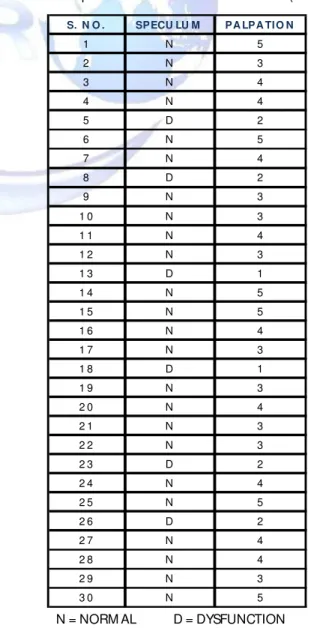
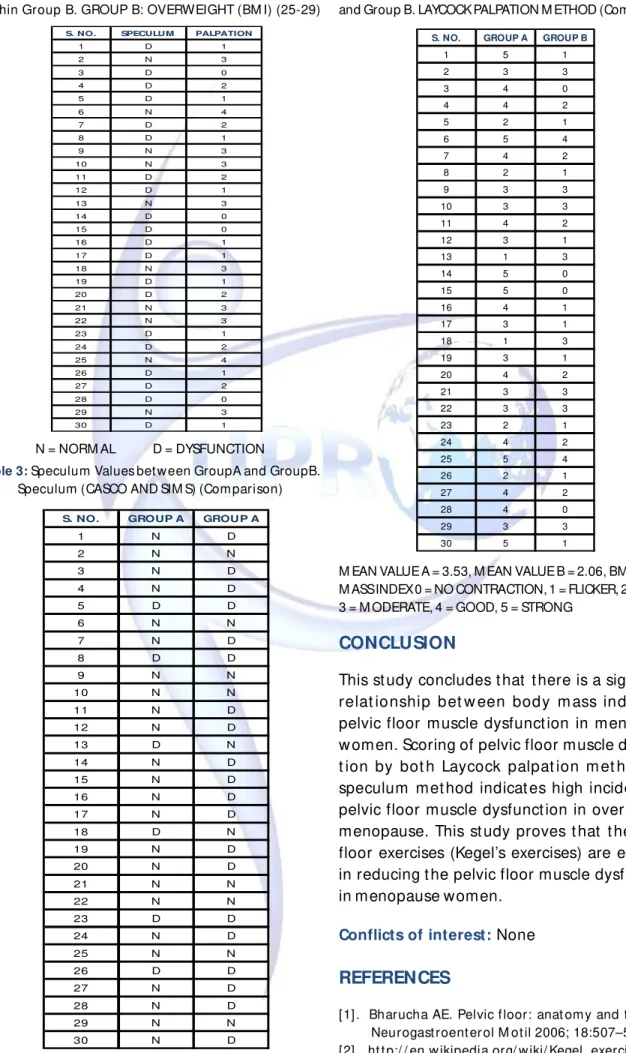
The results and discussion has been shown in Tables 1 to 4. In Table 1, the values shows that there was good reliability between speculum and manual muscle testing within group A. Table 2 shows the values of speculum tools and manual muscle test ing method within group B, which indicates that the pelvic floor muscle dysfunction correlates with very low values of manual muscle testing grades which could be the main reason for leakage of urine or prolapsed. Table 3 compares the speculum values between Group A and B which showed that about 20 out of 30 patients in overweight menopause group has pelvic floor dysfunct ion so in Group A, t he incidence of pelvic f loor dysfunct ion is reasonable low. Table 4 com pares m anual muscle testing grades between Group A and B which quantatively shows that Group B has low scor ing in t he gr ade w hich indicat es t he profound weakness of pelvic floor muscle. The mean value of A and B calculated by the help of Table 4 comes 3.5 and 2.06 respectively from the mentioned tables and it is clear that the women with high BM I (group) have the range of 0 means no contraction, 1 means flicker, 2 is weak, 3 is moderate while the women of low
BM I (group A) have less problem in comparison to group B.
Hence the need of Kegel exercise is there for patient so we applied this phenomenal exercise technique. Kegel exercises are a series of pelvic muscle exercises designed t o st rengthen t he muscles of the pelvic floor. The principle of Kegel exercises to strengthen the muscles of the pelvic floor, there by, improving the urethral and rectal sphinct er f unct ion. The success of Kegel exercises depends on proper t echnique and adherence of a regular exercise program. Basic position for pelvic floor exercises is to sit well back on a hard chair, t highs and feet unsupported, legs well apart, Lean forward with the elbow on the knees and the head drooped. Consciously relax t he st om ach on but t ock muscle.
Following are the Tables from 1 to 4:
Table 1: Values of Speculum and M anual M uscle Test ing
w it hin Gr oup A. GROUP A: NORM AL BM I (18-25).
S. N O . SPECU LU M PA LPA TI O N
1 N 5
2 N 3
3 N 4
4 N 4
5 D 2
6 N 5
7 N 4
8 D 2
9 N 3
1 0 N 3
1 1 N 4
1 2 N 3
1 3 D 1
1 4 N 5
1 5 N 5
1 6 N 4
1 7 N 3
1 8 D 1
1 9 N 3
2 0 N 4
2 1 N 3
2 2 N 3
2 3 D 2
2 4 N 4
2 5 N 5
2 6 D 2
2 7 N 4
2 8 N 4
2 9 N 3
3 0 N 5
Table 2:Values of Speculum and M anual M uscle Test ing
wit hin Group B. GROUP B: OVERWEIGHT (BM I) (25-29)
S. NO. SPECULUM PALPATION
1 D 1
2 N 3
3 D 0
4 D 2
5 D 1
6 N 4
7 D 2
8 D 1
9 N 3
10 N 3
11 D 2
12 D 1
13 N 3
14 D 0
15 D 0
16 D 1
17 D 1
18 N 3
19 D 1
20 D 2
21 N 3
22 N 3
23 D 1
24 D 2
25 N 4
26 D 1
27 D 2
28 D 0
29 N 3
30 D 1
S. NO. GROUP A GROUP A
1 N D
2 N N
3 N D
4 N D
5 D D
6 N N
7 N D
8 D D
9 N N
10 N N
11 N D
12 N D
13 D N
14 N D
15 N D
16 N D
17 N D
18 D N
19 N D
20 N D
21 N N
22 N N
23 D D
24 N D
25 N N
26 D D
27 N D
28 N D
29 N N
30 N D
Table 3:Speculum Values between GroupA and GroupB.
Speculum (CASCO AND SIM S) (Comparison) N = NORM AL D = DYSFUNCTION
N = NORM AL D = DYSFUNCTION
Table 4:M anual M uscle Testing Values between Group A
and Group B. LAYCOCK PALPATION M ETHOD (Comparison)
S. NO. GROUP A GROUP B
1 5 1
2 3 3
3 4 0
4 4 2
5 2 1
6 5 4
7 4 2
8 2 1
9 3 3
10 3 3
11 4 2
12 3 1
13 1 3
14 5 0
15 5 0
16 4 1
17 3 1
18 1 3
19 3 1
20 4 2
21 3 3
22 3 3
23 2 1
24 4 2
25 5 4
26 2 1
27 4 2
28 4 0
29 3 3
30 5 1
M EAN VALUE A = 3.53, M EAN VALUE B = 2.06, BM I = BODY M ASS INDEX 0 = NO CONTRACTION, 1 = FLICKER, 2 = WEAK, 3 = M ODERATE, 4 = GOOD, 5 = STRONG
CONCLUSION
This study concludes that there is a significant relat ionship bet w een body mass index and pelvic floor muscle dysfunction in menopause women. Scoring of pelvic floor muscle dysfunc-t ion by bodysfunc-t h Laycock palpadysfunc-t ion medysfunc-t hod and speculum method indicates high incidence of pelvic floor muscle dysfunction in over weight menopause. This study proves that the pelvic floor exercises (Kegel’s exercises) are effective in reducing the pelvic floor muscle dysfunction in menopause women.
Conflicts of interest: None
REFERENCES
[ 3] . W i esland er CK. Cli nica appr o ach an d of f ice eval u at i on o f t he p at i en t w i t h Pelvi c f l oo r d ysf u nct i on . Ob st et Gyn eco l Cl i n No r t h 2009;36(3):445-462.
[4]. M edline Plus M edical Encyclopedia: Kegel exercises. Nlm .nih.gov. 2011-08-29. Ret rieved 2011-09-02. [5]. Dumoulin C, Lemieux M C, Bourbonnais D, Gravel D,
Bravo G, M orin M . Physiotherapy for persistent postnat al stress urinary incont inence: a randomize controlled trial. Obstet Gynecol. 2004;104(3):504-510.
[6]. Dumoulin, C., Hay-Sm ith, J. Pelvic floor muscle training versus no treatment, or inactive cont rol treat ments, for urinary incont inence in w omen. Cochrane Database Syst Rev. 2010;(1):CD005654. [7]. Vaginal Prolapse. eM edicineHealt h. 2011
(2011-02-09). Retrieved 2011-09-02.
[ 8] . M ed line Plus M edical Encyclop edia: Ut er ine prolapse. Nlm.nih.gov. 08-29. Retrieved 2011-09-02.
[9]. Kenway M . Goh J. Inside Out – The essential women’s guide to pelvic support . Healthy Fit Solut ions Pty Ltd; 1 edition 2009.
[10]. BØ, K Can pelvic floor m uscle training prevent and treat pelvic organ prolapse. Acta Obstet Gynecol Scand. 2006;85(3): 263-268.
[11]. Kegel exercises: A how-to guide for women”. M ayo Clinic. 2010. http:/ / www.mayoclinic.com/ …/ kegel-e…/ WO00119/ NSECTIONGROUP=2.
[12].Kegel AH, Progressive resistance exercise in the functional restoration of t he perineal muscles. Am J Obstet Gynecol. 1948;56:238–249.
[13].Kegel AH. Stress incontinence and genital relaxation. Ciba Clin Sym p.1952;4(2):35–51.
[14].http:/ / www.nhs.uk/ planners/ pregnancycareplanner / documents/ bandbf_pelvic_floor_women.pdf [15]. Bo K, Sherburn M . Evaluation of female pelvic-floor
m uscl e f un ct io n an d st r en gt h . Phys Th er, 85;2005:269–282
[16]. Howard D, M iller J, De-Lancey J, Ashton-M iller J. Dif f eren t i al ef f ect s o f co ugh , Val sal va, an d continence status on vesical neck movement. Obstet Gynecol. 2000;95:535–540.
[17]. Verelst M , Leivseth G. Are fatigue and disturbances in pre-programmed activity of pelvic floor muscles associat ed wit h fem ale st ress urinary incontin-ence? Neurourol Urodyn. 2004;23:143–147. [18]. M orkved S, Salvesen KÅ, Bø K, Eik-Nes S. Pelvic floor
m uscle strength and t hickness incontinent and incont inent nulliparous pr egnant w om en. Int Urogynecol J.2004;15:384–390.
[19]. M orin M , Bourbonnais D, Gravel D, et al. Pelvic floor m uscle funct ion in cont inent and st ress urinary incontinent women using dynamomet ric measurement. Neuourol Urodyn.2004;23:668–674.