303
ABSTRACT
BACKGROUND AND OBJECTIVES:Low back pain is a disor-der afecting people of all ages, being among major diseases leading individuals to look for health professionals’ help. Clinicians agree that back pain is a heterogeneous condition, however there is no uniformity in the choice of most efective methods to manage pain. his study aimed at evaluating the contribution of the McKenzie method to manage low back pain, in addition to checking whether there is comparison of McKenzie with other treatment modalities. CONTENTS: Health Virtual Library and Pubmed portals were queried from November 2013 to March 2014. All studies were analyzed according to quality criteria established by the PEDro scale, in addition to inclusion and exclusion criteria established by the authors. Of 353 studies found, just six were considered eligible. McKenzie method compared to other therapeutic ap-proaches was efective in functional performance and dysfunc-tion indices, however there has been discrepancy of results due to heterogeneous samples of diferent clinical trials.
CONCLUSION: Although having contributed to manage low back pain patients, McKenzie method requires further studies to validate the technique in speciic patient groups.
Keywords: Low back pain, McKenzie method, Physiotherapeu-tic modalities.
RESUMO
JUSTIFICATIVA E OBJETIVOS: A dor lombar é um transtor-no que afeta pessoas de todas as idades, estando entre as principais doenças que levam o indivíduo a buscar ajuda de proissionais da área da saúde. Clínicos concordam que a dor lombar é uma con-dição heterogênea, porém não há uniformidade na escolha dos métodos mais eicazes para o tratamento da dor. O objetivo deste
McKenzie method for low back pain
Método McKenzie na dor lombar
Isadora Orlando de Oliveira1, Luísa Lang Silva Pinto2, Mauro Augusto de Oliveira3, Milton Cêra3
1. Universidade de São Paulo, Faculdade de Medicina de Ribeirão Preto, Departamento de Biomecânica, Medicina e Reabilitação do Aparelho Locomotor, Ribeirão Preto, SP, Brasil. 2. Pontifícia Universidade Católica de Campinas, Centro de Ciências da Vida, Curso de Fisioterapia, Campinas, SP, Brasil.
3. Pontifícia Universidade Católica de Campinas, Centro de Ciências da Vida, Cursos de Medicina, Fisioterapia e Fonoaudiologia, Campinas, SP, Brasil.
Submitted in May 31, 2016.
Accepted for publication in November 16, 2016. Conlict of interests: none – Sponsoring sources: none.
Correspondence to: Rua Coelho Neto, 85 apto 22 13023-020 Campinas, SP, Brasil. E-mail: [email protected]
© Sociedade Brasileira para o Estudo da Dor
estudo foi avaliar a contribuição do método McKenzie para o tratamento da dor lombar, além de veriicar se há comparação do McKenzie com outras abordagens de tratamento.
CONTEÚDO: Foram realizadas buscas nos portais da Bibliote-ca Virtual em Saúde e Pubmed no período de novembro de 2013 a março de 2014. Todos os estudos foram analisados de acordo com os critérios de qualidade estabelecidos pela escala de PEDro, além de critérios de inclusão e exclusão estabelecidos pelos auto-res. Foram encontrados 353 estudos, sendo que apenas 6 foram considerados elegíveis. O método McKenzie ao ser comparado com outras abordagens terapêuticas mostrou-se eicaz em índices desempenho funcional e disfunção, porém houve discrepância de resultados por conta de amostra heterogênea nos diversos en-saios clínicos.
CONCLUSÃO: Embora o método McKenzie tenha contribuí-do para o tratamento de pacientes com contribuí-dor lombar, é necessária a realização de novos estudos que validem a técnica em grupos especíicos de pacientes.
Descritores: Dor lombar, Modalidades de isioterapia, Método McKenzie.
INTRODUCTION
Low back pain reaches epidemic levels worldwide1. It is
consid-ered a heterogeneous clinical condition afecting a certain spinal region and is primarily related to the incorrect use of human biomechanics1. Low back pain is also responsible for signiicant
part of the demand for health services and is a multidimensional phenomenon involving psychosocial, behavioral and pathophys-iological processes2-4. So, it represents an important global and
socioeconomic problem, since it is a disabling condition with high costs both for individuals and the society5,6. It afects
pri-marily females aged between 40 and 80 years7.
In Brazil, approximately 10 million people have low back pain-associated incapacity8, primarily afecting individuals
between 50 and 59 years of age9. Pathophysiology is
com-plex10. In addition, there is still no “gold standard” for low
back pain management, since diagnostic and management systems available in the literature are still undergoing valida-tion and reliability processes.
McKenzie method (MDT) is a treatment system developed by New Zealander physiotherapist Robin McKenzie, which con-sists of evaluation, treatment and prophylaxis stages, with the following bases: 1) classiication of disorders related to spine and extremities; 2) centralization phenomenon and is reverse (peripheralization); 3) classiication of patients according to three mechanical or non-mechanical syndromes of
derange-Rev Dor. São Paulo, 2016 oct-dec;17(4):303-6 REVIEW ARTICLE
304
Oliveira IO, Pinto LL, Oliveira MA and Cêra M
Rev Dor. São Paulo, 2016 oct-dec;17(4):303-6
ment, dysfunction or postural; 4) emphasis on education and active patient involvement. MDT focuses on the spine and its peripheral joints and is based on solid principles aiming at an accurate evaluation to get the determining mechanical diagno-sis to develop a speciic treatment adequate for each patient11.
his study aimed at evaluating the contribution of the McK-enzie method for low back pain management, in addition to checking whether there are comparisons between McKenzie and other treatment approaches.
CONTENTS
his study was developed in the Pontifícia Universidade Católica de Campinas, Campinas/SP by means of a survey of data published from 2004 to 2013 in Medline via Pubmed and Virtual Health Library (VHL) including LILACS, Scielo, IBECS and Cochrane Library quotations.
Descriptors were: low back pain, sciatica and lumbar spine associ-ated to McKenzie, centralization, directional preference, derange-ment syndrome, extension exercises and McKenzie method, as well as their synonyms in Portuguese: dor lombar, ciática e coluna lombar associados à McKenzie, Método McKenzie, exercícios de ex-tensão, centralização, preferência direcional e síndrome do desarranjo. A manual search of reference lists of previously published systematic reviews and clinical trials was performed by the authors and, after this, available data were submitted to de-scriptive analysis. McKenzie International Institute references list was also taken into consideration.
Only controlled, randomized studies published in English and meeting the following criteria were selected: scores above
5 in the PEDro scale12, randomized clinical trials (RCT)
de-ining low back pain as going from the last rib to gluteal folds, with or without irradiation, where MDT or synonyms in the corresponding language were used to give name to one inter-vention performed; RCT where MDT was not mentioned, however interventions relected one or more principles of the method, such as repeated passive spinal movements or sus-tained positions in speciic directions, and RCT where other techniques were performed together with MDT, since this ap-proach relects current physiotherapy clinical practice. Excluded from this review were RCT in duplicate, those ob-tained regardless of keywords, those performed with restricted populations, RCT focused on speciic diseases (spondylolis-thesis, infection or inlammatory processes) and RCT where the experimental group would perform dynamic strength-ening exercises because this intervention does not represent MDT itself or the classiication proposed by it.
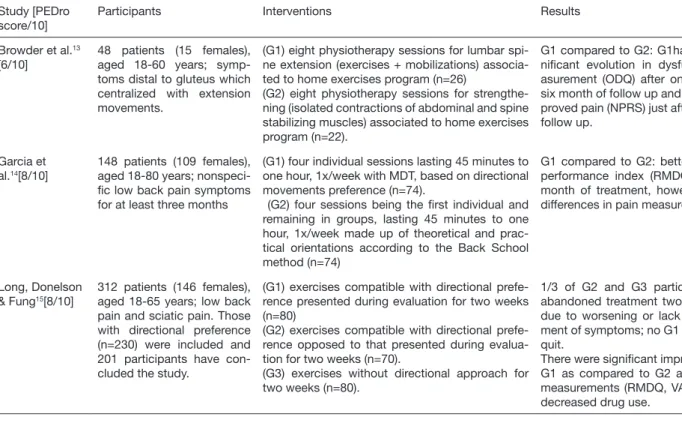
In VHL and Pubmed databases, 146 and 208 studies, re-spectively, were found, in a total of 353 studies. Most studies were excluded by duplicate (148), other studies were excluded according to exclusion criteria (197): studies with restricted populations, clinical trials focusing on speciic diseases, stud-ies with scores below 5 in the PEDro scale and non-random-ized studies. So, six RCT were selected for meeting inclusion and exclusion criteria (Table 1).
Among six evaluated RCT, one has addressed low back pain in its acute phase16, none in sub-acute phase, two have
ad-dressed low back pain in its chronic phase14,18 and three have
not speciied low back pain symptoms duration along their articles13,15,17.
Table 1. Summary of selected articles
Study [PEDro score/10]
Participants Interventions Results
Browder et al.13
[6/10]
48 patients (15 females), aged 18-60 years; symp-toms distal to gluteus which centralized with extension movements.
(G1) eight physiotherapy sessions for lumbar spi-ne extension (exercises + mobilizations) associa-ted to home exercises program (n=26)
(G2) eight physiotherapy sessions for strengthe-ning (isolated contractions of abdominal and spine stabilizing muscles) associated to home exercises program (n=22).
G1 compared to G2: G1had more sig-niicant evolution in dysfunction me-asurement (ODQ) after one week and six month of follow up and has also im-proved pain (NPRS) just after one week follow up.
Garcia et al.14[8/10]
148 patients (109 females), aged 18-80 years; nonspeci-ic low back pain symptoms for at least three months
(G1) four individual sessions lasting 45 minutes to one hour, 1x/week with MDT, based on directional movements preference (n=74).
(G2) four sessions being the irst individual and remaining in groups, lasting 45 minutes to one hour, 1x/week made up of theoretical and prac-tical orientations according to the Back School method (n=74)
G1 compared to G2: better functional performance index (RMDQ) after one month of treatment, however with no differences in pain measurement.
Long, Donelson & Fung15[8/10]
312 patients (146 females), aged 18-65 years; low back pain and sciatic pain. Those with directional preference (n=230) were included and 201 participants have con-cluded the study.
(G1) exercises compatible with directional prefe-rence presented during evaluation for two weeks (n=80)
(G2) exercises compatible with directional prefe-rence opposed to that presented during evalua-tion for two weeks (n=70).
(G3) exercises without directional approach for two weeks (n=80).
1/3 of G2 and G3 participants have abandoned treatment two weeks later due to worsening or lack of improve-ment of symptoms; no G1 member has quit.
There were signiicant improvements in G1 as compared to G2 and G3 in all measurements (RMDQ, VAS, BDI) and decreased drug use.
305
McKenzie method for low back pain Rev Dor. São Paulo, 2016 oct-dec;17(4):303-6Symptoms irradiation, on the other hand, was inclusion cri-teria just for one study13, being also exclusion factor in two
reviewed RCT14,16 and in the others15,17,18 patients could or
not present this symptom associated to low back pain. Excluded RCT were also diferent in sessions’ characteris-tics, being that the number of sessions has varied between eight13, seven17, four14 and two15. RCT where patients have
received orientations were also diferent, being performed in four sessions once a week lasting 45 to 60 minutes14, or single
60-minute session17. Two authors have not speciied number
or duration of sessions16,18.
Another aspect with regard to studies characteristics was the way how sessions were performed. For some studies, patients were divided in groups (G1, G2 and up to G3), but sessions were carried out individually17 or in groups18. It is worth
stressing that in some cases such information was not avail-able in the study13,15,16 and in one RCT, MDT was performed
individually and Back School Method in groups, being indi-vidual just the irst session14.
DISCUSSION
his review could identify that current scientiic evidences do not supply health professionals with enough information to guide the decision-making process during the choice of in-terventions for low back pain management, resulting in out-comes below expectations and wide variations between tech-niques employed by diferent therapists.
Studies have been carried out19-21 aiming at classifying patients
in speciic subgroups, with interventions and protocols which
could be more beneicial and compatible with their symp-toms. However, current scenario is that most people sufering from low back pain use muscle relaxants, traction, transcuta-neous electrical nerve stimulation (TENS) and orthoses. On the other hand, other approaches such as kinesiotherapy, are seldom used due to low adherence of patients to active treat-ment, since just 3% of patients sufering from low back pain are included in continuous physiotherapy programs23.
MDT, for example, has scientiic evidences proving that its exercises induce immune system activation and at the same time increase IL-4 cytokines concentrations which contribute for pain relief24. he evaluation process was also better than
MRI to distinguish painful from painless discs25.
A diferent technique used to treat low back pain and that, similar to MDT, requires active involvement of patients is the Back School method, the basis of which is an exercise pro-gram aiming at improving mobility, lexibility and stretching of symptomatic individuals26. In comparing the techniques,
there has been no statistical diference in pain between groups, but with regard to functional performance improvement, au-thors have reported that the group treated with MDT has shown statistically signiicant diference as compared to the Back School group14.
On the other hand, studies evaluating directional preference of participants have suggested signiicant low back pain im-provement, including less use of drugs15. Another group
per-forming mobilization exercises aimed at lumbar spine exten-sion had signiicant evolution in dysfunction measurements after one week and six months follow up and also pain just after one week of follow up13, conirming published results
Table 1. Summary of selected articles – continuation
Study [PEDro score/10]
Participants Interventions Results
Machado et al.16[8/10]
148 patients (73 females), aged 18-80 years; nonspe-ciic acute low back pain symptoms. 138 participants have concluded the study and 2 were excluded soon after randomization.
(G1) general orientations on how to keep active and avoid remaining for long periods in bed, con-irmation of favorable acute low back pain progno-sis and administration of paracetamol in speciic hours (n=73).
(G2) G1 + MDT-based protocol (n=73).
G2: Differences (p>0.05) in pain per-ception (NRS) and looked for less addi-tional health care.
Paatelma et al.17[7/10]
134 patients, aged 18-65 years; symptoms of nons-peciic low back pain with or without irradiation to one or both legs.
(G1) manual orthopedic therapy, with maximum of seven sessions lasting from 30 to 45 minutes each (n=45).
(G2) Treatment according to MDT, with maximum of seven sessions lasting 30 to 45 minutes each (n=52).
(G3) Just orientations in one-hour session (n=37).
After three months, six months and one year follow up there were no signiicant differences between G1 and G2; as compared to G3, interventions carried out by G1 and G2 were more effective, however without statistical signiican-ce.
Petersen et al.18[7/10]
350 patients (265 females), aged 18-60 years; low back pain symptoms for more than six weeks with centra-lization of peripheracentra-lization, with or without irradiation.
(G1) Treatment according to MMK, individually planned for each patient. For G1, approaches involving vertebral mobilization techniques, in-cluding high velocity maneuvers were prohibited (n=175).
(G2) All types of manual techniques, including ver-tebral mobilizations, high velocity maneuvers and trigger-points therapy. For G2 speciic exercises in preference directions were prohibited (n=175).
G1: higher success rate of treatment according to RMDQ scores, reaching statistical signiicance in the follow up of 2 and 1.
306
Oliveira IO, Pinto LL, Oliveira MA and Cêra M
Rev Dor. São Paulo, 2016 oct-dec;17(4):303-6
which have shown that low back pain treatment based on di-rectional preferences is highly reliable and valid27.
As to manual therapy, which is a musculoskeletal physiother-apy option being widely used as treatment for low back pain patients10, although diferent with regard to speciic
tech-niques17,18, both those treated with manual therapy and with
MDT had positive results in pain and dysfunction improve-ment measureimprove-ments. Notwithstanding, there are few scien-tiic papers and review studies addressing this intervention with methodological quality28.
From reviewed RCT including home orientations as part of the treatment16-18, all were conlicting among them, since they
have also given diferent types of orientations. However, their results were always worse than other techniques used with other intervention groups.
With regard to strengthening exercises, one RCT has addressed this type of treatment13 for chronic low back pain, using
exer-cises aiming at abdominal and spine stabilizing muscles, pro-moting isolated contractions of some muscles such as trans-verse muscle of abdomen, abdominal oblique muscles, lumbar quadrate muscle, multiidus and erector muscle of spine. Par-ticipants have engaged in a program of exercises encouraged by verbal commands and tactile stimuli given by therapists and were oriented to perform them at home only in case of miss-ing a session. As result, the group bemiss-ing treated with exten-sion exercises had better evolution in the item dysfunction as compared to the group performing strengthening exercises, in one and four weeks and six months follow up. In addition, the extension group has also shown higher change in pain scale, however just one week after treatment completion.
However, reviewed clinical trials had limitations, such as: 1) not having how to monitor home exercises performed by pa-tients; 2) the fact that therapists and patients were not blind; 3) progressive decrease in number of participants in long term follow up, with reasons varying from impossibility of contact, symptoms relief or dissatisfaction with treatment, among oth-ers; 4) the fact that authors have not divided patients accord-ing to duration of symptoms nor have taken into consider-ation low back pain biopsychosocial factor.
An additional limitation of one reviewed RCT13 was the fact
that it had a small number of participants, not enough to state that strengthening exercises had not produced favorable results to improve low back pain. However, most reviewed studies had a good sample size, totaling 1140 participants in six RCT, with mean of 190 participants per study, which has provided, together with high PEDro scale scores, reliability to the interpretation of results.
CONCLUSION
Our review has shown that MDT is beneicial and should be considered alternative to manage low back pain patients, since patients submitted to this intervention after physiother-apeutic evaluation have improved dysfunction, quality of life and daily life activities.
REFERENCES
1. Skikić EM, Suad T. he efects of McKenzie exercises for patients with low back pain, our experience. Bosn J Basic Med Sci. 2003;3(4):70-5.
2. Linton SJ. A review of psychological risk factors in back and neck pain. Spine (Phila Pa 1976). 2000;25(9):1148-56.
3. Almeida IC, Sá KN, Silva M, Baptista A, Matos MA, Lessa I. Prevalência da dor lom-bar crônica na população da cidade de Salvador. Rev Bras Ortop. 2008;43(3):96-102. 4. Pilz B, Vasconcelos RA, Marcondes FB, Lodovichi SS, Mello W, Grossi DB. he Bra-zilian version of STarT Back Screening Tool - translation, cross-cultural adaptation and reliability. Braz J Phys her. 2014;18(5):453-61.
5. Noriega-Elío M, Barrón Soto A, Sierra Martínez O, Méndez Ramírez I, Pulido Navar-ro M, Cruz Flores C. [he debate on lower back pain and its relationship to work: a retrospective study of workers on sick leave]. Cad Saude Publica. 2005;21(3):887-97. 6. Delitto A, George SZ, Van Dillen LR, Whitman JM, Sowa G, Shekelle P, et al. Low
back pain. J Orthop Sports Phys her. 2012;42(4):A1-57.
7. Hoy D, Bain C, Williams G, March L, Brooks P, Blyth F, et al. A systematic review of the global prevalence of low back pain. Arthritis Rheum. 2012;64(6):2028-37. 8. Oliveira VC, Furiati T, Sakamoto A, Ferreira P, Ferreira M, Maher C. Health locus of
control questionnaire for patients with chronic low back pain: psychometric proper-ties of the Brazilian-Portuguese version. Physiother Res Int. 2008;13(1):42-52. 9. Bhangle SD, Sapru S, Panush RS. Back pain made simple: an approach based on
principles and evidence. Cleve Clin J Med. 2009;76(7):393-9.
10. Marcondes FB, Lodovichi SS, Cera M. Terapia manipulativa ortopédica na dor verte-bral crônica: uma revisão sistemática. Acta Fisiátr. 2010;17(4):180-7.
11. Machado LA, de Souza MV, Ferreira PH, Ferreira ML. he McKenzie method for low back pain: a systematic review of the literature with a meta-analysis approach. Spine. 2006;31(9):E254-62.
12. Maher CG, Sherrington C, Hebert RD, Moseley AM, Elkins M. Reliability of the PE-Dro scale for rating quality of randomized clinical trials. Phys her. 2003;83(8):713-21. 13. Browder DA, Childs JD, Cleland JA, Fritz JM. Efectiveness of an extension-oriented treatment approach in a subgroup of subjects with low back pain: a randomized clini-cal trial. Phys her. 2007;87(12):1608-18; discussion 1577-9.
14. Garcia AN, Costa Lda C, da Silva TM, Gondo FL, Cyrillo FN, Costa RA, et al. Efec-tiveness of back school versus McKenzie exercises in patients with chronic nonspeciic low back pain: a randomized controlled trial. Phys her. 2013;93(6):729-47. 15. Long A, Donelson R, Fung T. Does it matter which exercise? A randomized control
trial of exercise for low back pain. Spine. 2004;29(23):2593-602.
16. Machado LA, Maher CG, Herbert RD, Clare H, McAuley JH. he efectiveness of the McKenzie method in addition to irst-line care for acute low back pain: a randomized controlled trial. BMC Med. 2010;8:10.
17. Paatelma M, Kilpikoski S, Simonen R, Heinonen A, Alen M, Videman T. Ortho-paedic manual therapy, McKenzie method or advice only for low back pain in work-ing adults: a randomized controlled trial with one year follow-up. J Rehabil Med. 2008;40(10):858-63.
18. Petersen T, Larsen K, Nordsteen J, Olsen S, Fournier G, Jacobsen S. he McKenzie method compared with manipulation when used adjunctive to information and ad-vice in low back pain patients presenting with centralization or peripheralization: a randomized controlled trial. Spine. 2011;36(24):1999-2010.
19. Fritz JM, Cleland JA, Childs JD. Subgrouping patients with low back pain: evo-lution of a classiication approach to physical therapy. J Orthop Sports Phys her. 2007;37(6):290-302. Review. Erratum in: J Orthop Sports Phys her. 2007;37(12):769.
20. Hebert JJ, Koppenhaver SL, Walker BF. Subgrouping patients with low back pain: a treatment-based approach to classiication. Sports Health. 2011;3(6):534-42. 21. Stanton TR, Fritz JM, Hancock MJ, Latimer J, Maher CG, Wand BM, et al.
Evalua-tion of a treatment-based classiicaEvalua-tion algorithm for low back pain: a cross-secEvalua-tional study. Phys her. 2011;91(4):496-509.
22. Delitto A, Erhard RE, Bowling RW. A treatment-based classiication approach to low back syndrome: identifying and staging patients for conservative treatment. Phys her. 1995;75(6):470-85; discussion 485-9.
23. Carey TS, Freburger JK, Holmes GM, Castel L, Darter J, Agans R, et al. A long way to go: practice patterns and evidence in chronic low back pain care. Spine. 2009;34(7):718-24.
24. Al-Obaidi S, Mahmoud F. Immune responses following McKenzie lumbar spine ex-ercise in individuals with acute low back pain: a preliminary study. Acta Med Acad. 2014;43(1):19-29.
25. Donelson R, Aprill C, Medcalf R, Grant W. A prospective study of centralization of lumbar and referred pain. A predictor of symptomatic discs and anular competence. Spine. 1997;22(10):1115-22.
26. Heymans MW, van Tulder MW, Esmail R, Bombardier C, Koes BW. Back schools for nonspeciic low back pain: a systematic review within the framework of the Cochrane Collaboration Back Review Group. Spine. 2005;30(19):2153-63.
27. Danish Institute for Health Technology Assessment. Low back pain. Frequency, man-agement and prevention form a HITA perspective. Danish Health Technology Assess-ment. 1999.1:1-106.