ORIGINAL
RES
EAR
CH
Correspondence to: Paulo Roberto Carvalho do Nascimento – Rua Iguatama, 1.012 – CEP: 35595-000 – Luz (MG), Brasil – E-mail: [email protected] Presentation: Jun. 2013 – Accepted for publication: Oct. 2014 – Financing source: none – Conflict of interests: nothing to declare – Approval at the Ethics Committee No. 53/2009 – (ACTRN12610000829011).
ABSTRACT | Chronic low back pain is a difficult condition to be treated. As some patients respond positively to treat-ment and others do not present any improvetreat-ments, one can think there are others conditional factors that need to be elucidated. By means of this study, we sought to inves-tigate the association between the occurrence of the for-mation of a positive relationship between patient and thera-pist, assessed by the therapeutic alliance inventory, and the adequate recruitment of the deep abdominal muscles, as well as to verify the effect of a protocol intervention based on motor control exercises on levels of pain and disability. The recruitment of the transverse abdominal and internal oblique muscles was examined by ultrasound imaging in 12 subjects with nonspecific chronic low back pain before and after implementation of a protocol for motor control exercises, with subsequent application of the therapeutic alliance inventory questionnaire. No association was found between the level of therapist/patient alliance and muscle recruitment. The proposed protocol was effective in reduc-ing the levels of pain and disability; however, recruitment of transverse abdominal and internal oblique muscles showed no significant changes in the end of the intervention. Based on these findings, we verified that the therapeutic alliance has no association with muscle recruitment in the short term. However, although there were no changes in muscle
Relationship between therapeutic alliance and deep
abdominal muscle recruitment in nonspecific low
back pain sufferers
Relação entre aliança terapêutica e recrutamento dos músculos abdominais profundos
em pacientes com dor lombar não especíica
Relación entre alianza terapéutica y reclutamiento de los músculos abdominales
profundos en pacientes con dolor de la región lumbar no especíico
Paulo Roberto Carvalho do Nascimento1, Paulo Henrique Ferreira2, Fábio Mícolis de Azevedo3,
Rúben de Faria Negrão Filho3
Study conducted at the Laboratory of Biomechanics and Motor Control of the School of Sciences and Technology of Universidade Estadual Paulista “Júlio de Mesquita Filho” (UNESP) – Presidente Prudente (SP), Brazil.
1Master’s Program in Physical Therapy, School of Sciences and Technology, UNESP – Presidente Prudente (SP), Brazil. 2Faculty of Health Sciences, University of Sydney – Sidney, Australia.
3Department of Physical Therapy, School of Sciences and Technology, UNESP – Presidente Prudente (SP), Brazil.
recruitment after the intervention program, the level of pain and disability was reduced.
Keywords | Low Back Pain/ultrasonography; Abdominal Wall; Physical Therapy Modalities.
RESUMO | A dor lombar crônica é uma condição difícil de
INTRODUCTION
Despite the large number of studies involving lum-bar pain, the mechanisms that lead to its develop-ment remain poorly understood, with 90% of cases classified as non-specific, since a definitive
diagno-sis cannot be achieved1. However, there is evidence
(level A) that psychosocial variables generally have greater impact than biomedical and biomechani-cal factors in the disability associated with low back
pain2. From a clinical point of view, low back pain
is a complex multifactorial process, which relies on somatic, psychological and environmental
character-istics2, and is often considered a difficult condition to
be treated by the classical approach to health, which focuses primarily on somatic factors, not being able
to avoiding its chronicity3 that may be associated
with significant levels of depression4,5, disability and
poor quality of life6.
Studies with depressed patients, but who did not present low back pain, indicated that the therapeutic alliance seems to influence positively toward lasting cognitive changes, as well as in anticipating
improve-ments in treatment7. The concept of therapeutic
alli-ance, originated in the field of psychotherapy, was
proposed by Bordin8, in which he argues that the
ther-apeutic alliance between the person seeking change and anyone who is willing to be an agent of change is one of the keys, if not the key in the change process.
Thus, it is possible to assume that, in patients with non-specific chronic low back pain, the establishment of a positive therapeutic alliance is able to promote proper muscle recruitment, contributing to the success of physical rehabilitation. The objective of this study was to investigate the impact of the therapeutic alliance in the recruitment of the deep abdominal muscles in patients with non-specific chronic low back pain.
METHODOLOGY
he research protocol was registered in the Australian New Zealand Clinical Trails Registry, under number ACTRN12610000829011, and approved by the Research Ethics Committee of Universidade Estadual Paulista “Julio de Mesquita Filho” (UNESP), campus Presidente Prudente, (process no. 53/2009).
Sample
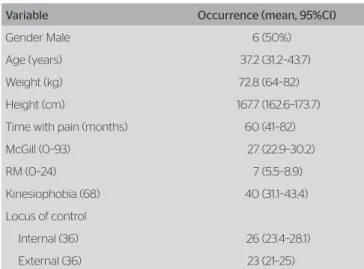
Twelve volunteers were involved in the study (50% males, 50% females), with homogeneous anthropometric and clinical characteristics and having pain or discomfort in the area between the costal margin and the inferior glu-teal fold, with or without mentioning pain in the legs, for more than three months (Table 1).
o recrutamento dos músculos transverso abdominal e oblíquo interno não apresentou nenhuma alteração significativa ao final da intervenção. Baseando-se nestes achados, verificou-se que a aliança terapêutica não tem relação com o recrutamento muscu-lar a curto prazo. Entretanto, embora não tenham sido observadas mudanças no recrutamento muscular após o programa de inter-venção, o nível de dor e incapacidade foi reduzido.
Descritores | Dor Lombar/ultrassonografia; Parede Abdominal; Modalidades de Fisioterapia.
RESUMEN | El dolor crónico de la región lumbar es una condición difícil de ser cuidada. Como algunos pacientes responden positi-vamente al tratamiento y otros no presentan mejoras, fue posible pensar en la existencia de otros factores condicionantes que preci-san ser elucidados. A través de eso estudio, se intentó averiguar la ocurrencia de una asociación entre formación de vínculo positivo entre paciente y terapeuta, evaluada por medio de un inventario de alianza terapéutica y reclutamiento de los músculos abdomi-nales profundos, y también verificar el efecto de un protocolo de
intervención basado en ejercicios de control motor en los niveles de dolor e incapacidad. El reclutamiento muscular de los múscu-los transverso del abdomen y oblicuo interno fue analizado por medio de la ultrasonografía de imagen en 12 personas con dolor crónica de la región lumbar, antes y después de la aplicación de un protocolo de ejercicios del control motor con uso posterior de un cuestionario de alianza terapéutica. No fue encontrada rela-ción entre lo nivel de alianza terapeuta/paciente y el reclutamiento muscular. El protocolo propuesto fue eficaz en la reducción de los niveles de dolor e incapacidad, pero el reclutamiento de los mús-culos transverso del abdomen y oblicuo interno no presentó nin-guna alteración significante al final de la intervención. Con base en esos hallazgos, se verificó que la alianza terapéutica no tiene relación al reclutamiento muscular a corto plazo. Sin embargo, a pesar de que no fueron observados cambios en el reclutamiento muscular después del programa de intervención, el nivel de dolor e incapacidad se disminuyó.
he selected participants met the following criteria: absence of structural changes of the lower limbs (LL) and/or lumbar spine; negative history of surgery in spi-nal segment; absence of red lags (tumors, infections, inlammatory processes) or clear signs of radiculopathy with abnormal relexes, dermatomes and/or miotomes; absence of rheumatic disease of the lumbar spine or urinary incontinence or cognitive impairment; Body Mass Index (BMI) <35 kg/m², allowing the visual-ization of the deep muscle layer; not in pregnancy or postpartum period and not involved in another treat-ment program.
Procedures
The volunteers were interviewed to fill the McGill
questionnaire9,which reports the level of pain; the
TAMPA Scale for Kinesiophobia10,which
quanti-fies the fear of movement and physical activity; the Multidimensional Health Locus of Control (MHLC)
scale11, which verifies the voluntary’s beliefs on their
own health condition and the Rolland Morris
ques-tionnaire, which assesses the degree of disability12.
After completing these questionnaires, the recruit-ment of the transverse abdominis (TrA) and inter-nal oblique (IO) muscles was assessed by ultrasound imaging. By completing the initial assessment, par-ticipants began a lumbar stabilization program, as
described by Costa et al.13.
Revaluation of the level of pain, degree of disability and muscle behavior, as well as analysis of the therapeu-tic alliance, occurred between the irst and second stages
of intervention and at the end of treatment. All study participants were informed about the procedures and objectives of the study and were asked to sign a free and informed consent form.
Analysis of therapeutic alliance
The analysis of the therapeutic alliance was verified by an independent evaluator by applying the WAI
questionnaire14 (patient version) in the transition
from the first to the second phase of the interven-tion program and at the end of the study. This ques-tionnaire consists of 36 questions directed to the patient, which allow evaluation of the three areas
proposed by Bordin8 for the formation of the
alli-ance. The alliance is a relationship based on the sense of working together in a fight against what ails the patient. Its construction is based on the agreement between therapist-patient regarding the objectives, the commitment to the proposed intervention and
the emotional bond between patient and therapist8.
The quality of the therapeutic alliance is established by adding the patient’s personal characteristics prior to therapy, the therapist’s personal characteristics, as well as technical skill, and the behavior between patient and therapist when addressing the patient’s
needs and characteristics15.
Ultrasonography
Muscle recruitment was measured using ultrasound
imag-ing, a noninvasive and reliable method16 that allows the
visualization and quantiication of changes in muscles of
the supericial and deep abdominal layers17.
The ultrasound imaging was performed with a 13.5 MHz transducer coupled to an ultrasound machine from Siemens (Issaquah, WA, USA), Sonoline Sienna model. For image acquisition of the recruitment of TrA and IO muscles, the protocol proposed and validated
by Ferreira et al.18 was used, in which study participants
were put in a supine position on a bed with their arms crossed over the chest, with hip and knee lexion at 50º and 90º, respectively, with force transducers aixed in the lower limbs (Figure 1).
he examiner responsible for obtaining images with ultrasonography was previously trained, and the intra-examiner reliability of the measurements was veriied in a pilot study, in which the recording of the images was performed on diferent days with a 24-hour interval between measurements.
Table 1. Anthropometric data and characteristics of the sample during the baseline
Variable Occurrence (mean, 95%CI)
Gender Male 6 (50%)
Age (years) 37.2 (31.2–43.7)
Weight (kg) 72.8 (64–82)
Height (cm) 167.7 (162.6–173.7)
Time with pain (months) 60 (41–82)
McGill (0–93) 27 (22.9–30.2)
RM (0–24) 7 (5.5–8.9)
Kinesiophobia (68) 40 (31.1–43.4)
Locus of control
Internal (36) 26 (23.4–28.1)
External (36) 23 (21–25)
Treatment of ultrasound images
he images obtained through ultrasonography were ana-lyzed in a software developed to provide the values corre-sponding to the thickness of TrA and IO muscles. After establishing a reference point, the program automatically overlaid a grid of vertical lines separated at a distance of 5, 10 and 15 mm from a vertical reference line that was drawn along the fascia that deines the medial edge of the TrA (Figure 2).
After calculating the thickness at each of these points, the arithmetic mean of muscle thickness was calculated for each image. From this measurement, the percentage of change between rest and contraction was calculated using Equation 1:
C – R x 100 = (%) (1)
R
where C is the mean thickness of the muscle during con-traction and R shows the average resting value of TrA and IO muscles.
Statistical analysis
he intra-examiner reliability when examining the ultra-sound measurements was previously observed in the begin-ning of the collections, in a pilot test, by calculating the
intraclass correlation coeicient (ICC3,1).
To check the behavior of the therapeutic alliance between the transition from the irst to the second stage
of the treatment protocol and at the end of the study, the nonparametric Friedman test was used.
To analyze the disability of muscle recruitment of TrA and IO muscles pre and post-intervention, non-parametric Kruskal-Wallis test was used, while the vari-ation in the level of pain in diferent stages of the study was veriied by one-way analysis of variance (ANOVA). In order to verify the association between continuous variables, two forced models of multiple linear regres-sion were constructed. Each of them used change in the recruitment of TrA and IO muscles pre- and post-intervention as the dependent variable and the thera-peutic alliance after the irst phase of the intervention, disability, pain and muscle recruitment during baseline as explanatory variables.
he regression models built were:
• change in the recruitment of TrA = - α- β1 x
disabi-lity + β2 x pain – β3 x TrA + β4 x WAI;
• change in the recruitment of OI = α + β1 x disability
+ β2 x pain – β3 x OI – β4 x WAI.
All statistical analysis were performed using the
PASW® statistical package for Windows, version 18.0,
considering a signiicance level of 5% (α<0.05).
RESULTS
he study of intra-examiner reliability for the ultra-sound examination of the TrA recruitment showed
Ultrasound transducer
Load cells 50º 90º
Figure 1. Patient position during the recording of the measures of muscle behavior through ultrasound imaging
TrA: transverse abdominis muscles; IO: internal oblique muscles. The first vertical line on the left indicates the edge of the transverse abdominis
excellent agreement, according to the classiication
proposed by Fleiss19 (ICC
3,1=0.88; 95%CI 0.61–0.96)
for the image captured during the extension movement and 0.82 (95%CI 0.39–0.95) for lexion.
The analysis of muscular behavior after the inter-vention period revealed no improvement in the recruitment of TrA and IO muscles with the inter-vention (p=0.5).
Pain and disability levels showed a statistically significant reduction (p=0.04 and p=0.03, respectively) after the application of the intervention protocol, revealing the occurrence of clinical improvement after the study.
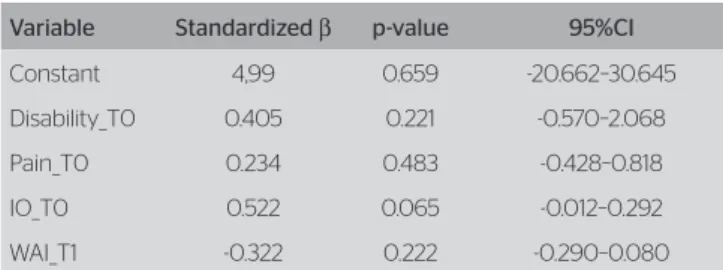
The regression model proposed and adjusted for TrA (Table 2) represented 41% of the variance, but
did not explain the recruitment of TrA (R2=0.7;
F=2.9; p=0.1). On the other hand, the model for IO (Table 3) indicated 54.9% of the variance,
signifi-cantly explaining IO recruitment (R2=0.8; F=4.3;
p=0.04). However, there was no association between the recruitment of IO at the end of the study and the therapeutic alliance.
DISCUSSION
The analysis of the recruitment of TrA and IO mus-cles occurred through a protocol proposed in the
lit-erature18, which showed a reproducible technique16,
as long as the person responsible for registering the
images is properly trained in the procedure20.
The presented regression models only allowed to explain the recruitment of IO; however, its association with the therapeutic alliance cannot be airmed. So far, we are not aware of any study that aims to evaluate the association between therapist/patient alliance and muscle
recruitment. However, a recent systematic review study21
showed that the positive alliance between therapist and patient appears to have a favorable efect on the result of physical treatments involving general exercise, spinal
manipulation and physiotherapy, while Ferreira et al.22
demonstrated its value in the treatment of low back pain. he analysis of the level of pain using the McGill ques-tionnaire at the end of the intervention showed a reduction in pain. his inding was similar to the result of systematic
reviews23-26, which suggested the efectiveness of motor
control exercises in relieving pain, although there is also a report showing the absence of clear efects of the use of
motor control exercises in pain intensity in the short term13.
At the end of the intervention, there has been a sig-niicant reduction in disability. he behavior of disabil-ity after exercise programs have generated conlicting results, with studies reporting no diference between
stabilization exercises and usual care27 or general
exer-cise28 to reduce disability in the short term. However,
in the medium and long term, stabilization exercises
stand out23,26. Recent research found results similar to
the present study, showing improvement in activity
limitation in the short term13.
The participation of the TrA muscle in stabilizing
the lumbar spine was observed in several studies27-31.
Ferreira et al.32 observed that the improvement in the
recruitment of TrA muscles in subjects with chronic low back pain contributes to the reduction of disability. Although our results reveal the same, no significant improvement in muscle recruitment was observed. This finding may be due to the fact that subjects were involved in a program in which they were submit-ted to a maximum of 12 sessions (mean≈10), since the dosage shown a capacity of interfering with the
response to treatment33. Thus, it is believed that the
decrease in pain and disability may be associated with a possible balance in the joint recruitment of TrA/IO muscles and not only with their individual
recruit-ment, since O’Sullivan et al.34 observed that the
dif-ference between subjects with and without a history of low back pain is not that of activity between the superficial and deep muscles, but the percentage of
Table 3. Forced regression model for the internal oblique muscle
Variable Standardized β p-value 95%CI
Constant 4,99 0.659 -20.662–30.645
Disability_T0 0.405 0.221 -0.570–2.068
Pain_T0 0.234 0.483 -0.428–0.818
IO_T0 0.522 0.065 -0.012–0.292
WAI_T1 -0.322 0.222 -0.290–0.080
WAI: therapeutic alliance scale; IO: right internal oblique muscle; T0: baseline; T1: intervention phase 1 Table 2. Forced regression model for the transversus abdominis muscle
Variable Standardized β p-value 95%CI
Constant -92,693 0.087 -202.910–17.524
WAI_T1 0.475 0.102 -0.168–1.477
Disability_T0 -0.338 0.344 -8.827–3.529
Pain_T0 0.746 0.058 -0.113–5.378
TrA_T0 -0.613 0.049 -1.137–-0.002
activation of deep muscles due to the more superfi-cial muscles.
he results presented in this study provide limited information mainly due to the sample size. herefore, a larger study on the subject can provide information to help clarify this issue.
CONCLUSION
he recruitment of TrA and IO muscles was not related to the therapeutic alliance. he performance of motor con-trol exercises for eight weeks is able to reduce disability and pain in the short term without necessarily causing changes in the recruitment of deep abdominal muscles.
REFERENCES
1. Koes BW, van Tulder MW, Thomas S. Diagnosis and treatment of low back pain. BMJ. 2006;332(7555):1430-4.
2. Linton SJ. A review of psychological risk factors in back and neck pain. Spine. 2000;25(9):1148-56.
3. Koleck M, Mazaux JM, Rascle N, Bruchon-Schweitzer M. Psycho-social factors and coping strategies as predictors of chronic evolution and quality of life in patients with low back pain: A prospective study. Eur J Pain. 2006;10(1):1-11.
4. Pincus T, Burton AK, Vogel S, Field AP. A systematic review of psychological factors as predictors of chronicity/disability in prospective cohorts of low back pain. Spine. 2002;27(5):E109-20.
5. Alschuler KN, Theisen-Goodvich ME, Haig AJ, Geisser ME. A comparison of the relationship between depression, perceived disability, and physical performance in persons with chronic pain. Eur J Pain. 2008;12(6):757-64.
6. Ferrell BR. The impact of pain on quality of life. A decade of research. Nurs Clin North Am. 1995;30(4):609-24.
7. Andrusyna TP, Tang TZ, DeRubeis RJ, Luborsky L. The factor structure of the working alliance inventory in cognitive-behavioral therapy. J Psychother Pract Res. 2001;10(3):173-8.
8. Bordin ES. The generalizability of the psychoanalytic concept of the working alliance. Psychotherapy: Theory Res Prac. 1979;16(3):252-60.
9. Pimenta CA, Teixeira MJ. Questionário de Dor McGill – Proposta de Adaptação do para a Língua Portuguesa. Rev Bras Anest. 1997;47(2):177-86.
10. Siqueira FB, Teixeira-Salmela LF, Magalhães LDC. Análise das propriedades psicométricas da versão brasileira da escala tampa de cinesiofobia. Acta Ort Bras. 2007;15:19-24.
11. Oliveira VC, Furiati T, Sakamoto A, Ferreira P, Ferreira M, Maher C. Health locus of control questionnaire for patients with chronic low back pain: psychometric properties of the Brazilian-Portuguese version. Physiother Res Int. 2008;13(1):42-52.
12. Nusbaum L, Natour J, Ferraz MB, Goldenberg J. Translation, adaptation and validation of the Roland-Morris questionnaire - Brazil Roland-Morris. Braz J Med Biol Res. 2001;34:203-10.
13. Costa LO, Maher CG, Latimer J, Hodges PW, Herbert RD, Refshauge KM, et al. Motor control exercise for chronic low back pain: a randomized placebo-controlled trial. Phys Ther. 2009;89(12):1275-86.
14. Horvath AO, Greenberg LS. Development and validation of the working alliance inventory. J Couns Psychol. 1989;36(2):223-33.
15. O’Hara MW, Stuart S, Gorman LL, Wenzel A. Eficacy of interpersonal psychotherapy for postpartum depression. Arch Gen Psychiatry. 2000;57(11):1039-45.
16. Costa L, Maher C, Latimer J, Hodges P, Shirley D. An investigation of the reproducibility of ultrasound measures of abdominal muscle activation in patients with chronic non-specific low back pain. Eur Spine J. 2009;18(7):1059-65.
17. Hodges PW, Pengel LH, Herbert RD, Gandevia SC. Measurement of muscle contraction with ultrasound imaging. Muscle Nerve. 2003;27(6):682-92.
18. Ferreira PH, Ferreira ML, Hodges PW. Changes in recruitment of the abdominal muscles in people with low back pain: ultrasound measurement of muscle activity. Spine. 2004;29(22):2560-6.
19. Fleiss JL. Design and analysis of clinical experiments. New York: Wiley; 2011.
20. Ferreira PH, Ferreira ML, Nascimento DP, Pinto RZ, Franco MR, Hodges PW. Discriminative and reliability analyses of ultrasound measurement of abdominal muscles recruitment. Man Ther. 2011;16(5):463-9.
21. Hall AM, Ferreira PH, Maher CG, Latimer J, Ferreira ML. The influence of the therapist-patient relationship on treatment outcome in physical rehabilitation: a systematic review. Phys Ther. 2010;90(8):1099-110.
22. Ferreira PH, Ferreira ML, Maher CG, Refshauge KM, Latimer J, Adams RD. The Therapeutic Alliance between clinicians and patients predicts outcome in chronic low back pain. Phys Ther. 2013;93(4):470-8.
23. Ferreira PH, Ferreira ML, Maher CG, Herbert RD, Refshauge K. Specific stabilisation exercise for spinal and pelvic pain: a systematic review. Aust J Physiother. 2006;52(2):79-88.
24. Rackwitz B, de Bie R, Limm H, von Garnier K, Ewert T, Stucki G. Segmental stabilizing exercises and low back pain. What is the evidence? A systematic review of randomized controlled trials. Clin Rehabil. 2006;20(7):553-67.
25. May S, Johnson R. Stabilisation exercises for low back pain: a systematic review. Physiotherapy. 2008;94(3):179-89.
26. Macedo LG, Maher CG, Latimer J, McAuley JH. Motor control exercise for persistent, nonspecific low back pain: a systematic review. Phys Ther. 2009;89(1):9-25.
27. Ferreira ML, Ferreira PH, Latimer J, Herbert RD, Hodges PW, Jennings MD, et al. Comparison of general exercise, motor control exercise and spinal manipulative therapy for chronic low back pain: a randomized trial. Pain. 2007;131(1-2):31-7.
28. Koumantakis GA, Watson PJ, Oldham JA. Trunk muscle stabilization training plus general exercise versus general exercise only: randomized controlled trial of patients with recurrent low back pain. Phys Ther. 2005;85(3):209-25.
29. Hodges PW, Richardson CA. Feedforward contraction of transversus abdominis is not influenced by the direction of arm movement. Exp Brain Res. 1997;114(2):362-70.
31. Richardson CA, Snijders CJ, Hides JA, Damen L, Pas MS, Storm J. The relation between the transversus abdominis muscles, sacroiliac joint mechanics, and low back pain. Spine. 2002;27(4):399-405.
32. Ferreira P, Ferreira M, Maher C, Refshauge K, Herbert R, Hodges P. Changes in recruitment of transversus abdominis correlate with disability in people with chronic low back pain. Br J Sports Med. 2010;44(16):1166-72.
33. Ferreira ML, Smeets RJ, Kamper SJ, Ferreira PH, Machado LA. Can we explain heterogeneity among randomized clinical trials of exercise for chronic back pain? a meta- regression analysis of randomized controlled trials. Phys Ther. 2010;90(10):1383-403.