(1) Universidade Federal de Sergipe, São Cristovão, SE, Brasil.
Source of Financial Aid: FAPITEC Conlict of interest: non-existent
Cerebral palsy dysphagia: a systematic review
Disfagia na paralisia cerebral: uma revisão sistemática
Edênia da Cunha Menezes(1)
Flávia Aparecida Hora Santos(1)
Flávia Lôbo Alves(1)
Received on 03/19/2017 Accepted on 06/16/2017 Mailing address: Edênia Menezes
Av. João Ouro n. 100, edf Canto Belo, bloco Sabia, apartameto 703 – São Cristóvão, SE, Brasil.
CEP: 49095-180
E-mail: [email protected]
ABSTRACT
Cerebral palsy (CP) encompasses a group of deinitive and non-progressive conditions, with a non-pro-gressive character and its installation in neonatal period. Motor disorders caused by CP may lead to chan-ges in swallowing, resulting in limitations in the activities that are attributed to non-progressive disorders that do not reach the developing child’s brain. This article reviews the clinical aspects of dysphagia in CP and the treatments in the area. Only papers published in the period from 2009 to 2017 were considered, using a methodological strategy for electronic search in the databases SciELO-Brazil, Lilacs and Medline/ Pubmed. The present research analyzed 24 articles, regarding the year of publication, sample and instru-ments used, verifying that Speech Therapists and other staff involved in the improvement and rehabilita-tion of cognitive funcrehabilita-tions have provided better rehabilitarehabilita-tion condirehabilita-tions, despite the need for more therapy
and diagnostic studies.
Keywords: Cerebral Palsy; Swallowing Disorders; Risk Factors
RESUMO
A paralisia cerebral engloba um grupo de afecções deinitivas e não progressivas no sistema nervoso
central sem caráter progressivo e de instalação no período neonatal. Os distúrbios motores ocasionados pela paralisia cerebral podem acarretar alterações na deglutição ocasionando limitações de atividade que são atribuídas a distúrbios não progressivos que ocorrem no cérebro infantil em desenvolvimento. Esse
artigo revisa os aspectos clínicos da disfagia na paralisia cerebral e as terapêuticas existentes na área. Foram considerados apenas os trabalhos publicados no período de 2009 a 2017, e utilizou-se como estratégia metodológica uma busca eletrônica nas bases de dados: SciELO–Brasil, Lilacs e Medline/
Pubmed. A presente pesquisa analisou 24 artigos, resumidamente, quanto ao ano de publicação, amos
-tra e instrumentos utilizados, constatando que o Fonoaudiólogo e os demais proissionais envolvidos no aperfeiçoamento e reabilitação das funções cognitivas têm criado melhores condições de reabilitação,
INTRODUCTION
Cerebral palsy (CP) is represented by a group of disorders characterized by altered movement, posture and tonus. The disorders are due to non-evolutionary damage of the central nervous system, which prevents the full development of this system still in the uterus,
during childbirth or in the irst years of life. The damage
is not progressive and it weakens in a variable way the coordination of the muscular action, resulting in the child’s inability to maintain postures and to perform normal movements, being able, with the passage of time, to have changes in its clinical manifestations.
It is classiied by the body location of the neuromotor
impairment, and the most common are tetraparesis, hemiparesis and paraparesis, and by type of tonus and posture alteration: athetoid, ataxic, hypotonic, spastic (corresponding to about 80% of cases) and mixed1-3.
The major cause of CP is perinatal anoxia due to abnormal or prolonged labor. The second major cause is prematurity. Less frequently are prenatal infections such as rubella, toxoplasmosis, cytomegalovirus, and postnatal infections such as meningitis. Patients with CP suffer from decreased cerebral oxygenation, which affects areas of swallowing control4.
Motor palsies of cerebral palsy are often accom-panied by disturbances of sensation, perception, cognition, communication and behavior, by epilepsy, and by secondary musculoskeletal disorders. They may lead to changes in swallowing as they change the anticipatory, preparatory, oral, pharyngeal and esophageal phases, causing limitations of activity that are attributed to non-progressive disorders that occur in the developing child’s brain5.
People may have dificulties in motor actions, such
as eating and swallowing, hindering hydration and adequate nutrition, which compromises nutritional status2,6.
The alimentary dificulties range from neurological
immaturity to the interference of the mood state and their caregivers’ preparation. Among the most frequently
encountered dificulties are dysphagia for solids and
liquids, regurgitations and vomiting, prolonged time to offer the meal and intestinal constipation. These manifestations are considered risk factors for eating disorders: by the motor alteration of the oropharyngeal dynamics; lack of understanding of the alimentary
context and dificulty in the voluntary motor action of
the oral phase, being able to alter the sequencing of the pharyngeal phase; and by the severity of pulmonary aspiration3.
Disturbances in the process of swallowing may cause problems in feeding. These disorders are called dysphagia. That can be, among other causes, secondary to neurological alterations that generate inadequate control of the oral, pharyngeal or
esoph-ageal swallowing phase. Eating dificulties may cause aspiration of food and luids into the airways, which
is the major cause of morbidity and mortality in CP7. Dificulties may develop or worsen in adulthood and
changes in feeding and swallowing are suggested and adults, for example, using a feeding tube. It is necessary that caregivers and professionals be attentive
monitoring the irst symptoms of food dificulties. High digestive alterations may trigger nutritional deicits and
problems in the growth curve, greater number of hospi-talizations and the need for gastrostomy3,4.
In an attempt to avoid clinical and nutritional impair-ments, children with CP who present changes in swallowing are referred for phonoaudiological therapy in dysphagia, in order to promote greater functionality in the diet and to verify if the feeding route used is safe
and eficient for each child8. The speech therapist, in
his or her assessment, should be aware of all orofacial muscles and functions. The patient’s posture and positioning during the evaluation were also guided4.
It is necessary the presence of an interdisciplinary team that is aware of these changes and capable of providing the appropriate treatment of these conditions, preventing the nutritional and health repercussions of these individuals. Changes in global growth, such as obesity and malnutrition, still represent challenges in the care of children with CP, both for pediatricians and
for specialized teams. These nutritional deiciencies
may add to impairments in motor and cognitive devel-opment, socialization, psychological function, utilization of health services and the need for hospitalizations, and global health in individuals who already have all these spheres compromised9.
It is important to emphasize that, in addition to the changes in movement, it is necessary to investigate the presence of other disorders such as cognitive, visual, auditory, linguistic, sensory cortical, attention, wakefulness and behavioral abnormalities, epilepsy, hormonal dysfunctions, orthopedic problems, gastroin-testinal and growth retardation. Children with CP may
digestive tract is of paramount importance. Therefore, a good relationship between speech therapy and the patient and his/her family is necessary to achieve the therapeutic objectives3. The objective of this article was to investigate the contribution and new indings of
Speech Therapy and other professionals in improving clinical intervention and analysis, understanding the characteristics of swallowing changes in this population through a systematic literature review.
METHODS
Selection of studies, inclusion criteria and data extraction. For the descriptors, structured and bilingual vocabulary (English/Portuguese) - Descriptors in Health Sciences (DeCS) were used. Thus, the method-ology adopted in this work was the systematic review, a
study that serves to direct the development of projects, guiding future research based on existing research
methods in the area of Hospital Speech-Language
Pathology.
Only papers published in the period from 2009 to 2017 were considered, and an electronic search in the databases was used as methodological strategy: SciELO-Brazil and Medline/Pubmed. We used he following exclusion criteria: studies whose study population consisted of adults (Figure 1). Those who had dysphagia associated with cerebral palsy were
included; and eating dificulties in cerebral palsy.
In order to obtain the results, we used the following descriptors in Portuguese: Paralisia Cerebral e Disfagia, as well as the following crossings: Motricidade Orofacial e Fonoaudiologia and in English the following descriptors: Cerebral Palsy and Deglutition Disorders.
DATABASE FOUND INCLUDED
EXCLUDED Because they did
not open
EXCLUDED Because they are not related to the
theme
TOTAL OF ARTICLES
SCIELO 8 8 0 0 8
PUBMED 203 15 4 183 16
TOTAL OF ARTICLES ANALYZED: 23
Figure 1. Criteria for identiication of the study
In the search, we evaluated and selected only the articles that belonged to the proposed theme. The data of each of the potentially relevant articles for the systematic review were collected through a protocol record containing: eligibility criteria, method, type of study, type of interventions and outcomes measured and results obtained. The articles selected for analysis were those the presented level of evidence:
• Systematic reviews
• Controlled studies
• Intervention studies
It is worth noting that, according to the principles of the systematic review, only studies with levels of evidence 1 and 2 should be selected. Thus, this work was developed through the following methodological steps: initially the electronic selection happened;
sorting the articles; then the analysis and classiication
based on the theme Dysphagia and Cerebral Palsy.
LITERATURE REVIEW
Thus, 23 papers met the criteria chosen in this study, and were selected. All of them were read in order to identify the year of publication, sample and instruments used (Figure 2).
The topic “absence of empirical material” appeared
only in one article and refers to the outcome/beneit of
the interventions and techniques used during feeding and swallowing in children with cerebral palsy. The
article conirms that empirical data is needed and
compared the oral sensory-motor interventions of 2 studies involving children with CP. The authors state that it is impossible to compare treatments that use different approaches, with different durations and intensity. Interventions during feeding may promote oral motor function, but they do not prove to be effective in feeding/nutrition and should be evaluated critically before being inserted into therapy10.
STUDY TYPE OF STUDY METHODOLOGY RESULTS
Haak e Peterson, 2009.
Cerebral palsy and aging Review
Review showing epidemiological data, mortality, motor aspects, life expectancy and life quality of adults with CP.
Because this research is totally informative for professionals, families and people with CP. It shows lack of evidence based on therapy and for life quality in adults with CP.
González e Jiménez, 2010. Patología gastrointestinal enniñosconparálisis cere -bral infantil y otrasdiscapa -cidades neurológicas
Review Analysis of the pathophysiology, diagnosis and treatment of the patients’ main nutritional and
di-gestive complications.
All patients with CP have gastrointestinal symp-toms or changes in their nutritional status at some point of their lives.
Otapowicz, 2010. Dyspha-gia in Children with Infantile
Cerebral Palsy Cross-Sectional It evaluated 67 children with spastic cerebral pal-sy, clinical and functional analysis of swallowing.
It showed that more than 50% of the children present dysphagia, being necessary the evalua-tion and early stimulaevalua-tion of these children with
CP.
Furkim, 2009. The use of
cervical auscultation in tra
-cheal aspiration in children with cerebral palsy
Retrospective
Cohort
Analysis of 101 medical records of children aged 1 to 12 years old with diagnosis of spastic
quad-riplegic cerebral palsy.
Statistical results showed that there is a signii-cant relationship between positive cervical
aus-cultation and laryngeal penetration or aspiration
observed in videoluoroscopy of swallowing and that negative cervical auscultation is more associated with non-penetration/aspiration. Hirata, 2012. Rehabilitation
of oropharyngeal dyspha-gia in children with cerebral palsy: A systematic review of the speech therapy ap-proach
Review
Systematic review on rehabilitation of oropharyn-geal dysphagia in children with CP, covering the period from 1977 to 2010, without exclusion by
language or nationality.
408 total items found. Of these, 310 were not repeated. Of the 310, only 22 addressed speech-language pathology in oropharyngeal dysphagia in children with CP.
Lucchi, 2009. Incidência de Disfagia Orofaríngea Em
Pacientes Com Paralisia
Cerebral Do Tipo
Tetra-paréticos Espásticos Insti -tucionalizados
Retrospective
Cohort
A study of 140 patients with spastic tetraparesis cerebral palsy from the Speech and Language Pathology department of the Cruz Verde Associa-tion of São Paulo, Brazil, gathering data from their medical records about swallowing.
There was presence of oropharyngeal dyspha-gia in different degrees, and functional swal-lowing was found in most patients (40%). Of the patients with functional swallowing and mild dysphagia, the majority, 65% and 50%, re-spectively. Of those with moderate dysphagia, 66.7% receive a diet in semi-liquid consistency, and 94.7% of patients with severe dysphagia make use of an alternative route of feeding. Lustre, 2013. Temporal
measurements of oral
transit time in children with
cerebral palsy of different
levels motors and the rela-tionship with the severity of dysphagia
Retrospective
Cohort
Study carried out in the Speech-Language Pathol-ogy and AudiolPathol-ogy Department, Association of Disabled Child Care (AACD in Portuguese), with 50 children with CP (mean age 3.6 years old). A clinical speech-language evaluation of swallowing was performed.
The mean swallowing time was 1.33 seconds for the liquid consistency and 3.33 seconds for the pasty consistency. Signiicant difference was found between groups for both consisten-cies, with progressive increase in swallowing time the greater the impairment of swallowing
function.
Araújo, 2013,
Anthropo-metric assessment of pa
-tients with cerebral palsy: which curves are more
ap-propriate?
Cross-Sectional
Study with 187 individuals with cerebral palsy, evaluating anthropometric data, description of the presence of dysphagia, constipation and
respira-tory infections.
The weight of most individuals with dysphagia,
recurrent respiratory infections, and constipa
-tion was below the 50th percentile, with
percent-ages of 67%, 75%, and 72%.
Arvedson, 2013. Feeding
children with cerebral palsy
and swallowing dificulties Review
Directed revision in dysphagia in children with ce-rebral palsy: types of deicits, clinical and instru-mental evaluation, management decision making
and evidence of intervention effectiveness.
Children with CP have changes in swallowing comprehensively and monitored over time. All children deserve opportunities for oral feeding as much as possible by analyzing the pulmo-nary status and levels of oropharynx ability. Araújo, 2012. Digestive
tract neural control and gastrointestinal disorders in cerebral palsy
Review
Systematic review of MEDLINE, LILACS, Sci-ELO and Cochrane Library databases from 1997 to 2012. The terms searched for were: cerebral palsy, dysphagia, gastroesophageal relux disease
and gastrostomy.
The most prevalent digestive disorders are dys-phagia, gastroesophageal relux disease and in-testinal constipation, with consequent repetitive
STUDY TYPE OF STUDY METHODOLOGY RESULTS
Kuperminc, 2013.
Nutri-tional management of chil-dren with cerebral palsy
Retrospective
Cohort
Study showing the evidences and the best prac-tices around the nutritional management of chil-dren with cerebral palsy (CP) with suggestions, speciicities regarding nutritional evaluation.
The study can guide practitioners in making
decisions about feeding, nurturing, and rais
-ing these children with complex needs. A col-laborative, family-centered, longitudinal, “big picture” approach lays the groundwork for
suc-cessful management
Benfer, et al, 2014. Oro
-pharyngeal Dysphagia and Gross Motor Skills in Chil-dren With Cerebral Palsy
Cross-Sectional
Population-based study. Children with a diagnosis of cerebral palsy were evaluated by direct mea-surements of OPD (Oral Motor Assessment Table, Dysphagia Disorders Research) and observations of suggestive signs of pharyngeal deiciency and
impaired salivary control (GMFM).
The OPD was presented at all levels of gross motor severity, through direct evaluations. This highlights the need for proactive screening of all children with CP, even with mild deiciency.
Benfer, et al, 2014. Oro
-pharyngeal dysphagia in preschool children with cerebral palsy: oral phase
impairments
Cross-Sectional
Study on the prevalence and patterns of oropha-ryngeal dysphagia (OPD) in pre-school children with cerebral palsy (CP), and their association with duration, frequency and eficiency of meals. There were 130 children diagnosed with CP in 18-36 months and 40 children with typical
develop-ment.
The dificulty in cleaning (70%) and chewing (65%) were the most common deiciencies in solids; And the dificulty of sucking a glass (60%) for luids.
Erasmus, et al, 2012. Clini
-cal practice: swallowing
problems in cerebral palsy Literature Review
A review that describes important functional and anatomical issues related to swallowing problems in children with CP based on literature and expert
opinion.
Children with cerebral palsy may have swallow-ing problems with severe drool as one of the
consequences. Malnutrition and peneumonia
by recurrent aspiration may increase the risk
of morbidity and mortality
Silvério, et al, 2009. Indica -dores da evolução do paci -ente com paralisia cerebral e disfagia orofaríngea após intervenção terapêutica
Retrospective
Cohort
Medical records of patients who underwent speech therapy for functional swallowing reha-bilitation in the Speech and Language Pathology Department in 2004 and 2005 were consulted.
Most people were fed with special preparation, before and after the intervention, occurring restriction of solids and liquids in the second moment. There was a decrease in the severity of dysphagia, reduction of bronchopneumonia and pulmonary mucus hypersecretion, weight
gain and reduction of suggestive signs of laryn
-gotracheal penetration and/or aspiration.
Silvério, et al, 2010. Paci -ente com paralisa cerebral coreoatetoide: evolução
clínica pós-intervenção
Retrospective
Cohort
This study aimed to verify the eficacy of the therapeutic intervention in swallowing function and in the clinical stability of children with choreo-athetoid cerebral palsy (CP) with oropharyngeal dysphagia.
There was a reduction in the incidence of sug-gestive signs of laryngotracheal penetration and/or aspiration, comparing pre and
post-intervention moments.
Vianna, 2011. Cerebral palsy: analysis of swal-lowing patterns before and after speech therapy
inter-vention.
Cross-Sectional
The present study aimed to analyze swallowing patterns before and after speech-language inter-vention in a group of children with Cerebral Palsy who present Dysphagia
A slight improvement in the swallowing pattern was observed, which consequently brought a better feeding pattern to the patients that were
evaluated and oriented.
Clancy, 2011. Longitudinal changes in feeding among children with cerebral palsy Between the ages of 4 and
7 year
Cross-Sectional
The study aimed to analyze feeding differences among children with cerebral palsy. Feeding data were collected from the parents’ questionnaires at 6-month intervals over 30 months.
Signiicant differences were observed between the severity groups for all feeding variables ex-cept coughing and choking during meals. Only in the variable coughing it showed signiicant changes over time.
Nápolis, 2015. Esophageal eosinophilia in pediatric patients with cerebral palsy
Cross-Sectional,
retrospective
cohort and
descriptive.
The study evaluated pediatric patients’ medical records diagnosed with cerebral palsy and eo-sinophilic esophagitis treated at a tertiary center
of pediatric gastroenterology from August 2005 to August 2013.
Of 131 patients with cerebral palsy, 7 had a di-agnosis of eosinophilic esophagitis in the study period. The most frequent symptoms associ-ated were recurrent vomiting and dysphagia. Oliveira, 2015. Therapeutic
intervention and family ac
-ceptance in a case of child with cerebral palsy
Case Study
The objective of this study was to describe the case of a 5-year-old child with chronic non-progressive encephalopathy and dysphagia from birth.
STUDY TYPE OF STUDY METHODOLOGY RESULTS
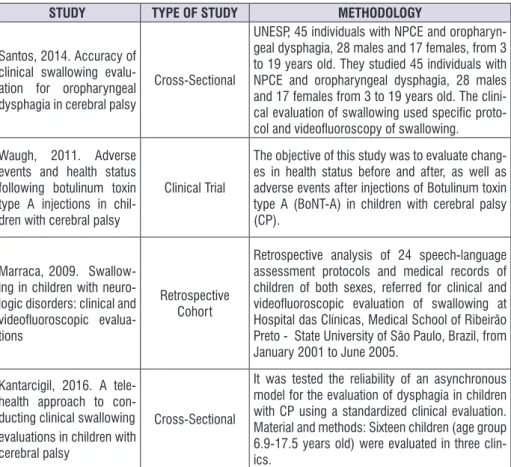
Santos, 2014. Accuracy of
clinical swallowing evalu-ation for oropharyngeal dysphagia in cerebral palsy
Cross-Sectional
UNESP, 45 individuals with NPCE and oropharyn-geal dysphagia, 28 males and 17 females, from 3 to 19 years old. They studied 45 individuals with NPCE and oropharyngeal dysphagia, 28 males and 17 females from 3 to 19 years old. The clini-cal evaluation of swallowing used speciic proto-col and videoluoroscopy of swallowing.
It was veriied that the clinical phonoaudiologi-cal evaluation of oropharyngeal dysphagia in NPCE presents greater sensitivity than speciic-ity. It was veriied that there was sensitivity of 80.0%, speciicity of 46.67%, positive predic-tive value of 77.78% and negapredic-tive predicpredic-tive value of 77.78%.
Waugh, 2011. Adverse events and health status following botulinum toxin type A injections in chil-dren with cerebral palsy
Clinical Trial
The objective of this study was to evaluate chang-es in health status before and after, as well as adverse events after injections of Botulinum toxin type A (BoNT-A) in children with cerebral palsy
(CP).
Data collected for the month prior to adminis-tration of BoNT-A indicated that children with CP had signiicant background morbidity. After injection of BoNT-A, adverse events occurred in 23.2% of the children. All adverse events were temporary and there were no deaths.
Marraca, 2009. Swallow-ing in children with
neuro-logic disorders: clinical and
videoluoroscopic
evalua-tions
Retrospective
Cohort
Retrospective analysis of 24 speech-language
assessment protocols and medical records of
children of both sexes, referred for clinical and videoluoroscopic evaluation of swallowing at Hospital das Clínicas, Medical School of Ribeirão Preto - State University of São Paulo, Brazil, from
January 2001 to June 2005.
There was a greater occurrence of inadequate control of the food bolus. There was a statisti-cally signiicant correlation between cervical auscultation and the hyoid and larygeal excur-sion, and laryngotracheal aspiration for liquid and pasty consistencies. Conclusion: both
pro-cedures are important and complementary in
the diagnosis of dysphagia.
Kantarcigil, 2016. A tele
-health approach to con-ducting clinical swallowing evaluations in children with
cerebral palsy
Cross-Sectional
It was tested the reliability of an asynchronous model for the evaluation of dysphagia in children with CP using a standardized clinical evaluation. Material and methods: Sixteen children (age group 6.9-17.5 years old) were evaluated in three
clin-ics.
Asynchronous clinical assessments of swal-lowing using standardized tools have accept-able levels of agreement with face-to-face as-sessments and may be an alternative for chil-dren with access.
Figure 2. Articles analyzed in the systematic review
prevalence and patterns of oropharyngeal dysphagia in pre-school children with cerebral palsy (CP),
associ-ating with feeding eficiency. In 93.8% of the children, oral phase deiciencies appeared in chewing and
swallowing, and changes were associated with a decline in their gross motor skills. In the other paper, they report that the oral motor patterns of children with CP vary from person to person, and that alterations in oral motor function may generate a spectrum of disabil-ities at each stage of the swallowing process, resulting in malnutrition, dehydration, pulmonary aspiration and pneumonia 4,11,12.
The theme oral motor function and therapeutic intervention appeared in 2 articles. In one of them, the authors concluded that oral sensory-motor therapy may be effective in promoting oral motor function, but may
not be in promoting the eficiency of oral feeding, caloric
intake and weight gain. In this study, the decrease in the presence of suggestive signs of pulmonary penetration and/or aspiration may be due to the guide-lines given to the caregivers regarding posture, volume and a more secure food consistency, in addition to the speech-language therapy itself. Stimulation, handling and feeding training have promoted greater swallowing
functionality12. In the other paper, the orientation of
caregivers on how to put the patient at the time of feeding is extremely necessary due to the need for adequate motor control for feeding4.
Among the articles that addressed dysphagia, 14 presented the evaluation of dysphagia and food intake in CPs. They described the evaluation process, which indicates important functional and anatomical issues related to swallowing problems in children with cerebral palsy.
One of the articles brought an evaluation of
dysphagia through speciic protocols collected during
interviews and observation of the ingestion of different food consistencies. They used cervical auscultation and pulse oximetry, coughing or choking during or after swallowing, poor oral motor skills, delayed pharyngeal response, multiple swallowing, increased secretion or stridor in the upper airways during or after swallowing and rhythm of the respiratory system. They found that satisfactory food intake is limited and threatens the children’s health due to factors such as neurological immaturity, interference of mood and preparation of caregivers, as well as the peculiarities of individuals
and deformities; epilepsy, dental alterations, cognitive and language delay that hinders the communication about hunger and food preferences, diets offered in paste consistency, making the meal monotonous and risk of loss of nutrients in its preparation, etc.).
The authors of another paper described the eating
dificulties (dysphagia) in children with CP, the clinical
and complementary evaluation process and the speech and language therapy, which aims to establish the positioning and types of utensils, food consis-tency, indication of the use of thickener and reduction of the fractionated volume that is offered in each food supply. In this article, dysphagia is characterized by the presence of signs such as cough or hypoxemia during or after feeding; nasal regurgitation; extraoral escape; poor oral motor coordination; delayed pharyngeal
response to elucidate the relex of swallowing; multiple
swallowing; increased secretion in the airways; fatigue
during or after feeding; stridor of luid in the upper
airways during or after feeding; apnea or dyspnea
during feeding; respiratory rhythm modiication; tearing
of the eyes, throat clearing, grimaces; prolonged time for swallowing and meal intake (45-60 min.); presence of residues in the oral cavity; protrusion of the tongue; tilt of the head, opisthotonos, diplopia, halitosis.
One of the articles addressed the clinical phonoau-diological evaluation as an instrument of investigation in oropharyngeal dysphagia that, although it has variable accuracy and distinct reliability among examiners, may lead the clinician to value any sign of risk in an
attempt to be more sensitive in the identiication of
silent laryngotracheal aspiration. They found that the clinical phonoaudiological evaluation of oropharyngeal dysphagia in Non-Progressive Chronic Encephalopathy
(NPCE) is more sensitive than speciicity and further
studies are needed to identify clinical predictors of
silent aspiration and to increase the speciicity of this
instrument in this population.
Another article aimed to verify the time of prepa-ration and oral transit of the swallowing of children with cerebral palsy and to relate it to the degree of dysphagia severity and to the motor level, according
to the Gross Motor Function Classiication System. The
mean swallowing time was 1.33 seconds for the liquid consistency and 3.33 seconds for the pasty consis-tency. It was found that the higher is the motor level of the group of children, the longer is the swallowing time
for the liquid consistency and a signiicant difference
was found between the groups for both consistencies, with progressive increase of the swallowing time the
greater the impairment of the swallowing function. Oral transit time in children with cerebral palsy was higher and represented the severity of the dysphagia presented, demonstrating that the greater is the overall motor impairment presented, the longer is the oral transit time1,3,9,11,13-20.
The topic consequences of digestive manifestations
was described in 7 articles. In them, it is conirmed that
upper digestive alterations may trigger recurrent
respi-ratory infections, insuficient nutritional intake, nutritional deicit in the growth curve, greater number of hospital -izations and the need for gastrostomy1,10,11,15,18-21.
The topic pulmonary complications/aspiration in children with CP was referred in 3 articles that addressed dysphagia and the risk of aspiration in children with cerebral palsy. Dysphagia and the potential pulmonary consequences and nutrition/malnutrition state cause stressful meal times. Thus, children with moderate to severe dysphagia require multiprofessional inter-vention due to gastrointestinal involvement, pulmonary involvement, nutrition/hydration, oral sensory-motor skills, behavioral issues and family interactions3,10,11.
Eosinophilia was the speciic theme of an article.
It addresses eosinophilic esophagitis in CP patients.
This type of esophagitis is deined by symptoms of
esophageal disorders, predominantly eosinophilic
inlammation restricted to the esophagus and causing
esophageal dysphagia. The early diagnosis of eosino-philic esophagitis is essential in CP patients and should be done carefully and should take into account the regular criteria, since the frequency of eosinophilic esophagitis in CP patients found in this study was high when compared to the presence of the same disease in the general population. Further studies are needed to
establish a speciic diagnosis and treatment in patients
with cerebral palsy and esophageal eosinophilia21.
The topic related to speech and language inter-vention/rehabilitation was present in 10 articles that described a plan to provide guidance, research approach and treatment of swallowing problems in cerebral palsy. The educational actions are approached as being essential to favor the adherence to speech-language therapy, and aimed at the caregivers of dysphagic patients. They are associated with the therapeutic process, encompassing the awareness and training for caregivers, helping them deal with functional issues related to food, that is, oral handling, type of diet, utensils, mode of supply, posture, signs of
In one of the articles, the caregivers were oriented in relation to the daily maintenance of the stimulation, optimizing the therapeutic results. In the study involving children with NPCE and their caregivers, there was an improvement in the caregivers’ knowledge and behavior regarding the feeding of their children, after the caregivers were submitted to an educational action aimed at the feeding of dysphagic children. The role of speech therapy has been described as being funda-mental in the orientation, education of family members and caregivers, and in the therapy of these patients. One of the articles aimed to verify the indicators of evolution in the feeding function and in the clinical stability of children with spastic quadriplegic CP who underwent speech therapy for the rehabilitation of oropharyngeal dysphagia. It was observed an evolution in the alimentary function and improvement in the clinical stability of children undergoing speech therapy. Suggestive signs of tracheal laryngeal penetration and/or aspiration were reduced due to the guidelines given to caregivers regarding posture, volume and food safety consistencies, as well as speech and language practice, which, through stimulation, manipulation and training, promote greater swallowing function-ality. After the intervention with the multidisciplinary team in dysphagia, according to the data of this study, there was a decrease in the severity of oropharyngeal dysphagia and the presence of suggestive signs of laryngotracheal penetration and/or aspiration, as well as greater clinical stability due to the decrease in episodes of bronchopneumonia, and weight gain.
Another study sought to measure the eficacy
of speech therapy intervention within a multidisci-plinary team in cases of oropharyngeal dysphagia in children with choreoathetoid cerebral palsy. This study showed that, because of the difference in overall motor impairment and better cognitive performance, although speech-language intervention may promote greater
eficacy of the swallowing process, some children
maintain the need to use the alternative feeding route, not only because of the risk, but because of the need for greater nutritional support, since oral feeding in these children usually requires more time and compensations.
Another article sought to identify existing
rehabili-tation methods in the area of dysphagia in cases
of cerebral palsy, with emphasis on the search for research using the following neuropathological methods: Bobath, Rodolfo Castillo Morales, orofacial motor sensory therapy and continuing education. The
article concluded that there are still few studies that cover the (re)habilitation of these children, regarding
the treatment of oropharyngeal dysphagia22. In this
research, only 22 publications were found, among 310 related to neurological diseases and swallowing disorders, which really focus on speech therapy. Among the articles found only 2 of them (9%) are national, which shows a limited concern of Brazilian
researchers in investigating the eficiency of methods
of rehabilitation of oropharyngeal dysphagia in. CP children4,6,12-16,23,24.
CONCLUSION
Numerous recent discoveries of neuroscience about the development and processing of information in the brain have been contributing to the understanding of learning. The speech therapist and other profes-sionals involved in the improvement and rehabilitation of cognitive functions have created better conditions for intervention and analysis. In view of the analyzed articles, the need for more research on clinical aspects
and therapeutic proposals is more speciic, the issues of pathological relexes and neuropathology.
REFERENCES
1. González Jiménez D, Díaz Martin JJ, Bousoño García C, Jiménez Treviño S. Patología gastrointestinal en niños con parálisis cerebral infantil y otras discapacidades neurológicas. An. Pediatría. 2010;73(6):361:-6.
2. Haak P, Lenski M, Hidecker MJC, Li M, Paneth N. Cerebral palsy and aging. Dev. Med. Child Neurol. 2009;51(4):16-23.
3. Araújo LA, Silva LR, Mendes FAA. Digestive tract neural control and gastrointestinal disorders in cerebral palsy. J. Pediatr. 2012;88(6):455-64.
4. Vianna CIO, Suzuki HS. Cerebral palsy: analysis of swallowing patterns before and after speech therapy intervention. Rev. CEFAC. 2011;13(5):790-800. 5. Marrara JL, Duca AP, Dantas RO, Trawitzki LVV,
Lima RAC, Pereira JC. Swallowing in children with
neurologic disorders: clinical and videoluoroscopic
evaluations. Rev Pró-Fono Atual. Cientif. 2009;20(4):231-6.
7. Furkim AM, Behlau MS, Weckx LLM. The use of cervical auscultation in tracheal aspiration in children with cerebral palsy. Rev. CEFAC. 2009;11(4):624-9.
8. Clancy KJ, Hustad KC. Longitudinal changes in feeding among children with cerebral palsy Between the ages of 4 and 7 years. Dev. Neurorehabilitation. 2011;14(4):191-8.
9. Araújo LA, Silva LR. Anthropometric assessment of patients with cerebral palsy: which curves are more appropriate? J. Pediatr. 2013;89(3):307-14.
10. Arvedson JC. Feeding children with cerebral
palsy and swallowing dificulties. Eur. J. Clin. Nutr.
2013;67:S9-S12.
11. Benfer KA, Weir KA, Bell KL, Ware RS, Davies PS,
Boyd RN. Oropharyngeal dysphagia in preschool
children with cerebral palsy: oral phase impairments. Res. Dev. Disabil. 2014;35(12):3469-81.
12. Benfer KA, Weir KA, Bell KL, Ware RS, Davies PS, Boyd RN. Oropharyngeal Dysphagia and Gross Motor Skills in Children With Cerebral Palsy. Pediatrics. 2014;131(5):1553-62.
13. Silvério CC, Henrique CS. Indicadores da evolução do paciente com paralisia cerebral e disfagia orofaríngea após intervenção terapêutica. Rev. Soc. Bras. Fonoaudiol. 2009;14(3):381-6.
14. Otapowicz D, Sobaniec W, Okurowska-Zawada B, Artemowicz B. Dysphagia in children with infantile cerebral palsy. Adv. Med. Sci. 2010;55(2):222-7.
15. Santos RRD, Sales AVMN, Cola PC, Jorge AG, Peres FM, Furkim AM et al. Accuracy of clinical swallowing evaluation for oropharyngeal dysphagia in cerebral palsy. Rev. CEFAC. 2014;16(1):197-201.
16. Erasmus CE, van Hulst K, Rotteveel JJ, Willemsen MAAP, Jongerius PH. Clinical practice: swallowing problems in cerebral palsy. Eur. J. Pediatr. 2012;171(3):409-14.
17. Kuperminc MN, Gottrand F, Samson-Fang L,
Arvedson J, Bell K, Craig GM et al. Nutritional
management of children with cerebral palsy: a practical guide. Eur. J. Clin. Nutr. 2013;67(2):21-3.
18. Lucchi C, Flório CPF, Silvério CC, Reis TM. Incidência de disfagia orofaríngea em pacientes com paralisia cerebral do tipo tetraparéticos espásticos institucionalizados. Rev. Soc. Bras. Fonoaudiol. 2009;14(2):172-6.
19. Lustre NS, Freire TRB, Silvério CC. Temporal measurements of oral transit time in children with cerebral palsy of different levels motors and the relationship with the severity of dysphagia. Audiol. Commun. Res. 2013;18(3):155-61.
20. Kantarcigil C, Sheppard JJ, Gordon AM, Friel
KM, Malandraki GA. A telehealth approach to conducting clinical swallowing evaluations in children with cerebral palsy. Research in Developmental Disabilities. 2016; 55:207-217.
21. Nápolis ACR, Alves FA, Rezende ER, Segunda GR.
Esophageal eosinophilia in pediatric patients with cerebral palsy. Einstein. 2015;13(2):232-7.
22. O’Flaherty SJ, Janakan V, Morrow AM, Scheinberg AM, Waugh MCA. Adverse events and health status following botulinum toxin type A injections in children with cerebral palsy. Dev. Med. Child Neurol. 2011;53(2):125-30.
23. Oliveira L, Valarelli LP, Caldas CAT, Nascimento WV, Dantas RO. Therapeutic intervention and family acceptance in a case of child with cerebral palsy. Rev. CEFAC. 2015;17(1):286-90.
24. Silvério CC, Henrique CS. Patient with