Exposure to fine particulate matter and hospital admissions
due to pneumonia: Effects on the number of hospital admissions
and its costs
NICOLE VARGAS PATTO1, LUIZ FERNANDO COSTA NASCIMENTO2*, KATIA CRISTINA C. MANTOVANI3, LUCIANA C. P. F. S. VIEIRA4,
DEMERVAL S. MOREIRA5
1Medical Student, Universidade de Taubaté (Unitau), Taubaté, SP, Brazil 2PhD, Department of Medicine, Unitau, Taubaté, SP, Brazil
3MSc in Statistics, Department of Energy, Universidade Estadual Paulista (Unesp), Campus Guaratinguetá, Guaratinguetá, SP, Brazil 4BA in Mathematics, Department of Energy, Unesp, Campus Guaratinguetá, Guaratinguetá, SP, Brazil
5PhD – Researcher, Centro de Previsão do Tempo e Estudos Climáticos, Instituto Nacional de Pesquisas Espaciais (CPTEC-Inpe), Cachoeira Paulista, SP, Brazil
S
UMMARYStudy conducted at Departamento de Medicina, Universidade de Taubaté
(Unitau), Taubaté, SP, Brazil
Article received: 1/5/2015
Accepted for publication: 5/4/2015
*Correspondence:
Address: Av. Tiradentes, 500 Taubaté, SP – Brazil
Postal code: 12030-180 Phone: +55 12 3621-8796
http://dx.doi.org/10.1590/1806-9282.62.04.342
Objective: Given that respiratory diseases are a major cause of hospitalization in children, the objectives of this study are to estimate the role of exposure to fine particulate matter in hospitalizations due to pneumonia and a possible re-duction in the number of these hospitalizations and costs.
Method: An ecological time-series study was developed with data on
hospital-ization for pneumonia among children under 10 years of age living in São José do Rio Preto, state of São Paulo, using PM2.5 concentrations estimated using a
mathematical model. We used Poisson regression with a dependent variable (hos-pitalization) associated with PM2.5 concentrations and adjusted for effective
tem-perature, seasonality and day of the week, with estimates of reductions in the number of hospitalizations and costs.
Results: 1,161 children were admitted to hospital between October 1st, 2011,
and September 30th, 2013; the average concentration of PM
2.5 was 18.7 µg/m3
(≈32 µg/m3 of PM
10) and exposure to this pollutant was associated with
hospi-talization four and five days after exposure.
Conclusion: A 10 µg/m3 decrease in concentration would imply 256 less
hospi-tal admissions and savings of approximately R$ 220,000 in a medium-sized city.
Keywords: particulate matter, air pollutants, pneumonia, child health, health care costs.
I
NTRODUCTIONIn 2012, respiratory diseases (RD) in children aged up to 10 years were responsible for 530,000 hospital admissions in Brazil, of which 96,000 occurred in the state of São Pau-lo.1 These hospitalizations have cost the public health
sys-tem (SUS) R$ 380 million, with R$ 85 million being spent in São Paulo. RDs include pneumonia, bronchiolitis and asthma. Hospital admissions based on these diagnoses to-taled 410,000 in Brazil and 72,000 in the state of São Pau-lo, generating an expense of R$ 280 million in Brazil and R$ 60 million in the state of São Paulo (1 US$ ≈ R$ 2.20).1
These figures show the relevance of RDs in pediatric populations both regarding number of hospital admis-sions and costs, in addition to a social cost that is hard to measure. Factors associated with the genesis of
respi-ratory disease include exposure to air pollutants, such as particulate matter less than 10 microns in aerodynamic diameter (PM10) and its fine fraction, PM2.5, nitrogen
ox-ides, sulfur dioxide, ozone and carbon monoxide. Recent studies conducted in large and medium-sized cities in Brazil show that exposure to these pollutants is associat-ed with hospitalizations for RD.2-11
the Regional Atmospheric Modeling System),12,13 which
takes into account the atmospheric dynamics.
The application of this model for studies about the effects of pollution on human health is present in the ar-ticles by Cesar et al.3 and Ignotti et al.14 It is a
mathemat-ical model covering South America and which takes into account the emission and transport of various gases and particulate aerosols based on data obtained by satellite, generating daily estimates for different pollutants. One of the advantages of using this model is its application in cities where there are no pollution metering stations. The use of the data estimated by this system, validated by Ignotti et al.,14 reduces research costs and streamlines the
process of analyzing the effects of air pollution on health. The concentrations of pollutants that are estimated us-ing this model are PM2.5, CO, NO2 and O3, every three
hours. These concentrations are estimated at a height of 40 meters above the ground in an area of 15 x 15 km.
The aim of our study was to estimate the role of ex-posure to PM2.5 in hospitalizations caused by RD, and the
reduction in the number of hospitalizations and associ-ated costs if the concentration of this pollutant fell in the city of São José do Rio Preto, São Paulo.
M
ETHODThis is an ecological time-series study with data on hos-pitalizations due to pneumonia (10th revision of the
In-ternational Statistical Classification of Diseases and Re-lated Health Problems – ICD-10 – J12.0 to J18.9) in children of both sexes aged up to 10 years and living in São José do Rio Preto, São Paulo. The study period was between October 1, 2011 and September 30, 2013.
Place of study: São José do Rio Preto is a municipality located in the northwest of the state of São Paulo, at an approximate distance of 450 km from the capital. Geo-graphically, it is located at latitude 20º50’ S and longitude 49º22’ W. It covers an area of 430 km², has a population of around 400,000 inhabitants, Human Development In-dex (HDI) of 0.80, and is an important regional hub, with a vehicle fleet of approximate 300,000 vehicles.
Data on hospital admissions for respiratory causes, according to place of residence, were obtained from the Ministry of Health’s database, through the SUS Hospi-tal Admission Authorizations (AIH) for the study period, month by month. The data of air pollutants were ob-tained from the Centro de Previsão do Tempo e Estudos Climáticos, Instituto Nacional de Pesquisas Espaciais (CPTEC-Inpe) website and refer to estimates obtained us-ing the CATT-BRAMS (Coupled Aerosol and Tracer Trans-port model to the Brazilian developments on the Region-al Atmospheric Modeling System) model.
The pollutant examined in this study was fine partic-ulate matter, PM2.5.
Pearson’s correlation test was used to assess possible correlation between pollutant concentrations and hospi-tal admissions. The effects of exposure to environmenhospi-tal pollutants may be reflected in hospital admissions on the same day or on subsequent days. Thus, we investigated these effects on hospitalizations both on the day of expo-sure (lag 0) and within five days (lag 1 to lag 5), because there is no consensus on the size of this window. We used a Poisson generalized linear regression model, because the outcome is a discrete quantitative variable. The results of the risk of hospitalization refer to exposure to PM2.5
adjust-ed for day of week, seasonality and effective temperature (ET), which is a combination of temperature values (T) and relative humidity (RH) calculated using the expression:
ET = T – 0.4*(T – 10)* (1 – RH/100)
Tables were constructed with average, minimum and max-imum values and the respective standard deviations for number of hospitalizations, the concentration of PM2.5
and effective temperature. The relative risks were calcu-lated with 95% confidence intervals for hospitalization due to pneumonia in children, as well as percentage in-creases of these risks, resulting from an increase corre-sponding to 10 µg/m3 in PM
2.5 concentrations. Excess
hospitalizations resulting from this increase in PM2.5 and
the financial costs that could cease to occur were estimat-ed using population attributable fraction, basestimat-ed on the average values charged for hospitalizations due to pneu-monia in the city of São José do Rio Preto, for the study period, also obtained from the Datasus website.
Strata software and a 5% significance level were used for data analysis.
R
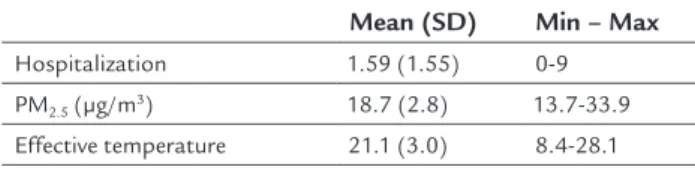
ESULTS1,161 children were admitted to hospital during the study period. The average, minimum and maximum values and standard deviations of the variables are shown in Table 1. Considering that PM2.5 concentrations correspond
to 60% of the PM10 concentrations, the mean values of
the concentration of this pollutant would be close to 31.6 µg/m3 ranging between 22.8 and 56.6 µg/m3 according
to the average, maximum and minimum values estimat-ed by the CATT-BRAMS for PM2.5, which were
respective-ly 18.7, 13.7 and 33.9 µg/m3.
Coefficients and the respective 95% confidence inter-vals provided by the model are shown in Table 2. The ef-fect of exposure to PM2.5 on hospital admissions is late,
TABLE 1 Descriptive analysis with mean, minimum and maximum values and standard deviation (SD) of the study variables, São José do Rio Preto, SP, 2011-2013.
Mean (SD) Min – Max
Hospitalization 1.59 (1.55) 0-9
PM2.5 (µg/m3) 18.7 (2.8) 13.7-33.9
Effective temperature 21.1 (3.0) 8.4-28.1
TABLE 2 Coeficients (coef) and standard error (se) obtained with Poisson regression at 0 to 5-day lag, São José do Rio Preto, SP, 2011-2013.
coef se
lag 0 0.008609 0.010926
lag 1 0.006802 0.011120
lag 2 -0.007561 0.011598
lag 3 -0.000831 0.011196
lag 4 0.022547 # 0.010475 #
lag 5 0.024877 # 0.010434 #
#p-value<0.05.
The relative risks and respective 95% confidence intervals for increases of 10 µg/m3 in PM
2.5 concentrations are
shown in Figure 1. A rise of 10 µg/m3 in the
concentra-tion of PM2.5 leads to significant increase between 25 ppt
and 28 ppt in the risk of hospitalization due to pneumo-nia among children four and five days after exposure.
A decline of 10 µg/m3 in the concentration of PM 2.5
would lead to 256 less admissions and savings close to R$ 220,000 within two years, considering the average cost of hospitalization at R$ 854.00. Note that this reduction re-fers to hospitalizations of children up to 10 years old and due to pneumonia.
D
ISCUSSIONThis study identified the role of exposure to PM2.5 in the
hospitalization of children due to pneumonia, and also identified excess admissions due to increased concentra-tion of this pollutant together with savings that would be generated if there was a decrease of 10 µg/m3 in PM
2.5
concentration, also sparing the social cost of pediatric hospitalization. The risks were significantly associated hospitalizations four and five days after exposure.
PM2.5, which has an aerodynamic diameter less than
2.5 micra, is called fine fraction or fine particulate mat-ter and can reach deeper areas in the lungs contributing with 60 to 70% of its concentration.15
The composition of the fine fraction of the particulate matter may vary according to the place of study; in São José dos Campos16 it contains the following ions: NH
4, SO4-2, Na,
K, Cl, Ca+2, NO
3, H, and Mg+2.16 Metals such as Al, Na, Si,
P, K, Ca and polycyclic aromatic hydrocarbons (PAHs) are also part.17
Exposure to particulate matter PM10 was associated
with impaired respiratory function in children in the city of Tirana, where the average concentrations of this pollut-ant reached 400 µg/m3, with a significant decrease in forced
vital capacity and expiratory peak.18 Exposure to PM 10 was
also associated with hospitalizations for pneumonia among children in studies conducted in Cubatão7 and São José
dos Campos.2 This information shows the relevance of
ex-posure to PM10 and inferring the importance of the role of
PM2.5 in hospitalizations for RD. In Araraquara, SP, which
is a major producer of sugar and alcohol and is located about 200 km from São José do Rio Preto, exposure to PM10 was associated with hospitalizations for pneumonia
in children, with concentrations of this pollutant (35.7 µg/ m3) similar to the adjusted concentrations found in São
José do Rio Preto (31.6 µg/m3).19
Exposures to PM2.5 were associated with
hospitaliza-tions due to bronchiolitis in a study by Sheffield et al.20
conducted between 1999 and 2007 based on the Nation-al Inpatient Sample, the largest database that evNation-aluates hospitalization costs for bronchiolitis in the United States. In this study, the authors identified nearly 48,000 hospi-talizations for bronchiolitis associated with exposure to PM2.5 and estimated a cost reduction of approximately
US$ 15 million per year, resulting from the decrease in the concentrations of this pollutant. Likewise, Carr et al.21
identified an increase of up to 15% in the chance of hos-pitalization for bronchiolitis with an increase of 10 µg/ m3 in the concentration of PM
2.5 in a study conducted in
Southern California between 1999 and 2005 where the average concentrations of PM2.5 were close to 25 µg/m3.
FIGURE 1 Relative risks with 95% conidence intervals for increases
in PM2.5 concentration (10 μg/m3) on lag days 0 to 5. São José do Rio
Preto, SP, Brazil, 2011-2013.
1.60
1.30
RR
1.00
0.70
Studies in Chile22 and the Netherlands23 highlight
the role of exposure to PM2.5 in episodes of wheezing and
asthma diagnosis in children.
A study conducted in Cuiabá, state of Mato Grosso, Brazil, showed that exposure to PM2.5 was associated with
hospitalizations for respiratory diseases (ICD-10 J00 to J99) in children; concentrations of this pollutant were high-er in the dry season than the annual avhigh-erage (11.9 µg/m3 –
7.5 µg/m3) and hospitalizations increased from 9.1 to 22%,
with the largest increases in the dry season.24 Cesar et al.3
identified the role of exposure to PM2.5 in hospitalizations
in children aged up to 10 years with diagnoses of pneumo-nia and asthma living in Piracicaba, São Paulo, a tradition-al region of sugarcane production. PM2.5 concentrations
were close to 29 µg/m3 with increases in the risk of
hospi-talization between 8 and 9% for a 10 µg/m3 rise in PM 2.5,
one and three days after exposure. These two studies used concentrations estimated by the CATT-BRAMS model.
Conversely, a study performed in Manaus, Amazonas, with data for PM2.5 concentrations estimated by aerosol
optical depth remote sensing from MODIS™, failed to as-sociate PM2.5 concentrations and pediatric hospitalizations,
associating the pollutant to the relative humidity of air in-stead. Note that PM2.5 concentrations ranged from 13 µg/
m3 in the rainy season to 21 µg/m3 in the dry season.25
In our study, the concentrations estimated by the CATT-BRAMS were within the range of estimated values for Cuiabá, MT, and Piracicaba, SP. The increase in the concentration of PM2.5 in São José do Rio Preto would
imply an increase between 23 and 26% in the risk of hos-pitalization, and these increases are close to those found in Cuiaba in the dry season.24 The effect of exposure to
PM2.5 appeared later in the fourth and fifth days after
ex-posure. Our results show the role of PM2.5 in the genesis
of hospitalizations due to pneumonia, unlike the results obtained in Cuiabá and Piracicaba, which included oth-er diagnoses of respiratory diseases in the analysis.
Using population attributable fraction, we were able to estimate a decrease of approximate 256 hospitalizations with savings of approximately R$ 220,000 in the two years of study, if there was a reduction in PM2.5 of 10 µg/m3.
These values of the attributable fraction are higher than those obtained by Marcílio and Gouveia, authors who stud-ied children under five years old in seven Brazilian cities.26
As for hospital admissions, despite the figures being low, it should be noted that this reduction only refers to the hospitalizations of children under 10 years old with pneumonia in a city of about 400,000 inhabitants served by the Unified Health System. One has to consider the harmful effects of exposure in the adult population whose
admissions could be due to other respiratory diseases such as asthma and complications of chronic obstructive pulmonary disease and cardiovascular diseases such as hypertension, myocardial infarction and stroke.
As for the reduction of financial costs with decreas-ing concentrations of air pollutants, Ostro and Chestnut27
calculated savings close to US$ 70 billion if the average concentrations of PM2.5 were 12 µg/m3. In addition, a
re-duction of 10 µg/m3 in PM
2.5 concentration would imply
an average increase in life expectancy of 0.6 (±0.2) years, possibly contributing to an increase of about 15% in cer-tain areas of the USA.28 Miraglia and Gouveia used the
DALY method to estimate that exposure to PM10 caused
approximately 20,000 deaths in 29 Brazilian cities plus greater area, with a cost of US$ 1.7 billion per year.29
L
IMITATIONSThis study may have limitations such as those derived from the nature of ecological studies, namely: It is not possible to identify the causality between exposure and outcome, but only to point out associations between ex-posures and outcomes; identifying if the person who was hospitalized was exposed, and if the person exposed was hospitalized is not possible; errors in diagnoses registered in the Datasus are not considered, leading to underre-porting or overreunderre-porting of cases of pneumonia in chil-dren. Children served by health plans and those treated in outpatient settings were not included.
Moreover, the Datasus does not include information on factors associated with pneumonia in children such as passive smoking, low birth weight, lack of breastfeeding, and more. Concentrations were considered homogeneous throughout the city and the authors assumed that chil-dren were exposed homogeneously to the pollutants. The amounts of pollutants were obtained using a mathemati-cal model, with a good correlation identified between these and actual data.13 However, there may be a degree of
un-certainty in the estimation of these data. The use of this data is recorded in two recent articles3,24 and proved to be
quite adequate, with few flaws in the quantification of val-ues. Relevant findings included the confirmation of the important role of exposure to PM2.5 in the number of
hos-pitalization and that the reduction in PM2.5 concentration
can reduce the financial costs. Also important is the anal-ysis of the role of exposure to PM2.5 in hospitalizations for
respiratory disease that is little studied in Brazilian articles. The results of our study, conducted in a medium-sized city, revealed the role of exposure to PM2.5 in
10 µg/m3 decrease in this pollutant’s concentration. The
implementation of policies to reduce these concentra-tions would certainly reduce the impact on hospitaliza-tions, not only among children with RD, but possibly among adults with this and other respiratory diseases.
A
CKNOWLEDGMENTNicole Vargas Patto thanks the São Paulo Research Foun-dation for the scholarship grant 2013/19430-5.
R
ESUMOExposição ao material particulado fino e internações por pneu-monias. Efeitos no número de internações e em seus custos
Objetivo: como as doenças do aparelho respiratório são importantes causas de internação em crianças, os objeti-vos deste estudo são estimar o papel da exposição ao par-ticulado fino nas internações por pneumonias e a possível redução do número dessas internações e de seus custos.
Método: um estudo ecológico de séries temporais foi de-senvolvido com dados de internação por pneumonias em crianças de até 10 anos de idade, residentes em São José do Rio Preto, SP, utilizando concentrações de PM2,5
estima-das por modelo matemático. Foi utilizada a regressão de Poisson com a variável dependente – internação, sendo as-sociada às concentrações de PM2,5, ajustada por
tempera-tura efetiva, sazonalidade e dia da semana e foram estima-das reduções no número de internações e em seus custos.
Resultados: foram internadas 1161 crianças entre 01.10.2011 e 30.09.2013. A concentração média de PM2,5 foi de 18,7 µg/
m3 (≈ 32 µg/m3 de PM
10) e a exposição a esse poluente foi
associada à internação 4 e 5 dias após a exposição.
Conclusão: redução em 10 µg/m3 em sua concentração
implicaria redução de 256 internações e de aproximados R$ 220 mil em uma cidade de porte médio.
Palavras-chave: material particulado, poluentes do ar, pneu-monia, saúde da criança, custos de cuidados de saúde.
R
EFERENCES1. Brasil. Ministério da Saúde. Departamento de Informática do SUS (Datasus). [cited 2014 Sep 09]. Available from: http://tabnet.datasus.gov.br/cgi/tabcgi. exe?sih/cnv/nruf.def .
2. Nascimento LFC, Pereira LAA, Braga ALF, Módolo MCC, Carvalho Jr JA. [Effects of air pollution on children’s health in a city in Southeastern Brazil]. Rev Saúde Pública. 2006; 40(1):77-82.
3. Cesar ACG, Nascimento LFC, Carvalho Jr JA. [Association between exposure to particulate matter and hospital admissions for respiratory disease in children]. Rev Saúde Pública. 2013; 47(6):1209-12.
4. Negrisoli J. Nascimento LFC. Atmospheric pollutants and hospital admissions due to pneumonia in children. Rev Paul Pediatr. 2013; 31(4):501-6. 5. Amâncio CT, Nascimento LFC. Asthma and air pollutants: a time series
study. Rev Assoc Med Bras. 2012; 58(3):302-7.
6. Gouveia N, Freitas CU, Martins LC, Marcilio IO. Hospitalizações por causas respiratórias e cardiovasculares associadas á contaminação atmosférica no Município de São Paulo, Brasil. Cad Saúde Pública. 2006; 22(12):2669-77. 7. Jasinski R, Pereira LAA, Braga ALF. Poluição atmosférica e internações
hospitalares por doenças respiratórias em crianças e adolescentes em Cubatão, São Paulo, Brasil, entre 1997 e 2004. Cad Saúde Pública. 2011; 27(11): 2242-52.
8. Moura M, Junger WL, Mendonça GAS, Leon AP. Qualidade do ar e transtornos respiratórios agudos em crianças. Rev Saúde Pública. 2008; 42(3):503-11.
9. Riguera D, André PA, Zanetta DMT. Poluição da queima de cana e sintomas respiratórios em escolares de Monte Aprazível, SP. Rev Saúde Pública. 2011; 4(5):878-86.
10. Ignotti E, Hacon SS Junger WL, Mourão D, Longo K, Freitas S, et al. Air pollution and hospital admissions for respiratory diseases in the subequatorial Amazon: a time series approach. Cad. Saúde Pública. 2010; 26(4):747-61.
11. Castro HA, Cunha MF, Mendonça GAS, Junger WL, Cunha-Cruz J, Leon AP. Efeitos da poluição do ar na função respiratória de escolares, Rio de Janeiro, RJ. Rev Saúde Pública. 2009; 43(1):26-34.
12. Longo KM, Freitas SR, Setzer A, Prins E, Artaxo P, Andreae MO. The Coupled Aerosol and Tracer Transport model to the Brazilian developments on the Regional Atmospheric Modeling System (CATT-BRAMS). Part 2: model sensitivity to the biomass burning inventories. Atmo Chem Phys Discuss. 2007; 7:8571-96.
13. Freitas SR, Longo KM, Dias MAFS, Chatfield R, Dias PLS, Artaxo P, et al. The Coupled Aerosol and Tracer Transport model to the Brazilian developments on the Regional Atmospheric Modeling System (CATTBRAMS). Part 1: Model description and evaluation. Atmos Chem Phys Discuss. 2007; 7:8525-69.
14. Ignotti E, Valente JG, Longo KM, Freitas SR, Hacon SS, Netto PA. Impact on human health of particulate matter emitted from burning in the Brazilian Amazon region. Rev Saúde Pública. 2010; 44(1):121-30.
15. Donaldson K, Stone V, Clouter A, MacNee W. Ultrafine particles. Occup Environ Med. 2001; 58(3):211-6.
16. Souza PA, Mello WZ, Mariani RL, Sella SM. Caracterização do material particulado fino e grosso e composição da fração inorgânica solúvel em água em São José dos Campos (SP). Química Nova. 2010; 33(6):1247-53. 17. Riva DR, Magalhães CB, Lopes AA, Lanças T, Mauad T, Malm O, et al. Low
dose of fine particulate matter (PM2.5) can induce acute oxidative stress, inflamation and pulmonar impairment in healthy mice. Inhal Toxicol. 2011; 23(5):257-67.
18. Tabaku A, Bejtja G, Bala S, Toci E, Resuli J. Effects of air pollution on children’s pulmonary health. Atmos Environ. 2011; 45(40):7540-5. 19. Souza LSV, Nascimento LFC. Air pollutants and hospitalar admission due to
pneumonia in children. A time serie study. Rev Assoc Med Bras. 2015 (no prelo). 20. Sheffield P, Roy A, Wong K, Trasande L. Fine particulate matter pollution linked to respiratory illness in infants and increased hospital costs. Health Aff (Millwood). 2011; 30(5):871-8.
21. Karr C, Lumley T, Schreuder A, Davis R, Larson T, Ritz, et al. Effects of subchronic and chronic exposure to ambient air pollutants on infant bronchiolitis. Am J Epidemiol. 2007; 165(5):553-60.
22. Pino P, Walter T, Oyarzum M, Villegas R, Romieu I. Fine particulate matter and whezzing illnesses in the first year of life. Epidemiol. 2004; 15(6):702-6.
23. Brauer M, Hoek G, Van Vliet P, Meliefste K, Fischer PH, Wijga A, et al. Air pollution from traffic and the development of respiratory infections and asthmatic and allergic symptoms in children. Am J Respir Crit Care Med. 2002; 166(8):1092-8.
24. Silva AMC, Mattos IE, Ignotti E, Hacon SS. Material particulado originário de queimadas e doenças respiratórias. Rev Saúde Pública. 2013; 47(2):345-52. 25. Andrade-Filho VS, Artaxo P, Hacon S, Carmo CN, Cirino G. Aerossóis de queimadas e doenças respiratórias em crianças, Manaus, Brasil. Rev Saúde Pública. 2013; 47(2):239-47.
26. Marcílio I, Gouveia N. Quantifying the impact of air pollution on the urban population of Brazil. Cad Saúde Pública. 2007; 23(suppl 4):s529-36. 27. Ostro B, Chestnut L. Assessing the health benefits of reducing particulate
matter air pollution in the United States. Environ Res. 1998; 76(2):94-106.
28. Pope CA 3rd, Ezzati M, Dockery DW. Fine-particulate air pollution and life expectancy in the United States. N Engl J Med. 2009; 360(4):376-86. 29. Miraglia SGEK, Gouveia N. Custos da poluição atmosférica nas regiões