36 Bakhtiniana, São Paulo, 9 (1): 36-53, Jan./Jul. 2014.
Argumentative Elements of Bakhtinian Carnivalization in the
Iconography of Heavy Metal /
Elementos argumentativos da
carnavalização bakhtiniana na iconografia do heavy metal
Adriano Alves Fiore Miguel Luiz Contani
ABSTRACT
Within „hard rock‟, especially the heavy metal genre, marketed products employ an iconography that could be considered hostile, abusive and aggressive. The presence of the grotesque in the vast majority of LP, CD and DVD cover art indicates that rule-breaking and provocation are natural attributes of the nonconformity and rebelliousness, typical of its discourse. This study is intended to search for a deeper understanding of the use of such strong and aggressive iconography by examining the grotesque as essential to the Bakhtinian concept of carnivalization, in conjunction with the polyphonic and dialogical processes, shifted here from their original literary character to the argumentative semantics of image reading.
KEYWORDS: Discourse; Argumentation; Grotesque; Image reading; Carnivalization
RESUMO
O chamado rock pesado, sobretudo o gênero heavy metal utiliza, em larga escala, uma iconografia considerada hostil, abusiva, infesta e agressiva na apresentação visual de seus produtos. A presença do grotesco no vasto universo ilustrativo de capas de LPs, CDs e DVDs disponíveis no mercado fonográfico funciona como argumento para evidenciar a quebra de regras e a provocação, atributos naturais do inconformismo e da rebeldia próprios de seu discurso. Este estudo tem o objetivo buscar uma compreensão mais profunda do uso dessa iconografia forte e agressora ao examinar o grotesco, elemento de substancial importância no conceito bakhtiniano de carnavalização, juntamente com o processo polifônico-dialógico, aqui transportados de seu caráter originalmente literário para o semântico-argumentativo da leitura de imagens.
PALAVRAS-CHAVE: Discurso; Argumentação; Grotesco; Leitura de imagens; Carnavalização
Pontifícia Universidade Católica de São Paulo – PUC/SP, São Paulo, São Paulo, Brazil; CNPq;
Bakhtiniana, São Paulo, 9 (1): 36-53, Jan./Jul. 2014. 37
Introduction
Heavy metal was born and developed in a milieu of socioeconomic and cultural forms and manifestations charged with disbelief in the good faith of men and governments. At first, the actions of the artists (as authors or interlocutors) and the public (as listeners) were restricted to Great Britain and the U.S., where the genre originated. Having continuously expanded since the 1960s, it has circled the globe,
utilizing the laugh and grotesque representations as a means of opposing the forces that maintain public order. Today, Brazil is one of its principal markets.
Heavy metal is widely propagated in printed and audiovisual publications of all levels and ambitions: Books, LPs, CDs and DVDs, magazines, essays, dissertations, theses, fanzines, blogs, websites, documentaries, films, T-shirts and accessories, music videos and encyclopedias. In this study, our analysis will focus on a reading of images and illustrations from album covers in order to seek understanding of the meanings constructed by the musicians and illustrators/designers. Thus, we intend to arrive at a broader judgment of the complete image creation process inherent in this style of music. Bakhtin‟s concept of carnivalization presents a number of components or elements that can facilitate better understanding of the use, and consequent reception, of these visual materials. The study is based on the presupposition that the commercial success of heavy metal is maintained and sustained by its tendency to project outrageous images that inspire fascination, vitality and rejuvenation. The exaggerated figures tend, furthermore, to give off an idea of immortality and the illusory sensation of absolute liberty that squares off against official seriousness (i.e., the Bakhtinian „serious tone‟).
Representations of skulls, demons or fanfare become visions charged with opposing (or ambivalent) sentiments: The old and the new, birth and death, low and
high; each pair functioning alone (or in concert with others) as real, unofficial spokesmen ever-ready to confront the established order wherever it may be found. The
38 Bakhtiniana, São Paulo, 9 (1): 36-53, Jan./Jul. 2014. As a theoretical foundation, this study adopts the concept of carnivalization developed by Mikhail Mikhailovich Bakhtin (1895-1975) in Rabelais and His World
(1984) and Problems of Dostoevsky’s Poetics (2011), while in Speech Genres & Other Late Essays (1986) and The Dialogic Imagination: Four Essays (2004) a relative outline can be found of his other pertinent themes: Polyphony, dialogism and exotopy. To comprehend Bakhtinian carnivalization, based on the perspective proposed herein, is to comprehend the visual argumentative discourse process used by design and marketing professionals hired to create cover art.
We opted for a methodological approach that considers a reflexive analysis of illustrations that present carnivalizing elements of the grotesque, the laugh, the mocking mouth, the tongue, the skull, demons and jesters. The main objective is, thus, a comparative examination of such illustrations with the precepts of carnivalization, understanding this process as an effective Bakhtinian contribution inasmuch as it observes argumentative and discursive aspects of communicational manifestations. That is, comprehending the trajectory of the grotesque in the studied images leads to a comprehension of their argumentative nature, given that they materialize the discourse of which they are the vehicle.
The analysis procedure combined this theoretical basis with reading of the images, in which figures and their respective subtitles discursively interrelate within a singular space of visual objects: LP, CD and DVD covers. This material reveals not only a constellation of meanings produced by the construction of what is conventionally
called the heavy metal genre, but also an essentially market-based and commercial enterprise.
1 Polyphony and Dialogism and its Applicability to the Reading of Grotesque Heavy Metal Images
Bakhtiniana, São Paulo, 9 (1): 36-53, Jan./Jul. 2014. 39 Bakhtin as dialogism. Before Dostoyevsky, according to Bakhtin (2011, p.6-13), fictional characters were not presented as real individuals in that they did not express
their judgments and ideas freely; their attitudes and declarations invariably were vehicles for the author‟s own confessions.
In Dostoyevsky‟s discourse, an effective interrelation occurs among a great number of independent and immiscible voices and consciences that are fully valued. These are so-called equipollent consciences that, in a dialog, act as individual clamors relating to other voices on equal footing; that is, without objectifying themselves or losing their being (their personality) as spontaneous and conscious voices. This internal independence and liberty in Dostoyevsky‟s characters, on a rigorous and calculated level within a textual whole, is also present in the triumphal spirit of carnivalesque actions discussed by Bakhtin (1984) inasmuch as they recognize that everything in the world is subject to change, that nothing is stable and totally static.
In the dialogism stimulated by the polyphonic voices of Dostoyevsky‟s characters, the discourse, however, is always unfinished and full of renewable possibilities. The dialog is fundamental for the survival of the different characters, despite their having originated from the same mind, that of the author. This situation is also valid in real life for everyone in all areas of art and knowledge. Man‟s thinking consciousness and an open-ended dialogic field of being must improve their coexistence
is they wish to face the inconclusiveness of the universe itself.
We applied the idea of literary dialogism to artistic illustration in heavy metal
40 Bakhtiniana, São Paulo, 9 (1): 36-53, Jan./Jul. 2014. This brings Goulart‟s statement to mind that, from the Bakhtinian perspective, “to utter is to act upon the Other, that is, to extrapolates the idea of comprehending and responding to utterances” (2007, p.94-95).1 According to this author, moreover, the word choice in our utterances/genres of discourse is based on “the intentions behind the whole” (2007, p.94-95).2 Furthermore, she states that “the more immediate and broader social situations determine the structure of the utterance, in which the words are oriented in function of the interlocutor and the social audience” (2007, p.94-95).3
In characterizing dialog as a constituent principal of Bakhtinian language, Goulart considers dialog in the broader sense of relations between the respective discourses established in the ambit of society and the individuals who interact within them in multiple forms, not only face to face. In other words “dialogism is, thus, the condition for discursive meaning, the link between language and social life” (GOULART, 2007, p.94-95). 4
It is the words – or in the case of this study, the images and illustrations – that the authors (or artists) direct in the function of interlocutor to the social audience or consumer market of heavy metal recordings, t-shirts and videos. Having in view that, to Bakhtin, dialogism is the structuring of the individual subject and that the concept of language derived from dialogism is determined by social and historical processes, it should be added that the notion of otherness, understood as “a unity of the interactions of multiple consciousnesses” leads to the decentralization of the subject in the concept of polyphony (ELICHIRIGOITY, 2009, p.128-129).
An authentic polyphonic visual spectacle of cantilevered voices unfolds on each album cover, a “unity of the interactions of multiple consciousnesses” (BAKHTIN, 2011, p.9-36) in the most varied disciplines (theology, religion, ethics, psychology, occultism, anatomy, etc.), whose images converge into a single scope: That of transmitting old ideas in order to awaken new perceptions and the desire to consume. It is in the social persona in which subjectivity flourishes, according to the Bakhtinian concept (BAKHTIN, 2011, p.36-37). Along with this proposition, we associate another
1
Text in original: enunciar é agir sobre o Outro, isto é, enunciar extrapola a ideia de compreender e responder enunciados.
2
Text in original: intenções que presidem o seu todo.
3
Text in original: A situação social mais imediata e o meio social mais amplo determinam a estrutura da enunciação, em que as palavras são orientadas em função do interlocutor, do auditório social.
4
Bakhtiniana, São Paulo, 9 (1): 36-53, Jan./Jul. 2014. 41 concept from Elichirigoity (2009, p.128-129): “[...] past and future possibilities are founded in present utterances, instilling effects of meaning. It is social tendencies that
configure the hegemony of certain language practices in a specific historical moment.”5 These voices (illustrations or drawings) dress themselves in death, the open throat of hell, monsters or court jesters “conjugating various themes in a semantic figurative and expressive orchestration” (BAKHTIN, 2004, p.316) of elevated cultural value to both Brazilian society and that of many other countries, since heavy metal is recognized as a worldwide sociological phenomenon.
2 Bakhtinian Carnivalization
Bakhtin (1984, p.3-6) underscores the importance of the laugh and the grotesque (and its manifestations as monsters, licentious gesturing, orgiastic banquets, clowns of all types, physical deformities, etc.) in popular comic culture. He coined the term carnivalization to support his sociological and philosophical theories of language, going
on to become one of the great names of literary criticism worldwide and, perhaps, the greatest Russian specialist on Rabelais and Dostoyevsky. The works of these authors are situated in a chaotic and humorous atmosphere, always tending to function in reverse of everything that is classified as commonplace. This represents a singular approximation with what appears in the social universe and, consequently, the symbolic imagery of heavy metal.
Bakhtin (1984, p.3-6) imagines the culture of the people as a counterweight to the official culture represented by the State and the Church; as something intrinsically connected to the laugh (to humor, whether positive or not), the grotesque, to exaggeration (hyperbole), the vocabulary of the public square (the insults, cursing, swearing, street jargon), in short, to any sort of aberration.
Among the various hypotheses developed to explain the origin of the word carnival, one is based on the feast of Isis (goddess of chastity, wife of Osiris and held as
the most popular figure in the Egyptian pantheon). In this feast, the goddess is celebrated as the queen of the sea. In March of each year, a richly adorned boat or ship
5
42 Bakhtiniana, São Paulo, 9 (1): 36-53, Jan./Jul. 2014. loaded with a great quantity of offerings, such as perfumes, is wheeled out into the Mediterranean Sea or the Nile (SPALDING, 1973, p.295). The feast came to be called
Navigium Isidis (or the Ship of Isis) and, later, the presence of the “wheeled ship” in
European holy days suggests that carnival is derived from Carrus Navalis which means “a chariot in the form of a ship” (FERREIRA, 2004, p.19). 6
The most plausible conjecture for the formation of the term is, ironically, based on the accusation that the Roman Catholic Church prohibited fornication and the eating of meat (i.e., carnivorism) to the faithful during the forty days of Lent, in memory of Christ‟s forty days in the desert while fasting and being tempted. It has been concluded that Lent or “the days in which we say goodbye to the flesh” ended up provoking a popular feast beforehand called Carnival given to binging and gluttony (FERREIRA, 2004, p.19-26).
2.1 The Grotesque or Grottoesque
Grottos, caverns and chthonic labyrinths always engendered respectful fascination among the cultures of primitive man. They occupy a role of enormous relevance in religious and social precepts, given that they “symbolize the death ritual, the initiatory type,” and this new (and special) understanding is considered “the knowledge of origins,” which can only be acquired through regressus ad uterum, i.e. “return to the uterus” (BRANDÃO, 1997, p.57). The term grotesque finds its genesis associated exactly with this sense of something recondite and, as a result, perturbing. The word comes from the Italian grottesca or grottesca, which, in turn, is derived from grotta, i.e., grotto. In the XVth century, the word was used to describe strange decorations or ornamental paintings discovered on subterranean walls of the thermal baths of the emperor Titus in Rome.
These works of art distort the normal order of the world, revealing that surprising figures in vegetable, animal and human form are arranged with exceptional artistic independence. Human societies of a serious tone tend to feel outraged by manifestations of this esthetic category (MOISÉS, 1984, p.266-267). The grotesque,
6
Bakhtiniana, São Paulo, 9 (1): 36-53, Jan./Jul. 2014. 43 since then, has assumed the meaning of poor taste, defectiveness (but not necessarily obscenity), ridicule, the monstrous and even the diabolic.
Beauty has only one type, ugliness has thousands […] From the human point of view, beauty is none other than form seen in its most elementary relationships, in its most absolute symmetry, and in its deepest harmony with our organism. […] What we call ugly, on the other hand, is a detail from a great whole that eludes us, and that harmonises not so much with man alone but with all of creation (VICTOR HUGO, 1827, apud ECO, 2013, p.281).
The grotesque Bakhtinian image is characterized by the versatility of transformation or metamorphosis. Its ambivalence is extraordinary, akin to its attitude in the face of time and evolution. Its perpetual boldness modifies the old and incorporates the new; this allows the association of heterogeneous elements that affront common sense. It understands that everything that exists is relative and also that the order of things in the world can undergo infinite alterations. The grotesque is dynamic, provoking the death of the old and the germination of what is to come.
2.2 The Laugh
The laugh, i.e., the medieval laugh according to Bakhtin (1984, p.89-91) included three distinct characteristics: Comic universalism, utopic liberty and unofficial popular truth. The comic universalism of the laugh is the worthy adversary of the serious tone emanating from the organs of public power, whether lay or religious; it is not only manifested by frolicking and gluttony, but also in all forms of carnivalesque
rites and spectacles: Burlesque debates, religious dramas, animal epics, parodies, fables and buffoonery.
Utopic liberty is propagated in the public square as well as in festive domestic
44 Bakhtiniana, São Paulo, 9 (1): 36-53, Jan./Jul. 2014. populations, oppressing and obscuring the human conscience. This truth is different: The result of flashes of human conscience that array themselves against all types of
imposed fear and intimidation, such as taboos, commandments, laws, punishments from beyond the grave and from hell.
The laugh exists when it concerns us. And the laugh is all the more interesting because it is in us, upon our referring to something familiar, e.g., Brazilian jokes about the Portuguese; jokes about Finns or Greenlanders aren‟t quite as funny. Melodrama balances the laugh with drama as the lyric with the tragic […] All humor or all laughter is “bitextual” and more complex than the serious. Seriousness is the affirmation of the same (PINHEIRO, 2012, n.d.).7
It is common knowledge that the laugh has innumerable functions, among them to serve as way of bringing people closer or as a means of attenuating conflicts in grave situations. It is so important in the individual (or social) life of the human being that popular culture attributes its creation to the devil himself; due to his extreme antiquity, vast experience and understanding, he has become the greatest of all humorists. Finally, the laugh is always a powerful antidote for attacking the unhappy accidents of life or negative energy from beyond.
2.3 Exaggeration and Representations of Skulls and Demons
Deformity is the primordial aspect of the grotesque and its function is to liberate man from the inhuman (atrocious, cruel) forms of necessity upon which the dominant ideas about the world are based. The characteristic signs of the grotesque style are: The exaggerated (or hyperbolization), hyperbolism (or immoderate use), profusion, illusion and excess. In the pantheon of grotesque images of the body, after the belly and the male member, it is the mouth that plays the most important role, followed closely by the rear end. The mouth is the principal human orifice that crosses the boundary between two bodies and, between the body and the world, the tongue is the auxiliary organ that completes and characterizes it (BAKHTIN, 1984, p.317).
7
Bakhtiniana, São Paulo, 9 (1): 36-53, Jan./Jul. 2014. 45 Innumerable mythological figures are represented by animals or fantastic fire-breathing beings, such as dragons of all shapes and colors and the Chimera.8 The mouth
serves as a point of union between two worlds: The exterior and the interior. The idea of the mouth wide open, with the tongue stretched out, the teeth and throat relieve fear and transforms it into laughter; it reflects the fight against cosmic fear, natural calamities and violent death. This patent expression of the open (or not shut) body generates an eternal carnivalizing renovation in which the old finds its end and the new is born in exuberance.
On the label of a bottle, the skull can indicate something noxious or poisonous when superimposed over two crossed femurs. It can contribute to well-being: Van Gogh produced an oil painting entitled Skull of a Skeleton with Burning Cigarette, (1886 Amsterdam Museum), by which viewers are alerted to the ills of nicotine. It can indicate strength and courage: The Vikings and the Lombards customarily drank from the skulls of their enemies killed in combat. It can also warn, spelling out clearly to enemies that the danger is real and deadly, as is the case of the Jolly Roger, the famous flag of the Caribbean pirates. It is now commonly used around high-tension power lines or transformers as a safety warning, as well as on pesticide packaging. It can even represent wisdom.
In the different religions of the world, the Devil goes by different names. The word satan descends from a Hebrew root meaning: To oppose, to obstruct or to accuse. The Hebrew term was translated into the Greek term diabolos (meaning opponent or
adversary), diabolus in Latin, teufel in German and, devil in English.
8 “Ch
imera, in Greek Khímaira, means „little goat‟. The Chimera has a complex symbolism as an
„imaginary creation‟ born in the depths of the subconscious, indicating, possibly, desires exasperated by frustration, which become sources of suffering. On the other hand, it could be interpreted as a psychic deformation, produced by a fertile and uncontrolled imagination. The tail corresponds to spiritual perversion and vanity; the body to capricious sexuality; the head to a dominating tendency” (BRANDÃO, 1997, p.244-245) Text in original: “Quimera, em grego Khímaira, significa „cabritinha‟. Quimera tem um
simbolismo complexo de „criações imaginárias‟, nascidas nas profundezas do inconsciente, configurando,
possivelmente, desejos exasperados pela frustração, os quais acabam por transformar-se em fonte de sofrimentos. De outro lado, pode ser interpretada como uma deformação psíquica, caracterizada por imaginação fértil e incontrolada. A cauda corresponde à perversão espiritual da vaidade; o corpo à sexualidade caprichosa; a cabeça a uma tendência dominadora.” Bakhtin calls the Chimera the
46 Bakhtiniana, São Paulo, 9 (1): 36-53, Jan./Jul. 2014.
3 Analyzing CD and DVD Cover Art
Cover art imagery from hard rock and heavy metal, the object of this analysis, will be considered as carnivalizing argumentative elements in three categories: The laugh, the skull and buffoonery. This will involve notions of the ironic laugh, the meaning emanating from hyperbole, the significance of the bodily lower stratum (the motifs of the tongue and the kiss), obscenity and representation styles of skulls, demons and court jesters (or buffoons).
3.1 The laughing skull
Flusser (2006, p.201) understands that whatever feeling of absolute calm and happiness that humanity reaches in some improbable moment of its history is nothing more than the product of a hopeful illusion, a terribly sinister peace, rationally confronted by the ironic smile. Much earlier in ancient Greece, the Athenian philosopher Socrates (469-399 B.C.) sought to demonstrate the natural stupidity of man and his consequent ineptitude to resolve his existential problems. His method came to be called Socratic irony, consisting of “a form of indirect communication frequently employed by Socrates in Plato‟s early dialogues chiefly to praise insincerely the abilities of his interlocutors while revealing their ignorance” (AUDI, 2005, topic position 38606).
Bakhtiniana, São Paulo, 9 (1): 36-53, Jan./Jul. 2014. 47 Fig. 1 – Cover of Abominog by the hard
rock/heavy metal band Uriah Heep
Fig. 2 – Cover of The Headless Children by W.A.S.P
While the veteran British hard rock/heavy metal band Uriah Heep generally occupies itself with magical or folkloric themes, the cover art of Abominog (Fig. 1), the
fourteenth release by the band, overflows with everything related to hyperbolism and the grotesque. Thus, it seems pertinent to include it in the analysis. The smile of the monkey/bat/demon hybrid surpasses irony: It becomes sarcastic, that is, direct, aggressive and violent, ignoring pretense and without respect for its neighbor. In it, ridicule assumes supreme or divine power, which it, presumably, opposes.
A creature possessing force of this magnitude certainly would not waste its time fearing mortals. Ironically, the portrait is rife with human (and animal) characteristics: The bloodcurdling, gaping mouth which consumes the world, coupled with an equally terrifying tongue; sharp and enormous teeth or fangs; a flattened, simian nose; a pair of horns; pointy ears and a penetrating (accusing) look replete with red irises and reptilian pupils. All this emerges from a background, also red, with yellow highlights, i.e., from the blazing inferno.
The songs and images of the American hard rock/heavy metal group W.A.S.P. tend to criticize political and religious situations. The cover art for The Headless Children (Fig. 2) parodies a descent to the hell of the heroes of Greek antiquity
(Orpheus, Hercules and Odysseus or Ulysses), where some wanderers are observed, fulfilling their penitence. The arguments of dethroning old earthly powers (punishment, torment) and of base material (orifice, grotto, cavern, reminiscent of the devouring throat of hell, entrance and exit point of life and death) are highlighted together with
48 Bakhtiniana, São Paulo, 9 (1): 36-53, Jan./Jul. 2014. In fact, these doomed men represent the foolishness of all men and women who practice stupidly malignant acts while alive. The three models of the Bakhtinian
carnivalesque laugh (comic universalism, utopic liberty and unofficial popular truth) are present, especially unofficial popular truth, which rises against the power of tyrants, dictators and criminals, such as Hitler, Al Capone, and Idi Amin, who are depicted in this line.
3.2 A Mocking Tongue
A painting by the sixteenth century artist Passerotti (Fig. 3) depicts an intimate scene of a couple (apparently of the lower class) in which excrescences of the face (nose, teeth, eyes, ears, lips and tongue) are accentuated, including the warts. The painting‟s construction is grotesquely hyperbolic, violating everything pertaining to a sense of modesty and physical beauty. There is ugliness, obscenity and comicality. The unofficial popular truth in the smile on the woman‟s face stands out, given that this breaking of moral precepts and prohibitions (taboos) was restricted to domestic moments or the feasts upon which the Church or State did not impose restrictions on behavior.
Fig. 3 - Charicature by Bartolomeo Passerotti.
(ECO, 2007, p.130)
Fig. 4 – Cover art of the Rolling Stones‟GRRR! featuring the
band‟s official Tongue and lips logo with canine fangs added.
Fig. 5 – Sticker featuring the Rolling Stones‟ Tongue and Lips
wearing a condom during the Bridges to Babylon tour.
Bakhtiniana, São Paulo, 9 (1): 36-53, Jan./Jul. 2014. 49 frame a protruding red tongue. It is a caricature that, on the one hand, dialogs with carnivalizing aspects (voices) of the comic, grotesque, rude and offensive while, on the
other, exists for its own sake, a species of graphic hyperbole modeled on the very mouth of vocalist Mick Jagger, which is transformed into a symbol for the band‟s irreverent and antiauthoritarian attitude whose clear sexual connotations were in keeping with the youth culture of the day.
The Stone‟s mouth and tongue logo is intimately linked with the comic drama of life, i.e., the vicissitude of the body and its grotesque and carnivalized anatomical parts, which always accompany human change and evolution. The unofficial popular truth of the laugh is as patent as the Flusserian ironic smile when it is shown that, by means of them, human impotence in mocked before its inevitable fatalities: Sickness, degeneration, aging and death. The Stones‟ logo has taken on a life of its own and undergone reinvention. In 1994, it appeared in another color to accompany AIDS prevention campaigns, wearing a spiky condom, which alludes to a virus (Fig. 5).
3.3 Spectacular Skulls
In 1980s Europe, the veteran Dutch rock group Picture took advantage of the commercial success of the American hard rock and/or heavy metal skull fad (Fig. 6), adding hair and a spiked collar, a de rigueur fashion accessory for metalheads during that glamorous age. The voices of universal comedy, unofficial popular truth of the
laugh and mockery behind the Flusserian ironic smile interact with the skull and death.
50 Bakhtiniana, São Paulo, 9 (1): 36-53, Jan./Jul. 2014. In Figure 7, multicolored rays, fangs, wild animals, a human face, skulls and fire stand out. Within a Bakhtinian system of representations, the enthronement of the heavy
metal genre is alluded to by means of the spectacularization of the pose of the infernal guitarist. A disguise is also represented, transporting the powerful symbol of the skull for rock fans to identify (with).
The skull, incontestably, carries in itself an intense sign of death and destruction, which also approximates an image of power. In Fig. 8, this idea is patent: Iron Maiden‟s mascot Eddie is having fun with astronauts beyond the Earth and the limits of humanity. Iron Maiden, beside Metallica, is the most successful heavy metal band in history.
3.4 The Buffoon and the Smiling, Deadly Skull
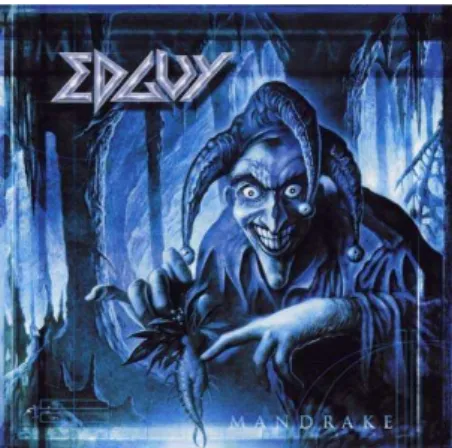
“[...] But between the trickster and the fool there arises, as a singular amalgam of the two, the figure of the buffoon. He is a trickster who wears the mask of the fool in order to induce, by incomprehension, a revealing misrepresentation and a mixture of languages” (BAKHTIN, 2004, p.152). In Fig. 9, we witness a meeting of voices of the grotesque, the skull, of sarcastic and Bakhtinian laughs, and of the presumed death of the court jester, another standout carnivalizing figure. The picture in various tones of blue creates a haunting atmosphere. The buffoon is a natural scoffer of the world and social convention and their pathetic lies, an eternal nonconformist who, through laughter, intends to turn everything upside down.
Fig. 9 – Cover art for Mandrake by the German heavy metal band Edguy.
Bakhtiniana, São Paulo, 9 (1): 36-53, Jan./Jul. 2014. 51 In Fig. 10, Iron Maiden‟s mascot Eddie is depicted as a coach driver (one who guides or is in command), exhibits the condition of dominance – force and power –
dialoging with voices of the grotesque, the diabolic laugh and the figures of death and the skull in an atmosphere worthy of great classic horror films.
Final remarks
In the creative process of heavy metal album cover art, a diversity of dialogs between voices (images or symbols of essential carnivalizing elements, such as the grotesque) stands out, both among themselves and with others, i.e., those who visualize them. It is surprising to find an explanatory potential in Bakhtin‟s vision that allows understanding of the discourse‟s framework, which, upon examining its argumentative resources, becomes clearer. This singular exercise of image reading proposes to relate notions of Bakhtinian polyphony and dialogism with the visual and sociological language of this music genre, already accepted as an important worldwide socio-historical phenomenon.
To the principal components of Bakhtinian carnivalization and the concepts of polyphony and dialogism are added the semantic-argumentative questions of discourse in order to produce a scientific gain in comprehension and greater respect for the universe of transgressional imagery in heavy metal. The journey becomes rich by demanding contact with history, with knowledge of mythology and dialog with the
visual arts. It is a contribution worth continuing to explore and, in so doing, glimpse a terminologically rich theory of argumentation from within the principles with which this thinker contemplates us. Moreover, it can also be seen to encourage the fan base of this music to enrich its perception regarding the significance of the argumentative elements present in the most popular images of heavy metal.
52 Bakhtiniana, São Paulo, 9 (1): 36-53, Jan./Jul. 2014. societal value systems: The State, religion and family. Millions of youth and adults the world over find, upon partaking of this vibrant style, a personal way to confront the
official rules fixed in common sense.
Inarguably, its success is due, along with the music, to its imagery, its ample, rich and revealing collection of visual images, substantial elements of Bakhtinian carnivalization, such as the grotesque, base material (the motifs of the gaping mouth and the tongue), the laugh, the skull, exaggeration and the representation of the Devil. These elements, besides provoking fascination, in that they deal with rule-breaking, provocation/nonconformism, vitality/rejuvenation, immortality and liberty, also awake enormous curiosity. Perhaps, for this reason, their use is never overlooked in commercial products and advertisements in the first place.
REFERENCES
AUDI, R. The Cambridge Dictionary of Philosophy. Kindle Edition. New York: Cambridge University Press, 2005.
BAKHTIN, M. M. Rabelais and His World. Transl. Helene Iswolsky. Bloomington: Indiana University Press, 1984.
_______. Speech Genres & Other Late Essays. Transl. Vern W. McGee, Caryl Emerson and Michael Holquist. Austin: University of Texas Press, 1986.
_______. Problems of Dostoevsky’s Poetics. Transl. Caryl Emerson. Minneapolis: The University of Minnesota Press, 2011.
_______. The Dialogic Imagination: Four Essays. Transl. Caryl Emerson and Michael Holquist. Austin, Texas: University of Texas Press, 2004.
BRANDÃO, J. de S. Mitologia grega. 11. ed. Petrópolis: Vozes, v. 1, 1997. ECO, U. On ugliness. Translated by Alastair McEwen. New York: Rizzoli, 2013. EDGUY. Mandrake. 2001. CD cover. AFM. Available at: [ http://www.metal-archives.com/albuns/Edguy/Mandrake/3153] Access on: 07 out. 2013.
ELICHIRIGOITY, M. T. Py. As vozes da argumentação. Bakhtiniana. Revista de Estudos do Discurso. São Paulo, n. 2, p.125-142, 2. sem. 2009.
FERREIRA, F. O livro de ouro do carnaval brasileiro. Rio de Janeiro: Ediouro, 2004. FLUSSER, V. A história do Diabo. Revisão técnica de Gustavo Bernardo. 2. ed. São Paulo: Annablume Editora, 2006.
GAMMA ray. To the Metal. 2010. CD cover. Alemanha: earMusic. Available at:
[http://www.metal-archives.com/albuns/Gamma_Ray/To_the_Metal%21/258927]
Bakhtiniana, São Paulo, 9 (1): 36-53, Jan./Jul. 2014. 53 GOULART, C. Enunciar é argumentar: analisando um episódio de uma aula de história com base em Bakhtin. Pro-Posições, v. 18, n. 3 (54), p.93-107, set./dez., 2007.
IRON maiden. Death on the Road. 2010. Cover of DVD box. United Kingdom: EMI. Available at: [http://www.metal-archives.com/albuns/Iron_Maiden/Death_on_the_ Road/107836]. Access on: Oct. 7, 2013.
_______. The Final Frontier. 2006. CD cover. United Kingdom: EMI.
MOISÉS, M. Dicionário de termos literários. 19. ed. São Paulo: Pensamento-Cultrix, 1984.
PICTURE. Eternal Dark. 1983. CD cover. US: Backdoor Records. [http://www.metal -archives.com/albums/Picture/Eternal_Dark/5493] Access on: Oct. 7. 2013.
PINHEIRO, A. Seminário de Pesquisa I. Postgraduate Program in Communication and Semiotics. Area: Sign and signification in media. Research field I: Culture and Media Ambience. Classroom notes. São Paulo: PUC/SP, 1. sem. 2012.
SPALDING, T. O. Dicionário das mitologias europeias e orientais. São Paulo: Cultrix, 1973.
THE ROLLING Stones. GRRR. 2012. CD cover. Geffen/A&M. The pock it company. Available at:
[http://www.google.com.br/imgres?imgurl=http://upload.wikimedia.org/wikipedia/en/1/ 11/The_Rolling_Stones_GRRR!_cc ]. Access on: Oct. 7. 2013.
____________. Tongue and Lips. n.d. Label.
URIAH Heep. Abominog. 1986. CD cover. United Kingdom: Castle Communications. VOLOSHINOV, V. N. Marxism and the Philosophy of Language. Translated by Ladislav Matejka and I.R.Titunik. Massachusetts: Harvard Press, 1986.
W.A.S.P. The Headless Children. 1989. CD cover. US: Capitol Records. Available at: [http://www.metal - archives.com/albums/W.A.S.P./ The_Headless_Children/ 3141]. Access on: Oct. 7. 2013.
Translated by William “Billy” Franklin Hanes –[email protected]
Received October 20,2013