4 Bakhtiniana, São Paulo, 9 (1): 4-18, Jan./Jul. 2014.
Discourse, Argumentation and Scenography in
“
Iconotexts
”
/ Discurso,
argumentação e cenografia em “
iconotextos
”
Roberto Leiser Baronas Maria Inês Pagliarini Cox
ABSTRACT
This article, in line with the enunciative trend of discursive studies, makes use of the trichotomic notion of enunciation scenes, emphasizing scenography (MAINGUENEAU, 1998; 2006; 2008; 2013) in order to read a set of three
“iconotexts,” 1
circulating on billboards in 2009 in the city of Cuiabá. Exhibited on the main avenues of Cuiabá, the “iconotexts” alluded to Dante de Oliveira‟s political legacy. Performing a scenographic analysis, based on the examination of the verbal and iconic materiality of the texts, this study identifies an overlapping of enunciators – the Dante de Oliveira Institute, the politician Dante de Oliveira, and the PSDB, the latter being chromatically symbolized. Besides the enunciators, the scenographic analysis of the three iconotexts also indicates the topography and the chronography activated in the narrative of the discursive event Dante de Oliveira. The study shows the epistemological relevance of placing scenography at the center of the analysis of political communication.
KEYWORDS: Discursive studies; Political communication; Enunciation scenes; Scenography
RESUMO
Este artigo, alinhado com a tendência enunciativa dos estudos discursivos, recorre à noção tricotômica de cenas de enunciação, com ênfase na cenografia (MAINGUENEAU, 1998; 2006; 2008; 2013), para ler um conjunto de três “iconotextos”, dados a circular no suporte outdoors em 2009, na cidade de Cuiabá. Expostos nas principais avenidas cuiabanas, os “iconotextos” evocam o legado político de Dante de Oliveira. Realizando uma análise cenográfica, baseada no exame da materialidade verbal e icônica dos textos, o estudo identifica uma sobreposição de enunciadores – o Instituto Dante de Oliveira, o político Dante de Oliveira e o PSDB, esse último simbolizado cromaticamente. Além dos enunciadores, o exame cenográfico dos três iconotextos indicia também a topografia e a cronografia ativadas na narrativa do acontecimento discursivo Dante de Oliveira. O estudo mostra, ainda, a pertinência e a produtividade epistemológica de se colocar a cenografia como ferramenta discursiva que busca dar conta de aspectos importantes da análise da comunicação política. PALAVRAS-CHAVE: Estudos discursivos; Comunicação política; Cenas de enunciação; Cenografia
Universidade Federal de São Carlos – UFSCar, São Carlos, São Paulo, Brazil; [email protected].
Universidade Federal de Mato Grosso – UFMT, Cuiabá, Mato Grosso, Brazil;
Bakhtiniana, São Paulo, 9 (1): 4-18, Jan./Jul. 2014. 5 [The] "discursive materialism" relies on the so-called "linguistic turn" in philosophy which emphasizes how language is not a neutral medium of designation, but a practice embedded in a life world: We do things with it, accomplish specific acts… Is it not time to turn this cliché around: Who is it that, today, claims that language is a neutral medium of designation? So, perhaps, one should emphasize how language is not a mere moment of the life world, a practice within it: The time miracle of language is that it can also serve as a neutral medium which just designates a conceptual/ideal content. In other words, the true task is not to locate language as a neutral medium within a life-world practice, but to show how, within this life world, a neutral medium of designation can nonetheless emerge.
Slavoj Zizek
First Words
In line with the enunciative trend of discursive studies, we mobilize the notion of
enunciation scene, such as thought by Maingueneau (1998; 2006; 2008; 2013), to read a
set of three “iconotexts” circulated on billboards in 2009, in the city of Cuiabá. In relation to the complex notion of scenes of enunciation (encompassing scene, generic
scene and scenography), we have resorted particularly to scenography for our reading of
the corpus. Displayed on the main avenues of Cuiabá, the “iconotexts” alluded to the
political legacy of the former state and federal Congressman, former mayor of Cuiabá,
former Minister of the Agrarian Reform and former governor of Mato Grosso, Dante
Martins de Oliveira. The billboards were sponsored by the Dante de Oliveira Institute
on the occasion of his third death anniversary, which occurred on July 6, 2006. We then
present photographs of the three “iconotexts”:
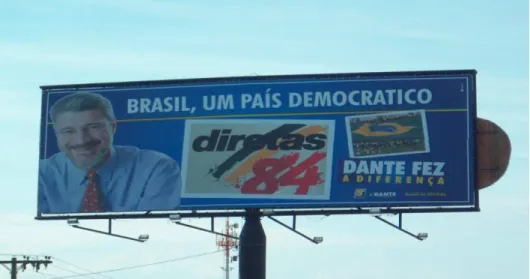
The first text was displayed on Mato Grosso avenue and shows, in the
foreground, a half body photograph, featuring Dante de Oliveira‟s smiling face; in the
background, on the upper part of the billboard, the slogan: “Brazil, a democratic
country;” below, in the center, the logo of the “Diretas Já” Campaign (“Direct Elections
Now”); on the left, the picture of the Brazilian flag draped over a crowd, an image probably alluding to one of the many demonstrations for the “Diretas Já” movement in
1984; below this photograph, another slogan, this time, featuring in uppercase “Dante
6 Bakhtiniana, São Paulo, 9 (1): 4-18, Jan./Jul. 2014.
Fig. 1: Billboard displayed on Mato Grosso Avenue
The second, displayed on Fernando Correa Avenue, differs from the first in
relation to the slogan –“Mato Grosso, a champion in human development” – and also in
relation to the photographs, which show the former mayor, born in Cuiabá, with a group
of Indigenous people in the Indigenous Tertiary Education from Mato Grosso State
University – UNEMAT, in an inauguration ceremony of the regional hospital in the
interior of the state, and in an event, talking to professionals from the technical training
project Arara Azul (Blue Macaw).
Fig. 2: Billboard displayed on Fernando Correa Avenue
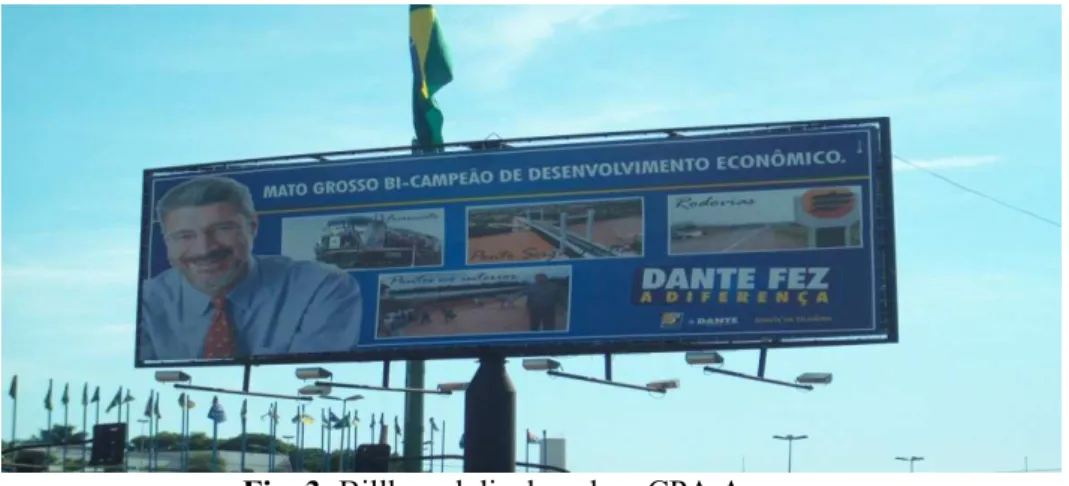
The third one, displayed on the CPA avenue, next to Bandeiras Square, differs
from the first ones in relation to the slogan – “Mato Grosso, bi-champion of economic
Bakhtiniana, São Paulo, 9 (1): 4-18, Jan./Jul. 2014. 7
infrastructure buildings launched during his eight years as the governor of Mato Grosso:
Terminal da Ferronorte in Alto Araguaia; Sérgio Motta Bridge connecting Cuiabá to
Várzea Grande in the neighboring region of Praieiro; the asphalt of the state roads and
the construction of bridges in country roads. The background in all texts is blue, white,
and orange.
Fig. 3: Billboard displayed on CPA Avenue
The texts that we analyzed belong to what the communicologists define as
political communication and as such are typically argumentative, since they aim at
leading the readers/voters to vote for candidates or for one of the political parties.
Referring to political communication, Fernandes says:
8 Bakhtiniana, São Paulo, 9 (1): 4-18, Jan./Jul. 2014.
environment in which politics is pursued (…) the media are active in
defining political „reality‟ (McNair, 2003, p.74)” (2010, p.123).
We believe, however, that, besides its persuasive character, through which a
speaker tries to convince his addressees of the pertinence and relevance of its
proposition and, mainly, given the enunciative specificities of the political
communication, this language practice should be thought of as a discursive genre which
participates in a particular scene of enunciation.
1 A Little Theory
The discourse genre is, on the one hand, a fruitful analytical category in the field
of discourse analysis and, on the other, a pedagogical instrument which is fundamental
in language teaching, since it relates words to the ideological places which they make
possible and which make them possible, showing that language is an inoculated product
of historicity.
However, genre alone, disconnected from a reflection that seeks to grasp the
aspects of meaning which differentiate one text from the other, is not enough to give
access to the meaning of the enunciative activity. Thus, based on Maingueneau (1998),
we considered the possibility of combining genre to the scene of enunciation, avoiding
notions such as that of the “situation of enunciation,” which is of a strictly linguistic
order, or of a “situation of communication,” which can be used in a purely sociological
approach, in which the discursive activity is described, somehow, from the outside.
Besides, according to Maingueneau, the term “scene” has the advantage of being able to
refer, at the same time, to a frame (“the scene represents...”) and to a process(“across
the scene,” “a circus scene,” as done by Tiririca in his campaign to become a federal
Congressman for the state of São Paulo in 2010 elections...). Anyway, it allows
highlighting the importance of the work in which some participants of a discourse genre
are permanently engaged: Putting themselves in the scene. The analysis of the scene of
enunciation, proposed by Maingueneau, distinguishes three components: The
encompassing scene, the generic scene and the scenography.
The encompassing scene corresponds to what is commonly meant by “type of
Bakhtiniana, São Paulo, 9 (1): 4-18, Jan./Jul. 2014. 9
between a “citizen,” a candidate and/or a political office-holder, addressing other
“citizens” about how he intends to tackle the issues of collective interest: Health, education, security, housing, infrastructure, public transport, social security, etc.,
conditions which define the statute of the partners who are in a certain pragmatic space
– historically defined. The encompassing scene is not enough to specify the verbal activities, since the speaking subjects are not directly confronted with the discursive
fields, such as politics, religion, publicity, literature, etc., but with discourse genres that
circulate in these spaces, more specifically, with generic scenes.
The generic scenes determine, particularly, the purposes, the roles of their
participants, a suitable place, some form of inscription in temporality (frequency,
duration, continuity, valid time of the text), the support (linked to a mode of transport
and storage and, thus, of memorization), occasionally a text plan, a certain use of the
language, which, in the case of politics, can materialize in a pamphlet, a flyer, a letter of
intent, a government program, etc., in sum, more or less stable forms of political
communication in our socio-historical and ideological formation.
However, the genre, although viewed from its purposes, the roles of its
participants, a suitable place, some form of inscription in temporality, cannot capture
the uniqueness of a text, the trace of meaning that differentiates it from other texts. A
novel can be enunciated, for example, through the scenography of an intimate diary, of
an account, of a chat next to a fireplace, of an exchange of love letters, of a farmer that
is reading a novel in which supposedly he will be the very victim of one of the
characters of the plot, as Cortázar does in Continuidade dos Parques (Continuity of
Parks), or even, a character that during the narrative spends all the time asking himself
if the woman he loves has betrayed him or not with his best friend, as Machado de Assis
does so well in Dom Casmurro. To approach this specificity that goes beyond the
generic scene, Maingueneau proposed the term scenography.
Scenography is based on the idea that the enunciator should develop, through his
enunciation, the situation from which he intends to enunciate. Every discourse, by its
own constitution, claims adherence to its universe by establishing the scenography
which legitimates it. Evidently, this scenography is imposed from the beginning, but it
is through enunciation that this imposed scenography can be legitimated. The
10 Bakhtiniana, São Paulo, 9 (1): 4-18, Jan./Jul. 2014.
produced by it; it legitimates an enunciation that, in turn, should legitimate it; it should
establish that the scenography from where the discourse comes is precisely the
scenography necessary to enunciatewhatever suits this or that kind of discourse genre.
Scenographies are usually based on speaking scenes already validated in culture:
Situations of communication characterized by genres, but also by unique utterances. For
instance, the slogan of Barack Obama‟s campaign: “Yes, we can,” in the presidential
elections of 2008, was based on the slogan of the United Farm Workers: “Si, se puede,”
already validated in North American society. Recently, in the semi-finals and finals of
the Libertadores da América Cup of 2013, this scene of validated speech, (re)written as
“Yes, we CAM,” was incorporated to the cheering from supporters of the Clube Atlético Mineiro – CAM. In this case, the polyphonic resonance between “can” and
“CAM” is produced by the change of an <n> by an <M> and of the lowercase by the uppercase, which are formally minimal changes, but capable of transforming what is the
same into Other. 2 Validated scene does not mean valued, but “already installed in the
universe of knowledge and of values of the public,” thus recognizable. In other words,
this slogan, since its emergence, was validated in our society as a kind of
word-monument that can be (re)utilized in situations in which a great difficulty must be
overcome.
2 Identities and the Spatialization of Language
2.1 Topography and Addressees
According to Maingueneau, a scenography defines the identity and the
relationship between the partners, the place (topography), and the moment of
enunciation (chronography). According to the author, “topography is a space from
which the enunciator intends to keep the discourse. This space, constructed through its
enunciation, allows you to define your place, as well as that occupied by your
addressees and competitors in the field” (2013, p.192).
2
Bakhtiniana, São Paulo, 9 (1): 4-18, Jan./Jul. 2014. 11
In the case of the “iconotexts” analyzed in this study, the place of enunciation is
the political field, a space where multiple positions are reciprocally delimited and
generally polemicize one another. Thus, in the “iconotexts,” we can observe that the
Dante de Oliveira Institute polemically dialogues with the party coalition that was in
power at that time, especially in the State Government: PR, PMDB, PT, PPS, PP. We
refer to the dialogue with the parties that headed the State Government, since Wilson
Santos, affiliated to the PSDB as Dante de Oliveira was, held the office of Mayor of
Cuiabá in 2009.
By evoking the political legacy of Dante de Oliveira, the “iconotexts” construct
interdiscursively a dysphoric representation of the parties that headed the State
Government. This negative representation can be seen in the slogan: “Dante made the
difference.” We observe that this difference is also marked semiotically, because the
slogan is placed in relation to the photographs which make up the “iconotext” in a
downward position. Thus, the assumption of this slogan suggests that the rulers at the
time did nothing to equal the feats of Dante de Oliveira, since Dante‟s actions exceeded
those of the traditional governor. They go from the fight for redemocratization of the
country, with the presentation of the constitutional amendment by the “Diretas Já” in
1984, to the completion of projects that were not restricted to the economic sphere, but
were especially aimed to invest in the human development of the state population.
Accordingly, if at the time the billboards displayed that there was some mediatic
consensus that the rulers were so prodigal in the investment in infrastructure needed to
boost agribusiness, especially in the first term of the Blairo Maggi Government, they
left something to be desired in relation to human development. Neither were they
worried about the redemocratization of Brazil. The three slogans at the top of the
“iconotexts” - “Brazil, a democratic country;” “Mato Grosso, a champion in human
development” and “Mato Grosso, bi-champion of economic development” – substantiate Dante‟s being placed somewhere out of the ordinary among the rulers or
the parties that were in government.
It is also worth highlighting that the blue, white and orange background
intersemiotically evokes the colors of the PSDB, the party Dante was affiliated with at
the time of his death. The semiotic resource to the colors of the PSDB extends, to this
12 Bakhtiniana, São Paulo, 9 (1): 4-18, Jan./Jul. 2014.
predominate in the “iconotexts” create, for the PSDB, in the interior of Mato Grosso
political field, a paratopic place (MAINGUENEAU, 1993), that is, a place which is
inscribed in the political field – investment in infrastructure, rewritten in the slogan
“Mato Grosso bi-champion of economic development” –, just like the parties that were in power at that time, and, at the same time, out of that field – investment in human
development, rewritten in the slogan “Mato Grosso champion in human development.”
This paratopic place is reinforced by the slogan: “Brazil, a democratic country.” In other
words, the colors produce an identification between Dante de Oliveira and the PSDB in
such a way that the political legacy of the first symbolically extends to the second, that
is, the colors place the PSDB on scene and project the Mato Grosso politician into the
national scenario, as someone fundamental in the process of redemocratization of
Brazil.
Although we cannot identify any linguistic explicit sign of their addressees in
the “iconotexts,” we can assume that they would be “primarily” the individuals that migrated to Mato Grosso after the end of Dante de Oliveira‟s second term, in 2002. It is
important to remember that since the 1970s Mato Grosso has been the Brazilian state
with the highest migration flow. We believe, therefore, that such billboards also speak
to these people, because they undoubtedly work as a vector of social, cultural and
political memory – as it will be shown below – which is independent of the migratory
flow.
2.2 The Properties of the Enunciator: Chromatic?
The “iconotexts” in question are constructed from a triple enunciative
perspective. In the first, we have an interlocutor, the Dante de Oliveira Institute, the
discursive subject that is responsible for the enunciation. The responsibility for the
enunciation is attributed to it. In the second, memory is evoked, Dante de Oliveira‟s
political legacy as an enunciator, who, after three years of his death is recollected
enunciatively. Although there are no quotes of Dante de Oliveira‟s speech on the
billboards, half-body photographs of the politician and those in which he appears
inaugurating works, in a kind of certificate of attendance, giving authenticity to this
Bakhtiniana, São Paulo, 9 (1): 4-18, Jan./Jul. 2014. 13
identifies, through the blue, white and orange colors, the speaker Dante de Oliveira
Institute and the enunciator Dante de Oliveira with the enunciator PSDB. This is a
chromatic enunciator that, despite its not textually taking responsibility for a single
word, is presented as the protagonist of the enunciation, putting itself at the scene. One
cannot ignore that in 2009 the first political articulations started, aiming the elections in
2010.
The perspective of the PSDB chromatic enunciator overdetermines previous
enunciative perspectives. This happens largely because the colors are also constituted as
a modality that expresses truth as well as the reading path which the reader should
follow to interpret it. According to Van Leuuwen,
[...] modality is a term-concept that refers to semiotic resources used to express the way in which the truths are represented and also how they should be taken. Resources of modality allow that a range of different degrees and types of modalities can be expressed as truths. Language has resources of modality to express the truth of the enunciations in terms of probability, frequency, knowledge, whose valuation of truth in the enunciation can and/or should be subjective or objective (2005, p.199).
This identification brings along the sense that all of Dante de Oliveira‟s actions,
as head of the government of Mato Grosso or in the Parliament in Brasília, were, on the
one hand, actions of the PSDB and, on the other, actions that could only be fulfilled
because Dante belonged to the PSDB. In other terms, this chromatic enunciator asserts
that Dante made the difference, especially because he belonged to the PSDB. We cannot
forget to emphasize that for these senses to materialize, it is necessary to silence the fact
that when Dante de Oliveira proposed the amendment of the “Diretas Já,” in 1984, he
was a militant in the Brazilian Democratic Movement – MDB and, when he was elected
governor for the first time in 1994, he belonged to the Democratic Labor Party - PDT.
Another aspect that deserves our attention is the physical space in which these
“iconotexts” were displayed. As we have mentioned before, these texts were displayed on billboards located on main avenues of the capital of Mato Grosso (Av. do CPA; Av.
Mato Grosso; Av. Fernando Correa), arteries on which thousands of people circulate by
car, bus or on foot on a daily basis. The “iconotexts,” when displayed on the main
arteries of Cuiabá, produce a kind of spatialization of language, constituting a
14 Bakhtiniana, São Paulo, 9 (1): 4-18, Jan./Jul. 2014.
exposed to the public. As passersby pass these avenues (whether they like it or not),
they perform a ritual look, transforming these billboards in a place of memory (NORA,
1993), a look which, although expected to be all-seeing, is a fixed gaze, a circumscribed
and bounding territory.
The enunciation “always DANTE,” which incorporates slogans of Dante‟s political campaigns and the half-body photograph, emphasizing Dante‟s face, attest
linguistically and semiotically to this space of celebration: A kind of cult of the political
hero Dante de Oliveira. Both the slogan “always DANTE” and the emphasis on the
face, supporting each other, identify the locutor with the person‟s face, giving a body to
the utterance and producing an effect of veracity to what is said. Moreover, the
photograph depicts a gentle physiognomy of the locutor Dante: Smiling, eyes wide open
and slightly arched eyebrows, happily gazing at his viewers/interlocutors. These
“semiotic resources” (VAN LEEUWEN, 2005) seek, one the one hand, to impute a mild tone to the locutor and, on the other, to create a relationship of interaction with
viewers/interlocutors. This trajectory of the gaze, even in an imaginary plane, requires
viewers/interlocutors to establish an affectionate contact with the locutor. Added to this
is the fact that the photograph, showing a person smiling to his viewers/interlocutors,
shows that this is in essence the locutor, addressing his viewers/interlocutors in an
affable manner, but sincere and honest to them.
3 Chronography: the Discursive Memory
3.1 Scenography and Narrative of the Event
The three aphorizations3 present at the top of the “iconotexts” discursively
summarize the political trajectory of Dante de Oliveira from three scenographies that
3
Bakhtiniana, São Paulo, 9 (1): 4-18, Jan./Jul. 2014. 15
can be understood in the “iconotexts” analyzed as “narratives of the event”
(GUILHAUMOU, 2009). These narratives seek, on the one hand, to describe the
“political legacy of Dante de Oliveira” and, on the other, to show that, thanks to this legacy, he still lives in the discursive memory of Brazilians residing in Mato Grosso. In
the first aphorization, “Brazil, a democratic country,” the responsibility for the
redemocratization of the country is attributed to Dante. The authorship for achieving
this important feat on behalf of Brazilian society that had lived two decades of an
authoritarian regime, more explicitly, of military dictatorship is attributed to him. In the
second, “Mato Grosso, a champion in human development,” the responsibility for
carrying out important actions that led to the placement of Mato Grosso in a prominent
place in the Brazilian scenario is also attributed to Dante. In the third and last one,
“Mato Grosso, bi-champion of economic development,” Dante is again responsible for making Mato Grosso a champion of economic development twice.
All these narratives, supported by the PSDB chromatic enunciator, converge on
the fact that Dante did not become glorious on account of his death, which occurred
prematurely at the age of 54, on July 6, 2006, or for his political career in favor of
Brazilians and Mato Grosso, but especially for belonging to the PSDB. Such narratives
aim to show that Dante still lives in the imagination not only of Mato Grosso, but of all
Brazilians. The enunciation “Dante de Oliveira, a 5-year unfilled gap in Mato Grosso:
State lost one of its most important politicians in recent decades,” a headline news story
published on the website Página Única, on July 6, 2011, on the occasion of the
inauguration of the headquarters of the Dante de Oliveira Institute in Cuiabá and the
fifth anniversary of the death of the former Congressman of Mato Grosso, attests to that
place of memory assigned elsewhere to Dante de Oliveira, turning him into a mythical
figure.
3.2 Heroization of Dante
The image of Dante as a hero, gestated with the creation of the Dante de Oliveira
Institute and recollected in the “iconotexts,” since they can be read as a metonymic
representation of Dante‟s biography with the aim of highlighting the achievements of
16 Bakhtiniana, São Paulo, 9 (1): 4-18, Jan./Jul. 2014.
this social actor in Brazil and Mato Grosso politics, seeks to show that he remains,
above all, active today by their heroic representation. This meaning can be attested in
the speech by the interim governor Chico Daltro, in 2011, in the week dedicated to the
memory of Dante de Oliveira in that year in Cuiabá4:
Dante de Oliveira was one of the most important politicians of Mato Grosso in the last decades. His political life was marked especially by the amendment of the Diretas Já!, in 1984, which marked the beginning of a major popular reaction that would end the military regime in 1985. Dante was a statesman and a reformer. His memory inspires us to think that, even after his death, a public man can touch generations with the legacy of his work.
The speech of the interim governor Chico Daltro is presented, on the one hand,
as a synthesis of the heroic journey of Dante in the Brazilian and Mato Grosso politics
and, on the other, as something that should serve as inspiration. It is a kind of
endorsement, of an echo of what Dante meant and still means, through the legacy of his
work, a memory-producing element for people from Mato Grosso and Brazil.
Final Words
The brief analyses carried out in this article aimed to highlight the
epistemological relevance and productivity of putting the scenography as a discursive
tool able to deal with important aspects of the analysis of political communication. This
approach allowed us to show that this kind of practice occurs argumentatively not only
through the persuasive intentionality of a locutor, aiming to convince the addressees of
the relevance and pertinence of his propositions, but also presents itself as a set of
strong indications that political communication, as a unique enunciative activity, in
addition to materializing a way to update the persuasive intentionality of the locutor,
engenders his argumentative character, mobilizing various scenographic resources.
In this sense, the “iconotexts” in question, the chromatic enunciator PSDB, when
activating a set of scenographies, narratives of the event of which Dante de Oliveira was
4 This news report from Cuiabá‟s
Bakhtiniana, São Paulo, 9 (1): 4-18, Jan./Jul. 2014. 17
the protagonist, largely responsible for the process of redemocratization in Brazil by
placing Mato Grosso as a champion in human and economic development, raising him,
because of these memorable trajectories, to the condition of a mythical hero, intended to
stand as the big beneficiary of this symbolic capital, aiming at the approaching 2010
statewide elections. In short, returning to the epigraph presented at the beginning of this
text and relocating it in order to think of our analyses, it seems to us that the chromatic
enunciator PSDB, seeking to sustain the historical journey of Dante de Oliveira by
making it memorable, tries, within that life world of political communication, to present
itself as a neutral medium for the designation of a content that would be both beneath
and beyond institutionally constituted interests.
REFERENCES
FERNANDES, J. L. Marketing político e comunicação (política). In: CORREIA, J. C.; FERREIRA, G. B. e ESPIRITO SANTO, P. (org.) Conceitos de comunicação política. Lisboa, Portugal: LabCom, 2010.
GUILHAUMOU, J. Linguística e história: percursos analíticos de acontecimentos discursivos. São Carlos, SP: Pedro & João Editores, 2009.
MAINGUENEAU, D. Les énoncés détachés dans la presse écrite. De la surassertion à
l‟aphorisation. TRANEL – Travaux Neuchâtelois de linguistique, Neuchâtel, n. 44, p.107-120, 2006.
_______. Citação e destacabilidade. Trad. Roberto Leiser Baronas & Fábio César Montanheiro. IN: MAINGUENEAU, D. Cenas da enunciação. POSSENTI, S. e SOUZA-E-SILVA, M. C. P. de. (org.). São Paulo, SP: Parábola Editorial, 2008b.
_______. Aforização: enunciados sem texto? Tradução de Ana Raquel Motta. In: MAINGUENEAU, D. Doze conceitos em análise do discurso. POSSENTI, S. e SOUZA-E-SILVA, M. C. P. de. (org.). São Paulo: Parábola Editorial, 2010.
_______. A aforização proverbial e o feminino. In: MOTTA, A. R. & SALGADO, L. S. (org.) Fórmulas discursivas. São Paulo: Contexto, 2011.
_______. Aforizações políticas, mídias e circulação de enunciados. 2012a. Trad. Roberto Leiser Baronas & Fernanda Mussalim Available at: <http://www.letras.ufscar.br/ linguasagem/edicao20/artigos/artigo_001.pdf>. Access on: 19 April 2014.
_______. Les phrases sans texte. Paris, FR: Armand Colin, 2012b.
_______. Argumentação e cenografia. IN: BRUNELLI, A. F; MUSSALIM, F. e FONSECA-SILVA, M. C. (org.). Língua, texto, sujeito e (inter)discurso: homenagem a Sírio Possenti. São Carlos, SP: Pedro & João Editores, 2013a.
18 Bakhtiniana, São Paulo, 9 (1): 4-18, Jan./Jul. 2014.
NORA, P. Entre memória e história: a problemática dos lugares. Projeto História. São Paulo, nº 10, p. 7-28, dez. 1993.
PÁGINA ÚNICA, Jornal Eletrônico de Cuiabá – MT. Available at: <http://www. paginaunica.com.br/TNX/conteudo.php?sid=179&cid=1340&parent=179>. Access on: 19 April 2014.
VAN LEEUWEN, T. Introducing Social Semiotics. Londres; Nova York: Routledge, 2005.
ZIZEK, Slavoj. Less than Nothing: Hegel and the Shadow of the Dialectic Materialism. London; New York: Verso, 2012.
Translated by Odila de Azevedo Watzel – [email protected]
Received October 10,2013