Materials Research, Vol. 10, No. 1, 75-78, 2007 © 2007
*e-mail: [email protected]
Structural Characterization of Mullites Synthesized
by Thermal Decomposition of Topaz
Robson de Miranda Soaresa, Antônio Claret Soares Sabionia*, Inês Sabioni Resckb,
Viviane Aparecida Silva Falcomerb, José Alves Diasb, Naira Machado da Silvac,
Sônia Maria Cabral de Menezesd, Geraldo Magela da Costae
a
Laboratório de Difusão em Materiais, Departamento de Física,
Universidade Federal de Ouro Preto, 35400-000 Ouro Preto - MG, Brazil
bLaboratório de Ressonância Magnética Nuclear, Instituto de Química,
Universidade de Brasília, CP 4478, 70904-970 Brasília - DF, Brazil
cPontifícia Universidade Católica do Rio de Janeiro – PUC/RJ,
Rua Marquês de São Vicente, 225, 22451-041 Rio de Janeiro - RJ, Brazil
dCENPES/PETROBRÁS, Avenida 1, Quadra 7, Cidade Universitária,
Ilha do Fundão, 21949-900 Rio de Janeiro - RJ, Brazil
eDepartamento de Química, Universidade Federal de Ouro Preto,
35400-000 Ouro Preto - MG, Brazil
Received: September 18, 2006; Revised: February 1, 2007
The structure of mullite obtained by thermal decomposition of topaz at 1340 °C and after additional thermal treatment at 1600 °C was characterized by 29Si and 27Al MAS NMR spectroscopy and x ray diffraction. No
amorphous phase was detected by these techniques. The 29Si MAS NMR spectra of the mullite samples showed
four resonance peaks at -81, -86, -90 and -94 ppm. The peak at -81 ppm corresponded to silicon near oxygen vacancies in the mullite structure. The peak at 86 ppm was related to a sillimanite-type site and was the major contribution, ranging from 42 to 50%. The two other peaks, at -90.0 ppm and -94 ppm, were interpreted as resulting from rearrangements of the sillimanite-type site by the replacement of AlO4 by SiO4 tetrahedra16. The 27Al MAS NMR data of the two samples exhibited three different peaks, two of which were attributed to tetrahedral
sites at 40 -45 and 63 -67 ppm, while the third was assigned to an octahedral site at about -6 ppm. The ratio of tetrahedral to octahedral aluminum sites was found to depend on the temperature applied during the preparation of the mullite and was higher at 1600 °C.
Keywords: mullite synthesis, topaz, characterization, 27Al and 29Si MAS NMR, XRD
1. Introduction
Mullite is an aluminum silicate widely used in traditional and advanced ceramic materials thanks to its low thermal expansion, low thermal conductivity, and excellent creep resistance. Mullite occurs as solid solution in the silica-alumina binary system1,2 and
can be described by the following general formula: Al4+2xSi2-2xO10-x, in which x ranging from 0.17 to 0.59denotes the number of oxygen vacancies per average unit cell1. The end members of this general
formula are sillimanite mineral (x = 0) and iota-alumina (x = 1). In general, the mullite compositions are non-stoichiometric. However, there are stoichiometric compositions such as 3Al2O3.2SiO2 (3:2 mullite), for x = 0.25, or 2Al2O3.SiO2 (2:1 mullite), for x = 0.4, in which the Al2O3/SiO2 ratio is equal to 1.5 and 2.0, respectively. The mullite structure consists of chains of edge-sharing AlO6 octahedra running parallel to the crystallographic c-axis and crosslinked by double chains of aluminum-oxygen and silicon-oxygen tetrahedra, which also run parallel to the c-axis3. This compositional variation
in mullite occurs due to the substitution of silicon for aluminum with the simultaneous formation of oxygen vacancies, which can be described by means of a defect formation reaction using Kröger-Vink notation, as follows4:
Al2O3 + 2Six
Si + Oox↔ 2Al´Si + Vo°° + 2SiO2 (1)
Increasing the number of oxygen vacancies per unit cell (x) causes the tetrahedral double chains to become gradually disarranged by removal of bridging oxygen atoms, leading to the formation of new Al*O
4 tetrahedra5. Thus, the higher the x value the higher the
tetra-hedral aluminum to silicon ratio. The crystal structure of mullite has been reviewed elsewhere3-6.
Due to the technological importance and widespread industrial use of mullite, which is rare in nature as a mineral, a number of proc-esses to produce synthetic mullites have been designed1. One of these
methods involves the preparation of mullite from topaz mineral7,8,
which is a fluorine aluminum silicate whose chemical formula is Al2SiO4[Fy(OH)1-y]27. This is a very attractive option, since
high-purity colorless topaz is abundant in nature and its gemological or commercial value is low8. Moreover, the transformation of topaz to
mullite is a clean procedure which does not form chemical residues, in line with the principles Green Chemistry.
This work deals with the structural characterization of mullite synthesized from topaz mineral, using 29Si and 27Al magic angle
76 Soares et al. Materials Research
at 1340 °C and heat-treated at 1600 °C, which are temperatures fre-quently used in the fabrication of mullite ceramics by sintering.
2. Experimental Procedure
The colorless, transparent and high purity topaz used in this work to produce mullite originated from the state of Minas Gerais, Brazil. The chemical composition of this topaz is shown in Table 1. The topaz was milled in a wet ball mill, using the material itself as the grinding medium (autogenous grinding). After milling, the topaz suspension was oven-dried, followed by heat treatment of the resulting topaz powder in an electric furnace to transform the topaz into mullite. The preparation of mullite by thermal decomposition of topaz occurs through the loss of fluorine, hydrogen and silicon as gases HF, H2O and SiF47-9. This transformation occurs only at
temperatures exceeding 1000 °C and can be achieved completely at 1300 °C. Two different mullite samples were prepared: M400 at 1340 °C, and M500 at 1600 °C. The M400 mullite was obtained by the thermal decomposition of topaz at 1340 °C for 3 hours, as indi-cated in the thermal cycle shown in Figure 1. In the case of the M500 sample, the thermal decomposition was followed by heat treatment at 1600 °C for 4 hours. The mullite was chemically analyzed by x ray fluorescence (XRF) and microstructurally characterized by scan-ning electron microscopy (SEM) (Model JSM 5510, JEOL, Japan). Powder x ray diffraction (XRD) patterns were recorded to analyze the topaz to mullite transformation and the effect of temperature on the mullite structure. The samples were examined by XRD using a diffractometer (Model Shimadzu XRD6000) with FeKα radiation and a graphite monochromator. The scanning rate used was 2°/minutes in the 15-70° range (2θ). Silicon was used as the internal standard. The diffraction data were analyzed using JADE software after subtract-ing background and strippsubtract-ing the Kα2 pattern. 29Si and 27Al MAS
NMR experiments were performed on a spectrometer (VARIAN MERCURY plus -7.05 T) at frequencies of 59.6 and 78.2 MHz, respectively. The spectrometer was equipped with a 7 mm CP/MAS probe and the samples were packed in zirconia rotors and spun at the magic angle at 4 and 6 kHz for 29Si and 27Al, respectively. 29Si MAS
spectra were acquired using a spectral width of 100 kHz, a single pulse duration of 7.5 µs (π/2), a recycle delay of 30 seconds, and an acquisition time of 0.05 seconds, with 500 scans accumulated and referenced to tetramethylsilane (TMS). A line broadening of 10 Hz and a Gaussian function of 0.003 seconds were applied to process the spectra. The 29Al MAS spectra were recorded using a spectral
width of 100 kHz, acquisition time of 0.05 seconds, a single pulse duration of 1.0 µs (π/20), and a recycle delay of 0.3 seconds, with 15000 scans accumulated and externally referenced to Al(H20)63+
(0.0 ppm). The spectra were processed using a line broadening of 25 Hz. The 29Si and 27Al MAS NMR spectra were deconvoluted by
the NUTS program. All the 29Si and 27Al spectra were fitted to a sum
of partial Gaussian/Lorentzian lines using a gradient algorithm that optimizes the position, width and amplitude of each line.
3. Results and Discussion
The x ray fluorescence analysis of the mullite indicated an Al2O3 content of 62.0 ±0.5 (mol %) in the M400 and M500 samples, corresponding to a nonstoichiometric mullite composition with an Al2O3/SiO2 ratio of 1.63. The number of oxygen vacancies per average unit cell (x) was calculated by means of the expression10:
x= 10-6$ mm++100200 (2)
where m is the alumina content in the mullite (mol %). The x-value for the M400 and M500 samples was found to be 0.30. It is worth noting that the Al/Si ratio increased from 2 in topaz to 3.26 in the M400 and M500 samples. This increase was due to the loss of silicon in the form of SiF4 gas during the thermal decomposition of topaz. Figure 2 shows a SEM micrograph of mullite obtained by thermal decomposition of topaz at 1340 °C for 3 hours. This mullite showed a needle-like microstructure (mullite whiskers), which is characteristic of mullite obtained by the decomposition of topaz8.
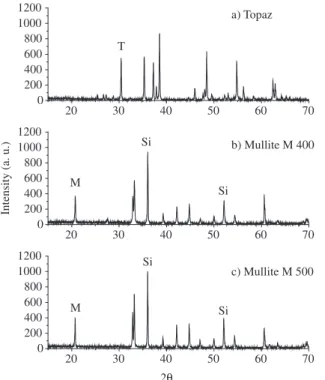
The experimental conditions used here resulted in very pure mul-lite without amorphous phase, as depicted in Figures 3a and 3c. No topaz phase was visible in the XRD pattern of the prepared mullites (M400 and M500). Table 2 shows the lattice parameters and the unit cell volumes of M400 and M500 samples obtained by x ray diffrac-tion. As can be seen in these figures, increased temperatures did not significantly modify the mullite crystalline structure. X ray diffraction data has proved to be a useful tool to estimate the alumina content in mullite. Several authors, working with mullite solid solutions obtained Table 1. Chemical composition of the colorless topaz.
Colorless topaz composition (wt. (%))
Al
2O
3SiO
2Fe
2O
3MnO
54.9
32.5
0.07
< 0.01
0 200 400 600 800 1000 1200 1400 1600 1800 0
200 400 600 800 1000 1200 1400 1600
6 °C/min 1.33 °C/min
Cool down Furnace shutted down
T
emperature (
°C)
Time (min)
Figure 1. Thermal cycle used for the decomposition of the colorless topaz.
Figure 2. SEM micrographs of the mullite derived from the decomposition
of colorless topaz heated at 1340 °C during 3 hours. The needle-type micro-structure is observed as a fiber network (x10000).
Vol. 10, No. 1, 2007 Structural Characterization of Mullites Synthesized by Thermal Decomposition of Topaz 77
one or two AlO4 by SiO4 tetrahedra16. A possible amorphous phase in
the mullite would generate a resonance peak at around -110 ppm11-20,
which was not observed at the 29Si spectra shown in Figure 4, thus
corroborating our x ray diffraction measurements.
Figure 5 illustrates the deconvoluted 27Al MAS NMR spectra
of the M400 and M500 samples, showing three distinct signals for aluminum sites. These signals were attributed to an octahedral site and two tetrahedral sites, and have also been detected in other
mul-Table 2. Unit cell parameters and unit cell volume of mullite.
Samples Cell parameters (Å) Volume
(Å3)
a b c
M 400 7.563 ± 0.008 7.685 ± 0.002 2.885 ± 0.002 167.70 M 500 7.568 ± 0.002 7.682 ± 0.005 2.885 ± 0.002 167.71 Figure 3. Powder XRD patterns for a) colorless topaz, b) M400 sample, and
c) M500 sample.
2Q
20 30 40 50 60 70
0 200 400 600 800 1000 1200
a) Topaz T
Intensity (a. u.)
b) Mullite M 400 Si
20 30 40 50 60 70
0 200 400 600 800 1000 1200
M
Si
Si
Si
20 30 40 50 60 70
0 200 400 600 800 1000 1200
M
c) Mullite M 500
Figure 4. Experimental and deconvoluted 29Si MAS NMR spectra of the
M400 and M500 samples.
-60 -70 -80 -90 -100 -110 -60 -70 -80 -90 -100 -110
1
2
3
4
1
2
3
4 Mullite M 400
Mullite M 500 1340 °C
1600 °C
Site 1 (-81.0 ppm): 22% Site 2 (-86.3 ppm): 42% Site 3 (-90.0 ppm): 29% Site 4 (-93.9 ppm): 7%
Site 1 (-80.7 ppm): 18% Site 2 (-86.2 ppm): 50% Site 3 (-89.9 ppm): 25% Site 4 (-93.9 ppm): 7% by different processes, have found a linear dependence between
alu-mina content (m) and the a-lattice parameter. Using, for example, the relationship established by Fischer et al.10 as follows:
m (% mol) = 144.5a (Å) – 1029.5 (3)
one finds an alumina content of 63.35 ±1.50 (% mol) in mullite obtained from topaz, which is reasonably consistent with the value of 62.0 mol % found in our x ray fluorescence analysis.
29Si and 27Al MAS NMR experiments were used for the first time
to characterize the structure of mullite obtained from topaz, and led to the determination of the local environment of silicon and aluminum atoms in the structure of the M400 and M500 samples.
According to the literature, the structure of mullite from differ-ent sources and with various compositions has four NMR silicon tetrahedral sites typically at -81, -86, -90 and -94 ppm11-20.These
local environments of Si atoms were also observed in the structure of mullite obtained from topaz, and were similar in the M400 and M500 samples. Figure 4 shows the 29Si MAS NMR deconvoluted spectra of
the M400 and M500 samples. The high frequency peaks at -81.0 and -80.7 ppm, determined with 22 and 18%, respectively, for the M400 and M500 samples, are assigned to the local arrangement of the (Si, Al, Al*) cluster13 and correspond to silicon near oxygen vacancies in
the mullite structure17. Site 2 at -86.3 ppm in both samples is related
to a sillimanite-type site16-21 and corresponded to the major
contribu-tion, which ranged from 42 to 50%. The two other peaks at -90.0 ppm (25-29%) and -93.9 ppm (7%) were interpreted as resulting from rearrangements of the sillimanite-type site by the replacement of
Figure 5. Experimental and deconvoluted 27Al MAS NMR spectra of the
M400 and M500 samples.
Mullite M 400 1340 °C
Mullite M 500 1600 °C
200 100 -100 -200
ppm 0
200 100 -100 -200
ppm 0
Site 1 (67.0 ppm): 16% Site 2 (45.0 ppm): 33% Site 3 (-5.7 ppm): 51%
Site 1 (63.0 ppm): 33% Site 2 (40.0 ppm): 35% Site 3 (-6.0 ppm): 32% 2
2 1
1
3
78 Soares et al. Materials Research
lites obtained from different sources18-20,22. In the samples used in this
work, an octahedral site at -5.7 ppm and two tetrahedral sites at 45.0 and 67.0 ppm were observed in the structure of the M400 sample, while the same three sites were assigned to -6.0, 40.0 and 63.0 ppm in the M500 sample. The intensity of the tetrahedral occupancy at 63.0 ppm in the M500 sample increased (16 →33%) after the sample was heat-treated at 1600 °C, while the octahedral one at -6.0 ppm decreased (51 → 32%), revealing three signals with approximately the same intensities (33: 35: 32).
4. Conclusions
27Al and 29Si MAS NMR and x ray diffraction was used to
charac-terize the mullite structures obtained by heat-treating topaz at 1340 °C and 1600 °C. Neither of these techniques revealed any amorphous phase in the various mullite samples. The four resonance peaks in the 29Si spectra at -81, -86, -90 and -94 ppm, obtained by simulation
with Gaussian/Lorentzian functions, were nearly the same at 1340º and 1600 °C, with the main contribution (42-50%) represented by the sillimanite-type site at -86 ppm. The 27Al MAS NMR data revealed
three different peaks in the mullite samples, two of which were at-tributed to tetrahedral sites at 40-45 and 63-67 ppm while the third was assigned to an octahedral site at about -6 ppm. The tetrahedral to octahedral aluminum site ratio, which was found to depend on the heat-treatment temperature, was higher at 1600 °C.
Acknowledgments
The authors are grateful to FAPEMIG, CNPq, IQ|UnB and FINEP (grant CT-INFRA 970/2001) for financial support, and also to CENPES – PETROBRAS.
References
1. Schneider H, Okada K, Pask JA. Crystal chemistry of mullite, pp. 4-30 in:
Mullite and Mullite Ceramics. England: John Wiley & Sons Ldt; 1994.
2. Pask JA. Importance of starting materials on reactions and phase equilibria in the Al2O3-SiO2 system. Journal European Ceramic Society. 1996; 16(14):101-108.
3. Johnson BR, Kriven WM, Schneider J. Crystal structure development during devitrification of quenched mullite. Journal European Ceramic
Society. 2001; 21(14):2541-62.
4. Fielitz P. et al. Self-diffusion of Oxygen in Mullite. Journal European
Ceramic Society. 2001; 21(14):2577-82.
5. Schneider H, Eberhard E. Thermal expansion of mullite. Journal
Ameri-can Ceramic Society. 1990; 73(67):2073-76.
6. Cameron WE. Mullite-substituted alumina. American Mineralogist. 1977; 62(7-8):747-55.
7. Sabioni ACS. et al. Imperial topaz from Ouro Preto, Brazil: chemical char-acter and thermal behaviour. Journal Gemmology. 2003; 28(5):283. 8. Monteiro RR, Sabioni ACS, Costa GM. Preparação de mulita a partir do
mineral topázio. Cerâmica. 2004; 50(316):318-23.
9. Day RA, Vance ER, Cassidy DJ. The topaz to mullite transformation on heating, J. Materials Research. 1995; 10(11):2963-69.
10. Fischer RX, Schneider H, Voll D. Formation of Aluminium Rich 9:1 Mullite and its Transformation to Low Alumina Mullite upon Heating.
Journal European Ceramic Society. 1996; 16(2):109-113.
11. Merwin LH. et al. 29Si and 27Al MAS NMR Spectroscopy of Mullite.
Phys. Chem. Minerals. 1991; 18(7):47-52.
12. Schneider H, Merwin LH, Sebald A. Mullite formation from noncrystal-line precursors. Journal Material. Science. 1992; 27(3):805-12. 13. Ban T, Okada K. Analysis of local cation arrangement in mullite using
29Si magic-angle spinning nuclear magnetic resonance spectra. Journal
American Ceramic Society. 1993; 76(10):2491-96.
14. Selvaraj U, Komarneni S, Roy R. Structure differences in mullite xerogels from different precursors characterized by 27Al and 29Si MAS NMR. J.
Solid State Chem.. 1993; 106(1):73-82.
15. Jaymes L. et al. New synthesis of mullite. Structural evolution study by
17O, 27Al and 29Si MAS NMR Spectroscopy. J. P. J. Sol-Gel Sci. Technol..
1994; 2(1-3):367-70.
16. Jaymes I. et al. Evolution of the Si environment in mullite solid solutions by 29Si MAS-NMR spectroscopy. Journal of Non-Crystalline Solids.
1996; 204(2):125-134.
17. Gomes S, François M. Characterization of mullite in silicoalumi-nous fly ash by XRD, TEM, and 29Si MAS NMR. Cem. Concr. Res..
2000; 30:175-81.
18. Zhao H, Hiragushi K, Mizota Y. 27Al and 29Si MAS-NMR studies of
structural changes in hybrid aluminosilicate gels. Journal European
Ceramic Society. 2002; 22(9-10):1483-91.
19. Zhao H, Hiragushi K, Mizota, Y. Phase segregation on non-stoichiometric aluminosilicate gels characterized by 27Al and 29Si MAS-NMR. Journal
of Non-Crystalline Solids. 2002; 311:99-206.
20. He H. et al. 29Si and 27Al MAS NMR spectra of mullite from different
kaolinites. Spectrochim. Acta Part A. 2004; 60(5):1061-1064. 21. Schmucker M. et al. AlO4/SiO4 distribution in tetrahedral double chains of
mullite. Journal American Ceramic Society. 2005; 88(10):2935-2937. 22. Bodart PR. et al. Aluminium environments in mullite and an
amor-phous sol-gel precursor examined by 27Al triple-quantum MAS NMR.