THE EFFECT OF TREATMENT WITH MELATONIN UPON
THE ULTRASTRUCTURE OF THE MOUSE PINEAL GLAND:
A QUANTITATIVE STUDY
REDINS, G. M., REDINS, C. A. and NOVAES, J. C.
Departamento de Morfologia, Centro Biomédico, Universidade Federal do Espírito Santo, CEP 29040-090, Vitória, ES, Brazil
Correspondence to: Dr. Carlos Alberto Redins, Rua Cyro Lima, 45, Enseada do Suá, CEP 29050-230, Vitória, ES, Brazil, e-mail: [email protected]
Received August 7, 2000 – Accepted October 19, 2000 – Distributed November 30, 2001
(With 2 figures)
ABSTRACT
In order to evaluate melatonin implication in the regulating of its own secretory process by pinea-locytes, we used morphometric techniques for transmission electron microscopy. In mice treated with 100 mg of melatonin (N-acetyl-5-methoxy-tryptamine) by daily subcutaneous injection, we observed a decrease in number and volumetric density of lysosomes. Our results showed that melatonin in-fluences the secretory activity of pinealocytes and participates in a complex secretory regulating mechanism.
Key words: pineal gland, melatonin, ultrastructure.
RESUMO
Efeito do tratamento com melatonina sobre a ultra-estrutura da glândula pineal do camundongo: estudo quantitativo
A fim de avaliar a implicação da melatonina no controle de sua própria secreção pelos pinealócitos, utilizamos técnicas morfométricas aplicadas à microscopia eletrônica de transmissão. Em camundongos tratados com doses subcutâneas diárias de 100 mg de melatonina (5-metoxi-N-acetil-triptamina) obser-vamos uma diminuição do número e da densidade volumétrica dos lisosomos nos pinealócitos. Esses resultados mostram que a melatonina atua sobre a própria glândula pineal, participando de um complexo mecanismo regulador da secreção nos pinealócitos.
Palavras-chave: glândula pineal, melatonina, ultra-estrutura.
INTRODUCTION
The synthesis of melatonin (N-acetyl-5-me-thoxy-tryptamine) takes place in several tissues, especially in the pineal gland and retina, where one can observe that its synthesis is rhythmic (Cas-sone & Natesan, 1997). The serotonin N-acetyl-transferase (NAT), an enzyme that is necessary to produce melatonin, exhibits a daily rhythm with higher nocturnal activity, over a hundred times, when compared with its diurnal activity (Illnerová & Vanecek, 1986). Although we do not know the
retinohy-pothalamic tract through the suprachiasmatic nucleus (SCN) and superior cervical ganglion, which are responsable for adrenergic innervation of the gland (Arendt, 1998). Melatonin synthesis is regulated by pinealocytic β-adrenergic receptors, cellular mechanisms which involve cyclic nucleoti-des, prostaglandins, inositol trisphosphate, and Ca2+
(Reiter, 1986). The structure and secretory activity of pinealocytes can also be altered by several hormones like estrogens, testosterone, proges-terone, follicle-stimulating hormone (FSH), luteinizing hormone (LH), and prolactine (revision in Cardinali, 1984). These hormones may act directly upon pinealocytes or alter the sympathetic innervation of the gland, resulting in decreased nerve impulses. The major evidence for direct hormonal activity upon the pineal gland is the demonstration of hormone-receptors in subcellular fractions of the organ. Thus, in the pineal gland of mammals, a lot of receptors have been emons-trated for estrogens, testosterone, progesterone, rolactine, prostaglandins (Cardinali, 1984), and melatonin (Vacas & Cardinali, 1980). In the pineal gland of rats treated with melatonin, Freire & Cardinali (1975) reported an increase in the activity of NAT. Likewise, the same increased activity was observed for hydroxyindole-O-methyl-transferase (HIOMT) by Freire & Cardinali (1975) and Trentini et al. (1982) in these animals. In pineal glands of rats, treated with melatonin, Freire & Cardinali (1975) also reported morphological alterations of pinealocytes with an increase in the number of ribo-somes, microtubules, Golgi cisternae, and annulate lamellae, which suggested increased activity of this organ.
In this research we used morphometric pa-rameters to quantify the dense-core vesicles, lyso-somes, Golgi apparatus and lipid droplets of pinealocytes, in order to evaluate the effects of exogenous melatonin upon the secretory activity of the pineal gland in mice.
MATERIAL AND METHODS
Fifteen male adult Swiss outbred albino mice eight weeks old and separated into three groups of five animals each, were included in the present study. In the experimental group, at 10 h the ani-mals received daily subcutaneous melatonin (Sigma) injections of 100 mg in 0.1 ml of vehicle (5% alcoholic saline) during 22 consecutive days,
according to Lang et al. (1983, 1984). The sham-control group animals received at 10 h a.m. daily s.c. vehicle injections of 0.1 ml during 22 con-secutive days. The control group animals received no treatment. During the whole experiment the animals were housed in separate groups, under normal laboratory conditions with respect to na-tural light (12:12 h light-dark cycle), with food and water ad libitum. Twenty-four hours after the last injection, the animals were killed by cervical decapitation under ether anesthesia; the pineal glands were immediately removed and rapidly flooded with Karnovsky’s fixative solution (0.8% paraformaldehyde and 1.5% glutaraldehyde in 0.2 M cacodylate buffer at pH 7.4). The organs were post-fixed in 1% osmium tetroxide solution for 1 h, buffered at pH 7.2 with Na-cacodylate (0.1 M), subsequently dehydrated in an ascending sequence of ethanol and acetone, and embedded in Epon 812. Thin sections, prepared with a diamond knife and a Reichert Jung Super Nova microtome, were stained with uranyl acetate and lead citrate (Reynolds, 1963). These sections were examined and photographed in a Zeiss EM 10 electron microscope from the Center for Electron Microscopy – Institute of Biological Sciences – UFMG.
For quantitative estimation, ten 18 × 24 cm micrographs, at a final magnification of X12,500, were taken from each mouse using systematic ran-dom sampling. Each cm2 on the micrograph
re-presented 0.64 µ m2 of pineal tissue. From each
animal a total area of 2,764.80 µm2 of pineal tissue
was measured and the dense-core vesicles and lysosomes present in the micrographs were counted and the data expressed as the number of these structures per 100 µ m2 of area of pinealocytic
cytoplasm.
RESULTS
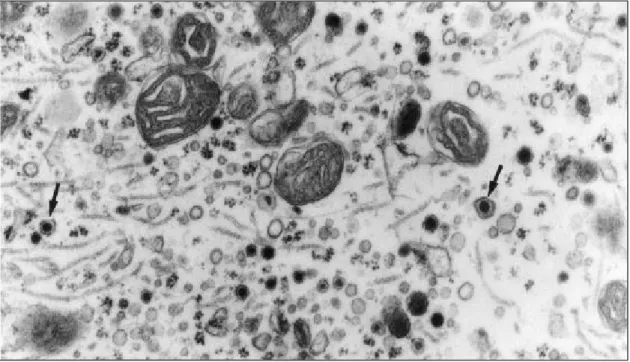
The pinealocytes of mice have a cell outline which is difficult to make out in histological sec-tions. The cells show frequent complex interdi-gitations with other pinealocytes and its nuclei are round to ovoid and usually contain indentations and prominent nucleoli (Fig. 1). The perikaryon and cytoplasmic processes contain both rough and smooth endoplasmic reticulum, numerous mito-chondria, Golgi apparatus, lysosomes, lipid dro-plets, and small secretory vesicles, some of which with electron-dense cores (granulate vesicles or dense-core vesicles) (Fig. 2). The quantitative data are assembled in Table 1. In the group treated with melatonin we observed a decrease in the number and volumetric density of dense-core vesicles and an increase in the number and volumetric fractions of lipid droplets and Golgi apparatus. On the other hand, there was not any statistically significant difference when we compared the control and the sham-control groups.
DISCUSSION
The dense-core vesicles are particularly fre-quent in pinealocytes of mice and their enclosed
flocculent material, which is believed to be protei-naceous in nature, and may contain active peptides, serotonin, melatonin and other pineal indoles (Vollrath, 1984). In rat pinealocytes, Karasek et al. (1990) reported an increase in the number of dense-core vesicles, during the day when the levels of serum melatonin were usually depressed. Like-wise, melatonin titers in the blood were often aug-mented, during the night, while the number of dense-core vesicles diminished. These data suggest that melatonin probably is stored in dense-core vesicles. The proteinaceous secretory content of granulate vesicles could be related to the trans-port of pineal hormones (Collin et al., 1986).
The number of dense-core vesicles in pi-nealocytes shows a circadian rhythm and varies according to reproductive activity (Novaes et al., 1998; Redins & Novaes, 1995; Redins et al., 1997, 1999) and the age of the animals (Redins & No-vaes, 1999).
In the rat, hamster, and mouse pinealocytes, Haldar-Misra & Pévet (1983a, b) reported, in vitro, that melatonin, together with norepinephrine, provokes a decrease in the number of dense-core vesicles. In the absence of norepinephrine, the same authors reported that melatonin induces the for-mation of dense-core vesicles in rat pinealocytes.
Fig. 1 — Pinealocyte of mouse, treated with melatonin, showing an indented nucleus (N) with a prominent nucleolus. Single
Analyzed parameters Control group Sham-control group Melatonin group
Number of dense-core vesicles per 100 µm2 of pinealocytic cytoplasm
16.386 ± 0.834 17.388 ± 2.786 9.080 ± 1.330*
Number of lysosomes per 100 µm2
of pinealocytic cytoplasm 2.315 ± 0.125 2.582 ± 0.234 3.523 ± 0.296*
Volumetric fraction of dense-core
vesicles (%) 0.409 ± 0.037 0.426 ± 0.012 0.225 ± 0.019**
Volumetric fraction of lysosomes
(%) 0.269 ± 0.034 0.263 ± 0.018 0.579 ± 0.110***
Volumetric fraction of lipid
droplets (%) 1.254 ± 0.269 1.293 ± 0.455 1.214 ± 0.377
Volumetric fraction of Golgi
apparatus (%) 0.256 ± 0.042 0.201 ± 0.075 0.401 ± 0.106
* p < 0.01 in relation to control group and p < 0.05 in relation to sham-control group; ** p < 0.01 in relation to control and sham-control groups;
*** p < 0.05 in relation to control and sham-control groups; n = 5.
Fig. 2 — Portion of the cytoplasm of mouse pinealocyte, treated with melatonin, showing dense-core vesicles (arrows). X37,000.
TABLE 1
Number of dense-core vesicles and lysosomes and volumetric fraction of dense-core vesicles, lysosomes, lipid droplets, and Golgi apparatus of male mice pinealocytes from control group, sham-control group, and the
group treated with melatonin. Mean ±± SEM.
Our results in vivo show that melatonin provokes a decrease in the number and volumetric fraction of dense-core vesicles, suggesting a
treated with melatonin, this hormone induces the secretory activity of pinealocytes. These data are not in accordance with our results and will be compared to the findings reported by Haldar-Misra & Pévet (1983a, b) when a lack of norepinephrine occurs.
In mouse pinealocytes, treated with mela-tonin, the increase in the number and volumetric fraction of lysosomes, concomitant with a decrease of dense-core vesicles, could be related to a pos-sible role of these organelles in controlling the release of the pineal’s hormones. A similar feature occurs at the hypothalamo-neuro-hypophyseo axis, where lysosomes are involved in the process of fractioning protein carriers and releasing me-chanism of hormones (Castel et al., 1984).
In mice pinealocytes treated with melatonin, even with participation of Golgi apparatus in the mechanism of formation of dense-core vesicles (Karasek, 1986), our results could not show any significant variation in the volumetric fraction of this organelle. Likewise, we could not observe any difference in the volumetric fraction of lipid dro-plets. Besides, they were particularly frequent in pinealocytic cytoplasm. These lipid inclusions should be considered by some authors as secretory products of pinealocytes or places for storage of secretion (Vollrath, 1981).
In mice pinealocytes treated with melatonin, our results show a quantitative decrease of dense-core vesicles and an increase in the number of lysosomes. Such alterations in the secretory process of pinealocytes suggest that melatonin acts upon the pineal gland, and takes part in a complex regu-latory mechanism of secretion in these cells. The presence of melatonin receptors in the pineal organ (Vacas & Cardinali, 1980) and the results in vitro of Haldar-Misra & Pévet (1983a, b) indicate that melatonin may act selectively upon the secretory mechanism of pinealocytes.
Acknowledgments — We thank the Center for Electron Mi-croscopy – Institute of Biological Sciences – UFMG and the CNPq for financial support.
REFERENCES
ARENDT, J., 1998, Melatonin and the pineal gland: influ-ence on mammalian seasonal and circadian physiology.
Reviews of Reproduction, 3: 13-22.
CARDINALI, D. P., 1984, Neural-hormonal integrative mechanisms in the pineal gland and superior cervical ganglia. In: R. J. Reiter (ed.), Comprehensive Endocri-nology: The Pineal Gland. Raven Press, New York, pp. 83-107.
CASSONE, V. M. & NATESAN, A. K., 1997, Time and time again: the phylogeny of melatonin as a transducer of biological time. J. Biol. Rhythms, 12(6): 489-497. CASTEL, M., GAINER, H. & DELLMANN, H. D., 1984,
Neuronal secretory systems. Int. Rev. Cytol., 88: 303-459. COLLIN, J. P., MEISSL, H., VOISON, P., BRISSON, P. & FALCON, J., 1986, Rhythmic signals of pineal trans-ducers: physiological, biochemical and cytochemical evi-dence. In: R. J. Reiter & M. Karasek (eds.), Advances in Pineal Research. John Libbey & Company Ltd., London,
pp. 41-50.
FREIRE, F. & CARDINALI, D. P., 1975, Effect of melatonin treatment and environmental lighting on the ultrastruc-tural appearance, melatonin synthesis, norepinephrine turnover and microtubule protein content of the rat pi-neal gland. J. Neural Transm., 37: 237-257.
HALDAR-MISRA, C. & PÉVET, P., 1983a, The influence of different 5-methoxyindoles on the process of protein/ peptide secretion characterized by the formation of granular vesicles in the mouse pineal gland. An in vivo
study. Cell Tissue Res., 230(1): 113-126.
HALDAR-MISRA, C. & PÉVET, P., 1983b, The influence of melatonin on the process of protein and/or peptide secretion in the pineal gland of rat and hamster. An in vivo study. Cell Tissue Res., 231(1): 73-82.
ILLNEROVÁ, H. & VANECEK, J., 1986, Effect of light on the N-acetyltransferases rhythm in the rat pineal gland.
In: R. J. Reiter & M. Karasek (eds.), Advances in Pineal Research. John Libbey & Company Ltd., London, pp. 69-76.
KARASEK, M., 1986, Quantitative aspects of the ultrastruc-ture of the mammalian pinealocyte. In: R. J. Reiter & M. Karasek (eds.), Advances in Pineal Research. John Libbey & Company Ltd., London, pp. 9-18.
KARASEK, M., STANKOV, B., LUCINI, V., SCAGLIONI, F., ESPOSTI, G., MARIANI, M. & FRASCHINI, F., 1990, Comparison of the rat pinealocyte ultrastructure with melatonin concentrations during daytime and at night. J. Pineal Res., 9(4): 251-257.
LANG, U., AUBERT, M. L., CONNE, B. S., BRADTKE, J. C. & SIZONENKO, P. C., 1983, Influence of exogenous melatonin on melatonin secretion and on the neuroen-docrine reproductive axis of intact male rats during se-xual maturation. Endocrinology, 112: 1578-1584. LANG, U., RIVEST, R. W., SCHLAEPFER, L. V.,
NOVAES, J. C., REDINS, C. A. & CARVALHO, R. D., 1998, The effects of castration on the dense-core vesicles and lysosomes of pinealocytes in adult mice: a quantitative study. Braz. J. morphol. Sci., 15(1): 3-7.
REDINS, C. A. & NOVAES, J. C., 1995, Morphology of the pineal organ in some wild rodents. Rev. Brasil. Biol., 56(3): 621-626.
REDINS, C. A. & NOVAES, J. C., 1999, Ultrastructure of the pineal gland in Akodon arviculoides cursor (Roden-tia: Cricetidae): a quantitative study of dense-core ve-sicles. Braz. J. morphol. Sci., 16(1): 105-111. REDINS, C. A., NOVAES, J. C., LIMA, M. T. V. & GOMES,
G. E., 1997, Ultrastructural comparison of pineal secre-tory rudimentary photoreceptor cells in Crypturellus par-virostris (Aves: Tinamiformes) during breeding and rest-ing periods: a quantitative study. Rev. Brasil. Biol., 57(3):
521-529.
REDINS, C. A., NOVAES, J. C. & TORRES, K. B., 1999, The effects of testosterone on the mice pinealocytes: a quantitative study. Tissue & Cell, 31(1): 233-239.
REITER, R. J., 1981, The mammalian pineal gland: struc-ture and function. Am. J. Anat., 162: 281-313.
REITER, R. J., 1986, Pineal melatonin production: photo-periodic and hormonal influences. In: R. J. Reiter & M.
Karasek (eds.), Advances in Pineal Research, 1. John Libbey & Company Ltd., London, pp. 89-98.
REITER, R. J., 1995, Functional pleiotropy of the neurohor-mone melatonin: antioxidant protection and neuroendo-crine regulation. Frontiers in Neuroendocrinology, 16: 383-415.
REYNOLDS, E. S., 1963, The use of lead citrate at high pH as an electron opaque stain in electron microscopy. J. Cell Biol., 17: 208-212.
TRENTINI, G. P., DE GAETANI, C. F., CRISCUOLO, M., BALEMANS, M. & SMITH, I., 1982, The effect of me-latonin and other indole derivatives in maintaining ovu-lation in rats kept in continuous light and the influence of these indoles on HIOMT activity in the pineal gland.
J. Neural Transm., 53: 305-314.
VACAS, M. I. & CARDINALI, D. P., 1980, Binding sites for melatonin in bovine pineal gland. Horm. Res., 13: 121-131.
VOLLRATH, L., 1981, The Pineal Organ. Springer-Verlag, Berlin, 665p.