Relationship between silent atrial ibrillation and the maximum
heart rate in the 24-hour Holter: cross-sectional study
Relação entre ibrilação atrial silenciosa e frequência cardíaca máxima
no Holter de 24 horas: estudo transversal
Marcelo Lapa Kruse
I, José Cláudio Lupi Kruse
II, Tiago Luiz Luz Leiria
III, Leonardo Martins Pires
I, Caroline Saltz Gensas
IV,
Daniel Garcia Gomes
V, Douglas Boris
V, Augusto Mantovani
IV, Gustavo Glotz de Lima
VIInstituto de Cardiologia – Fundação Universitária de Cardiologia (IC-FUC), Porto Alegre, Rio Grande do Sul, Brazil
ABSTRACT
CONTEXT AND OBJECTIVE: Occurrences of asymptomatic atrial ibrillation (AF) are common. It is impor-tant to identify AF because it increases morbidity and mortality. 24-hour Holter has been used to detect paroxysmal AF (PAF). The objective of this study was to investigate the relationship between occurrence of PAF in 24-hour Holter and the symptoms of the population studied.
DESIGN AND SETTING: Cross-sectional study conducted at a cardiology hospital.
METHODS: 11,321 consecutive 24-hour Holter tests performed at a referral service were analyzed. Patients with pacemakers or with AF throughout the recording were excluded.
RESULTS: There were 75 tests (0.67%) with PAF. The mean age was 67 ± 13 years and 45% were female. The heart rate (HR) over the 24 hours was a minimum of 45 ± 8 bpm, mean of 74 ± 17 bpm and maximum of 151 ± 32 bpm. Among the tests showing PAF, only 26% had symptoms. The only factor tested that showed a correlation with symptomatic AF was maximum HR (165 ± 34 versus 147 ± 30 bpm) (P = 0.03). Use of beta blockers had a protective efect against occurrence of PAF symptoms (odds ratio: 0.24, P = 0.031).
CONCLUSIONS: PAF is a rare event in 24-hour Holter. The maximum HR during the 24 hours was the only factor correlated with symptomatic AF, and use of beta blockers had a protective efect against AF symptom occurrence.
RESUMO
CONTEXTO E OBJETIVO: A ocorrência de ibrilação atrial (FA) assintomática é comum. A identiicação da FA é importante e está associada com maior morbimortalidade. O Holter de 24 horas vem sendo utilizado para a detecção de FA paroxística (FAP). O objetivo desse estudo é investigar a relação entre a ocorrência de FAP no Holter de 24 horas e os sintomas na população estudada.
TIPO DE ESTUDO E LOCAL: Estudo transversal realizado em um hospital de cardiologia.
MÉTODOS: Análise de 11.321 exames consecutivos de Holter de 24 horas realizados em serviço de refe-rência. Foram excluídos pacientes com marcapasso e aqueles com FA durante toda a gravação.
RESULTADOS: Foram identiicados 75 (0,67%) exames apresentando FAP. A idade média foi de 67 ± 13 anos e 45% eram do sexo feminino. A frequência cardíaca (FC) encontrada nas 24 horas foi mínima de 45 ± 8 bpm, média de 74 ± 17 bpm e máxima de 151 ± 32 bpm. Entre os exames apresentando FAP, apenas 26% apresentaram sintomas. O único fator testado que evidenciou correlação com FA sintomática foi a FC máxima (165 ± 34 versus 147 ± 30 bpm) (P = 0,03). O uso de betabloqueadores teve efeito protetor para ocorrência de sintomas na FA (odds ratio: 0.24, P = 0.031).
CONCLUSÕES: A FAP é um evento raro em Holter de 24 horas. A FC máxima nas 24 horas foi o único fator relacionado com FA sintomática e o uso de betabloqueadores teve efeito protetor para ocorrência de sintomas na FA.
IMD, MSc. Medical Electrophysiologist, Electrophysiology Service, Instituto de Cardiologia – Fundação Universitária de Cardiologia (IC-FUC), Porto Alegre, Rio Grande do Sul, Brazil.
IIMD.Cardiologist, Instituto de Cardiologia – Fundação Universitária de Cardiologia (IC-FUC), Porto Alegre, Rio Grande do Sul, Brazil. IIIMD, MSc, PhD. Medical Electrophysiologist, Electrophysiology Service, Instituto de Cardiologia – Fundação Universitária de Cardiologia (IC-FUC), Porto Alegre, Rio Grande do Sul, Brazil.
IVMedical Student, Universidade Federal de Ciências da Saúde de Porto Alegre (UFCSPA), and Scientiic Initiation Student, Instituto de Cardiologia – Fundação Universitária de Cardiologia (IC-FUC), Porto Alegre, Rio Grande do Sul, Brazil.
VMD. Resident, Electrophysiology Service, Instituto de Cardiologia – Fundação Universitária de Cardiologia (IC-FUC), Porto Alegre, Rio Grande do Sul, Brazil.
VIMD, PhD. Medical Electrophysiologist, Electrophysiology Service, Instituto de Cardiologia – Fundação Universitária de Cardiologia (IC-FUC), Porto Alegre, Rio Grande do Sul, Brazil.
KEY WORDS: Atrial ibrillation. Signs and symptoms.
Electrocardiography, ambulatory. Arrhythmias, cardiac.
Electrophysiology.
PALAVRAS-CHAVE: Fibrilação atrial. Sinais e sintomas.
Eletrocardiograia ambulatorial. Arritmias cardíacas.
INTRODUCTION
Atrial ibrillation (AF) is the most common sustained arrhythmia in
medical practice.1 It is oten associated with a signiicant increase
in morbidity and mortality, particularly in elderly patients. AF is the leading cause of embolic episodes. Cerebrovascular causes
account for 75% of these embolic phenomena.2,3
he diagnosis of AF can be based on the patient’s symptoms, but in several cases it may also be asymptomatic. It is sometimes identiied by chance or when the patient has a thromboembolic event. Early diagnosis is important in preventing morbidity and
mortality, which are largely due to stroke.4,5
Several tools for assessment of AF have been developed, such as transtelephonic monitoring, 24-hour Holter and implantable loop
monitoring of electrocardiographic changes.6 All these techniques
have been evaluated in order to better deine the presence of par-oxysmal arrhythmias such as parpar-oxysmal atrial ibrillation (PAF). his can be also done within the post-treatment scenario, such as the
post-AF ablation setting.7,8 24-hour Holter is useful for correlating
arrhythmic events that may be detected with the patient’s symptoms.
OBJECTIVES
he objective of this study was to investigate the relationship between the presence of PAF in 24-hour Holter and the symp-toms of the population studied.
METHODS
A cross-sectional study was conducted on patients undergo-ing 24-hour Holter monitorundergo-ing. Consecutive patients from pri-vate practice (n = 7974) or from the Arrhythmia Ambulatory at Instituto de Cardiologia (n = 3347), from 1998 to 2007, for whom the test was solicited, were included in this analysis.
Two examiners with experience in assessing arrhythmia reviewed and reported on all the tests in order to identify the presence of PAF. Patients who presented PAF episodes that lasted for more than 30 seconds were included. Patients were instructed to carefully ill out their diaries, which were reviewed regard-ing the duration of symptoms. Palpitations, dyspnea, dizziness and chest pain reported by the patients were considered to be AF symptoms. he symptomatic group was formed by patients who experienced at least one episode, associated with symptoms that occurred together with the PAF episode.
he sotware used for analysis on the Holter tracings was DMI (Diagnostic Medical Instruments; Holter Eclipse Analyzer, AR-200 sotware ALT V5.08B, Burdick Inc, United States) and Cardio Sistemas (Cardio Sistemas Comercial e Industrial Ltda, São Paulo, Brazil).
An analysis on the factors associated with increased symp-tomatic sensitivity to arrhythmia and the period of the day in which the events occurred was performed. he data were col-lected from the ambulatory Holter system. Patients with both
a permanent pacemaker and permanent AF throughout the recording were excluded, as well as those that presented PAF last-ing for less than 30 seconds. he maximum, minimum and mean heart rates used were those obtained in the 24-hour analysis. All of them were duly revised. he examiners analyzed and con-irmed the pauses that were greater than two seconds.
he database was stored in Microsot Excel 2000. he signiicance level used was P < 0.05 with a statistical power of 80%. Continuous data, such as episode duration and frequency of episodes, were analyzed by means of Student’s t test. Analysis on the diferences between categorical variables, such as the symptoms during PAF events, was performed using the chi-square test (Fisher). For asym-metrical variables, the Mann-Whitney test and analysis of covari-ance (ANCOVA) for repeated measurements were used. Logistic regression was performed to identify factors that increased the odds of symptomatic PAF. he statistical analysis was performed using the Statistical Package for the Social Sciences (SPSS) v.12.
his study was approved by the Research Ethics Committee of the Institute of Cardiology of Rio Grande do Sul, University Cardiology Foundation (Instituto de Cardiologia/Fundação Universitária de Cardiologia, IC/FUC).
RESULTS
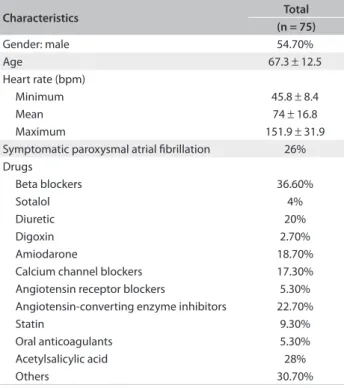
11,321 Holter tests were performed and analyzed. PAF was found in 75 cases (one test per patient), which represented a prevalence of 0.67%.
he mean age was 67 ± 13 years and 45% were female
(Table 1). he patients underwent one test only. he diferences between the symptomatic PAF (SPAF) and asymptomatic PAF
(APAF) groups are demonstrated in Table 2. Table 3 shows the
Table 1. Baseline characteristics of the study population
Characteristics Total
(n = 75)
Gender: male 54.70%
Age 67.3 ± 12.5
Heart rate (bpm)
Minimum 45.8 ± 8.4
Mean 74 ± 16.8
Maximum 151.9 ± 31.9
Symptomatic paroxysmal atrial ibrillation 26% Drugs
Beta blockers 36.60%
Sotalol 4%
Diuretic 20%
Digoxin 2.70%
Amiodarone 18.70%
Calcium channel blockers 17.30% Angiotensin receptor blockers 5.30% Angiotensin-converting enzyme inhibitors 22.70%
Statin 9.30%
Oral anticoagulants 5.30% Acetylsalicylic acid 28%
multivariate analysis on factors associated with the correlation between occurrences of PAF and symptoms. he heart rate (HR)
ranged from a minimum of 45 ± 8 bpm to a mean of 74 ± 17 bpm
and a maximum of 151 ± 32 bpm. Among the individuals with
tests showing PAF, only 26% had symptoms. he maximum HR was higher in the group with a symptomatic correlation with
arrhythmia (165 ± 34 versus 147 ± 30 bpm) (P = 0.03), as shown
in Figure 1. Use of beta blockers had a protective efect against PAF symptoms (odds ratio, OR: 0.24, P = 0.031).
he duration in minutes of the episodes of PAF was similar
in the two groups (P = 0.53), as shown in Figure 2. here was no
diference in the number of episodes of PAF in the two groups
(P = 0.36), as shown in Figure 2.
DISCUSSION
here is evidence showing that atrial ibrillation, which was once considered to be a benign arrhythmia, is a condition that causes
signiicant morbidity.2,3 It has become a public health problem
because of the aging of the population and the increasing preva-lence of degenerative diseases. he subjects of the present study who showed PAF during the 24-hour Holter test were of rela-tively high average age and presented comorbidities resulting from chronic diseases.
Even though our study was conducted on a selected popula-tion of patients for whom a Holter test was indicated, the
prev-alence of PAF was similar to that reported in the literature.8,9
he presence of symptoms in patients with PAF is of fundamental importance because this is the criterion for curative treatment of such arrhythmia, whether by surgical means or by catheter abla-tion. Identiication of asymptomatic PAF is also important, since the need for antiplatelet drugs or anticoagulant medication for preventing thromboembolic events has to be assessed. Symptoms were present during the Holter test in 59% of the patients who were found to have PAF. However, a correlation between the Table 2. Characteristics of the groups with symptomatic paroxysmal atrial ibrillation (SPAF) and asymptomatic paroxysmal atrial ibrillation (APAF)
Characteristics SPAF
(n = 20)
APAF (n = 55) P
Gender 5.3 18.8 0.28
Age 66.5 ± 15.8 67.6 ± 11.1 0.08 Number of episodes 4.6 ± 5.5 11.6 ± 29.6 0.1 Number of drugs 3.3 ± 1.5 2.4 ± 2.0 0.16 Prevalence during wakefulness 75% 81.80% 0.52 Duration of atrial ibrillation (min) 120 122 0.81 Maximum heart rate (bpm) 164 ± 7.3 164 ± 7.3 0.03*
*Signiicance obtained from analysis of covariance (ANCOVA) with estimated means (± standard error) and adjusted according to the factors of age, gender, number of episodes, number of drugs and heart rate.
Table 3. Multivariate analysis on factors associated with the correlation between occurrences of paroxysmal atrial ibrillation and symptoms
Variable* Odds ratio P 95% conidence
interval
Increment of 1 bpm in maximum
heart rate 1.022 0.015 1.004 1.040 Use of beta blocker 0.246 0.031 0.068 0.883
*Variables placed in the model backwards were: age, gender, minimum heart rate, mean heart rate, maximum heart rate, use of beta blocker, sotalol, amiodarone, digoxin, atrial ibrillation during wakefulness, duration of atrial ibrillation episode in minutes; bpm = beats per minute.
Figure 2. Number of episodes of paroxysmal atrial ibrillation in atrial ibrillation (SPAF) and asymptomatic paroxysmal atrial ibrillation (APAF) (P = 0.36).
SPAF APAF
320 300 280 260
240 220 200 180 160
140
D
ur
ation (minut
es)
SPAF APAF
240
220
200
180
160
140
120
100
80
M
aximum hear
t r
a
te (BP
M)
Figure 1. Diferences between maximum heart rates, in beats per minute (BPM) in the groups with symptomatic paroxysmal atrial ibrillation (SPAF) and asymptomatic paroxysmal atrial ibrillation (APAF) (P = 0.03).
episode of arrhythmia and the reported symptom was present in only 26% of the cases.
he perception of symptoms changed ater ablation inpa-tients were found to have symptomatic AF, as demonstrated by
Hindricks et al.10 Increased incidence of asymptomatic AF was
Before ablation, 50% of the patients had either symptomatic or asymptomatic PAF, while 38% of the patients recognized precisely
all episodes of PAF. Even with a history of symptomatic PAF,10
only 5% of the patients had asymptomatic PAF during electrocar-diographic recordings over seven days.
Jabaudon et al.11 compared the detection of AF with the
inci-dence of cerebral thromboembolic events, because of the impor-tance of such occurrences. hey analyzed arrhythmia through electrocardiographic recordings over a seven-day period (event-loop recording), in addition to basic electrocardiography and Holter tests ater the occurrence of the episodes. AF was found in 2.7% of the basic electrocardiograms, 5% of the Holter tests and 5.7% of the event-loop recordings. he basic
electrocardio-graphic and Holter results were normal11 in patients who were
diagnosed by means of the latter method.
he Discern AF Trial study was applied to evaluate the fol-low-up on patients who had been referred for AF ablation, with an implantable event monitor over the three-month period before the procedure. he device was able to diagnose 69% of the 2355 apparent episodes of arrhythmia as AF or atrial lut-ter. During this period, the device was activated 5013 times. According to the monitor, only 47% of the patients were con-irmed by the event monitor, whereas 46% of them remained
relapse-free ater ablation.12
he current drug treatment or non-pharmacological approaches may ofer partial or complete relief of the symptoms. However, this may lead to the belief that AF has been completely controlled or even cured, due to the absence of symptoms or documentation of sinus rhythm through electrocardiography or occasional 24-hour Holter tests. Another important point is that the use of beta blockers drugs provides protection against occurrences of symptoms relating to PAF, probably because of their negative chronotropic property.
Another important finding from this study was the posi-tive symptomatic correlation in patients who presented higher HR during the 24-hour recording. This was evident even when the analysis was controlled for the use of antiarrhythmic and negative chronotropic drugs. Although the Holter test was used to check HR over a 24-hour period, it showed that the HR during episodes of AF corresponded to the maximum HR in most tests.
he limitations of this study included the selection bias inher-ent to the study design, the possibility that patiinher-ents might presinher-ent some pathological condition or symptoms indicating they should undergo a 24-hour Holter test, lack of information regarding the indication of tests and the exact use of antiarrhythmic drugs. he daily journal of symptoms illed out by patients also repre-sented a limitation, given that the patients might omit impor-tant symptoms or overvalue them. his certainly occurs, as was
proven in a study on long-term electrocardiographic monitoring
over a seven-day period, among patients with atrial ibrillation.13
One of the main implications for clinical practice from the present study is that a symptom-based approach towards evalu-ating PAF is unreliable. Our study showed that symptoms are not only related to PAF per se; HR seems to be an important factor too. PAF with a slow HR may be missed during a routine clini-cal visit.
his study provides the notion that curative treatment has to be followed by prolonged monitoring. Future investigations should be directed towards better understanding of the factors that contribute to occurrences of symptoms in PAF. Holter moni-toring is a valuable tool within this scenario.
CONCLUSION
Detection of asymptomatic episodes of PAF in patients who underwent a 24-hour Holter test was a uncommon event. hese results were in accordance with the literature and demon-strated that there was a low correlation between symptoms and episodes of PAF during Holter recording.
he prevalence of PAF was similar to that found in the lit-erature. hese events were oten asymptomatic in this selected population of patients. he maximum HR during the arrhythmia episode was the only factor related to the presence of symptoms during the arrhythmia event. Use of beta blockers served as a protector against occurrences of symptoms in patients with PAF.
REFERENCES
1. Benjamin EJ, Wolf PA, D’Agostino RB, et al. Impact of atrial ibrillation
on the risk of death: the Framingham Heart Study. Circulation.
1998;98(10):946-52.
2. Cabin HS, Clubb KS, Hall C, Perlmutter RA, Feinstein AR. Risk for
systemic embolization of atrial ibrillation without mitral stenosis. Am
J Cardiol. 1990;65(16):1112-6.
3. Petersen P, Godtfredsen J. Embolic complications in paroxysmal atrial
ibrillation. Stroke. 1986;17(4):622-6.
4. Page RL, Tilsch TW, Connolly SJ, et al. Asymptomatic or ‘’silent’’ atrial
ibrillation: frequency in untreated patients and patients receiving
azimilide. Circulation. 2003;107(8):1141-5.
5. Miller CS, Grandi SM, Shimony A, Filion KB, Eisenberg MJ.
Meta-analysis of eicacy and safety of new oral anticoagulants (dabigatran,
rivaroxaban, apixaban) versus warfarin in patients with atrial
ibrillation. Am J Cardiol. 2012;110(3):453-60.
6. Halimi F, Van Erven L, EHRA Scientiic Initiatives Committee. Validation
of success following atrial ibrillation ablation: a European survey.
Europace. 2009;11(8):1002-3.
7. Fenelon G, Scanavacca M, Atié J, et al. Atrial ibrillation ablation
in Brazil: results of the registry of the Brazilian Society of Cardiac
8. Zimerman LI, Fenelon G, Martinelli Filho M, et al. Diretrizes Brasileiras de
Fibrilação Atrial. Arq Bras Cardiol. 2009;92(6 supl. 1):1-39. Available from:
http://publicacoes.cardiol.br/consenso/2009/diretriz_fa_92supl01.pdf.
Accessed in 2013 (Oct 28).
9. Humphries KH, Kerr CR, Steinbuch M, Dorian P; Canadian Registry of
Atrial Fibrillation investigators. Limitations to antiarrhythmic drug use
in patients with atrial ibrillation. CMAJ. 2004;171(7):741-5.
10. Hindricks G, Piorkowski C, Tanner H, et al. Perception of atrial ibrillation
before and after radiofrequency catheter ablation: relevance of
asymptomatic arrhythmia recurrence. Circulation. 2005;112(3):307-13.
11. Jabaudon D, Sztajzel J, Sievert K, Landis T, Sztajzel R. Usefulness
of ambulatory 7-day ECG monitoring for the detection of atrial
ibrillation and lutter after acute stroke and transient ischemic attack.
Stroke. 2004;35(7):1647-51.
12. Verma A, Champagne J, Sapp J, et al. Discerning the incidence of
symptomatic and asymptomatic episodes of atrial ibrillation before
and after catheter ablation (DISCERN AF): a prospective, multicenter
study. JAMA Intern Med. 2013;173(2):149-56.
13. Mehall JR, Kohut RM Jr, Schneeberger EW, Merrill WH, Wolf RK. Absence
of correlation between symptoms and rhythm in “symptomatic” atrial
ibrillation. Ann Thorac Surg. 2007;83(6):2118-21.
Sources of funding: Three Holter devices were given by Cardio Sistemas (Cardio Sistemas Comercial e Industrial Ltda, São Paulo, Brazil); two
Scientiic InitiationScholarships were given by FAPICC (Support Fund of
the Instituto de Cardiologia – Fundação Universitária de Cardiologia)
Conlict of interest: None
Date of irst submission: June 11, 2013
Last received: November 13, 2013
Accepted: November 22, 2013
Address for correspondence: Gustavo Glotz de Lima
Av. Princesa Isabel, 395
Santana — Porto Alegre (RS) — Brasil
CEP 90620-000