Does hypericin boost the eicacy of high-power laser?
A preliminary experimental study on rats
A hipericina aumenta a eicácia do laser de alta potência?
Um estudo preliminar e experimental em ratos
Murat Zor
I, Serdar Goktas
II, Ibrahim Yildirim
III, Unal Orhan Zorba
IV, Seref Basal
V, Bilal Firat Alp
V, Engin Kaya
VI, Osman Erogul
VIIDepartment of Urology, Gülhane Military Medical Academy, Ankara, Turkey
ABSTRACT
CONTEXT AND OBJECTIVE: Lasers are widely used in treating symptomatic benign prostatic hyperplasia. In current practice, potassium titanyl phosphate (KTP) lasers are the most common type of laser systems used. The aim here was to evaluate the rapid efect of high-power laser systems after application of hypericin.
DESIGN AND SETTING: Experimental animal study conducted in the Department of Urology, Gülhane Military Medical Academy, Ankara, Turkey, in 2012.
METHODS: Sixteen rats were randomized into four groups: 120 W KTP laser + hypericin; 120 W KTP laser alone; 80 W KTP laser + hypericin; and 80 W KTP laser alone. Hypericin was given intraperitoneally two hours prior to laser applications. The laser incisions were made through the quadriceps muscle of the rats. The depth and the width of the laser incisions were evaluated histologically and recorded.
RESULTS: To standardize the efects of the laser, we used the ratio of depth to width. These new values showed us the depth of the laser application per unit width. The new values acquired were evaluated sta-tistically. Mean depth/width values were 231.6, 173.6, 214.1 and 178.9 in groups 1, 2, 3 and 4, respectively. The most notable result was that higher degrees of tissue penetration were achieved in the groups with hypericin (P < 0.05).
CONCLUSIONS: The encouraging results from our preliminary study demonstrated that hypericin may improve the efects of KTP laser applications.
RESUMO
CONTEXTO E OBJETIVO: Lasers são amplamente utilizados no tratamento de hiperplasia benigna de próstata sintomática. Na prática atual, lasers de fosfato de titanilo de potássio (KTP) são os tipos mais comuns usados dos sistemas. O objetivo foi avaliar o efeito rápido do sistema laser de alta potência após a aplicação de hipericina.
TIPO DE ESTUDO E LOCAL: Estudo experimental animal, realizado no Departamento de Urologia, Acade-mia de Medicina Militar de Gülhane, Ancara, Turquia, em 2012.
MÉTODOS: 16 ratos foram divididos aleatoriamente em 4 grupos: 120W KTP laser + hipericina; 120W KTP laser somente; 80W KTP laser + hipericina; 80W KTP laser somente. Hipericina foi dada intraperitonealmen-te duas horas anintraperitonealmen-tes da aplicação do laser. As incisões a laser foram feitas através do músculo quadríceps dos ratos. A profundidade e a largura das incisões a laser foram avaliadas histologicamente e registradas.
RESULTADOS: Para padronizar o efeito do laser foi utilizada a razão entre profundidade e largura. Estes no-vos valores nos mostraram a profundidade da aplicação do laser de largura por unidade. Os nono-vos valores adquiridos foram avaliados estatisticamente. Os valores da média de profundidade/largura foram 231,6, 173,6, 214,1 e 178,9 nos grupos 1, 2, 3 e 4, respectivamente. O resultado mais notável foi atingir altos graus de penetração tecidual nos grupos com hipericina (P < 0,05).
CONCLUSÕES: Os resultados promissores do nosso estudo preliminar mostraram que hipericina pode melhorar os efeitos das aplicações do laser KTP.
IMD. Urology Specialist, Department of Urology,
Sarikamis Military Hospital, Kars, Turkey. IIMD. Professor and Head of Department of
Urology, Selcuklu Medical Faculty, Selcuk University, Konya, Turkey.
IIIMD. Professor, Department of Urology, Gülhane
Military Medical Academy, Ankara, Turkey. IVMD. Associate Professor, Department of Urology,
Rize University Medical Faculty, Rize, Turkey. VMD. Associate Professor, Department of
Urology, Gülhane Military Medical Academy, Ankara, Turkey.
VIMD. Urology Specialist, Department of Urology,
Gülhane Military Medical Academy, Ankara, Turkey.
VIIPhD. Head of Department of Biomedical
Science, Gülhane Military Medical Academy, Ankara, Turkey.
KEY WORDS:
Hypericum. Lasers, solid-state. Prostatic hyperplasia. Photochemotherapy. Endoscopy.
PALAVRAS-CHAVE:
Hypericum.
INTRODUCTION
Lasers are widely used in urological surgery, especially for man-agement of symptomatic benign prostate hyperplasia (BPH). he major advantages of light-induced tissue removal are that it vaporizes and coagulates at the same time. hese characteris-tics of lasers simplify the treatment of symptomatic BPH both for surgeons and for patients.
Potassium titanyl phosphate (KTP) lasers are based on sys-tems that produce neodymium-YAG laser light; this light is then passed through a KTP crystal. his doubles the frequency and halves the wavelength of the laser light emitted to 532 nm, which is in the green part of the visible spectrum. Historically, application of KTP laser energy in urology began in the late 1980s when the early KTP laser systems with power outputs of initially 20 W and later 38 W became available.1 However, it took a long time for KTP lasers to be developed to the point of reaching suicient power to vaporize the prostate rapidly. he 120 W KTP laser introduced by Laserscope-AMS in 2006 as the GreenLight HPS had the beneit of greater vaporization capability and decreased duration of surgery.2 However, high power brings some risks such as the potential for inadvertently penetrating too deeply with the laser and causing perforation of the bladder, injury of the oriice, especially with large median lobes, or perforation of the prostatic capsule with opening of large venous sinusoids at the end of the procedure. To achieve accurate laser power for rapid vaporization while avoiding harm to the adjacent tissues is a hard balance to maintain.
Hypericin is a naturally occurring polycyclic aromatic naphthodianthrone that is isolated from plants of the genus
Hypericum. his natural substance has been used in traditional Chinese medicine for thousands of years. In recent time, teas made from plants containing hypericin (St. John’s wort) have been reported to have antineoplastic, antiviral and antidepres-sant properties.3,4
Photodynamic therapy (PDT) involves activation of a pho-tosensitizer by means of light of an appropriate wavelength to produce focal damage to tissue. he treatment typically involves systemic administration of a photosensitizer and its subsequent activation by light of an appropriate wavelength to create a pho-tochemical reaction that causes photodamage. PDT has become an accepted treatment for certain types of malignant tumors and is showing great promise for treating and managing a variety of nonmalignant diseases.5
Hypericin contains extended pi-orbital electrons that become excited by ultraviolet and green light, thus leading to production of toxic singlet oxygen and radical species.6-8
VanderWerf et al. were the irst to report that KTP lasers and hypericin presented strong phototoxicity towards human tumor cell lines.9 Both apoptosis and necrosis have been proposed
as mechanisms for cell death resulting from hypericin PDT. he photocytotoxic activity of hypericin has been tested in sev-eral experimental studies in vivo and in vitro.10-14
Hypericin is reported to be safe because no toxic efects on mice kept in the dark have been observed, nor have there been any genotoxic efects from a variety of in vitro and in vivo
assays.15,16 Moreover, hypericin is present as a constituent in
Hypericum extract, which is used clinically as an antidepres-sant and apparently causes no side efects.17 Taken together, these attributes make hypericin a potential tool in PDT.
Recent clinical testing has revealed that hypericin was not tumoricidal in a patient with mesothelioma who was exposed to 632 nm red laser light, but clear evidence of phototoxicity was seen in two subjects ater intradermal drug injection when acti-vated by green laser emissions at 514 nm rather than by 632 or 670 nm red light.18,19
Obstructive tissue is instantly removed by vaporization, but laser energy that is not absorbed by the supericial tissue will penetrate deeper, thus causing a rim of 1-2 mm of coagulated prostatic tissue and residual stromal tissue inside the prostatic surgical capsule. By using hypericin, KTP laser energy could be absorbed more eiciently.
To our knowledge, studies on the photodynamic thera-peutic properties of hypericin have only focused on the late immunological response of tumor tissue to low-power laser and no study on high-power laser has been published on the subject. None of the observers evaluated the rapid effect of high-power laser systems after application of hypericin as a photosensitizer.
OBJECTIVE
To evaluate the rapid efect of high-power laser systems ater application of hypericin and whether this can be adopted for laser vaporization of the prostate.
METHODS
This study was planned as a preliminary study and was con-ducted after obtaining approval from the local committee of our Medical Academy. All animal experiments were done in accordance with the Principles of Laboratory Animal Care (prepared by the National Institutes of Health; NIH Publication No. 85-23 rev. 1995).
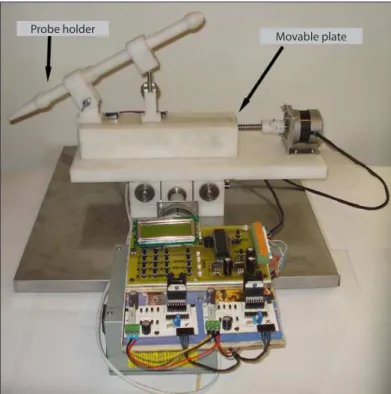
he animals were anesthetized by means of intraperitoneal injection of a mixture of ketamine hydrochloride (50 ml/kg) and xylazine hydrochloride (5 ml/kg). he animals were then placed in a ventral position and ixed. he skin above the biceps femoris muscle was dissected until the sole biceps femoris muscle had been exposed. Laser incisions were made through the biceps femoris muscle of the rats. To achieve standardization of the laser incisions, we used a “laser movement system” (Figure 1). With this device, we gained the ability to move the laser probe at a constant velocity over equal distances in the X and Y planes. hrough this, the laser probes pro-duced standardized incisions. During laser operation, the bare iber-optic was adjusted to move at 4 mm/sec, parallel to and 3 mm above the denuded biceps femoris muscle. he incision length was 1.5 cm. Ater laser application, the biceps femoris muscle was dissected and was ixed in 10% neutral bufered formalin for 24 hours and then embedded in parain. he depth and width of the laser incisions were evaluated histologically and recorded. To assess and standard-ize the efects of the laser, we used the ratio of depth to width. hese new values showed us the depth of the laser application per unit width. he new values acquired were evaluated statistically.
Statistical analysis
he statistical data were analyzed using the Statistical Package for the Social Sciences (SPSS, Chicago, IL, USA), version 15.0 for Windows. All values were expressed as mean ± standard devia-tion (SD). he diferences between means were analyzed by using the Mann-Whitney U test. P values less than 0.05 were consid-ered to indicate statistical signiicance.
RESULTS
he most notable result from the study was that higher degrees of tissue penetration were achieved in the groups with hypericin. his diference was statistically signiicant (P < 0.05). he mean depth/width values and the statistical analysis are summarized in Table 1.
DISCUSSION
One of the cardinal rules for photoselective vaporization of the prostate (PVP) is that the surgeon needs to see a good cav-ity, created with an open channel from the verumontanum to the bladder. PVP relies on instant vaporization rather than on delayed tissue sloughing. herefore, “what you see” at the end of the procedure is exactly “what you will get”.2 Studies on the mechanism of tissue responses to PDT in vivo have revealed that the tissue destruction may be either an immediate efect due to direct cell killing or a late efect due to vascular dam-age and immunoreactions.5,20,21 Most previous studies focused on low-energy lasers and observed cell death ater a couple of hours; none of the studies used high-power laser systems with application of hypericin.10,22-25 Use of low-power KTP will result in early edema and delayed sloughing of necrotic tissue conse-quent to vascular damage and immunoreactions, and more so than the direct tissue ablation mentioned above, thereby result-ing in prolonged obstruction and severe postoperative dysuria. Because of these limitations, we used high-power KTP in our study. To our knowledge, this is the irst study on the use of hypericin with high-power KTP laser.
he photoselective properties of the green 532 nm laser wave-length arise because this visible wavewave-length is strongly absorbed within the very supericial layer of tissue, given that the chro-mophores of the blood vessels and hemoglobin contained in this layer serve as primary and selective absorbers. Oxyhemoglobin has maximum excitation capacity at 414 nm wavelength.20,26 Hypericin is also an appropriate absorber for KTP laser, since its maximum excitation occurs at 545 nm wavelength.2,19
he time interval between administration of hypericin and application of the laser plays an important role regarding drug distribution between vessels and tissue. Half an hour ater admin-istration, intense hypericin luorescence is mainly observed within blood vessels, with a small amount of luorescence in the perivascular region.25,27,28 his maximizes the absorption of
Table 1. Comparison of mean depth/width values between the groups with the Mann-Whitney U test
Groups Depth/width P-value
Group 1 (hypericin + 120 W KTP laser) 231.6 ± 38.9
P < 0.05 Group 2 (120 W KTP laser alone) 173.6 ± 52.5
Group 3 (hypericin + 80 W KTP laser) 214.1 ± 47
P < 0.05 Group 4 (80 W KTP laser alone) 178.9 ± 7.6
Figure 1. Laser movement system.
Probe holder
the laser energy in the vasculature. he peak concentration of hypericin in tissue is reached ater four hours. Six hours ater administration, only faint luorescence is observed in the vasculature.24
Use of laser energy within 30 minutes ater application of hypericin, i.e. at the time when it mostly is still in the vessels, does not provide any extra gain in relation to the classical PVP because KTP laser is instantly and nearly completely absorbed in blood. Waiting more than four hours ater hypericin admin-istration would result in dissemination of hypericin into the prostate. he depth of KTP laser penetration into the prostate is 1 mm.26 his is a limitation on investigating the efectiveness of hypericin, given that KTP laser energy is absorbed mostly by the hemoglobin in well-vascularized prostate tissue. In order to reach equilibrium between tissue and vasculature, we applied the laser two hours ater administration of hypericin.
In the literature, there are several studies showing statisti-cally signiicant diferences in necrosis between rats with and without hypericin. However, none of these studies used powers higher than 1 W.9-11,22-24 In our study, we used laser energies of 80 and 120 W, and to standardize the laser efectiveness we used the ratio of depth to width. We found that with hypericin adminis-tration, the tissue penetration of the green light laser was greater and reached a statistically signiicant diference.
he results obtained from this preliminary study are prom-ising for future studies. Development of novel hypericin-con-taining drugs may decrease the frequencies of complications and morbidity from laser vaporization of the prostate, through reducing the duration of the operation, and may lead to greater eiciency of the operation. hese results are encouraging with regard to shortening the duration of the operation and increas-ing the efectiveness of laser prostate operations in the future. Nonetheless, further studies are warranted in order to determine the value of this approach, with a view to introducing it within clinical scenarios.
CONCLUSIONS
he results of our study demonstrated higher tissue penetration levels through hypericin applications. To our knowledge, this is the irst study evaluating the rapid efect of high-power laser sys-tems ater application of hypericin as a photosensitizer.
REFERENCES
1. Malek RS, Nahen K. Photoselective vaporization of the prostate: KTP laser therapy of obstructive benign prostatic hyperplasia. AUA Update Ser. 2004;23:153-60.
2. Anson K. Could the latest generation potassium titanyl phosphate lasers be the ones to make transurethral resection of the prostate an operation of historical interest only? Curr Opin Urol. 2004;14(1):27-9.
3. Kasper S. Treatment of seasonal afective disorder (SAD) with hypericum extract. Pharmacopsychiatry. 1997;30 Suppl 2:89-93. 4. Vitiello B. Hypericum perforatum extracts as potential antidepressants.
J Pharm Pharmacol. 1999;51(5):513-7.
5. Dougherty TJ, Gomer CJ, Henderson BW, et al. Photodynamic therapy. J Natl Cancer Inst. 1998;90(12):889-905.
6. Thomas C, MacGill RS, Miller GC, Pardini RS. Photoactivation of hypericin generates singlet oxygen in mitochondria and inhibits succinoxidase. Photochem Photobiol. 1992;55(1):47-53.
7. Diwu Z, Lown JW. Photosensitization with anticancer agents. 17. EPR studies of photodynamic action of hypericin: formation of semiquinone radical and activated oxygen species on illumination. Free Radic Biol Med. 1993;14(2):209-15.
8. Ebermann R, Alth G, Kreitner M, Kubin A. Natural products derived from plants as potential drugs for the photodynamic destruction of tumor cells. J Photochem Photobiol B. 1996;36(2):95-7.
9. VanderWerf QM, Saxton RE, Chang A, et al. Hypericin: a new laser phototargeting agent for human cancer cells. Laryngoscope. 1996;106(4):479-83.
10. Chung PS, Rhee CK, Kim KH, et al. Intratumoral hypericin and KTP laser therapy for transplanted squamous cell carcinoma. Laryngoscope. 2000;110(8):1312-6.
11. Kamuhabwa AA, Roskams T, D‘Hallewin MA, et al. Whole bladder wall photodynamic therapy of transitional cell carcinoma rat bladder tumors using intravesically administered hypericin. Int J Cancer. 2003;107(3):460-7.
12. Liu CD, Kwan D, Saxton RE, McFadden DW. Hypericin and photodynamic therapy decreases human pancreatic cancer in vitro and in vivo. J Surg Res. 2000;93(1):137-43.
13. Blank M, Kostenich G, Lavie G, et al. Wavelength-dependent properties of photodynamic therapy using hypericin in vitro and in an animal model. Photochem Photobiol. 2002;76(3):335-40. 14. Solár P, Cavarga I, Hofmanová J, et al. Efect of acetazolamide on
hypericin photocytotoxicity. Planta Med. 2002;68(7):658-60.
15. Meruelo D, Lavie G, Lavie D. Therapeutic agents with dramatic antiretroviral activity and little toxicity at efective doses: aromatic polycyclic diones hypericin and pseudohypericin. Proc Natl Acad Sci U S A. 1988;85(14):5230-4.
16. Okpanyi SN, Lidzba H, Scholl BC, Miltenburger HG. Genotoxizität eines standardisierten Hypericum-Extraktes. [Genotoxicity of a standardized Hypericum extract]. Arzneimittelforschung. 1990;40(8):851-5. 17. Linde K, Ramirez G, Mulrow CD, et al. St John’s wort for
depression--an overview and metadepression--analysis of randomised clinical trials. BMJ. 1996;313(7052):253-8.
18. Koren H, Schenk GM, Jindra RH, et al. Hypericin in phototherapy. J Photochem Photobiol B. 1996;36(2):113-9.
20. Fingar VH. Vascular efects of photodynamic therapy. J Clin Laser Med Surg. 1996;14(5):323-8.
21. Korbelik M. Induction of tumor immunity by photodynamic therapy. J Clin Laser Med Surg. 1996;14(5):329-34.
22. Vandenbogaerde AL, Geboes KR, Cuveele JF, et al. Antitumour activity of photosensitized hypericin on A431 cell xenografts. Anticancer Res. 1996;16(4A):1619-25.
23. Chen B, de Witte PA. Photodynamic therapy eicacy and tissue distribution of hypericin in a mouse P388 lymphoma tumor model. Cancer Lett. 2000;150(1):111-7.
24. Chen B, Xu Y, Roskams T, et al. Eicacy of antitumoral photodynamic therapy with hypericin: relationship between biodistribution and photodynamic efects in the RIF-1 mouse tumor model. Int J Cancer. 2001;93(2):275-82.
25. Vantieghem A, Assefa Z, Vandenabeele P, et al. Hypericin-induced photosensitization of HeLa cells leads to apoptosis or necrosis. Involvement of cytochrome c and procaspase-3 activation in the mechanism of apoptosis. FEBS Lett. 1998;440(1-2):19-24.
26. Bachmann A, Ruszat R. The KTP-(greenlight) laser--principles and experiences. Minim Invasive Ther Allied Technol. 2007;16(1):5-10. 27. Assefa Z, Vantieghem A, Declercq W, et al. The activation of the
c-Jun N-terminal kinase and p38 mitogen-activated protein kinase signaling pathways protects HeLa cells from apoptosis following photodynamic therapy with hypericin. J Biol Chem. 1999;274(13):8788-96.
28. Hamilton HB, Hinton DR, Law RE, et al. Inhibition of cellular growth and induction of apoptosis in pituitary adenoma cell lines by the protein kinase C inhibitor hypericin: potential therapeutic application. J Neurosurg. 1996;85(2):329-34.
Acknowledgements: The authors would like to thank Orcun Cankaya for designing the “laser movement system” and giving permission for its use
Sources of funding: None
Conlict of interests: None
Date of irst submission: November 13, 2012
Last received: October 31, 2013
Accepted: November 6, 2013
Address for correspondence: Murat Zor
Saikamis Military Hospital 36500 Kars — Turkey
Tel. 905337305191