Evaluation of Reference Centers for Special
Immunobiologicals implementation
Laura Andrade Lagôa NóbregaI, Hillegonda Maria Dutilh NovaesII, Ana Marli Christovam SartoriI
I Departamento de Moléstias Infecciosas e Parasitárias. Faculdade de Medicina. Universidade de São Paulo. São
Paulo, SP, Brasil
II Departamento de Medicina Preventiva. Faculdade Medicina. Universidade de São Paulo. São Paulo, SP, Brasil
ABSTRACT
OBJECTIVE: To describe the Reference Centers for Special Immunobiologicals and evaluate their implementation considering formal regulations.
METHODS: We conducted a program evaluation, of evaluative research type. From August 2011 to January 2012, a questionnaire was applied to the 42 Reference Centers for Special Immunobiologicals existing in the Country, approaching the structure, human resources, and developed activities dimensions. We conducted a descriptive analysis of data and used a clustering for binary data with the squared Euclidean distance, by the farthest neighbor method, to aggregate services with similar features.
RESULTS: We observed great diversity among the services in the three dimensions. he clustering resulted in ive service proiles, named according to their characteristics. 1) Best structure: 12 Reference Centers for Special Immunobiologicals with the highest proportion of services with the minimum of rooms recommended, purpose-built vaccine refrigerators, preventive maintenance of the cold chain, and oxygen source. 2) Immunobiologicals distributor: six Reference Centers for Special Immunobiologicals that distributed more than applied immunogens; no doctor present for more than half of the working hours and no purpose-built vaccine refrigerators . 3) Incipient implementation: ive Reference Centers for Special Immunobiologicals with inadequate structure, such as absence of purpose-built vaccine refrigerators, preventive maintenance of the cold chain and oxygen source; none had computer. 4) Vaccination rooms: 13 Reference Centers for Special Immunobiologicals, everyone did routine immunization, most participated in vaccination campaigns. 5) Teaching and research: six services, all inserted into teaching hospitals, developed researches and received trainees; most had doctors in more than half of the working hours.
CONCLUSIONS: he evaluation of the Reference Centers for Special Immunobiologicals implementation was based on the proiles found and considered the oicial regulations: services categorized as “better structure” and “teaching and research” were considered implemented; “immunobiologicals distributor” and “vaccination room” services, partially implemented, and the ones with the “incipient implementation” proile, not implemented. he results of this evaluation can contribute to the reformulation of the services, considering the current context.
DESCRIPTORS: Immunization. Health Centers. Immunization Programs, organization & administration. Vaccines, supply & distribution. Program Evaluation. Health Services Evaluation. Correspondence:
Laura Andrade Lagôa Nóbrega Av. Dr. Enéas de Carvalho Aguiar, 470 1º andar sala 102 Cerqueira César 05403-000 São Paulo, SP, Brasil E-mail: [email protected]
Received: 10 Feb 2015 Approved: 25 Oct 2015
How to cite: Nóbrega LAL, Novaes HMD, Sartori AMC. Evaluation of Reference Centers for Special Immunobiologicals implementation. Rev Saude Publica. 2016;50:58.
Copyright: This is an open-access article distributed under the terms of the Creative Commons Attribution License, which permits unrestricted use, distribution, and reproduction in any medium, provided that the original author and source are credited.
INTRODUCTION
Patients with chronic diseases, such as immune deiciencies (congenital or acquired), neurological, hematological, and metabolic disorders, heart diseases, lung diseases, and others, or with exposure to risk situations, have a higher risk of infection or severe illness by certain pathogens and have recommendations for speciic immunizations15,24,25. Several countries, such as United Kingdom, France, Germany, United States, Mexico, and Argentina, have established vaccination calendars for these individuals1,2,4,7,8,13.
To meet these special groups in Brazil, the Programa Nacional de Imunizações (PNI – National Immunization Program) created the Reference Centers for Special Immunobiologicals (CRIE), which are public and free vaccination units. hese Centers provide vaccines and immunoglobulins not available on the PNI routine for individuals with a higher risk of infection or severe illness, and for those with contraindication of immunobiologicals used routinely. Besides, the CRIE are also responsible for the investigation and follow-up of cases of adverse events following immunization (AEFI)15. he irst services were created in 1993. Until 2000, 34 CRIE were created and, since 2002, each Brazilian state has at least one of these services16.
Several publications discuss indications of special immunobiologicals or describe the care to speciic groups in the CRIE3,5,6,21,24,26, but we did not ind studies that evaluate the implementation of CRIE in national perspective.
he aim of this study was to describe the CRIE existing in Brazil, in 2011, and evaluate if their implementation occurred in accordance with the guidelines and regulations established by PNI.
METHODS
he methodology adopted in the study was evaluation of health program of evaluative research type19. All managers of the 42 CRIE in the Country were invited to participate,
identiied by a list provided by the PNI General Coordination in June 2011. In 21 states, only one CRIE was identiied, located in the capital. Six states and the Federal District had more than one service: Para (two), Bahia (two), Federal District ( four), Sao Paulo (seven), Rio de Janeiro (three), and Rio Grande do Sul (three).
he CRIE are under the coordination of three instances: Brazilian Ministry of Health, by the PNI; State Secretariats of Health (SES); and the institution in which they are located (local level, usually higher complexity hospitals). he functioning and operation of CRIEs follow the Ordinance 48, from July 28, 2004a, which sets the minimum structure and the necessary human resources, also considering possible emergency care, since the target audience includes individuals with increased risk of presenting adverse events following immunization. he operation must occur on a time that allows the application of immunobiologicals (or their distribution to application in other service) in cases of urgency, as prophylaxis after exposure. he indications of immunobiologicals follow the PNI recommendations, listed in the CRIE Manual, revised and updated periodically by a group of experts15.
he data source was a semi-structured questionnaire developed for this study, consisting of 170 questions. he following program dimensions were studied: structure (existence of minimal physical area, institution in which it is inserted, equipment and inputs), human resources (number and training of professionals, workload, training for emergency care), and developed activities (application of immunobiologicals and their distribution to be applied in another service, assistance for adverse events following immunization, teaching and research activities). he regulations of the Ordinance that establishes general guidelines for CRIE operation guided the formulation of the questions, and the questionnaire was reviewed by the Technical Advisory of the General Coordination of PNI and by the Technical Management of Support to CRIE Management from the General Coordination of PNI.
a Ministério da Saúde, Secretaria
he questionnaire was available in online platform (virtual environment), from August 2011 to January 2012, and answered by the managers of the CRIE, or their substitutes, after agreement by signing the informed consent form. he project was approved by the Research Ethics Committee of the Hospital das Clinicas of Faculdade de Medicina of Universidade de São Paulo (Protocol of research 0281/10).
In the descriptive analysis, we estimated the simple frequencies of the answers for the characterization of the services. To create service proiles with similar characteristics, we selected nuclear issues in the three evaluated dimensions and performed the analysis using the clustering for binary data with the squared Euclidean distance, by the furthest neighbor method (complete linkage). his technique allows one to move successively in the algorithm by clustering small groups in larger ones, according to the values of the squared Euclidean distance, producing a tree of groups named dendrogram. he cutof level in the dendrogram is deined by the researcher and must represent the most suitable number of groups, in accordance with the research goals9.
RESULTS
All 42 CRIE illed the questionnaire, with varying completeness and quality.
Figure 1 presents the number of immunobiologicals doses applied by the CRIE, from 2006 to 2010, by region and year (nine CRIE without information). In 2010, the CRIE accounted for 518,964 immunobiologicals doses applied. he record was made by applied doses and each person could receive more than one immunobiological. Few services (21.0%) recorded the attended cases in which the required immunobiological was not released. he total number of applied doses increased 66.0% in the studied period; but this increase was not uniform, being higher in the Northeast (118.0%), followed by South (87.0%), and Southeast (63.0%). In the North and Midwest there was not increase in the number of applied doses; however, this datum was not informed by 10 (59.0%) services of these regions. hirty-ive CRIE (83.0%) mentioned applying immunobiologicals of the PNI routine calendar and 31 (74.0%) reported participating in vaccination campaigns.
he 40 CRIE (95.0%) reported that they rendered assistance to adverse events following events; 36 (86.0%) mentioned counting on support of experts for this service; 34 (81.0%), with hospital support; and 28 (67.0%), with laboratory support (Table).
CRIE without information: 9
Figure 1. Number of immunobiologicals doses applied in the Reference Centers for Special Immunobiologicals (CRIE), by region and year, in the period from 2006 to 2010.
0 50,000 100,000 150,000 200,000 250,000 300,000 350,000
Midwest North Northeast South Southeast
G1: best structure; G2: immunobiologicals distributor; G3: incipient implementation; G4: vaccination room; G5: teaching and research
a Questions used in the statistical clustering for the creation of CRIE profiles. b Characteristics not included in the creation of the profiles.
Table. Structural and human resources characteristics and developed activities in the Reference Centers for Special Immunobiologicals (CRIE) in accordance with the services and distribution profiles (%) of the structural and human resources characteristics and developed activities. Brazil, 2011.
Characteristics
Profile
G1 G2 G3 G4 G5 Total
(n = 12) (n = 6) (n = 5) (n = 13) (n = 6) (N = 42)
% % % % % %
Structure
Proportion of services that are inserted into teaching institutiona 58.0 0 0 0 100 31.0
Proportion of services that have minimal physical structure, according to the recommendation (reception, doctor’s office, preparation and/or vaccination room)a
92.0 50.0 60.0 54.0 83.0 69.0
Proportion of services that are inserted into building where other services operatea 75.0 100 80.0 92.0 100 88.1
Proportion of services that share the working area with other activitiesa 17.0 17.0 100 62.0 50.0 45.2
Proportion of services that have purpose-built vaccine refrigeratora 58.0 0 20.0 54.0 50.0 42.9
Proportion of services with preventive maintenance for cold chaina 92.0 83.0 20.0 0 83.0 52.4
Proportion of services that have electrical power generatorb 91.7 50.0 80.0 46.2 100 71.4
Proportion of services that have oxygen sourcea 92.0 33.0 20.0 69.0 17.0 57.1
Proportion of services that have computera 75.0 100 0 100 100 80.1
Proportion of services that have faxa 42.0 33.0 0 69.0 83.0 50.0
Human Resources
Proportion of services that have doctor in more than 50.0% of working hoursa 66.7 0 60.0 23.1 83.3 45.2
Proportion of services that have human resources training to meet emergenciesa 100.0 17.0 20.0 69.0 67.0 64.3
Developed activities
Proportion of services that apply routine immunobiologicalsa 92.0 33.0 60.0 100 100 83.3
Proportion of services that apply more than 80.0% of the released
immunobiologicals in their own CRIEa 50.0 33.3 60.0 92.3 83.3 66.7
Proportion of services that participated in vaccination campaigns in the
last 5 yearsa 67.0 83.0 80.0 69.0 83.0 73.8
Proportion of services that meet non-presential solicitations (only the requests)a 100 67.0 60.0 85.0 83.0 83.3
Proportion of services that provide a counter-reference document to the
patient/requester, when there is no indication of immunobiologicala 100 67.0 40.0 54.0 67.0 69.0
Proportion of services that register the cases seen to which the
immunobiological was not releasedb 16.7 16.7 20.0 23.1 33.3 21.4
Proportion of services with operation to the public more than 40 hours a weeka 58.3 66.7 40.0 84.6 50.0 59.5
Proportion of services that have available telephone contact for 24 hoursa 67.0 83.0 60.0 46.0 67.0 61.9
Proportion of services that meet people who received immunobiologicals
in other health units and present adverse events following immunizationa 83.0 83.0 80.0 92.0 100 88.1
Proportion of services that have support of experts for cases of adverse
events following immunizationb 91.7 100 80.0 76.9 83.3 85.7
Proportion of services that have laboratory support for cases of adverse
events following immunizationb 83.3 83.3 40.0 61.5 50.0 66.7
Proportion of services that have hospital support for cases of adverse events
following immunizationb 91.7 100 80.0 76.9 50.0 81.0
Proportion of services that rely on technical support Group for the
discussion of cases of adverse events following immunizationb 58.3 0 40.0 53.8 66.7 47.6
Proportion of services that receive traineesa 75.0 33.0 60.0 85.0 100 73.8
Nine services reported having no doctor, at the time of the research, and four reported lack of nurse. here were trained professionals for emergency care in 27 services (64.0%).
Regarding the infrastructure, lack of suicient cold chain equipment was reported by 29 CRIE managers (69.0%) and 35 (83.0%) reported use of domestic refrigerators. Source of oxygen was available in 24 CRIE (57.0%).
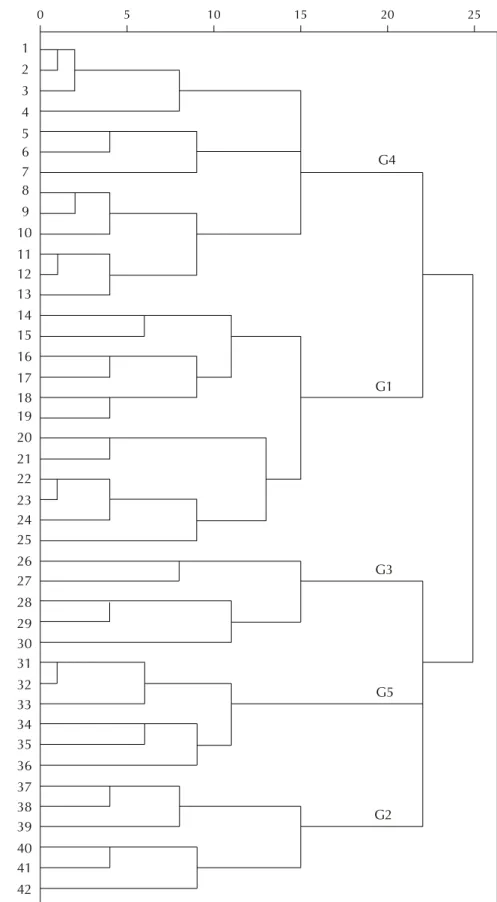
In the dendrogram analysis resulting from the application of the grouping method for binary data, using the Euclidean distance squared, by the furthest neighbor method (complete linkage), to the selected data for the characterization of the services, we opted by cutting the squared Euclidean distance measure in 20 points. Five clusterings resulted from this, in which the services were considered to have relevant characteristics in common and that difered them from other clusterings (Figure 2).
Group 1 was named “best structure” proile, because it featured the largest number of services that had the minimum recommended rooms (reception, doctor’s oice, and preparation or vaccination room). his group also showed greater proportion of services with presence of oxygen source, purpose-built vaccine refrigerators, and preventive maintenance of the cold chain. All services of this group had trained professionals to meet emergencies. Most received trainees, but less than half did research activities (Table).
Group 2 was named “immunobiologicals distributor” proile, for being the group with services that applied fewer doses of immunobiologicals in relation to the total distributed immunogens (administered and distributed) by the service. It also featured the lowest frequency of services that applied the vaccines of the routine calendars. Only half of the services had minimal physical structure and none of them had purpose-built vaccine refrigerators. It was the only group in which no CRIE had doctor present during more than half of the working hours. his group also showed the lowest frequency of trained professionals to meet emergencies.
Group 3 was named “incipient implementation” because it includes services with insuicient structure, according to the foreseen in the Ordinance that regulates the CRIE. None of them had unique physical area, few had purpose-built vaccine refrigerator and oxygen supply and the services had the lowest rate of preventive maintenance of the cold chain. None of these CRIE had computer or fax. Less than half worked more than 40 hours a week, considered as minimum necessary period for application and distribution of immunobiologicals satisfactorily in the CRIE.
Group 4, named “vaccination room” proile, included services that showed features that were more similar to a conventional vaccination room. All services did routine vaccination, and most of them applied the majority of their immunobiologicals and participated in vaccination campaigns. Most services worked more than 40 hours a week.
In Group 5, called “education and research” proile, all CRIE were inserted into teaching hospitals, developed research activities and received trainees. his group presented the best index of presence of doctors. Most services had appropriate minimum physical structure. All applied routine vaccines and most applied more than 80.0% of released immunobiologicals and participated in vaccination campaigns.
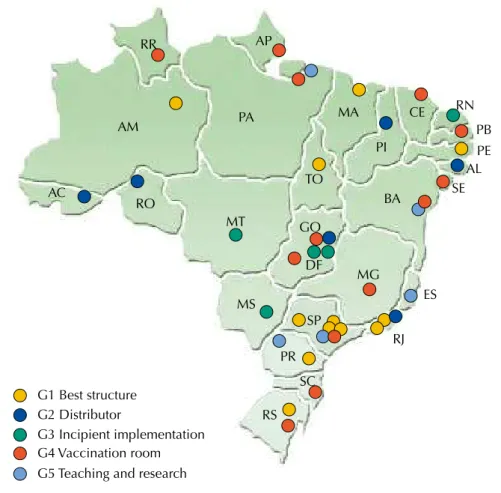
Twelve of the 18 CRIE of the “better structure” and “teaching and research” groups were located in the Southeast and South regions (Figure 3). From the ive services of the “incipient implementation” proile, four were located in the Midwest region. In the North and Northeast, there is no evidence of the predominance of any group.
he degree of CRIE implementation was evaluated considering the Ordinance that regulates the services. he CRIE with the proiles called “better structure” and “teaching and research” were considered implemented. he CRIE with the “immunobiologicals distributor” and “vaccination room” proiles were considered partially implemented. he CRIE of the “incipient implementation” proile were considered not implemented.
CRIE: Reference Centers for Special Immunobiologicals; G1: best structure; G2: immunobiologicals distributor; G3: incipient implementation; G4: vaccination room; G5: teaching and research
Figure 2. Dendrogram of the clustering for binary data with the squared Euclidean distance, by the farthest neighbor method, with formation of five groups of services with similar features.
0 5 10 15 20 25
CRI
E
1 2 3 4 5 6 7 8 9 10 11 12 13 14 15 16 17 18 19 20 21 22 23 24 25 26 27 28 29 30 31 32 33 34 35 36 37 38 39 40 41 42
G4
G1
G3
G5
Figure 3. Geographic distribution and profile (G1 to G5) of the Reference Centers for Special Immunobiologicals in Brazil by state, in 2011.
AP RR
AM
AC
PA
RO
MT
MA
TO
PI CE
GO
MS
DF
RN
PB PE AL
BA SE
MG
ES
RJ SP
PR
SC
RS G1 Best structure
G2 Distributor
G3 Incipient implementation G4 Vaccination room G5 Teaching and research
Figure 4. Distribution of Reference Centers for Special Immunobiologicals (CRIE) according to the profile (G1 to G5) and opening year.
2010
2009
2008
2007
2006
2005
2004
2003
2002
2001
2000
1999
1998
1997
1996
1995
1994
1993
G1 Best structure
G2 Immunobiologicals distributor G3 Incipient implementation G4 Vaccination room
G5 Teaching and research
Opening year
DISCUSSION
his is the irst systematic study that evaluated the implementation of CRIE in national perspective based on primary data, analyzing the structure, human resources, and developed activities dimensions. he data showed the diversity of the services’ situation nearly two decades after the creation of the special immunobiologicals program by PNI, indicating that the implementation of CRIE occurred without uniformity.
Regarding the CRIE distribution across the Country, we did not observe a population coverage criterion for the deinition of the number of services by state. According to personal information of state managers of immunization, distribution of these immunogens to the cities via Health Regions seems to have been implemented in some states, as an alternative to increase patients access to special immunobiologicals.
We expected to observe a relation between the time of opening of the services and the degree of implementation, but the results do not prove this hypothesis, because all services of “incipient implementation” were inaugurated for over a decade (Figure 4). On the other hand, there seems to be a relation between the region where the CRIE were located and the degree of implementation, since most CRIE of G1 and G5 were located in the Southeast, while most CRIE of G3 were located in the Midwest region.
Some faced barriers for the implementation of CRIE may have been caused by changes in policies for the Brazilian Uniied Health System (SUS) over time. he conventional vaccination rooms were decentralized with the municipalization of health, what did not occurred with the CRIE. he local context of the institutions that house the CRIE, regarding the available structure, human resources, and their priorities, appear to have been instrumental in the implementation and performance of the services.
Several factors may have contributed to the increase in the number of immunobiologicals doses applied by CRIE, such as: increased target audience, disclosure of the existence of CRIE and dissemination of knowledge about the recommendations of special immunobiologicals. his increase was most evident in the Northeast, followed by the South and Southeast regions. he absence of an increase in the number of doses applied in the North and Midwest regions may be due to information bias, since more than half of the services of these regions did not inform the number of immunobiologicals doses applied. Obstacles to the growth of some services may be arising from the inadequacy of the physical area, lack of cold chain equipment (or their inadequacy regarding regulations)14, and the lack of essential human resources. hese factors can also impair the activities of evaluation and application of immunobiologicals, as well as the care of emergencies and investigation of adverse events following immunization.his panorama may have changed in recent years, since some improvements may have been implemented, such as the transfer of funds from the Ministry of Health to the states for adequacy of the cold chainb.
Despite the heterogeneity within the groups, the proiles called “better structure” (G1) and “teaching and research” (G5), which amounted to 18 services (43.0%), resembled more what was proposed in the Ordinance that regulates the CRIE, being considered implemented. he characteristics that distinguished these two groups from the others were the higher proportion of services with more complete structure (G1) and higher proportion of services that developed activities such as application of immunogens in the very CRIE, participation in campaigns, application of routine vaccinations, and teaching and research activities (G5).
he initial proposal for all CRIE was that they were privileged spaces for the development of teaching and research, training and capacity building. Some CRIE have developed studies in speciic populations immunizations and adverse events following immunizaiton3,6,10-12,17,18,20-23. he CRIE that comprise the two most well-structured proiles could further develop teaching and research activities, counting on greater support and encouragement of the SES and the Ministry of Health/PNI. Meanwhile, placing the same requirements for services with very diferent conditions may hamper the identiication of which activities could be considered more relevant to b Ministério da Saúde, Secretaria
the diferent types of CRIE. Although not presenting appropriate conditions to develop research, the “immunobiological distributor” and “vaccination room” proiles could invest in training and capacity building for health professionals in their coverage area, as well as in the strengthening of their main activities of application and dispensing of special immunobiologicals. he services with “incipient implementation” proiles require extensive adequation of the structure and human resources and reorganization of the developed activities to ind their vocation.
Regarding the limitations of this study, the results must be analyzed with caution, since they were based on a questionnaire applied at a distance. With this type of assessment tool and without on-the-spot inspection, the responses must be treated as mentioned information and are subjected to the subjectivities of the respondents, related to their personal opinions or interpretations of the questions. Some questions were unused because they are not well formulated or their formatting has raised questions in the online form. Besides, the choice of the questions for the statistical analysis may have relected in the inal outcome of the implementation evaluation.
Additionally, the introduction of new vaccines into the PNI routine immunization calendar, such as the 10-valent pneumococcal conjugate and meningococcal C conjugate (2010), IPV (2012), varicella (2013), and hepatitis A (2014), may have altered the demand for vaccines in the CRIE. Besides, new services were created (at least three more CRIE were opened since the end of data collection until 2014, in Minas Gerais, Rio de Janeiro, and Acre). However, there is no evidence that substantial changes have occurred in the services since the data collection.
Considering that less than half of the services were classiied as fully implemented, the results of this study may contribute to the restructuring of the services, including the review of the role of CRIE and reformulation of the special immunobiologicals program, based on the current context.
REFERENCES
1. Assen S, Agmon-Levin N, Elkayam O, Cervera R, Doran MF, Dougados M et al. EULAR recommendations for vaccination in adult patients with autoimmune inflammatory rheumatic
diseases. Ann Rheum Dis. 2011;70(3):414-22. DOI:10.1136/ard.2010.137216 PMID:21131643
2. Brenol CV, Mota LMH, Cruz BA, Pileggi GS, Pereira IA, Rezende LS, et al. Consenso 2012 da Sociedade Brasileira de Reumatologia sobre vacinação em pacientes com artrite reumatoide. Rev Bras Reumatol. 2013;53(1):4-23. DOI:10.1590/S0482-50042013000100002
3. Cabral IC, Costa TNA, Soares MJGO, Dantas RA, Santos SR. Conhecimento de mães de crianças
com câncer sobre vacinação especial. Rev Enferm UERJ. 2011;19(4):552-7.
4. Danziger-Isakov L, Kumar D. Vaccination in solid organ transplantation. Am J Transplant.
2013;13(s4):311-7. DOI:10.1111/ajt.12122
5. Feijó RB, Cunha J, Krebs LS. Calendário vacinal na infância e adolescência: avaliando diferentes
propostas. J Pediatr (Rio J). 2006;82(3 supl):S4-14. DOI:10.1590/S0021-75572006000400002
6. Frauches DO, Matos PASB, Vatanabe JH, Oliveira JF, Lima APNB, Moreira-Silva SF. Vacinação contra pneumococo em crianças com doença falciforme no Espírito Santo, entre 2004 e 2007. Epidemiol Serv Saude. 2010;19(2):165-72. DOI:10.5123/S1679-49742010000200009
7. Heijstek MW, Ott de Bruin LM, Borrow R, Klis F, Koné-Paut I, Fasth A et al. Vaccination in paediatric patients with auto-immune rheumatic diseases: a systemic literature review for the
European League against Rheumatism evidence-based recommendations. Autoimmun Rev.
2011;11(2):112-22. DOI:10.1016/j.autrev.2011.08.010
8. Hilgendorf I, Freund M, Jilg W, Einsele H, Gea-Banacloche J, Greinix H et al. Vaccination of allogeneic haematopoietic stem cell transplant recipients: report from the international
consensus conference on clinical practice in chronic GVHD. Vaccine. 2011;29(16):2825-33.
DOI:10.1016/j.vaccine.2011.02.018
10. Lopes MH, Mascheretti M, Franco MM, Vasconcelos R, Gutierrez EB. Occurrence of early
adverse events after vaccination against influenza at a Brazilian reference center. Clinics.
2008;63(1):21-6. DOI:10.1590/S1807-59322008000100005
11. Lopes MH, Sartori AM, Souza TV, Mascheretti M, Chaves TS. Hepatitis B revaccination for
healthcare workers who are anti-HBs-negative after receiving a primary vaccination series. Rev
Soc Bras Med Trop. 2012;45(5):639-42. DOI:10.1590/S0037-86822012000500018
12. Macêdo LS, Freire SM, Andrade JAF. Acidentes ocupacionais com BCG em salas de vacina do
Estado da Bahia. Rev Baiana Saude Publica. 2013;37(1):222-35.
13. Miller MA, Rathore M. Immunization in special populations. Adv Pediatr. 2012;59(1):95-136.
DOI:10.1016/j.yapd.2012.04.017
14. Ministério da Saúde, Secretaria de Vigilância em Saúde, Departamento de Vigilância Epidemiológica. Manual de rede de frio. 4a. ed. Brasília (DF): Ministério da Saúde; 2013.
15. Ministério da Saúde, Secretaria de Vigilância em Saúde, Departamento de Vigilância das Doenças Transmissíveis. Manual dos centros de referência para imunobiológicos especiais. 4a ed. Brasília (DF): Ministério da Saúde; 2014.
16. Ministério da Saúde, Secretaria de Vigilância em Saúde. Programa Nacional de Imunizações:
30 anos. Brasília (DF): Ministério da Saúde; 2013. (Série C. Projetos e Programas e Relatórios).
17. Miyaji KT, Luiz AM, Lara AN, Chaves TSS, Piorelli RO, Lopes MH et al. Active assessment of
adverse events following yellow fever vaccination of persons aged 60 years and more. Hum
Vaccin Immunother. 2013;9(2):277-82. DOI:10.4161/hv.22714
18. Monteiro AI, Bellei NC, Sousa AR, Santos AM, Weckx LY. Infecções respiratórias em crianças
menores de dois anos de idade submetidas a profilaxia com palivizumabe. Rev Paul Pediatr.
2014;32(2):152-8. DOI:10.1590/0103-0582201432214813
19. Novaes HMD. Avaliação de programas, serviços e tecnologias em saúde. Rev Saude Publica.
2000;34(5):547-59. DOI:10.1590/S0034-89102000000500018
20. Oliveira DS, Lara AN, Luiz AM, Miyaji KT, Sartori AM, Lopes MH. Spontaneous reporting of adverse events following pandemic influenza A (H1N1) immunization in a reference center in the State of
São Paulo, Brazil. Rev Soc Bras Med Trop. 2013;46(3):348-51. DOI:10.1590/0037-8682-1265-2013
21. Oliveira VLB, Moura GN, Caetano JA. Esquema de imunobiológicos especiais aplicados
em recém-nascidos em um serviço de referência no Ceará. Rev Bras Promoç Saude.
2010;23(2):188-95. DOI:10.5020/18061230.2010.p188
22. Piacentini S, Contrera-Moreno L. Eventos adversos pós-vacinais no município de Campo Grande
(MS, Brasil). Cienc Saude Colet. 2011;16(2):531-6. DOI:10.1590/S1413-81232011000200016
23. Sherlock MSM, Cardoso MVLML, Lopes MMCO, Lélis ALPA, Oliveira NR. Imunização em
criança exposta ou infectada pelo HIV em um serviço de imunobiológicos especiais. Esc Anna
Nery. 2011;15(3):573-80. DOI:10.1590/S1414-81452011000300019
24. Silva CA, Terreri MTR, Barbosa CMPL, Hilário MOE, Pillegi GCS, Ferriani VPL et al. Consenso
de imunização para crianças e adolescentes com doenças reumatológicas. Rev Bras Reumatol.
2009;49(5):562-89. DOI:10.1590/S0482-50042009000500007
25. Strikas RA. Advisory committee on immunization practices recommended immunization
schedules for persons aged 0 through 18 years - United States, 2015. Morb Mortal Wkly Rep.
2015:64(4):93-4.
26. Succi RC, Farhat CK. Vacinação em situações especiais. J Pediatr. 2006;82(3 supl):S91-100.
DOI:10.1590/S0021-75572006000400011
Authors’ Contribution: All authors participated in the study design. Preparation of the data collection instrument: LALN, AMCS. Conduction of data collection: LALN. Organization and analysis of the database: LALN. All authors participated in the interpretation of results and in the drafting and critical review of the manuscript.
Acknowledgments: To Maykon Anderson Pires de Novais, for the preparation of the online tool for data collection, and to Rogério Ruscitto do Prado, for the conduction of the statistical analysis. To the General Coordination of the National Program of Immunization, for the support during the development of the project and interviews and during data collection. To the Institute of Health Technology Assessment, for the support in the conduction of the project.