Growth of
Aechmea fasciata
plants in function of substrate
base saturation and fertirrigation methods
(1)Luiz Vitor CrepaLdi SanCheS(2), Fernanda Ludwig(3)*, roberto Lyra ViLLaS bôaS(4), CaroLine de Moura d’andréa MateuS(4)
ABSTRACT
Bromeliads are plants that have a high variability in the fertilization possibilities. This is due to the capacity of absorption of water and nutrients by their foliar trichomes and root system. This research was conducted with the objective to evaluate the development of Aechmea fasciata plants according to the substrate base saturation and the application methods of the nutritive solution. The experiment was conducted in a greenhouse with light intensity between 8,000 and 9,000 Lx. The experimental design was a randomized block design with a factorial statistical arrangement 2x5 factorial (2 percentages of substrate base saturation x 5 combinations between the methods of fertirrigation) with 4 repetitions and 7 plants by portion. The substrate base saturation (V%) established was from 20% to 40% and the fertirrigation was provided by a leaf cistern and directly in the substrate, following these proportions: 100% leaf cistern, 75% leaf cistern and 25% substrate, 50% leaf cistern and 50% substrate, 25% leaf cistern and 75% substrate and 100% substrate. The plants were conducted in vase number 11, 15 and 17, and in each change of vases, it was evaluated the plant height, the rosette diameter, the stalk diameter, the number of leaves and the leaf width. The dry phytomass and leaf area were determined in the vase changes 15 and 17. Moreover, the root exploration and the inclination degree of the plants were determined in the end of the cultivation in vase 17. As conclusion, substrate base saturation greater than 20% damages the growth of Aechmea fasciata plants. The best development of the aerial and root part of Aechmea fasciata plants were achieved when 75% of the nutritive solution is applied via cistern and 25% via substrate.
Keywords: bromeliads, leaf fertilization, substrate.
RESUMO
Crescimento de plantas de Aechmea fasciataem função da saturação por bases e formas de aplicação da fertirrigação
As bromélias são plantas que apresentam grande variabilidade quanto às possibilidades de adubação, devido à capacidade de absorção de água e nutrientes via tricomas foliares e sistema radicular. O trabalho foi conduzido com o objetivo de avaliar o desenvolvimento de plantas de Aechmea fasciata em função das saturações por base do substrato e formas de aplicação da solução nutritiva. O experimento foi conduzido em casa de vegetação, sob intensidade luminosa entre 8.000 e 9.000 Lx. Adotou-se o delineamento experimental em blocos ao acaso com esquema fatorial 2 x 5 (2 percentuais de saturação por bases do substrato x 5 combinações entre as formas de aplicação da fertirrigação) com 4 repetições, e 7 plantas por parcela. A saturação por bases do substrato (V%) estabelecida foi de 20 e 40% e a fertirrigação foi fornecida via cisterna da planta e diretamente no substrato, seguindo as seguintes proporções: 100% cisterna, 75% cisterna e 25% substrato, 50% cisterna e 50% substrato, 25% cisterna e 75% substrato e 100% substrato. As plantas foram conduzidas em vasos número 11, 15 e 17, e em cada troca de vaso foram avaliadas a
altura de planta, o diâmetro da roseta, diâmetro de caule, número de folhas e largura de folha. A fitomassa seca e área foliar foram determinadas nas trocas dos vasos 15 e 17 e a exploração radicular e grau de inclinação das plantas ao final do cultivo em vaso
17. Saturações por bases superiores a 20% prejudicam o crescimento de plantas de Aechmea fasciata. Melhor desenvolvimento de parte aérea e sistema radicular de plantas de Aechmea fasciata são conseguidos quando 75% da solução nutritiva são aplicadas via cisterna e 25% via substrato.
Palavras-chave: bromélia, adubação foliar, substrato.
DOI: http://dx.doi.org/10.14295/oh.v23i4.1028
(1) Received in 21/04/2017 and accepted in 20/12/2017 (2) Faculdades Integradas de Bauru (FIB), Bauru-SP, Brazil
(3) Universidade Estadual do Rio Grande do Sul (UERGS), Unidade em Santa Cruz do Sul, Santa Cruz do Sul-RS, Brasil. *Corresponding author:
(4) Universidade Estadual Paulista “Júlio de Mesquita Filho” (UNESP), Departamento de Recursos Naturais/Ciência do Solo (FCA/UNESP),
Botucatu-SP, Brazil.
1. INTRODUCTION
Bromeliads plants grow almost exclusively in tropical and subtropical regions, mainly in the Brazilian Atlantic Forest, where there exist around 1.2 thousand species (NEGRELLE et al., 2012). According to the same authors, their characteristics, such as the easy adaptation and maintenance, besides their beautiful shapes and colors, made possible their diffusion as an ornamental plant in whole world. Moreover, the bromeliads of the genre
Aechmea, Guzmania, Neoregelia, Tillandsia and Vriesea
are the most commercialized (JUNQUEIRA and PEETZ, 2008). Aechmea fasciata, popularly known as caraguatá or gravatá, is native to Brazil, being endemic to warm environment sand displaying an epiphytic growth habit (GIAMPAOLI et al., 2017).
The bromeliads leaves have structures denominated foliar trichomes, which are adapted to absorption of water and nutrients. Due to this specialty, the bromeliads have an exceptional absorption capacity of nutrients by their leaves (SANTOS et al., 2012). Fact that brings the need of a special care when applying fertilizers because they are extremely sensitive to the excess of nutrients (DEMATTÊ, 2006). According to Vitoria and Leite (2008), in commercial cultivation, the nutrient supplied by fertilizing is variable, occurring via leaf and substrate.
Since it is a recent culture, it lacks technical information that can promote an increase of productivity and quality (VITORIA and LEITE, 2008). This lack of information and the long time to achieve a commercial size and to form the seeds, which can be between eight to ten years, are the main reasons for the predatory extractivism that is still seen in Brazil (NEGRELLE et al., 2012; SANTOS et al., 2015). The cultivation of ornamental bromeliads has been considered an important strategy for preservation of these plants since it makes possible the supply of higher quality plants in the commerce, reducing the demand from plants from the natural environment (TAMAKI et al., 2011). The formal producers of bromeliads are located mainly in the states of São Paulo, Rio de Janeiro and Santa Catarina, including the hybrid production of different species of
Guzmania, Aechmea, Neoregelia, Vriesea and Ananas comosus micropropagated in the Netherlands, Belgium and USA (NEGRELLE et al., 2012).
There is a lack of information on the production of bromeliads for commercial purposes which would promote an increase in productivity and the maintenance of plant health (GIAMPAOLI et al., 2017), especially in relation to pH correction. One of the most used methods for the correction of soil acidity is that of substrate base saturation,
and this saturation needs to be defined considering the
requirements of each species (VIEIRA e WEBER, 2017). In Brazil, there are not a great number of research studies on the methodologies and parameters of to the nutritional aspect of bromeliad. Currently, by analyzing all the
productive process, it is noticeable that the major difficulty
found by the producers is related to the nutritional factor. This is because bromeliads are plants that absorb a great part of their nutrients by their foliar trichomes and they do not depend on their roots, which leads to an unsatisfactory
root development. This leads to the plants not fixing well in
the vase and, consequently, they will topple and the product will depreciate. Therefore, it is clear the necessity to realize studies for a better nutritional balance in both aerial and root parts, promoting a better root development and a better product quality.
The hypothesis of this research is that the increase of substrate base saturation and different forms of fertirrigation may promote improvements in the growth of
Aechmea fasciata. Thus, this work was conducted with the objective to evaluate the development of Aechmea fasciata
plants according to the substrate base saturation and the application methods of the nutritive solution.
2. MATERIAL AND METHODS
The experiment was conducted in a greenhouse in the Department of Natural Resources/Soil Science in the São Paulo State University “Júlio de Mesquita Filho” (UNESP – FCA) Campus Botucatu/SP. The cultivation environment
had thermo-reflective mesh with 70% of shading in order to filter the solar radiation and keep it in the scale of 8,000
to 9,000 Lx, which is considerate ideal for the culture by Benzing e Renfrow (1974).
The experimental design was a randomized block design with a factorial statistical arrangement 2x5 factorial (2 percentages of substrate base saturation x 5 combinations between the methods of fertirrigation) with 4 repetitions and 7 plants per plot. The substrate base saturation (V%) established was from 20% to 40% and the fertirrigation was provided by a leaf cistern and directly in the substrate, following these proportions: 100% leaf cistern, 75% leaf cistern and 25% substrate, 50% leaf cistern and 50% substrate, 25% leaf cistern and 75% substrate and 100% substrate. The combinations between the methods of fertirrigation were determined from the maximum volume that the plant could retain in its leaf cistern in each cultivation phase in the diverse recipients.
The substrate pine bark was analyzed according to Brasil (2006), presenting the physical characteristics of 220kg m-3 of dry bulk density; 61.5% of solids, 14% of
aeration space, 3.7% of available water, 3.5% of buffer water and 17.2% of remaining water. Also, chemical characteristics of 1.12 dS m-1 of electrical conductivity; 5,2
of pH, 25,5 mmolckg-1 of sum of the bases, 470 mmol cdm
-3
of capacity of cation exchange and 5% of substrate base saturation; 0,54 mmolc dm-3 of K; 18 mmol
c dm
-3 of Ca
and 7 mmolc dm-3 of Mg.
Two nutritive solutions were applied during the vegetative development period. The solution 1 was utilized twice a week (Monday and Wednesday) and the solution 2 once a week (Friday). The concentration of nutritive solution, in mg L-1, are the following: 23 N-NO
3 -, 11
N-NH4+, 79 N-urea, 49 P, 93 K, 6,5 Mg, 9,4 S, 0,6 Fe, 0,1
B, 0,3 Cu, 0,3 Mn, 0,03 Mo, 0,3 Zn (solution 1 for vases 11, 15 and 17); 107 N-NO3-, 7 N-NH
4
+, 77 P, 239 K, 78 Ca
(solution 2 for vases11 and 15) and 51 N-NO3-;77 P; 239 K
(solution 2 for vase 17).
The plants evaluation, rosette diameter, stalk diameter, number of leaves and leaves width were determined in the ending moment of the development cycle in vases 11, 15 and 17. The leaf area and the total dry phytomass were determined in the end of the development cycle in vases 15 and 17. Moreover, the root exploration and the inclination degree of the plants were determined in the end of the development
cycle in vase 17, when the floral induction happened.
The plant height was determined by using a graduated ruler vertically placed in the substrate level, measuring until the last leaf fold. The rosette diameter was also determined by using a graduated ruler, which was used to measure between two opposite leaves in the point where they fold. In addition, the stalk diameter was determined in the closest position to the substrate, using a digital caliper. The number of leaves was determined by a simple counting, disregarding the leaves in senescence and the leaves that were not above the leaf cistern level. Moreover, the leaves width was determined by using a graduated ruler in a distance from the insertion of the leaf in the stalk of 2 cm for the plants in vase 11 and 15, and 5 cm for the plants in vase 17. The leaf area was measured by using an electronic leaf area meter of the brand Li-Cor, model
L1-3100, in cm². Furthermore, the dry phytomass was obtained after the forced drying using air circulation, heated to 65°C, until the material reach constant mass, and it was determined in a semi-analytical scale. The root exploration was determined by assigning grades in percentage (%) for each plant according to the rooted area, in vase 17. Finally, the plant angle of inclination in relation to vase was determined by using a protractor and a graduated ruler, in vase 17.
The effect of interaction between factors was submitted to analysis of variance (ANOVA). The effects of substrate base saturation and of application methods were submitted to analysis to the Tukey’s Test at the level of 1 and 5%
of significance. The statistical software utilized was the
SISVAR (FERREIRA, 2011).
3. RESULTS AND DISCUSSION
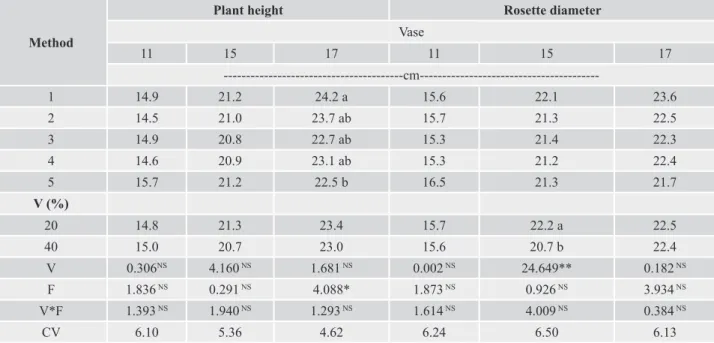
The average plant height did not differ significantly in
function of the substrate base saturation and the methods of fertirrigation when in vases 11 and 15 (Table 1). In the vase 17, the plants presented higher height when the fertirrigation was 100% via cistern (24.2 cm) and the lowest when it was 100% via substrate (22.5 cm). Vitoria and Leite (2008), by studying the potassium sources in three frequencies of leaf application, registered an average height of 22.5 cm for Aechmea fasciata. Moreover, Santos et al. (2015) obtained values between 20 and 26 cm. Therefore, the plant height is independent from the application methods and the substrate base saturation, which indicates that it is little affected by the environment factor, responding accordingly to the genetic characteristics of the specie.
Table 1. Averages values of height (cm) and rosette diameter (cm) of bromeliad (Aechmea fasciata), in centimeters, in function of the substrate base saturation and the fertirrigation methods in three evaluation times.
Method
Plant height Rosette diameter
Vase
11 15 17 11 15 17
---cm---1 14.9 21.2 24.2 a 15.6 22.1 23.6
2 14.5 21.0 23.7 ab 15.7 21.3 22.5
3 14.9 20.8 22.7 ab 15.3 21.4 22.3
4 14.6 20.9 23.1 ab 15.3 21.2 22.4
5 15.7 21.2 22.5 b 16.5 21.3 21.7
V (%)
20 14.8 21.3 23.4 15.7 22.2 a 22.5
40 15.0 20.7 23.0 15.6 20.7 b 22.4
V 0.306NS 4.160 NS 1.681 NS 0.002 NS 24.649** 0.182 NS
F 1.836 NS 0.291 NS 4.088* 1.873 NS 0.926 NS 3.934 NS
V*F 1.393 NS 1.940 NS 1.293 NS 1.614 NS 4.009 NS 0.384 NS
CV 6.10 5.36 4.62 6.24 6.50 6.13
F: method of fertirrigation. 1: 100% leaf cistern; 2: 75% leaf cistern e 25% substrate; 3: 50% leaf cistern e 50% substrate; 4: 25% leaf cistern e 75% substrate e 5: 100% substrate. V: substrate base saturation. V1: 20%; V2: 40%. Averages followed by the same letter in the column do not differ by the
The low values of the CV (%) indicate low variability of the plants height, meeting to one of the requirements for
the quality classification of bromeliad by Ibraflor (2000),
which is 90% of standardization of the plants height in the batch.
The genre Aechmea is classified as tank-dependent
(accumulate water), according to Paula (2000), because they present well developed tanks and leaf scales with high
absorption efficiency, making the roots merely fasteners.
Even though they have this higher capacity of nutrients absorption by the trichomes present in the leaves, it was not observed absorption restriction by the root system because the growth was similar, independently of the method of
nutritive solution application. Carneiro et al. (2009) verified
that the Aechmea plants conducted only with fertilization via substrate presented greater height, rosette diameter and number of leaves. Therefore, when the plants are extensively cultivated, the roots take over the function of water and nutrients absorption, besides its natural function of support. In a research done by Amaral et al. (2009),
they verified that the fertilization done via substrate was beneficial for the growth of epiphytic bromeliads.
The average of the rosette diameter did not significantly
differ in function of the method of fertirrigation (except in vase 15) and the substrate base saturation, where the highest value was observed with 20% of substrate base
saturation (Table 1). These results find support in the
literature because many authors indicate that the bromeliad is better developed in substrates with pH values between 3.5 and 6.5 (MEIJIAS and RUANO, 1990; BAENSCH, 1994; KÄMPF, 2000). Since the pH value of the substrate was initially in 7.0, the addition of more corrective elevated the pH to inadequate levels for the culture.
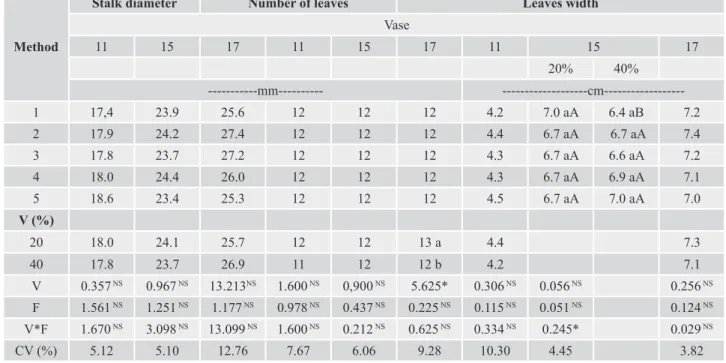
The methods of nutritive solution application and the
substrate base saturation did not influence significantly the
stalk diameter (Table 2). The stalk diameter is important to support the aerial part of the plant, and the higher the plant height is, the greater the stalk diameter should be. Since the plants had similar height in the different treatments, the stalk diameter was consistent.
Table 2. Averages values of stalk diameter, number of leaves and leaves width of bromeliad plants (Aechmea fasciata), in mm, in function of the substrate base saturation and the methods of fertirrigation in three evaluation times.
Method
Stalk diameter Number of leaves Leaves width
Vase
11 15 17 11 15 17 11 15 17
20% 40%
---mm---
---cm---1 17,4 23.9 25.6 12 12 12 4.2 7.0 aA 6.4 aB 7.2
2 17.9 24.2 27.4 12 12 12 4.4 6.7 aA 6.7 aA 7.4
3 17.8 23.7 27.2 12 12 12 4.3 6.7 aA 6.6 aA 7.2
4 18.0 24.4 26.0 12 12 12 4.3 6.7 aA 6.9 aA 7.1
5 18.6 23.4 25.3 12 12 12 4.5 6.7 aA 7.0 aA 7.0
V (%)
20 18.0 24.1 25.7 12 12 13 a 4.4 7.3
40 17.8 23.7 26.9 11 12 12 b 4.2 7.1
V 0.357 NS 0.967 NS 13.213NS 1.600 NS 0,900 NS 5.625* 0.306 NS 0.056 NS 0.256 NS
F 1.561 NS 1.251 NS 1.177 NS 0.978 NS 0.437 NS 0.225 NS 0.115 NS 0.051 NS 0.124 NS
V*F 1.670 NS 3.098 NS 13.099 NS 1.600 NS 0.212 NS 0.625 NS 0.334 NS 0.245* 0.029 NS
CV (%) 5.12 5.10 12.76 7.67 6.06 9.28 10.30 4.45 3.82
F: method of fertirrigation. 1: 100% leaf cistern; 2: 75% leaf cistern e 25% substrate; 3: 50% leaf cistern e 50% substrate; 4: 25% leaf cistern e 75% sub-strate e 5: 100% subsub-strate. V: subsub-strate base saturation. V1: 20%; V2: 40%. Averages followed by the same letter, lowercase in the column and upper case
in the line, do not differ by the Tukey’s Test by 5%. *, ** e NS = significant at 1% probability, significant at 5% probability and not significant at the Test.
The number of leaves was not influenced by the method
of nutritive solution application, being only changed in function of the percentage of substrate base saturation for the vase 17, and presenting its highest value in the saturation of 20% (Table 2). Over time, there was no increase in the number of leaves; however, it was observed that when a new leaf appeared, the oldest leaf entered in senescence. Vitoria and Leite (2008) obtained, in average, plants with 14 leaves; number which is greater than the one obtained in this present work. According to Kämpf (1994), the ideal
number of leaves for an appropriate plant development is between 10 and 20; therefore, the number of leaves observed in this work is in the optimal range.
The leaf area in bromeliad plants was significantly influenced by the interaction effect between the method of
application and the substrate base saturation, for vases 15 and 17 (Table 3). In vase 15, when the plants were conducted in substrate base saturation of 20%, the greatest foliar area was observed in treatment 2, 3 and 5, and the smallest leaf area was observed in treatment 4. On the other hand, in substrate base
saturation of 40%, the greatest leaf area was obtained with 100% of the application via leaf cistern, and the smallest was with 75% via leaf cistern and 25% via substrate. Considering the substrate base saturation, the leaf area was greater when it was 20%, in the solution application in the proportions of 75% via leaf cistern and 25% via substrate, 50% via leaf cistern and 50% via substrate and 100% via substrate.
Table 3. Averages values of leaf area of bromeliad plants (Aechmea fasciata), in function of substrate base saturation and the methods of fertirrigation in two evaluation times.
Part of the plant Method of
application
Vase 15 Vase 17
20% 40% 20% 40%
---cm2
---1 1654.3 bcA 1634.0 aA 1906.4 bA 1721.4 bA
2 1943.8 aA 1288.6 bB 2332.7 aA 2124.1 aA
3 1728.1 abA 1415.6 abB 2030.5 abA 2192.4 aA
4 1435.7 cA 1522.3 abA 2055.1 abA 1981.7 abA
5 1722.8 abA 1443.7 abB 2167.0 abA 1805.4 bB
V 557458.070** 177751.550**
F 31392.680NS 189453.660**
V*F 167019.530** 75582.530*
CV (%) 7.17 7.30
F: method of fertirrigation. 1: 100% leaf cistern; 2: 75% leaf cistern e 25% substrate; 3: 50% leaf cistern e 50% substrate; 4: 25% leaf cistern e 75% sub-strate e 5: 100% subsub-strate. V: subsub-strate base saturation. V1: 20%; V2: 40%. Averages followed by the same letter, lowercase in the column and upper case
in the line, do not differ by the Tukey’s Test by 5%. *, ** e NS = significant at 1% probability, significant at 5% probability and not significant at the Test.
When the plants were in vase 17, the ones conducted in substrate base saturation of 20% presented the greatest leaf area when 75% of the solution application was via leaf
cistern and 25% via substrate, differing significantly from
when 100% of the application was via leaf cistern. For the substrate base saturation of 40%, the greatest leaf areas were obtained when 75% of the solution was applied via
leaf cistern and 50% via leaf cistern, differing significantly
when 100% of the solution was applied via cistern and 100% via substrate. The plants conducted in substrate base saturation of 20% presented greater leaf area when 100% of the solution was applied via substrate, compared to the base saturation of 40%.
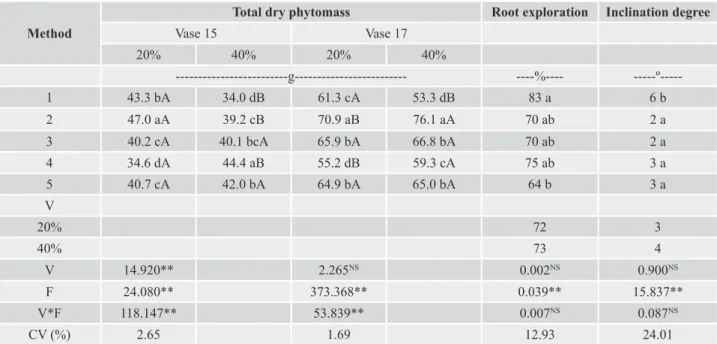
The total dry phytomass presented effect of the interaction between the substrate base saturation and the
Table 4. Averages values of root exploration and inclination degree of bromeliad plants (Aechmea fasciata) in function of substrate base saturation and methods of fertirrigation.
Method
Total dry phytomass Root exploration Inclination degree
Vase 15 Vase 17
20% 40% 20% 40%
---g--- ----%----
---º---1 43.3 bA 34.0 dB 61.3 cA 53.3 dB 83 a 6 b
2 47.0 aA 39.2 cB 70.9 aB 76.1 aA 70 ab 2 a
3 40.2 cA 40.1 bcA 65.9 bA 66.8 bA 70 ab 2 a
4 34.6 dA 44.4 aB 55.2 dB 59.3 cA 75 ab 3 a
5 40.7 cA 42.0 bA 64.9 bA 65.0 bA 64 b 3 a
V
20% 72 3
40% 73 4
V 14.920** 2.265NS 0.002NS 0.900NS
F 24.080** 373.368** 0.039** 15.837**
V*F 118.147** 53.839** 0.007NS 0.087NS
CV (%) 2.65 1.69 12.93 24.01
F: method of fertirrigation. 1: 100% leaf cistern; 2: 75% leaf cistern e 25% substrate; 3: 50% leaf cistern e 50% substrate; 4: 25% leaf cistern e 75% sub-strate e 5: 100% subsub-strate. V: subsub-strate base saturation. V1: 20%; V2: 40%. Averages followed by the same letter, lowercase in the column and upper case
in the line, do not differ by the Tukey’s Test by 5%. *, ** e NS = significant at 1% probability, significant at 5% probability and not significant at the Test.
The root exploration was superior in the plants that received 100% of the solution via leaf cistern, compared to those that received 100% of the fertirrigation via substrate (Table 4). With the increase of the humidity in the substrate, there was a reduction of the root exploration in the container, reducing 19% of the explored area when 100% of the solution was applied via substrate. This is an indicative that the bromeliad A. fasciata does not tolerate
humidity close to the field capacity, fact which was also
described by Paula (2000). Another possibility is that the quantity of the nutritive solution provided via leaf cistern has slowly drained to the substrate, maintaining it with a minimum level of water for the root development. In function of the substrate presented only 3.7% of its space with available water, when the solution was applied via substrate, there could have happened percolation of the solution, making the substrate drier for a long period.
The inclination degree of the bromeliad plants was superior in the plants that received 100% of the solution via leaf cistern, with 6° (Table 4). Even though it was observed greater root exploration when plants received 100% of the fertirrigation via leaf cistern, compared to those that received 100% of the fertirrigation via substrate, the inclination degree was superior to the other treatments. This greater root exploration should have been predominant of thin roots responsible for water and nutrients absorption, with less capacity to plant support. However, this higher inclination degree did not lead to plant tipping. According
to the quality standards of Ibraflor (2000), the bromeliad
plant must have a good formation, represented by its support in the vase.
CONCLUSIONS
The best growth of the Aechmea fasciata was achieved with 20% of substrate base saturation and 75% of the nutrient solution via the cistern and 25% of the substrate.
ACKNOWLEDGMENTS
The authors are thankful to Eco Flora Bromélias.
AUTHORS CONTRIBUTIONS
L.V.C.S.: conception and design of the research, obtaining data, analyze and interpretation of data, statistical analysis, wrote and critically analyses of manuscript. F.L.:
analyze and interpretation of the data, statistical analysis, wrote and critically analyses of manuscript. R.L.V.B.:
conception and design of the research, obtaining data, analyze and interpretation of the data, wrote and critically
analyses of manuscript and financial and obtaining
funding. C.M.A.M.: conception and design of the research, obtaining data analyze and interpretation of the data, statistical analysis, wrote and critically analyses of manuscript.
REFERENCES
AMARAL, T.L.; JASMIM, J.M.; NAHOUM, P.I.; FREITAS, C.B.; SALES, C.S. Adubação nitrogenada e
potássica de bromeliáceas cultivadas em fibra de coco
BAENSCH, U. Blooming bromeliads. Nassau: Tropic Beauty, 1994. 269p.
BENZING, D.H.; RENFROW, A. The mineral nutrition of bromeliaceae. Botanical Gazette, v.135, p.281-288. 1974.
BRASIL. Instrução Normativa n° 46 de 12/09/2006.
(Aprova os Métodos Analíticos Oficiais para Análise de
Substratos e Condicionadores de Solos, na forma do Anexo
à presente Instrução Normativa). Diário Oficial da União,
n° 177 de 14/09/2006. 2006.
CARNEIRO, D.N.M.; PAIVA, P.D.O.; CECÍLIA, E.R.A.S.; CARNEIRO, L.F.; PAIVA, R. Adubação foliar e via substrato no desenvolvimento inicial de mudas de bromélia imperial. Revista Brasileira de Horticultura Ornamental, v.15, p.23-28. 2009.
DEMATTÊ, M.E.S.P. Cultivo de Tillandsia kautskyi
E. Pereira, bromélia brasileira em risco de extinção: considerações sobre adubação foliar. Revista Brasileira de Horticultura Ornamental, v.12, p.112-116. 2006.
FERREIRA, D.F. Sisvar: A computer statistical analysis system. Ciência e Agrotecnologia, v.35, p.1039-1042, 2011.
GIAMPAOLI, P.; SANTOS, D.S.; MOLLO, L.; KANASHIRO, S.; TAVARES, A.R. Effect of fertilization with urea on development in the ornamental bromeliad
Aechmea fasciata. Revista Ciência Agronômica, v.48, p.657-662. 2017.
IBRAFLOR - Instituto Brasileiro de Floricultura. 2000.
Padrão Ibraflor de Qualidade. Campinas, 90p.
JUNQUEIRA, A.H.; PEETZ, M.S. Mercado interno para
os produtores da floricultura brasileira: características,
tendências e importância sócio-econômica recente. Revista Brasileira de Horticultura Ornamental, v.14, p.37-52. 2008.
KÄMPF, A.N. Adubação foliar em Aechmea fasciata (L) Backer. Revista da Sociedade Brasileira de Bromélias,
v.1, p. 16-20, 1994.
KÄMPF, A.N. Seleção de materiais para uso como substrato. In KÄMPF, A.N., FERMINO, M.H., Substratos para Plantas: a base da produção vegetal em recipientes.
Porto Alegre: Gênesis, p.139-146, 2000.
MEJIAS, R.M.J.; RUANO, M.R.C. El cultivo industrial del plantas em maceta. Réus: Ediciones de Horticultura, 664p. 1990.
NEGRELLE, R.R.B.; MITCHELL, D.; ANACLETO, A. Bromeliad ornamental species: conservation issues and challenges related to commercialization. Acta Scientiarum Biological Sciences, v.34, p.91-100. 2012.
PAULA, C.C. Cultivo de bromélias. Viçosa: Aprenda Fácil, 139p. 2000.
SANTOS, F.H.S.; ALMEIDA, E.F.A; FRAZÃO, J.E.M.; SANTOS, A.C.P. Nutrição nitrogenada em bromélias.
Revista Brasileira de Horticultura Ornamental, v.18, p.39-46. 2012.
SANTOS, F.H.S.; ALMEIDA, E.F. A.; FRAZÃO, J.E.M.; REIS, S.N.; NASCIMENTO, A.M.P. Adubação nitrogenada via substrato no cultivo de bromélia. Ornamental Horticulture, v.21, p.185-192. 2015.
TAMAKI, V.; PAULA, S.M.; NIEVOLA, C.C.; KANASHIRO, S. Soluções nutritivas alternativas para o cultivo de bromélias ornamentais. O Mundo da Saúde, v.35, p.91-97. 2011.
VIEIRA, C.; WEBER, O. Saturação por Bases no Crescimento e na Nutrição de Mudas de Ipê-Amarelo.
Floresta e Ambiente, v.24, p. 1-10. 2017;
VITÓRIA, E.S.S.; LEITE, I.C. Desenvolvimento e qualidade de plantas de Aechmea fasciata (Lindley) Baker com a utilização do cloreto de potássio ou do sulfato de potássio aplicados em três frequências por via foliar.