Original Article 371
-INEFFECTIVE AIRWAY CLEARANCE IN CHILDREN WITH ASTHMA:
A DESCRIPTIVE STUDY
Lanuza Celes Mendes1, Joyce Carolle Bezerra Cavalcante2, Marcos Venícios de Oliveira Lopes3, Luisa Helena de Oliveira Lima4
1 Nurse, Maternidade Escola Assis Chateaubriand, Federal University of Ceará (UFC). Ceará, Brazil. E-mail: lana_celes@hotmail. com
2 Nurse, Hospital Geral de Fortaleza,Ceará, Brazil. E-mail: [email protected]. 3 Ph.D. in Nursing. Professor at UFC. Ceará, Brazil. E-mail: [email protected]
4 Ph.D. in Nursing. Adjunct Professor I, Federal University of Piauí. Piauí, Brazil. E-mail: [email protected]
ABSTRACT: This cross-sectional study was performed with 147 children with a medical diagnosis of asthma admitted to a public children’s hospital in Fortaleza, Cerará (CE). The objective of the study was to analyze the accuracy of the deining characteristics of the nursing diagnosis “ineffective airway clearance” in children with asthma. A physical examination checklist was used for data collection. The most frequent deining characteristics were adventitious respiratory sounds (82.3%), dyspnea (55.8%), and changes in respiratory rate (50.3%). The nursing diagnosis “ineffective airway clearance” was present in 55.8% of the sample. The deining characteristic with the greatest sensitivity was “adventitious respiratory sounds”. The speciic characteristic for this diagnosis was “wide eyed”. Regarding the predictive values, adventitious respiratory sounds showed a high negative predictive value. In conclusion, studies that contribute to deining the most common deining characteristics for a particular population should be encouraged, as they serve as a guide for the practice of nursing.
DESOBSTRUÇÃO INEFICAZ DAS VIAS AÉREAS EM CRIANÇAS
ASMÁTICAS: UM ESTUDO DESCRITIVO
RESUMO: Estudo transversal, realizado com 147 crianças internadas com diagnóstico médico de asma, em um hospital infantil público de Fortaleza-CE. Foi desenvolvido com o objetivo de analisar a acurácia das características deinidoras do diagnóstico de enfermagem “desobstrução ineicaz das vias aéreas” em crianças asmáticas. Utilizou-se um roteiro de exame físico para a coleta de dados. As características deinidoras mais frequentes foram ruídos respiratórios adventícios (82,3%), dispneia (55,8%), e mudança na frequência respiratória (50,3%). O diagnóstico de enfermagem: “desobstrução ineicaz das vias aéreas” esteve presente em 55,8% da amostra. A característica deinidora de maior sensibilidade foi “ruídos adventícios respiratórios”. A característica especíica para este diagnóstico foi “olhos arregalados”. Com relação aos valores preditivos, os ruídos adventícios respiratórios mostraram elevado valor preditivo negativo. Conclui-se que estudos que contribuem para deinir o peril de características deinidoras mais comuns para uma população particular devem ser estimulados, pois servem de guia para a prática de enfermagem.
DESCRITORES: Diagnóstico de enfermagem. Cuidado da criança. Asma. DESCRIPTORS: Nursing diagnosis. Child care. Asthma.
LIMPIEZA INEFICAZ DE LAS VÍAS AÉREAS EN NIÑOS ASMÁTICOS:
UN ESTUDIO DESCRIPTIVO
RESUMEN: Estudio transversal realizado con 147 niños asmáticos ingresados en un hospital público de Fortaleza-CE, Brasil. Ha sido desarrollado con el objetivo de analizar la efectividad de las características deinitorias del diagnóstico de enfermería “limpieza ineicaz de las vías aéreas” en niños asmáticos. Se utilizó un guión de examen físico para recopilar los datos. Las características deinitorias más frecuentes fueron ruidos respiratorios agregados (82,3%), disnea (55,8%) y cambio en la frecuencia respiratoria (50,3%). El diagnóstico de enfermería: “limpieza ineicaz de las vías aéreas” estuvo presente en el 55,8% de la muestra. La característica deinitoria para este diagnóstico fueron los “ruidos respiratorios agregados”. La característica especíica ha sido “ojos muy abiertos”. Con relación a los valores predictivos, los ruidos respiratorios agregados presentaron un alto valor predictivo negativo. Se llegó a la conclusión de que los estudios que contribuyen a conigurar el peril de las características deinitorias más comunes a una población particular deben ser fomentados, pues sirven de guía para la práctica de enfermería.
INTRODUCTION
Establishing a nursing diagnosis assumes vital importance during the application of the nursing process, as this is considered to be the intellectual activity that nurses are expected to perform in their daily practice in order to judge the human responses that require nursing care. The nursing diagnosis is an essential element in the nurses’ decision-making process, permitting the identiication of evidence based on factual information regarding the real condition of the individual, thus allowing nursing professionals to identify the accurate nursing diagnosis, thereby promoting adequate interventions and achieving effective outcomes.1
The nursing diagnosis was introduced in Brazil in 1967 by Wanda de Aguiar Horta, and is used as a planning tool to guide care in spe-ciic clinical situations. Therefore, the diagnosis is highly important to direct nursing practice and to organize the knowledge grounding this practice.3 The nursing diagnosis is a clinical judg-ment regarding the responses of the individuals, family or community to the health problems and real or potential processes, and is used to guide one’s care plan.4
In order to achieve an accurate nursing diag-nosis, it is necessary to identify clinical indicators capable of predicting them. Clinical indicators (the term) has also been used as being synonymous to deining characteristics, clinical evidence, signs and symptoms.5 The nursing diagnosis must have clinical references (deining characteristics) that are present in a population with a speciic diagnosis.6 To determine these, it is necessary to identify a pat-tern standard that guarantees selecting patients that either have or do not have the speciic diagnosis, and knowing the cause of their problems. Therefore, achieving an accurate nursing diagnosis means de-termining the speciicity, sensitivity and predictive value of indicators associated with a speciic diag-nosis, which are relevant aspects for its validation.5 This study was deined as a continuation of earlier studies, developed as a partnership between members of the Group for Studies on Nursing Diagnosis, Interventions and Outcomes. According to the NANDA taxonomy7, Inef-fective Airway Clearance (IAC) is deined as the inability to clear secretions or obstructions from the respiratory tract to maintain a clear airway. The deining characteristics of IAC are dyspnea, di-minished breath sounds, orthopnea, adventitious
respiratory sounds ( crackles, sonorous breath sounds and wheezes), ineffective cough, absent cough, ineffective or absent sputum production, cyanosis, dificulty vocalizing, wide-eyed expres-sion, changes in respiratory rate and rhythm, and restlessness.
The selected group (children with asthma) presents important characteristics, because asthma has great epidemiological importance. Every year in Brazil, there are nearly 280,000 admissions due to asthma, which ranks as the fourth cause of hos-pital admissions according to the Uniied Health System (2.4% of the total number of admissions in 2006). Furthermore, asthma ranks as the third cause of admissions among children and young adults. In 2006, the Northeast region accounted for nearly 120,000 admissions due to asthma (ap-proximately 44% of all asthma cases). Considering only children younger than nine years of age, in 2006 asthma accounted for 7.75% of hospital ad-missions in Brazil.8 It has been reported that the number of hospital admissions increased between 1993 and 1999. In 2006, admissions due to asthma cost the Uniied Health System 88 million Reais, 1.3% of the total annual expenses related to hospi-tal admissions and the third largest amount spent on one single disease.8
From this perspective, the present study had the following objectives: to identify the prevalence of the IAC nursing diagnosis among children with asthma; determine the association between this diagnosis and its deining characteristics; verify the reproducibility of the deining characteristics for establishing the ICA nursing diagnosis in children with asthma; and identify the accuracy of the deining characteristics of the ICA nursing diagnosis in children with asthma.
METHOD
The study was performed at a public chil-dren’s hospital in Fortaleza-CE, located in the area covered by the Regional Administrative Depart-ment referred to as Secretaria Executiva Regional IV
– SER IV. The referred hospital was chosen because it is responsible for the Program for Comprehen-sive Care to Children with Asthma (Programa de Atenção Integral à Criança com Asma - PROAICA), in Fortaleza-CE. Other determining factors for choosing the referred location included its easy accessibility and the attachment established with the professionals in the Program regarding other studies developed in the same location.
The study population consisted of children with asthma who were inpatients in the referred hospital. In 2009 in Fortaleza, 3384 children be-tween zero and nine years of age were admitted with asthma, and the mean length of stay was 3.4 days. The sample size was estimated according to the formula n=Zα2.P.Q/E2, which considers an ininite population, due to the impossibility of deining the exact size of the population in the referred institution in which: n=sample size; Zα= signiicance level; P = prevalence of the health condition; Q = (1-P); and E =sample error.
The following parameters were considered: signiicance level of 95% (Zα=1.96); and sample error of 7%. Regarding the prevalence of the event, a 75% rate was considered, which had previously been estimated in a study regarding the nursing diagnosis involving acute respiratory infection.10 It was not possible to use the prevalence of the studied diagnosis as a reference because it was not found in literature. The estimated sample size was 147 children with asthma.
The following inclusion criteria were used: children aged between zero and six incomplete years; and children with a medical diagnosis of asthma. The exclusion criterion was: children with another associated chronic disease.
Consecutive sampling was used, considering all the children who met the inclusion criteria. The children were recruited from the hospital unit of the referred hospital.
The data collection instrument was based on the taxonomy from the North American Nurs-ing Diagnosis Association,7 divided into domains and classes to identify the IAC nursing diagnosis. Therefore, to allow for a more accurate identii-cation of the deining characteristics, a physical examination checklist was used. The chosen data collection instrument contains the signs and symp-toms that represent the deining characteristics and
factors related to the IAC nursing diagnosis which are likely present in children with asthma. The in-strument was validated in terms of its appearance and content by four faculty members who had been engaged in studies regarding nursing diag-nosis in patients with heart disease, two of whom work directly with children having congenital heart disease. After making adjustments accord-ing to submitted suggestions, the instrument was applied as a pilot test on ive children with asthma in conditions similar to those assessed in the pres-ent study. No inadequacies were observed in the test and, thus, the instrument was considered to be adequate.
The data were collected after the children’s parents/guardians were fully informed abut the conidentiality of the information and identities, and signed the Free and Informed Consent Form (FICF). A thorough nursing clinical examination was performed, based on the data collection instru-ment and by consulting the results of biochemical and radiological exams, including the prescrip-tions and evaluaprescrip-tions of every professional that comprised the nursing healthcare team at the hospital.
The process of elaborating and inferring the diagnosis and collaborative problems was performed according to the following steps: data collection, interpretation/grouping and naming of the categories.11 In order to name the diagnoses, the NANDA Taxonomy II was used.7
In the diagnostic inference process, the clini-cal backgrounds were forwarded to ive experts with the purpose of observing their agreement regarding the presence or absence of the IAC diagnosis.
There was a consensus among most experts regarding the occurrence or absence of the diag-nosis, i.e., the diagnosis was present when three or more experts considered the patient to have asthma. All experts signed the FICF.
The data were organized into tables and ana-lyzed based on absolute and percentage frequen-cies, also including measures of central tendency, measures of dispersion, tests of means and cor-relation coeficients associations and differences. The Kolmogorov-Smirnov test was used to verify the normality of the numerical data, and Levene’s test was used to verify the homogeneity of variances.
frequencies greater than ive, and the Fisher’s test for the expected frequencies smaller than ive. The Chi-Square and Fisher’s tests are non-parametric tests used to compare two nominal variables, verifying if there is a dependent relationship between them.
The T test was used to calculate the differ-ence between the means. Pearson’s correlation coeficient was used for the data showing normal-ity, homogeneity of variance and linearity. For the other data, Spearman’s Rho correlation coeficient was used. Accuracy was analyzed by means of sensitivity, speciicity and the predictive value.
The research proposal was evaluated and ap-proved by the Federal University of Ceará Ethics
Committee, under review number 181/07, and the hospital gave permission for the data collection.
Before the study, the patients’ parents/ guardians provided consent and signed the FICF. The patients’ parents/guardians were informed regarding their right to participate or decline par-ticipation, with no harm to their care or treatment.
RESULTS
This section presents tables containing the present study results. The tables show the de-mographic data and the IAC diagnosis, with an analysis of their deining characteristics.
Table 1 – Children with asthma according to gender, age, weight and length of stay. Fortaleza-CE, 2009
Variables N %
Gender
Female 66 44.9
Male 81 64.3
Total 147 100.0
KS* (p value) Mean Standard deviation Median
Age (months) 0.002 24.42 19.667 18.00
Weight (grams) 0.000 13690.15 21767.389 11200.00
Length of stay (days) 0.001 3.96 2.622 3.00
*Kolmogorov-Smirnov test.
According to the data, it is observed that there is a higher prevalence of male children with asthma (64.3%). The children’s mean age was 24.42 months (±19.667), the median weight was 11.200 kg (± 21.7) and the median length of stay was three days (Table1). An asymmetrical distribution (p< 0.05) was observed for the weight and length of stay variables, in view of the presence of extreme values.
Regarding the agreement between the ex-perts in terms of the IAC nursing diagnosis, a 0.170 value was reported for Kendall’s coeficient of concordance (Kendall’s W). This value denotes the overall agreement among all the experts. In this study, a 17% combined agreement was found among the experts.
Table 2 – Prevalence of the deining characteristics
and the diagnosis for ineffective airway clearance. Fortaleza-CE, 2009
Deining characteristics n %
Diminished breath sounds 27 18.4
Adventitious respiratory sounds 121 82.3
Ineffective cough 32 30.5
Absent cough 36 24.5
Excessive sputum 66 44.9
Dificulty vocalizing 8 5.4
Changes in respiratory rate 74 50.3
Changes in respiratory rhythm 24 16.3
Restlessness 25 17.0
Dyspnea 82 55.8
Orthopnea 48 32.7
Ineffective airway clearance
Present 82 55.8
Absent 65 44.2
375 -The most prevalent deining characteristic
was “adventitious respiratory sounds” (82.3%). Only three characteristics presented prevalence
greater than 50%. The IAC nursing diagnosis was present in 55.8% of the studied population.
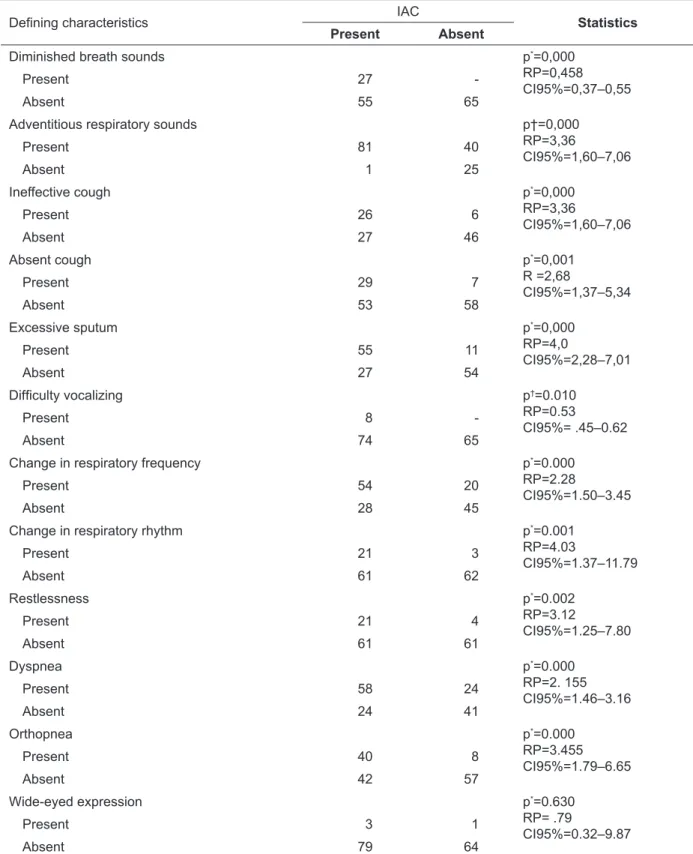
Table 3 – Relationship between the diagnosis of ineffective airway clearance and the deining
characteristics. Fortaleza-CE, 2009
Deining characteristics IAC Statistics
Present Absent
Diminished breath sounds p*=0,000
RP=0,458 CI95%=0,37–0,55
Present 27
-Absent 55 65
Adventitious respiratory sounds p†=0,000
RP=3,36
CI95%=1,60–7,06
Present 81 40
Absent 1 25
Ineffective cough p*=0,000
RP=3,36
CI95%=1,60–7,06
Present 26 6
Absent 27 46
Absent cough p*=0,001
R =2,68
CI95%=1,37–5,34
Present 29 7
Absent 53 58
Excessive sputum p*=0,000
RP=4,0
CI95%=2,28–7,01
Present 55 11
Absent 27 54
Dificulty vocalizing p†=0.010
RP=0.53
CI95%= .45–0.62
Present 8
-Absent 74 65
Change in respiratory frequency p*=0.000
RP=2.28
CI95%=1.50–3.45
Present 54 20
Absent 28 45
Change in respiratory rhythm p*=0.001
RP=4.03
CI95%=1.37–11.79
Present 21 3
Absent 61 62
Restlessness p*=0.002
RP=3.12
CI95%=1.25–7.80
Present 21 4
Absent 61 61
Dyspnea p*=0.000
RP=2. 155 CI95%=1.46–3.16
Present 58 24
Absent 24 41
Orthopnea p*=0.000
RP=3.455
CI95%=1.79–6.65
Present 40 8
Absent 42 57
Wide-eyed expression p*=0.630
RP= .79
CI95%=0.32–9.87
Present 3 1
Absent 79 64
*Chi-Square Test; † Fisher’s exact test.
Nearly all of the deining characteristics of the IAC diagnosis presented a statistically signiicant association (p<0.05). The only exception was the characteristic “wide-eyed expression” (p=0.630). Among the characteristics with statistical
signii-cance, those with greater magnitude were: excessive sputum and change in respiratory rhythm. The prevalence ratio of these characteristics showed that they can increase the child’s probability of present-ing the IAC diagnosis up to four times.
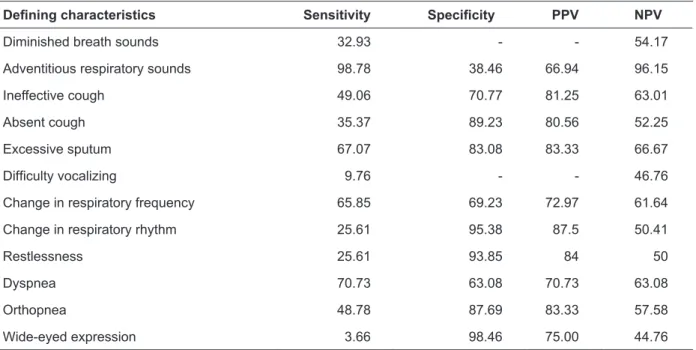
Table 4 - Sensitivity, speciicity, Positive Predictive Value (PPV) and Negative Predictive Value (NPV) for the deining characteristics of ineffective airway clearance. Fortaleza-CE, 2009
Deining characteristics Sensitivity Speciicity PPV NPV
Diminished breath sounds 32.93 - - 54.17
Adventitious respiratory sounds 98.78 38.46 66.94 96.15
Ineffective cough 49.06 70.77 81.25 63.01
Absent cough 35.37 89.23 80.56 52.25
Excessive sputum 67.07 83.08 83.33 66.67
Dificulty vocalizing 9.76 - - 46.76
Change in respiratory frequency 65.85 69.23 72.97 61.64
Change in respiratory rhythm 25.61 95.38 87.5 50.41
Restlessness 25.61 93.85 84 50
Dyspnea 70.73 63.08 70.73 63.08
Orthopnea 48.78 87.69 83.33 57.58
Wide-eyed expression 3.66 98.46 75.00 44.76
The deining characteristic with the greatest sensitivity for the IAC diagnosis was “adventi-tious respiratory noises” (98.78%). The other char-acteristics presented low sensitivity values. On the other hand, the characteristic that presented the greatest level of speciicity was “wide-eyed expression” (98.46%). Other characteristics pre-sented high values of speciicity and should be considered important for the addressed diagno-sis. Regarding the predictive values, adventitious respiratory noises had a high negative predictive value and the characteristics ineffective cough, absent cough, excessive sputum, change in re-spiratory rhythm, and orthopnea has moderate positive prediction values.
DISCUSSION
A diagnosis is identiied by deining char-acteristics that describe how patients develop the related group of signs and symptoms. Because some characteristics determine more than one di-agnosis, nursing professionals must receive proper training to avoid making wrong diagnoses in error.
In this sense, this study identiied the most important determining characteristics for the nurs-ing diagnosis IAC.
According to literature,5 male children are more likely to develop asthma, considering that their airways are smaller in diameter and greater in tonicity compared to female children of the same age, which results in a lower pulmonary low. One report-ed study12 found that of the 434 children evaluated, 62.7% were male, which agrees with another study13, which found a 54.2% male prevalence among the 48 children with asthma who were analyzed. These data are similar to those found in the present study, in which 64.3% of the children were male.
The mean age of the studied children was 24.42 months (±19.667), which agrees with another study with a similar population,14 which found a mean age of 28.5 months. According to literature,15 for 78.7% of children the irst hospital admission occurs before the age of 24 months, and the irst symptoms also occur before 24 months in 86.2% of children.
char-acteristics were “adventitious respiratory sounds” (82.3%), “dyspnea” (55.8%), and “change in respi-ratory rhythm” (50.3%). These values are similar to those found in another study14 of children with asthma, which found a 66.7% prevalence for the diagnosis, with the most prevalent characteristics being adventitious respiratory sounds (76.2%) and change in respiratory frequency (61.9%).
The signiicant deining characteristics were: diminished breath sounds, adventitious respira-tory sounds, excessive sputum, dyspnea, orthop-nea, ineffective cough, absent cough, difficult vocalizing, change in respiratory frequency and change in rhythm, different from results found in another study of children with asthma, in which the greatest prevalence was for dyspnea, orthop-nea and accessory muscle use.14
In addition to the identiication of prevalence and signiicance, it is also important to determine sensitivity, speciicity, the positive predictive value and the negative predictive value of the deining characteristics. To do this, it is necessary to establish a speciic population to avoid changing the param-eters in order to better guide nursing care.
In the literature,14 the deining characteristic that is sensitive for the identiied diagnosis is “ad-ventitious respiratory sounds” and there is no data regarding high speciicity. In the present study, the most sensitive defining characteristic was the same, but “wide-eyed expression” was also considered speciic, which was different from the study stated above. There were no characteristics with high positive or negative predictive values for the referred diagnosis. It should be highlighted that the characteristic “wide-eyed expression” pre-sented high speciicity. This indicates that when this characteristic is absent, the IAC diagnosis will also be absent in populations with characteristics similar to those of the present study, because speci-icity refers to the capacity that the absence of a deining characteristic has to indicate the absence of the diagnosis. No other IAC studies that identi-ied deining characteristics with high speciicity values were located.
It should be highlighted that studies regard-ing nursregard-ing diagnoses and their relationships with the deining characteristics as predictors of a diagnosis remain in their infancy. Children with asthma are more susceptible to developing responses such as ineffective airway clearance. The deiciency of these types of studies reveals that studies focused on nursing care plans regarding this diagnosis are particularly relevant.
CONCLUSION
In this study a 55.8% prevalence was found for the ineffective airway clearance diagnosis in children with asthma. All the diagnosis char-acteristics were considered statistically signii-cant (p<0.005), except “wide-eyed expression” (p=0.63).
The most sensitive characteristic for the di-agnosis was “adventitious respiratory sounds”, which is also the characteristic with the highest negative predictive value. The characteristic with greatest speciicity was “wide-eyed expression”.
Studies that collaborate to outline the pro-iles of the most frequent deining characteristics for a speciic population should be encouraged, considering that few studies exist in the literature. Furthermore, these studies could serve as guides for nursing practice, thus contributing to an ac-curate identiication of the diagnosis as well as for the systematization of nursing care in order to make the NANDA language more accessible for use among nursing professionals.
The analysis of the accuracy of the deining characteristics of the IAC nursing diagnosis is rel-evant for nursing because it provides nurses with better clarity when establishing the diagnosis of asthma in children.
REFERENCES
1. Santos ASR, Souza PA, Valle AMD, Cavalcanti ACD, Sá SPC, Santana RF. Caracterização dos diagnósticos
de enfermagem identiicados em prontuários de
idosos: um estudo retrospectivo. Texto Contexto Enferm. 2008 Jan-Mar; 17(1):141-9.
2. Horta WA. Processo de enfermagem. São Paulo (SP): EPU; 1979.
3. Creason NS, Camilleri DD, Kim MJ. Concept development in nursing diagnosis. In: Rodgers
BL, Knal KA, editors. Concept development in
nursing: foundations, techniques, and applications. Philadelphia (US): Saunders; 1993. p. 217-34. 4. Carpenito-Moyet LJ. Diagnósticos de enfermagem:
aplicação à prática clínica. Porto Alegre (RS):
Artmed; 2005.
5. Chang BL, Uman GC, Hirsch M. Predictive power of
clinical indicators for self-care deicit. Nurs Diagn.
1998 Apr; 9(2):71-82.
6. Grant JS, Kenney MR. Clinical referents for nursing diagnoses. J Neurosci Nurs. 1992 Apr; 24(2): 94-98. 7. North American Nursing Diagnosis Association
(NANDA). Diagnósticos de enfermagem da
NANDA: deinições e classiicações 2007-2008. Porto
8. Ministério da Saúde (BR). DATASUS. Informações
de saúde [online]. 2007 [citado 2008 mar 25].
Disponível em http://www.datasus.gov.br/ 9. Rouquayrol MZ, Almeida Filho N. Epidemiologia e
saúde.6ª ed. Rio de Janeiro (RJ): MEDSI; 2003.
10. Monteiro FPM, Silva VM, Lopes MVO. Diagnósticos de enfermagem identificados em crianças com infecção respiratória aguda. Rev Eletr Enferm [periódico na Internet]. 2006 [acesso 2009 Jul 1]; 8(2):213-21. Disponível em: http://www.en.ufg.br/ revista/revista8_2/v8n2a06.htm
11. Gordon M. Nursing diagnosis: process and application. St. Louis (US): Mosby; 1994.
12. Ventura RN, Naspitz C, Puccini RF, Silva EMK. Avaliação do programa de atenção a crianças asmáticas acompanhadas nas unidades de saúde do
município de Embu, São Paulo, no período de 1988 a 1993. Cad Saúde Pública. 1998 Jan-Mar; 14(1):117-28. 13. Werner C, Yamamoto LY, Marten M, Moliani
C, Yoshida FR, Aguari G, et al. Situação das crianças asmáticas da Unidade Básica de saúde
do Conjunto Cafezal-Londrina-PR. Semina. 1995
Set; 16(Esp):81-4.
14. Silveira UA, Lima LHO, Lopes MVO. Características definidoras dos diagnósticos de enfermagem desobstrução ineficaz das vias aéreas e padrão
respiratório ineicaz em crianças asmáticas. Rev Rene. 2008 Out-Dez; 9(4):125-33.
15. Lasmar L, Goulartb E, Sakuraic E, Camargos P.
Fatores de risco para hospitalização de crianças e adolescentes asmáticos. Rev Saúde Pública. 2002 Ago; 36(4):409-19.
Correspondence to: Luisa Helena de Oliveira Lima Rua Zuza Lino, 1239, ap. 01