The scientific production regarding
leadership in the context of nursing
*C
ritiCal
r
eview
1 Doctoral student, Federal University of Santa Catarina, Nursing Graduate Program. CNPq scholarship. Member of the Nursing Education Research Group. Florianópolis, SC, Brazil. [email protected] 2 PhD in Nursing. Associate professor, Federal University of Santa Catarina. CNPq scholarship of Research productivity. Leader of the Nursing Education Research Group. Florianópolis, SC, Brazil. [email protected] 3 Doctoral student, Federal University of Santa
RESUmo
O estudo tem por objeivo ideniicar a pro
-dução cieníica sobre liderança no contexto da enfermagem produzida nos úlimos 10 anos (1999-2008). Trata-se de uma revisão bibliográica na base de dados LILACS, na qual foram incluídos trabalhos publicados no formato de arigos, teses, dissertações, editoriais, apresentação de trabalho em eventos; em português, inglês ou espanhol; disponíveis na íntegra no formato eletrônico. Optou-se pela construção de um formulário para registrar os dados das produções, entre eles: referência, procedência dos manuscri
-tos, ano, categoria, objeivos, metodologia e referencial teórico. Encontrou-se 57 publi
-cações, das quais houve o predomínio de ar
-igos originais, do ipo descriivo, no âmbito hospitalar e a escassa uilização de Teorias de Liderança fundamentando os estudos. A pes
-quisa aponta para a necessidade de adotar programas de desenvolvimento de líderes e projetos de educação permanente nos servi -ços de saúde, a im de prepará-los para apli
-car a liderança na enfermagem.
dEScRiToRES
Enfermagem Liderança Serviços de Saúde
AbSTRAcT
The objecive of this study is to idenify the scieniic producion in the context of nursing produced in the last decade (1999-2008). This literature review was performed using the LILACS database and included studies published as aricles, theses, dissertaions, editorials and pre
-sentaions in events. Studies were writen in Portuguese, English, or Spanish with the electronic full-text version available. A form was developed to register the data regarding the producion, which included: reference, source of the manuscript, year, category, objecive, methodology and theoreical framework. A total of 57 pub
-licaions were found; most were original, descripive aricles performed in the hos
-pital environment, and very few studies were founded on the Leadership Theory. It is necessary to adopt leadership develop
-ment programs and permanent educaion projects within health services, with the purpose of preparing nurses to work as leaders.
dEScRiPToRS
Nursing Leadership Health Services
RESUmEn
Estudio que objeiva ideniicar la pro
-ducción cieníica sobre liderazgo contex -tualizado en enfermería generada en los úlimos diez años (1999-2008). Se trata de una revisión bibliográica en base de datos LILACS, en la que se incluyeron trabajos publicados como arículos, tesis, diserta
-ciones, editoriales, presentaciones de tra
-bajos en eventos; en portugués, inglés o español; disponibles íntegramente en for
-mato digital. Se optó por construir un for
-mulario para registrar los datos de los tra -bajos, entre ellos: referencia, procedencia del manuscrito, año, categoría, objeivos, metodologías y referencial teórico. Se en
-contraron 57 publicaciones, predominando arículos originales de ipo descripivo, en ámbito hospitalario, y la escasa uilización de Teorías de Liderazgo fundamentando los estudios. La invesigación determina la necesidad de adoptar programas de desa
-rrollo de líderes y proyectos de educación permanente en servicios de salud, a efec
-tos de aplicar el Liderazgo en enfermería.
dEScRiPToRES
Enfermería Liderazgo Servicios de Salud
Simone coelho Amestoy1, Vânia marli Schubert backes2, Letícia de Lima Trindade3, bruna
Pedroso canever4
PRoDUção CIENtíFICA SoBRE LIDERANçA No CoNtExto DA ENFERMAGEM
inTRodUcTion
Given numerous changes in the world that originated in economic, sociology, poliical theory, ethics and philos -ophy, which characterize the complexity of current imes, the need for greater lexibility and a broader view con -cerning knowledge emerged, which requires the qualii -caion of professionals with new competencies and skills, among them leadership.
Leadership began to be scieniically studied at the beginning of the 20th century and consists of the process of inluencing people to work in an ethical-professional manner. It requires the establishment of ies of trust to work collecively, aiming to achieve common objecives(1). Some authors from the ield of Nursing consider it a phe -nomenon of group inluence, in which it is necessary to aggregate individual eforts in order to achieve goals shared by the group(2-4). Hence, we observe that the ex
-ercise of leadership in the current context is included in a nurse’s acions because nurses have, with increasing fre -quency, occupied prominent funcions in health services related to the management of care.
In order to provide a beter understand -ing of the topic, it is necessary to clarify that the learning-teaching process of nurses sufered many changes over the years and resulted in important changes in diferent historical contexts, changing the proile of nurses, as well(5). It is worth noing that new guidelines for a competence-based Under -graduate Nursing Curriculum were estab -lished in 2001, which include health care, decision-making, communicaion, adminis -traion and management, coninuing educa -ion and leadership(6).
Nurses stand out in the ield of health given the mul -iplicity of tasks they perform in addiion to intellectual work, coordinaion of the nursing team’s acions in rela -ion to the work schedule, tasks, assignment of personnel as well as the organizaion and implementaion of care(7). Given the previous discussion, mastering knowledge of leadership permits nurse-leaders to aid in the construc -ion and change of the structure of the work of their teams and insituions, inluencing administraion, educa -ion, research, decision-making, improvement and auton -omy of collaborators to provide quality care(8).
In addiion to strengthening care, leadership can help nurses to construct a saisfying work environment through the establishment of healthy professional bonds and efecive dialogical processes among nurses and the remaining mem -bers of the nursing team and the mulidisciplinary team.
The educaion of leaders sill remains a challenge in the learning-teaching process, not only for the educa -ional process, but also for health services and nurses.
Leadership is an essenial condiion, which enables one to visualize a future with new perspecives and possibiliies of work, and to become able to contribute to a greater visibility and valorizaion of the profession(2).
Because nurses have the responsibility to coordinate the nursing team and manage hospital units and faciliies, they are seen as professionals people look to for guidance, informaion and referrals. For this reason, coninuous up -daing is required and one cannot solely rely on learning acquired during an undergraduate program(9). Nurses also muliply knowledge, which needs to be shared with the team so everyone is constantly improving.
However, educaional insituions and health facili -ies need to be sensiive to the importance of teaching and learning leadership to contribute to the educaion of professionals apt to take on posiions of leadership on nursing teams and being capable of adoping conscious aitudes and becoming agents of transformaion(10). The educaion of poliically-minded nurses is expected to be able to meet the needs of individuals and colleciviies. For that, one needs to rethink the exising gap between teaching and the requirements of the job market to provide nurses with tools to be used in the leadership of their work place and contribute to the construc -ion of dialogical spaces based on paricipa -ive, autonomous, and criical management in the health services.
Given the beneits and importance of leadership, we seek to explore this profes -sional competence and, consequently, the need to verify the scieniic producion in the ield has emerged. In this context, this study aimed to idenify the publicaion of studies addressing leadership in the context of nursing indexed in the Lain American and Caribbean Health Sciences (LILACS) database from 1999 to 2008. The study also permited the ideniicaion of the main theories in leadership and enumerates them in the Lain-American publicaions as well as contributes to criical re -lecion regarding the development of research in the top -ic and emphasizes its importance in the health context.
mETHod
This bibliographic study follows the assumpions of bibliographic reviews, which recovers published studies, systemaizes them, analyzes, discusses and draws conclu -sions concerning a topic of interest aiming to increase the reliability and depth of reviews(11).
To perform this review, we followed the following stag -es: selecion of the theme and key words; deiniion of da -tabases for search; establishment of criteria for sampling selecion; ideniicaion of the general panorama of results
Given the beneits
and importance of leadership, we
seek to explore this professional competence and, consequently, the need
to verify the scientiic production in the ield
of a search; construcion of a form to record the collected data; analysis of data and interpretaion of results(12).
A search in the LILACS database was iniiated for studies addressing leadership in the context of nursing published between 1999 and 2008 using the descrip -tors: Liderança, Leadership, Liderazgo and Enfermagem,
Nursing, Enfermería, that is, respecively writen in Portu -guese, English and Spanish.
The period of ime was chosen given the constant up -daing of knowledge and informaion and also because it includes 2001, the year when the new curricular guidelines were established emphasizing and disseminaing the con -cept of leadership as a professional competence for nurses.
Inclusion criteria were: studies published in the format of papers, theses and dissertaions, editorials, presentaion in events; writen in Portuguese, English or Spanish; and have the full text available in electronic format. Another three re -searchers replicated the search to ensure the correct applica -ion of search procedures and inclus-ion criteria. The following stage consisted of reading, organizing results, and categoriz -ing informaion extracted from the papers. A form was used to record the references of the studies, the year and origin, ield of knowledge, type of study and details of the study’s methodology. The objecives, inal consideraions, and lead -ership framework used in the studies were also considered.
Data were collected between September and Octo -ber 2009. Aterwards, the full texts of all the studies were read followed by the systemaizaion and categorizaion of the indings.
RESULTS And diScUSSion
A total of 481 studies were found in LILACS using the descriptor Liderança, Leadership, Liderazgo. Ater it was
combined with Nursing, a large number of studies were
found (154 studies). Ater exclusion criteria were applied, original papers from the state of São Paulo and those pub -lished in 2005 predominated.
The publicaions were mainly descripive studies, though neither qualitaive nor quanitaive designs were predominant; diversiied techniques of data collecion were also used. Even though these studies addressed leadership in the context of nursing, just a few used Lead -ership Theories to ground the studies. A total of 154 stud -ies were selected with 91 stud-ies published between 1999 and 2008. A total of 57 studies were found in the full text version freely available on line.
The most signiicant exclusion criterion (30.7% of the studies were excluded) was not being published during the predetermined period of study (1999 to 2008). A total of 63 papers out of 154 were excluded ater this criterion was applied. Another relevant criterion was related to the availability of papers online and free of charge; 34 papers
were excluded given this last criterion resuling in 57 stud -ies (37% of the total stud-ies) in the format of scieniic pa -pers, dissertaions and theses.
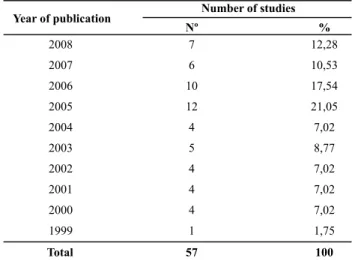
The analysis of the 57 studies revealed a greater num -ber of studies published in 2005. Table 1 presents the years and number of studies.
Table 1 – Number of scientiic studies addressing leadership in
the context of nursing published in LILACS – Florianópolis, SC, Brazil – 2009
Number of studies Year of publication
Nº %
2008 7 12,28
2007 6 10,53
2006 10 17,54
2005 12 21,05
2004 4 7,02
2003 5 8,77
2002 4 7,02
2001 4 7,02
2000 4 7,02
1999 1 1,75
Total 57 100
Most studies (34/52.6%) originated in the state of São Paulo, which is one of the main academic regions in Bra -zil and has a considerable impact in the scieniic produc -ion in the ield of nursing; ten (17.5%) studies were from Rio de Janeiro, Brazil. Two studies originated in each of the Brazilian states of Paraná, Santa Catarina and Ceará, while Rio Grande do Sul, Goiás, and Minas Gerais had one study each. One study was published in Brazil but originated from a discussion among nurses from various countries such as the United States, Canada, Columbia, Ecuador, Argenina, Peru, Mexico and Brazil. Another three studies published in Brazil had Mexican, American and Canadian origins. Hence, a predominance of Brazilian studies addressing the topic in the invesigated period was observed.
In relaion to the methodology, descripive studies pre -dominated (28 studies/49.1%). There were 26 (45.61%) original studies, 11 (19.29%) relecive studies, seven (12.28%) bibliographic reviews, ive (8.77%) historical stud -ies, two theses, two editorials, one dissertaion, one experi -ence report, one tesimony and one round table. There is a greater interest in and more space is available in scieniic publicaions for ield research, which in part explains the larger number of original studies. Despite the large num -ber of Lain-American studies addressing the subject, the number of theses and dissertaions addressing the topic in the context of nursing is small, indicaing the importance of greater academic investment in the topic.
study combined qualitaive and quanitaive approaches. This result shows that there was not a considerable dif -ference between the use of qualitaive or quanitaive re -search in Lain-American studies addressing leadership in the context of nursing between 1999 and 2008.
The techniques used to collect data were diversiied including non-paricipant observaion, workshops, ques -ionnaires, semi-structured interviews, internaional in -struments, bibliographic review and scales. The use of diferent techniques shows the subject allows for many forms of invesigaion.
In relaion to the studies’ seings, 27 studies were conducted in hospital faciliies. Ten (17.54%) of these were conducted in university hospitals, eight (14.03%) in private hospitals, ive (8.77%) in public hospitals, three (5.26%) in philanthropic hospitals and one study was car -ried out in a hospital facility that was not characterized. One of the studies was carried out in three hospital facili -ies and another in two facili-ies concomitantly. Only two studies were conduced in primary health care units, which shows the great interest of researchers in developing studies in hospital faciliies. Researchers state that hospi -tal faciliies are seen as places conducive for professional development and are considered complex systems that absorb a large number of health workers with posiions for diverse workers such as in administraion, hygiene, and maintenance, among others(13). Addiionally, this envi
-ronment is, historically and culturally, a space where com -plex relaionships are developed, permeated with unique experiences of health workers and users.
Some studies assert that the nurse-leader has an es -senial role within a health facility, whether in a hospital or primary health care unit. For this reason, during the exercise of leadership, this professional has to promote a favorable environment to perform care, assuming the diicult task of coordinaing the nursing team. For that, nurses need to develop and improve skills and competen -cies that favor the balanced leadership of a group, among which are: the constant search for knowledge, eicient communicaion, problem-solving capacity, and good in -terpersonal relaionships, among others(9,10,14).
Another objecive was to idenify the main Theories of Leadership used in the studies. The Managerial Grid Model was ideniied in seven studies(15), four studies ad
-opted the Situaional Leadership Theory(16) and one used Behavioral Theories(17).
The Managerial Grid Model consists of a behavioral the -ory created by Blake and Mouton, researchers of the Ohio State University(15), in which each manager is, to a greater or lesser extent, oriented toward producion, people or power. The scores composing the Managerial Grid are: (9.1) the manager aims to maximize producion through the ex -ercise of power and authority; (1.9) the manager seeks to promote good relaionships among colleagues and subor
-dinates; (1.1) does what is necessary to remain in the orga -nizaion; (5.5) the manager’s intenion is to reach halfway, which results in conformity with reality; (9.9) producion-orientaion is combined with people-producion-orientaion. The later may be seen as team management in which the manager seeks, in addiion to guide toward goals, to reach excellent results of great quanity through paricipaion, commitment and the resoluion of conlict(15). Some researchers invesi
-gate the use of the Management Grid Model to idenify the styles dominant among nurses in the hospital rouine. The studies highlight that nurses aim to adopt style Grid 9.9 in which management of the team is permeated by an open communicaional process, permiing mutual understand -ing, saisfacion, consensus, creaivity and innovaion in the work place(4,18-19). Based on these indings, we also highlight that the behavior of the leader relects on the team’s per -formance, since its members mirror the model they believe or perceive as necessary to perform their pracice in deliv -ering care to paients in health services. One can infer the nurse-leader’s leadership style by analyzing the behavior of the group given the nursing work rouine, which deter -mines the right moment for the leader to adhere to behav -ior and diverse aitudes, aiming to involve collaborators(4). From this perspecive, we observe the valorizaion of com -municaional processes in the exercise of leadership, which is indicated as a preponderant aspect in the construcion of good interpersonal relaionships at work.
The Situaional Leadership Theory of Hersey and Blanchard focuses on the inter-relaionship between the amount of guidance and direcion provided, also called task behavior. The amount of socio-emoional support (relaionship behavior) provided by the leader and the level of maturity of those being led in performing a task(16). This model was developed to help people to become lead -ers, regardless of their role or posiion, because it ofers a greater understanding of the relaionship between an ef -icient leadership style and the level of readiness of those being led.
the leadership style used by nurses and the style nurses should adopt in relaion to the level of maturity of the team members given the care aciviies developed. The results showed that the style most used by nurses was E3 (sharing) while they should adopt style E4 (delegat -ing), given the level of maturity of the auxiliary personnel, which suggests the team presented a high level of matu -rity (M4)(21). A similar result was obtained in a study con
-ducted in surgical centers in which E3 also predominated among the studied nurses. Style E3 encourages the team to paricipate in the decision-making process. Hence, the communicaion of the leader in this style is bilateral, that is, the nurse encourages and supports the team members in the development of the required task(22).
Likert’s system 4 was also used. It inluences the for -maion of work teams, collaboraing in the establishment of ies of trust and loyalty between team members and supervisors. Interpersonal relaionship skills and problem-solving capacity are considered relevant in this model. Therefore, the efecive paricipaion of the group in de -termining organizaional objecives is encouraged, highly moivaing them to achieve such objecives. The commu -nicaion process is eicient and efecive, with a reciprocal low of informaion and a technically competent leader -ship capable of achieving a high level of performance(17). Communicaion represents a strategy that facilitates the performance of the nurse-leader and is present in a large porion of the selected studies(10,14,20,23-24). Because the beneits of communicaion are recognized, a new way of thinking about leadership in nursing is proposed through the use of dialog, which consists of a human phenomenon that cannot be reduced to simply ‘deposiing’ ideas of one individual into another. Rather, it refers to the meeing of individuals to discuss problems and situaions aiming to transform reality(25). Dialogical leadership emerges as the ability of a leader to inluence his/her collaborators to act criically and relecively upon their pracice through the establishment of an eicient communicaion process, and can contribute and encourage changes in micro and macro spaces where the nursing team acts, as well as en -couraging autonomy, co-responsibility, and valorizaion of workers and users of health services(26).
Another study highlights leadership as a strategy to fa -vor the implementaion of the evidence-based pracice in nursing, encouraging nurses to seek scieniic knowledge whether through the development of studies or use and applicaion of the results obtained during professional pracice. Through this approach, nurses can become agents of change, incorporaing innovaions in their daily pracice through the integraion and incorporaion of evi -dence originaing in scieniic knowledge in humane and ethical care provided by the nursing team(27).
The analysis of the theories used in the studies showed that research in nursing is seldom based on Theories of Leadership because only 12 (21.05%) out the 57 studies
theoreical framework observed in nurses in relaion to leadership may be directly related to the limited number of tools provided to these professionals to exert leader -ship in their work place and also to the low valorizaion of leadership during the educaion of these professionals. A similar result as found in another study developed with clinical nurses who worked in a philanthropic hospital in Pelotas, RS, Brazil(10).
Being prepared is a prime condiion for nurse-leaders to implement changes in their work place, aiming to improve quality of care while reconciling organizaional objecives with the needs of the nursing team. Given the previous dis -cussion, we idenify the need for nurses to adopt a refer -ence to guide their professional pracice to enhance care and its planning, as well as the expected results.
concLUSion
The analysis of the results revealed a large number of studies in which original and descripive papers predomi -nated, in addiion to several techniques of data collecion approaching leadership in the context of nursing. Howev -er, studies addressing the topic in the LILACS database are sill scarce. The studies were mainly Brazilian; this topic is seldom invesigated in the internaional scope.
The hospital facility was the prevalent study seing and we believe this result may be associated with the con -cern of researchers in relaion to the diiculies found by some nurses to exert leadership in this environment.
Even though the concept of leadership was highlighted by the new curricular guidelines as a desirable profession -al competency for nurses, we perceive, given the devel -opment of research, that Leadership Theories are seldom used in the analyzed studies, which may hinder the avail -ability and use of tools by nurses in relaion to the applica -ion of leadership in the health services. We note that this is an essenial tool for professionals to develop and take leadership posiions aiming to qualify care provided to in -dividuals and the collecivity, meet the social health needs and promote humanized care.
There is also a need to adopt programs to develop leaders and projects of coninuing educaion in health ser -vices to prepare individuals to apply leadership based on the establishment of an eicient communicaion process
in order to encourage autonomy, co-responsibility, and the valorizaion of the leader and his/her collaborators, aiming to meet the health needs of the populaion.
REFEREncES
1. Gaudêncio P. Super dicas para se tornar um verdadeiro líder. São Paulo: Saraiva; 2007.
2. Simões ALA, Fávero N. Aprendizagem da liderança: opinião de
enfermeiros sobre a formação acadêmica. Rev Laino Am En
-ferm. 2000;8(3):91-6.
3. Lourenço MR, Trevizan MA. Liderança situacional: análise de esilo de enfermeiros-líderes. Acta Paul Enferm. 2002;15(1):48-52.
4. Santos I, Castro CB. Esilos e dimensões da liderança: iniciaiva
e invesigação no coidiano do trabalho de enfermagem hos
-pitalar. Texto Contexto Enferm. 2008;17(4):734-42.
5. Ito EE, Peres AM, Takahashi RT, Leite MMJ. O ensino de enfer
-magem e as diretrizes curriculares nacionais: utopia x reali
-dade. Rev Esc Enferm USP. 2006;40(4):570-5.
6. Brasil. Ministério da Educação; Conselho Nacional de Educação; Câmara de Educação Superior. Resolução CNE/CES n. 3, de 7 de novembro de 2001. Insitui Diretrizes Curriculares Nacionais do Curso de Graduação em Enfermagem [Internet]. Brasília; 2001 [citado 2008 nov. 12]. Disponível em: htp://prograd.ufvjm. edu.br/diretrizes-curriculares/doc_view/5-enfermagem.html 7. Rodrigues FCP, Lima MADS. A muliplicidade de aividades
realizadas pelo enfermeiro em unidades de internação. Rev Gaúcha Enferm. 2004;25(3):314-22.
8. Gelbcke FL, Souza LA, Dal Sasso G, Nascimento E, Bub MBC.
Liderança em ambientes de cuidados críicos: relexões e desai
-os à Enfermagem Brasileira. Rev Bras Enferm. 2009;62(1):136-9.
9. Amestoy SC, Cestari ME, Thofehrn MB, Milbrath VM. Carac
-terísicas que interferem na construção do enfermeiro-líder. Acta Paul Enferm. 2009;22(5):673-8.
10. Amestoy SC. Liderança como instrumento no processo de
trabalho da enfermagem [dissertação]. Rio Grande: Pro
-grama de Pós-Graduação em Enfermagem da Universidade Federal do Rio Grande; 2008.
11. Ganong LH. Integraive reviews of nursing research. Res Nurs Health. 1987;10(1):1-11.
12. Beyea SC, Nicoll ELH. Wriing integraive review. AORN J. 1998;67(4):877-80.
13. Matos E, Pires D. Teorias administraivas e organização do tra
-balho: de Taylor aos dias atuais, inluências no setor saúde na
14. Ribeiro M, Santos SL, Meira TGBM. Releindo sobre liderança em enfermagem. Esc Anna Nery Rev Enferm. 2006;10(1):109-15.
15. Blake RR, Mouton JS. Corporate excellence through: Grid organizaion development. Houston: Gulf Publishing; 1968.
16. Hersey P, Blanchard K. Management of organizaional be
-havior: uilizing human resources. Englewood Clifs: Pren
-ice-Hall; 1969.
17. Likert R, Likert JG. Administração de conlitos: novas aborda
-gens. São Paulo: McGraw-Hill do Brasil; 1979.
18. Trevizan MA, Mendes IAC, Hayashida M, Galvão CM, Cury SRR. Análise de expectaivas sobre liderança do enfermeiro à luz das teorias Grid. Rev Gaúcha Enferm. 2001;22(1):20-9.
19. Marques MC, Melo MRAC. O Grid gerencial: uma análise de
-scriiva na área da enfermagem. Esc Anna Nery Rev Enferm. 2004;8(2):275-8.
20. Balsanelli AP, Cunha ICKO. Liderança no contexto da enfer
-magem. Rev Esc Enferm USP. 2006;40(1):177-22.
21. Wehbe G, Galvão MC. Aplicação da liderança situacio
-nal em enfermagem de emergência. Rev Bras Enferm. 2005;58(1):33-8.
22. Silva MA, Galvão CM. Aplicação da liderança situacional na enfermagem de centro cirúrgico. Rev Esc Enferm USP. 2007;41(1):104-12.
23. Santos KMA, Silva MJP. Comunicação entre líderes e liderados: visão dos enfermeiros. Rev Esc Enferm USP. 2003;37(2):97-108.
24. Galvão CM, Sawada NO, Castro AP, Corniani F. Liderança e comunicação: estratégias essenciais para o gerenciamento
da assistência de enfermagem no context hospitalar. Rev La
-ino Am Enferm. 2000;8(5):34-43.
25. Freire P. Pedagogia do oprimido. 47ª ed. Rio de Janeiro: Paz e Terra; 2005.
26. Amestoy SC, Trindade LL, Waterkemper R, Heidman ITS, Boehs AE, Backes VMS. Liderança dialógica nas insituições hospitalares. Rev Bras Enferm. 2010;63(5):844-7.
27. Galvão CM, Sawada NO. A liderança como estratégia para
implementação da práica baseada em evidencias na enfer