Strategy in the care of cardiac surgical
patients: evaluation of the Sense of
Coherence
ESTRATÉGIA NO CUIDADO AO PACIENTE CARDÍACO CIRÚRGICO: AVALIAÇÃO DO SENSO DE COERÊNCIA
ESTRATEGIA EN EL CUIDADO AL PACIENTE CARDÍACO QUIRÚRGICO: EVALUACIÓN DEL SENTIDO DE LA COHERENCIA
1 RN. Master’s student, Graduate Program in Fundamental Nursing at the University of São Paulo at Ribeirão Preto College of Nursing. Ribeirão Preto, SP,
[email protected] 2 RN. Ph.D. student, Graduate Program in Fundamental Nursing at the University of São Paulo at Ribeirão Preto College of
Nursing. Ribeirão Preto, SP, Brazil. [email protected] 3 RN. Associate Professor, General and Specialized Nursing Department, University of São Paulo
O
RIGINAL
A
R
TICLE
RESUMO
Senso de coerência é o construto proposto por Antonovsky para avaliar a capacidade do indivíduo de lidar com o estresse. O pre-sente estudo objetiva medir o senso de co-erência e avaliar sua relação com variáveis sócio-demográficas e o uso de psicofárma-cos, em uma amostra de 127 indivíduos in-ternados para realização de cirurgias cardí-acas. O senso de coerência desses indiví-duos obteve um valor médio de 149,6 (D.P.=24,6), variando de 98 a 191 (interva-lo possível de 21 a 203), com va(interva-lores maio-res indicando maior senso de coerência. Participantes do sexo masculino, maiores de 60 anos, casados, e que não faziam uso de psicofármacos no pré-operatório de ci-rurgias cardíacas indicaram maior senso de coerência, apresentando diferenças estatis-ticamente significativas para as variáveis sexo e uso de psicofármacos. Os resultados sugerem que pacientes do sexo feminino e mais jovens precisam de maior atenção dos profissionais da enfermagem no planeja-mento do cuidado perioperatório.
DESCRITORES
Enfermagem perioperatória. Cirurgia torácica.
Avaliação em enfermagem.
Fernanda Gaspar Torrati1, Cristiane França Lisboa Gois2, Rosana Aparecida Spadoti Dantas3
ABSTRACT
Sense of coherence is the construct pro-posed by Antonovsky to assess individu-als' capacity of dealing with stress. This study aimed to measure the sense of co-herence and evaluate its association to so-ciodemographic variables and the use of psychotropic drugs among 127 patients in the preoperative period of cardiac surger-ies. The mean value of sense of coherence was 149.6 (S.D.= 24.6), ranging from 98 to 191 (possible range was 21 to 203), with higher values indicating higher sense of co-herence. Higher values were observed among male patients, older than 60 years, married and who did not use psychotro-pic drugs. Statistically significant differ-ences occurred only for gender and use of psychotropic drugs. Results suggest that female and young patients need more at-tention from nurses in the planning of their perioperative care.
KEY WORDS
Perioperative nursing. Thoracic surgery. Nursing assessment.
RESUMEN
El sentido de la coherencia es el constructo propuesto por Antonovsky para evaluar la capacidad del individuo para enfrentarse al estrés. El presente estudio objetiva medir el sentido de la coherencia y evaluar su rela-ción con variables sociodemográficas y uso de psicofármacos en una muestra de 127 individuos internados para la realización de cirugías cardíacas. El sentido de la coheren-cia de tales individuos obtuvo un valor me-dio de 149,6 (D.P. = 24,6), variando de 98 a 191 (intervalo posible de 21 a 203), con mayores valores indicando mayor sentido de la coherencia. Los participantes de sexo mas-culino, mayores de 60 años, casados y que no hacían uso de psicofármacos no preope-ratorios en cirugías cardíacas demostraron mayor sentido de la coherencia, presentan-do diferencias estadísticamente significati-vas para las variables sexo y uso de psicofár-macos. Los resultados sugieren que los pa-cientes de sexo femenino y más jóvenes ne-cesitan de mayor atención de los profesio-nales de enfermería en el planeamiento del cuidado perioperatorio.
DESCRIPTORES
Enfermería perioperatoria. Cirugía torácica.
INTRODUCTION
Health professionals who deliver care to patients in the perioperative period of cardiac surgeries, among other types, are confronted with different reports on how the experience of this period can be stressful and cause anxi-ety for patients as well as their relatives, as they are ex-posed to a wide range of feelings and emotions.
Anxiety is one of the symptoms patients awaiting surgical procedures most frequently mention, mainly in case of car-diac surgery. It has been associated with blood pressure changes(1), thoracic pain complaints in the preoperative
pe-riod and pain complaints in the postoperative pepe-riod(2). The
relation between depression and hemodynamic changes has also been observed, with alterations in blood pressure and cardiac frequency among patients in the preoperative phase of coronary artery bypass graft surgery(1). Postoperative
re-covery can also be affected, like in the case of depressive pa-tients with some of the following problems:
in-creased and continuing pain(3), higher
morbid-ity rates, higher re-hospitalization rates, difficul-ties to return to daily actividifficul-ties(3), more cases of
cardiac events like angina, acute myocardial in-farction, repeated surgeries or cardiac arrest within twelve months after the surgery(4).
People’s ability to deal with the stress ex-perienced during perioperative hospitaliza-tion is an important aspect for research by health professionals, paying attention to some consequences that can affect them dur-ing this period, particularly adjustment dis-orders related to post-traumatic stress, de-pression and cognitive deficits, especially upon discharge from hospital(5).
One of the constructs that has been stud-ied in research on stress coping abilities is the sense of coherence(6), referring to a global
orientation, a way of looking at the world, of dealing with the stressors present in daily life.
The sense of coherence is the key concept Aaron Antonovsky’s Salutogenic Theory, which is considered as a new approach in the health area to assess people with chronic health conditions or belonging to specific groups, such as elderly, adolescents, pregnant women and chil-dren(6). It intends to investigate how and why some people
feel good, even after having gone through intense stress situations, broadening discussions on the relation between stress and coping strategies. The sense of coherence can exert the following effects on people’s health: 1 – a direct influence on different organic systems, as the sense of co-herence supposedly affects people’s reasoning, determin-ing whether the situation they are exposed to is danger-ous, safe or pleasant. Consequently, the organism will have
supposedly mobilize existing resources, leading to de-creased stress and, thus, indirectly affecting physiological systems, such as cardiovascular and immunological reac-tions for example; 3 – people with a high sense of coher-ence are more prone to make healthy choice regarding their lifestyle, including: diet, physical exercise, preventive tests, among others(6).
The sense of coherence is assessed through an instru-ment called the Antonovsky Sense of Coherence Question-naire(6), with 29 items. Since its publication in the 1980’s(6),
high sense of coherence scores have been associated with less presence of depressive symptoms and anxiety(7). In
car-diac patients, there are records of greater social support(8),
better psychological wellbeing(9), improved quality of life and
self-esteem when sense of coherence levels are higher(10).
Assessing the sense of coherence has shown to be rel-evant for different health areas. Its use by nurses can col-laborate to identify coping strategies used by people who are able to be well or satisfied, despite going through situations that might suggest the op-posite. Thus, assessing the sense of coherence adds up to the assertion that nurses need to be prepared to understand each phase of the human response to diseases, knowing how to identify and perceive the signs that communi-cate what each person presents(11). This
per-spective is in line with the focus of nursing theories in practice and research and can high-light points like the promotion of well-being and the favoring of coping strategies for pa-tients and relatives who are facing disease situ-ations or traumas. One example is the assess-ment of coronary artery bypass graft surgery patients’ sense of coherence, with a higher fre-quency of pain complaints after the surgery among patients with a decreased sense of co-herence(12). It is useful for health services to
assess this construct in the attempt to plan more holistic care delivery to those patients, exposed to stress situations, particularly cardiac surgeries in this research.
OBJECTIVES
In view of the above, this study was carried out to mea-sure the sense of coherence construct among patients hos-pitalized in the preoperative period of cardiac surgeries and to assess possible relations between the sense of coher-ence measure and the variables: gender, age, civil status, education, remunerated activity performance and the use of psychiatric drugs in the preoperative period.
METHOD
...high sense of coherence scores have
been associated with less presence of depressive symptoms and anxiety. In cardiac
patients, there are records of greater social
support, better psychological wellbeing,
improved quality of life and self-esteem when sense of coherence
Medical School Hospital das Clínicas between September 2007 and November 2008. These participants were selected according to the following criteria: being 18 years of age or older, being hospitalized for a cardiac surgery for the first time, and being in clinical (physical and psychological) con-ditions to answer the researchers’ questions. Patients hos-pitalized at the intensive care unit during the preoperative period were not included due to clinical instability in this period. Approval for this Project was obtained from the hospital’s research ethics committee (CEP Opinion No 8157/ 2006), which granted permission to access the patient file archive service. All subjects who agreed to participate in the study signed the Free and Informed Consent Term.
The researchers collected the data through individual interviews and consultation of participants’ medical records. Two instruments were used, the first for sociodemographic (gender, age in full years, education, marital situation and occupation) and clinical characterization (hospitalization time, type of cardiac disease that motivated the surgical treatment and use of psychiatric drugs during hospitaliza-tion) of the participants. The second instrument used was Antonovsky’s Sense of Coherence Questionnaire(6), in its
version adapted to Portuguese(13). This instrument
com-prises 29 items, which are answered on a seven-point scale with anchor phrases at the ends (1 and 7), with score one representing the weakest sense of coherence and seven the strongest. High scores indicate a strong sense of coherence, within a possible interval from 29 to 203. The original ver-sion of the instrument showed adequate internal consis-tency in international studies involving cardiac patients (10,14-15). The version adapted for use in Brazilian cardiac patients
also showed adequate internal consistency (alpha corre-sponding to 0.79)(13).
Data were processed and analyzed using the Statistical Package for Social Science (SPSS), version 15.0. For descrip-tive data analysis, position (mean, median) and variability (standard deviation) were used for continuing variables and simple frequency measures for categorical variables. Cronbach’s alpha was used to verify the internal consistency of items in Antonovsky’s Sense of Coherence Questionnaire. To test for the presence of differences between sense of coherence scores and the variables of interest, Student’s t-test for independent samples was used. Significance was set at 0.05.
RESULTS
With regard to the sociodemographic characterization of the 127 study participants, the number of male (66; 52 %) and female (61; 48%) participants was similar. Average age was 57.4 (SD=12.6) years, ranging between 18.4 and 79.3 years, and later grouped in two categories: less than
60 years (68 subjects; 53.5%) and 60 years or older (59; 46.5%). The majority was married or lived with significant others (84; 66.1%), followed by single (19; 15%), widowed (18; 14.2%) and separated people (6; 4.7%). Education was characterized by few years of formal study, with 83 (65.4%) participants who did not finish primary education and 11 (8.7%) who were illiterate. Next, they were grouped in two categories: up to the primary level (101 subjects; 79.5%) and secondary and higher level (26; 20.5%).
The collected clinical data revealed that participants were predominantly awaiting surgical treatment for coro-nary artery disease (90; 70.9%) and that the average pre-operative hospitalization time was 13.3 days (SD=11.6), in an interval ranging from zero (interview on the day of hos-pitalization) to 59 days, with a median of 12 days. Comor-bidities were present which are considered risk factors for cardiovascular diseases, the most prevalent of which were: systemic arterial hypertension (103 patients; 81.1%), dyslipidemias (69; 54.3%), diabetes mellitus (46; 32,6%) and obesity (31; 24.4%). Most subjects had between two and three comorbidities (78 patients; 63.4%).
To answer the items of Antonovsky’s Sense of Coher-ence Questionnaire, participants need to subjectively as-sess what is being asked about themselves and their lives, and this assessment can be compromised by the use of psychiatric drugs, such as antidepressants and anxiolytics. Among the 127 participants who answered this question-naire, 31 (24.4%) used psychiatric drugs, 21 (67.7%) of whom were taking anxiolytics and eight (25.8%) antidepres-sants, associated or not with other psychiatric drugs, while two others patients were taking anticonvulsants during the preoperative period.
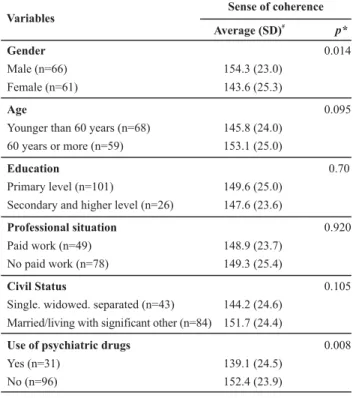
Results for Antonovsky’s Sense of Coherence Scale indi-cated a mean sense of coherence measure of 149.2 (SD= 24.6), ranging from 98 to 191, with a Cronbach’s alpha of 0.77, confirming the instrument’s internal consistency in the study group.
Table 1 - Results of tests to compare mean scores for sense of coherence among the subjects, considering the variables: gender, age, education, paid work, civil status and use of psychiatric drugs in the preoperative period - Ribeirão Preto - 2007/ 2008
Sense of coherence Variables
Average (SD)#
p*
Gender
Male (n=66)
Female (n=61)
154.3 (23.0)
143.6 (25.3)
0.014
Age
Younger than 60 years (n=68)
60 years or more (n=59)
145.8 (24.0)
153.1 (25.0)
0.095
Education 0.70
Primary level (n=101)
Secondary and higher level (n=26)
149.6 (25.0)
147.6 (23.6)
Professional situation
Paid work (n=49) No paid work (n=78)
148.9 (23.7) 149.3 (25.4)
0.920
Civil Status
Single. widowed. separated (n=43) Married/living with significant other (n=84)
144.2 (24.6) 151.7 (24.4)
0.105
Use of psychiatric drugs
Yes (n=31) No (n=96)
139.1 (24.5) 152.4 (23.9)
0.008
#SD = Standard Deviation *Student’s T Test
DISCUSSION
The study participants’ sociodemographic characteris-tics were similar to those of North American patients(10)
re-garding gender and age. As expected, however, lower edu-cation levels were found among Brazilian participants. The validation of Antonovky’s Sense of Coherence Scale for use in Brazilian cardiac patients is still recent(13). Therefore, the
present results could not be compared yet with other re-sults involving cardiac patients attended at different health institutions in Brazil for clinical or surgical treatment. It is highlighted that the sociodemographic and clinical similar-ity of the study group, with patients who participated in the validation study of Antonovsky’s Sense of Coherence Study for use with Brazilian cardiac patients(13) strengthens
evidence on the validity and reliability of this instrument for patient assessment in the preoperative phase of car-diac surgery.
In the assessment of participants’ sense of coherence, scores between 98 and 191 were found in a possible inter-val from 29 to 203, with higher scores indicating greater sense of coherence(6). The lowest score was higher than
those found in other studies with cardiac patients(10,13-14).
The highest score (191) was similar to other studies that assessed patients undergoing clinical treatment for cardiac
age sense of coherence score was 149.2 (SD=24.6), similar to average scores among cardiac patients hospitalized for clinical treatment (M=143.2; SD=24.9)(13) and in clinical
fol-low-up after cardiac surgery (M=146.4; SD=25.9)(10). In the
possible interval for sense of coherence, 116 is the median point.
People’s ability to cope with the stress experienced during hospitalization for surgical treatment of their car-diac disease is an important aspect for research by health professionals. Antonovsky’ sense of coherence is one of the constructs that has been studied in recent stress coping ability research is the sense of coherence(6), which has
shown associations with other variables, such as social sup-port and self-esteem(10). Some individual characteristics(16)
influence both self-esteem and the sense of coherence con-struct. Older and married people with a higher education level tend to have a greater sense of coherence, while nega-tive events in life, such as the death of a close relanega-tive, be-sides problems at work or with family, can decrease the sense of coherence(15). Age and the diagnosis time of chronic
illnesses were considered predictive variables of the sense of coherence score among cardiac patients and patients with cancer. The construct score did not vary according to patients’ gender, race or education level(14).
In this study, when analyzing intergroup differences between sense of coherence scores, significant differences (p=0.014) appeared, with higher average scores among men (M=154.3). A similar result had already been observed in another study of cardiac patients(7), but this result goes
against the premise defended in the study(6) and by other
researchers(14) that the sense of coherence does not depend
on people’s gender. Some experts have questioned this premise, based on gender differences, to contradict the idea that the sense of coherence does not depend on gender. They argue that several sciences, such as psychology and sociology, have already confirmed that men and women differ in various aspects, including the resources used to deal with stress situations. Stressors have shown greater impact among women, with more intense reactions to stress. Hence, if gender differences exist in terms of coping resources, it would be natural that these also act in the determination of the sense of coherence(17).
As for the relation between the sense of coherence con-struct and participants’ age, the elderly group showed a higher average score than the adult group, but this differ-ence was not statistically significant (p= 0.095). This result strengthens the author’s(6) original viewpoint that a person’s
not vary according to the education level. In this research, differences in the examined construct scores according to education, civil status and paid work were not proven.
Considering that a strong association exists between depression and anxiety measures and sense of coherence scores, lower scores were expected for patients using psy-chiatric drugs during preoperative hospitalization, as proven in the research group. Patients who did not take these drugs demonstrated greater sense of coherence (M=152.4) than those who did (M=139.1), indicating a statistically signifi-cant difference (p=0.008). This result, however, differs from the result observed among patients hospitalized for clini-cal treatment of cardiac diseases, in which the author of the research did not find a statistically significant difference between participants using psychiatric drugs or not(13).
CONCLUSION
Among the 127 patients hospitalized for surgical treat-ment of cardiac diseases, a high average score was found for the sense of coherence construct, which can be consid-ered a protection factor for the development of perioperative anxiety and depression. Relations between scores for this construct and age, civil status, education and paid work were not confirmed, with a statistically signifi-cant difference for the gender variable only, showing higher scores for men. As expected, the sense of coherence mea-sure was associated with the use of psychiatric drugs dur-ing hospitalization, with patients usdur-ing psychiatric drugs showing lower scores for sense of coherence.
The study’s cross-sectional design is a study limitation, as it does not permit confirmation of the cause-and-effect relations between the sense of coherence score and the selected sociodemographic variables, nor of the relation with patients’ use of psychiatric drugs. Longitudinal stud-ies have already been planned, needed to confirm the ex-istence of these relations in the perioperative period of
cardiac surgery and determine the causality between vari-ables. Although no probabilistic sample was used, the re-sults support those identified in international studies, indi-cating that a person’s ability to cope with stress situations like cardiac surgery is an important aspect for research by health professionals. It should be highlighted that sense of coherence is one of the most studied constructs in stress coping ability research.
The Salutogenic Theory can provide a perspective that is more coherent with nursing’s proposal to holistically address the people they are taking care of. Assessing care-dependent individuals’ sense of coherence would permit a better understanding of how they would react to the disease and its treatment, broadening their strategies in favor of coping. In the field of cardiovascular illnesses, a strong sense of coherence in cardiac patients during re-habilitation from the disease or surgical treatment could take the form of a dynamic feeling of trust, for example, in their ability to sort the variations deriving from the in-stability of the chronic disease’s evolution. The aim would be to adapt to their new physical and psychological con-dition, so as to find the necessary motivation to get back to their life, as possible, besides minimizing the impact of the cardiac disease on their family and involving in activi-ties that are significant for their new condition of having a chronic illness.
The use of Antonovsky’s Sense of Coherence Scale in clinical nursing practice makes it possible to identify people needing more attention in care planning, with a view to promoting strategies that can help them to cope with the stress situation they are facing during hospitalization and while awaiting the surgical procedure. The abovementioned relevance is highlighted with regard to the use of this in-strument to measure the sense of coherence construct in case of cardiovascular illnesses in patients with chronic con-ditions or specific groups, such as elderly, adolescents, preg-nant women and children.
REFERENCES
1. Hallas CN, Thornton EW, Fabri BM, Fox MA, Jackson M. Predicting blood pressure reactivity and heart rate variability from mood state following coronary artery bypass surgery. Int J Psychophysiol. 2003;47(1):43-55.
2. Greszta E, Sieminska MJ. Relationship of preoperative anxiety-state and anxiety-trait in patients qualified for coronary artery bypass graft surgery to the perception of postoperative pain and other pain complaints. Ann Acad Med Stetin. 2008;54(1):157-63.
3. Burg MM, Benedetto MC, Soufer R. Depressive symptoms and mortality two years after coronary artery bypass graft surgery (CABG) in men. Psychosom Med. 2003;65(4):508-10.
4. Connerney I, Shapiro PA, McLaughlin JS, Bagiella E, Sloan RP. Relation between depression after coronary artery bypass surgery and 12-month outcome: a prospective study. Lancet. 2001;358(9295):1766-71.
5. Rothenhausler HB, Grieser B, Nollert G, Reichart B, Schelling G, Kapfhammer HP. Psychiatric and psychosocial outcome of cardiac surgery with cardiopulmonary bypass: a prospective 12-month follow-up study. Gen Hosp Psychiatry. 2005;27(1):18-28.
7. Kontinnen H, Haukkala A, Uutela A. Comparing sense of coher-ence, depressive symptoms and anxiety, and their relationships with health in a population-based study. Soc Sci Med. 2008;66 (12):2401-12.
8. Baigi A, Hildingh C, Virdhall H, Fridlund B. Sense of coherence as well as social support and network as perceived by patients with a suspected or manifest myocardial infarction: a short-term follow-up study. Clin Rehabil. 2008;22(7):646-52.
9. Drory Y, Kravetz S, Hirschberger G. Long-term mental health of men after a first acute myocardial infarction. Arch Phys Med Rehabil. 2002;83(3):352-59.
10. Dantas RAS, Motzer AS, Ciol M. The relationship between quality of life, sense of coherence and self-esteem in persons after coronary artery bypass graft surgery. Int J Nurs Stud. 2002;39(7):745-55.
11. Carvalho ARS, Matsuda LM, Carvalho MSS, Almeida RMSSA, Schneider DSLG. Pós-operatório de revascularização miocárdi-ca: tipos de complicações. Ciênc Cuidado Saúde. 2006;5(1):50-9.
12. Karlsson I, Rasmussen C, Ravn J, Thiis JJ, Pettersson G, Larsso PA. Chest pain after coronary artery bypass: relation to coping capacity and quality of life. Scand Cardiovasc J. 2002;36(1):41-7.
13. Dantas RAS. Adaptação cultural e validação do Questionário de Senso de Coerência de Antonovsky em uma amostra de
pacientes cardíacos brasileiros[tese livre-docência]. Ribeirão
Preto: Escola de Enfermagem de Ribeirão Preto, Universida-de Universida-de São Paulo; 2007.
14. Bruscia K, Shultis C, Dennery K, Dileo C. The sense of coher-ence in hospitalized cardiac and cancer patients. J Holist Nurs. 2008;26(4):286-94.
15. Bergman E, Malm D, Karlsson JE, Berterö C. Longitudinal study of patients after myocardial infarction: Sense of coherence,
quality of life, and symptoms. Heart Lung.2009;38(2):129-40.
16. Vargas TVP, Maia EM, Dantas RAS. A auto-estima de indivídu-os que foram submetidindivídu-os à cirurgia de revascularização do miocárdio. Rev Esc Enferm USP. 2005;39(1):20-7.
17. Volanen SM, Suominen S, Lahelma E, Koskenvuo M, Silventoinen K. Negative life events and stability of sense of coherence: a five-year follow-up study of Finnish women and men. Scand J Psychol. 2007;48(5):433-41.