J Vasc Bras. 2012;11(4):329-333.
Introduction
he efects of radiation on human tissues have been extensively studied because radiotherapy is one of the therapeutic options in the treatment of several malignant
tumors. One of the well-known adverse efects of radiation is the injury to healthy tissue in areas close to malignant tumors due to radiotherapy.
Breast cancer has a high mortality rate among women: it is the second most frequent type of cancer in the world Abstract
Several complications may occur as a consequence of adjuvant radiotherapy for cancer. One of these complications is actinic lesions of the subclavian artery in patients undergoing radiotherapy for breast cancer; however, there are few reported cases. In the present case report, we describe a case of right subclavian artery occlusion in a patient undergoing radiotherapy for breast cancer. Occlusion was treated by means of conventional artery bypass with interposition graft with polytetraluoroethylene (PTFE). Our extensive review of the literature revealed 12 reported cases showing the diferent treatment options performed. We concluded that actinic arteritis of the subclavian artery is an uncommon condition; however, its presence should be considered in all patients with upper limb ischemia who underwent radiotherapy.
Keywords: subclavian artery; radiation efects; breast cancer.
Resumo
Diversas são as complicações possíveis da radioterapia na adjuvância do tratamento de neoplasias. Lesões actínicas de artéria subclávia em pacientes submetidos a este tipo de tratamento para neoplasia de mama são complicações conhecidas, porém com poucos relatos de casos publicados. No presente relato, descrevemos um caso de oclusão de artéria subclávia direita em paciente submetida à radioterapia para tratamento de neoplasia de mama, tratada com a revascularização convencional, com interposição de enxerto de politetraluoretileno (PTFE). Na revisão da literatura realizada, foram encontrados doze casos descritos que evidenciaram diferentes opções terapêuticas. Concluímos que a arterite actínica de artéria subclávia é uma doença incomum, entretanto sua hipótese deve ser aventada em todos os pacientes com isquemia de membro superior já submetidos a tratamento de radioterapia.
Palavras-chave: artéria subclávia; efeitos de radiação; câncer de mama.
Actinic arteritis of subclavian artery. Case report and
literature review
Arterite actínica de artéria subclávia. Relato de caso e revisão de literatura
Sergio Quilici Belczak1, Nino Behar2, Igor Rafael Sincos3, hiago José Cavaquini4,Gilberto Nering5,
Caio Azevedo6,Luis Felipe Slavo7, Ricardo Aun8
Study carried out at the Serviço de Cirurgia Vascular do Hospital Geral de Carapicuíba – Carapicuíba (SP), Brazil.
1 Doutor pela Faculdade de Medicina da Universidade de São Paulo. Chefe do Serviço de Cirurgia Vascular do Hospital Geral de Carapicuíba. Chefe do Serviço de Cirurgia Endovascular e
Radiologia Intervencionista do Hospital IGESP. Docente da disciplina de Cirurgia Vascular da Faculdade São Camilo – São Paulo (SP), Brazil.
2 Acadêmico do quinto ano de medicina do Centro Universitário São Camilo. Membro da Liga Acadêmica de Angiologia e Cirurgia Vascular do Centro Universitário São Camilo – São Paulo (SP),
Brazil.
3 Doutorando pela Faculdade de Medicina da Universidade de São Paulo. Chefe do Serviço de Cirurgia Vascular do Hospital Geral de Carapicuíba. Chefe do Serviço de Cirurgia Endovascular e
Radiologia Intervencionista do Hospital IGESP. Docente da disciplina de Cirurgia Vascular da Faculdade São Camilo – São Paulo (SP), Brazil.
4 Acadêmico do quinto ano de medicina do Centro Universitário São Camilo. Membro da Liga Acadêmica de Angiologia e Cirurgia Vascular do Centro Universitário São Camilo – São Paulo (SP),
Brazil.
5 Acadêmico do quinto ano de medicina do Centro Universitário São Camilo. Membro da Liga Acadêmica de Angiologia e Cirurgia Vascular do Centro Universitário São Camilo – São Paulo (SP),
Brazil.
6 Acadêmico do quinto ano de medicina do Centro Universitário São Camilo. Membro da Liga Acadêmica de Angiologia e Cirurgia Vascular do Centro Universitário São Camilo – São Paulo (SP),
Brazil.
7 Acadêmico do quinto ano de medicina do Centro Universitário São Camilo. Membro da Liga Acadêmica de Angiologia e Cirurgia Vascular do Centro Universitário São Camilo – São Paulo (SP),
Brazil.
8 Professor de Cirurgia Vascular da Faculdade de Medicina da Universidade de São Paulo. Chefe do Serviço de Cirurgia Vascular e Endovascular do Prof. Dr. Ricardo Aun - Hospital Israelita
She underwent hormone therapy with 20 mg/day tamoxifen for ive years ater surgical treatment.
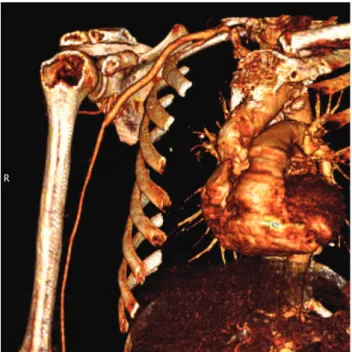
Ater the diagnosis of critical arterial insuiciency of the right upper extremity, the patient underwent arteriography, which revealed occlusion of the subclavian artery in its middle third and brachial artery reill at the proximal third, with no signs of concurrent atherosclerosis (Figure 1). She underwent CT angiogram scanning, which did not reveal any local anatomic anomalies and conirmed arterial occlusion (Figure 2). Based on these indings, the hypothesis of actinic arteritis of the right subclavian artery was raised based on the fact that radiotherapy had been applied to that site.
As subclavian artery occlusion was extensive, surgery was the treatment chosen, with the interposition of an arterial grat of the subclavian artery to the brachial artery using a 6-mm PTFE prosthesis because the two internal saphenous arteries had already been removed. A right supraclavicular and longitudinal brachial approach was used. End-to-side anastomoses were constructed with prolene 6.0 in the arterial regions where there were no changes. Surgery was uneventful, and the patient was discharged on the ith postoperative day without any complaints and with a palpable radial pulse. Ninety days ater the surgery, outpatient follow-up of the patient showed that she had no complaints and that there was good perfusion of the extremity. Control CT angiogram did not show any abnormalities (Figure 3).
and the most common in the female population1. Radical
breast cancer treatment, particularly when complemented by radiotherapy, is knowingly responsible for substantial morbidity of the limb in the same side afected by the disease. Lymphatic system lesions, venous thrombosis of axillary and subclavian veins and limiting scar retraction are well-known complication reported in the medical literature. A severe and little known complication that may afect these patients is critical ischemia of an upper extremity due to arterial injury2,3.
In oncology, arterial stenosis as a complication of radiotherapy is very rare, although reported in experimental studies that found evidence of it4. In major publications,2,3,5
histological lesions due to radiation are not speciic and are oten associated with risk factors of atherosclerosis. Several types of lesions have been described, such as ruptures, aneurysms, occlusions, stenosis and thrombosis5.
Although reports of arterial occlusive lesions ater radiotherapy are found in the literature,5 few series have
been described considering the broad use of this treatment. he involvement of the subclavian artery in patients that underwent adjuvant radiotherapy for the treatment of breast cancer is rarely discussed in publications6,7. We describe a
case of right subclavian artery occlusion in a patient that underwent radiotherapy for the treatment of cancer in the right breast. We provide evidence of the physiopathology of this disease and describe possible indications of treatment based on our extensive review of the literature.
Case report
A 68-year-old patient presented with reversible cyanosis and pain when the right arm and forearm were at rest. Symptom onset was three months earlier: the irst sign was pain to move the upper right extremity, which worsened progressively. here were no palpable pulses in the right upper extremity, but the other pulses in the contralateral upper and lower extremities were normal.
he patient had hypertension and was an ex-smoker (10 pack/year). Twenty years before, she had undergone varicose vein stripping with bilateral removal of saphenous veins. Twelve years before she had a diagnosis of invasive ductal carcinoma with lymph node involvement. he patient underwent radical mastectomy and axillary lymph node dissection. She received six cycles of adjuvant chemotherapy using the cyclophosphamide, methotrexate and 5-luorouracil (CMF) regimen and radiotherapy over the breast and the thoracic wall at a total dose of 5000 cGy divided into 25 fractions. he supraclavicular and axillary lymph node chains were also irradiated anteroposteriorly.
layer and hyalinization of the internal elastic lamina. he endothelium was described as sot and having vacuolated cells that projected into the vessel lumen8. Forty years later,
Warren described similar results and reported that the hyalinization of the internal elastic lamina was progressive, even up to four years ater irradiation9. In the same decade,
Sheeha not only conirmed those indings in a series of necropsies, but also showed evidence of foam cells in the intima of those vessels. hose cells had migrated from the blood current and implanted in the site of the lesion induced by radiotherapy10. Ater those reports, numerous authors
described similar indings and conirmed the pattern of injury to the vessels of human beings that are exposed to therapeutic doses of radiation11-13. Fajardo organized
and described the histological changes found in actinic arteritis: proliferation of the subendothelial connective tissue, rupture of the internal elastic lamina, accumulation of ibrinoid substances in the intima and subintimal layers, degeneration of smooth muscles, dense ibrosis in the adventitia, foam cell aggregates on the injured wall and possible obliteration of vasa vasorum14.
he actual incidence of arterial disease induced by radiotherapy is hard to determine because it varies substantially with anatomic site. Artery lesions of the supra-aortic trunks in their intrathoracic portion have been rarely described and seem to be less common than the involvement of coronary arteries.15 However, lesions
in the cervical segment of carotid arteries have been described more frequently and usually afect the carotid bifurcation16.Likewise, the involvement of the subclavian
artery ater radiotherapy in patients with cancer has already been deined, and some reports about it have already been published5.
Table 1 sows the results of a thorough review of the literature about this topic3,5,7,17-20. We found twelve cases of
actinic arteritis of the subclavian artery, particularly ater radiotherapy to treat breast cancer. In agreement with our report, the interval between irradiation and onset of symptoms was extremely variable, ranging from 2 to 42 years (mean 14.7 years). Clinical presentations varied from discrete symptoms to the development of limb gangrene. Symptom onset was gradual, as in the case reported here, or sudden, when there was thrombosis or embolization.
he main diference between patients that receive radiotherapy and those with atherosclerosis is that, in the irst group, large or small caliber arteries are afected by the irradiated ield and, therefore, collateral circulation is compromised, whereas vessels out of the ield of irradiation are supposedly normal. Another important diference, seen in the case reported here, is that tissues change ater Discussion
Woolbach, in 1909, was the irst author to report that vessels exposed to radiotherapy might sufer lesions. Ater histological evaluation, he described the increase of subendothelial connective tissue, thickening of the middle Figure 2. CT angiogram with three-dimensional reconstruction shows occlusion of subclavian artery in middle third and reilling of proximal third of brachial artery. No local anatomic anomalies were found.
3. Mavor GE, Kasenally AT, Harper DR, Woodruf PWH. hrombosis of the subclavian-axillary artery following radiotherapy for carcinoma of the breast. Br J Surg. 1973;60:983-985. http://dx.doi. org/10.1002/bjs.1800601219
4. Aun R, Weltman E, Lopes LH, Cutait R, Langer B, Puech-Leão LE. Actinic arterial lesions: efects of a dose of 2000 rads on the iliac artery of rabbits. Rev Hosp Clin Fac Med Sao Paulo. 1984;39(1):32-4. PMid:6484438.
5. Piedbois P, Becquemin JP, Blanc I, et al. Arterial occlusive disease alter radiotherapy: a report of fourteen cases. Radiother Oncol. 1990;17:133-140. http://dx.doi.org/10.1016/0167-8140(90)90101-2
6. Budin, JA, Casarella, WWJ, Harisiadis L. Subclavian artery occlusion following radiotherapy for carcinoma of the Breast. Radiology 1976;118:169-173. PMid:1244653.
7. McCallion WA, Barros D’Sa AAB. Management of critical upper limb ischaemia long after irradiation injury of the subclavian and axillary arteries. Br J Surg. 1991;78:1136-1138. http://dx.doi. org/10.1002/bjs.1800780933
8. Woolbach SB. he pathologic history of chronic x-ray dermatitis and early x-ray carcinoma. J Med Res. 1909;21:415-429. Pmid:19971926. PMCid:2099040.
9. Warren S. Efects of radiaron on norma tisúes. Arch
Pathol. 1942;34:1070-79.
10. Sheehan JF. Foam cell plaques in the intima of irradiated small arteries. Arch Pathol. 1944;27:297-309.
11. Kaufman B, Lapham LW, Shealy CN, Pearson OH. Transpheinoidal ytrium 90 pituitary ablation-radiation damage to the internal carotid artery. Acta Radiol horac Biol. 1966;17-25.
12. homas E, Forbus WD. Irradiation injury to the aorta and to the lung. Arch Pathol. 1958;67:256-63.
13. Applefeld MM, Slawson RG, Spicer KM, Singleton RT, Wesley MN, Wiernik PH. Long-term cardiovascular evaluation of patients with mastectomy and local radiotherapy, which results in local
ibrosis and make access to arteries diicult. As in the case reported here, good results are expected because vessels out of the irradiated area are supposedly normal, regardless of which vessel is used for the grat.
Another possible treatment is balloon percutaneous transluminal angioplasty, which has the advantage of not requiring access in previously irradiated areas. In the few cases reported so far,2,5,17 subclavian artery stenosis
progressed gradually. As in our case, onset takes a long time and, when symptoms appear, there has already been progression into an extensive lesion for which endovascular treatment is no longer efective.
he analysis of the case reported here and the ones in the studies reviewed indicates that the results of revascularization of lesions induced by radiation in the subclavian artery are usually satisfactory. Indications and surgical planning should be carefully made because of the diiculties that may be found during the operation to treat these complex lesions.
References
1. Rezende LF, Pedras FV, Ramos CD, Gurgel MSC. Avaliação das compensações linfáticas no pós-operatório de cáncer de mama com dissecção axilar através da linfocintilograia. J Vasc Bras. 2008; 7:370-375. http://dx.doi.org/10.1590/S1677-54492008005000002
2. Sensus-Konefka E, Jassem J. Cardiovascular efects of breast cancer radiotherapy. Cancer Treat Rev. 2007;33:578-593. PMid:17764850. http://dx.doi.org/10.1016/j.ctrv.2007.07.011
Table 1. Cases of actinic arteritis of subclavian artery after radiotherapy to treat breast cancer described in the literature.
Authors Journal Year Number of Cases Treatment Progression Hassen-Khodja
RH et al.17
Journal of Vascular Surgery Vol 40, Number 2
2004 2 Carotid-humeral bypass with saphenous vein and carotid-subclavian bypass after carotid artery angioplasty.
Good progression in long term follow-up of both cases.
Lewis J et al.18 Clinical Oncology 9:122-123 1997 1 Stent angioplasty and warfarin as
anticlotting agent.
Good progression, improvement of subclavian steal symptoms. Piedbois et al.5 Radiotherapy and
Oncology; 17: 133-140
1990 1 Carotid-humeral bypass and saphenous vein graft.
Good progression in long term follow-up.
Hughes WF et al.19 Am J Surg. May; 147(5):
698-700
1984 1 Subclavian-brachial bypass using PTFE. Amputation of second inger (sequela of ischemia). Good progression in the long term. Mavor GE et al.3 Brit. J. Surg. Vol 60, No 12,
December
1973 2 Clinical treatment. Intermittent claudication.
Hashmonai et al.20 Cancer 61:2015-2018 1988 2 Subclavian-brachial bypass using PTFE;
clinical treatment.
Good progression in both cases; patient treated clinically overcame claudication.
McCallion et al.7 Br. J. Surg. Vol 78,
September, 1136-1138
1991 3 Carotid-brachial bypass using saphenous graft; carotid-brachial bypass using saphenous graft; subclavian-axillary bypass using PTFE.
J Surg. 1984;147:698-700. http://dx.doi.org/10.1016/0002-9610(84)90146-6
20. Hashmonai M, Elami A, Kuten A, Lichtig C, Torem S. Subclavian Artery Occlusion After Radiotherapy for Carcinoma of the Breast. Cancer. 1988;61:2015-2018. http:// dx.doi.org/10.1002/1097-0142(19880515)61:10%3C2015::AID-CNCR2820611014%3E3.0.CO;2-Z
Correspondence
Sergio Quilici Belczak Rua Cônego Eugênio Leite, 1126, apto. 153 CEP 05414-001 – São Paulo (SP), Brazil Fone: (11) 8383-7803 E-mail: [email protected]
Authors’ contributions
Conception and design: SQB, NB Analysis and interpretation: NB Data collection: SQB, TJC, GN Writing the article: SQB, LFGS, CA Critical revision of the article: SQB, RA, IRS Final approval of the article*: SQB, RA, IRS, TJC, NB, CA, GN, LFGS Statistical analysis: Not apply to article. Overall responsibility: SQB *All authors have read and approved the inal version submitted to J Vasc Bras.
Hodgkin’s disease treated by thoracic mantle radiation therapy. Cancer Treat Rep. 1982;66:1003-13. PMid:7074628.
14. Fajardo LF. Pathology of Radiation Injury. New York: Masson Publishers; 1981. p. 22-33.
15. Hancock SL, Hope RT. Long-term complications of treatment and causes of mortality alter Hodgkin’s disease. Semin Radiat Oncol. 1996;6:225-42. http://dx.doi.org/10.1016/S1053-4296(96)80018-X
16. Lesèche G, Castier Y, Chataigner O, et al. Carotid artery revascularization through a radiated ield. J Vasc Surg. 2003;38:244-50. http://dx.doi.org/10.1016/S0741-5214(03)00320-3
17. Hassen-Khodja R, Kiefer E. Radiotherapy-induced supra-aortic trunk disease: early and long-term results of surgical and endovascular reconstruction. J Vasc Surg. 2004;40:254-261. PMid:15297818. http://dx.doi.org/10.1016/j.jvs.2004.04.020
18. Lewis J, Roberts JT, Gholkar A. Subclavian Artery Stenosis Presenting as Posterior Cerebrovascular Events After Adjuvant Radiotherapy for Breast Cancer. Clin Oncol. 1997;9:122-123. http:// dx.doi.org/10.1016/S0936-6555(05)80451-0