Intravenous misplacement of nephrostomy tube following
percutaneous nephrolithotomy: Three new cases and review
of seven cases in the literature
_______________________________________________
Xiao-Feng Chen
1, Shan-Qun Chen
1, Liang-Yu Xu1, Ye Gong
1, Zhuang-Fei Chen
2, Shao-Bin Zheng
21Department of Urology, the First People’s Hospital of Chenzhou, Southern Medical University, Hunan, P.
R. China; 2Department of Urology, Nanfang Hospital, Southern Medical University, Guangzhou, P. R. China
ABSTRACT
ARTICLE
INFO
______________________________________________________________ ______________________
Purpose: We investigated the characteristics and management of patients with intrave-nous misplacement of a nephrostomy tube.
Materials and Methods: Between July 2007 and July 2013, 4148 patients with uroli-thiasis underwent percutaneous nephrolithotomy (PCNL) in our hospital. Intravenous misplacement of a nephrostomy tube occurred in two of these patients. Another pa-tient with intravenous misplacement of a nephrostomy tube, who underwent PCNL in another hospital, was transferred to our hospital. The data of the three patients were retrospectively analyzed.
Results: The incidence of intravenous misplacement of a nephrostomy tube following PCNL was 0.5% (2/4148) at our hospital. A solitary kidney was present in one of the three patients. The tip of tube was located into the inferior vena cava (IVC) in two pa-tients and into the renal vein in one patient. All three papa-tients were successfully mana-ged with strict bed rest, intravenous antibiotics and one-step (one patient) or two-step (two patients) tube withdrawal under close monitoring. None of the patients underwent antithrombotic therapy. The original operations were performed successfully under close observation in two patients and changed to another operation in one patient. All patients were discharged uneventfully.
Conclusions: The incidence of intravenous misplacement of a nephrostomy tube following PCNL is 0.5% at our hospital. Intravenous nephrostomy tube misplacement is an unmon complication of PCNL. A solitary kidney may render patients susceptible to this com-plication. Most patients may be managed conservatively with strict bed rest, intravenous antibiotics and one-step or two-step tube withdrawal under close monitoring.
Key words:
Nephrostomy, Percutaneous; Urolithiasis; Kidney Calculi
Int Braz J Urol. 2014; 40: 690-6
_____________________
Submitted for publication: November 27, 2013
_____________________
Accepted after revision: April 16, 2014
INTRODUCTION
Percutaneous nephrolithotomy (PCNL) was introduced by Fernström and Johansson in 1976 (1), and is an important approach for removing kidney stones. A recent study demonstrated an in-crease in PCNL use in the United States over the last decade (2). Although PCNL is an established
IBJU | A RARE COMPLICATION OF PCNL
691
embolization, perforation and infection (7,8). The-refore, the mechanism and proper management of this injury should be investigated. However, few publications have reported on the intravenous misplacement of a nephrostomy tube. We report our experience with three cases of intravenous nephrostomy tube misplacement following PCNL and review the few such cases published in the literature.MATERIALS AND METHODS
We retrospectively reviewed the records of patients who were treated for urolithiasis in our hospital between July 2007 and July 2013, and identified 4148 patients who underwent PCNL. Intravenous misplacement of a nephrostomy tube following PCNL occurred in two of the 4148 pa-tients. Another patient with intravenous mispla-cement of a nephrostomy tube, who underwent PCNL in another hospital, was transferred to our hospital. The data of these three patients were re-trospectively analyzed.
Case Reports
Patient 1 was a 42-year-old man admit-ted to our hospital with the main complaint of repetitive left flank pain. His medical history was unremarkable. White blood cells (12/µL) were detected in the urine. Empirical antibiotics were started. After imaging examination, the patient was diagnosed with staghorn renal calculi and mild hydronephrosis, and underwent PCNL. The procedure of PCNL through the superior calyce-al tract was uneventful, and the stones located in the superior calyx and renal pelvis were cleared. A sheath was kept in place temporarily. Additio-nal lower pole calyceal puncture was required for complete clearance of stones in the inferior and middle calyces. The puncture site of the inferior calyceal fornix was localized under radiological monitoring using contrast material, producing an antegrade nephrostogram. Clear urine was seen on withdrawal of the stylet. After renal puncture, a flexible-tip guidewire was inserted. The tip of gui-dewire curled within the calyx around the stone under fluoroscopic visualization. The tract was
di-lated with fascial dilators to accommodate an 18F sheath. Immediately after dilator removal, brisk venous bleeding was noted. An 18F nephrostomy tube was inserted promptly through the sheath to tamponade the tract and was then closed. Another 18F nephrostomy tube with a safe guidewire was inserted through the former superior calyceal she-ath to drain the collecting system. The drain fluid from the nephrostomy tube in the superior calyx became clear several hours later. An attempt at opening the inferior calyceal tube on the second postoperative day resulted in brisk bleeding and the tube was immediately sealed. Postoperative computed tomography (CT) showed that the tube had pierced the renal parenchyma, entered the left renal vein and extended up to the inferior vena cava (IVC; Figure-1). On postoperative day 12, the closed tube was pulled back and repositioned in the renal vein just proximal to the sinus under CT monitoring with a cardiac surgery and anesthesio-logy team standing by. A second-look PCNL was performed in the operating room on postoperati-ve day 15. The intrapostoperati-venously misplaced tube was not discovered within the collecting system, and was removed under ultrasound monitoring, with a surgical team on standby ready to intervene. The postoperative course was smooth and no bleeding occurred. The patient was discharged on postope-rative day 22, and the residual stones were treated subsequently by elective PCNL.
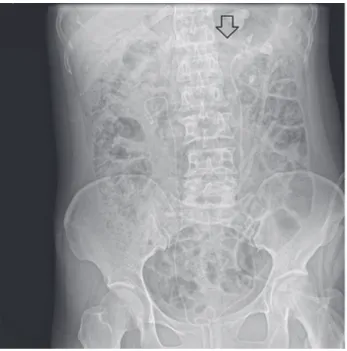
Patient 2 was a 38-year-old woman who was admitted to our hospital with the main com-plaint of consistent, dull pain in the left flank. She had undergone a right ureteroscopic lithotomy due to a middle ureteral calculus 5 days before. White blood cells (18/µL) were detected in the urine. Antibiotics were started, according to the results of prior urine culture and sensitivity. The patient was diagnosed with staghorn renal calcu-li and moderate hydronephrosis, and underwent PCNL. Access to the middle calyx was achieved using fascial dilators, under fluoroscopic guidan-ce. Immediately after dilator removal, heavy ve-nous bleeding was noted through the sheath. A nephrostomy tube was inserted through the she-ath. Fluoroscopy with contrast material opacified the renal vein, demonstrating that the tube had lodged within the IVC. The tube was immediately withdrawn and positioned at the site of entry into the renal vein. The tube was spigotted. Another simultaneous PCNL through the inferior calyceal tract was performed uneventfully (Figure-2). The former spigotted tube was not discovered within the collecting system and was removed under ul-trasound monitoring with a surgical team on stan-dby, during the second-look PCNL on postoperati-ve day 7. No bleeding occurred. The postoperatipostoperati-ve course was smooth.
Patient 3 was a 48-year-old man who had undergone a right open nephrectomy owing to kidney trauma 2 years ago. His serum creatinine level before surgery was 1.2mg/dL (normal range, 0.6-1.4mg/dL). The patient was diagnosed with left upper ureteral calculus and mild hydronephrosis, and undergone a PCNL in a community hospital 3 days before. Intense bleeding led to a sudden in-terruption of the PCNL. A nephrostomy tube was promptly inserted and closed in order to control the bleeding. The patient suffered an 800mL blood loss. In view of the massive hemorrhage and the solitary kidney, the patient was transferred to our hospital on the second postoperative day with the tube closed.
At our institution, CT showed the nephros-tomy tube piercing the renal parenchyma and en-tering the left renal vein (Figure-3). An attempt at opening the tube on postoperative day 3 did not result in bleeding, owing to tube obstruction
by clotted blood. The tube was closed again to prevent secondary bleeding due to detachment of clotted blood. The nephrostomy tube was removed under ultrasound monitoring, with a surgical team on standby, on postoperative day 7. No bleeding occurred. Flexible ureteroscopy with Ho:YAG laser lithotripsy was performed 3 days later. Mucosal injury was not found during ureteroscopy. The
Figure 2 - The radiograph of the kidneys, ureters and bladder revealing the tip of nephrostomy tube (white arrow) lodged at the site of entry into the renal vein. Additional findings including another nephrostomy tube and a double-J stent.
IBJU | A RARE COMPLICATION OF PCNL
693
postoperative course was smooth. The postopera-tive serum creatinine level was 1.0mg/dL.RESULTS
The incidence of intravenous misplace-ment of a nephrostomy tube following PCNL was 0.5% (2/4148) at our hospital. The data of the three patients are summarized in Table-1. The tip of the nephrostomy tube was located in the IVC in two patients and in the renal vein in one patient. The diagnosis was delayed in two of the three pa-tients. All three patients were managed success-fully with strict bed rest, intravenous antibiotics and one-step (in one patient) or two-step (in two patients) tube withdrawal under close monitoring. None of the three patients required open surgery for identifying the injured vein or removing the stone. None of the patients underwent antithrom-botic therapy or developed deep venous thrombo-sis. The original operations were performed suc-cessfully under close observation in two patients and changed to another type of operation in one patient. All patients were discharged uneventfully.
DISCUSSION
Intravenous misplacement of a nephros-tomy tube is an uncommon complication of PCNL. Few publications have reported the misplacement of a nephrostomy tube in the renal vein, IVC or atrium. To date, apart from the three cases repor-ted here, only seven cases of this complication have been reported in six articles in the PubMed databa-se (4,5,9-11). The data from thedataba-se publications are summarized in Table-1. The manners of intravenous misplacement may be different in various patients. There are large venous collars around the calyceal necks and also horizontal arches crossing over the calyces to link anterior and posterior veins (12). The renal vein is proximal to the renal pelvis and ma-jor posterior calyces (13). The proximity of the renal vein and its branches to the renal pelvis and calyces predisposes the veins to be injury during PCNL. The perforation of a large venous trunk by the guidewire and subsequent dilatation of the injured vein can result in catheter migrating to the venous system during the nephrostomy tube exchanging
procedu-re, when radiological monitoring is not used (4). The relatively rigid silicon catheter can easily penetrate the infected renal parenchymal tissue, pass into a major vein, and then to the renal vein and extend into the IVC if the kidney is severely infected (11). However, Mazzucchi et al. consider that a lesion in a large renal vein branch caused by the instruments used during percutaneous surgery is the most like-ly cause of bleeding, and that the proximity of the Amplatz sheath to the injured vein could inadver-tently direct the nephrostomy tube inside the ve-nous system (6). In our patients, the guidewire was not found to pass directly into the venous system on radiological monitoring during the procedure. Hen-ce, we considered that the nephrostomy tube passed into a vein after the fascial dilators had torn a large vein, as described by Mazzuchi et al. (6).
Hypertrophy of a solitary kidney is a recog-nized risk factor for excessive bleeding, and could further contribute to the increased transfusion re-quirements in PCNL patients with a solitary kidney (14). The need for transfusion is almost doubled in patients with solitary kidneys compared with that in patients with two kidneys each (15). Unclear vi-sualization of the operative field owing to bleeding in the kidney may contribute to misplacement of the tube into the vascular system (10). We found that 40% (4/10) of the patients with this compli-cation had a solitary kidney. The high prevalence of solitary kidney indicates that a solitary kidney may render these patients susceptible to intravenous misplacement of a nephrostomy tube. A history of chronic inflammation or operation on the affected kidney was found in 90% of the patients, and might be an important risk factor for intravenous catheter migration (10). Moreover, it was puzzling that 8 of 10 affected kidneys were on the left side.
IBJU
|
A RARE COMPLICA
TION OF PCNL
694
Kidney detection withdrawal therapy operation
Dias-Filho (4) 63 F Uterine cervical carcinoma, pelvic
external beam radiotherapy and left
PTN
No 12F Foley catheter
Left Renal vein, IVC, right
atrium
Yes 1-step under luoroscopy
No Catheter placement
Late elective PCN
Shaw (5) 54 M Left nephrectomy, ureterosigmoidostomy,
cystoprostatectomy, right SWL
Yes 14F Foley catheter, nephrostomy
tube
Right Renal vein No 2-step under luoroscopy
Yes PCNL A exploratory laparotomy, Late elective PCNL and
ESWL
Skolarikos (9) NA NA NA NA Nephrostomy
tube
NA IVC NA NA -step
under luoroscopy
NA NA NA
Mazzucchi (6) 52 M right nephrectomy Yes Nephrostomy tube
Left Renal vein Yes 1-step No PCNL NA
35 F right nephrectomy Yes Nephrostomy tube
Left Renal vein, IVC
Yes 2-step under luoroscopy
No PCNL NA
Li (11) 32 F Left surgical lithotomy No Nephrostomy tube
Left Renal vein, IVC
Yes 2-step under ultrasound
Yes PCNL NA
Kotb (12) 50 M Left PCNL , left PTN No 12F Foley catheter
Left Renal vein, IVC
Yes 1-step during open
pyelotomy
No* Catheter placement
An open pyelotomy
Present study
Patient 1
42 M None No Nephrostomy
tube
Left Renal vein, IVC
Yes 2-step under CT monitoring
No PCNL Late elective PCNL
Patient 2 38 F Right URL No Nephrostomy
tube
Lleft Renal vein, IVC
No 2-step under luoroscopy
No PCNL Simultaneous PCNL
Patient 3 48 M Right nephrectomy Yes Nephrostomy tube
Left Renal vein Yes 1-step under ultrasound
No PCNL Late elective URL
IBJU | A RARE COMPLICATION OF PCNL
695
bleeding. The detection of intravenous mispla-cement of a nephrostomy tube was delayed in 5 of 6 patients (4-6,10,11). The timing of detection in the four other patients was unavailable. In our hospital, the detection of tube misplacement was delayed in two of the three patients, as antegrade pyelography was not performed at the end of the percutaneous procedure. Delayed active bleeding may result in large blood loss, if the undiscovered intravenous tube is open. Early detection of the misplaced intravenous tube in the operation room may allow earlier withdrawal of the tube and pre-vent late hemorrhage. Thus, antegrade pyelogra-phy must be routinely performed at the end of a percutaneous renal procedure in order to check the exact positioning of the nephrostomy tube, even in patients with severe bleeding (6).Our patients, like the other patients re-ported in the literature, were safely managed with strict bed rest, antibiotics and one-step (one patient) or two-step (two patients) withdrawal of the tube under close monitoring. Central venous
pressure (CVP; 5-12cm H2O) is generally similar
to intrapelvic pressure (< 15 cm H2O) when the renal pelvis does not communicate freely with the outside (e.g., nephrostomy tube was closed) (10). Contaminated urine reflux through the in-jured large vein due to the urinary tract obs-truction may result in sepsis or even septic sho-ck when the intrapelvic pressure is higher than CVP. Therefore, the use of prophylactic antibio-tics should be considered.
Among the 10 patients, all of whom were discharged uneventfully, three patients underwent the original procedure, and two underwent
ano-ther type of procedure; the type of procedure in the remaining five patients was unavailable. Among our three patients, two underwent the ori-ginal procedure. We considered that the oriori-ginal procedure could be performed under close obser-vation if no active bleeding occurred.
Venous thrombosis was founded in one of the seven patients who did not receive antithrom-botic therapy. None of our 3 patients received an-tithrombotic therapy or developed venous throm-bosis. The anti-coagulation mechanisms can avoid the formation of atrial thrombi and consequent pulmonary embolism (4), and thrombotic pheno-mena are probably not observed due to the high blood flow and low venous pressure inside the-se veins (6). Thus, antithrombotic therapy is not necessary for these patients. Moreover, bleeding into the renal tract secondary to antithrombotic therapy can occur postoperatively. Therefore, we suggest that antithrombotic therapy should not be routinely administered to these patients. However, since embolism is a potentially major complica-tion, antithrombotic therapy is essential for pa-tients with hypercoagulable states.
On the basis of our own experience and the findings of the literature review, we suggest ma-naging these patients as follows (Table-2). First, once intravenous misplacement is detected, the tube should be closed immediately. Second, the closed tube should be pulled back and repositio-ned immediately at the site of entry into renal vein under CT, ultrasound or fluoroscopic monitoring, if its tip is located in the renal vein trunk, IVC or even the atrium. The closed nephrostomy tube can be removed in the operating room under CT,
ultra-Table 2 - The procedure of managing an intravenously misplaced nephrostomy tube.
Location of the tube’s tip steps When Monitoring method Renal vein adjacent to the
sinus
One step: Remove the tube
about 7 days later CT, ultrasound or luoroscopy
renal vein trunk, IVC or atrium
Two step:
First step: repositioning immediately into the renal vein just proximal to the
sinus
immediately CT, ultrasound or luoroscopy
sound or fluoroscopic monitoring after 7 days when a pericatheter tract has formed. Antegrade pyelo-graphy must be routinely performed at the end of a percutaneous procedure to check the exact position of the nephrostomy tube.
CONCLUSIONS
The incidence of intravenous misplace-ment of a nephrostomy tube following PCNL is 0.5% at our hospital. Intravenous misplacement of a nephrostomy tube is an uncommon complication following PCNL, and this finding is supported by a literature review. Patients with a solitary kidney may be susceptible to this complication. Most patients may be managed conservatively with strict bed rest, intravenous antibiotics, and tube withdrawal. The misplaced nephrostomy tube can be successfully re-moved by one-step or two-step withdrawal under close monitoring.
ABBREVIATIONS
CT = computed tomography CVP = central venous pressure IVC = inferior vena cava NA = not available
PCNL = percutaneous nephrolithotomy PTN = percutaneous tube nephrostomy SWL = shock wave lithotripsy
URL = ureteroscopic lithotripsy
CONFLICT OF INTEREST
None declared.
REFERENCES
1. Fernström I, Johansson B: Percutaneous pyelolithotomy. A new extraction technique. Scand J Urol Nephrol. 1976; 10: 257-9. 2. Mirheydar HS, Palazzi KL, Derweesh IH, Chang DC, Sur RL:
Percutaneous nephrolithotomy use is increasing in the United States: an analysis of trends and complications. J Endourol. 2013; 27: 979-83.
3. Lingeman JE, Matlaga BR, Evan AP: Surgical management of upper urinary tract calculi. In: Wein AJ (ed.), Campbell-Walsh Urology, 9th ed. Philadelphia: Saunders 2007; pp. 1500. 4. Dias-Filho AC, Coaracy GA, Borges W: Right atrial migration of
nephrostomy catheter. Int Braz J Urol. 2005; 31: 470-1.
5. Shaw G, Wah TM, Kellett MJ, Choong SK: Management of renal-vein perforation during a challenging percutaneous nephroli-thotomy. J Endourol. 2005; 19: 722-3.
6. Mazzucchi E, Mitre A, Brito A, Arap M, Murta C, Srougi M: In-travenous misplacement of the nephrostomy catheter following percutaneous nephrostolithotomy: two case reports. Clinics (Sao Paulo). 2009; 64: 69-70.
7. Mallmann CV, Wolf KJ, Wacker FK: Retrieval of vascular foreign bodies using a self-made wire snare. Acta Radiol. 2008; 49: 1124-8.
8. Koseoglu K, Parildar M, Oran I, Memis A: Retrieval of intravas-cular foreign bodies with goose neck snare. Eur J Radiol. 2004; 49: 281-5.
9. Skolarikos A, Alivizatos G, Papatsoris A, Constantinides K, Zer-bas A, Deliveliotis C: Ultrasound-guided percutaneous neph-rostomy performed by urologists: 10-year experience. Urology. 2006; 68: 495-9.
10. Li D, Xiao L, Tang Z, Qi L, Luo K, Huang L, et al.: Management of intravenous migration of urologic catheter. Urology. 2013; 82: 248-52.
11. Kotb AF, Elabbady A, Mohamed KR, Atta MA: Percutaneous silicon catheter insertion into the inferior vena cava, following percutaneous nephrostomy exchange. Can Urol Assoc J. 2013; 7: E505-7.
12. Sampaio FJ, Aragão AH: Anatomical relationship between the renal venous arrangement and the kidney collecting system. J Urol. 1990; 144: 1089-93.
13. Sampaio FJB: Review Anatomy Background for Intrarenal En-dourologic Surgery. J Endourol. 1992; 6: 301-5.
14. El-Nahas AR, Shokeir AA, El-Assmy AM, Mohsen T, Shoma AM, Eraky I, et al.: Post-percutaneous nephrolithotomy extensive hemorrhage: a study of risk factors. J Urol. 2007; 177: 576-9. 15. Bucuras V, Gopalakrishnam G, Wolf JS Jr, Sun Y, Bianchi G,
Er-dogru T, et al.: The Clinical Research Ofice of the Endourological Society Percutaneous Nephrolithotomy Global Study: nephroli-thotomy in 189 patients with solitary kidneys. J Endourol. 2012; 26: 336-41.
16. Winield HN, Weyman P, Clayman RV: Percutaneous neph-rostolithotomy: complications of premature nephrostomy tube removal. J Urol. 1986; 136: 77-9.
_______________________ Correspondence address:
Shao-Bin Zheng, MD Department of Urology, Nanfang Hospital, Southern Medical University,
1838 Guangzhou Road, Guangzhou 510515, P. R. China