
Programa de P´os-Gradua¸c˜ao em Engenharia El´etrica
Refinamento de Malha Superficial Baseado na
Aproxima¸c˜
ao Suave da Superf´ıcie do Modelo
C´
assia Regina Santos Nunes
Orientador: Prof. Dr. Renato Cardoso Mesquita (UFMG)
Co-Orientador: Prof. Ph.D. David Alister Lowther (McGill University)
Tese apresentada ao Curso de P´os-Gradua¸c˜ao em Enge-nharia El´etrica da Universidade Federal de Minas Ge-rais, como requisito parcial para obten¸c˜ao do t´ıtulo de Doutor em Engenharia El´etrica.
Programa de P´os-Gradua¸c˜ao em Engenharia El´etrica
Remeshing Driven by Smooth Approximation
of Model Surface
C´
assia Regina Santos Nunes
Advisor: Prof. Dr. Renato Cardoso Mesquita (UFMG)
Co-Advisor: Prof. Ph.D. David Alister Lowther (McGill University)
Thesis presented to the Graduate Program in Electrical Engineer of the Federal University of Minas Gerais in partial fulfillment of the requirements for the degree of Doctor in Electrical Engineer.
To my parents, Sebasti˜ao Daniel e Maria F´atima, my first masters.
Ao professor Renato Cardoso Mesquita por ter compartilhado comigo grandes id´eias
e permitido que eu realizasse este trabalho. Sua paciˆencia, disponibilidade e exigˆencia
foram essenciais para o meu crescimento intelectual e pessoal.
`
As minhas queridas irm˜as, Danielle F´atima e Maria Cl´audia, pelo carinho e incentivo.
Aos alunos de inicia¸c˜ao cient´ıfica, em especial, Felipe Terra e Raphael Chaves, pelo
empenho na execu¸c˜ao deste trabalho.
Aos professores Jaime Arturo Ram´ırez, Rodney Rezende Saldanha e Elson Jos´e da
Silva pelos ensinamentos e aux´ılios para apresenta¸c˜oes de trabalhos em Congressos.
Aos colegas do GOPAC Ricardo, Alexandre, Douglas e Luciano pelas brincadeiras e
ajuda na solu¸c˜ao de problemas.
Aos colegas de caminhada, Lane, Carla, Marcelo, Anderson, Jose Hissa, Ademir, Julio
e Elizabeth pelas trocas de exper´ıˆencias e conversas agrad´aveis na hora do caf´e.
Ao meu amigo, Frederico Bruno Ribas Soares, pelas palavras reconfortantes e
incen-tivadoras.
`
As minhas amigas Larissa, Ma´ıra, Ana Paula e Let´ıcia pelas nossas conversas
inter-min´aveis sobre tudo.
Ao Geraldo, meu osteopata, fisioterapeuta, acupunturista e grande amigo.
Aos mestrandos, doutorandos, professores e funcion´arios do CPDEE/UFMG pela
convivˆencia e coopera¸c˜ao.
`
A CAPES, pela bolsa de estudos durante a realiza¸c˜ao deste trabalho.
`
A CAPES/PDEE, pela concess˜ao da bolsa de doutorado sandu´ıche para a McGill
I would like to also thank professor David Alister Lowther for receiving me and
coa-ching me during my stay in Montreal/Canad´a.
Many thanks to my CADLAB/McGill friends, Dileep Nair and Linda Wang, for
sharing amazing moments with me.
Thanks a lot to Kate, Sue, Gustavo, Nadia, Marcia and, specially, Raquel for been
my family when I was in Montreal.
O m´etodo de elementos finitos ´e uma poderosa ferramenta para a comunidade de
engenharia. Uma das barreiras para automatiza¸c˜ao de an´alises pelo m´etodo de
elemen-tos finielemen-tos ´e a gera¸c˜ao autom´atica de malhas de boa qualidade. Uma malha com boa
distribui¸c˜ao de n´os e elementos bem formados contribui na gera¸c˜ao de sistemas bem
con-dicionados, minimizando erros num´ericos e singularidades. Contudo, a maioria das malhas
n˜ao ´e considerada satisfat´oria sem a aplica¸c˜ao de alguma etapa de p´os-processamento para
melhorar suas propriedades. As malhas que representam modelos resultantes da
aplica-¸c˜ao das opera¸c˜oes Booleanas e de montagem `a modelos pr´e-existentes possuem um grande
n´umero de elementos mal formados. O problema de baixa qualidade tamb´em ocorre em
malhas geradas por t´ecnicas de reconstru¸c˜ao de superf´ıcies.
Este trabalho apresenta um algoritmo efetivo de refinamento de malhas superficiais
para melhorar a forma dos elementos, a distribui¸c˜ao nodal e suas conex˜oes. Este processo
consiste na aplica¸c˜ao de s´eries de operadores de modifica¸c˜ao local para: mover, retirar
e inserir n´os na malha superficial. Para evitar a perda das caracter´ısticas geom´etricas
do modelo, uma nova t´ecnica de aproxima¸c˜ao da geometria ´e apresentada. Como, na
maioria das vezes, apenas a configura¸c˜ao da malha ´e conhecida, a aproxima¸c˜ao suave do
modelo ´e calculada por partes a partir dos n´os que comp˜oem a malha. Os movimentos
dos n´os s˜ao direcionados pela aproxima¸c˜ao, o que assegura que eles permane¸cam sobre a
superf´ıcie original durante o aprimoramento da malha. Alguns exemplos s˜ao apresentados
para ilustrar os resultados alcan¸cados ap´os a aplica¸c˜ao do nosso esquema de refinamento
da malha.
The finite element method is a powerful tool for the engineering community. One of
the barriers for automating finite element analysis is the automatic generation of
high-quality meshes. Meshes with good nodes distribution and well-shaped elements provides
good system conditioning, which minimizes errors and singularities that might arise.
How-ever, most meshes can hardly be called satisfactory without any kind of post-processing
to improve their qualities. The meshes representing models generated by the application
of the Boolean and assembly operations to predefined primitives have a large number
of badly shaped elements. The quality problem also raises in models obtained by the
acquisition process, like scanning devices.
This work presents an effective remeshing algorithm to improve the shape,
distribu-tion and connectivity of the surface mesh elements, while keeping the mesh geometrically
close to the model surface. Our post-processing scheme applies series of local mesh
modi-fications operators to the input mesh. The local operators are able to improve, refine and
simplify the mesh. To ensure fidelity, a novel technique was developed to approximate
the model surface by smooth surface patches. Since, most of the time, only the mesh
configuration is available, a smooth surface approximation is evaluated by pieces from the
mesh nodes. The approximation is used to drive the nodes movements and assure that
they stay on top of the original model surface during the application of the local mesh
modifications. Many examples are presented to illustrate the accomplished results of this
work.
O texto a seguir consiste em um resumo estendido sobre o trabalho desenvolvido nesta
tese. Primeiramente, este texto introduz o problema abordado, a principal motiva¸c˜ao
para solucion´a-lo e alguns dos principais m´etodos relacionados. Em seguida, uma breve
descri¸c˜ao da principal metodologia desenvolvida ´e apresentada. Finalmente, as conclus˜oes
s˜ao apresentadas.
Introdu¸c˜
ao
O m´etodo de elementos finitos (FEM - Finite Element Method) ´e uma boa escolha para solucionar equa¸c˜oes diferenciais parciais (PDEs - Partial Differential Equations) em dom´ınios complexos. FEM aproxima numericamente a solu¸c˜ao de PDEs lineares e
n˜ao-lineares pela substitui¸c˜ao do sistema cont´ınuo de equa¸c˜oes por um n´umero finito
de equa¸c˜oes alg´ebricas lineares e n˜ao-lineares acopladas. O dom´ınio do problema deve
ser dividido em partes menores de forma simples, construindo uma malha de elementos
finitos. Esta malha deve aproximar o dom´ınio de estudo e seus elementos devem satisfazer
restri¸c˜oes de tamanho e forma.
Em an´alise pelo FEM, a qualidade da aproxima¸c˜ao da superf´ıcie e a qualidade da
forma dos elementos da malha volum´etrica afetam a precis˜ao dos resultados num´ericos.
Por exemplo, se os ˆangulos internos dos elementos s˜ao pr´oximos a 180◦, o erro de
dis-cretiza¸c˜ao da solu¸c˜ao aumenta; se os ˆangulos s˜ao pr´oximos a zero, o n´umero de condi¸c˜ao
da matriz do elemento aumenta. Resumindo, uma malha com boa distribui¸c˜ao de n´os
e elementos bem formados contribui na gera¸c˜ao de sistemas bem condicionados, o que
minimiza erros num´ericos e singularidades que possam ocorrer.
A qualidade da malha volum´etrica est´a intimamente ligada `a qualidade da malha
superficial. Uma malha superficial de baixa qualidade pode inviabilizar a gera¸c˜ao da
malha volum´etrica correspondente, ou os elementos obtidos s˜ao de baixa qualidade. Em
geral, os programas geradores de malhas volum´etricas tˆem autonomia para inserir novos
pontos na malha superficial, mas n˜ao podem decidir sobre a retirada ou modifica¸c˜ao da
localiza¸c˜ao de um v´ertice da malha inicial. A malha superficial inicial deve estar presente
na malha volum´etrica resultante. Assim, malhas superficiais de boa qualidade facilitam a
obten¸c˜ao de malhas volum´etricas tamb´em de boa qualidade.
A princ´ıpio, modeladores de s´olidos podem produzir malhas superficiais de alta
qua-lidade, mas ap´os a aplica¸c˜ao de algumas opera¸c˜oes Booleanas e de opera¸c˜oes montagem
a modelos pr´e-existentes, a qualidade da malha resultante diminui drasticamente. O
pro-blema de baixa qualidade tamb´em ocorre em malhas geradas por t´ecnicas de reconstru¸c˜ao
de superf´ıcies. Estas t´ecnicas reconstroem superf´ıcies a partir de um conjunto de pontos,
os quais podem ser obtidos de v´arios tipos de fontes, como digitalizadores tridimensionais
a laser. As t´ecnicas de reconstru¸c˜ao enfatizam a aproxima¸c˜ao da geometria e topologia,
mas n˜ao garantem a qualidade da malha superficial gerada.
Neste contexto, refinar a malha superficial torna-se muito importante para
maximi-zar a qualidade da forma de seus elementos, reduzindo o n´umero de ˆangulos agudos,
melhorando a distribui¸c˜ao nodal e suas conex˜oes.
O objetivo deste projeto ´e a gera¸c˜ao de malhas superficiais de alta qualidade para
modelos obtidos atrav´es de processos de aquisi¸c˜ao de dados ou modelos resultantes da
aplica¸c˜ao das opera¸c˜oes Booleanas e/ou de montagem sobre primitivas pr´e-definidas. Uma
malha de alta qualidade viabiliza um sistema de elementos finitos bem condicionado, o
que aumenta a precis˜ao dos resultados obtidos.
Para melhorar a qualidade da malha superficial, diferentes m´etodos de p´os-processamento
podem ser usados. Existem trˆes t´ecnicas b´asicas para melhoramento da malha: suaviza¸c˜ao
(smoothing), simplifica¸c˜ao (clean-up) e subdivis˜ao (refining). Suaviza¸c˜ao inclui qualquer m´etodo que melhora o posicionamento dos n´os sem alterar suas conex˜oes. Simplifica¸c˜ao,
geralmente, refere-se a processos que modificam a conectividade dos elementos, atrav´es da
inserindo novos elementos. Na maioria das vezes, a aplica¸c˜ao de apenas uma dessas
t´ec-nicas n˜ao ´e suficiente para alcan¸car o n´ıvel de qualidade desejado. Ent˜ao, para garantir a
obten¸c˜ao de uma malha superficial com alto grau de qualidade, duas ou trˆes t´ecnicas s˜ao
aplicadas em conjunto, o que gera m´etodos h´ıbridos de p´os-processamento.
Em outra classifica¸c˜ao, os m´etodos de refinamento de malhas superficiais s˜ao divididos
em trˆes grupos. O primeiro grupo ´e baseado no particionamento das malhas 3D em pat-ches(partes) e no tratamento de cada parte em separado. Esta t´ecnica produz resultados razo´aveis, mas ´e muito sens´ıvel a estrutura dospatches, al´em da amostragem dos v´ertices ser de dif´ıcil controle. Outro grupo de algoritmos est´a baseado na parametriza¸c˜ao global
da malha original. Uma nova triangula¸c˜ao de boa qualidade ´e gerada sobre o dom´ınio
param´etrico e depois projetada de volta ao espa¸co 3D. Assim, a malha resultante ´e uma
vers˜ao melhorada do modelo original. A principal desvantagem dos m´etodos de
para-metriza¸c˜ao global ´e a sensibilidade dos resultados `a parapara-metriza¸c˜ao utilizada. Converter
uma estrutura 3D n˜ao-trivial num plano param´etrico distorce drasticamente a estrutura
e informa¸c˜oes importantes, n˜ao especificadas claramente, podem ser perdidas. Mesmo
que a parametriza¸c˜ao minimize as distor¸c˜oes do modelo original, ´e imposs´ıvel elimin´a-las
completamente. Al´em disso, os m´etodos de c´alculo da parametriza¸c˜ao global s˜ao lentos,
pois eles envolvem a solu¸c˜ao de grandes sistemas de equa¸c˜oes, muitas vezes n˜ao-lineares.
A principal alternativa `a parametriza¸c˜ao global ´e trabalhar diretamente sobre a malha
superficial e realizar s´eries de modifica¸c˜oes locais para melhorar, enriquecer ou simplificar
a malha. Est´a t´ecnica ´e conhecida como processo de adapta¸c˜ao da malha ou simplesmente
remeshing(refinamento da malha) e este m´etodo ´e utilizado neste trabalho. Algoritmos de remeshing podem ser considerados m´etodos h´ıbridos, pois os operadores de modifica¸c˜ao local da malha encapsulam as t´ecnicas b´asicas de suaviza¸c˜ao, simplifica¸c˜ao e subdivis˜ao.
Os operadores de modifica¸c˜oes locais permitem mover, retirar e inserir n´os na malha
superficial. Para evitar a perda das caracter´ısticas geom´etricas do modelo, torna-se
es-sencial o uso de uma aproxima¸c˜ao da geometria do modelo. Essa aproxima¸c˜ao direciona
os movimentos dos n´os e assegura que eles permane¸cam sobre a superf´ıcie original do
modelo.
Infelizmente, na maioria das vezes, apenas a configura¸c˜ao da malha ´e conhecida e n˜ao
as caracter´ısticas geom´etricas do modelo. Para superar este problema, uma representa¸c˜ao
aproxima-¸c˜ao geom´etrica ´e calculada por partes a partir dos v´ertices que comp˜oem a malha. Os
operadores de modifica¸c˜oes locais s˜ao aplicados `a malha, levando em considera¸c˜ao as
infor-ma¸c˜oes geom´etricas provenientes da aproxima¸c˜ao da superf´ıcie do modelo. A constru¸c˜ao
da representa¸c˜ao suave da superf´ıcie do modelo constitui na principal contribui¸c˜ao deste
trabalho.
A pr´oxima se¸c˜ao apresenta a t´ecnica introduzida para o c´alculo da aproxima¸c˜ao suave
da superf´ıcie do modelo. Em seguida, o m´etodo para refinamento de malhas superficiais
utilizando esta t´ecnica ´e discutido.
Aproxima¸c˜
ao Suave da Superf´ıcie do Modelo
A aproxima¸c˜ao da superf´ıcie do modelo ´e muito importante durante o processo de
refinamento da malha superficial. ´E atrav´es dela que as caracter´ısticas geom´etricas do
modelo ser˜ao conhecidas e preservadas. Um operador de modifica¸c˜ao local da malha
´e aplicado apenas quando a qualidade da forma do elemento e o erro de aproxima¸c˜ao
permanecem dentro dos limites pr´e-estabelecidos.
A aproxima¸c˜ao utilizada deve garantir a representa¸c˜ao de modelos gerados atrav´es da
aplica¸c˜ao das opera¸c˜oes Booleanas e opera¸c˜ao de montagem sobre primitivas pr´e-definidas,
assim como de modelos gerados a partir de t´ecnicas de reconstru¸c˜ao de superf´ıcies. Por
defini¸c˜ao, os modelos reconstru´ıdos s˜ao obtidos a partir de um conjunto desorganizado
de pontos P, usualmente denso, amostrados diretamente de uma superf´ıcie suave S. Por
outro lado, as malha resultantes das aplica¸c˜oes das opera¸c˜oes Booleanas e de montagem
podem ser formadas por superf´ıcies planares e curvas. Seu conjunto de v´ertices ´e
normal-mente reduzido. Para representar os dois tipos de modelos, a t´ecnica de aproxima¸c˜ao da
superf´ıcie do modelo por um conjunto de patches(partes) suaves ´e introduzida. A cada face da malha ´e associado um patch suave, que pode ser plano ou curvo. Aproximar a geometria do modelo por um conjunto de patches diminui o tempo de processamento e minimiza erros de aproxima¸c˜ao, pois a parametriza¸c˜ao global ´e evitada.
Para calcular a aproxima¸c˜ao de uma face da malha, os v´ertices da mesma e os
v´er-tices vizinhos s˜ao utilizados. O uso dos v´erv´er-tices vizinhos ´e importante para melhorar a
lo-cal do modelo. Se o conjunto de v´ertices ´e coplanar, a aproxima¸c˜ao da face ´e um patch plano; sen˜ao, a face ´e aproximada por um patch curvo. Outro aspecto considerado na identifica¸c˜ao do tipo depatch ´e o erro associado `a aproxima¸c˜ao calculada. Ap´os o c´alculo dopatch curvo, o erro m´edio entre o patch e os v´ertices utilizado no c´alculo ´e avaliado. Se o erro for maior que um valor limite especificado (por exemplo: o erro m´aximo pode ser
limitado em 2%), a aproxima¸c˜ao ´e descartada e a face ´e ent˜ao aproximada por um plano.
A aproxima¸c˜ao de toda a superf´ıcie do modelo ´e formada por um conjunto de patches suaves curvos ou planos. Os patches curvos s˜ao patches B-splines calculados atrav´es da t´ecnica de m´ınimos quadrados, onde os v´ertices da face a ser aproximada e seus v´ertices
vizinhos s˜ao as entradas.
As superf´ıcies param´etricas B-splines s˜ao frequentemente usadas em sistemas CAD
(Computer Aided Design - Projeto Assistido por Computador) para aproximar pontos distribu´ıdos irregularmente no espa¸co. Entre as vantagens na utiliza¸c˜ao das B-splines,
destacam-se: i) garantia de boa aproxima¸c˜ao de uma grande variedade de s´olidos; ii)
preserva¸c˜ao de altos graus de continuidade em superf´ıcies complexas; e iii) controle local,
o que significa que uma modifica¸c˜ao local da forma n˜ao ´e propagada para toda a superf´ıcie.
O problema consiste em encontrar um patch de superf´ıcie B-spline s(u, v), que apro-xima um conjunto de v´ertices, com representa¸c˜ao da forma:
s(u, v) =
ν X
ω=0
Mω(u, v)cω, (1)
onde,cω s˜ao pontos de controle eMω(u, v) s˜ao fun¸c˜oes base.
Seja pτ,τ = 1, ..., µ, o conjunto de v´ertices da face e seus v´erticies vizinhos e sτ suas
aproxima¸c˜oes. A aproxima¸c˜ao ´e calculada como um m´ınimo da fun¸c˜aoF:
F =
µ X
τ=0
ks(uτ, vτ)−pτk
2 = µ X τ=0 " ν X ω=0
Mω(uτ, vτ)cω−pτ #2
. (2)
Ou seja, assumindo que as fun¸c˜oes base, Mω, s˜ao dadas ou pr´e-calculadas, precisa-se
encontrar o conjunto de pontos de controle, cω, que minimize F.
Este problema cl´assico de aproxima¸c˜ao por m´ınimos quadrados sempre possui solu¸c˜ao.
ser suficientemente suave. Por isso, acrescenta-se `a Equa¸c˜ao 2 um termo quadr´atico de
regulariza¸c˜ao (Fs), denominado termo de suaviza¸c˜ao ou termo de penalidade. Assim,
garante-se que a solu¸c˜ao seja ´unica e com suaviza¸c˜ao controlada. Frequentemente, esse
termo ´e obtido a partir da aproxima¸c˜ao dethin-plate energy, uma fun¸c˜ao quadr´atica nas derivadas parciais de segunda ordem:
Fs = Z Z
(s2
uu+ 2s
2
uv+s
2
vv)dudv. (3)
ou a partir de membrane energy que ´e quadr´atica nas derivadas parciais de primeira ordem:
Fs = Z Z
(s2
u+s
2
v)dudv. (4)
Acrescentando o termo de suaviza¸c˜ao a Equa¸c˜ao 2, a fun¸c˜ao a ser minimizada torna-se:
F = µ X τ=0 " ν X ω=0
Mω(uτ, vτ)cω−pτ #2
+λFs, (5)
ondeλ´e um valor real maior ou igual a zero, denominado parˆametro de suaviza¸c˜ao. Como
F e qualquer um dos termos de suaviza¸c˜ao (Fs) s˜ao quadr´aticos em cω, a Equa¸c˜ao 5 pode
ser reescrita na forma matricial:
F=kBc−pk22+λcTEc, (6)
onde, c = (c1, ..., cν)T, p = (p1, ..., pµ)T, E ´e uma matriz ν × ν, sim´etrica e definida
positiva, e a matriz B´eµ×ν, da forma:
B =
M1(u1, v1) . . . Mν(u1, v1)
M1(u2, v2) . . . Mν(u2, v2)
... . . . ...
M1(uµ, vµ) . . . Mν(uµ, vµ) (7)
Tomando-se o gradiente de F e igualando-o a zero, tem-se:
A matriz BTB ´e de ordem n
×n, sim´etrica e semi-definida positiva, ent˜ao a solu¸c˜ao da Equa¸c˜ao 8 com λ = 0 n˜ao ´e necessariamente ´unica. Como E ´e positiva definida, a
solu¸c˜ao do sistema matricial (BTB+λE) paraλ >0 ´e tamb´em definida positiva e desse
modo n˜ao singular, o que implica que a Equa¸c˜ao 8 tem solu¸c˜ao ´unica.
Uma boa aproxima¸c˜ao dos n´os da malha ´e muito importante para preserva¸c˜ao das
caracter´ısticas geom´etricas do modelo durante o processo de melhoramento da malha
superficial. A t´ecnica de aproxima¸c˜ao suave da superf´ıcie do modelo apresentada neste
trabalho garante isto. Ela reduz erros de aproxima¸c˜ao e pode ser utilizada para aproximar
uma grande variedade de s´olidos.
A seguir o m´etodo de refinamento de malha superficial introduzido neste trabalho e
algumas caracter´ısticas de implementa¸c˜ao s˜ao discutidos.
Remeshing
O m´etodo de refinamento proposto deve garantir a melhoria de malhas de modelos
gerados pela aplica¸c˜ao das opera¸c˜oes Booleanas e de montagem a modelos pr´e-existentes,
bem como de modelos obtidos a partir de um conjunto de pontos por m´etodos de
recons-tru¸c˜ao. Os elementos da malha resultante devem possuir boa qualidade; ˆangulos internos
pr´oximos a 60◦ (elementos triangulares) ou superior (demais elementos); boa
distribui-¸c˜ao dos v´ertices e boa aproximadistribui-¸c˜ao da superf´ıcie do modelo. A forma e distribuidistribui-¸c˜ao dos
elementos s˜ao requisitos dos geradores de malha volum´etrica. A qualidade da
aproxima-¸c˜ao geom´etrica ´e necess´aria para que os resultados das simula¸c˜oes eletromagn´eticas sejam
v´alidos e compat´ıveis com a realidade.
Estudos recentes indicam o processo de adapta¸c˜ao da malha superficial como excelente
alternativa para o refinamento de malhas superficiais de baixa qualidade. Ele evita as
desvantagens dos m´etodos que utilizam parametriza¸c˜oes globais, pois trabalha diretamente
sobre a malha que representa o modelo.
O m´etodo apresentado neste trabalho ´e baseado nos operadores de modifica¸c˜oes locais,
que encapsulam os m´etodos b´asicos de suaviza¸c˜ao, simplifica¸c˜ao e subdivis˜ao da malha.
Para evitar a perda de informa¸c˜oes geom´etricas do modelo, calcula-se uma aproxima¸c˜ao
Os operadores de modifica¸c˜ao local s˜ao aplicados sempre que a qualidade dos
elemen-tos da malha ´e aprimorada. Eles permitem simplificar, enriquecer e movimentar elemenelemen-tos
da malha. Para garantir que as caracter´ısticas geom´etricas do modelo n˜ao sejam perdidas,
a execu¸c˜ao dos operadores est´a condicionada ao desvio entre os elementos da malha e a
aproxima¸c˜ao suave. Se este desvio ultrapassa os limites pr´e-estabelecidos, a opera¸c˜ao n˜ao
pode ser executada.
Os operadores de modifica¸c˜oes locais utilizados neste trabalho s˜ao: uni˜ao de aresta
(edge-collapsing), divis˜ao de aresta (edge-splitting), realoca¸c˜ao de v´ertice (vertex reloca-tion) e troca de arestas (edge-swapping). Estes operadores s˜ao aplicados sequencialmente para alcan¸car as caracter´ısticas de malha desejadas. Os operadores de uni˜ao de aresta e
divis˜ao de aresta s˜ao usados para melhorar a forma dos elementos e tamb´em a taxa de
amostragem, a qual varia de acordo com a curvatura local. Regi˜oes de maior curvatura
conter˜ao elementos menores e maior n´umero de v´ertices, enquanto regi˜oes planas conter˜ao
v´ertices mais esparsos e elementos maiores. A aproxima¸c˜ao do modelo fornece
informa-¸c˜oes sobre a curvatura local. As operainforma-¸c˜oes de troca de elementos e realoca¸c˜ao de v´ertices
melhoram apenas a qualidade da forma dos elementos. A qualidade da aproxima¸c˜ao
geo-m´etrica ´e medida a priori. Opera¸c˜oes que diminuem o ˆangulo m´ınimo dos elementos envolvidos ou aumentam o desvio entre o elemento e a aproxima¸c˜ao geom´etrica n˜ao s˜ao
aplicadas. A aplica¸c˜ao de uma modifica¸c˜ao local modifica a configura¸c˜ao dos elementos.
Os operadores de modifica¸c˜ao local s˜ao detalhados a seguir. Seja uma aresta AB, a
opera¸c˜ao de uni˜ao de aresta consiste em unir os v´ertices A e B num ´unico v´ertice. Esta
opera¸c˜ao ´e executada se a exclus˜ao da aresta AB n˜ao faz com que as arestas conectadas
ao v´erticeB extrapolem o desvio permitido.
A opera¸c˜ao de divis˜ao de aresta introduz um novo v´ertice na aresta AB. O novo
v´ertice ´e inserido quando se aumenta o valor do ˆangulo m´ınimo das faces que compartilham
a aresta longa, ou quando a distˆancia da aresta `a superf´ıcie supera o desvio m´aximo
permitido. O novo v´ertice ´e calculado sobre a superf´ıcie aproximada. Caso as faces
que compartilham essa aresta sejam triangulares, os triˆangulos existentes s˜ao divididos
produzindo quatro novos triˆangulos.
O procedimento de realoca¸c˜ao de v´ertices consiste em redefinir todas as faces que
compartilham o v´erticeA. Todas essas faces s˜ao mapeadas num mesmo plano e o melhor
obtida e o resultado ´e mapeado sobre a superf´ıcie aproximada, obtendo-seA′.
Por ´ultimo, tem-se o operador de troca de arestas. Este operador ´e aplicado quando
os ˆangulos internos dos triˆangulos que compartilham a aresta testada crescem. Os
triˆan-gulos que compartilham a aresta devem ser coplanares ou praticamente coplanares. Esta
opera¸c˜ao introduz modifica¸c˜oes na curvatura local.
O processo de refinamento da malha superficial pode ser resumido pelo algoritmo:
1: Defini¸c˜oes preliminares:
2: Obt´em-se o conjunto de patches associados `as faces a serem refinadas 3: Calcula o desvio entre a malha e o modelo aproximado
4: Preenche o vetor E de arestas a serem testadas 5: Refinamento da malha:
6: enquanto a malha sofre altera¸c˜oes 7: paracada aresta e∈E
8: se a uni˜ao de v´ertices aumenta ˆangulos internos 9: e n˜ao perde caracter´ısticas geom´etricas
10: une e
11: sen˜ao sea troca de arestas aumenta ˆangulos internos 12: e n˜ao perde caracter´ısticas geom´etricas
13: troca e
14: sen˜ao sea divis˜ao de arestas melhora a geometria oua qualidade da malha
15: divide e
16: fim se
17: realoca os v´ertices da aresta e 18: fim para
19: fim enquanto
Tabela 1: Algoritmo para Refinamento da Malha
Caracter´ısticas de Implementa¸c˜
ao
O m´etodo foi implementado no GSM (Gopac Solid Modeler). O GSM ´e um Modelador
de S´olidos Voltado para Aplica¸c˜oes em Eletromagnetismo, que se encontra em
desenvol-vimento pelo GOPAC (Grupo de Otimiza¸c˜ao e Projeto Assistido por Computador) da
UFMG (Universidade Federal de Minas Gerais). Este modelador garante a interpreta¸c˜ao
´
finitos superficial; facilita e agiliza os processos de cria¸c˜ao, edi¸c˜ao, visualiza¸c˜ao e acesso
`a representa¸c˜ao computacional de s´olidos. O modelador tem como objetivo gerar uma
malha de elementos finitos de boa qualidade, capaz de fornecer as informa¸c˜oes necess´arias
para simula¸c˜ao eletromagn´etica do modelo. O GSM est´a dividido em quatro subsistemas,
sendo que cada um pode ser desenvolvido e operado individualmente, mesmo que estejam
interligados. Estes subsistemas s˜ao:
• subsistema de Interface, respons´avel direto pela intera¸c˜ao do usu´ario com o GSM e pela visualiza¸c˜ao do modelo constru´ıdo. As fun¸c˜oes que o GSM realiza s˜ao captadas
e descritas por procedimentos da interface, que ativam procedimentos dos outros
subsistemas. Os resultados das fun¸c˜oes s˜ao recebidos e apresentados pela Interface;
• subsistema de Modelagem, respons´avel pelas opera¸c˜oes realizadas na representa¸c˜ao interna. Possui fun¸c˜oes que avaliam a descri¸c˜ao de um novo modelo ou de uma
alte-ra¸c˜ao e, a seguir, acionam as fun¸c˜oes do subsistema de Representa¸c˜ao para criar ou
alterar uma representa¸c˜ao. Tamb´em ´e respons´avel pelas quest˜oes topol´ogicas e
geo-m´etricas solicitadas pelo sistema. As opera¸c˜oes Booleanas e opera¸c˜ao de montagem
est˜ao contidas neste subsistema;
• subsistema de Representa¸c˜ao, ou N´ucleo: respons´avel pela manipula¸c˜ao, gerencia-mento e acesso `a representa¸c˜ao interna. As fun¸c˜oes para armazenagerencia-mento da
descri-¸c˜ao dos objetos e composi¸c˜oes em bases de dados permanentes s˜ao tamb´em inclu´ıdas
nesse subsistema. Os dados das representa¸c˜oes internas podem ser lidos por fun¸c˜oes
de outros subsistemas, mas as cria¸c˜oes e modifica¸c˜oes s˜ao realizadas pelo subsistema
de representa¸c˜ao;
• subsistema de Gera¸c˜ao de Malha, garante a gera¸c˜ao da malha de elementos finitos a partir da descri¸c˜ao geom´etrica da fronteira, obtida da representa¸c˜ao B-rep.
A biblioteca SINTEF LSMG (vers˜ao 1.0) foi utilizada para calcular e tratar ospatches de superf´ıcie B-splines.
Todo projeto foi realizado utilizando t´ecnicas de orienta¸c˜ao a objeto. A superf´ıcie
suave aproximada foi encapsulada numa classe que ´e respons´avel por fornecer a interface
necess´aria aos operadores de modifica¸c˜ao local. Assim, facilita-se a troca do tipo superf´ıcie
Cada face da malha est´a associada a uma aproxima¸c˜ao da superf´ıcie do modelo. A
aproxima¸c˜ao pode ser um patch B-spline ou um plano. Admite-se um erro de 2% para o patchB-spline em rela¸c˜ao aos pontos utilizados para seu c´alculo. As aproxima¸c˜oes geradas com erro maior que 2% s˜ao descartadas e as faces s˜ao aproximadas por planos. Regi˜oes
com curvatura acentuada precisam de malhas mais densas para que a aproxima¸c˜ao obtida
seja v´alida.
´
E importante relembrar que todas as novas faces geradas pelos operadores de
modi-fica¸c˜ao local s˜ao testadas antes da aplica¸c˜ao dos mesmos. Os testes est˜ao relacionados `a
qualidade da forma e `a qualidade da aproxima¸c˜ao geom´etrica. Opera¸c˜oes que
degrada-riam a qualidade da forma dos elementos ou acrescentadegrada-riam `a malha um desvio maior que
o permitido n˜ao s˜ao realizadas.
Para os modelos resultantes das opera¸c˜oes Booleanas e de montagem, apenas as faces
da regi˜ao de interface participam do processo de refinamento. Num modelo gerado a partir
de uma nuvem de pontos todas as faces s˜ao utilizadas pelo m´etodo. Ospatches das faces das regi˜oes de interface devem ser calculados antes da aplica¸c˜ao das opera¸c˜oes Booleanas
e de montagem, pois os v´ertices das faces que ser˜ao destru´ıdas auxiliam no c´alculo da
aproxima¸c˜ao suave da superf´ıcie do modelo.
Conclus˜
oes
A gera¸c˜ao de malhas volum´etricas de alta qualidade ´e essencial para garantir solu¸c˜oes
eletromagn´eticas precisas e de alta qualidade. A qualidade da aproxima¸c˜ao do modelo ao
s´olido real estudado torna as simula¸c˜oes compat´ıveis com a realidade.
A qualidade da malha volum´etrica est´a intimamente ligada `a qualidade da malha
superficial. Uma malha superficial de baixa qualidade pode inviabilizar a gera¸c˜ao da
malha volum´etrica correspondente, ou os elementos obtidos s˜ao de baixa qualidade. Neste
contexto, garantir a obten¸c˜ao de malhas superficiais de boa qualidade facilita a gera¸c˜ao
de malhas volum´etricas tamb´em de boa qualidade.
Este trabalho apresenta um m´etodo de refinamento baseado na aplica¸c˜ao de s´eries
de operadores de modifica¸c˜ao local a malha superficial. Essas opera¸c˜oes s˜ao direcionadas
considerando as coordenadas dos v´ertices da malha e suas conex˜oes. A aproxima¸c˜ao
garante as informa¸c˜oes geom´etricas necess´arias `a manuten¸c˜ao das caracter´ısticas originais
do modelo. O m´etodo discutido ´e eficiente na melhoria da qualidade da malha superficial
de modelos obtidos atrav´es da aplica¸c˜ao de opera¸c˜oes Booleanas e de montagem a modelos
1 Introduction 1
1.1 Motivation . . . 2
1.2 The Problem Origin . . . 3
1.3 Approach . . . 4
1.4 Contributions . . . 5
1.5 Outline of this work . . . 6
2 General Concepts 7 2.1 Finite Element Method . . . 7
2.2 Geometric Modeling . . . 9
2.2.1 Constructive Solid Modeler . . . 11
2.2.2 Sweep Representation . . . 12
2.2.3 Boundary Representation . . . 12
2.2.3.1 Euler Operators . . . 14
2.2.4 Boolean and Assembly Operations . . . 15
2.2.4.1 Primitive Mesh Generation . . . 17
2.2.4.2 Intersecting Process . . . 17
2.2.4.3 Elements Classification . . . 18
2.2.4.4 Boolean Evaluation and Elimination of Undesired Elements 20 2.3 Finite Element Mesh . . . 21
2.3.1 Delaunay Triangulation . . . 24
2.3.2 Delaunay Tetrahedralization . . . 25
2.3.3 Surface Mesh Generation . . . 27
2.3.3.1 Sphere Discretization . . . 28
2.3.3.2 Swept Primitives Discretization . . . 29
2.3.3.3 Surface Reconstruction . . . 29
2.4 Mesh Quality Measures . . . 31
2.4.1 Triangular Elements . . . 36
2.4.1.1 The Minimum/Maximum Angle . . . 36
2.4.1.2 The Aspect Ratio . . . 36
2.4.1.3 The Distortion Metrics . . . 36
2.4.2 Tetrahedral Elements . . . 36
2.4.2.1 Radius-edge ratio . . . 37
2.4.2.2 Aspect ratio . . . 38
2.4.2.3 Dihedral Angle . . . 38
2.5 Surfaces . . . 38
2.5.1 Surface Representation . . . 39
2.5.2 Bezier Surface . . . 42
2.5.3 B-Spline Surface . . . 44
2.6 Smooth Approximation of a Points Cloud . . . 46
2.7 Discussion . . . 49
3 Surface Mesh Post-Processing Methods 51
3.1 Smoothing Methods . . . 52
3.1.1 Averaging Methods . . . 53
3.1.2 Optimization-Based Methods . . . 53
3.1.3 Physically-Based Methods . . . 54
3.2 Clean-up Methods . . . 54
3.2.1 Shape Improvement . . . 54
3.2.2 Topological Improvement . . . 55
3.3 Refinement Methods . . . 55
3.3.1 Edge Bisection . . . 55
3.3.2 Point Insertion . . . 56
3.4 Local Mesh Modification Operators . . . 56
3.5 Hybrid Methods . . . 58
3.5.1.1 Geometric Surface Mesh . . . 60
3.5.1.2 The Geometric Support . . . 61
3.5.1.3 Unit Surface Mesh Construction . . . 62
3.5.2 Surazhsky and Gotsman’s Method . . . 63
3.5.2.1 Geometric Background . . . 64
3.5.2.2 Remeshing . . . 65
3.6 Discussion . . . 67
4 Remeshing Driven by Smooth Approximation of Model Surface 69
4.1 Avoiding the Planar Facets Triangulation . . . 71
4.2 Remeshing . . . 73
4.2.1 Approximation of the Model Surface . . . 75
4.2.2 Algorithm . . . 77
4.3 Implementation Characteristics . . . 80
4.4 Discussion . . . 83
5 Results 85
5.1 Models Generated by Boolean and Assembly Operations . . . 85
5.1.1 Results when the planar facet triangulation is avoided . . . 85
5.1.2 Results Applying the New Remeshing Scheme . . . 89
5.1.3 Discussion . . . 98
5.2 Models Generated by Acquisition Process . . . 100
5.3 Discussion . . . 113
6 Conclusions 115
6.1 Summary of the Accomplished Work . . . 120
6.2 Future Work . . . 123
Bibliography 124
✶
Introduction
Numerical methods based on spatial discretizations, as the finite element method, the
boundary element method, the finite volume method, and others, play an important role
in computer aided design (CAD), engineering (CAE), and manufacturing (CAM). Namely,
the finite element method (FEM) is probably the most widespread analysis technique in
the engineering community. This technique is capable of solving field problems governed
by partial differential equations for very complex geometries. However, successful and
efficient use of FEM still requires significant expertise, time, and cost.
Many researchers are investigating ways to automate FEM, thus allowing improved
productivity, more accurate solutions, and use by less trained personnel. Often the most
time consuming and experience requiring task faced by an analyst is the discretization
of the general geometric definition of a problem into a valid and well conditioned finite
element mesh. For complex geometries, the time spent on geometry description and mesh
generation are the pacing items in the computational simulation cycle. A particularly
complex example given by Mavriplis [Mav00] showed the mesh preparation time to be 45
times that required to compute the solution.
Automatic generation of consistent, reproducible, high quality meshes without user
intervention makes the power of the finite element analysis accessible to those not expert in
the mesh generation area. Therefore, tools for an automated and efficient mesh generation
are important prerequisites for the complete integration of the FEM with design processes
in CAD, CAE, and CAM systems.
Most of the research on development of fully automatic unstructured mesh generators
has been concentrated on various triangulation schemes. The advantage of them lies in
the fact that simplicial elements (triangles and tetrahedra) are most suitable to discretize
domains of arbitrary complexity, particularly when locally graded meshes are needed.
Over the past decades, a wide class of algorithms for the generation of triangular and
tetrahedral meshes has been established from three basic strategies: tree based approach,
advancing front technique, and Delaunay triangulation. While the meshing schemes for
the discretization of 2D problems matured into very robust and efficient algorithms, there
are still many open issues in 3D, including not only theoretical guarantee of convergence,
quality bounds but also implementation aspects as robustness and versatility.
The long-term goal for developers of meshing tools is the generation of high quality
meshes directly from CAD models, without user interaction.
1.1
Motivation
The finite element method is a powerful tool for the engineering community. One
of the barriers to automating finite element analysis is the automatic generation of high
quality meshes.
Triangle meshes are flexible and commonly used as boundary representation for
sur-faces with complex geometric shapes. In addition to their geometric qualities or
topo-logical simplicity, intrinsic qualities such as shape of triangles, their distribution on the
surface and the connectivity are essential for many algorithms working on them.
The quality of the volumetric mesh generated from the surface triangulation is directly
affected by the quality of the surface mesh. If the surface mesh quality is poor, the
volumetric mesh either cannot be generated or a poor quality volumetric mesh results.
In finite element analysis, the quality of the model surface approximation and the
mesh quality are very important. For example, if the elements angles become too large,
the discretization error in the finite element solution is increased and, if the angles become
regular meshes are necessary for engineers to perform effective finite element analysis.
The accuracy and cost of the analysis directly depends on the size, shape, and number of
elements in the mesh.
Unfortunately, most of surface meshes can hardly be called satisfactory without any
kind of post-processing to improve their intrinsic qualities.
In this context, improving the surface mesh quality is an almost obligatory step for
the mesh data in finite element analysis. This step must reduce or eliminate sharp angles,
improve the nodes distribution and their interconnections, while preserving the geometric
characteristics as much as possible.
1.2
The Problem Origin
Usually, automatic mesh generators can produce surface meshes with a specified
qual-ity degree for simple predefined primitives, like spheres, cylinders or prisms. However, to
generate models with high complexity two options frequently can be chosen: the
appli-cation of the Boolean (union, intersection or subtraction) and assembly operations over
predefined primitives; or the reconstruction of surfaces by an acquisition process, such as
medical imagery, laser range scanners, contact probe digitizers, radar and seismic surveys.
Unfortunately, both methods produce surface meshes with a large number of badly shaped
elements. For the Boolean and assembly operations, the elements in the intersection
ar-eas are usually split into degenerate ones, decrar-easing drastically the elements quality, as
Figure 1.1 illustrates. Each triangle from one object can be intersected by more than one
triangle in the other object, and this generates small and badly shaped triangles which
compose the resultant mesh. The surface meshes with this level of quality cannot be used
as input for finite element volumetric mesh generators.
Badly shaped triangles also raises in meshes generated by an acquisition process.
During the reconstruction process, the algorithm guarantees good approximation for the
geometry and topology, but it does not guarantee the triangle shape quality. In many
cases, the generated mesh possess a large amount of triangles and many of them are badly
shaped, which sometimes makes impracticable the volumetric mesh generation. Figure
(a) Gear Model (b) Three-phase transformer model
Figure 1.1: Examples of surface meshes generated by the application of Boolean and assembly operations over predefined primitives
(a) (b)
Figure 1.2: a) Reconstructed surface from a points cloud, b) zoom of a small part of the surface, [Goi04]
As consequence, the surface meshes of models generated by: the application of the
Boolean and assembly applications over simple models; or from an acquisition process,
should be improved, before being used as input to electromagnetic simulation by finite
element method.
1.3
Approach
The final goal of our project is the generation of high quality surface meshes for models
obtained by acquisition process or models resultants from the application of the Boolean
well conditioned finite element system that minimizes numerical errors and singularities
that might otherwise arise.
To improve the surface mesh quality, different post-processing methods can be used,
such as surface smoothing, cleaning-up, refining, adaptive methods, among others. This
work presents some advantages of using the mesh adaptation process to improve the mesh
quality. It works directly on the surface mesh and applies series of local modifications
operators on the mesh. These operators can enrich, simplify or improve locally the mesh.
To avoid losing model geometric characteristics, it is necessary to know the model surface
geometry.
Unfortunately, most of the time, only the mesh configuration is available. To overcome
this, it is important to have an approximation of the model surface geometry. We introduce
a smooth surface approximation evaluated by pieces from the mesh nodes to approximate
the model geometry. Each mesh face is approximated by a B-spline surface patch using
least squares formulation. The approximation is used to drive the nodes movements and
assure that they stay on top of the original model surface during the application of the
local mesh modifications.
The optimization procedure will then consist of analyzing the current mesh edges in
order to collapse the short edges, to split the large ones, to improve mesh connections and
distribution. Edge swapping and vertices relocations improve the elements shape quality.
The deviation between the mesh elements and the geometric approximation of the model
is controlled during the whole process.
1.4
Contributions
The main contribution of our work is the development of a remeshing method suitable
to improve indistinctly the surface mesh of models generated by application of Boolean
and assembly operation over 3D primitives and models reconstructed from a set of points.
It performs series of local mesh modifications driven by a smooth approximation of the
model surface.
We also introduce a new approach to evaluate the model surface approximation
generated by application of Boolean and assembly operation over 3D primitives and
mod-els reconstructed from a set of points.
1.5
Outline of this work
This document is organized in 6 chapters (including this one). Chapter 2 surveys
the general concepts of finite element method, geometric modeling, mesh generation and
mesh quality metrics. It also brings a brief study on surfaces and a technique to evaluate
a smooth surface approximation of a scattered set of points based on the least square
formulation.
In chapter 3, we discuss the state-of-the-art in surface mesh post-processing
meth-ods. The basic methods like smoothing, cleaning-up and refinement are presented first.
Following two remeshing techniques are detailed.
Chapter 4 presents our method to improve surface mesh quality, the remeshing driven
by smooth approximation of model surface. It preserves the geometric characteristics of
models that can be obtained after the application of the Boolean and assembly operations
to predefined primitives or reconstructed from a set of unorganized points.
In chapter 5, some results are shown to illustrate the accomplished work. The initial
mesh elements quality and the initial model geometry will be compared to the respective
results after the application of our remeshing approach.
✷
General Concepts
This project goal is to produce high quality meshes, to guarantee the evaluation of
accurate results in electromagnetic simulation throughout the finite element method.
In order to have a better understanding of the area where this work is inserted, this
chapter surveys the general concepts of finite element method, geometric modeling, mesh
generation, mesh quality metrics, surfaces and smooth approximation. The problems that
may arise during the mesh generation, surface reconstruction or after the Boolean and
assembly operations application are highlighted.
2.1
Finite Element Method
”The limitations of the human mind are such that it cannot grasp the behavior of its complex surroundings and creations in one operation. Thus the process of subdividing all systems into their individual components or ’elements’, whose behaviors is readily under-stood, and then rebuilding the original system for such components to study its behavior is a natural way which the engineer, the scientist, or even economist proceeds”- O. C. Zienkiewicz and R. L. Taylor (1989).
”Everybody nowadays knows what finite elements are: they are the methods for solving
boundary value problems in which one divides the domains of the problem into little pieces over which the solution is approximated using polynomials. The little pieces are finite elements, and the polynomials are called shape functions”- J. T. Oden (1990).
Many physical phenomena in science and engineering can be modeled by partial
dif-ferential equations (PDEs). When these equations have complicated boundary conditions,
are posed on irregularly shaped objects, or the domains include non-linear materials, the
PDEs usually do not admit closed-form solutions. A numerical approximation of the
solution is thus necessary.
The finite element method (FEM) is one of the numerical methods for solving PDEs. FEM evolved in the early 1950’s with the aim of solving mechanical engineering problems,
as heat diffusion, fluid flow, and stress analysis. In 1970, PP. Silvester and M. V. K Chari
proposed the use of this method for electromagnetic problems, including in its formulation
the solution of non-linear problems. The methods used before 1970 were not completely
satisfactory, in particular when the structure had a complex geometry or when nonlinearity
in ferromagnetic materials was considered [Ida97].
FEM numerically approximate the solution of a linear or nonlinear PDE by replacing
the continuous system with finite number of coupled linear or nonlinear algebraic
equa-tions. This process of discretization associates a variable to each node in the problem domain.
It is not enough to choose a set of points to act as nodes; the problem domain
must be partitioned into small pieces of simple shape. In the FEM, these pieces are called
elementsand they are usually triangles or quadrilaterals (in two dimensions) or tetrahedra or hexahedral bricks (in three dimensions). The FEM employs a node at every element
vertex; each node is typically shared among several elements. The collection of nodes
and elements is called a finite element mesh. Two and three-dimensional finite element meshes are illustrated in Figure 2.1.
Since the elements have simple shapes, it is easy to approximate the behavior of a
PDE on each element. The change of the dependent variable with regard to position
is approximated within each element by an interpolation function. The interpolation
function is defined relative to the values of the variable at the nodes associated with each
(a) Two dimensional mesh
(b) Three dimensional mesh
Figure 2.1: Finite element meshes
formulation. The interpolation functions are then substituted into the integral equation,
integrated, and combined with the results from all other elements in the solution domain.
The results of this procedure can be reformulated into a matrix equation of the form
AΦ =b , which is subsequently solved for the unknown variable.
The accuracy of the numerical solution depends on the size and also on the shape of
finite elements. The smaller are the elements, the closer the numerical solution will be
to the exact solution. But, as the number of elements increase, the processing time also
increases.
Considering the elements shape, various metrics of quality for first order triangular
and tetrahedral mesh elements have appeared in the mathematical and technical literature.
Some of these metrics are discussed in section 2.4.
Before the discretization of the problem domain into the finite element mesh, the
domain need to be modeled. Next section presents techniques to accomplish this.
2.2
Geometric Modeling
The term geometric modeling first came into use in the early 1970s with the rapidly
developing computer graphics, computer-aided design (CAD) and manufacturing (CAM)
technologies. It refers to a collection of methods used to define the shape and other
geometric characteristics of an object [Mor85].
When a model of something is constructed, it means to create a substitute of that
thing - a representation. If the model is a good one, it will respond to questions in the
for an objective, while ignoring other information. For many applications, the geometric
model of a physical object may require the complete description of surface reflectance
properties, texture and color; or it may include only information on elastic properties of
the object material. The required detail can be determined by the uses and operations
to which the model is intended to. If the model is rich enough in descriptive detail, one
can perform operations on it that yield the same results as operations performed on the
subject itself.
Geometric modeling methods are used to construct precise mathematical description
of the shape of a real object or to simulate some process. The geometric modeling is
divided in many subareas, among them three are the most common:
• Wireframe modeling: It describes the object in terms of its vertices and edges, the faces and other characteristics are referenced. It is simple to construct, but the
representation is usually ambiguous with lack of visual coherence and information
to determine the object interpretation;
• Surface modeling: It provides mathematical description of the shape of the objects surfaces, it also offers few integrity checking features. But surfaces are not
necessar-ily properly connected and there is no explicit connectivity information stored. This
subarea is often used where only the visual display is required, e.g. flight simulators.
• Solid Modeling: It contains information about the closure and connectivity of the volumes of solid shapes, it also guarantees consistent description of closed and
bounded objects and provides a complete description of an object modeled as a rigid
body in 3D space. Solid models enable a modeling system to distinguish between
the inside and outside of a volume;
Solid modelers permit rapid construction of finite element models. They associate the
geometric entities (abstract solids) to symbolic representations, throughout representation
schemes. The major representation schemes are the constructive solid geometry, the sweep
representation and the boundary representation. Following, these schemes are described
and their description is based on [Req80, Mag00a, Nun02] works. The schemes can be
used by themselves or combined forming hybrid representation schemes. The Boolean
of solid manipulation and, unfortunately, most of the time, the meshes quality degrades
after their application.
2.2.1 Constructive Solid Modeler
In constructive solid geometry (CSG) a solid is defined as a combination of simple
regular solids. This simple solids are called primitives, typically spheres, blocks,
cylin-ders, pyramids, torus, etc. The primitives are combined among themselves by a set of
Boolean and assembly operations or modified by geometric transformations to produce
more complex solids. The Boolean operations are the intersection, union and difference.
These operations are discussed in section 2.2.4.
Modeling a solid with this scheme is very intuitive for most users. The CSG models
are usually represented by CSG trees. Figure 2.2 shows the construction steps of a CSG
model.
2.2.2 Sweep Representation
The basic notion embodied in sweeping schemes is very simple: A solid is represented
by amoving object plus thetrajectory. The most common are the rotational and transla-tional sweep of 2D primitives (circles, squares, rectangles, etc. ), Figure 2.3 presents both
of them.
(a) Rotational (b) Translational
Figure 2.3: Sweep Solids [Mag00a]
Usually, this scheme is used to represent the primitives of the CSG models.
2.2.3 Boundary Representation
A boundary representation (B-rep) represents a solid by segmenting its boundary into
a finite number of bounded subsets. Each B-rep element of the model is formed by a set
of other elements, following a hierarchy: the model is formed by a set of regions, that are
formed by a set of shells, that are formed by a set of faces that posses edges delimited by
vertices, which represents the minimum structure, as shown in Figure 2.4.
(a) Region (b) Faces (c) Edges and
Vertices
Figure 2.4: B-rep elements [Mag00a]
Mag00b]. It implements the use concept, which enables the multiple existence of the basic topological elements (vertex, edge or face) to share the same geometry and form.
For example, any internal face of the model make reference to exactly two FaceUses and all model boundary faces make reference to only oneFaceUse (the one that takes part in the model). Theuse concept can also be applied to vertices and edges and these elements can have two or more uses. This concept is illustrated in Figure 2.5.
Figure 2.5: Main features of B-rep structure [Mag00a, Nun02]
Each bounded region has its own orientation (direction), compatible with the
orien-tation of the other components. Each FaceUses is oriented by the outer LoopUse. The Holes on the face are defined by counter-oriented loops. Each LoopUse is composed of a sequence ofHalfEdges related toEdgeUses, which are finally bounded by twoVertexUses. The HalfEdges are responsible for the model orientation and they are always treated in pairs (called mates) belonging to the same region. Figure 2.6 shows how the B-rep elements interact. The structure is represented in UMLi
notation.
The B-rep data structure (Figure 2.6), involves the primitive elements Model, Region, Shell, Face, Edge, HalfEdge and Vertex. Face, Edge and Vertex have derivative elements representing their occurrence in each region (FaceUse,EdgeUse andVertexUse) and their geometry (FaceGeom,EdgeGeom andVertexGeom). Faces do not have any direction, but FaceUses do. So, the loop concept is related to theFaceUse direction, and is, then, called LoopUse. Auxiliary structures link all the uses of one edge to the uses of edges in one shell. The same situation occurs between the uses of one vertex and the uses of vertexes
in one shell. All the topological structure are based on double linked lists. In these lists,
only the head node makes reference to the element that is hierarchically one level higher. i
Figure 2.6: B-rep data structure [Nun02]
Usually, the B-rep models are built by a sequence of Euler operators to guarantee valid
solids constructions. Next section presents a brief explanation about these operators.
2.2.3.1 Euler Operators
A B-rep solid is considered topologically correct if its elements are well connected
(ex: faces are bounded by edges which, then, connect two vertexes). The assurance
of topological validity is obtained by Euler operators [Mag00a, Mag00b, Nun02]. To
guarantee the solid topological validity, a variation of Euler formula was defined:
V −E+F −L= 2∗(R+S−H) (2.1)
being V, E and F, respectively, the number of vertex, edges and faces; L is the number
shells (holes in regions) and it is the component genus (which corresponds toH, ofHole).
The Euler operators defined to the presented B-rep data structure are presented on
Table 2.1. Even though the nomenclature and description use the words Face, Loop,
Edge and Vertex, the operators will be applied to the use of these elements. The word
use was omitted to facilitate the association between the elements and letters used in the name of the operators. For example, the operator MVFR introduces a new region to the
B-rep model. The new region starts with one vertex and one face. The operator MEV
introduces a new vertex and a new edge to the data structure. The new edge is connected
from an existent vertex to the new one.
Table 2.1: Basic Euler operators defined to the B-rep data structure [Mag00b] Operator Description
MVFR Make Vertex, Face, Region KVFR Kill Vertex, Face, Region
MEV Make Edge, Vertex KEV Kill Edge, Vertex MEF Make Edge, Face KEF Kill Edge, Face MEKL Make Edge, Kill Loop KEML Kill Edge, Make Loop MFKLH Make Face, Kill Loop Hole KFMLH Kill Face, Make Loop Hole
MSKR Make Shell, Kill Region KSMR Kill Shell, Make Region MFFR Make double Face, Region KFFR Kill double Face, Region
2.2.4 Boolean and Assembly Operations
The Boolean operations allow users to perform operations like union, subtraction and
intersection over simple models to generate new models with higher complexity.
Assemblies are very important in electromagnetic problems where objects are
com-posed of parts with different materials in direct contact. When the FEM is used to solve
these problems, it is necessary to interpret the common boundary between the parts as a
single piece, even when the parts are used separately to perform other operations. Doing
for instance, the air that involves an electrical device. This air region can be easily shaped
using the assembly operation performed in a box assembled to an electrical device located
in its interior. A model for an assembly should reflect its important geometric properties:
the shape, the arrangement and the individual characteristic of its components [Arb90].
The algorithm to generate the polygonal representation is called boundary evaluator. The process of boundary evaluation presented here is based on works [Nun03, Mag00a].
This process follows thedivide and conquer algorithm presented in [Req85, Til80]. It has four steps:
1. mesh generation over primitives;
2. intersecting process;
3. elements classification;
4. Boolean evaluation and elimination of all undesired elements.
Each step returns a consistent and compatible polygonal mesh to be used in the
next step, until the result is achieved. Compatible polygonal mesh means that there is
coincidence among vertex and edges endpoints. Figure 2.7 shows examples of a compatible
mesh and a non compatible one.
(a) Compatible mesh ex-ample
(b) Non-compatible mesh example
Figure 2.7: Examples of compatible and non-compatible meshes
The three first steps of the boundary evaluation are common to all operations. Only
the Boolean evaluation and the elimination of undesired elements are specifically done,
according to the executed operation.
Before starting this work, a triangular representation of a model was a prerequisite
them is easier than working with polygonal meshes. The following subsections explains the
boundary evaluation steps for general polygonal meshes and how it affects the resultant
mesh quality.
2.2.4.1 Primitive Mesh Generation
The first step of boundary evaluation is the generation of surface mesh over
primi-tives. Many solids in engineering problems have curved surfaces. These solids can not be
represented by a collection of polygons without precision losses: the polygonal
represen-tation is only an approximation of the real solid. However, the polygonal mesh is very
flexible and can be automatically generated.
The 3D primitive can be chosen from a set of predefined ones (ellipsoids, torus,
cylin-ders or prisms), swept primitives, which are generated by applying sweep operations
(translational or rotational) to 2D primitives (arcs or polylines) or it can be a
recon-structed surface. Methods to generate surface meshes for these 3D primitives are detailed
in section 2.3.3.
2.2.4.2 Intersecting Process
Finding the intersection points is the first step in the intersecting process. In order
to accomplish this, the convex hull of each object is tested. If intersections exist, all
components of one object need to be compared in relation to the other object components,
to identify the intersection points. After evaluating all the intersection points and edges,
they are separated into two groups: i) points located on facet’s boundary and ii) points
and edges located inside the facets. The first group is directly inserted into the data
structure. Then each facet and the second group are triangulated using a constrained 2D
Delaunay mesh generator [She96]. The data structure modifications are realized by the
application of the Euler Operators 2.2.3.1.
The evaluation of the intersection points between triangular surface meshes is easier
than in polygonal surface meshes. There are a limited number of possible combinations
between triangles, as Figure 2.8 illustrates.
compati-Figure 2.8: Possible combinations between triangles [Mag00a]
ble, correct and formed by triangular faces. It will be ready for the elements classification.
The elements quality deterioration that may appear in the resultant mesh occurs in
this step. Each element from one object is commonly intersected by more than one element
from other object, as in Figure 2.9(a). The small and badly shaped triangles appear when
the triangulation is regenerated, as shown at Figure 2.9(b). The new triangles form the
resulting mesh.
(a) Before (b) After
Figure 2.9: The shaded part represent the triangles generated after the intersections are evaluated
2.2.4.3 Elements Classification
When all intersections have been computed, each element of one shell needs to be
shared oron anti-shared, depending on the orientation. This step is executed twice, once for the shell Aelements and another for shell B elements.
Vertex is the first one to be classified. The raycasting technique is applied to classify a vertex from shellA, when it is noton a shell B. This technique is shown in Figure 2.10.
Figure 2.10: Raycasting technique
Inraycasting, an arbitrary ray passing by a vertex of shellAis chosen and the number of intersections of this ray in shell B is evaluated. If it is even, the point is classified as out, and if it is odd, the point receives in as its classification.
When the vertex classification is over, the edges classification starts. This
classifica-tion is done applying Table 2.2. Whether one vertex is not on the other shell, the edge receives this vertex classification. For on/on endpoints classification, the edge mid point needs to be classified by raycasting and the edge receives its classification. If the inter-secting process was correctly executed the classification in/out can not exist. In Table 2.2, ”RAY” meansraycasting and ”ER”, error.
Table 2.2: Edges Classification [Arb90]
Endpoints OUT/OUT OUT/ON ON/ON IN/ON IN/IN OUT/IN
Edges OUT OUT RAY IN IN ER
The loops are classified according to their edges classification. A loop with one vertex
has its classification. Whether one loop edge is noton the other shell the loop receives its classification. If a loop has edges with in and out classification that means error in the intersecting process. When all loop edges areon, the loop ison and an equal loop exists in the other shell. The orientation of these loops are compared and the loop receives an extra
classification: shared for the same orientation and anti-shared for opposite orientation. To finish, the face will receive the extern loop classification. All possible combinations for
Table 2.3: Faces Classification [Arb90]
Edge OUT OUT OUT OUT OUT OUT OUT OUT OUT
Edge OUT OUT OUT IN IN IN ON ON ON
Edge OUT ON ON OUT IN ON OUT IN ON
Face OUT ER OUT ER ER ER OUT ER OUT
Edge IN IN IN IN IN IN IN IN IN
Edge OUT OUT OUT IN IN IN ON ON ON
Edge OUT IN ON OUT IN ON OUT IN ON
Face ER ER ER ER IN IN ER IN IN
Edge ON ON ON ON ON ON ON ON ON
Edge OUT OUT OUT IN IN IN ON ON ON
Edge OUT IN ON OUT IN ON OUT IN ON
Face OUT ER OUT ER IN IN OUT IN ON
2.2.4.4 Boolean Evaluation and Elimination of Undesired Elements
The previous steps are common for all Boolean and assembly operations. Now, each
operation has a different treatment.
Boolean evaluation consists in deciding which elements remains and which will be
eliminated. Each face received one of the eight possible classification. The A elements
are: onAinB, onAonBshared, onAonBanti-shared or onAoutB, while the B elements are: onBinA, onBonAshared, onBonAanti-shared or onBoutA. For each classification and op-eration, an action is performed, Table 2.4 shows the necessary action for each face
clas-sification. In this table, A+B corresponds to the assembly operation and ”A-Shared”
meansanti-shared. The Euler operators are used to update the B-rep data.
Table 2.4: Decision Table for Boolean and Assembly Operations [Muu91]
A B A−B A∪B A∩B A+B
ON IN kill kill retain retain ON ON SHARED kill retain retain retain ON ON A-SHARED retain kill kill retain ON OUT retain retain kill retain IN ON retain+flip kill retain retain ON SHARED ON kill kill kill kill ON A-SHARED ON kill kill kill kill OUT ON kill retain kill retain
After implementing all Boolean evaluation steps, a correct triangular mesh is achieved.
This mesh may be used as the input to another operation or to the volumetric mesh
2.3
Finite Element Mesh
As defined in the section 2.1, a finite element mesh is a discretization of a geometric
domain into small simple shapes. Discretizing an object is a more difficult problem than
it appears at first glance. A useful mesh should satisfy constraints that sometimes seem
almost contradictory. A mesh must conform the object and ideally should meet constraints
on size and shape of its elements.
Consider first the goal of correctly modeling the shape of a solid. Scientists and
engi-neers often wish to model objects with complex shapes and possibly with curved surfaces.
Boundaries may appear in the interior of a region as well as on its exterior surfaces. They
are typically used to separate regions that have different physical properties. In practice,
curved boundaries can often be approximated by piecewise planar boundaries, so
theoret-ical mesh generation algorithms are often based upon the idealized assumption that the
input geometry is piecewise linear. Given an arbitrary straight-line two dimensional
re-gion, it is not difficult to generate a triangulation that conforms to the shape of the region.
But, finding a tetrahedralization that conforms to an arbitrary linear three-dimensional
region is trickier [She97].
Another goal of mesh generation is that the elements should be relatively well shaped.
Elements with small angles may degrade the quality of the numerical solution, because
they can make the system of algebraic equations ill-conditioned. Whether a system of
equations is ill-conditioned, roundoff error degrades the accuracy of the solution if the
system is solved by direct methods, and the convergence is slow if the system is solved by
iterative methods. By placing a lower bound on the smallest angle of a triangulation, one
is also bounding the largest angle; for instance, in two dimensions, if no angle is smaller
than θ, then no angle is larger than 180−2θ. Hence, many mesh generation algorithms
take the approach of attempting to bound the smallest angle.
Satisfying both constraints of element size and shape are difficult, because the
ele-ments must meet only at their vertices. The edge of one triangular element can not be a
portion of an edge of an adjoining element and also a face can not be a portion of other face
as Figure 2.11 illustrates. There are variants of methods like the finite element method
that permit such noncompatible elements. However, such elements are not preferred, as
![Figure 1.2: a) Reconstructed surface from a points cloud, b) zoom of a small part of the surface, [Goi04]](https://thumb-eu.123doks.com/thumbv2/123dok_br/15748253.126547/27.892.265.673.460.787/figure-reconstructed-surface-points-cloud-zoom-small-surface.webp)
![Figure 2.2: Steps of a CSG model construction [Hui92]](https://thumb-eu.123doks.com/thumbv2/123dok_br/15748253.126547/34.892.269.667.583.968/figure-steps-of-a-csg-model-construction-hui.webp)
![Figure 2.5: Main features of B-rep structure [Mag00a, Nun02]](https://thumb-eu.123doks.com/thumbv2/123dok_br/15748253.126547/36.892.134.800.306.527/figure-main-features-b-rep-structure-mag-nun.webp)
![Table 2.1: Basic Euler operators defined to the B-rep data structure [Mag00b]](https://thumb-eu.123doks.com/thumbv2/123dok_br/15748253.126547/38.892.320.612.461.808/table-basic-euler-operators-defined-data-structure-mag.webp)
![Figure 2.11: Elements are not permitted to meet in the manner depicted here [She97]](https://thumb-eu.123doks.com/thumbv2/123dok_br/15748253.126547/45.892.351.594.187.297/figure-elements-permitted-meet-manner-depicted-she.webp)
![Figure 2.13: Three stages in the progression of an advancing front algorithm [She97]](https://thumb-eu.123doks.com/thumbv2/123dok_br/15748253.126547/46.892.224.712.422.528/figure-stages-progression-advancing-algorithm-she.webp)
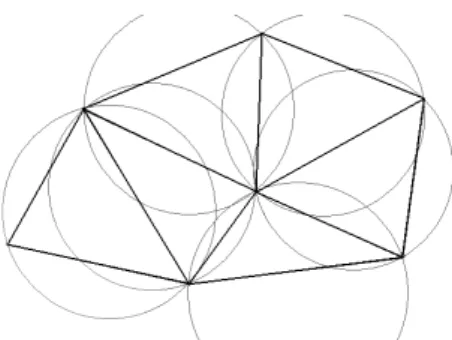
![Figure 2.18: PSLG example and its Delaunay triangulation with and without constraints [She97]](https://thumb-eu.123doks.com/thumbv2/123dok_br/15748253.126547/49.892.191.736.113.456/figure-pslg-example-delaunay-triangulation-constraints-she.webp)

![Figure 3.7: Three stages in the construction of a finite element mesh. [Fre00]](https://thumb-eu.123doks.com/thumbv2/123dok_br/15748253.126547/83.892.162.780.112.511/figure-stages-construction-finite-element-mesh-fre.webp)
