Licenciado sob uma Licença Creative Commons DO): http://dx.doi.org. . / - . . .AO
[T]
Hippotherapy and respiratory muscle strength in
children and adolescents with Down syndrome
[)]
Equoterapia e força muscular respiratória em
crianças e adolescentes com síndrome de Down
[A]
Valéria Sovat de Freitas Costa[a], Hudday Mendes da Silva[b, c], Elioenai Dornelles Alves[d],
Patrick Ramon Stafin Coquerel[b], André Ribeiro da Silva[d], Jônatas de França Barros[b]*
[a] Centro Universitário de Brasília UniCEUB , Brasília, DF, Brazil
[b] Universidade Federal do Rio Grande do Norte UFRN , Natal, RN, Brazil [c] Faculdade Leão Sampaio FLS , Juazeiro do Norte, CE, Brazil
[d] Universidade de Brasília UnB , Brasília, DF, Brazil
[R] Abstract
Introduction: )ndividuals with Down syndrome may have decreased respiratory muscle strength due to
hy-potonia, a common characteristic in this population. Objective: To analyze the effects of a hippotherapy
pro-gram on respiratory muscle strength in individuals with Down syndrome. Materials and methods: The study
included subjects, of which were in the hippotherapy practicing group PG and of which were in the non-practicing group NPG . Study subjects were of both sexes, aged - years, and all diagnosed with Down
* VSFC: MSc, e-mail: [email protected] (MS: MSc, e-mail: [email protected] EDA: PhD, e-mail: [email protected]
PRC: MSc, e-mail: [email protected]
syndrome. A manovacuometer was used to measure respiratory muscle strength, following the protocol pro-posed by Black and (yatt . Statistical analysis was performed by means of descriptive distribution. After verifying normality and homoscedasticity of the variables, the Mann-Whitney test was used to determine dif-ferences between the means of the two groups PG and NPG , and the Spearman’s rank correlation coefficient test was used to view possible relationships with age and time practicing hippotherapy. Significance was set at p < . . Results and discussion: )ndividuals who practiced hippotherapy showed improvements in both
inspiratory and expiratory respiratory muscle strength, although no significant difference was demonstrated.
Conclusion: This study demonstrates that hippotherapy benefits respiratory muscle strength in individuals
with Down syndrome, and that the youngest subjects had the best results.
[P]
Keywords: Down syndrome. Respiratory muscle strength. (ippotherapy. [B]
Resumo
Introdução: Os indivíduos portadores de síndrome de Down (SD) podem apresentar uma redução da for-ça muscular respiratória, principalmente em função da hipotonia, característica comum nessa população. Objetivo: Analisar o efeito de um programa de equoterapia sobre a força muscular respiratória em indiví-duos com SD. Materiais e métodos: Participaram do estudo 41 indivíindiví-duos, sendo 20 pertencentes ao grupo praticantes (GP) e 21 ao grupo não praticante (GNP), de ambos os sexos, com idades compreendidas entre 7 e 13 anos, todos diagnosticadas com síndrome de Down (SD). Utilizou-se a manovacuometria para aferição da força muscular respiratória, seguindo o protocolo proposto por Black e Hyatt (23). A análise estatística deu-se a partir de uma distribuição descritiva. Após verificado a normalidade e homocedasticidade das va-riáveis utilizou-se o teste de Mann Whitney para verificar as diferenças entre as médias dos grupos (GNP e GP), como a utilização do teste de correlação de Spearman para visualizar possíveis relações com a idade e o tempo de prática de equoterapia. Adotou uma significância de p < 0,05. Resultados e discussão: Os indiví-duos que realizavam a equoterapia apresentaram melhoras em relação à força muscular respiratória, tanto inspiratória (MIP) quando expiratória (MEP), embora não apresentando diferença significativa em relação ao grupo não praticante. Conclusão: Este estudo demonstra que o programa de equoterapia apresenta be-nefícios na força muscular respiratória em indivíduos com SD e que principalmente os mais jovens obtiveram melhores resultados. [K]
Palavras-chave: Síndrome de Down. Força muscular respiratória. Equoterapia.
thousand people have this syndrome in Brazil. Most are poor, with little or no access to care or informa-tion, and unable to attend early stimulation treatment clinics (4).
The evolution of DS treatment is undergoing im-portant advances. Comparing the data available from the middle of last century and today, the increase in life expectancy of this population is evident .
The main physical characteristics common to chil-dren with DS include hypotonia, ligament laxity and reduced muscle strength. Over the years, joint wear and musculoskeletal abnormalities that affect mus-cle strength quality can also develop . Moreover, individuals with DS are predisposed to respiratory complications resulting from obstruction of the Introduction
upper airway, lower airway disease, pulmonary hy-pertension, pulmonary hypoplasia, congenital heart disease, obstructive sleep apnea, immunodeficiency, obesity and hypotonia , which can be aggravated by general weakness of the muscles of the torso and extremities, as well as postural deviations adopted by these individuals .
Due to the reasons above, individuals with DS have low respiratory pressure values. According to Biasoli and Machado , maximal expiratory pressure MEP values tend to be below %, while maximal inspira-tory pressure M)P values tend to be below % of that expected for populations of healthy, sedentary youth, for which the normal range for these variables are MEP from to cm( O, and M)P from - to - cm( O.
The measurement of maximal respiratory pres-sures can help to direct therapeutic objectives, iden-tify early respiratory diseases and classify their se-verity, and evaluate responses to therapies . The measurements of maximal inspiratory and expira-tory pressures are determinant in the appropriate assessment of lung function, and can be performed on healthy individuals of different ages, or on individu-als with disorders and/or different types of altera-tions, such as Down syndrome . )n these patients, the sequential measurement of maximal respiratory pressures enables quantification of progression of respiratory muscle weakness .
Policarpo and Santos claim that individu-als with DS have a deficit of respiratory muscle strength, and believe that these individuals benefit from muscle training, which minimizes future respi-ratory complications.
According to a study by (errero et al. , the inability to maintain quality of posture and move-ments, a characteristic common to people with SD, affects the torso and alters the harmony of breath-ing mechanics, modifybreath-ing thoracic and abdominal pressures. Assisted motor development balances the thorax and abdomen, maintaining a balance point between these two cavities, and thus adjusting lung capacity and volumes.
)t is generally agreed that in hippotherapy, the movement of the horse, which, like humans, has three-dimensional motion that consists of move-ments on three axes vertical, right and left, and front and back , transmits these movements to the rider. )n turn, the rider must stay balanced on the ani-mal by performing postural adjustments in the pelvis,
upper limbs and head , a process that encourages favorable changes in some kinematic variables in the gait of children with DS, and contributes to improve balance deficits, stability of the walking pattern and also in the torso musculature, which is responsible for respiratory dynamics.
(ippotherapy is a therapeutic and educational method that uses horseback riding in an interdis-ciplinary approach to education and health, mainly aiming for motor rehabilitation and education for the biopsychosocial development of poeple with disabili-ties. (ippotherapy uses horses to promote physical, psychological and educational benefits .
(ippotherapy has been shown to produce im-provements in postural and motor control in special populations with cerebral palsy, genetic disorders, developmental delays and Down syndrome , which reaffirms the theory that this therapy is ben-eficial for individuals with these conditions. )n addi-tion to improvements of motor and postural control, social and emotional interactions may have positive effects on quality of life and self-esteem .
Studies show that muscular hypotonia in indi-viduals with SD leads to increased susceptibility to reduced cardiorespiratory capacity due to disability of the transversus abdominis muscle, which fails to create synergy with the diaphragm, and decreases the action of the oblique muscles, which biomechani-cally stabilize the ribcage. This effect also reduces the action of the intercostal muscles, interfering in the quality of deep, ample and adequate breathing, and reducing the physical conditioning of these individu-als , .
By being seated on a horse, a hippotherapy pa-tient receives around , to , tonic adjust-ments/ min, and about to multidimension-al impulses/minute, stimulating the proprioceptive system and the receptors of the vestibular system, thereby developing dynamic and static balance re-actions .
Each and every movement of the horse requires the rider to adjust their muscle tone to the body sche-ma, which is neurological and established by simulta-neous proprioceptive and exteroceptive information, and hippotherapy multiplies these effects .
This study aimed to analyze the effect of hippo-therapy on the respiratory muscle strength of pa-tients with Down syndrome aged between and years in the Federal District of Brazil.
Materials and methods
This study was a cross-sectional, analytical, ob-servational study. )nclusion criteria included: being diagnosed with DS; aged between and years; not using medication that influenced the variable studied; signing of a free and informed consent form F)CF by an adult guardian; signature of the Term of )nstitutional Science by participating institutions and the group practicing hippotherapy; medical evaluation with authorization to participate in the study; and, for the group that practiced hippotherapy, medical evalu-ation with authorizevalu-ation to practice hippotherapy as well as having practiced for at least months; and, for the non-practicing group, to not perform any kind of activity with the same objectives as hippotherapy.
The sample was composed of children and adoles-cents of both sexes, selected by convenience, where a prior visit to the institutions was undertaken to present the project to the [therapy] coordinators and preselect the subjects who could participate in the study, according to the inclusion criteria described above. After this process, the institutions indicated children and adolescents with SD with the de-sired characteristics. Those interested in participat-ing were given the F)CF for inclusion in the study, which signed.
The project, developed in the institutions, was forwarded, evaluated and approved by the Research Ethics Committee of the Faculty of (ealth Sciences at the University of Brasilia, according to resolution
/ under protocol / .
After collecting the F)CFs, the participants were divided into two groups non-practicing = NPG; prac-ticing = PG . The PG was composed of individuals
boys and girls , while the NPG was composed of boys and girls . The activity proposed for the PG was hippotherapy lessons, while the NPG did not undertake any type of activity with objectives similar to those of hippotherapy. To select the individuals in the PG, the institutions that offer hippotherapy were selected, including the Associação Nacional de Equoterapia [National Association of (ippotherapy] ANDE-BRAS)L , located in the Federal District,
and the Instituto Cavalo Solidário [(orse Outreach )nstitute], headquartered in Brasília and Ceilândia, following the same treatment criteria proposed by ANDE-BRAS)L. For selection of NPG participants, it was decided to select from the following institutions: the Associações de Mães, Pais, Amigos e Reabilitadores de Excepcionais [Association of Mothers, Fathers, Friends and Rehabilitators of Exceptional People] AMPARE , located in the Federal District, and Instituto Ápice Down [Down Apex )nstitute], also lo-cated in the Federal District.
)t is worth noting that the two institutions’ treat-ment protocols for hippotherapy are based on the courses of ANDE-BRAS)L, in the city of Brasília, Federal District, although each individual has their specificity of care according to individual physical and psychological characteristics. The protocol method of ANDE-BRAS)L is based on promoting physical and psychological gains, requiring participation of the entire body, thus contributing to the development of muscle strength, relaxation, body awareness and improved motor coordination and balance.
The methodology proposed by Black and (yatt was used for control of the variable respiratory muscle strength, with the device duly calibrated, and individuals were instructed to perform maximal expi-ration MEP and maximal inspiexpi-ration M)P maneu-vers, coupling the mouth of the GERAR™
manovacu-ometer in the mouth of individuals in sitting position, with the hips and knees flexed at a ° angle, and their spine duly supported. The maneuvers were sustained for a minimum period of seconds, with verbal encouragement from the evaluator. All mea-surements were performed with the nostrils closed with a nasal clip, in order to prevent air from escaping through the nose.
Statistical analysis was by means of descriptive distribution of means, minimum, maximum and standard deviation. The Kolmogorov-Smirnov test was performed to evaluate the normalcy of data distribution. )nferential statistics by means of the Levene test were usedto check the homoscedastic-ity of the variables, evaluating equalhomoscedastic-ity or not of the variances between variables of the groups. After the verifications above, the Mann-Whitney test was used to verify the differences between the means of the groups NPG and PG , and Spearman’s correlation test to view possible relationships with age and time practicing hippotherapy. A significance level of p <
Results and discussion
The tests were selected and applied on individu-als; however, during analysis of the data, by means of the boxplot, discrepant outlier values of two in-dividuals in the NPG were found, which could have influenced the results of the analysis. For this reason, these values were excluded. Thus, the data analysis was performed with results from individuals with Down syndrome, divided into two groups: the PG was composed of individuals boys and girls , while the NPG was composed of participants boys and girls . Participants were aged between and years. The majority of participants in both groups were male, and aged years.
)n the Figure , it is observed that the median of the M)P variable is the same for both groups, meaning that the halves of the values of the two groups were the same, even though the mean of the PG - . ± . was higher than that of the NPG - . ± . . )t also shows that for the two variables, the PG has widely dispersed data. The means show that for both vari-ables, the values for the PG are higher than the NPG, thus indicating that the respiratory muscle strength of the PG is better than that of the NPG.
After checking the normality and homoscedastic-ity of the data by means of the Kolmogorov-Smirnov and Levene tests,respectively, a normal sample was identified; however, unequal variances were ob-served for the Levene test p < . Table . For this reason, an inferential, nonparametric statistic was maintained with the Mann-Whitney U test, adopting significance levels of p < . .
Table presents the major descriptive measure-ments that represent respiratory muscle strength M)P and MEP and the P-value of the Mann-Whitney U test, which was applied because these variables pointed to unequal variances in the homoscedasticity test, as shown above.
According to the test, there was no significant dif-ference for the variables under analysis, even though the raw values for the two variables were better in the PG.
The table above presents the results of tests to evaluate respiratory muscle strength. )t can be ob-served that for both the variable that evaluates inspi-ratory muscle strength M)P and expiinspi-ratory muscle strength MEP , the values for individuals with DS are better among those who practice hippotherapy PG , compared with those who do not practice, although there is no significant difference between the vari-ables analyzed p > . .
Considering the formula presented by Neder et al. as the values predicted for MEP and M)P in healthy subjects of all ages, the individuals in this study have MEP and M)P values below that expected for their age group.
)n one study conducted in children with clinical diagnosis of DS, Schuster et al. evaluated respi-ratory strength using a manovacuometer, and ob-served severe respiratory muscle weakness in all of
Figure 1 - Boxplot for the variables maximal expiratory pressure (MEP cm/H2O) and maximal
inspi-ratory pressure (MIP cm/H2O)
MEP
120
100
80
60
40
Hippotherapy No hippotherapy
MIP
- 40
- 60
- 80
- 100
- 120
Hippotherapy No hippotherapy
Table 1 - Normality and homoscedasticity test for the prac-ticing and non-pracprac-ticing groups (PG and NPG) in both genders
Ko lmogorov-Smirnov Test Levene Test
Variable NPG PG
MEP 0.66 0.03* 0.88
MIP 0.45 0.01* 0.87
Note: MEP = maximal expiratory pressure; MIP = maximal
the children, who later underwent intervention with linear load pressure and showed significant improve-ment. )n this study, it was observed that all subjects in both groups had muscle weakness, and the M)P and MEP values of the PG, although lower than predicted in the literature, were higher than those for the NPG.
Freitas et al. , in a bibliographic review aiming to research values of normality for maximal respira-tory pressures in the age range between and years, concluded that in the majority of studies, the subjects are evaluated in the seated position with a nasal clip. The maximal efforts were performed from the residual volume and total lung capacity, sustained for a period of one to three seconds. )n accordance with this study, a nasal clip was used for all mea-surements of M)P and MEP, in a seated position, and efforts from the volumes and capacities mentioned by the author.
Similarly, Alexandre et al. recommended per-forming three to five maneuvers in order to obtain three acceptable maneuvers in which there was no leak; of these three, two should be reproducible with a difference less than % . )n this study, for greater reproducibility of measurement, the M)Pand MEP measurements were performed three times, and the highest value was considered, provided that it did not exceed % of the other measurements. )n case there was a discrepancy between the measurements, the procedure was repeated.
Santos et al. state that DS patients present a series of clinical characteristics, especially mus-cular hypotonia. This is a factor associated with deficit of torso muscle strength, which in turn re-sults in loss of respiratory muscle strength. The same authors evaluated respiratory function and created a profile of DS children aged between and years, revealing low values of respiratory
muscle strength. This study had a similar result, where the M)P and MEP values of individuals of both groups were far below the predicted values for age. Regardless, the values of the PG were greater than those of the NPG, showing that hippotherapy can affect this variable.
)n one study evaluating respiratory muscle strength in subjects, of which suffered from intellectual disability, had Down syndrome and were classified as having no mental disability, Silva et al. showed that individuals with intellectual disability, with and without Down syndrome, have lower M)P and MEP.
Values of maximal expiratory pressure are greater compared to those of maximal inspiratory pressure in children and adolescents of both sexes . This was also observed in this study, where in both groups the mean values of these variables were greater for MEP than M)P.)t is noteworthy that for Scanlan et al. , the minimum and maximum values for both variables are respectively to cm( O, with nega-tive values for M)P.
)n this study, we did not have access to the num-ber of hippotherapy sessions that each individual performed. (owever, one inclusion criterion was having a minimum of months of hippotherapy ac-tivity twice per week, making months the mean time of this activity for the PG. Some authors agree that it is not necessary to publish the period, since so few sessions of hippotherapy are needed for results, yet changes after twelve sessions are cited , .
As noted in the Table , significant correlation was shown only for the variable M)P in relation to age; thus, the older the individual, the better the inspiratory respiratory muscle strength. For other variables, moderate but not significant correlations were observed.
Table 2 - Variables of muscle strength with Mann-Whitney U test of both genders
Variables Mean SD SD of the
mean
Variation coefficient
Confidence interval (95%) p
Lower Upper
MEP- PG 79.00 25.16 5.63 31.85% 67.22 90.78
0.25
MEP- NPG 70.00 15.28 3.50 21.82% 62.64 77.36
MIP- PG -69.75 25.16 5.63 -36.07% -81.52 -57.98
0.43
MIP- NPG -62.37 14.75 3.38 -23.66% -69.48 -55.26
Table 3 - Correlation between respiratory muscle strength variables with time practicing hippotherapy and age
Variables Time practicing
hippotherapy Age
r p r p
MEP 0.07 0.76 -0.39 0.09
MIP 0.05 0.85 0.65 0.01*
Note: *p < 0.05.
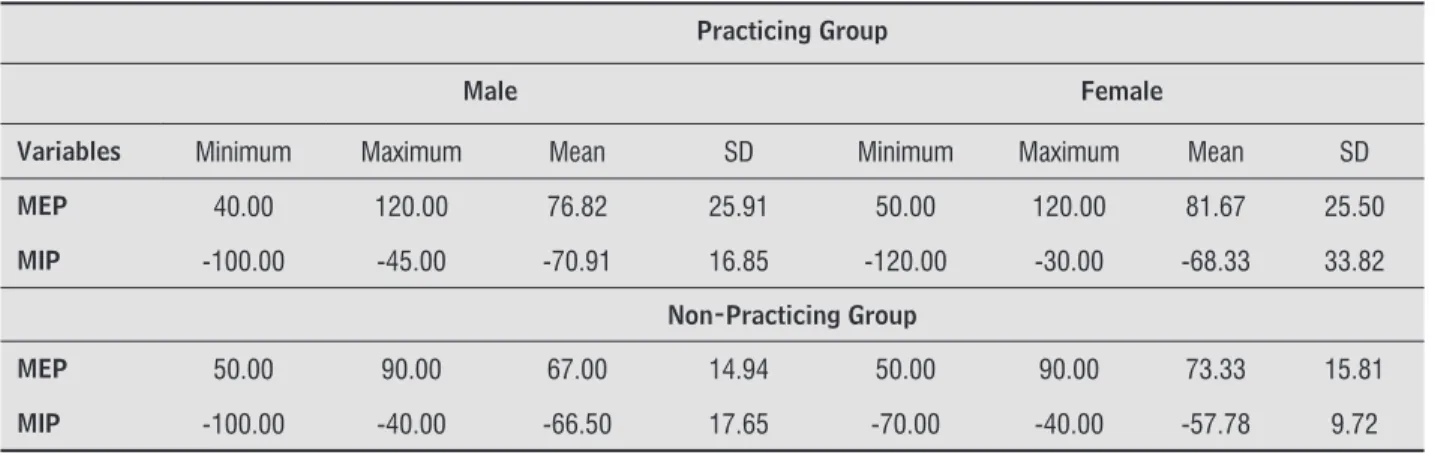
For both sexes, the mean values of the tasks per-formed by the PG were higher in comparison to indi-viduals in the NPG Table . As regards the variables M)P and MEP, which represent inspiratory and expi-ratory muscle strength, respectively, this study shows that the values of both groups and sexes are lower than those expected for individuals without disability. Considering the studied population of individuals with DS, in both groups boys showed better results only on the inspiratory muscle strength test.
Stefanutti and Fitting assessed MEP and M)P, and observed larger maximal respiratory pressure in boys. )n a study with children aged between and years, Wagener et al. demonstrated that sex influences respiratory muscle strength in children and adolescents. They showed that boys
have higher pressures than girls, relating to the fact that they have larger muscle area, although when compared to young adults of the same sex, they had lower MEP, also due to less muscle development.
)n this study, in both groups, boys showed higher values only for M)P. The studies cited above were performed with so-called normal children who did not have DS. )n one study that conducted respiratory evaluation on institutionalized individuals with DS and normal subjects, the author found that individuals with SD had respiratory muscle strength % lower when compared to normal individuals, measured by means of manovacuometer .
)t is worth noting that the formulas proposed for estimating M)P and MEP, which have the primary ob-jective to quickly establish reference values in evalu-ation tests of respiratory muscle strength, need to be carefully observed. This is the case for the M)P and MEP values predicted by Neder et al. , which is the only formula for predicted values for the entire Brazilian population. The predicted values of M)P and MEP, estimated by the equation proposed by these authors, for both females and males, were higher than those obtained in the results of this study.
Conclusion
The results of this study suggest that the practice of hippotherapy may influence respiratory muscle
Table 4 - Distribution of descriptive values of mean, minimum, maximum and standard (SD) deviation in relation to sex and groups
Practicing Group
Male Female
Variables Minimum Maximum Mean SD Minimum Maximum Mean SD
MEP 40.00 120.00 76.82 25.91 50.00 120.00 81.67 25.50
MIP -100.00 -45.00 -70.91 16.85 -120.00 -30.00 -68.33 33.82
Non-Practicing Group
MEP 50.00 90.00 67.00 14.94 50.00 90.00 73.33 15.81
. Biasoli MC, Machado CC. (idroterapia: aplicabilidades clínicas. Rev Bras Med. ; : - .
. Venkateshiah S, )ochimescu O. The utility of spi-rometry in diagnosing pulmonary restriction. Lung.
; : - .
. Oliveira KM, Macêdo TM, Borja RO, Nascimento RA, Medeiros Filho WC, Campos TF, et al. Força muscular respiratória e mobilidade torácica em crianças e ado-lescentes com leucemia aguda e escolares saudáveis. Rev Bras Cancerol. ; : - .
. Policarpo CL, Santos LJ. Avaliação da força muscular respiratória em indivíduos portadores de síndrome de Down. Rev Bras Fisioter. ; Supl : . . (errero P, Asensio A, Garcia E, Marco A, Olivan B, )barz A,
et al. Study of the therapeutic effects of an advanced hippotherapy simulator in children with cerebral pal-sy: a randomised controlled trial. BMC Musculoskelet Disord. 2010;11:71.
. Espindula AP, Assis )SA, Simões M, Ribeiro MF, Fer-reira AA, Ferraz PF, et al. Material de montaria para equoterapia em indivíduos com síndrome de Down: estudo eletromiográfico. ConScientiae Saúde.
; : - .
. Silveira MM, Wiberlinger LM. Reeducação da postura com a equoterapia. Rev Neurociênc.
; : - .
. Associação Nacional de Equoterapia. Apostila do curso básico de equoterapia. Brasília: ANDE; . . Torquato JA, Lança AF, Pereira D, Carvalho FG,
Silva RD. A aquisição da motricidade em crianças portadoras de síndrome de Down que realizam fi-sioterapia ou praticam equoterapia. Fisioter Mov.
; : - .
. Bass M, Duchowny C, Llabre M. The effect of therapeu-tic horseback riding on social functioning in children with autism. J Autism Dev Disord. ; : - . . Santos S. Fisioterapia na equoterapia: análise de seus
efeitos sobre o portador de necessidades especiais. Aparecida: )déias e Letras; .
. Silva CP, Valadares YD. Avaliação da força muscular respiratória em indivíduos com síndrome de Down. Conexão Ci R Cient. ; : - .
strength in patients with Down syndrome, of both sexes and aged between and years, when com-pared with individuals with Down syndrome who do not practice hippotherapy.
This study aimed to analyze the respiratory mus-cle strength of individuals with Down syndrome and, specifically, to verify the possible effect caused in pa-tients of hippotherapy. )t was also possible to com-pare, within the group that practiced hippotherapy, the difference between boys and girls, and, with the results of the tests, to correlate this difference to age and time practicing hippotherapy.
Among individuals who practice hippotherapy, the best results for respiratory muscle strength were for more advanced ages. )n addition, the results of inspi-ratory and expiinspi-ratory muscle strength of individu-als with Down syndrome who practice hippotherapy were greater than those who do not.
References
. Projeto Down. Com sua mão, essas crianças vão longe. [cited , July ]. Available from: http://www. projetodown.org.br/
. )nstituto Brasileiro de Geografia e Estatística. Censo demográfico : características gerais da popula-ção, religião e pessoas com deficiência. Rio de Janeiro: )BGE; .
. Organização Movimento Down. Estatísticas sobre sín-drome de Down. [cited , Feb ]. Available from: http://www.movimentodown.org.br/ / / estatisticas-sobre-sindrome-de-down/
. Centro de )nformação e Pesquisa da Síndrome de Down. Projeto Down [website]. [cited , Jan ]. Avail-able from: http://www.projetodown.org.br/ . Berg P, Becker T, Martian A, Primrose KD, Wingen J.
Motor control outcomes following Nintendo Wii use by a child with Down syndrome. Pediatr Phys Ther.
; : - .
. Reis CS, Ladewig ). Efeitos do uso de dicas agudas, com dois focos atenção, em uma criança como síndrome de Down. Pensar Prát. ; : - .
. Santos AM, Lobo VCT, Lourenço MGF. Perfil da função respiratória de crianças portadoras de síndrome de Down na faixa etária de a anos de idade. Fisioter Bras. ; : - .
. Silva VZ, Barros JF, Azevedo M, Godoy JR, Arena R, Cip-riano G. Bone mineral density and respiratory muscle strength in male individuals with mental retardation with and without Down syndrome . Res Dev Disabil.
; : - .
. Scanlan CL, Wilkins RL, Stoller JK. Fundamentos da terapia respiratória de Egan. São Paulo: Manole; . . Casady RL, Nichols-Larsen DS. The effect of hippo-therapy on ten children with cerebral palsy. Pediatr Phys Ther. ; : - .
. Graup S, Oliveira RM, Link DM, Copetti F, Mota CB. Efeito da equoterapia sobre o padrão motor da mar-cha em crianças com síndrome de Down: uma análise biomecânica. Revista Digital Buenos Aires . [cited , May ]; . Available from: http:// www.efdeportes.com/efd /equot.htm
. Stefanutti D, Fitting JW. Sniff nasal inspiratory pres-sure. Reference values in Caucasian children. Am J Respir Crit Care Med. ; : - .
. Wagener JS, (ibbert ME, Landau L). Maximal re-spiratory pressures in children. Am Rev Respir Dis.
; : - .
. Romano AMC. Avaliação funcional respiratória em indivíduos com síndrome de Down [dissertação]. Pi-racicaba: Universidade Metodista de Piracicaba; .
Received: / / Recebido: / /
Approved: / / Aprovado: / /
. Paiva ARF, Pedrosa ACP, Senna )NP, Coelho PV, Souza MBA, Fontes PLB. Efeito da hippoterapia no desenvolvimento funcional de duas crianças por-tadoras de síndrome de Down. Temas Desenvolv.
; : - .
. Silveira MM, Wibelinger LM. Reeducação da postura com a equoterapia. Rev Neurocienc.
; : - .
. Angonese RRD, Wisniewski MSW. Os benefícios da equoterapia sobre o equilíbrio e tônus muscular de crianças de necessidades especiais. Rev Perspect. [cited , Jun ]; . Avalaible from: http://www.uricer.edu.br/rperspectiva/inicio. php?id_numero=
. Black LF, (yatt RE. Maximal respiratory pressures: normal values and relationship to age and sex. Am Rev Respir Dis. ; : - .
. Neder JA, Andreoni S, Lerario MC, Nery LE. Reference values for lung function tests. )). Maximal respiratory pressures and voluntary ventilation. Braz J Med Biol Res. ; : - .
. Schuster RC, Rosa LR, Ferreira DG. Efeitos do treina-mento muscular respiratório em pacientes portadores de síndrome de Down: estudo de casos. Rev Fisioter S Fun. ; : - .
. Freitas DA, Borja RO, Ferreira GM, Nogueira MAS, Mendonça KMPP. Predictive equations and nor-mal values for maxinor-mal respiratory pressures in childhood and adolescence. Rev Paul Pediatr.
; : - .
. Alexandre BL, Araújo SG, Machado MG. Pressões respiratórias máximas. )n: Machado MG. Bases da fisioterapia respiratória: terapia intensiva e reabilitação. Rio de Janeiro: Guanabara Koogan;