FOREIGN CAPITAL EXPANSION IN EASTERN EUROPE
RADULESCU MAGDALENA
ASSOCIATE PROFESSOR, UNIVERSITY OF PITESTI
[email protected]
Abstract:
Eastern Europe faced many transformations in the banking sector area, especially during 90s as a result of the privatization process. Many large banking corporations acquired state-owned local banks and developed their operations on the new markets. The foreign capital represents almost 90% of the total banking assets on the Eastern markets. The consolidation and concentration process of the foreign capital on the banking markets continued during the last financial crisis.
Key words: banking systems, restructuring and consolidation, Central and Eastern European countries, financial crisis.
JEL Classifications: G21, E42, E58.
1. Introduction
Europe has managed to gain ground against the great banking competitors in the neighbouring continents and it has achieved huge success especially through the multitude of active and loyal clients it has, and also through the promptness of the services these banking corporations make available to all. Since 2013 the region undergoing recession has been struggling to reach a more active and stricter regulatory environment. It is necessary to consolidate the foreign capital these corporations have, to increase the assets base, and also the new capital sources.
The market leader for Central and Eastern Europe is Raiffeisen Bank International. The consolidated profit recorded a 7.4% growth in 2014 and an 8.2% growth in terms of operating incomes. The business model adopted by Raiffeisen Bank will be optimized mainly on the markets in the Czech Republic, Poland, Romania and Slovakia as well. Also, in Central and Eastern Europe, namely in the Czech Republic, we find a bank operating in the country of origin only but which is a leader in terms of the products it provides to customers, mainly mortgage credits, savings credits and mutual credits. The bank was successful and deposits recorded increases of up to 5% each year from 2012 to 2015. A successful bank in this region which is a national leader is OTP, Hungary’s largest bank. It owns its own branches in the entire region of Central and Eastern Europe, being the national leader in all banking segments except for the corporate segment.
Eastern Europe is the largest subdivision of Europe but the western banks control the greatest part of the eastern European banking system. The banks in Poland, the Czech Republic and Hungary are included in the category of banks with growth potential and also with an attractive side. The banking corporations need foreign capital, and the other markets are vulnerable to a credit crisis.
Analysing the banking privatization history and the financial liberalization which flowed quickly and without interruption, one may be notice that most of the emerging markets are dominated by foreign banking ownership, whereas in the developed countries with well-predetermined financial and banking economy, the banking ownership has evolved around the already existing commercial models. A clear example can be noted as follows: a small number of Austrian and Italian banks dominate the banking sectors in emerging Europe, while those from Spain and Portugal dominate much of Latin America (ECB, 2014). Moreover, in Poland, branches of the six largest euro area-based banks represent nearly 40 percent of the national banking assets. The National Bank of Poland and the financial supervisor have worked closely with the ECB, including by running a national asset quality review in parallel with those carried out by ECB.
2. Foreign Capital Expansion in
Poland, the Czech Republic, Hungary and Bulgaria
The banking system has undergone a transformation in the Central European countries, as well as in Eastern Europe, so that, to the state interest, a rehabilitation of the existing banks heavily indebted was noticeable, enabling the access of foreign banks owning large and promising capital.
Interestingly, the number of foreign participants counts more than their market share, suggesting that these affect the local banking competition more when they enter the market rather than after obtaining a substantial market share. Some of the countries where the banking system has taken shape following the expansion of foreign banking capital are Poland, the Czech Republic, Hungary, Slovakia, and Bulgaria. To better see how this foreign capital reflected on the national economies, we shall analyse these banking systems and the way they operate in turn.
Poland is the first country we will consider because the consolidation of the Polish banking sector was largely associated with the development and expansion of the banking sector in the EU countries and there were employed different consolidation models used by the banks in the USA. Deregulation of 1989 contributed to the creation of a large group of small private banks and paved the way towards the privatization of the state banks which characterizes most of the market. After the completion of the privatization process, the major banks were still controlled by the same foreign investors that merged within the groups and frequently carried out operations harmonized into a single entity. This process has affected the market concentration the most. Poland’s adhesion to the EU led to cross-border consolidation, due to the fact that the big investors relied on the takeover of the branches by subsidiaries of their parent banks in Poland.
The evolution within the EU banking sector has significantly contributed to mergers and acquisitions of Polish banks. Takeovers by parent banks led to the immediate mergers of these branches, as well as the post-crisis recovery process resulted in a forced sale by creating market expansion and consolidation opportunities (Kozak, 2013). In the years 2009-2013 several bank mergers and acquisitions took place in Poland, which shows a significant impact on the performance and structure of the whole banking sector. Some of them could be considered improvement methods.
According to experts, the Polish banking sector is still able to make mergers and acquisitions. The supervisory authorities and the public sector are trying to figure out the appropriate scale and scope for these banks which could eliminate the insolvency risk and the need to provide the public with the rescue funds in case of danger. The Polish banks’ consolidation is one of the most important ways of gaining a greater market share, as well as the restructuring of some of them. Foreign banks played an important role in the withdrawal of the Polish banking sector from the crisis in the first half of the 1990s. They were involved in the modernization and consolidation process in Poland’s successive stages for the banking sector development.
The Polish banking system owns more than 67 commercial banks having the legal status of joint-stock companies, most of them being controlled by private shareholders, 17 are joint-stock companies with foreign capital, and 20 have majority foreign capital. The largest investors in the banking sector in Poland are Germany, Italy, the USA and the Netherlands (NBP, 2015).
The participation in the consolidation of banks in distress was one of the most important involvement ways for the foreign banks undergoing a “restructuring process”. The first banks with foreign capital emerged in 1990. For the equity capital there was a numeral requirement, but this was not a major obstacle for the foreign
investors. In 1990 Amerykański Bank (AmerBank) became the first commercial bank with foreign capital which
entered the economic market in Poland. In the following periods we can also mention: Citibank (Poland), Creditanstalt Bank, the International Bank in Poland (much later: IBP Bank), Raiffeisen Centrobank, Saint Stanislaw Polish-Canadian Bank and GE Capital Bank. Other foreign banks passively carried out the investment strategy and opened subsidiaries in Poland.
Another reason why the foreign banks initiated operations in Poland resulted from the international operation of the corporate clients. Some foreign banks complied with the policy to track loyal customers and supported their country of origin through the companies which invested in business venture associations or started a long-term cooperation with the Polish counterparts.
Thus, the foreign companies requested financial services from the local banks newly established by the national banks in Poland, but due to the technological and organizational gap, they were unable to meet the financial expectations (NBP, 2013).
After the EU adhesion, some mergers and acquisitions carried out on the Polish banking market resulted from transactions between the banks in the country of origin and banks in Western Europe. In 2007, Pekao Bank took over 66% of Bank BPH banking operations as a result of an acquisition of Bayerische Hypound german Vereinsbank AG (the majority shareholder of BPH Bank) by the Italian UniCredit Bank (the majority shareholder of Bank Pekao). The purchase of the entire BPH Bank was stopped by the Polish Financial Supervisory Authorities given the risk of excessive growth of the domestic banking sector concentration.
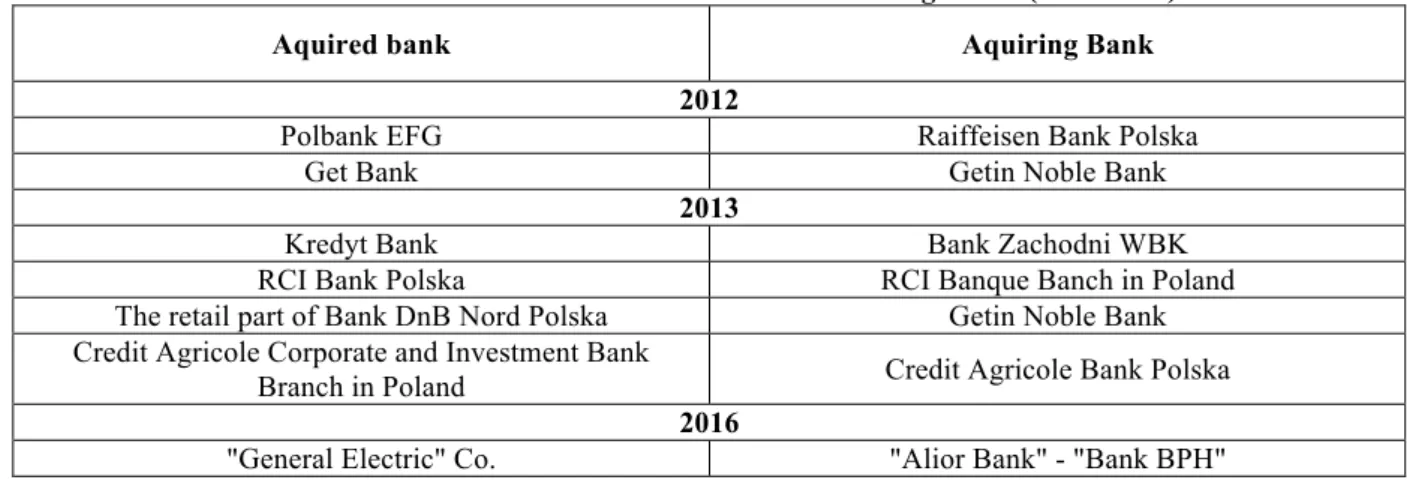
The Polish banking sector is dominated by five banks, namely PKO BP, Bank Pekao, BRE Bank, ING Slaski and BZWBK - which currently hold 43.32% of the assets and 45.45% of the banking deposits at country level. An important part of the banking sector consolidation process in Poland was the performance of mergers without an obvious influence of the financial crisis. This type of consolidation was motivated by the intention to increase the market share, to reduce fixed costs, to harmonize the group’s organizational structure and to improve its management efficiency (Table 1).
Table 1. Consolidation of the Polish banking sector (2012-2016)
Aquired bank Aquiring Bank
2012
Polbank EFG Raiffeisen Bank Polska
Get Bank Getin Noble Bank
2013
Kredyt Bank Bank Zachodni WBK
RCI Bank Polska RCI Banque Banch in Poland
The retail part of Bank DnB Nord Polska Getin Noble Bank
Credit Agricole Corporate and Investment Bank
Branch in Poland Credit Agricole Bank Polska
2016
"General Electric" Co. "Alior Bank" - "Bank BPH"
Source: Summary Evaluation of the Financial Situation of the Polish Banks, NBP/KNF – editions of 2003-2016;)
Examples of this consolidation type were mergers by:
§GE Money and GE Capital in 2004;
§Fortis Bank Polska and Dominet Bank in 2009;
§Getin Bank and Noble Bank in 2010;
§Santander Consumer Bank and AIG Bank Polska in 2011;
§Raiffeisen Bank Polska and EFG Polbank in 2012;
§Bank Zachodni WBK and Kredyt Bank in 2013.
The consolidation of the banking sector in Poland significantly influenced its concentration level. Therefore, a relatively large number of banking mergers and acquisitions did not result in an increased level of concentration but it was the dominant type of national structural transformation.
The next country we shall analyse in terms of foreign banking capital is the Czech Republic. The Czech banking system has the characteristic structure of the market economy, in which the National Bank accounts for the monetary and foreign exchange policy, as well as for the banking flows control. The main major banks present are as follows: Ceská Sporitelna (ERSTE Group), Komerční Banka (KB) (Societé Generale Group), Reiffeisen Bank, Volksbank, ING, Citibank, alongside the largest Czech bank Ceskoslovenská Obchodní Banka (CSOB).
The Czech banking sector is formed of banking institutions which primarily have international ownership. It is dominated by large foreign banking groups, but although the banking sector is significantly divided on foreign capital, the small and medium concentrated banks have strengthened their position on the Czech market in recent years. The main novelty elements for the foreign investors are the financial stability and the availability of financing, the incentive investments, skilled workforce and a high level of education. Typical activities include commercial loans of corporate and retail customers, customer accounts and deposit administration, credit card operations, credit and loan operations, international syndicalization, the management of the mutual and administration funds, banking treasury operations and back office activities (Zurek, 2015).
All of these banks went through a long privatization process as the privatization history began in 1992 as follows:
§ 1992 - Živnostenská banka (Berliner Handels and Frankfurter Bank, currently Uni Group Credit)
§ 1998 –Poštovní Investment bank (Today ČSOB)
§ 2000 - Česká spořitelna (Erste Bank)
§ 2001 - Komerční banka (Société Générale)
In the early 1990s the Czech state banks dominated the market and the number of licenses rose sharply. The number of banking licenses peaked in 1995 (54 active banks out of 55 licenses). The accumulation of non-performing loans in the corporate sector triggered a banking crisis in the 2nd half of the year 1995 and at least 10 smaller banks collapsed; the four largest banks were subsequently taken over by the foreign investors after the government eliminated the balances. As a result, the number of banks was reduced to 37 in 2002 and it has remained almost stable since then.
Following these privatization processes, the Czech banking system experienced a broad diversification, the foreign capital made its presence felt and at credit institutions level we can talk about several forms such as:
- banks to save the buildings. 50 banks fall in this category, being German construction companies (System closed with state subsidy) and the law in force is 96/1993 which aims to support and finance housing;
- The mortgage banks in the Czech Republic are another newly developed category. There are 14 universal banks granting mortgage loans, but only one bank specializes in mortgage loans (Hypoteční Bank).
Also, there are state owned banks as Českomoravská záruční a rozvojová banka (100% of the shares owned by the Czech Republic and Česká exportní banka, where 80% of the shares are stated owned, and the remaining 20% belong to a state entity, EGAP (Kielar, 2013).
The Czech banking sector has remained well-capitalized and has not required any public aid, and the average capital adequacy of the banking sector also recorded good values.
As regards the breakdown of loans according to their purpose, the loans for house purchase had the largest weight. They represented 74% of total volume of household credits. The non-performing loan weight recorded a slightly constant decline, because in the mid 2013 it had a value of 5.3% and it was 3.8% in March 2016.
The banking market, largely foreign owned, seems stable, both in terms of capital and in terms of liquidity. The Czech credit institutions have steadily increased the capital insertion starting with 2008, indicating a great ability to withstand loan losses. At the same time, the ratio of non-performing loans remained fairly stable despite the increase in total loans. In its latest round of banking risk tests, the Czech National Bank reported that the overall capital ratio of the banking sector would remain above the regulations (European Commission, 2016). The foreign capital, having a direct weight in the local banks, has gradually increased up to 79% in 2015 of the total capital within the banking sector. This share would be even higher in case the branches of foreign banks were also included.
Within the market economy, the banking system of this country is evolving towards a beneficial balance from the economic point of view as the Czech Republic presents relatively low external and internal macroeconomic imbalances, controllable levels of the public debt and deficits, it currently has a stable and healthy banking sector with liquidity excess, able to meet the financing needs of both domestic and foreign investors, and it also presents a minimal risk of losses caused by financial crises and associated instabilities.
The Hungarian banking system has undergone significant changes since 1987, the year when the two-level banking system was founded. Since the large privatization wave of the state banks started since 1994 and 1999, the universal credit institutions have become the backbone of the financial system.
At present, not only that banks represent two thirds of the total institutional assets in the financial system, but they also have a substantial presence in all financial intermediation markets and also hold major stakes in the capital and insurance market and financial fund sectors.
Due to relatively concentrated structure of the market and the existence of a market leader in office, the Hungarian banking market is characterized by monopolistic competition, depending on the risk in the retail segment and the corporate segment which is more competitive. Thus, banks are able to provide a combination of relatively low deposit rates and high lending rates to households. The interest margin was the main reason behind the outstanding operation rate regarding the profitability degree of banks operating in Hungary in the Central and Eastern European region. Between 2003 and 2008, the banking sector increased dramatically, supported by the subsidizing scheme for the housing loan interest rate, aid granted by the government, and the orientation of the regulatory authorities concerning the increasingly dynamic spread of risky foreign currency credits.
From 2008 to 2014 the currency depreciation for the banks’ loan portfolios deepened, which determined the regulatory authorities to put an end to lending in foreign currency. Given the crisis effects, both on the retail and corporate loans, the volumes declined and led to a sharp drop in funding in foreign currency, while banks’ profits were affected as a result of several government measures (Szikszai and Badics, 2014)
be a higher inflation, higher credit risk, higher proportion of loans granted to customers in the structure of the banks’ assets, adding to the risks the lack of scale efficiency generated by the small size of the market. However, the relatively high profitability of banks in Hungary suggests that the banks make use of their market power and oligopoly pricing methods, which mainly characterizes the household.
Undoubtedly, the foreign banks, due to their sustainable functions on their domestic markets, had various advantages over the local banks in transition economies. They could contribute to the service development for a while, whereas the domestic banks in the host countries faced problems with the non-performing loans. In addition, the existing personnel of the local banks were very often uninterested in innovative services. Citibank’s market entry provides a good example because it managed to introduce ATM networks for the wealthy clients before any other bank. In addition, their size and technological advances have contributed to scale and widely diversified economies, while the banks in Hungary, due to their inefficient and costly transaction processing, found it difficult to compete. Other notable examples were given by Budapest Bank, known for the import technology and Creditanstalt, with the largest transaction in Budapest Stock Exchange (Csizmazia, 2014).
Hungary was successful in creating a comfortable environment for the foreigners who were aiming investments, not only in production but also in the service sector such as the financial sector. The authorities could use various instruments to combat the freely fluctuating danger by gradually releasing the currency trade. However, the foreign ownership in the banking sector is not always welcome. Due to the vital role of this sector in the economy, the state believed that the concerns regarding the foreign influence could be alleviated if the entry of foreign banks is well regulated.
The development potential in Hungary is quite high, as the banks in this country take into account the withdrawal of certain foreign banks from their territory in order to consolidate their position and the local divisions. During the transition to a market economy, Hungary attached great importance to the development of a sound capital market in order to promote the economic development and financing of the enterprises in Hungary. The law on capital markets regulates the offering and sale of securities and bonds, and also the institutional framework of the capital market in Hungary. Therefore, the control and supervision of the state capital markets was delegated to the Financial Supervisory Authority in Hungary.
The country entered the financial crisis with a high level of the private sector debt, most of which being denominated in foreign currency. The financial sector was profitable but heavily dependent on the wholesale financing. Since the outbreak of the financial crisis, most of the issues have been debated around the value in the banking system in Hungary which focused on two key points: foreign currency loans which increased exponentially with the appreciation of the Swiss franc and the recession regarding the credit stimulation, in particular to small and medium-sized enterprises. Nevertheless, the efficiency of the banking sector has not improved, unlike Poland and the Czech Republic.
Among the main major banks that support the base economy in Hungary we name Erste Bank Hungary, Cib Bank, OTP Bank, Banco Popolare Hungary, Citibank, BNP Paribas Hungaria Bank Rt. Erste Bank in Hungary is one of the leading retail banks in the country, and OTP Bank Plc. is the largest bank among the Hungarian credit institutions, being the dominant player in each segment of the banking market in Hungary, at the same time. Also, one of the largest and most international banks in Hungary is Citibank Zrt which has been operating in Hungary starting with 1985, and BNP Paribas Bank Hungary Rt. is operating as a joint-venture bank in Hungary. It provides clients with various services regarding the international trade, export financing, energy financing, media and telecommunications on the capital market (ECB, 2014).
Banks remain cautious in their lending mode, even if they are well capitalized and highly liquid. Moving forward, the main challenges are to reduce the high percentage of non-performing loans and promote healthy market-based growth of lending to the private sector. The banking sector shows better results supported by the overall economic improvement.
Bulgaria’s economic performance remained submitted in the post-crisis period as well. After the economic decline of 2009, the economic growth fluctuated around 1% per year, and this situation is forecast to remain so in the short term. Price stagnation, followed by the deflation in mid-2013, was expected to expand even farther in 2015. The unstable political sector and also the turbulences in the banking system had a negative impact on the financial confidence in the second half of year 2014. The public finances also deteriorated considerably in 2014. We will assess the Bulgarian economy amid the Annual Growth Survey of the Commission recommending three main pillars for the accession to the EU economic and social policy in 2015. We may consider investments, structural reforms and fiscal responsibility. In line with the investment objective, the Plan for Europe is also exploring ways to maximize the impact of public resources and to unlock private investments (European Commission, 2015).
the fourth largest bank in the country by size, Corporate Commercial Bank (KTB). Thus, this aspect pointed out faults of the financial sector concerning the supervisory practices and the concentration risk. This undermined the banking supervision credibility leading to increased doubts regarding the health state of the other components of the financial sector. The trust in the Bulgarian banking system was highly affected in 2014.
The banking sector and particularly domestic capital banks came under liquidity pressure in late June of 2014. Therefore, the EU Recovery and Resolution Bank which came into force on 1 January 2015, was of great importance because it provides that the competent authorities should intervene earlier in banking crises before they get out of control. Moreover, the Bulgarian National Bank (BNB) also took measures to ensure a better supervision. After the summer crisis, the authorities announced a series of measures to restore the credibility of the banking system. In the first half of 2014, BNB took macro-prudential measures initiated to preserve the capital buffers accumulated in 2014. (Koford and Tschoegl, 2003).
The supervision deficiencies were revealed, and the approach which is crucial to the future stability of the banking system was more deeply reviewed. The weaknesses were particularly noticed in the quality, scope and frequency of on-site inspections, especially for the systematic credit institutions. The authorities announced their intention to closely cooperate with the Supervisory Mechanism of the European Central Bank. Moreover, as a first step towards these issues, BNB launched a Self-assessment process. In addition, measures were taken to increase the number of on-site inspections and to expand their scope.
The Bulgarian banking system comprises the Central Bank, development banks, commercial banks and branches of foreign banks. The Bulgarian economy operates based on the free market principles, which has a large private sector and a smaller public sector. According to the World Bank, Bulgaria is a country with industrialized upper average incomes. During the financial crisis of 2007-2010, Bulgaria recorded a 5.5% decline in the economy in 2009, but quickly recovered positive levels of growth of up to 0.2% in 2010 compared to other Balkan countries. However, the growth continued to be weak in the next years, so that the before crisis GDP was to be reached in 2014
The commercial banks provide a full range of banking services. At present, there are 30 commercial banks, more than 90 percent of which are foreign owned banks and six branches of foreign banks. The largest bank in Bulgaria is Bulbank which was taken over in 2000 by UniCredito Italy, and the second largest bank is DSK Bank, owned by OTP Bank in Hungary. Moreover, the National Bank of Greece owns a majority stake in United Bulgarian Bank, the third largest bank in the country.
Among the foreign banks with substantial presence in Bulgaria, we include the French banks Société Générale through its branch SG Express Bank and BNP Paribas, Raiffeisen Bank from Austria, the Dutch bank ING and the American bank Citibank. There is also a series of Greek banks with branches in Bulgaria, including the National Bank of Greece and Piraeus Bank. The biggest long-term problem the foreign banks face is that they do not have a certain advantage when they engage in the banking and retail sector, in general, on a market which is already competitive. Not surprisingly, the researchers found that in the industrial countries, foreign banks tend to have lower margins and profits compared to the domestic banks while the opposite is true in developing countries.
By necessity the foreign banks which monopolized Bulgaria represent the large banks category. The activities of the foreign banks improved the debtor quality. Extending the credit databases and the improvement of debt application reduced the prevalence of fraudulent debtors. The Bulgarian lending agents have become more experienced in judging the risk.
Already there are banks such as FIB, which are managed by Bulgaria, although the vast majority of the shares are in the hands of the passive foreign owners. Also, there are many banks such as Roseximbank, Corporate Bank, First Eastern International Bank, Bank of International Trade and the Economic Development and Investment Bank, which seem to be owned by Bulgaria, but the owners do not have the legal right over them as well.
The capital of each state needs an impulse, a fair support, but this aid must not invade the local territory, but it should only represent the stake for a healthy and continuously evolving banking and financial system. The economies outlined above have experienced both periods of glory and decline. Thus, the international banking activity has become dependent on higher earnings and exorbitant profits, and their framework has improved in line with the objectives undertaken and the services required.
3. Conclusions
the consolidation process of the banks facing difficulties was one of the most important involvement ways of the foreign banks undergoing a restructuring process at national level.
It is worth noting that since the international banking activity has been able to grow rapidly in recent years, the economic environment connected to the world financing-banking circuits and it has adapted as to evolve from each economic failure. The inflow of the new foreign capitals has brought an additional technological exchange, new marketing methods and effective management, projects to efficiently promote the system products, as well as the improvement of all banking products tailored to the customer needs.
Banks’ natural advantages from collecting information and risk reduction play an important role on the financial markets in the global context. If the banks do not possess the ability to carry out the financial intermediation and grant loans, we can notice that the reduction of the activities will impact on the investments and the economic aggregates. Thus, an important step that must be taken assiduously regarding the essential of the financial markets is to channel funds to individuals or firms which hold productive investment opportunities.
The totality of the trends noticed in the developed countries and also those on the emerging markets have managed to implement systems to capitalize on the social banking capital. Not only the inflow of foreign capital, the purchase of new foreign banks, investment of part of the profits to other non-resident branches or long-term mergers with various banking institutions, have involved economic relations in the long term, but also the system’s ability to overcome unavoidable economic obstacles such as the economic crises, bankruptcy and unforeseen losses. The banking corporations, through the giant dimensions they achieved, have diversified their banking products and services to satisfy all the needs of individuals and legal persons and have provided financial-banking consultancy services, leasing services as well as activities on the capital market.
It is necessary for the multinational banking corporations to participate more intensely in customer training, disciplining and informing on new and effective trading methods. Thus, the economic crisis, the foreign capital inflows as well as the continuous changes in the financial regulations have influenced the corporate banking environment amid the financial distribution in all the economic processes towards modernity, innovation and global civilization.
4. References
[1] Claessens Stijn and van Horen Neeltje, The Impact of the Global Financial Crisis on Banking Globalization, available online at https://www.imf.org/external/pubs/ft/wp/2014/wp14197.pdf [accessed at 30th June 2016].
[2] Csizmazia Roland Attila, The Development of the Hungarian Banking Sector Prior to Basel II, 2014, available online at http://www.sapientpress.com/IJKIB/IJKIB-01-1004.pdf [accessed at 29th June 2016].
[3] European Central Bank, Banks in Europe – Hungary, available online at http://www.ecbs.org/banks/hungary/ [accessed at 22nd June 2016].
[4] European Commission, Country Report Bulgaria 2015 Including an In-Depth Review on the prevention and
correction of macroeconomic imbalances, Brussels, 26.2.2015, available online at
http://ec.europa.eu/europe2020/pdf/csr2015/cr2015_bulgaria_en.pdf [accessed at 22nd June 2016].
[5] European Commission, Country Report Czech Republic 2016, Commission Staff Working document,
Brussels, 26.2.2016 SWD(2016) 73 final, available online at
http://ec.europa.eu/europe2020/pdf/csr2016/cr2016_czech_en.pdf [accessed at 23rd June 2016].
[6] European Commission, Cotonou Agreement, available online at
http://ec.europa.eu/development/body/cotonou/lome_history_en.htm [accessed at 30th June 2016].
[7] European Commission, International cooperation and development, Building partnerships for change in developing countries, available online at https://ec.europa.eu/europeaid/domestic-financial-systems-hungary_en [accessed at 30th June 2016].
[8] International Monetary Fund, IMF Country Report No. 13/221, July 2013, Republic of Poland: Financial System Stability Assessment, available online at https://www.imf.org/external/pubs/ft/scr/2013/cr13221.pdf [accessed at 30th June 2016].
[9] Kielar Petr, Banking System in the Czech Republic, available online at
http://petr.kielar.cz/subdom/petr/download/BankingSystem.pdf [accessed at 29th June 2016].
[10] Koford Kenneth and Adrian E. Tschoegl, Foreign banks in Bulgaria, 1875-2002, William Davidson
Working Paper Number 537 January 2003, available online at
https://deepblue.lib.umich.edu/bitstream/handle/2027.42/39922/wp537.pdf?sequence=3 [accessed at 30th June 2016].
[12] National Bank of Czech Republic, http://www.cnb.cz/cs/o_cnb/ [accessed at 22nd June 2016].
[13] National Bank of Poland, Business Guide Poland, 2015 http://www.npb.pl/ [accessed at 30th June 2016].
[14] Romanian Ambassy in Czech Republic, Business Guide Czech Republic, 2014 pp.9, available online at
http://www.dce.gov.ro/Materiale%20site/Indrumar_afaceri/Indrumar_afaceri_Cehia.pdf [accessed at 28th June 2016].
[15] SSRN – Social Science Research Network, How Does Foreign Entry Affect the Domestic Banking
Market? Available online at http://papers.ssrn.com/sol3/papers.cfm?abstract_id=615032 [accessed at 30th June 2016].
[16] Szikszai Szabolcs, Financialisation, economy, society and sustainable development, Studies in Financial Systems No. 8 Hungary, available online at http://fessud.eu/ [accessed at 30th June 2016].
[17] Žůrek Jan, Investment in the Czech Republic, pag.43-46, available online at
https://www.kpmg.com/CZ/cs/IssuesAndInsights/ArticlesPublications/Factsheets/Documents/KPMG-Investment-in-the-Czech-Republic-2015.pdf [accessed at 28th June 2016].
[18] * * * Top of the European Banks, available online at http://www.relbanks.com/top-european-banks/assets [accessed at 30th June 2016].
[19] * * * Czech Republic 2015 I 2016 - available online at
http://www.amcham.cz/files/files/CR%20overview%20-%20online(1).pdf [accessed at 23rd June 2016].
[20] * * * Banking, Banks and accounts in Bulgaria, available online at