Effects of Minority Stress, Group-Level
Coping, and Social Support on Mental Health
of German Gay Men
Frank A. Sattler1*, Ulrich Wagner2, Hanna Christiansen1
1Department of Clinical Child and Adolescent Psychology, Philipps University Marburg, Marburg, Germany, 2Department of Social Psychology and Center for Conflict Studies, Philipps University Marburg, Marburg, Germany
Abstract
Objective
According to epidemiological studies, gay men are at a higher risk of mental disorders than heterosexual men. In the current study, the minority stress theory was investigated in Ger-man gay men: 1) it was hypothesized that minority stressors would positively predict mental health problems and that 2) group-level coping and social support variables would moder-ate these predictions negatively.
Methods
Data from 1,188 German self-identified gay men were collected online. The questionnaire included items about socio-demographics, minority stress (victimization, rejection sensitiv-ity, and internalized homonegativity), group-level coping (disclosure of sexual orientation, homopositivity, gay affirmation, gay rights support, and gay rights activism), and social sup-port (gay social supsup-port and non-gay social supsup-port). A moderated multiple regression was conducted.
Results
Minority stressors positively predicted mental health problems. Group-level coping did not interact with minority stressors, with the exception of disclosure and homopositivity interact-ing marginally with some minority stressors. Further, only two interactions were found for social support variables and minority stress, one of them marginal. Gay and non-gay social support inversely predicted mental health problems. In addition, disclosure and homoposi-tivity marginally predicted mental health problems.
Conclusions
The findings imply that the minority stress theory should be modified. Disclosure does not have a relevant effect on mental health, while social support variables directly influence mental health of gay men. Group-level coping does not interact with minority stressors
OPEN ACCESS
Citation:Sattler FA, Wagner U, Christiansen H (2016) Effects of Minority Stress, Group-Level Coping, and Social Support on Mental Health of German Gay Men. PLoS ONE 11(3): e0150562. doi:10.1371/journal.pone.0150562
Editor:Garrett Prestage, The University of New South Wales, AUSTRALIA
Received:May 22, 2015
Accepted:February 15, 2016
Published:March 4, 2016
Copyright:© 2016 Sattler et al. This is an open access article distributed under the terms of the
Creative Commons Attribution License, which permits unrestricted use, distribution, and reproduction in any medium, provided the original author and source are credited.
Data Availability Statement:Due to ethical restrictions, data are available on request from the corresponding author.
Funding:The authors have no support or funding to report.
relevantly, and only one relevant interaction between social support and minority stress was found. Further longitudinal or experimental replication is needed before transferring the results to mental health interventions and prevention strategies for gay men.
Objective
In the past two decades, a growing number of studies have been published on mental health disparities between gay men and heterosexual individuals [1–8]. King and colleagues [9] con-ducted a meta-analysis in which they compared the prevalence of mental disorders in gay and bisexual men with that of heterosexual men. They included North American, European, and Australasian studies. Results indicated that gay men and bisexual individuals have significantly higher 12-month prevalence rates of depression, anxiety disorders, substance dependence, and substance abuse than heterosexual men. Similar results are reported by two other meta-analy-ses [10–11].
Meyer [10] proposed a model that explains the higher mental morbidity among sexual minority persons compared to heterosexual majority persons. According to Meyer [10], gay men and other sexual minorities are at higher risk of experiencing minority stressors which include victimization [12] (in Meyer’s terminology, prejudice events), rejection sensitivity [13] (in Meyer’s terminology, rejection expectation), concealment of sexual orientation, and inter-nalized homonegativity [14] (in Meyer’s terminology, internalized homophobia). Meyer [10] postulated that these minority stressors have a negative effect on mental health and that coping and social support–at an individual or a group level–moderate this effect negatively. Many studies confirmed that victimization, rejection sensitivity, concealment, and internalized homonegativity predict mental health problems [6,15–23]. While Szymanski & Owens [24] found that group-level coping in sexual minority women did not moderate the prediction of heterosexist events on distress, no data is yet available on this prediction for gay men. Szy-manski & Owens [24] operationalized group-level coping with items based on the sense of community scale for gay men by Proescholdbell, Roosa, and Nemeroff [25]. The dimensions of this original scale are influence (e. g.“How much do you feel your opinion matters to other gay men?”), shared emotional connection (e. g.“In general, how well do you understand other gay men?”), and fulfillment of needs/belonging (e. g.“How much do you feel that you can depend on other gay men?”).
are group-level coping variables, since they enable gay men to develop a positive gay identity which could help to tolerate stress. Gay rights support refers to the responders’opinion that gay men should have the same rights as heterosexual men [27]. Gay rights activism describes the active behavioral component of gay rights support: it captures whether gay men engage in actions which favor gay rights improvement, such as demonstrating for gay rights [28]. Gay rights support and gay activism are conceptualized as group-level coping variables, since they might enable gay men to change their situation, get a higher social status, and be more tolerant to stress. While Folkman, Lazarus, Gruen, and DeLongis [29] measured coping with variables that assessed“coping and behavioral strategies that people use to manage internal and external demands in a stressful encounter”, it is still unknown whether group-level coping variables are used as a response to stress or if they are unconnected. Nevertheless we suggest that disclosure, homopositivity, gay affirmation, gay rights support, and gay rights activism are connected to the group-level coping variables used by Szymanski and Owens [24] and that they might enable an adaptive coping with stress. Social support is conceptualized as both gay social support and non-gay social support. While gay social support is operationalized as the total number of gay supports, which the individual has, non-gay social support is operationalized as the total num-ber of non-gay supporters (such as women, heterosexual men, or bisexual men), which the individual has. Although satisfaction with heterosexual and sexual minority support was found to be similar among elderly lesbians, gay men, and bisexuals [30], it remains unclear whether there are different effects of gay and non-gay support on the mental health of gay men. Mental health problems are operationalized with the total number of mental health symptoms (such as depression and anxiety symptoms).
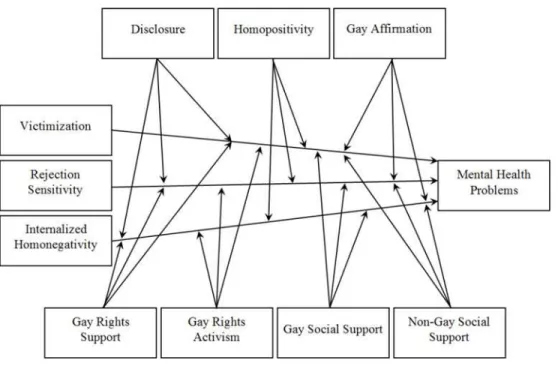
In summary, we propose a minority stress model based on Meyer [10] but with some changes. The current minority stress model includes a number of minority stressors, group-level coping variables, social support variables, and mental health. We want to investigate whether minority stressors predict mental health problems and whether group-level coping and social support moderates these predictions.
Fig 1. Hypothesized Minority Stress Model.
Method
The study was approved by the Ethics Committee of the Department of Psychology at the Phi-lipps University Marburg. In the first page of the study participants were informed about the questionnaire (including conditions of participation, anonymity issues, data protection, and duration). They were asked for informed consent by choosing between two online answering options ("Yes, I agree with the conditions" or "No, I do not agree with the conditions"). Only those who provided informed consent were forwarded to the questionnaire. This method of providing online informed consent was approved by the Ethics Committee of the Department of Psychology at the Philipps University Marburg.
Participants
The study was approved by the Ethics Committee of the Department of Psychology at the affili-ated university. Participants were recruited online at the affiliaffili-ated university, associations of sexual minorities, online news portals, and online gay social networks. The language of the study was German. In the first page of the study participants were informed about the ques-tionnaire (including conditions of participation, anonymity issues, data protection, and dura-tion). In total, 1,933 persons provided informed consent and participated in the study between the 29thof April and the 29thof May 2014. Data of responders in the following conditions were excluded from the analyses: no informed consent (n= 30), incomplete questionnaire (n= 431), female sex (n= 36), non-gay identification (n= 131), younger than 18 or older than 77 years (n= 7), living in an opposite-sex marriage and a same-sex civil union at the same time (n= 1), smoking more than 60 cigarettes per day because of the high improbability (n= 5), question-naire completion in less than five or more than 45 minutes (n= 73), and missing values regard-ing questionnaire completion time (n= 31). The final sample consisted of 1,188 self-identified gay men. Their average questionnaire completion time was 14.8 minutes (SD= 6.90).
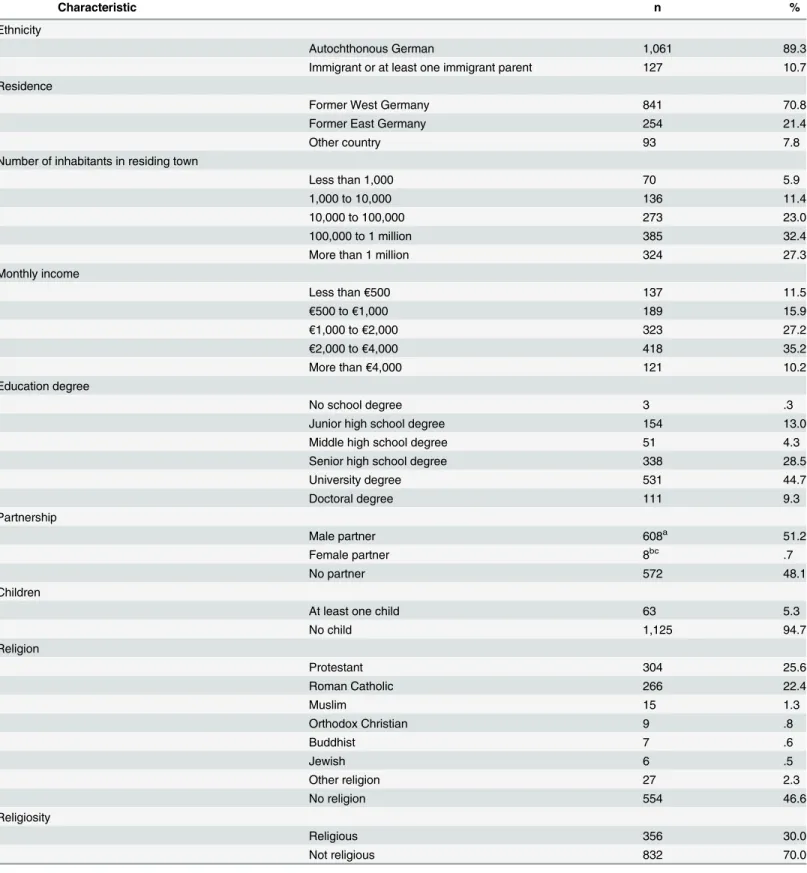
The participants’mean age was 38 years (SD= 11.02; range = 18–73 years). For a detailed display of the sample’s socio-demographic characteristics, seeTable 1.
Materials and Procedure
The goal in the present study was to create a short and comprehensible questionnaire that would assess a high number of constructs. Therefore, all used inventories were abbreviated and mostly 5-point Likert-type response formats were used if participants were asked for levels of agreement and 4-point scales if they were asked to quantify behaviors.
Victimizationwas assessed with an adapted version of a victimization scale by Herek and Berrill [12]. The original scale consists of 12 items measuring violence and victimization expe-rienced after the age of 16 and a further 12 items assessing victimization in the past year (e. g.
“Had verbal insults directed at you?”). The scale has a 3-point response format (0 =never, 1 = once, 2 =twice or more). In the present study, five adapted items that assess victimization since the age of 16 (seeS1 Appendix) and an amplified 4-point response scale (1 =never, 2 =once, 3 =twice, 4 =three times or more) was used. Herek and Berrill [12] did not report on the psycho-metric properties of the victimization subscale. The current version of the subscale had a satis-factory internal consistency, with Cronbach’s alpha = .72. A maximum likelihood factor analysis with one extracted factor was applied on the victimization scale. The factor analysis revealed that all items loaded on the same factor (λ= .35 to .84), explaining 42.36% of the variance.
Table 1. Socio-Demographic Sample Characteristics.
Characteristic n %
Ethnicity
Autochthonous German 1,061 89.3
Immigrant or at least one immigrant parent 127 10.7
Residence
Former West Germany 841 70.8
Former East Germany 254 21.4
Other country 93 7.8
Number of inhabitants in residing town
Less than 1,000 70 5.9
1,000 to 10,000 136 11.4
10,000 to 100,000 273 23.0
100,000 to 1 million 385 32.4
More than 1 million 324 27.3
Monthly income
Less than€500 137 11.5
€500 to€1,000 189 15.9
€1,000 to€2,000 323 27.2
€2,000 to€4,000 418 35.2
More than€4,000 121 10.2
Education degree
No school degree 3 .3
Junior high school degree 154 13.0
Middle high school degree 51 4.3
Senior high school degree 338 28.5
University degree 531 44.7
Doctoral degree 111 9.3
Partnership
Male partner 608a 51.2
Female partner 8bc .7
No partner 572 48.1
Children
At least one child 63 5.3
No child 1,125 94.7
Religion
Protestant 304 25.6
Roman Catholic 266 22.4
Muslim 15 1.3
Orthodox Christian 9 .8
Buddhist 7 .6
Jewish 6 .5
Other religion 27 2.3
No religion 554 46.6
Religiosity
Religious 356 30.0
Not religious 832 70.0
aOf these, n = 143 (23.5%) lived in a civil union. They comprise 12.0% of the total sample. bOf these, n = 5 (62.5%) lived in a marriage. They comprise .4% of the total sample. cOf these, n = 4 were in a partnership with a man and woman.
your lap. His mom comes to take him away”). The original scale has a 6-point Likert-type for-mat (1 =very unconcernedandvery unlikely, 6 =very concernedandvery likely). In the current study, participants were presented with three slightly modified items (seeS1 Appendix) and asked“Do you think this happened because of your sexual orientation?”They were presented with a 5-point Likert-type scale (1 =strongly disagree, 5 =strongly agree), since we aimed to use comparable item format structures (see above). While the coefficient alpha reported for the original Gay-Related Rejection Sensitivity scale was excellent (.91) [13], the one in the present study reached only .64. This is discussed in the limitations section. A maximum likelihood fac-torial analysis with one extracted factor was applied on the rejection sensitivity scale. It revealed that all items loaded on the same factor (λ= .49 to .73), explaining 38.58% of the variance.
Internalized homonegativitywas assessed with an adapted version of the personal homo-negativity subscale of the Internalized Homohomo-negativity Inventory (IHNI) [14]. The original IHNI has two more subscales: gay affirmation and morality of homosexuality. It contains 22 items, of which 11 are part of the personal homonegativity subscale (e. g.,“I feel ashamed of my homosexuality”). It has a 6-point Likert-type response format (1 =strongly disagree, 6 = strongly agree). In the current study, a 3-item scale (seeS1 Appendix) and a 5-point Likert-type format (1 =strongly disagree, 5 =strongly agree) was used. The original personal homonegativ-ity subscale has a reported coefficient alpha of .89 [14], and the present one was comparably high, with .86. A maximum likelihood factor analysis with one extracted factor was applied on the internalized homonegativity scale: all items loaded on the same factor (λ= .82 to .84), explaining 68.72% of the variance.
Disclosurewas assessed with an adapted version of the disclosure scale by Herek and Berrill [12]. The original scale is composed of three items assessing disclosure of one’s sexual orienta-tion (e.g.“If you are gay, lesbian, or bisexual, how much would you say you are“out”to your blood relatives?”). It uses a 10-point Likert-type scale (0 =not out at all, 9 =completely out). In the present study, the items were slightly adapted (seeS1 Appendix) and a 5-point Likert-type answering scale (1 =not out at all, 5 =completely out) was used. Herek and Berrill [12] did not report on the psychometric properties of their disclosure subscale. The internal consistency of the adapted scale was satisfactory, with an alpha coefficient of .83. A maximum likelihood fac-torial analysis with one extracted factor was computed for the disclosure scale. Results indicate that all items loaded on the same factor (λ= .75 to .88), explaining 64.61% of the variance.
Homopositivitywas assessed with a modified version of the Homopositivity Scale (HPS) [26]. The HPS contains nine items that either compare gay men with heterosexual men (e. g.,
“Gay men tend to be less vulgar than straight men”) or make general statements about gay men without mentioning a comparison group (e. g.,“Most gay men have a flawless sense of taste”). The HPS contains a 5-point Likert-type scale (1 =strongly disagree, 5 =strongly agree). In the present study, three items of the HPS were used, which overtly compared gay men with heterosexual men (seeS1 Appendix). The response format was not changed. The coefficient alpha reported for the original HPS was .78 [26], and the one in the current study was compa-rably high, with .76. A maximum likelihood factorial analysis with one extracted factor was computed for the homopositivity scale. It revealed that all items loaded on the same factor (λ= .64 to .85), explaining 51.95% of the variance.
affirmation scale. It revealed that all items loaded on the same factor (λ= .83 to .85), explaining 70.15% of the variance.
Gay rights supportwas assessed with an adapted version of the Support for Lesbian and Gay Human Rights Scale (SLGHR) [31]. The SLGHR contains three factor-analytically derived subscales: social and political rights (e. g.,“All employers should strive to develop just and favourable [sic] conditions in the workplace for lesbians and gay men”), freedom of expression issues, and privacy of identity. The SLGHR consists of 34 items with a 5-point Likert-type scale (1 =strongly agree, 5 =strongly disagree). In the current study, three items of the social and political rights subscale were used, which were adapted to address solely support of gay men’s rights (seeS1 Appendix). Additionally, the response format was reversed (1 =strongly disagree, 5 =strongly agree). Ellis and colleagues [31] did not report on the psychometric properties of the SLGHR. The version in the present study had a coefficient alpha of .64. Implications of this low coefficient alpha are discussed in the limitations section as well. A maximum likelihood factorial analysis with one extracted factor was applied on the gay rights support scale. It revealed that all items loaded on the same factor (λ= .51 to .69), explaining 40.06% of the variance.
Gay rights activismwas assessed with an adapted version of the participation in gay activ-ism scale by Stürmer and Simon [28]. The scale consists of six items that assess if (yes or no) participants have been involved in gay rights activism in the past five years (e. g.,“boycott against gay-unfriendly businesses”). If participants indicate“yes”, they are asked for the num-ber of times they have participated in gay rights activism. In the present study, four adapted items were used and a new item was included that assesses gay rights activism in the social media (seeS1 Appendix). The item format was modified by using a 4-point scale (1 =never, 2 =once, 3 =twice, 4 =three times or more). While the original scale has a coefficient alpha of .65 [28], the adapted version’s was slightly higher, with .68, though this is still not satisfactory. See
thelimitationssection for possible implications of the low coefficient. A maximum likelihood
factorial analysis with one extracted factor was conducted on the gay rights activism scale. It revealed that all items loaded on the same factor (λ= .43 to .60), explaining 30.50% of the variance.
Mental healthwas assessed with adapted items from the Brief Symptom Inventory (BSI) [32,33] and the Diagnostic Interview of Mental Disorders (DIPS) [34]. The BSI contains 53 items assessing mental problems in the past week (e. g.,“loneliness”). Its nine subscales are somatization, obsessive-compulsive, interpersonal sensitivity, depression, anxiety, hostility, phobic anxiety, paranoid ideation, and psychoticism. In the present study, a shortened version of the BSI was used, with three items for each of the nine dimensions. Further, three items related to alcohol dependency were added from the DIPS. They were adapted in order to match the one-week time frame of the BSI. The current mental health scale thus consisted of 30 items in total (seeS1 Appendix) and included the BSI’s 5-point Likert-type response format (1 =not at all, 5 =extremely). In order to validate the mental health scale, based on BSI and DIPS, both an explorative and confirmative factor analysis were computed: in the explorative factor analysis (maximum likelihood) with promax rotation, five factors were extracted. The eigenvalue of the first factor was 12.09, while further eigenvalues dropped considerably to 1.64, 1.41, 1.12, and 1.04. All items were loading positively on the first factor (λ= .40 to .79). In total, 50.04% of the variance for the mental health scale was explained by the five factors. For confor-mational testing, a maximum likelihood factorial analysis with one factor and an oblique pro-max rotation (kappa 4) was calculated. 38.29% of the variance in the mental health scale was explained by the factor. All items loaded on the factor (λ= .38 to .80). The authors decided to use the one-factor solution, since eigenvalues of additional factors in the five-factor solution were very low. The global BSI score has a coefficient alpha of .92 [33] and the alcohol depen-dency scale of the DIPS a Cohen’s kappa coefficient of .70 [34]. The coefficient alpha in the modified scale of mental health problems was highly satisfactory with an alpha of .95.
Statistical Analyses
A moderated multiple regression was used to test the proposed minority stress model (Fig 1). All analyses were carried out using IBM SPSS Statistics 22.0.
Results
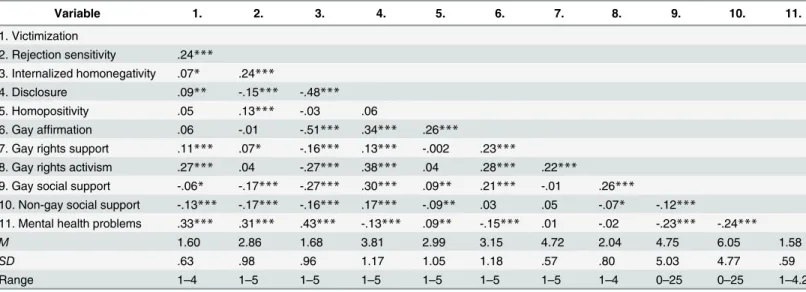
Bivariate correlations, means, standard deviations, and ranges of the assessed variables are shown inTable 2.
In the following section, correlations of the minority stressors, group-level coping, social support, and mental health variables are portrayed. Significant two-way correlations which are underneath the threshold ofr= .10 are interpreted as marginal [35]. Rejection sensitivity was significantly and positively correlated with victimization and internalized homonegativity (r= .24,p<.001, each), while victimization was marginally associated with internalized
homone-gativity (r= .07,p<.05). All three minority stressors (victimization, rejection sensitivity, and
internalized homonegativity) were significantly and positively correlated with mental health problems (r= .31,p<.001 tor= .43,p<.001). The minority stressors were further
signifi-cantly and negatively associated with gay and non-gay social support (r= -.13,p<.001 tor=
-.27,p<.001), with the exception of victimization being only marginally associated with gay
social support (r= -.06,p<.05). Victimization was marginally and positively correlated with
disclosure (r= .09,p<.01). Disclosure was negatively related to rejection sensitivity and
inter-nalized homonegativity (r= -.15,p<.001 andr= -.48,p<.001, respectively), whereas
disclo-sure was marginally and positively correlated with victimization (r= .09,p<.01). Notably,
homopositivity was significantly and positively correlated with rejection sensitivity (r= .13, p<.001) and marginally with mental health problems (r= .09,p<.01). This is inconsistent
.001 andr= .27,p<.001, respectively). Rejection sensitivity was positively and marginally
cor-related with gay rights support (r= .07,p<.05). Internalized homonegativity was significantly
and negatively associated with gay affirmation, gay rights support, and gay rights activism (r= -.16,p<.001 tor= -.51,p<.001). Most group-level coping variables were associated with one
another (r= .13,p<.001 tor= .38,p<.001). Only homopositivity was unrelated with
disclo-sure, gay rights support, and gay rights activism (-.002,p>.05 tor= .06,p>.05). Gay social
support and non-gay social support were negatively associated with one another (r= -.12,p<
.001). Mental health problems were significantly and negatively correlated with disclosure, gay affirmation, gay support, and non-gay support (r= -.13,p<.001 tor= -.24,p<.001). Notably,
mental health problems were not significantly associated with gay rights support or gay rights activism (r= .01,p>.05 andr= -.02,p>.05, respectively).
A moderated multiple regression was conducted to examine the hypothesized model. Minority stressors, coping, social support, and interactions of the minority stressors with the coping and social support variables were included. Results are indicated inTable 3.
The moderated multiple regression model predicted 36% (p<.001) of the variance of
men-tal health problems. Predictions with beta weights lower than .10 are interpreted as marginal predictions [36].
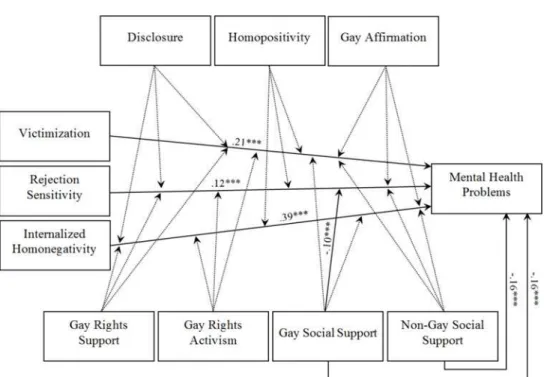
Victimization (β= .21,p<.001), rejection sensitivity (β= .12,p<.001), and internalized
homonegativity (β= .39,p<.001) significantly and positively predicted mental health
prob-lems (Fig 2). Gay social support (β= -.17,p<.001) and non-gay social support (β= -.16,p<
.001) negatively predicted mental health problems, whereas disclosure and homopositivity marginally predicted mental health problems (β= .09,p<.01 andβ= .07,p<.01,
respec-tively). Gay affirmation (β= .01,p>.05), gay rights support (β= .04,p>.05), and gay rights
activism (β= -.003,p>.05) did not predict mental health outcomes. Only one significant
moderating relationship withβ>.10 was found for rejection sensitivitygay social support
(β= -.10, p<.001) on mental health problems. Marginal positive moderations were found in
Table 2. Correlations of Minority Stress, Group-Level Coping, Social Support, and Mental Health Problems.
Variable 1. 2. 3. 4. 5. 6. 7. 8. 9. 10. 11.
1. Victimization
2. Rejection sensitivity .24***
3. Internalized homonegativity .07* .24***
4. Disclosure .09** -.15*** -.48***
5. Homopositivity .05 .13*** -.03 .06
6. Gay affirmation .06 -.01 -.51*** .34*** .26***
7. Gay rights support .11*** .07* -.16*** .13*** -.002 .23***
8. Gay rights activism .27*** .04 -.27*** .38*** .04 .28*** .22***
9. Gay social support -.06* -.17*** -.27*** .30*** .09** .21*** -.01 .26***
10. Non-gay social support -.13*** -.17*** -.16*** .17*** -.09** .03 .05 -.07* -.12***
11. Mental health problems .33*** .31*** .43*** -.13*** .09** -.15*** .01 -.02 -.23*** -.24***
M 1.60 2.86 1.68 3.81 2.99 3.15 4.72 2.04 4.75 6.05 1.58
SD .63 .98 .96 1.17 1.05 1.18 .57 .80 5.03 4.77 .59
Range 1–4 1–5 1–5 1–5 1–5 1–5 1–5 1–4 0–25 0–25 1–4.2
Bivariate two-way correlations. M = mean, SD = standard deviation *p<.05.
**p<.01. ***p<.001.
Table 3. Moderated Multiple Regression Analysis Predicting Mental Health Problems from Minority Stress, Group-Level Coping, and Social Support.
Predictor Source of mental health problems
β
Victimization .21***
Rejection sensitivity .12***
Internalized homonegativity .39***
Disclosure .09**
Homopositivity .07**
Gay affirmation .01
Gay rights support .04
Gay rights activism -.001
Gay social support -.16***
Non-gay social support -.16***
Interactionsa
Total adjustedR2 .36***
aSigni
ficant interactions include victimization*homopositivity (β= .08**), rejection sensitivity*gay social support (β= -.10***), internalized homonegativity*disclosure (β= .09*), internalized homonegativity*non-gay social support (β= -.06*). Marginally significant interactions include victimization*non-gay social support (β= -.05†) and internalized homonegativity*homopositivity (β= .05†).
†p<.10
*p<.05. **p<.01. ***p<.001.
doi:10.1371/journal.pone.0150562.t003
Fig 2. Empirical Minority Stress Model.Only significant predictions and moderations are displayed with beta weights>.10.*p<.05.**p<.01.***p<.001.
the case of victimizationhomopositivity and internalized homonegativitydisclosure (β= .08,
p<.01 andβ= .09, p<.05, respectively), while a marginal negative moderation was found for
internalized homonegativitynon-gay social support (β= -.06, p<.05). The remaining 17
interactions (e. g., victimizationdisclosure and rejection sensitivitygay activism) were not
significant.
Discussion
The current study examined a minority stress model for gay men based on Meyer [10]. This investigation is the first to examine the predictive values of a broad number of minority stress-ors, group-level coping variables, and social support variables on mental health in German gay men. Results support the hypotheses that the minority stressors victimization, rejection sensi-tivity, and internalized homonegativity positively predict mental health problems. These find-ings are consistent with previous minority stress research [6,15–17,19–21,23].
In addition, it was hypothesized that the effect of minority stress on mental health problems is moderated by group-level coping and social support. In accordance with these hypotheses, gay social support moderated the effect of rejection sensitivity on mental health problems. Also, two marginal and positive interactions between victimizationhomopositivity and
inter-nalized homonegativitydisclosure, as well as a marginal and inverse interaction of internalized
homonegativitynon-gay social support were found. These three interactions had low beta
weights (β<.10) and are thus interpreted as marginally and being of little relevance [36]. No
other significant interactions of minority stressors with group-level coping or social support variables were observed. Since we are the first to examine this complex model of predictions and moderating influences on the mental health of gay men, our findings are in need of future replication. Future research should search for adaptive group-level coping variables including investigations on gay rights support and gay rights activism, since our findings related to those measures are hard to interpret due to their low alpha coefficients.
Another hypothesis was that group-level coping and social support would not predict men-tal health problems. Indeed, gay affirmation, gay rights support, and gay rights activism did not predict mental health problems. In contrast, disclosure and homopositivity marginally pre-dicted a higher degree of mental health problems, while both gay and non-gay social support predicted a lower degree of mental health problems. Previous studies have failed to find a posi-tive relationship between disclosure and mental health problems [18,22]. An explanation for the discrepancy might be that in contrast to us, they did not control for possible confounding variables such as internalized homonegativity and that the relationships are very small. In another study, internalized homophobia and emotional support mediated the association between concealment and mental health in a sample of behaviorally bisexual men [37].
Limitations
As with any empirical research, the current study has some limitations. First, due to the online sampling approach, the extent to which the findings can be generalized to the German or West-ern gay male population is unclear. Second, no causality can be concluded from the current study because of the cross-sectional design. It is thus also possible that mental health problems produce a higher perception of minority stressors. This is likely in the case of depression, since this mental disorder is associated with biases in attention, processing, and memory [38]. Third, although factorial analyses were applied and reliabilities were estimated of all scales, no further validation was done. As a result, the rejection sensitivity, gay rights support, and gay rights activism scales had rather low alpha coefficients [39], meaning that their results cannot be interpreted well. Fourth, gay social support was dependent on non-gay social support because non-gay support was derived from subtracting gay support from total support. Therefore, these scales can only be interpreted with caution. Fifth, the study did not include constructs of resilience. Confusions of the variables in the study (e. g. group-level coping) with resilience are thus possible.
Conclusion
The findings imply that the minority stress theory [10] should be modified. In accordance with Meyer [10], victimization, rejection sensitivity, and internalized homonegativity predict mental health problems. However, disclosure has a marginal and positive effect on mental health, while social support variables directly influence mental health of gay men. Also, homopositivity predicts mental health problems marginally. Group-level coping and social support do not interact with minority stressors with one exception: gay social support interacts with rejection sensitivity. Further longitudinal or experimental replication is needed before transferring the results to mental health interventions and prevention strategies for gay men.
Supporting Information
S1 Appendix.
(DOCX)
Author Contributions
Conceived and designed the experiments: FAS UW HC. Performed the experiments: FAS UW HC. Analyzed the data: FAS UW HC. Contributed reagents/materials/analysis tools: FAS UW HC. Wrote the paper: FAS UW HC.
References
1. Cochran SD, Mays VM. Lifetime prevalence of suicide symptoms and affective disorders among men reporting same-sex sexual partners: Results from NHANES III. Am J Public Health. 2000; 90: 573–578. PMID:10754972
2. Cochran SD, Mays VM. Relation between psychiatric syndromes and behaviorally defined sexual ori-entation in a sample of the US population. Am J Epidemiol. 2000; 151: 516–523. PMID:10707921
3. Cochran SD, Sullivan JG, Mays VM. Prevalence of mental disorders, psychological distress, and men-tal health services use among lesbian, gay, and bisexual adults in the United States. J Consult Clin Psych. 2003; 71: 53–61.
4. Fergusson DM, Horwood LJ, Beautrais AL. Is sexual orientation related to mental health problems and suicidality in young people? Arch Gen Psychiatry. 1999; 56: 876–880. PMID:10530626
6. Frisell T, Lichtenstein P, Rahman Q, Långström N. Psychiatric morbidity associated with same-sex sex-ual behaviour: Influence of minority stress and familial factors. Psych Med. 2010; 40: 315–324.
7. Plöderl M. Sexuelle Orientierung, Suizidalität und psychische Gesundheit [Sexual orientation, suicidal-ity, and mental health]. Weinheim, Germany: Beltz; 2005.
8. Sandfort TGM, de Graaf R, Bijl RV, Schnabel P. Same-sex sexual behavior and psychiatric disorders: Findings from the Netherlands mental health survey and incidence study (NEMESIS). Arch Gen Psy-chiatry. 2001; 58: 85–91. PMID:11146762
9. King M, Semlyen J, Tai SS, Killaspy H, Osborn D, Popelyuk D, Nazareth I. A systematic review of men-tal disorder, suicide, and deliberate self harm in lesbian, gay and bisexual people. BMC Psychiatry. 2008; 8: 70–86. doi:10.1186/1471-244X-8-70PMID:18706118
10. Meyer IH. Prejudice, social stress, and mental health in lesbian, gay, and bisexual populations: Con-ceptual issues and research evidence. Psych Bull. 2003; 129: 674–697.
11. Plöderl M, Sauer J, Fartacek R. Suizidalität und psychische Gesundheit von homo- und bisexuellen Männern und Frauen: Eine Metaanalyse internationaler Zufallsstichproben [Suicidality and mental health of gay and bisexual men and women: A meta-analysis of international probability samples]. Ver-haltenstherapie & Psychosoziale Praxis. 2006; 38: 283–302.
12. Herek GM, Berrill KT. Documenting the victimization of lesbians and gay men: Methodological issues. In: Herek GM, Berrill KT, editors. Hate crimes: Confronting violence against lesbians and gay men. Newbury Park: Sage; 1992. pp. 270–286.
13. Pachankis JE, Goldfried MR, Ramrattan ME. Extension of the rejection sensitivity construct to the inter-personal functioning of gay men. J Consult Clin Psych. 2008; 76: 306–317.
14. Mayfield W. The development of an internalized homonegativity inventory for gay men. J Homosexual. 2001; 41: 53–76.
15. Feinstein BA, Goldfried MR, Davila J. The relationship between experiences of discrimination and men-tal health among lesbians and gay men: An examination of internalized homonegativity and rejection sensitivity as potential mechanisms. J Consult Clin Psych. 2012; 80: 917–927.
16. Goldberg AE, Smith JZ. Stigma, social context, and mental health: Lesbian and gay couples across the transition to adoptive parenthood. J Couns Psych. 2011; 58: 139–150.
17. Hatzenbuehler ML, McLaughlin KA, Keyes KM, Hasin DS. The impact of institutional discrimination on psychiatric disorders in lesbian, gay, and bisexual populations: A prospective study. Am J Public Health. 2010; 100: 452–459. doi:10.2105/AJPH.2009.168815PMID:20075314
18. Juster R-P, Smith NG, Ouellet É, Sindi S, Lupien SJ. Sexual orientation and disclosure in relation to psychiatric symptoms, diurnal cortisol, and allostatic load. Psychosom Med. 2013; 75: 103–116. doi:
10.1097/PSY.0b013e3182826881PMID:23362500
19. Lewis RJ, Derlega VJ, Griffin JL, Krowinski AC. Stressors for gay men and lesbians: Life stress, gay-related stress, stigma consciousness, and depressive symptoms. J Soc Clin Psych. 2003; 22: 716–
729.
20. Newcomb ME, Mustanski B. Internalized homophobia and internalizing mental health problems: A meta-analytic review. Clin Psych Rev. 2010; 30: 1019–1029.
21. Rostosky SS, Riffle EDB, Horne SG, Miller AD. Marriage amendments and psychological distress in lesbian, gay and bisexual (LGB) adults. J Couns Psych. 2009; 56: 56–66.
22. Ullrich PM, Lutgendorf SK, Stapleton JT. Concealment of homosexual identity, social support and CD4 cell count among HIV-seropositive gay men. J Psychosom Res. 2003; 54: 205–212. PMID:12614830
23. Zakalik RA, Wei M. Adult attachment, perceived discrimination based on sexual orientation, and depression in gay males: Examining the mediation and moderation effects. J Couns Psych. 2006; 53: 302–313.
24. Szymanski DM, Owens GP. Group-level coping as a moderator between heterosexism and sexism and psychological distress in sexual minority women. Psych Women Quart. 2009; 33: 197–205.
25. Proescholdbell RJ, Roosa MW, Nemeroff CJ. Component measure of psychological sense of commu-nity among gay men. J Commucommu-nity Psychol. 2006; 34: 9–24.
26. Morrison TG, Bearden AG. The construction and validation of the homopositivity scale: An instrument measuring endorsement of positive stereotypes about gay men. J Homosexual. 2007; 52: 63–89. 27. Sarason IG, Levine HM, Basham RB, Sarason BR. Assessing social support: The social support
ques-tionnaire. J Pers Soc Psychol. 1983; 44: 127–139.
29. Folkman S, Lazarus RS, Gruen RJ, DeLongis A. Appraisal, coping, health status, and psychological symptoms. J Pers Soc Psychol. 1986; 50: 571–579. PMID:3701593
30. Grossman AH D’Augelli AR, Hershberger SL. Social support networks of lesbian, gay, and bisexual adults 60 years of age and older. J Gerontol. 2000; 55: 171–179.
31. Ellis SJ, Kitzinger C, Wilkinson S. Attitudes towards lesbians and gay men and support for lesbian and gay human rights among psychology students. J Homosexual. 2003; 44: 121–138.
32. Derogatis LR, Melisaratos N. The brief symptom inventory: An introductory report. Psychol Med. 1983; 13: 595–605. PMID:6622612
33. Franke GH. Brief Symptom Inventory von L. R. Derogatis (Kurzform der SCL-90-R): Deutsche Version [Brief Symptom Inventory by L. R. Derogatis (brief form of the SCL-90-R): German Version]. Göttingen, Germany: Beltz; 2000.
34. Schneider S, Margraf J. DIPS für DSM-IV: Diagnostisches Interview bei psychischen Störungen [DIPS for DSM-IV: Diagnostic Interview of Psychiatric Disorders]. Heidelberg, Germany: Springer; 2006. 35. Cohen J. Statistical power analysis for the behavioral sciences. 2nd ed. Hillsdale: Lawrence Erlbaum
Associates; 1988.
36. Acock AC. A gentle introduction to Stata. 2nd ed. College Station: Stata Press; 2008.
37. Schrimshaw EW, Siegel K, Downing MJ, Parsons JT. Disclosure and concealment of sexual orientation and the mental health of non-gay-identified, behaviorally bisexual men. J Consult Clin Psych. 2013; 81: 141–153.
38. Disner SG, Beevers CG, Haigh EAP, Beck AT. Neural mechanisms of the cognitive model of depres-sion. Nat Rev Neurosci. 2011; 12: 467–477. doi:10.1038/nrn3027PMID:21731066