American Journal of Applied Sciences 2 (1): 397-399, 2005 ISSN 1546-9239
© Science Publications, 2005
397
Application of Polyelectrolyte in Turbidity Removal from Surface Water
1
A.H. Mahvi and
2M. Razavi
1School of Public Health and Institute of Public Health Research
Center for Environmental Research, Tehran University of Medical Sciences, Tehran, Iran
2Tehran Water and Wastewater Engineering Company, Tehran, Iran
Abstract: One of the most important treatment processes in surface water treatment plants is coagulation. Surface waters such as rivers and lakes contain suspended particles and turbidity. With the aid of coagulants, and by flocculation process, followed by sedimentation and filtration, these impurities can be removed from raw waters these days, besides conventional chemicals such as Alum and Ferric chloride, polymers are getting common. Polymers can be used as pretreatment and filter aids chemicals, also. There are some advantages in the usage of polymers, such as; higher sedimentation rate, lower price, better finished water quality, lower sludge volume produced, and a better sludge quality with respect to mineral coagulants. Of course some disadvantages are related to the polymers such as the monomers and residues in finished water which may be a health hazard. In this research, four different polymers for turbidity removal from raw waters were investigated. Raw water with turbidities of 200, 500, 700 and 1000 FTU were treated with optimum polymer dosage. The results showed that, polymers with small dosage can be used for water purification. In this regard it was found that Magnafloc LT27 has lowest dosage and better floc strength with respect to others.
Key words: Polyelectrolyte, Turbidity, Surface Water
INTRODUCTION
One of the natural pollutants in surface waters especially rivers are suspended particles. The presence of this parameter will cause turbidity in waters. The usual source of turbidity is clay particles resulting from the erosion of soil in the catchments area; potable water quality must the accepted drinking water standards of a society. On of the physical characteristics of potable water that should meet the standards is turbidity. In some cases this standards is a low as 1 Nephlometric Turbidity Unit (NTU) and in some other cases are as high as 5 Jackson Turbidity Unit (JTU) as Maximum permissible [1]. The size of colloidal particles are in the rang of a few nanometers up to some hundred micrometers, usual colloidal particles in surface waters have sites ranging from 0.001 up to 10 microns .The time to settle down these particles range from half an hour up to 63 years [2] From the engineering point of view, application of coagulation and flocculation is necessary or removal and settlement of colloidal particles. The colloidal particles in an aqua’s solution carry electrical charges on their surface. Which the case of clay particles it is a negative charge. Because of the presence of these similar charges, the colloidal particles can not get together and form a heavier particle for settlement [3]. This stable system should be unstablized by the application of coagulants. In this regards, the particles will get enough close to each other to make a heavier and bigger particles [4]. Besides mineral coagulants such as Alum and Ferric chloride, these exit polymers which are being used for turbidity removal
[2, 3]. The dominant mechanism in this regard is bridging between the colloidal particles. The usage of polymers for water treatment processes are adopted since 1980 [5]. Cationic polymers are used as primary coagulants, whereas nonionic and anionic polymers are used as coagulant aids mostly [6, 7]. The advantages of polymers over mineral coagulants are: more than 50% reduction in sludge volume, lower water content, better dewatering characteristic, no effects on water pH, no increase in total dissolved solids of finished water, no dissolution of any substances in the treated water, which in the case of mineral coagulants the dissolution of Al and Fe happens and shorter settling time [8]. It has been reported that in U.S. more than half of the water treatment plants have employed one or more polyelectrolyte [6]. In some researches, there have been shown that cationic polyelectrolyte are very applicable for the reduction of THMS precursors [9, 10]. In another research, the application of a cationic polyelectrolyte in a direct filtration process was studied. The turbidity of the finished water was about 0.05 formation turbidity unit [11]. The main objective of this research is surveying the application of 4 different polyelectrolyte in turbidity removal.
MATERIALS AND METHODS
American J. Applied Sci., 2 (1): 397-399, 2005
398 of 200, 500, 700, and 1000 FTU. Four different types of Magnafloc polyelectrolyte known as 1597, LT31, 611TR and LT27 were used which the first 3 were strong cationic and the last one was strong anionic one. All the chemical tests and analysis were done according to Standard method for the examination of water and wastewater [12].
RESULTS AND DISCUSSION
Jar test was conducted on turbid water with turbidity of 200 FTU. Four different polymers, Magnafloc LT27, 611TR, LT31 and 1569 were added with dosage of 0.15, 0.7, 0.35 and 0.30 mg/L, respectively. Figure 1 shows the efficiency of turbidity removal by the polymers.
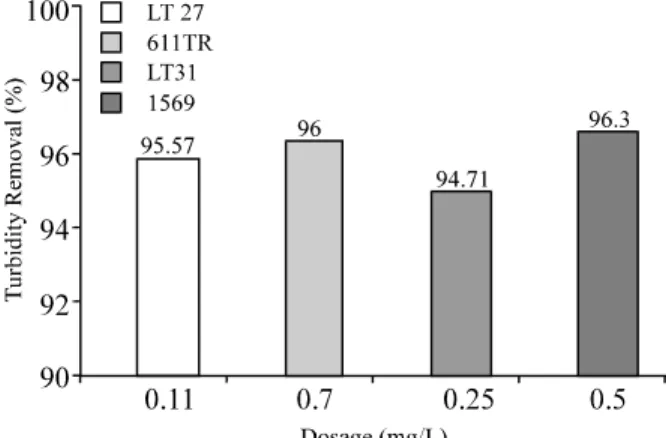
At the second phase, raw turbid water with turbidity of 500 FTU was followed by Jar test. Figure 2 represents the effect of 4 polymers on turbidity removal. The dosage of Magnafloc polymers LT27, 611TR, LT31 and 1569 were 0.1, 0.9 and 0.3 mg/L, respectively. In the next step, Jar test were done by some polymers on turbid water with turbidity of 700 FTU. Figure 3 shows the turbidity removal efficiency of Magnafloc polymers LT27, 611TR, LT31 and 1569 with dosage of 0.11, 0.7, 0.25 and 0.5 mg/L , respectively.
Fig. 1: Effect of Polymers on Turbidity Removal Raw Water Turbidity = 200 FTU
Fig. 2: Effect of Polymers on Turbidity Removal Raw Water Turbidity = 500 FTU
Fig. 3: Effect of Polymers on Turbidity Removal Raw Water Turbidity = 700 FTU
Fig. 4: Effect of Polymers on Turbidity Removal Raw Water Turbidity = 1000 FTU
At the end, the high turbid water with turbidity of 1000 FTU were prepared for Jar test analysis using the same polymers. Figure 4 represent the results of Jar test on floc formation and turbidity removal efficiency of Magnafloc LT27, 611TR, LT31 and 1569 with dosage of 0.11, 0.9, 0.15 and 0.7 mg/L, respectively.
None of the polymers resulted in producing treated water with turbidities less than 10 FTU. There for either they can be used as coagulant aids or filtration should be followed after on. Anionic polymers with high molecular weight such as Magnafloc LT27 and cationic one such as 611TR had a better turbidity efficiency removal than the other two. Of course it should be mentioned that as the turbidity gets higher, this is not true any more, since the adsorption of ions and charge neutralization mechanism is applied. The efficiency of polymers in turbidity removal from raw waters in the range of 200 FTU is as: LT27 > 1597> 611TR > LT31, whereas for optimum polymer dosage the sequence is as: 611TR = 1597 > LT31 > LT27.
These results show that Magnafloc LT27 has advantage over the other 3 polymers because of higher efficiency and lower dosage consumed.
American J. Applied Sci., 2 (1): 397-399, 2005
399 polymers are in the order of: 1597 > 611TR > LT27 > LT31. The dosage of polymers that were used in this phase is in the order of: 611TR > LT31 > 1597 > LT27. It is worth to say that the turbidity efficiency removal for these water samples were very close together, about 93-94%, but since the dosage of LT27 was lowest, this polymer has the highest advantage for use.
For raw waters with turbidity of 700 FTU, the turbidity removal efficiency lay in the order of: 1597 > 611TR > LT27 > LT31 and for polymer dosage it is as: 611TR > LT31 = 1597 > LT27, the results show that the efficiency of 1597 is higher than the others, but the dosage is slightly more the lowest one . On the other hand, since the dosage of polymer LT27 is lowest with respect to the other 3 polymers and because of health aspects of polymer residues in finished water, Magnafloc LT27 is suggested.
For raw waters with turbidity of 1000 FTU, the sequence of turbidity efficiency removal for these polymers is as: 1597 > 611TR > LT31 > LT27. The dosage of Magnaflocs consumed is in the order of: 611TR > 1597 > LT31 > LT27. Again, the results show that LT27 has the lowest dosage consumed and since the efficiency for turbidity removal are very close to each other, than Magnafloc LT27 has advantage over the other 3.
This research has come up with similar results to Topka Water Department in turbidity removal from raw water [13]. Again the results of this research are in accordance to turbidity removal by cationic and anionic polyelectrolyte used in Jar Test [14]. Since the dosage of polymers in this research was lower than polyelectrolyte application in turbidity removal with dosage of up to 10 mg/L in a water treatment plant, the efficiency in turbidity removal was also lower [11]. With many advantages that polymers have in water treatment, their usage is recommended.
REFERENCES
1. Iranian Institute of Standard and Industrial Researches, 1993. Water Quality Company, Tehran, Iran.
2. Smauel, D.F. and M.A. Osman, 1983. Chemistry of Water Treatment. Copy right by Butler worth Publishers.
3. Nasseri. S., 1994. Coagulant and coagulation processes: basic methods in water treatment industry. Seminar Proceedings of Coagulant in Water Industry, Ahvaz, Iran.
4. Metcalf and Eddy, Inc., 1982. Wastewater Engineering. McGraw Hill, NewYork, USA. 5. Kashkuli, H.A., 1994. Coagulation chart and
important notices on coagulant usage in treatment of surface waters. Seminar Proceedings of Coagulant in Water Industry, Ahvaz, Iran.
6. Letterman, R.D. and R.W. Pero, 1990. Contaminants in polyelectrolytes used in water treatment. J. AWWA., 82: 87.
7. Weber, W.J., 1972. Phsiochemical Process for Water Quality Control. John Wiley and Sons Inc. 8. SamnarShad, A.A. and M.R. Bnazadeh, 1982.
Industrial Water Treatment Guidelines, Jahad Publication.
9. Trussel, R.R. and M.D. Umphres, 1982. The formation of trihalomethanes, J. AWWA, 70: 604. 10. Narkis, N. and M. Rebhun, 1977. Stoichiometric
relationship berween humic and fulvic acids and flocculants. J. AWWA., 69: 325.
11. Letterman, R.D, R.R. Sama and E.J. Didomenico, 1979. Direct filtration using polyelectrolyte coagulants. J. AWWA., 71: 332-338.
12. APHA-AWWA-WPCF, 1995. Standard Methods for the Examination of Water and Wastewater. 18th Edn. American Public Health Association. Washington, D.C.U.S.A.
13. Robinson, C.N.J.R., 1979. Cationic polyelectrolytes reduce organic matter in turbid surface water. J. AWWA., 71: 226.