Prevalence of dementia in
Colombian populations
Efraín Amaya Vargas1, Ángela Magnolia Ríos Gallardo2, Guillermo González Manrrique3,
Lina M. Murcia-Paredes4, María Consuelo Angarita Riaño5, Grupo DNEUROPSY6.
ABSTRACT. With the gradual increase in the life expectancy of the population due to scientific progress and public health at the service of society, the prevalence of dementia has been increasing at different rates worldwide. Currently, the prevalence rates range between 5% and 7% (6.4% in the U.S. and up to 8.5 % in Latin America) in subjects older than 60 years. The lowest prevalence rate (2.1%) has been reported from sub-Saharan Africa, probably due to selective mortality under 60 years of age. By contrast, a very high prevalence of dementia (23.6% dementia in individuals ≥60 years) was observed in the city of Neiva, Southern Colombia. We believe that this high rate could be explained by the presence of several risk factors such as very low schooling, low socio-economic strata, chronic diseases, the inclusion of geriatric homes among others, and additional unknown factors.
Key words: dementia – epidemiology, prevalence, caregivers, health-care services for older people – economy, health priorities, prevalence of dementia in Neiva and Colombia.
PREVALÊNCIA DE DEMÊNCIA EM POPULAÇÕES COLOMBIANAS
RESUMO. Com o aumento gradual da expectativa de vida das pessoas, devido aos progressos científico e de saúde pública a serviço da sociedade, a prevalência de demência tem aumentado a taxas bastante divergentes em todo o mundo. Atualmente, as taxas de prevalência variam entre 5% e 7% (6,4% em os EUA até 8,5% na América Latina) em indivíduos com idade superior a 60 anos. Prevalência mais baixa (2,1%) foi relatada na África sub-saariana, provavelmente devido a mortalidade seletiva abaixo dos 60 anos de idade. Ao contrário, uma alta prevalência de demência (23,6% de demência em pessoas ≥60 anos) foi observada na cidade de Neiva, no sul da Colômbia. Acreditamos que essa taxa alta pode ser explicada pela presença de vários fatores de risco, como: baixa escolaridade, níveis socio-económicos mais baixos, doenças crônicas, inclusão de instituições geriátricas, entre outros, e outros possíveis fatores desconhecidos.
Palavras-chave: demência – epidemiologia, prevalência, cuidadores, serviços de cuidados de saúde para os idosos – economia, prioridades em saúde, prevalência de demência em Neiva e Colômbia.
INTRODUCTION
History and definition of dementia. he Colombi-an medical literature1 discusses the historical
evolution of the dementia concept from 2000 BC to 2000 AC. he World Health Organiza-tion (WHO) deines dementia as a syndrome caused by a brain disease usually of a chron-ic or progressive nature, with alteration of multiple higher cortical functions, including memory, thinking, orientation, comprehen-sion, language, ability to learn, perform
cal-culations, and decision making. Awareness is not lost. Deicits in cognitive skills are com-monly accompanied, and occasionally pre-ceded, by deterioration of emotional control, social behavior or motivation.2 Dementia is
characterized by the presence of persistent cognitive impairment that interferes with an individual’s ability to perform their profes-sional or social activities. It is independent of the presence of changes in level of awareness and is caused by a disease that afects the
cen-1Neurologist, Professor of Medicine Program and Member of the Group DNEUROPSY - Surcolombiana University; 2Psychologist, PhD Psychology Focusing on Cognitive Neuroscience. Teacher and Director of the Group DNEUROPSY - Surcolombiana University; 3Neurologist. Health Specialist in Management. Head of the Area of Neurophysiology University Hospital in Neiva. Professor and Member of the Group DNEUROPSY - Surcolombiana University; 4Psychologist. Specialist in Health Psychology, Masters Student in Psychology. Member of Group DNEUROPSY - Surcolombiana University; 5General Medical. Specialist in Management of Health Organizations. Master’s Student in Public Health. Area Leader for Public Health. Department of Health - Huila. 6Research Group in the Development of Neurosciences and Psychology - Surcolombiana University.
Efraín Amaya Vargas. Grupo de investigación: DNEUROPSY – Universidad Surcolombiana – USCO. E-mail: [email protected] Disclosure: The authors report no conflicts of interest.
Received September 18, 2013. Accepted in final form November 20, 2014.
tral nervous system. Dementia is an acquired disease as the impairment term makes clear. his can be caused by many diseases and while often having slow, progressive and irreversible evolution, it can also be acute or sub-acute, being reversible by treating the speciic underly-ing disease, when such treatment is available and pro-vided at the right time.3-5
Currently, the diagnosis is obtained by using bio-markers and neurogenetics. hese indings allow pa-tients to be identiied, years or even decades, before reaching the clinical diagnosis of dementia (presymp-tomatic disease of Alzheimer).6 his advance is
impor-tant because until a few years ago, accurate diagno-sis and diferentiation of subtypes was possible only through an exam of pathological anatomy.7,8
Currently, the DSM-5 deines dementia as a progres-sive and chronic disease of the central nervous system that afects higher cognitive functions (thinking, lan-guage, and memory).9
In 2008, the World Health Organization (WHO) published guidelines to expand the treatment of de-mentia in low- and middle-income countries.10 In 2012,
it urged governments to consider dementia a public health priority.11 In September 2014, through the World
Alzheimer Report it was recommended that dementia be integrated into public health programs with other non-communicable chronic diseases.12
Dementia worldwide and in Latin America. he risk of de-mentia in the developing world is set to increase quickly over the next 50 years due to the growth in the elderly population (≥60 years), unlike other age groups.11 Since
1999, a group of experts from Alzheimer’s Disease In-ternational (ADI) have created a common agenda to counteract the imbalance that exists in research in the ield of dementia. Only 10% of population-based re-search in dementia was performed in low- and middle-income regions, home to 66% of afected individuals, and the group was therefore called the 10/66 group.13
he 10/66 Dementia Research Group is a network of re-searchers around the world, pooling eforts to promote research on dementia in low- and middle- income coun-tries. he number of people with dementia globally in 2013 was estimated at 44 million, expected to reach 76 million in 2030 and 135 million by 2050. he new data represent a 17% increase in global estimates, compared with previous published data in the World Alzheimer’s Report which estimated the number of people living with dementia at 35 million in 2010, 66 million in 2030 and 115 million by the year 2050.10
hese igures reveal a global problem with an impact
that afects developing countries whose limited resourc-es and time complicate the development of compre-hensive systems of social protection, health and social care. Progress is expected in the treatment of dementia that could mitigate the impact of the next epidemic, but concerted efort is essential to close the gap between diagnosis and treatment. he high-income countries belonging to the G8, formed by the world’s most indus-trialized nations (Germany, Italy, Canada, Japan, USA, UK, France and Russia) have sufered the burden of de-mentia epidemic.11 In the coming decades, most
demen-tia patients will be located in low- and middle-income countries, where 71% of dementia patients reside. he problem is particularly acute in low- to middle-income (LMI) countries, since dementia is contributing to in-creased disability in the elderly.14
he 2010 World Alzheimer Report estimated the an-nual global cost of dementia at US$ 604 billion. hese costs included three components: direct medical care, social care and the indirect costs of informal care pro-vided by unpaid family caregivers.
Dementia has a huge impact on the socio-economic conditions in the world. he cost of $ 604 billion rep-resents 1.0% of all gross domestic product (GDP) col-lected worldwide. If dementia care were a country, it would be the 18th largest economy, in the same position
as Turkey and Indonesia. If It was a company it would be the largest in the world with annual incomes exceed-ing Wal-Mart ($ 414 billion) and Exxon Mobil (US$ 311 billion)11.
he 2013 World Alzheimer Report noted that only 13 countries are currently prepared for the epidemic of dementia, implementing a national plan to tackle the disease.
A collaborative global action plan for governments, industry and non-proit organizations is suggested. It also notes that research must be a global priority to-ward improving the quality and coverage of care, inding treatments that alter the course of disease and identi-fying more options for prevention. Policy, the develop-ment of health systems and social care services should also be prioritized.10,15 By the middle of the 21st century,
78% of the world’s elderly population will reside in low- to middle-income countries, with the concomitant ex-pected increase in cases of dementia.16
To comprehend the magnitude of the dementia problem the igures must be analyzed. hese show that Latin America and the Caribbean (LAC) have the high-est prevalence in the world (8.5% in ≥60 years, whereas in the United States the rate is 6.4%,10,17 although most
60 lie between 5% and 7%.10 he variation in the actual
prevalence of dementia is inluenced in sub-Saharan Af-rica (2.1%) by the selective mortality of persons under 60 years.18 Despite the low prevalences determined in
Africa, India and Bangladesh, elderly populations face additional risk factors for dementia such as those relat-ed to HIV and traumatic brain injury. hese pathologies predict an increase in patients with dementia.19
In 2005, Ferri suggested that the prevalence of mentia in developing countries was lower than in de-veloped countries.20 However, eight prevalence studies
have been conducted in six diferent Latin American countries, inding a prevalence of 7.1% in the elderly (≥65) relecting the rates of developed countries. he prevalence in relatively young old (65-69 years) was el-evated in the Latin American indings. Regarding the risk factor of illiteracy, the rate was 9,3% in the elderly population and the prevalence of dementia in illiterates was twice as high as in literates.21
In Latin America, Alzheimer’s disease is the leading cause of dementia. Rates vary from 49% in Maracaibo, Venezuela, to 84.5% in Concepción, Chile. he second most common kind of dementia is the vascular type, whose prevalence ranges from 8.7% in Lima, Peru, to 26.5% in Maracaibo, Venezuela.21
here are substantial diferences in the results of Latin American studies on the prevalence of dementia where rates range from between 2% in a study conduct-ed in Brazil22 to 13% in a study of Venezuela.23
In Colombia, dementia was reported in epidemio-logical studies in 1987 by the Neurosciences group of the University of Antioquia, where presenile dementia closely resembling Alzheimer’s disease was found in the population under 50 years old. he existence of a DNA mutation was identiied explaining the condition, with an autosomal dominant transmission mode which im-plies a 50% risk in all children of those afected.24
In Bogota, the Health Ministry ran a pilot study on the prevalence of dementias in the community pub-lished in 2000.25 Although the results show an
osten-sible high prevalence “it is not valid, since the sample was not reliable and therefore does not relect the Bo-gota population”. Nevertheless, from the standpoint of validation of a community outreach strategy as well as use and adaptation of diagnostic techniques, this study represents an important precedent for the development of future projects.26
Subsequently, a study for Pradilla et al.27 between
1995 and 1996 was performed, in which a sample of 8,910 people divided into ive geographic areas was ex-amined: central, southwestern, northwestern, eastern
and the Colombian Caribbean coast. A neuropsycho-logical test was applied. he Hachinski,28 Yesavage,29
and Blessed30 scales, along with the NINCDS-ADRDA
diagnostic criteria for Alzheimer’s disease,7 the
NINDS-AIREN criteria for vascular dementia31 and DSM-IV
for all types of dementia were applied. he prevalence of eight neurological disorders was determined in the general population, including the overall prevalence of dementia: 13.1 per thousand (95%CI: 8.5 to 19.3).
In the city of Neiva, Huila, Colombia, in the 2003-2005 period, Gooding et al.26 conducted a
used as the screening test, 31% of individuals who con-tinued to the second phase with some level of cogni-tive impairment would have been classiied as normal with the version. his indicated that the extended ver-sion MMSE/50 eliminated 31% of the false negatives, showed greater sensitivity than the original version and was established as a good screening tool. At this stage, 219 subjects (34%) were classiied with some degree of cognitive impairment. In the second phase of this selected group, only 170 individuals remained (77.7%) after elimination of 22% based on exclusion criteria and 152 people were classiied as having probable de-mentia because at the time the only deinitive diagno-sis was reached by neuropathological examination. he number (152) with probable dementia corresponded to 23.6%. his represents the highest prevalence detected in the country thus far. his prevalence was represented by 59.9% dementia of degenerative dementia and 40% mixed, vascular and other unspeciied types.
he risk factors identiied included illiteracy, low education level, low socioeconomic status (21.9%), his-tory of high blood pressure (92%), diabetes mellitus (86.8%), dyslipidemias (82.2%), depression (32.9%), cardiovascular disease (13.5%), and cerebrovascular disease (7.3%). A total of 81% of those with dementia had low levels of schooling: 44% were illiterate and 37% had fewer than three years of schooling, an alarmingly high igure. he study shows that one of the most im-portant risk factors is low education which is why some authors have proposed that people with more schooling are resistant to the efects of dementing processes as a result of a greater cognitive reserve32 which represents a
modulator of neurodegenerative processes and clinical manifestations of cognitive decline and dementia. his is associated with the ability to optimize the execution of tasks through the recruitment of neural networks and use of alternative cognitive strategies mediated
by formal education processes. Reading level has been shown as a good measure of cognitive reserve and a reli-able predictor of executive and cognitive functioning in the aging process.33
High school education has been shown to be a pro-tective factor. hus, in an assessment of dementia in a highly-educated population in Tianjin, China, the prev-alence was lower in the elderly with high school educa-tion, suggesting an association between lower cognitive activity and presence of dementia.34 Regarding illiteracy
as a risk factor, in Latin America a rate of 9.3% is re-ported among older adults35,36 and the prevalence of
de-mentia in illiterates is twice that of literates.21 However,
studies that included more than 15,000 people without dementia in six Latin American countries, China and In-dia, did not check the association between cognitive im-pairment and age or education but conirmed the pres-ence of neuropsychiatric disorders among people with cognitive impairment who progressed to dementia.37
As regard to clinical risk factors, hypertension was con-sidered a major risk factor for the incidence of dementia and it has also been suggested that its therapeutic control can reduce the risk of developing dementia in old age by 3-20%.35,36,38 he World Alzheimer Report 2014 reveals
that diabetes can increase the risk of dementia by 50%.12
On the other hand, nutritional deicit plays an im-portant role in the process of brain aging and resultant cognitive impairment. It has been reported that the Mediterranean diet, characterized by high consumption of vegetables, fruits, nuts and grains, is linked to a re-duced risk of Alzheimer’s disease and lower mortality of patients with the disease.39-41
Taking into account the high prevalence of demen-tia in Neiva (23.6%), we considered it appropriate to produce a short synopsis in a bid to analyze the demo-graphics and cultural issues that may be afecting these numbers.
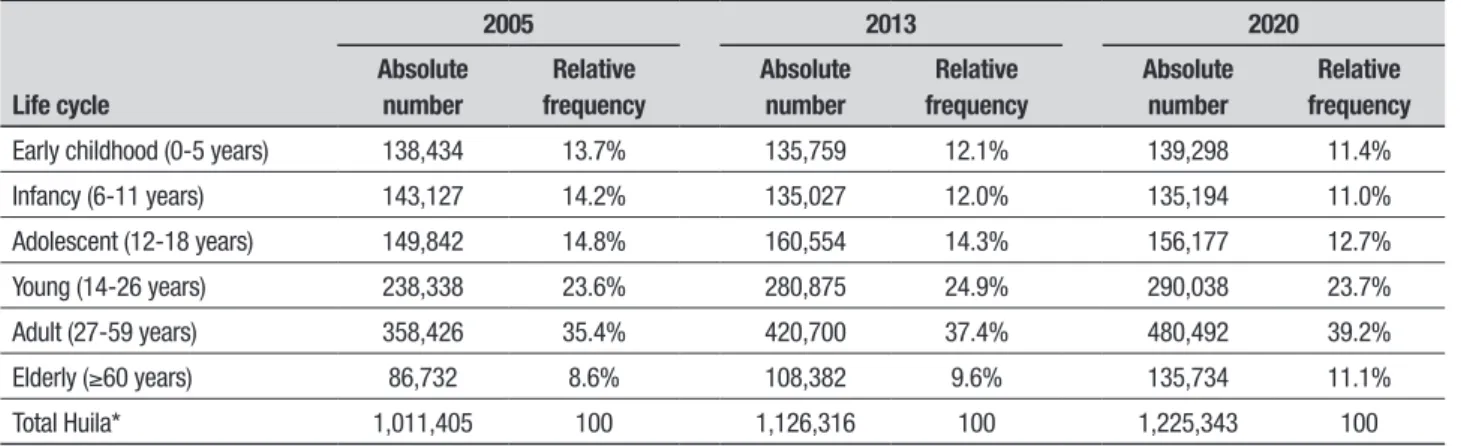
Table 1. Proportion of the population life cycle Huila department 2005, 2013 and 2020.
Life cycle
2005 2013 2020
Absolute number
Relative frequency
Absolute number
Relative frequency
Absolute number
Relative frequency
Early childhood (0-5 years) 138,434 13.7% 135,759 12.1% 139,298 11.4%
Infancy (6-11 years) 143,127 14.2% 135,027 12.0% 135,194 11.0%
Adolescent (12-18 years) 149,842 14.8% 160,554 14.3% 156,177 12.7%
Young (14-26 years) 238,338 23.6% 280,875 24.9% 290,038 23.7%
Adult (27-59 years) 358,426 35.4% 420,700 37.4% 480,492 39.2%
Elderly (≥60 years) 86,732 8.6% 108,382 9.6% 135,734 11.1%
HUILA STATE OVERVIEW
he city of Neiva is the capital of the Huila Department. Huila was founded in 1905 and is located in the south-ern Andean region, consisting of 37 municipalities with an area of 19,890 km2 representing only 1.8% of the
to-tal area of the country. It has an average temperature of 24°C with a warmer central department, especially in the valley of Neiva which averages 28°C, extending to the north end throughout the semiarid region of Yara-raca (Tatacoa). It had a population of 1,126,316 inhab-itants in 2013, 59.9% of which is located in the urban municipalities and 40.1% in rural areas. he average population density in the department is 50.86 inhabit-ants/km2. In 2012 Neiva had a population of 337,848
inhabitants. he composition of the department’s pop-ulation is multiracial: 97.78% Mestizos and Whites, 1.17% Blacks and Afro-Colombians and 1.05% Amerin-dians or InAmerin-dians.
By gender, the department’s population in 2013 was 50.1% male and 49.9% female. he average population density of the capital, Neiva, is 231 km2.
he population of the department of Huila is expan-sive in nature, showing a high concentration of young ac-tive population and labor, plus a decline in the adult and elderly population, although projections for 2020 show a pattern of decline in young people and rise in the num-ber of adults.42 he crude death rate fell from 20.6 per
thousand in 2005 to 18.2 per thousand in 2011, while the birth rate remains stable at 4.5 per 1,000 inhabit-ants in 2005 versus 4.3 per 1,000 inhabitinhabit-ants in 2011.43
he age groups from youth to seniors, by contrast, show a percentage increase, sustained in adulthood and in the elderly. Adults will present an increase of 3.8% and greater than 2.5% increase, while the young show a minimum increase of 0.1% in the 2005-2020 period (Table 1). hese changes can be explained by the be-havior of fertility in the department. he total fertility rate of 83.3 births per 1000 women aged 15-4t9 years in 2005 fell to 71.5 births per 1,000 women in the same age group in 2013.
Life expectancy at birth for the 2005-2010 period was 74 years and is set to rise by two years to 76 for the 2015-2020 period according to the Health Situa-tion Analysis (ASIS – Analisis de la Situación de Salud – HUILA, 2011). his increase in life expectancy at birth relects increased survival and therefore greater repre-sentation in the population pyramid of adult age groups and older people (Figure 1). he proportion of the elder-ly population by 2020 will be the same as that of infants and children. Other possible explanations for this dy-namic is the decrease in the speciic mortality rate
asso-ciated with violence (from 75 per 100,000 population in 2005 to about 50 per 100,000 inhabitants in 2011) and increased survival associated with non-communicable diseases with high prevalence, thus allowing younger adults and elderly to reach the cycle. herefore, Huila is undergoing a slow demographic transition from a clearly wide expansive population pyramid to a narrow-based stationary population pyramid.
Conclusions. he high prevalence of dementia in Latin America and the Caribbean (8.5%) could be associated with the conluence of genetic or environmental risk factors.41 For example, the increased mobility of
indi-viduals and families has expanded genetic isolates, and early-onset Alzheimer’s disease (Medellin, Colombia)44
and Huntington’s disease in Maracaibo, Venezuela.45
he fact that the expression of the disease occurs af-ter reproductive age may also contribute to its spread. Finally, in consanguineous marriages, relatively com-mon in some poor areas, dementia in one or both par-ents increases the risk of having children who will also be afected in the future.46
Local governments are unlikely to change their cur-rent focus from malnutrition and communicable diseases to an “incurable” disease and dementia. In addition, the prevalence of many preventable chronic diseases such as diabetes and cardiovascular increases as the low- to mid-dle-income countries adopt westernized life styles, fur-ther increasing pressure on limited health resources.19
Although the dental status of our study population was not included, the only data on the prevalence of
Source: ASIS Huila 2011. DANE42. Estimates of population and population projections 2005, 2013-2020. Population by age group.
Figure 1. Population pyramid, Department of Huila, 2005, 2013, 2020
80 y más 75-79 70-74 65-69 60-64 55-59 50-54 45-49 40-44 35-39 30-34 25-29 20-24 15-19 10-14 5-9 0-4
10% 5% % 5% 10%
2020
2005
edentulism in Colombia from a study conducted in1998 revealed 25% edentulism in both jaws and 7% in the lower jaw only.47 his is important to consider because
an association between edentulism and cognitive status has been found in industrialized countries as well as in some rural populations in developing countries.17,46-50
While the igure of 8.5% prevalence in Latin America and the Caribbean is considered high, inding a igure almost triple (23.6%) this in the city of Neiva26 can be
explained by several factors. hese are the inclusion of four geriatric homes and also the inverse population pyramid, in addition to the presence of risk factors such as low education and poverty. Low education implies low cognitive reserve. he 37% with less than 3 years
of schooling coupled with an illiteracy rate of up to 44% gives a total low schooling rate of 81%. In addition, it was found that 82.9% had diicult living conditions, belonging to low socio-economic strata associated with chronic diseases such as diabetes and high blood pres-sure, heart disease, known to have a marked inluence on vascular function and anatomy, and hence on brain irrigation and oxygenation. his high prevalence may be alarming but was reached based on a rigorously de-signed study where participants underwent proper and perhaps the most comprehensive screening at the time for early diagnosis. Finally, we believe there could be other unknown risk factors and etiologies inluencing this high prevalence.
REFERENCES
1. Toro-Gonzalez G, Roman-Campos G, Uribe-Uribe CS. Neurociencia: Contribución a la historia. Bogota: Imprenta Nacional de Colombia; 2006.
2. ICD-10. Intgernational Statistical Classification of Diseases and Related Health Problems. 10th ed. Geneva: World Health Organization; 1992. 3. Cummings JL, Benson DF. Dementia: A clinical apporach. Boston:
But-terworths; 1983.
4. Whitehouse PJ. Dementia. Philadelphia: FA Davis; 1993.
5. Nitrini R, Dozzi-Brucki SM. Demencia: Definicion y clasificacion. Revista neuropsicologia, neuropsiquiatria y neurociencias 2012;12:75-98. 6. Sperling RA, Aisen PS, Beckett LA, et al. Toward defining the
preclini-cal stages of Alzheimer’s disease: recommendations from the National Institute on Aging-Alzheimer’s Association workgroups on diagnostic guidelines for Alzheimer’s disease. Alzheimers Dement 2011;7:280-292. 7. McKhann G, Drachman D, Folstein M, Katzman R, Price D, Stadlan EM. Clinical diagnosis of Alzheimer’s disease: report of the NINCDS-ADRDA Work Group under the auspices of Department of Health and Human Ser-vices Task Force on Alzheimer’s Disease. Neurology 1984;34:939-944. 8. Zerr I, Kallenberg K, Summers DM, et al. Updated clinical diagnostic
crite-ria for sporadic Creutzfeldt-Jakob disease. Brain 2009;132:2659-2668. 9. Association AP. DSM-5: American Psychiatric Association; 2013. 10. Ferri CP, Sousa R, Albanese E, Ribeiro WS, Honyashik M. World
Al-zheimer Report. Executive Summary. London: AlAl-zheimer’s Disease In-ternational; 2009.
11. WHO. Dementia: a public health priority: World Health Organization; 2012.
12. Prince M, ALbanese E, Guerchet M, Prina M. World Alzheimer Report. London: 2014.
13. Prince M. Dementia in developing countries. A consensus statement from the 10/66 Dementia Research Group. Int J Geriatr Psychiatry. 2000;15:14-20.
14. Sousa RM, Ferri CP, Acosta D, et al. Contribution of chronic diseases to disability in elderly people in countries with low and middle incomes: a 10/66 Dementia Research Group population-based survey. Lancet 2009;374(9704):1821-30.
15. Prince M, Guerchet M, Prina M. Alzheimer’s Disease International; World Alzheimer Report; Journey of Caring: An Analysis of Long-Term Care for Dementia. 2013.
16. Aisen PS. Pre-dementia Alzheimer’s trials: overview. J Nutr Health Aging 2010;14:294.
17. Maestre GE. Dementia in Latin America and the Caribbean: an over-looked epidemic. Neuroepidemiology 2008;31:252-253.
18. Ineichen B. The epidemiology of dementia in Africa: a review. Soc Sci Med 2000;50:1673-1677.
19. Maestre GE. Assessing dementia in resource-poor regions. Curr Neurol Neurosci Rep 2012;12:511-519.
20. Ferri CP, Prince M, Brayne C, et al. Global prevalence of dementia: a Delphi consensus study. Lancet 2005;366(9503):2112-2117.
21. Nitrini R, Bottino CM, Albala C, et al. Prevalence of dementia in Latin America: a collaborative study of population-based cohorts. Int Psycho-geriatr 2009;21:622-630.
22. Ramos-Cerqueira AT, Torres AR, Crepaldi AL, Oliveira NI, Scazufca M, Menezes PR, Prince M. Identification of dementia cases in the com-munity: a Brazilian experience. J Am Geriatr Soc 2005;53:1738-1742. 23. Molero AE, Pino-Ramirez G, Maestre GE. High prevalence of dementia
in a Caribbean population. Neuroepidemiology 2007;29:107-112. 24. Lopera F, Arcos M, Madrigal L, Kosik K, Cornejo W, Ossa J. Demencia
tipo Alzheimer con agregación familiar en Antioquia, Colombia. Acta Neurol Colombiana 1994;10:173-187.
25. Jacquier M, Suárez R, Ruiz Á, Cano CA, Montañés P, Shinchi A, Castro de Navarro L. Prevalencia de las demencias con énfasis en la enfer-medad de Alzheimer en la población comunitaria de Bogotá: Estudio piloto. Santa Fe de Bogota: 2000.
26. Gooding M, Amaya, E, Parra M, Rios A. Prevalencia de las demen-cias en el municipio Neiva 2003-2005. Acta Neurol Colombiana. 2006; 22:243-248.
27. Pradilla G, Vesga BE, León-Sarmiento FE, Grupo Geneco. Estudio neu-roepidemiológico nacional (EPINEURO) colombiano. Rev Panam Salud Pública 2003;14:105.
28. Hachinski VC, Iliff LD, Zilhka E, et al. Cerebral blood flow in dementia. Arch Neurol 1975;32:632-637.
29. Yesavage JA, Brink TL, Rose TL, Lum O, Huang V, Adey M, & Leirer VO. Development and validation of a geriatric depression screening scale: a preliminary report. J Psychiatr Res 1983;17:37-49.
30. Blessed G, Tomlinson BE, Roth M. The association between quantita-tive measures of dementia and of senile change in the cerebral grey matter of elderly subjects. Br J Psychiatry 1968;114(512):797-811. 31. Roman GC, Tatemichi TK, Erkinjuntti T, et al. Vascular dementia:
diag-nostic criteria for research studies. Report of the NINDS-AIREN Interna-tional Workshop. Neurology 1993;43:250-260.
32. Katzman R. Education and the prevalence of dementia and Alzheimer’s disease. Neurology 1993;43:13-20.
33. Soto-Añari M, Flores-Valdivia G, Fernández-Guinea S. Nivel de Lectura como medida de reserva cognitiva en adultos mayores. Rev Neurol 2013;56:79-85.
34. Wei CJ, Cheng Y, Zhang Y, Sun F, Zhang WS, Zhang MY. Risk factors for dementia in highly educated elderly people in Tianjin, China. Clin Neurol Neurosurg 2014;122:4-8.
35. Igase M, Kohara K, Miki T. The Association between Hypertension and Dementia in the Elderly. Int J Hypertens 2012;2012:320648. 36. Dickstein DL, Walsh J, Brautigam H, Stockton SD Jr., Gandy S, Hof
PR. Role of vascular risk factors and vascular dysfunction in Alzheimer’s disease. Mt Sinai J Med 2010;77:82-102.
38. Castilla-Guerra L, Fernandez-Moreno Mdel C, Alvarez-Suero J, Jime-nez-Hernandez MD. [Can the treatment of arterial hypertension help to prevent dementia?]. Rev Neurol 2013;56:91-100.
39. Scarmeas N, Stern Y, Tang MX, Mayeux R, Luchsinger JA. Mediterra-nean diet and risk for Alzheimer’s disease. Ann Neurol 2006;59:912-921. 40. Trichopoulou A, Costacou T, Bamia C, Trichopoulos D. Adherence to a Mediterranean diet and survival in a Greek population. NEJM 2003;348: 2599-2608.
41. Scarmeas N, Luchsinger JA, Mayeux R, Stern Y. Mediterranean diet and Alzheimer disease mortality. Neurology. 2007;69:1084-1093. 42. DANE. Estimaciones de poblacion 1985-2005 y proyecciones de
po-blacion 20056-2020. Bogota: Departamento Administrativo Nacional de Estatistica, 2006.
43. Iriarte BCM, Mazabel CD, Angarita R. Ma C., Montenegro PCA. Análisis de Situación de Salud con el Modelo de los Determinantes Sociales de Salud Huila 2012. Gobernacion del Huila. Secretaria Departamental de Salud. Neiva – Huila. 2014.
44. Acosta-Baena N, Sepulveda-Falla D, Lopera-Gomez CM, et al. Pre-dementia clinical stages in presenilin 1 E280A familial early-onset
Al-zheimer’s disease: a retrospective cohort study. Lancet Neurology. 2011;10:213-220.
45. Ceaser M. Left by the lakeside. Lancet 2004;364(9434):569-570. 46. Kaur M, Balgir PP. APOE2 and consanguinity: a risky combination for
Alzheimer’s disease. J Alzheimers Dis 2005;8:293-297.
47. Okamoto N, Morikawa M, Tomioka K, Yanagi M, Amano N, Kurumatani N. Association between Tooth Loss and the Development of Mild Mem-ory Impairment in the Elderly: The Fujiwara-kyo Study. J Alzheimers Dis 2014; Oct 31. [Epub ahead of print]
48. Del Brutto OH, Gardener H, Del Brutto VJ, Maestre GE, Zambrano M, Montenegro JE, Wright CB. Edentulism associates with worse cognitive performance in community-dwelling elders in rural ecuador: results of the atahualpa project. J Comm Health 2014;39:1097-1100.
49. Saito Y, Sugawara N, Yasui-Furukori N, Takahashi I, Nakaji S, Kimura H. Cognitive function and number of teeth in a community-dwelling popu-lation in Japan. Ann Gen Psychiatry 2013;12:20.