An update on aging and dementia in Chile
Patricio Fuentes1, Cecilia Albala2
ABSTRACT. Chile is in an advanced demographic transition stage with the population over 60 years of age representing 15% of the total population and whose number of elderly has more than doubled between 1990 and 2014. Rapid economic advancement has promoted significant changes in social organization to which the country is not accustomed. The mental health problems of the elderly are particularly challenging to the country’s present social and health structures. The prevalence of dementia in people over 60 years exceeds 8% and is even higher in the rural population. There is more training on dementia in the local medical and scientific community, increased awareness within the civilian community but insufficient responsiveness from the state to the broad diagnostic and therapeutic requirements of patients and caregivers. The objective of the present study was to provide an update of the information on dementia in the context of the ageing process in Chile. Key words: demography, epidemiology, dementia, aging, Chile.
ATUALIZAÇÃO EM ENVELHECIMENTO E DEMÊNCIA NO CHILE
RESUMO. O Chile está num avançado estágio de transição epidemiológica, com a população de 60 anos ou mais representando 15% da população total e o número de idosos tem mais que dobrado entre 1990 e 2014. O rápido avanço econômico tem promovido significantes mudanças na organização social para as quais o país não está habituado. Os problemas de saúde mental em idosos são particularmente desafiadores para as estruturas sociais e de saúde atuais do país. A prevalência de demência entre aqueles com idade superior a 60 anos excede 8% e é mais elevada na população rural. Há mais treinamento em demência na população médica e comunidade científica locais, aumentando o conhecimento dentro da comunidade civil, porém, com insuficiente resposta do estado às necessidades diagnósticas e terapêuticas de pacientes e cuidadores. O objetivo deste estudo foi providenciar uma atualização da informação sobre demência no contexto de envelhecimento cerebral do Chile.
Palavras-chave: demografia, epidemiologia, demência, envelhecimento, Chile.
INTRODUCTION
I
n recent decades, Latin American countrieshave experienced rapid demographic and
epidemiological transition,1,2 which has led to
a rapidly aging population and increase in the frequency of chronic and degenerative diseas-es. In the regional context, Chile is the coun-try whose life expectancy at birth (LEB) has grown fastest. Between the periods 1970-75 and 2010-2015 LEB increased from 60.5 to 76.5 years in men and from 66.8 to 81.7 years
in women.3,4 It is estimated that the
magni-tude of the increase in life expectancy seen in Chile, together with the sustained decline in fertility, currently at 1.9, is set to cause high
sustained growth of the older population.5
In Chile, the absolute number of elderly
has more than doubled between 1990, when the population ≥60 years was 1179,637 peo-ple and 2014, with 2,679,910 peopeo-ple in this age group. In relative terms, the proportion of people ≥60 years has increased from 9% of the total population in 1990 to 14.9% in
2014.3,4 he age group growing fastest is the
80 years and over bracket whose annual rate of growth in Latin America and the
Carib-bean has attained 3.94%.6 his age group in
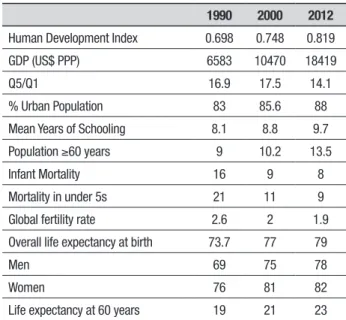
Chile has grown by 130% between 1990 and 2010 (Table 1).
he socioeconomic and health achieve-ments of the country place Chile among the high-income countries, with a GDP of US$ 21000 (IMF 2014) and health indicators com-parable with western developed countries
1Geriatrics Section, Medicine Department, Clinical University Hospital of Chile and Cognitive Neurology and Dementia Unit, Neurology Service, Hospital del Salvador,
Santiago, Chile; 2 Institute of Nutrition and Food Technology, Santiago, Chile El Líbano 5524, Macul, Santiago,Chile.
Patricio Fuentes. Av. Santos Dumont 999 – office B430 – Independencia, Santiago, Chile. E-mail [email protected]
Disclosure: The authors report no conflicts of interest.
Received September 05, 2014. Accepted in final form November 05, 2014.
and the USA. However, persistent major inequalities in wealth distribution persist with a signiicant impact on
health indicators of the elderly.7,8 he objective of this
re-view was to update the information on the problem of de-mentia in Chile, in the context of rapid population aging.
Dementia, characterized by a progressive deterio-ration in intellectual function afecting functionality, is probably the most feared and devastating disease among the problems afecting the elderly, representing a major cause of disability and dependence in older age. According to the 10/66 dementia research group, dementia is the leading cause of dependency in older
people.9,10 he mean proportion of dependency
attrib-utable to dementia is 36%, followed by limb paralysis/ weakness with 11.9% and stroke with 8.7%. In Chile,
the burden of disease study performed in 200711
identi-ied dementia as the third leading cause of DALYs lost in the 60-74y age group (25,531 DALYs lost), after cata-racts (28,350) and Ischemic Heart disease (26,506), and the second leading cause of DALYs lost in women.
he 2013 PAHO/WHO estimated prevalence of de-mentia for Latin America (standardized by European
Table 1. Human development changes in Chile.
1990 2000 2012
Human Development Index 0.698 0.748 0.819
GDP (US$ PPP) 6583 10470 18419
Q5/Q1 16.9 17.5 14.1
% Urban Population 83 85.6 88
Mean Years of Schooling 8.1 8.8 9.7
Population ≥60 years 9 10.2 13.5
Infant Mortality 16 9 8
Mortality in under 5s 21 11 9
Global fertility rate 2.6 2 1.9
Overall life expectancy at birth 73.7 77 79
Men 69 75 78
Women 76 81 82
Life expectancy at 60 years 19 21 23
GDP: gross domestic product; PPP: purchasing power parity; Q1/Q5: quintile ratio.
region population) was 8.5%12 and WHO estimates for
the high-income countries in the Southern cone of Latin America (Argentina, Chile and Uruguay) predicts a 77% increase in cases of dementia by 2030 and 134-146% for the rest of Latin America. he most common form of dementia is Alzheimer’s disease (AD) constituting 60 to
75% of dementias in the elderly.13,14
he irst available population data in Chile is derived from the WHO Age associated dementias study
con-ducted in Concepción, Chile in 1990-9215 where a crude
prevalence of 4.38 (3.57-5.33) was reported.16,17 In the
cited study, Alzheimer’s disease was the most common type of dementia, accounting for 85% of the cases. he latest population data available about dementias in the country and its contribution to the burden of disease in the elderly in Chile is from the National Survey of De-pendency (NSD) in the elderly. he NSD was conducted in 2010 in a representative sample of 4860 people 60y
and older.18 Briely, the NSD study was a cross-sectional
survey, carried out in a probabilistic sample of indepen-dent-living older adults, 60 years and older, residents of all Chilean Regions. A stratiied, multi-stage sampling design, with selection proportional to population size, was the method applied, ensuring the participation of people from both urban and rural areas. From within each municipality, sectors (and subsequently house-holds) were selected randomly. he population of 80 years and older was oversampled to allow for a more precise estimation of dependency in this growing sector of the Chilean population. he study was approved by the Institute of Nutrition and Food Technology, Univer-sity of Chile Ethics Committee. Dementia was deined using the test validated in the WHO Age associated de-mentias study in Concepción, consisting of a score<22
on the Mini-Mental State Examination (MMSE)19 and
a score>5 on the Pfefer activities questionnaire20 with
sensitivity of 94.4% (95%CI: 70.6-99.7) and speciicity
of 83.3% (95%CI: 72.3-90.7).21 Symptoms of
Depres-sion were evaluated with the Geriatric DepresDepres-sion Scale
(GDS-15)22 adopting a cut point >4 as positive screening.
he total crude prevalence of dementia in people
Table 2. Prevalence (%) of dementia by age group, in urban and rural samples and in men and women.
Dementia 60-64y 65-69y 70-74y 75-79y 80-84y ≥85y
Urban 0.94 3.9 3 8.4 17.2 29
Rural 2.6 5.1 6.9 10.6 29.7 50.4
Total 1.2 4.1 3.7 8.8 19.4 32.6
Men 1 5.9 3.6 6 18.2 24.4
Illiterate
30
20
10
0
% Dementia
≤8 ≤12 ≥13
Years of education
25.2
8.7
4.7
1.2
Figure 1. Prevalence of dementia by years of education, Chile 2010. 60y and older observed was 7.0% (women 7.7%; men
5.9%; p=0.15) and proved higher in rural than in urban samples (10.3% vs 6.3%; p=0.002 (Table 2).
In both men and women, there is a signiicant in-crease in the prevalence of dementia with increasing age (p<0.0001). he same situation was observed in both urban and rural samples (p<0.002).
Figure 1 shows a strong negative association of de-mentia with years of education (p<0.001). Dede-mentia prevalence in illiterates is 25.2% while the rate in sub-jects with ≥13 years of schooling is only 1.2%.
Table 3 shows the proportion of dependence at-tributable to dementia by gender and area of residence. Around one third of dependency is attributable to de-mentia, except among men from urban areas where the percentage is lower (27%).
he adjusted model for dementia showed no as-sociation with gender but an independent positive association with rurality and age as well as a negative association with educational level attained (Table 4). he strongest association was observed for age with an OR=10.75 for the 80y and older group in comparison with the 60-69 years-old group, followed by education (OR=2.76) in the group with less than 8 y of schooling compared to the group with 8 y or more.
In a subsample of 287 people (50% women) of Ma-puche ethnicity, a higher crude prevalence of
demen-Table 3. Dementia, dependence and proportion of dependence attributable to dementia by gender and area of residence.
Urban % Rural % Total %
Dementia 7.3 11.8 8.1
Dependence 19.5 31.0 21.5
Proportion of dependence attributable to Dementia
37.6 38.1 37.8
***Pearson: Design-based F(1. 617) P < 0.001
Men
Dementia 5.0 12.8 6.7
Dependence 16.3 33.0 19.8
Proportion of dependence attributable to Dementia
30.7 38.8 33.8
***Pearson: Design-based F(1.868) P < 0.001
Women
Dementia 8.6 11.0 9.0
Dependence 21.2 29.6 22.5
Proportion of dependence attributable to Dementia
40.6 37.2 40.0
***Pearson: Design-based F(1.868) P < 0.001
Table 4. Logistic regression model for dementia with years of education, age, gender and rurality as independent variables.
Dementia OR 95% CI p
≥8 years of education 1 Reference
< 8 years schooling* 2.76 1.54-4.94 <0.001
Age 60-69 y 1 Reference
Age 70-79y 2.56 1.32-4.98 <0.005
Age ≥80y 10.95 6.42-18.7 <0.001
Urban 1 Reference
Rural 1.42 1.00-2.01 0.045
Men 1 Reference
Women 1.17 0.77-1.79 0.460
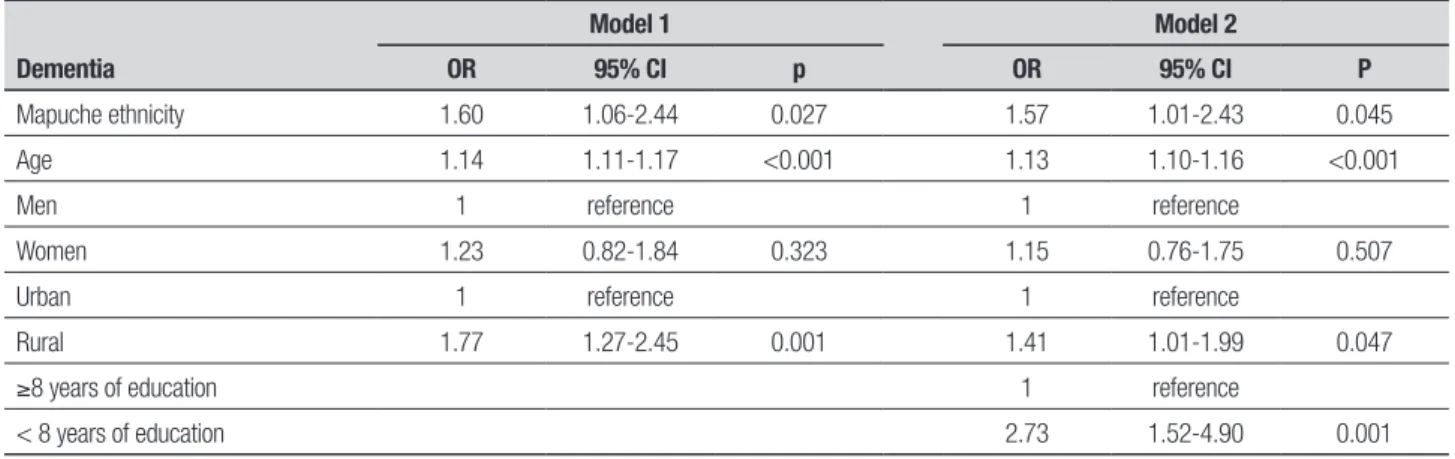
tia was found than in individuals of non-Mapuche origin (10.9% vs 6.9%, p<0.02). his association per-sisted after adjusting for age, sex and educational level (OR=1.6;95% CI 1.06-2.44) as shown in Table 5. How-ever, these results should be interpreted with caution considering that the diagnostic instruments used have not been validated in the Mapuche people.
Progress to date. Currently, there is no national strat-egy in Chile for dementia while existing governmental health programmes, such as the National Program for the Elderly or the Mental Health Program, have devoted scant attention to initiatives aimed at the healthcare of persons with dementia. Recent governments have shown no greater sensitivity to the problem and have given it only secondary priority. However, a new work-group is now in place within the Ministry of Health with the aim of creating a future National Dementia Plan. In 2002, the government established an organization called SENAMA (Servicio Nacional del Adulto Mayor) tasked with improving the quality of life for older peo-ple, taking a gerontological perspective; this institution has supported public dementia-related initiatives such as the irst Day Care Center for people with dementia
in the country, named Kintun,24 located in the
munici-pality of Peñalolen in Santiago intended for families of limited means.
Only a few private clinics or large hospitals,
concen-trated in major cities, have integral units for the diag-nosis and treatment of dementia with multidisciplinary professional teams. At the primary care level, there are basic standards and clinical guidelines for cognitive im-pairment and dementia : a screening instrument called EFAM (Functional Assessment of the Elderly) is in rou-tine use, validated for use in the local setting, which allows the detection of older adults in the community who are at risk of losing functionality in the short and medium term and enables categorization by level of
independence.23 Furthermore, since 2008 the
Preven-tive Medical Examination for the Elderly (EMPAM) has been in place, as part of the so-called GES guarantee or AUGE (80 pathologies included): this provides a com-prehensive beneits package, free and guaranteed to be delivered both in the public and private health systems; it prioritizes certain diseases, but has not yet incorpo-rated dementia despite its recognized disease burden.
At higher levels of health complexity, there are mem-ory clinics in public hospitals, where patients with
cog-90
85
80
75
70
77.9 78.6
79.8
81 82
85.9
2005-10 2010-15 2015-20 2020-25 2045-50
Years of life
2000-05
600000
500000
400000
300000
200000
100000
0
150493
2015 2020 2025 2050
Number of dementia cases
2010
181761
221523
273087
533188
Figure 2. Life expectancy at birth and estimated number of dementia cases. Chile 2002-2050
Table 5. Logistic regression model for association of dementia with Mapuche ethnicity adjusted by years of education, age, gender and rurality.
Dementia
Model 1 Model 2
OR 95% CI p OR 95% CI P
Mapuche ethnicity 1.60 1.06-2.44 0.027 1.57 1.01-2.43 0.045
Age 1.14 1.11-1.17 <0.001 1.13 1.10-1.16 <0.001
Men 1 reference 1 reference
Women 1.23 0.82-1.84 0.323 1.15 0.76-1.75 0.507
Urban 1 reference 1 reference
Rural 1.77 1.27-2.45 0.001 1.41 1.01-1.99 0.047
≥8 years of education 1 reference
nitive disorders can be examined adequately and a prob-able diagnosis reached within a reasonprob-able timeframe. However, therapeutic options are limited since it is not possible to prescribe approved anti-dementia medica-tion as a result of absence of central funding. Neither are cognitive stimulation programmes readily available, al-though there are many memory workshops at the coun-ty level for cognitively healthy individuals. Appropriate psychotropic drugs for the management of neuropsy-chiatric symptoms are equally diicult to prescribe un-der the public system. In general, people with dementia experiencing signiicant behavioural change have poor access to inpatient care in public hospitals. here are vir-tually no health structures that can be classed as acute psychogeriatrics units, and the only public hospital in the country specializing in older adults, the Geriatrics National Institute, has major limitations in physical and human resources.
It is noteworthy that the diagnosis and treatment of patients with dementia is mainly carried out by neu-rologists and geriatricians and only a very small propor-tion are diagnosed by psychiatrists. Addipropor-tionally, in re-cent years there has been little interest in the study and management of mental disorders in the elderly within specialist training, despite the obvious increase in prev-alence of these diseases.
here are about 1700 long-term care homes; half of them concentrated in the capital and a third
infor-mal.25 Most are private and others, run by religious or
philanthropic organizations, receive some support from the state. It is clear that the majority of patients with advanced dementia are being cared for by relatives. Day hospitals and day-care centers for patients with cogni-tive disorders are scarce.
Chile has only three or four research centres in neu-roscience applied to neurodegenerative diseases (the University of Chile, the Catholic University and the Uni-versity of Concepcion) able to compete internationally. Moreover, in the last decade, the country has become an important platform in Latin America for conducting clinical trials with new anti-dementia drugs at various stages of development. A signiicant contribution re-garding training, management and care is provided by the relevant scientiic societies and the local association of family volunteers (Corporación Alzheimer Chile). he Society of Neurology, Psychiatry and Neurosurgery of Chile as well as the Society of Geriatrics and Geron-tology of Chile collaborate in various workgroups and provide training and information to professionals and community representatives through courses, publica-tions and media campaigns highlighting the enormous
challenges Chilean society is set to face in the near fu-ture. For 20 years or so, the Corporation Alzheimer Chile, ailiated with Alzheimer’s Disease International, has provided education, medical care and psychological support to families and caregivers, particularly those on low incomes.
here is growing interest in incorporating psychoge-riatric training on cognitive impairment and dementia into under and postgraduate curricula of health profes-sions in most academic institutions, both public and private. In the short-term, this is expected to reverse the current low level of training of both professionals and non-professionals providing mental health care to older adults.
Chile is facing an ageing population and conse-quently a steep increase in the incidence and prevalence of dementia, a problem typical of developed countries. However, the dementia challenge is being faced by a system applying standards more typically encountered in developing countries. Socioeconomic inequality and the structure and dynamics of the country’s healthcare system prevent delivery of quality care to the majority
of those afected by dementia.8 Hence, even small
im-provements in the various agencies and systems will lead to important redress in the medium term.
Current key needs. he increasing health problems in ag-ing societies pose large potential demand for health ser-vices and expose Ministries of health in Latin America to a signiicant increase in the health-care budget. he enormous cost of the disease is a challenge for health systems given the predicted increase in prevalence. he accelerated aging of the Chilean population, particularly the group of 80y and older, and the growing number of cases of dementia reported poses a huge challenge to the country. It is imperative to anticipate the growing and urgent demand for a particularly vulnerable group often forgotten and discriminated.
People with dementia live for many years after the irst symptoms of the disease. With appropriate sup-port many of them can and should be able to continue participating and contributing to society and to have a good quality of life. In this context, early detection of the disease and the design of programmes aimed at combat-ting reversible risk factors while stimulacombat-ting protective factors should be a priority for the public health policies in the country.
matter of national priority. Also, qualiied staf and in-vestment in infrastructure and technology will be vital to achieve earlier diagnosis and more efective future therapeutic interventions.
Optimum coordination of social and support net-works leveraging the existing community will also be crucial for families and caregivers. All these interven-tions of urgent implementation must be synchronized with a change in social culture toward greater inclusion of the frail and reducing stigmas.
Finally, interventions aimed at caring for people with dementia are required urgently. Although the pro-portion of elders living alone remains low (15%), the changing patterns of the population structure will im-pact living arrangements in the future, with a substan-tial reduction in family size and consequently, in the availability of family caregivers. Dementia is stressful for caregivers, who need proper support from the inan-cial, legal, social and health systems.
In the NSD, a high burden of care was associated with
dementia of the care-recipient and low social support to the caregiver. he high burden of caregivers is a cause of concern. When caregiving is performed under conditions of poverty, without breaks, training and resources for care along with a lack of institutional or social support, there is a high risk of associated morbidity as a result of caregivers missing out on preventive health programmes (mammogram, pap smear, etc.), increased depression rates and decreased immunity. he risk of neglect and abuse is also increased with an overwhelmed caregiver.
he process of population ageing in developing coun-tries has important economic and social consequences. Our societies are getting older faster than developed nations, but in a context of poverty, unequal economic distribution and gender inequality. To face these chal-lenges, timely and integral social policies for pensions, housing and healthcare are required.
Support. Research related to this paper was funded by Fondecyt grant Nº 1130947.
REFERENCES
1. Albala C, Vio F. Epidemiological transition in Latin America: the case of Chile. Public Health 1995;109:431-442.
2. Albala C, Vio F, Kain J, Uauy R. Nutrition transition in Latin America: the case of Chile. Nutrition Rev 2001;59:170-176.
3. Instituto Nacional de Estadísticas INE Chile. Estimaciones y proyeccio-nes de población por sexo y edad. Total pais 1950-2050. INE F/Chi 1.92. INE 1995.
4. Instituto Nacional de Estadísticas INE Chile. Población País y Regiones. Actualización 2002-2012 – Proyección 2013-2020. INE 2014. Available at http://www.INE.cl
5. Palloni A, Pinto-Aguirre G, Pelaez M. Demographic and health condi-tions of ageing in Latin America and the Caribbean. Int J Epid 2002; 31:762-771.
6. United Nations. World Population Prospects, The 2010 Revision (Popu-lation Division). New York. UN 2010.
7. Albala C, Sánchez H, Lera L, Angel B, Cea X. Efecto sobre la salud de las desigualdades socioeconómicas en el adulto mayor. Resulta-dos basales del estudio expectativa de vida saludable y discapacidad relacionada con la obesidad (Alexandros). Rev Med Chile 2011;139: 1276-1285.
8. Gitlin LN, Fuentes P. The republic of Chile: an upper middle-country at the crossroads of economic developments and aging. Gerontologist 2012;52:297-305
9. Sousa RM, Ferri CP, Acosta D, et al. Contribution of chronic diseases to disability inelderly people in countries with low and middle incomes: a 10/66 DementiaResearch Group population-based survey. Lancet 2009;374(9704):1821-30.
10. Sousa RM, Ferri CP, Acosta D, et al. The contribution of chronic dis-eases to the prevalence ofdependence among older people in Latin America, China and India: a 10/66 Dementia Research Group popula-tion-based survey. BMC Geriatr 2010;6:10:53.
11. Ministerio de Salud de Chile. Estudio de carga de enfermedad y carga atribuible, Chile 2007. MINSAL 2007.
12. OPS/OMS. Demencia una prioridad de salud pública. Washington, D.C. OPS 2013.
13. Evans DA, Funkenstein HH, Albert MS, et al. Prevalence of Alzheimer’s Disease in a Community Population of Older Persons Higher Than Pre-viously Reported. JAMA 1989;262:2551-2556.
14. Prince M. Epidemiology of dementia. Psychiatry 2004;3:11-13. 15. Amaducci L. Baldereschi M, Amato MP, et al. The World Health
Organi-zation: cross-national research program on age-associated dementias. Aging 1991;3:89-96.
16. Albala C, Quiroga P, Klaasen G, Rioseco P, Pérez H, Calvo C. Preva-lence of dementia and cognitive in Chile (abstract 483). Conf Proc World Congr Gerontol, Adelaide, 1997.
17. Nitrini R, Bottino CM, Albala C, et al. Prevalence of dementia in Latin America: a collaborative study of population-based cohorts. Int Psycho-geriatr 2009;21:622-630.
18. SENAMA 2010. Estudio Nacional de la Dependencia en las Personas Mayores. Impresores Grafica Puerto Madero, Chile. Retrieved from http://www.senama.cl/filesapp/Estudio_dependencia.pdf.
19. Folstein MF, Folstein SE, McHugh PR. Mini-mental state. A practical method for grading the cognitive state of patients for the clinician. J Psychiatr Res 1975;12:189-98.
20. Pfeffer RI, Kurosaki TT, Harrah CH, Chance JM, Filos S. Measurement of functional Activities in older adults in the community. J Gerontol 1982; 37:323-9.
21. Quiroga P, Albala C, Klaassen G. Validación de un test de tamizaje para el diagnóstico de demencias en Chile. Rev Méd Chile 2004;132: 467-478.
22. Sheikh JI, Yesavage JA. Geriatric Depression Scale (GDS): Recent evidence and development of a shorter version. Clin Gerontol 1986;5: 165-172.
23. Albala C, Icaza G, Vío F, et al. A short test to evaluate cognitive impair-ment based on Folstein’s MMSE. Gerontology 2001;47(S1):S183 24. Gobierno de Chile. KINTUN, SENAMA/Servicio Nacional del Adulto
Mayor. http://www.senama.cl/n4511_10-10-2013.html