Artigo Original
Kelly Martins1 Marília Fontenele1,2 Silva Câmara1,2 Edi Lúcia Sartorato3
Keywords
Hearing loss Aged Presbycusis Deafness Genetics
Descritores
Perda auditiva Idoso Presbiacusia Surdez Genética
Correspondence address:
Kelly Martins
R. Heraclito Domingues, 964, São Gerardo, Fortaleza (CE), Brasil, CEP: 60320-200.
E-mail: [email protected]
Received: 11/08/2012
Study carried out at the Universidade de Fortaleza – UNIFOR – Fortaleza (CE), Brazil. (1) Fundação “Edson Queiroz”, Universidade de Fortaleza – UNIFOR – Fortaleza, CE, Brazil. (2) Universidade Federal de São Paulo – UNIFESP – São Paulo, SP, Brazil.
(3) Universidade Estadual de Campinas – UNICAMP – Campinas, SP, Brazil.
Conlict of interest: nothing to declare.
sensorineural hearing loss
Estudo genético e audiológico em idosos com
perda auditiva sensorioneural
ABSTRACT
Purpose: This study aimed to correlate probable predisposing factors for sensorineural hearing loss in elderly by investigating the audiologic characteristics and frequency of mutations in genes considered responsible for non-syndromic hearing loss. Methods: Sixty elderly patients were separated into two groups: the Case Group, composed of 30 individuals, 21 females and nine males, all 60 years old or older and presenting diagnoses of sensorineural hearing loss, and the Control Group, composed of 30 elderly individuals matched to the experimental group by age and gender, presenting normal hearing. The patients underwent anamnesis and pure tone audiometry in frequencies of 250, 500, 1000, 2000, 3000, 4000 and 6000 Hz. Blood samples were collected from each patient for analysis of mutations in nuclear and mitochondrial genes related to non-syndromic sensorineural hearing loss. Results: It was observed a greater tendency to noise exposure and consumption of alcohol in the Case Group. The statistically signiicant symptoms between the groups were tinnitus and hearing dificulty in several situations as: silent environment, telephone, television, sound location and in church. All the individuals of Case Group presented sensorineural and bilateral hearing loss. The symmetry and progression of the hearing impairment were also statistically signiicant between the groups. No genetic mutations were identiied. Conclusion: The most reported symptoms were communication dificulties and tinnitus. The predominant auditory characteristics included sensorineural, bilateral, progressive and symmetrical hearing loss. It was not evidenced a relationship between sensorineural hearing loss in elderly and genes considered responsible for non-syndromic hearing loss as no genetic mutation was found in this study.
RESUMO
INTRODUCTION
Life expectancy has increased throughout the world over the past several decades. According to the World Health Organization-WHO(1), elderly people are those aged over
65 years; however, this reference age is valid for developed countries. In developing countries, such as Brazil, the age that deines elderly people is 60 years. In Brazil, elderly popula-tion has increased by 70%, from 1980 to 1999, an increase of six million people aged at least 60 years old and, in 2000, the elderly population reached 14,536,029, representing 8.6% of the total Brazilian population(2).
Throughout the natural aging process, many changes occur in several systems of the body, including the auditory system. Aging of the hearing system includes changes to the ear (outer, middle and inner), auditory pathways in the central nervous system and, especially, the degeneration of cochlear hair cells, which usually causes the hearing loss associated with aging(3). According to the World Health
Organization(1), in 2001, more than 15 million Brazilians had
a hearing problem and only 40% of the affected individuals were aware of the disease. Elderly individuals compose an important subset of those affected with hearing problems, and they are the focus of this study.
Hearing loss associated with aging is called presbycusis and presents in a sensorineural manner, either as a progres-sive or bilateral form, that initially affects hearing of high frequencies(4). Presbycusis generally occurs in individuals over
60 years old and the likelihood of development increases sig-niicantly with age. Additionally, presbycusis is more common in males than in females(5). It can lead to serious dificulties
in oral communication for elderly individuals because people with presbycusis exhibit decreased in hearing sensitivity and a decline in speech intelligibility, reducing their social contacts and greatly reducing quality of life(6).
Despite the high prevalence of presbycusis, it is dificult to prevent, the underlying cause is unknown, and there is no way to reverse the hearing deicit. Some authors have indicated that both endogenous factors, such as heredity or disease (for example: diabetes and hypertension) and exogenous factors, such as nutrition, stress, and exposure to noise, may inluence non-syndromic hearing loss(7).
Some studies have also identiied several new mutations in genes responsible for non-syndromic hearing loss, includ-ing GJB2, GJB6 and mitochondrial genes. Mutations in the GJB2 gene, which codiies the Conexin 26 protein (Cx26), are responsible for more than half of the cases of genetic hearing loss(8).
The relationship between mitochondrial disease and hearing loss was irst established by Petty et al.(9), in 1986, from the
study of a patient with mitochondrial myopathy and hearing loss. Diseases linked to mitochondrial DNA are passed to both sexes only by the mother and correspond to 0.5 to 1% of the genetic causes of sensorineural hearing loss(10).
Mitochondrial hearing loss can be classiied as one of two types: syndromic, when hearing loss is related to a clinical multiple frame (often severe), and non-syndromic, which occurs
when the hearing loss is the only symptom, as in aminoglyco-side hypersensitivity and presbycusis(11).
Considering the previous information, this study aimed to correlate probable predisposing factors for sensorineural hear-ing loss in elderly by investigathear-ing the audiologic characteristics and frequency of mutations in genes considered responsible for non-syndromic hearing loss.
METHODS
This is a cross-sectional study conducted from August 2008 to June 2010 in the cities of Fortaleza (CE) and Campinas (SP). The research was approved by the Research Ethics Committee of Universidade de Fortaleza, by the Opinion nº 319/2005. The study followed the Resolution nº 196/96 of the National Health Council and the individuals agreed to participate by signing a Free and Informed Consent Term which described the stages of the study and its purpose.
The sample was consisted of 60 elderly patients randomly selected in the city of Fortaleza (CE). The average age of the individuals was 75.2 years, ranging between 61 and 85 years old, and 42 (70%) were female and 18 (30%) were male. The elderly were separated into two groups: the Case Group con-tained 30 individuals, 21 females and nine males, aged at least 60 years old and presenting diagnoses of sensorineural hearing loss, and the Control Group, which contained 30 elderly indi-viduals matched to the experimental group by age and gender, presenting normal hearing.
The selected patients were referred to the Audiology Department at Universidade de Fortaleza and underwent pure tone audiometry, air and bone pathways, performed with a Grason Stadler-16 audiometer and TDH-29 headphones in an acoustically treated cab. The hearing thresholds of 250, 500, 1000, 2000, 3000, 4000 and 6000 Hz frequencies were measured for all patients to classify them in the groups. The hearing impairment was deined according to the criteria of Bureau International d’Audiophonologie (BIAP)(12). The
audiometries were analyzed and classiied according to type of hearing loss, laterality, symmetry and the progres-sive characteristic was evidenced considering the patients’ report. Individuals with neurological diseases or neoplasms were excluded from the study.
According to the inclusion criteria of both groups, the patients were sorted, and answered an audiologic anamnesis containing information on audiologic history such as fam-ily history of hearing loss, noise exposure, cranial trauma and ototoxic drugs; situations and environments of hearing dificulty; otologic history as ear pain, dizziness, tinnitus, otorrhea, nauseas, swoons and ear, throat and/or nose sur-gery; and medical history containing information on general health of the patients.
study of polymorphisms in the CDH23 gene and study of single nucleotide polymorphisms (SNPs) in the KCNE1, KCNQ1 and KCNQ4 genes. The A1555G mitochondrial mutation and the deletion mtDNA4977 were also investigated.
The Two Proportions Equality Test, which compares if the proportion of responses of two speciic variables and/or their levels are statistically signiicant, was used for statistical analysis. The signiicance level in this study was set at 0.05 (5%) and the result of each comparison is reported as p-value statistic. Statistically signiicant results were indicated with the symbol (*) and results tending to be signiicant were indicated with the symbol (#). The symbol (-x-) was used when it was not possible to apply the test.
RESULTS
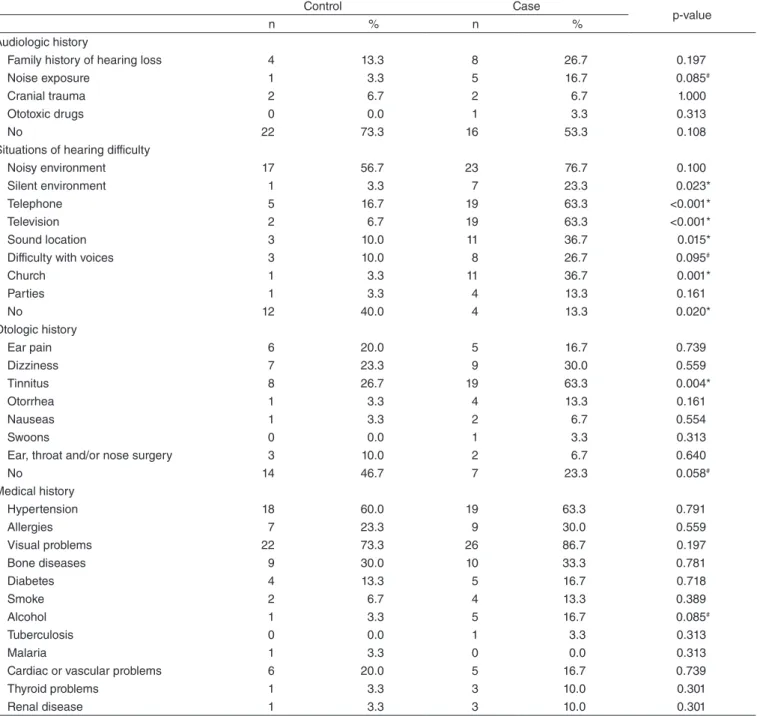
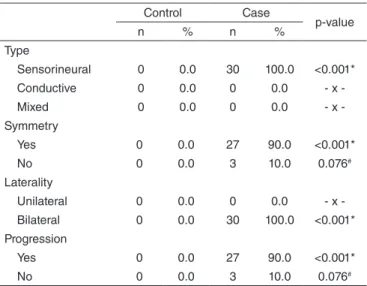
The data gathered in this study are presented in Tables 1 to 3. The statistically signiicant results are properly evidenced in the tables.
DISCUSSION
The age related hearing loss is a complex disorder, in-luenced by genetic, lifestyle, environmental and stochastic factors(13). According to the audiologic history obtained in our
study (Table 1), there was a greater tendency to noise exposure in patients of Case Group. Previous studies have indicated that
Table 1. Data related to audiologic anamnesis
Control Case
p-value
n % n %
Audiologic history
Family history of hearing loss 4 13.3 8 26.7 0.197
Noise exposure 1 3.3 5 16.7 0.085#
Cranial trauma 2 6.7 2 6.7 1.000
Ototoxic drugs 0 0.0 1 3.3 0.313
No 22 73.3 16 53.3 0.108
Situations of hearing difficulty
Noisy environment 17 56.7 23 76.7 0.100
Silent environment 1 3.3 7 23.3 0.023*
Telephone 5 16.7 19 63.3 <0.001*
Television 2 6.7 19 63.3 <0.001*
Sound location 3 10.0 11 36.7 0.015*
Difficulty with voices 3 10.0 8 26.7 0.095#
Church 1 3.3 11 36.7 0.001*
Parties 1 3.3 4 13.3 0.161
No 12 40.0 4 13.3 0.020*
Otologic history
Ear pain 6 20.0 5 16.7 0.739
Dizziness 7 23.3 9 30.0 0.559
Tinnitus 8 26.7 19 63.3 0.004*
Otorrhea 1 3.3 4 13.3 0.161
Nauseas 1 3.3 2 6.7 0.554
Swoons 0 0.0 1 3.3 0.313
Ear, throat and/or nose surgery 3 10.0 2 6.7 0.640
No 14 46.7 7 23.3 0.058#
Medical history
Hypertension 18 60.0 19 63.3 0.791
Allergies 7 23.3 9 30.0 0.559
Visual problems 22 73.3 26 86.7 0.197
Bone diseases 9 30.0 10 33.3 0.781
Diabetes 4 13.3 5 16.7 0.718
Smoke 2 6.7 4 13.3 0.389
Alcohol 1 3.3 5 16.7 0.085#
Tuberculosis 0 0.0 1 3.3 0.313
Malaria 1 3.3 0 0.0 0.313
Cardiac or vascular problems 6 20.0 5 16.7 0.739
Thyroid problems 1 3.3 3 10.0 0.301
Renal disease 1 3.3 3 10.0 0.301
factors responsible for sensorineural hearing loss in elderly include the physiological processes of aging, endogenous factors, and environmental causes (exogenous factors)(14,15).
Noise is the most studied and best documented environmental factor causing hearing loss. However, after a lifetime of noise exposure, it is dificult to distinguish between noise induced hearing loss and wage related hearing loss, audiometrically as well as anatomically(13).
Studies have demonstrated that hearing loss has a negative effect on the functional status, on quality of life, on cognitive function, and on the emotional, behavioral and social well-being of the elderly(16). In the situations of hearing dificulty (Table 1),
we identiied a statistically signiicant difference between the groups in several variables: silent environment, telephone, television, sound location and in church. Dificulties in daily routine can be explained by studies that have revealed a decrease in hearing sensitivity and a reduction in speech intelligibility in individuals with presbycusis(6,15,17).
Tinnitus is the subjective perception of sound in the absence of external sound sources. It is deined as a disorder that pro-duces extreme discomfort and it is dificult to characterize, treat
and, according to its severity, can exclude affected individuals from their normal social life(18). Some studies(19,20) have also
reported that tinnitus is often followed by development of a hearing deicit. This inding was also observed in our study, as tinnitus showed a statistically signiicant difference between the two patient groups (Table 1).
Some studies previously identiied a signiicant relation-ship between alcohol use and hearing loss(21-23). According
to the medical history provided (Table 1), it was observed a greater tendency to alcohol ingestion among the patients of Case Group. Although this relationship between alcoholism and hearing loss has been studied, it remains contradictory due to the fact that the hearing deicit is often associated with age.
Previously published literature indicates that hearing loss in elderly is characterized by sensorineural hearing loss(3,4,24)
and presents in a bilateral and progressive form, worsening with age(5,25,26). In this study (Table 2), all patients in the Case
Group presented with sensorineural bilateral hearing loss and reported progressive characteristics, agreeing with published data. A symmetric audiometric characteristic has also been observed in some studies(4,26,27), in agreement with data from our
study, in which 90% of the Case Group individuals presented symmetry in their audiometric curves.
It is estimated that over 100 genes are potentially involved in non-syndromic deafness(28). Mutations in the GJB2 gene have
been potentially linked to many cases of hearing loss(8,29). This
gene is involved in both recessive and dominant forms of non-syndromic hearing loss and the most frequent mutation found in this gene is the 35delG(28). In cases lacking mutations in the GJB2
gene or in heterozygotes for 35delG, mutations in the GJB6 gene (Cx30) may be responsible for the development of hearing loss, as it exhibits a close relationship to GJB2 (about 76% of identi-cal amino acids) and its proximity to the chromosomal location of the Cx26 gene, receiving the same designation of Cx26(30).
This high prevalence reveals the importance of genetic re-search on investigation of deafness, contributing substantially to determine an accurate diagnostic and an appropriate treatment to the hearing impairment. Nevertheless, it was not identiied any genetic mutations related to non-syndromic hearing loss in this study (Table 3).
The sensorineural hearing loss is a multifactorial disorder; therefore, more studies are extremely important in order to in-vestigate the real inluence of those factors in the susceptibility of hearing loss in the elderly. Certainly, our small sample does not permit generalization of the indings in the study, however, provides important information to guide further researches on hearing impairment in the elderly.
CONCLUSION
In agreement to the indings, the most reported symptoms were communication dificulties and tinnitus. The predominant auditory characteristics included sensorineural, bilateral, sym-metrical and progressive hearing loss. It was not evidenced a relationship between sensorineural hearing loss in elderly and genes considered responsible for non-syndromic hearing loss as no genetic mutation was found in this study.
Table 3. Data related to investigated mutations
Genetic mutations Control Case p-value
n % n %
35delG (GJB2) 0 0 0 0 x
-Deletion D(GJB6-D13S1830) 0 0 0 0 x
-Deletion D(GJB6-D13S1854) 0 0 0 0 x
-Polymorphisms in gene CDH23 0 0 0 0 x
-Mitochondrial mutation A1555G 0 0 0 0 x
-Deletion MtDNA4977 0 0 0 0 x
-Legend: - x - = impossible to apply Two Proportions Equality Test
Table 2. Data related to audiologic characteristics
Control Case
p-value
n % n %
Type
Sensorineural 0 0.0 30 100.0 <0.001*
Conductive 0 0.0 0 0.0 - x -
Mixed 0 0.0 0 0.0 x
-Symmetry
Yes 0 0.0 27 90.0 <0.001*
No 0 0.0 3 10.0 0.076#
Laterality
Unilateral 0 0.0 0 0.0 x
-Bilateral 0 0.0 30 100.0 <0.001*
Progression
Yes 0 0.0 27 90.0 <0.001*
No 0 0.0 3 10.0 0.076#
*p-value statistically significant; #p-value next to acceptance limit, tending to be significant; Two Proportions Equality Test
ACKNOWLEDGMENTS
We would like to thank the participants and the National Council of Technological and Scientiic Development – CNPq – for the collaboration in this study.
*KVCM performed the data collection; analysis of results and writing of scientiic article; MFSC guided all the stages of the study; ELS performed the genetic analysis of the study.
REFERENCES
1. WHO: World Health Organization. International classification of functioning, disability and health. Geneva: World Health Organization; 2001.
2. IBGE: Instituto Brasileiro de Geograia e Estatística [Internet]. Censo Demográico 2000 [cited 11 Mar 2011]. Available from: http://www. ibge.gov.br/home/
3. Batista FP, Rezende GM, Vaz RN, Mitre EI. Análise Comparativa do Índice de Reconhecimento de Fala (IRF) em Pacientes Presbiacúsicos com e sem Recrutamento. Rev CEFAC. 2006;8(2):230-4.
4. Sanchez-Legaza E, Ciges JM, Gonzalez PM, Miranda CJI. Recruitment in presbycusis. An Otorrinolaringol Ibero Am.2006;33(2):183-91. 5. Greco MC, Russo ICP. Achados audiológicos de indivíduos idosos
atendidos em uma clínica particular de São Paulo-SP. Acta ORL. 2006;24(4):245-54.
6. Russo ICP. A intervenção fonoaudiológica na terceira idade. 5ª ed. Rio de Janeiro: Revinter; 1999.
7. Oeken J, Lenk A, Bootz F. Inluence of age and presbyacusis on DPOAE. Acta Oto-Laryngol.2000;120(3):396-403.
8. Salvinelli F, Cassale M, D’ascanio L, Firrisi L, Greco F, Baldi A. Hearing loss associated with 35delG mutation in connexin 26 (GJB2): audiogram analysis. J Laryngol Otol. 2004;118(1):8-11.
9. Petty RKH, Harding AE, Morgan-Hughes JA. The clinical features of mitochondrial myopathy. Brain.1986;109(5):915-38.
10. Tekin M, Arnos KS, Pandya A. Advances in hereditary deafness. Lancet. 2001; 358(9287):1082-90.
11. Carvalho MFP, Ribeiro FAQ. As deiciências auditivas relacionadas às alterações do DNA mitocondrial. Rev Bras Otorrinolaringol. 2002;68(2):268-75.
12. BIAP: Bureau International d’Audiophonologie [Internet]. BIAP Recommendation 02/1 bis. Audiometric Classification of Hearing Impairment; 1996 [cited 2013 Mar 17]. Available from: http://www.
biap.org/en/recommendations/65-ct-2-classification-des-surdites/5-recommandation-biap-021-bis
13. Liu XZ, Yan D. Aging and hearing loss. J Pathol. 2007;211(2):188-97. 14. Mazurek B, Stöver T, Haupt H, Gross J, Szczepek A. Pathogenesis and
treatment of presbyacusis: current status and future perspectives. HNO. 2008;56(4):429-32, 434-5.
15. Viude A. Fatores associados à presbiacusia em idosos [Tese]. São Paulo: Universidade de São Paulo; 2002.
16. Mulrow CD, Aguilar C, Edicott JE, Vélez R, Tuley MR, Charlip WS, et al. Association between hearing impairment and the quality of life of elderly individuals. J Am Geriatr Soc. 1990;38(1):45-50.
17. Bess FH, Williams AH, Lichtenstein MJ. Avaliação audiológica dos idosos. In: Musiek FE, Rintelmann WF, organizadores. Perspectivas atuais em avaliação auditiva. Barueri: Manole; 2001. p. 343-70. 18. Dias A, Cordeiro R, Corrente JE. Incômodo causado pelo zumbido
medido pelo Questionário de Gravidade do Zumbido. Rev Saúde Pública. 2006;40(4):706-11.
19. Konig O, Schaette R, Kempter R, Gross M. Course of hearing loss and occurrence of tinnitus. Hear Res.2006;221(1-2):59-64.
20. Zagolski O. Tinnitus in elderly patients. Otolaryngol Pol.2005;59(1):91-6. 21. Rossi AG, Bellé M, Sartori SA. Avaliação audiológica básica em
alcoólicos. Rev Ci Med Biol. 2006;5(1):21-8.
22. Ribeiro SBA, Jacob-Corteletti LCB, Alvarenga KF, Marques JM, Campelo RM, Tschoeke SN. Avaliação auditiva em alcoolistas abstêmicos. Rev Bras Otorrinolaringol. 2007;73(4):452-62.
23. Meneses C, Mário MP, Marchiori LLM, Melo JJ, Freitas ERFS. Prevalência de perda auditiva e fatores associados na população idosa de Londrina, Paraná: estudo preliminar. Rev CEFAC. 2010;12(3):384-92. 24. Silva BSR, Sousa GB, Russo ICP, Silva JAPR. Caracterização
das queixas, tipo de perda auditiva e tratamento de indivíduos idosos atendidos em uma clínica particular de Belém-PA. Arq Int Otorrinolaringol. 2007;11(4):387-95.
25. Huang T. Age-related hearing loss. Minn Med. 2007;90(10):48-50. 26. Amaral LCG, Sena APRC. Peril audiológico dos pacientes da terceira
idade atendidos no Núcleo de Atenção Médica Integrada da Universidade de Fortaleza. Fono Atual. 2004;7(27):58-64.
27. Magalhães AT, Gofi-Gomez MVS. Índice de reconhecimento de fala na Presbiacusia. Arq Int Otorrinolaringol. 2007;11(2):169-74.
28. Pfeilsticker LN, Stole G, Sartorato EL, Delino D, Guerra ATM. A investigação genética na surdez hereditária não-sindrômica. Rev Bras Otorrinolaringol. 2004;70(2):182-86.
29. Schmidt PMS, Tochetto TM. Investigação genética da surdez hereditária: mutação do gene da Conexina 26. Rev Soc Bras Fonoaudiol. 2009;14(1):142-7.