Original Article
Artigo Original
CoDAS 2015;27(5):433-6 Adriana Neves de Andrade1,2
Mariane Richetto da Silva1,2 Maria Cecilia Martinelli Iorio1,2 Daniela Gil1,2
Keywords
Hearing Tests Auditory Cortex Speech Discrimination Tests Educational Status Auditory Perception
Descritores
Testes Auditivos Córtex Auditivo Testes de Discriminação de Fala Escolaridade Percepção Auditiva
Correspondence address:
Adriana Neves de Andrade, Departamento de Fonoaudiologia Universidade Federal de São Paulo Rua Botucatu, 802, Vila Clementino, São Paulo (SP), Brasil, CEP: 04023-900. E-mail: [email protected]
Received: 11/26/2014
Accepted: 04/22/2015
Study carried out at the Integrated Center for Assistance, Research and Education in Hearing, Hearing Disorders discipline, Speech-Language Pathology and Audiology Department, Universidade Federal de São Paulo – UNIFESP – São Paulo (SP), Brazil.
(1) Graduate Program of Human Communication Disorders, Speech-Language Pathology and Audiology ield, Universidade Federal de São Paulo – UNIFESP – São Paulo (SP), Brazil.
(2) Speech-Language Pathology and Audiology Department, Universidade Federal de São Paulo – UNIFESP – São Paulo (SP), Brazil.
Financial support: Fundação de Amparo à Pesquisa do Estado de São Paulo – FAPESP.
Conlict of interests: nothing to declare.
Inluence of the educational status on the Dichotic
Sentence Identiication test in Brazilian Portuguese
Inluência do grau de escolaridade no teste de Identiicação
de Sentenças Dicóticas em Português Brasileiro
ABSTRACT
Purpose: To compare the performance of the Dichotic Sentence Identiication (DSI) test in the Brazilian Portuguese version, considering: the right and left ears and the educational status in normal-hearing individuals.
Methods: This investigation assessed 200 individuals who are normal listeners and right-handed and were divided into seven groups according to the years of schooling. All the participants underwent basic audiologic evaluation and behavioral auditory processing assessment (sound localization test, memory test for verbal and nonverbal sounds in sequence, dichotic digits test, and DSI). Results: The evaluated individuals revealed an average educational status of 13.1 years and results within normal limits in the selected tests for the audiologic and auditory processing assessments. Regarding the DSI test, the educational status showed a dependent relationship with the percentages of correct answers in each stage of the test and the evaluated ear. There was a statistically signiicant positive correlation between the educational status and the percentage of correct answers for all the stages of the DSI test in both the ears. There was also an effect of the educational level on the results obtained in each condition of the DSI test, with the exception of directed attention to the right ear.
Conclusions: Comparing the performance considering the variables studied in the DSI test, we concluded that there is an advantage of the right ear and that, the better the educational level, the better the performance of the individuals.
RESUMO
Objetivo: Comparar o desempenho, na versão em português brasileiro, do teste de identiicação de sentenças dicóticas (DSI) entre: as orelhas direita e esquerda e escolaridade em indivíduos audiologicamente normais.
Métodos: Foram avaliados 200 indivíduos normouvintes, destros, separados em sete grupos de acordo com os anos de escolaridade.Todos os sujeitos foram submetidos à audiológica básica e comportamental do processamento auditivo (teste de localização sonora, teste de memória para sons verbais e não verbais em sequência, teste dicótico de dígitos e DSI). Resultados: Os sujeitos avaliados apresentaram média de escolaridade de 13,1 anos e resultados adequados nos testes selecionados para a avaliação audiológica e do processamento auditivo. Em relação ao teste DSI, a escolaridade teve relação de dependência com as porcentagens de acertos em cada etapa do teste e com a orelha avaliada. Houve correlação positiva estatisticamente signiicante entre a escolaridade e a porcentagem de acertos para todas as etapas do teste DSI em ambas as orelhas. Também houve efeito do grau de escolaridade nos resultados obtidos em cada etapa do teste DSI, com exceção da etapa de escuta direcionada à direita. Conclusões: Na comparação do desempenho considerando as variáveis estudadas no teste DSI, concluiu-se que: há vantagem da orelha direita e quanto maior o nível educacional, melhor o desempenho dos indivíduos.
434 Andrade AN, Silva MR, Iorio MCM, Gil D
CoDAS 2015;27(5):433-6 INTRODUCTION
The behavioral evaluation of the auditory processing is carried out with special hearing tests designed to infer the per-formance of the individuals in adverse hearing situations. The good performance in these situations may relect the integrity of the physiological auditory mechanisms, which, in turn, are essential in the acoustic processing of the auditory informa-tion, in the perception of the speech, and in the learning and comprehension of the language(1).
The studies made to investigate the central auditory skills identiied that the hearing tests may be inluenced by some factors, among which the peripheral hearing loss(2-4), age(3-5),
educational status and cognitive resources(6), handedness(7),
sustained attention skills(8), and linguistic processing stand out.
To try to minimize the impact of some of these variables, several hearing tests were designed; among them, the Dichotic Sentences Identiication (DSI) test(2). The DSI test is a dichotic
listening test of high redundancy and predictability, which was elaborated with the purpose of evaluating individuals with peripheral hearing loss. The DSI has three versions: English(2),
Australian English(9), and Brazilian Portuguese(10).
The special tests are used to investigate the listening skills, and when there is a dificulty to perform these procedures, it can be said that there is an auditory processing disorder (APD). The APD can appear as a single entity or coexist with other alterations, such as learning disabilities. The impairment of learning skills is not limited to the listening skills(11).
Currently, the majority of the hearing tests that are used to assess the auditory processing have normality criteria es-tablished for age and handedness(12). However, because the
educational level can inluence directly the results obtained in these tests, a careful analysis according to this variable is necessary. Thus, the aim of this study was to compare the per-formance in the Brazilian Portuguese version of the DSI test between: the right and left ears and the educational status in normal-hearing individuals.
METHODS
This study was analyzed and approved by the Research Ethics Committee under the process no. 0322/07 and received inancial support from Fundação de Amparo à Pesquisa do Estado de São Paulo (FAPESP). The partici-pants were volunteers, recruited for the participation in the research from brochures, posting on the web and/or verbal invitation from the researchers. For the participation in the survey, the following inclusion criteria were listed: age group between 13 and 49 years old, both genders, luent reading regardless of educational status, right-handedness (score in the hand dominance test of Edinburgh(13,14) ≥50),
auditory thresholds of up to 25 dBHL in all evaluated sound frequencies (250 to 8000 Hz), type A tympanometric curve (compliance values between 0.3 and 1.6 ml and pressure peak between ±100 daPa), presence of contralateral stape-dial acoustic relexes (difference between 70 and 90 dB), adequacy in the tests of sound localization (4/5 correct
answers), memory for verbal and nonverbal sounds in se-quence (2/3 correct answers) and dichotic digit (≥95% of correct answers). We excluded the individuals who showed reading dificulties, score <50 points in the Edinburgh Handedness Inventory(13,14), hearing loss, alteration in the
ossicular eardrum mobility and/or in the tests to assess auditory processing.
The participants were 200 individuals (adolescents and young adults), right-handed, normal listeners, matched by genre (100 men and 100 women, in the age group between 13 and 49 years old (mean age 29.7 years)), and inhabitants of the metropolitan region of São Paulo – SP.
All the individuals answered questions regarding their level of formal education and, from this information, were divided into seven groups, considering the years of schooling com-pleted: three to seven years (n=14), eight years (n=10), nine to ten years (n=10), 11 years (n=42), 12 to 15 years (n=64), 16 years (n=36), and 17 years or more (n=24). This distribu-tion of the groups was done according to the methodological model adopted by IBGE (Brazilian Institute of Geography and Statistics) for the Brazilian census(15).
After these procedures, the DSI(10) test was applied at
50 dBSL, in four situations: training, binaural integration, direct-ed attention to the right ear, and directdirect-ed attention to the left ear. In all the stages of the test, the evaluated individual heard two simultaneous sentences, one in each ear. For the binaural integration stages (training and binaural integration), the indi-vidual was asked to indicate both the sentences presented. For the directed attention stages (right and left ears), the individual should just indicate the sentence presented on the ear that he or she should pay attention to.
The DSI was applied in a soundproof booth, using the following equipment: a Grason-Stadler audiometer, GSI-61 model, supra-aural headphones, TDH-50P model, and a Philips discman with MP3, Expanium model, volume 30.
For the statistical analysis of the results, we used as instru-ments the Minitab version 15 and the SPSS version 11 and adopted the hypothesis test with a 0.05 signiicance level. The results were analyzed with descriptive measures and inferential analysis (analysis of covariance and variance with repeated measures, Spearman’s correlation coeficient, Kruskal-Wallis test, and Bonferroni method).
RESULTS AND DISCUSSION
The mean age of the individuals in the study was 29.7 years and mean educational status was 13.1 years. The covariance analysis, carried out at the DSI test, pointed out that the edu-cational status showed a dependent relationship with the dif-ference between the mean percentages of correct answers in each stage of the test (p=0.009*) and with the assessed ear (p=0.009*). There was a statistically signiicant positive correlation between educational status and the percentage of correct answers for all stages of the DSI test, for the right and left ears (Table 1).
435
Inluence of the educational status on the DSI test
CoDAS 2015;27(5):433-6
answers increased following the increasing level of schooling (Figures 1 to 3).
The difference in performance between the right and left ears in the administration of dichotic listening tests may occur because of the inluence of the brainstem nuclei in the efferent regulation of other high cortical structures. During the dichotic presentation of a speech signal, the signals directed for the nondominant hemisphere are partially degraded by the circuits of the dominant hemisphere(16), thus demonstrating the existing
functional hemispheric differences(17).
There was an interaction effect between the stages of the test and ear according to the educational level for the degrees of schooling of 11 years and 12 to 15 years (Table 2).
The lack of signiicance between the stage of the test and ear in the participants with higher educational status leads us to believe that individuals with high literacy use the resources of memory and cognitive skills more eficiently. Thus, the good perception of the speech signal, regardless of the stage of the test, would be the result of the reception, storage, and retrieval of the presented auditory information(18).
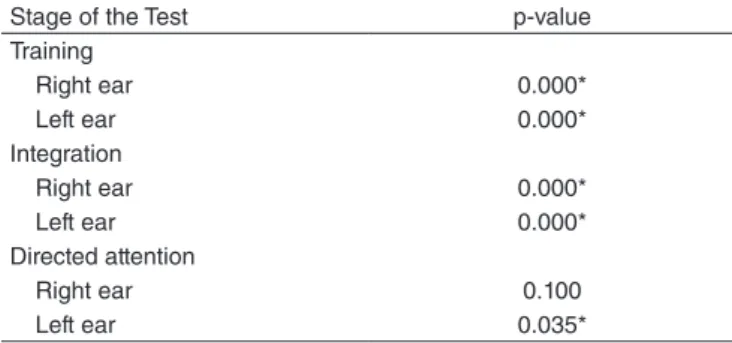
The individuals, on average, showed lower performance in the stage of training, followed by binaural integration and the directed attention stage. In addition, there was an effect, statistically signiicant, of the level of education on the results obtained in the training and binaural integration stages for the right and left ears and the stage of directed attention only to the left ear (Table 3).
The high performance in the directed attention stages in the dichotic listening tests, when compared with the binaural integra-tion stage, has been reported previously(19). The studies have shown
that the dificulties observed in the stages of binaural integration, in dichotic listening tests, may occur because of the alterations in the skills of attention and/or working memory(20). The inluence of
the educational status on the performance on the test was already expected because, in general, people with high educational level are in high professional positions that require extensive use of attention and other cognitive processes, and this demand in the information processing could also be relected in the listening skills.
Although the auditory processing is extensively studied in children, adolescents and adults with auditory sensibility within normal limits and complaints in the auditory perception(1),
there is a lack of studies addressing the relationship between the performance of the individuals and the educational status, especially in adults.
In the context of this gap, and observing indirect evidence on individuals with dificulties in school, learning disabilities(21),
and auditory processing alterations, this study, using reference
Figure 1. Diagrams of dispersion of the percentages of correct answers
in training by ear and educational status Training
Right Left
% Cor
rect ans
w
er
s
100
Educational status (years)
10 90
80
70
60
50
40
5 15 20 25 5 10 15 20 25
Figure 2. Diagrams of dispersion of the percentages of correct answers
in binaural integration by ear and educational status Binaural Integration
Right Left
% Cor
rect ans
w
er
s
100
Educational status (years)
10 90
80
70
60
50
40
5 15 20 25 5 10 15 20 25
Figure 3. Diagrams of the dispersion of the percentages of correct
answers in directed attention by ear and educational status Directed attention
Right Left
% Cor
rect ans
w
er
s
100
Educational status (years)
10 90
80
70
60
50
40
5 15 20 25 5 10 15 20 25
Table 1. Correlation between educational status and percentage of correct answers in the DSI test by ear
Stage of the test
Training RE Training LE Integration RE Integration LE DAR DAL
Educational status (years)
rs 0.29 0.31 0.28 0.37 0.20 0.17
P 0.000* 0.000* 0.000* 0.000* 0.005* 0.015*
N 200 200 200 200 200 200
436 Andrade AN, Silva MR, Iorio MCM, Gil D
CoDAS 2015;27(5):433-6
values designed for the DSI, from the educational status, aims to contribute to the detection of hearing disabilities in individuals with different levels of instruction and complaints of dificulty to process auditory information. Future research, with a focus on performance according to the educational status, with tests already used in clinical practice, should be carried out in order to make the behavioral assessment of the auditory processing more sensitive to detect small alterations in the processing of auditory information, even in individuals with a high degree of literacy. On the other hand, the establishment of normality criteria considering the educational status can also beneit indi-viduals with a low level of education that may have their audi-tory processing assessed without the inluence of this variable.
CONCLUSION
When comparing the performance considering the variables studied in the DSI test, it was possible to conclude that there is a right ear advantage and that, the higher the educational level, the better the performance of the individuals.
*ANA was responsible for elaborating the study, collection and tabulation of data, and preparing the manuscript; MRS participated in the data tabulation and preparation of the manuscript; DG and MCMI assisted in the elaboration and design of the study and in the overall orientation for the stages of implementation, supervision of the data collection, and preparation of the manuscript.
REFERENCES
1. Frota S, Pereira LD.Processamento auditivo: estudo em crianças com distúrbios da leitura e da escrita. Rev Psicopedag. 2010;27(83):214-22. 2. Fifer RC, Jerger JF, Berlin CL, Tobey EA, Campbell JC. Development
of a dichotic sentence identiication test for hearing-impaired adults. Ear Hear. 1983;4(6):300-5.
3. Buss LH, Rossi AG, Buss CH, Oliveira RC. Desempenho nas habilidades auditivas de atenção seletiva e memória auditiva em um grupo de idosos protetizados: inluência de perda auditiva, idade e gênero. Rev CEFAC. 2013;15(5):1065-72.
4. Nishihata R, Vieira MR, Pereira LD, Chiari BM. Processamento temporal, localização e fechamento auditivo em portadores de perda auditiva unilateral. Rev Soc Bras Fonoaudiol.2012;17(3):266-73. 5. Tun PA, Williams VA, Small BJ, Hafter ER. The effects of aging on
auditory processing and cognition. Am J Audiol. 2012;21(2):344-50. 6. Paulo DL, Yassuda MS. Queixas de memória de idosos e sua relação com
escolaridade, desempenho cognitivo e sintomas de depressão e ansiedade. Rev Psiq Clin. 2010;37(1):23-6.
7. Schimithorst VJ, Farah R, Keith RW. Left ear advantage in speech-related dichotic listening is not specific to auditory processing disorder in children: A machine-learning fMRI and DTI study. Neuroimage Clin; 2013.
8. Jerger J, Musiek FE. Report of Consensus Conference on the Diagnosis in School- Aged Children. J Am Acad Audiol. 2000;11:467-74. 9. Golding M. The development of two speech based tests of central
auditory function for Australian use. Aust N Z J Audiol. 2001;23(1):1-9. 10. Andrade AN, Gil D, Iorio MCM. Elaboração da versão em português
brasileiro do teste de identiicação de sentenças dicóticas (DSI). Rev Soc Bras Fonoaudiol. 2010;15(4):540-5.
11. Pinheiro FH, Capellini SA. Desenvolvimento das habilidades auditivas de escolares com distúrbio de aprendizagem, antes e após treinamento auditivo, e suas implicações educacionais. Rev Psicopedagogia. 2009;26(80):231-41.
12. Pereira LD, Schochat E. Testes auditivos comportamentais para avaliação do processamento auditivo central. São Paulo: Pró Fono; 2011. 13. Oldield RC. The assessment and analysis of handedness: the Edinburgh
Inventory. Neuropsychologia. 1971;9(1):97-113.
14. Brito GNO, Brito LS, Paumgarttem FJR, Lins MF. Lateral preferences in brazilian adults: an analysis with the Edinburgh Inventory. Cortex. 1989;25(3):403-15.
15. Brasília. Ministério do Planejamento, Orçamento e Gestão. Instituto Brasileiro de Geograia e Estatística. [Internet] Censo Demográico 2000. Brasília (DF): Ministério do Planejamento, Orçamento e Gestão; 2000. Available from: http://www.ibge.gov.br/home/estatistica/populacao/ default_censo_2000.shtm
16. Harris J. Brain lesions, central masking and dichotic speech perception. Brain Lang. 1994;46(1):96-108.
17. Bocca E, Calearo C, Cassinari V, Migliavaca F. Testing “cortical” hearing in temporal lobe tumors. Acta Otolaryngol. 1955;45:289-304.
18. Parbery-Clark A, Strait DL, Anderson S, Hittner E, Kraus N. Musical Experience and the Aging Auditory System: Implications for Cognitive Abilities and Hearing Speech in Noise. PLoS ONE. 2011;6(5):180-2. 19. Roup CN, Wiley TL, Wilson RH. Dichotic word recognition in young
and older adults. J Am Acad Audiol. 2006;17(4):230-40.
20. Costa-Ferreira MIDC, Zimmermann N, Oliveira CR, Rodrigues JC, Liedtke FV, Prando ML, et al. Comunicação, cognição e processamento auditivo: evidências de intersecção em casos de lesão cerebrovascular direita. Psico. 2010;41(1):21-31.
21. Pinheiro FH, Cardoso AM, Vieira AC, Capellini SA. Testes de escuta dicótica em escolares com distúrbio de aprendizagem. Braz J Otorhinol. 2010;76(2):257-62.
Table 2. P-values obtained in the comparison between the stages of
the test and ears by educational status
Educational
status (years) Stage of the test Ear
Interaction stage of the test × Ear
3–7 0.000* 0.103 0.297
8 0.000* 0.004* 0.011*
9–10 0.001* 0.188 0.465
11 0.000* 0.000* 0.020*
12–15 0.000* 0.000* 0.002*
16 0.000* 0.009* 0.232
17 or +years 0.127 0.067 0.453
ANCOVA with repeated measures.
Table 3. P values obtained in the comparison of the effects of educational
status on the results by stage of the test in each ear
Stage of the Test p-value
Training
Right ear 0.000*
Left ear 0.000*
Integration
Right ear 0.000*
Left ear 0.000*
Directed attention
Right ear 0.100
Left ear 0.035*