www.bjorl.org
Brazilian
Journal
of
OTORHINOLARYNGOLOGY
ORIGINAL
ARTICLE
Benchmarks
for
the
Dichotic
Sentence
Identification
test
in
Brazilian
Portuguese
for
ear
and
age
夽
,
夽夽
Adriana
Neves
de
Andrade
∗,
Daniela
Gil,
Maria
Cecilia
Martinelli
Iorio
DepartmentofSpeechTherapy,UniversidadeFederaldeSãoPaulo(UNIFESP),SãoPaulo,SP,Brazil
Received27June2013;accepted4October2014 Availableonline21July2015
KEYWORDS
Hearing; Hearingtests; Auditorycortex; Speechdiscrimination test;
Validityoftests; Spatialprocessing
Abstract
Introduction:Dichotic listeningtests shouldbeusedinlocallanguagesandadaptedforthe population.
Objective: StandardizetheBrazilianPortugueseversionoftheDichoticSentenceIdentification testinnormallisteners,comparingtheperformanceforageandear.
Methods:Thisprospectivestudyincluded200normallistenersdividedintofourgroups accord-ingtoage:13---19years(GI),20---29years(GII),30---39years(GIII),and40---49years(GIV).The DichoticSentenceIdentificationwasappliedinfourstages:training,binauralintegrationand directedsoundfromrightandleft.
Results:Betterresultsfortherightearwereobservedinthestagesofbinauralintegrationin allassessedgroups.Therewasanegativecorrelationbetweenageandpercentageofcorrect responsesinbothearsforfreereportandtraining.Theworstperformanceinallstagesofthe testwasobservedfortheagegroup40---49yearsold.
Conclusions: Referencevaluesfor theBrazilianPortugueseversionoftheDichoticSentence Identification testinnormal listeners aged13---49 yearswere established accordingto age, ear,andteststage;theyshouldbeusedasbenchmarkswhenevaluatingindividualswiththese characteristics.
© 2015Associac¸ãoBrasileira de Otorrinolaringologiae CirurgiaCérvico-Facial. Publishedby ElsevierEditoraLtda.Allrightsreserved.
夽
Pleasecitethisarticleas:AndradeAN,GilD,IorioMCM.BenchmarksfortheDichoticSentenceIdentificationtestinBrazilianPortuguese forearandage.BrazJOtorhinolaryngol.2015;81:459---65.
夽夽Institution:UniversidadeFederaldeSãoPaulo(UNIFESP),SãoPaulo,SP,Brazil. ∗Correspondingauthor.
E-mail:[email protected](A.N.Andrade). http://dx.doi.org/10.1016/j.bjorl.2015.07.003
PALAVRAS-CHAVE
Audic¸ão; Testesauditivos; Córtexauditivo; Testesde discriminac¸ãoda fala;
Validadedostestes; Processamento espacial
Valoresdereferênciaparaotestedeidentificac¸ãodesentenc¸asdicóticas emportuguêsbrasileirosegundoorelhaeidade
Resumo
Introduc¸ão:Ostestesdeescutadicóticadevemserutilizadosnalínguanativaeadaptadospara apopulac¸ãoalvo.
Objetivo:Estabelecer critérios de referência para o teste DSI em indivíduos normouvintes segundoaorelha,faixaetáriaeetapadoteste.
Método: Estudoprospectivotransversalcom200indivíduosnormouvintes,separadosemquatro grupos:13a19anos(GI),20a29anos(GII),30a39anos(GIII)e40a49anos(GIV).Oteste DSIfoi aplicadoemquatro etapas:Treino,integrac¸ãobinaural,escutadirecionadadireitae esquerda.
Resultados: Foram observados melhores resultados para a orelha direita nas etapas de integrac¸ãobinauralemtodososgruposavaliados.Houvecorrelac¸ãonegativaentrea porcent-agemdeacertoseaidade,bilateralmente, paraasetapasdetreinoeintegrac¸ãobinaural. Opiordesempenho,emtodasasetapasdoteste,foiobservadoparaafaixaetáriade40a 49anosdeidade.
Conclusões:Osvaloresdereferênciapara aversãoem portuguêsbrasileirodotesteDSI em indivíduosnormouvintesde13a49anosdeidadeforamestabelecidossegundoaidade,orelha eetapadotesteedevemserutilizadoscomopadrõesdereferêncianaavaliac¸ãodosindivíduos comessascaracterísticas.
©2015Associac¸ãoBrasileira deOtorrinolaringologiaeCirurgiaCérvico-Facial.Publicadopor ElsevierEditoraLtda.Todososdireitosreservados.
Introduction
Auditory processing assessment targets the understand-ing of the auditory function and its association with communicationandisperformedthroughspecialbehavioral auditorytestsaimed at assessingtheindividual’s auditory performance in similarsituations to thoseexperienced in dailylife.
Dichotic listening tests are amongthe types of stimu-lation used for auditory capacity assessment. In dichotic listening tests with linguistic materials, most individuals tend to display better performance for the informa-tion offered to the right ear compared to the left ear.1
Among the dichotic listening tests utilized in Brazil is theDichotic Sentence Identification (DSI) test, which was originallycreatedinEnglish.2
TheBrazilianPortugueseversionoftheDSI3hassixparts:
calibration,training.binaural integration,directedreport ontheright, directedreportontheleftear,andtraining. This test allows assessing theauditory capacity of figure-backgroundforverbalsounds(identifyingspeechsoundsin the presence of other speech sounds), with verbalsound recognition in dichotic listening acting as the underlying auditory physiological mechanism.3 After the tool
devel-opment for auditory processing assessment, the authors4
studied the incidence of errors in the sentences given in theDSI inBrazilianPortugueseaccordingtogender.Inthe study,ahigherincidenceoferrorswasobservedwhenthe following sentencewaspresented: ‘‘That ignores the pri-marypurposeistowin,’’regardlessofthetestpresentation stage.
The authors hypothesized that the high incidence of errors in this sentence could berelated to a difficulty in visualprocessingormemory,dependingonthestrategyused bytheindividualtoindicatethesentencethatwasheard.4
Severalfactorsmayinfluencetheindividuals’resultsin behavioralhearingtests;amongthesefactorsisage.Studies haveshownthatwithincreasingagetheremaybeadecline intheproductionandcomprehensionofsyntactically com-plexsentencesandchangesmay alsoariseinthe working memoryoperationpatterns.5
It is known that to achieve the diagnosis of auditory processing disorder, it is necessary touse tools thathave beenvalidatedforthepopulationtobeanalyzedafter cul-turaladaptation,controllingallfactorsthatareextrinsicto theassessment.3The adequate useof auditoryprocessing
testscomplementsperipheralhearingevaluation6andmust
alsobeperformedwhenassessingindividualswithhearing loss, whether or not theyare users of individual hearing aids.Therefore,thecorrectinterpretationofresultsisvital for diagnostic purposes and toassist in the rehabilitation process.6---8
Consideringtheuseofstandardizedteststoassess audi-toryprocessingandtheeffectofageandearonthedichotic listeningtasks,thisstudyaimstoestablishreferencevalues fortheBrazilianPortugueseversionoftheDSIinnormal lis-tenersaged13---49yearsold,accordingtotheear,agerange, andteststage.
Methods
toparticipateinthestudythroughInternetadvertisement, leafletdistribution,exhibitionofpostersinplaceswithhigh concentrationsofpeople(shoppingmalls,restaurants, busi-nesses, and public and private educational institutions), andverbalinvitationsmadebytheresearcherand/orthird parties.The following equipmentwas usedfor thestudy: MiniHeine3000otoscope,PhilipsExpaniumcd-playerwith MP3, Grason-Stadler GSI --- 61 audiometer, with a pair of TDH-39supra-auralearphones,AT235himmittanciometer, compactdiskwithdichoticdigittest,9andDSI.3
Forinclusioninthisstudy,thefollowingeligibility crite-riawereused:agebetween13and49years(bothgenders), Portugueseasthenativelanguage,preferablyrighthanded, readingfluency,noevident neurologicalalterationand/or mental disorders, auditory threshold lowerthan 25dB HL between 250 and 8000Hz, type A tympanometric curves andpresence ofacousticreflexes withcontralateral stim-ulation,differencebetweenhearingthresholdsintheright andleftear<10dBHLinalltheassessedfrequencies,and performanceof≥95%correctanswersinthedichoticdigit
test.9
Duringa12-monthperiod,atotalof256individuals vol-untarilycametotheservice,ofwhom56wereexcludedfor notmeetingall theeligibilitycriteria. The studyincluded 200 individuals, matched for gender, with fluent read-ing, level of schoolingof 3---20 years(mean 13.1 yearsof schooling),dividedintofourgroups accordingtoage:GI ---50subjects(25femalesand25males)agedbetween13and 19years;GII--- 50subjects(25femalesand25males)aged between 20 and 29 years;GIII --- 50 subjects (25 females and25males)agedbetween30and39years;andGIV---50 subjects(25 females and25 males)agedbetween 40 and 49years.
AllsubjectsweresubmittedtotheEdinburghHandedness Inventory,10,11 basic audiological assessment (anamnesis,
meatoscopy, pure tone audiometry, speech audiometry, acousticimmittance measures, and contralateralacoustic reflex)andbehavioralauditoryprocessing(sound localiza-tiontest,sequentialmemorytestforverbalandnon-verbal sounds,dichotic digittest ---appliedandanalyzed accord-ing tothe criteriaproposed by Pereira and Schochat)9 to
excludethepresenceofperipheralhearinglossand/or audi-toryprocessingdisorder.Aftertheseprocedures,theDSItest in Brazilian Portuguese was applied in four stages: train-ing,binaural integration,directedreportontheright and directedreportontheleft.
Inallteststages,theassessedsubjectheardtwo simul-taneous sentences --- one in each ear --- and the response depended on the task. At the binaural integration stage (trainingandbinauralintegration),theindividualwasasked toindicate both sentences; for the directed report stage (right andleft), the subjectshouldonly indicatethe sen-tenceprovidedtotheearunderassessment.
The analysis of resultswasperformed using the statis-tical software Minitab version 15 and SPSS version 11. A significancelevelof0.05wassetforeachhypothesistest.
Results
The test stage and ear variables were crossed with the covariateage,usingAnalysisofCovariance(ANCOVA)with
repeatedmeasures.Asaresult,therewasanassociationof dependencebetweenthedifferencesofthemean percent-ageofcorrectanswersineachstageofthetest(p=0.000*) andineachear(p=0.007*).
Spearman’s coefficient was usedto verifythe correla-tion between the percentage of correct answers in each teststagebyearandage. Therewasastatistically signif-icant correlation between age and the stages of training andbinaural integration,for both the right andleft ears (p<0.001).
The behaviorof thepercentagesof correctanswersby the assessed population is shown in the scatter plots for thetrainingstage(Fig.1),binauralintegration(Fig.2),and directedreport(Fig.3).Basedonthedispersionofcorrect answerpercentages,aLOWESScurvewasdrawntoaid visu-alizationofpossibletrends.
The results showed there was a negative correlation betweenageandpercentageofcorrectanswersforthe bin-auralintegration stages of the DSI (training and binaural integration), witha sharper decline to theleft. The per-centagesof correctanswers in thedirectedreport stages werehigherthaninthebinauralintegrationstages.
Using analysis of covariance (ANCOVA) with repeated measures,astatisticallysignificantinteractionwasobserved betweenthe test stages and theside of the earassessed for individuals aged 13---19 years (p=0.001), 30---39 years (p=0.039),and40---49years(p=0.007).
Afterverifyingtheeffectoftheinteractionbetweenthe teststagesbyearandage,themeanpercentageofcorrect answersobtainedin differentagegroups were compared, accordingtotheteststageandear,usingtheKruskal---Wallis test.Theagerangeinfluencedtheindividuals’performance forthe stages of binauralintegration (trainingand binau-ralintegration)oftheDSI(p<0.004),andcomparisonswere madetolocatethesedifferences(Table1).
Thereweresignificantdifferencesbetweenperformance comparisonsintrainingfortheextremeagegroupsforthe right ear(13---19 vs. 40---49 years) andleft ear(20---29 vs.
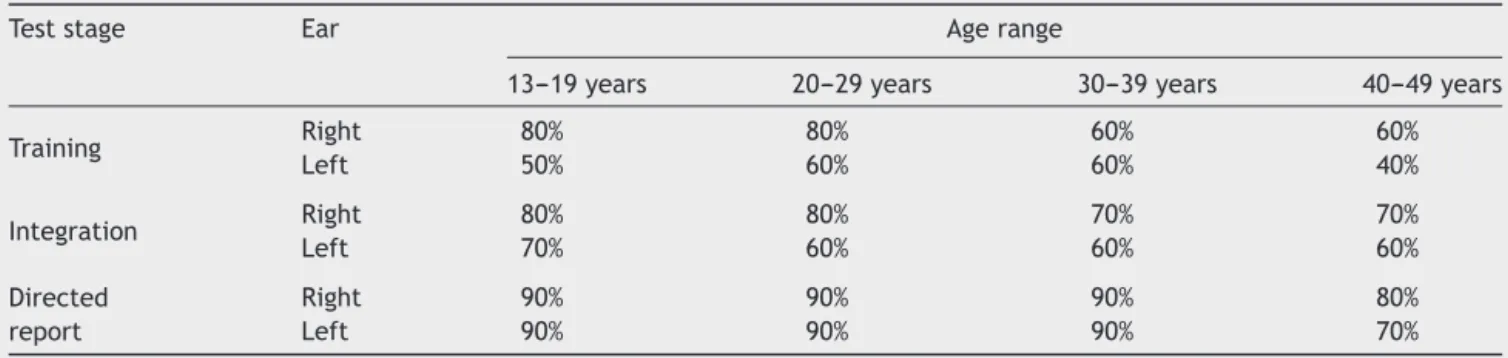
40---49years).Forthebinauralintegrationstage,therewere significantdifferencesinperformancecomparisonsbetween theage groups 20---29 yearsvs. 30---39 yearsin both ears. Finally,thereferencevalueswereestablishedaccordingto theobservationofthefifthpercentileofpercentage distri-butionofcorrectanswersinagivenagegroup(Table2).
Theestablishedreferencevaluesweresimilarfortheage groupsof 13---29 yearsandthe performancedecrease was moremarkedafter30yearsofage.
Discussion
We comparison the results obtained in the DSI in Brazil-ianPortuguesewiththeresultsobtainedinothercountries, sincetheBrazilianPortugueseversionisrecent,compared totheversions inEnglish,andhasbeenlittlestudied.The meanperformanceintheDSItestinBrazilianPortugueseat thebinauralintegrationstageshowed 93.70%accuracy on therightand88.60%accuracyontheleft,withtheresults corroboratingstudiescarriedoutinotherlanguages,2,12that
15 40 50 60 70 80 90 100
20 25 30 35 40 45 50
Age (years)
Right Left
Training
% Correct ans
w
ers
15 20 25 30 35 40 45 50
Figure1 Scatterplotsofcorrectanswerpercentagesinthetrainingstagebyageandear.
ontheleftfortheAustralianversionofDSI12inindividuals
withouthearingloss.
With increasingage, there wasa decrease in the per-centageofcorrectanswersinthebinauralintegrationstage, demonstratedinthescatterplotsinwhichtheLOWESScurve showedadownwardconfiguration,withasharperdeclinefor theleftear.Aftertheageof30,testperformancetendedto decreaseinallassessedstages.Theperformancedecrease withincreasingageinindividualsassessedbydichotic listen-ingtestshasbeenpreviouslyreportedbyseveralstudies12---20
andhasbeenattributedtoachangeintheinterhemispheric transfer of auditory information via the corpus callosum. Thisscenariobecomesmoreevidentinelderlyindividuals, because in addition to the interhemispheric integration inefficiency,theremaybeother deficitssuch ascognitive
decline, which further hinders the capacity to recognize speechstimulipresentedtotheleftear.
The individuals showed worse performance in the bin-aural integration stages (training and integration) when comparedtothedirectedreportstages,withtherightear showingbetterperformancethantheleftearatthe binau-ralintegrationstagesfor allagegroups;thesedifferences werestatisticallysignificant.
Thesignificantadvantageoftherightearwithincreasing age in the three listening stages assessed in the DSI test hasbeen reported inanother study14 that found that,for
thedirectedreportstage,therightearadvantagewasmore pronouncedafter40yearsofage.Toexplaintheeffectof the disadvantage of the leftear withincreasing age, the authorsdescribedthreepossibleoccurrences:14
15 40 50 60 70 80 90 100
20 25 30 35 40 45 50
Age (years)
Right Left
Integration
% correct ans
w
ers
15 20 25 30 35 40 45 50
15 40 50 60 70 80 90 100
20 25 30 35 40 45 50
Age (years)
Right Left
Directed report
% correct ans
w
ers
15 20 25 30 35 40 45 50
Figure3 Scatterplotsofcorrectanswerpercentagesinthedirectedreportstagebyageandear.
- Declineof knowncognitive factors, such asmemory or informationprocessingstrategies.
- More accentuated impairment of the auditory pathway structuresforinformationinputthroughtheleftear.One possibilitywould be a relatively higher decrease in the righthemisphere,whencomparedtothelefthemisphere, withincreasingage.
- Decreasedefficiencyintheinterhemisphericinformation transferdue tothereduction inneural elements in the corpus callosum,generating disadvantage for the infor-mationreceivedthroughtheleftear.
Therewasnosignificantcorrelationbetweenageandthe percentageofcorrectanswersinthedirectedreportstages, bothontherightandtheleft;therewasalsonoeffectof age rangeon the mean percentageof correctanswers in bothears in thedirectedreportstage. These results pos-siblyoccurred becausethe directedreportstages showed betterresultswhencomparedtotheotherDSIteststages, withsignificantdifferences.Thisresultwasexpected,asthe individualsincludedinthisstudyhadnoauditoryprocessing disorderandsowouldbeabletodirecttheirauditory atten-tion. The capacity to direct the auditory attention was
Table1 p-valuesobtainedfrommultiplecomparisonstolocatetheeffectofagerangeinthepercentageofcorrectanswers
byteststageandear.
Teststage Ear Comparison p
Training
Right
13---19yearsvs.20---29years >0.999 20---29yearsvs.30---39years 0.643 30---39yearsvs.40---49years >0.999 13---19yearsvs.40---49years 0.032a
13---19yearsvs.30---39years 0.315
20---29yearsvs.40---49years 0.089
Left
13---19yearsvs.20---29years 0.597
20---29yearsvs.30---39years 0.199
30---39yearsvs.40---49years 0.236
13---19yearsvs.40---49years 0.063
13---19yearsvs.30---39years >0.999
20---29yearsvs.40---49years 0.001a
Integration
Right
13---19yearsvs.20---29years 0.634
20---29yearsvs.30---39years 0.011a
30---39yearsvs.40---49years 0.711
Left
13---19yearsvs.20---29years 0.482
20---29yearsvs.30---39years 0.015a
30---39yearsvs.40---49years 0.068
Table2 ReferencevaluesfortheDichoticSentenceIdentificationtestbyearandagerange.
Teststage Ear Agerange
13---19years 20---29years 30---39years 40---49years
Training Right 80% 80% 60% 60%
Left 50% 60% 60% 40%
Integration Right 80% 80% 70% 70%
Left 70% 60% 60% 60%
Directed report
Right 90% 90% 90% 80%
Left 90% 90% 90% 70%
demonstrated by a mean performance of 98% of correct answersforallagerangesinthedirectedreportstages,both ontherightandontheleft.
TheDSItestwasdesignedtotestthecentralevaluation ofindividualswithperipheralhearingloss,asitsufferslittle influenceofsensorineural hearinglossofcochlear origin.2
However,toanalyzetheperformanceofspecialpopulations inbehavioralhearingtests,suchasindividualswithhearing loss,itisnecessarytoestablishnormalitycriteriafor indi-vidualswithgoodhearingacuitywithoutauditoryprocessing disorders.
Considering the requirements established in the inclu-sioncriteriaforparticipationinthisstudy,theresultscan beextrapolatedtothe adultpopulation. However,asage directly influences the results of the DSI test, it is sug-gestedthatnewstudiesbecarriedoutwithindividualsaged 50 years and older, to establish reference criteria for this population. It is also necessary to applythe DSI test to special populations, such as individuals with auditory processingdisorders,speechand/orlanguagedisorders,and sensorineuralhearingloss.
Conclusions
Aftercriticalanalysis ofthe results, thereference values establishedfortheBrazilian Portugueseversionof theDSI testinnormallistenersaged13---49yearsold,accordingto age,ear,andteststageare:
Age range 13---19 years old: 80% correctanswers (in the trainingandbinaural integrationstages---rightear[RE]), 50%correctanswers(inthetrainingstage---leftear[LE]), 70% correctanswers(inbinauralintegrationstage---LE), and90%correctanswers(inthedirectedreportstage). Age20---29yearsold:80%correctanswers(inthetraining and binaural integrationstages --- RE),60% (in the train-ingandbinauralintegrationstages---LE),and90%correct answers(inthedirectedreportstage).
Age30---39yearsold:60%correctanswers(inthetraining stages(REandLE)andbinauralintegration---LE),70% cor-rectanswers(inbinauralintegrationstage---RE),and90% correctanswers(inthedirectedreportstage).
Age range 40---49 years old: 60% correctanswers (in the trainingREandbinauralintegrationLEstages),40%(inLE trainingstage),70%correctanswers(inREbinaural inte-grationstage)80%correctanswers(inthedirectedreport
stageRE),and70%correctanswers(inthedirectedreport stageLE).
Funding
ThisstudywasfundedbyFundac¸ãodeAmparoàPesquisado EstadodeSãoPaulo(FAPESP).
Conflicts
of
interest
Theauthorsdeclarenoconflictsofinterest.
References
1.MartinJS,JergerJF.Someeffectsofagingoncentralauditory processing.JRehabilResDev.2005;42Suppl.2:25---44. 2.Fifer RC, Jerger JF, Berlin CL, Tobey EA, Campbell JC.
Development of a Dichotic Sentence Identification test for hearing-impairedadults.EarHear.1983;4:300---5.
3.Andrade AN, Gil D, Iório MCM. Elaborac¸ão da versão em português brasileiro do teste de identificac¸ão de sentenc¸as dicóticas(DSI).RevSocBrasFonoaudiol.2010;15:540---5. 4.Andrade AN, BucuvicEC, GilD, Iorio MCM. Análise de erros
nasfrasesapresentadasnaversãoemportuguêsbrasileirodo testedeidentificac¸ãode sentenc¸asdicótica. DistúrbComun. 2009;21:179---85.
5.KemperS.Languageandaging.In:CraikF,SalthouseTA,editors. Thehandbookofagingandcognition.Hillsdale,NJ:Lawrence Erlbaum;1992.p.213---70.
6.GilD,IorioMCM.Formalauditorytraininginadulthearingaid users.Clinics.2010;65:165---74.
7.Bamiou DE, Musiek FE, LuxonLM. Etiology and clinical pre-sentations of auditory processing disorders. Arch Dis Child. 2001;85:361---5.
8.Chermak GD, Musiek FE. Auditory training: principles and approachesforremediatingandmanagingauditoryprocessing disorders.SemHear.2002;23:297---308.
9.PereiraLD,SchochatE.Processamentoauditivocentral:manual deavaliac¸ão.1sted.SãoPaulo:Lovise;1997.
10.OldfieldRC.Theassessmentand analysisofhandedness:the EdinburghInventory.Neuropsychologia.1971;9:97---113. 11.BritoGNO,Brito LS,PaumgarttemFJR, LinsMF.Lateral
pre-ferences in Brazilianadults: an analysis with theEdinburgh Inventory.Cortex.1989;25:403---15.
13.CooperJCJr,Gates GA.Hearingintheelderly-the Framing-hamCohort,1983---1985:PartIIprevalenceofcentralauditory processingdisorders.EarHear.1991;12:304---11.
14.JergerJ,ChmielR,AllenJ,WilsonA.Effectsofageandgender onDichoticSentenceIdentification.EarHear.1994;15:274---86. 15.JergerJ,AlfordB,LewH,RiveraV,ChmielR.Dichotic-listening, event-relatedpotentials,andinterhemispheric-transferinthe elderly.EarHear.1995;16:482---98.
16.JergerJ.Asymmetry inauditoryfunction inelderly persons. SeminHear.2001;22:255---70.
17.Hällgren M,Larsby B, LyxellB, Arlinger S. Cognitive effects in dichotic speech testing in elderly persons. Ear Hear. 2001;22:120---9.
18.BellisTJ,WilberLA.Effectsofagingandgenderon interhemi-sphericfunction.JSpeechLangHearRes.2001;44:246---63. 19.GootjesL,StrienJWV,BoumaA.Ageeffectsinidentifyingand
localisingdichoticstimuli:acorpuscallosumdeficit?JClinExp Neuropsychol.2004;26:826---33.