R
E
V
IS
Ã
O
R
E
V
IE
W
* This article was originally publisched by Environ Health Perspect 118:727–734 (2010). doi:10.1289/ehp.0901835 [Online 22 February 2010] and is part of the scientific collaboration between Cienc Saude Coletiva and EHP. 1 Department of Epidemiology, Emory University School of Public Health, Atlanta, Georgia, USA; 2 Department of Medicine, University of Maryland School of Medicine, Baltimore, Maryland, USA;
3 Department of Psychology, and 4 Department of Psychiatry, University of North Carolina at Chapel Hill, Chapel Hill, North Carolina, USA;
5 Center for Autism Spectrum Disorders, Children’s National Medical Center, Washington, DC, USA;
6 Department of Pediatrics, 7 Department of Psychiatry, and 8 Department of Neurology, George Washington University School of Medicine, Washington, DC, USA; 9 Center for Development and Learning, Kennedy Krieger Institute, Baltimore, MD, USA; 10 Department of Pediatrics, Johns Hopkins University School of Medicine, Baltimore, Maryland, USA;
11Eunice Kennedy Shriver National Institute of Child Health and Human Development, National Institutes of Health, Department of Health and Human Services, Bethesda, Maryland, USA; 12 LaKind Associates, LLC, Catonsville, Maryland, USA; 13 Department of Epidemiology and Preventive Medicine, University of Maryland School of Medicine, Baltimore, Maryland, USA; 14 Department of Pediatrics, Milton S. Hershey Medical Center, Penn State College of Medicine, Hershey, Pennsylvania, USA.
Address correspondence to LaKind Associates. LLC, 106 Oakdale Ave. 21228 Catonsville MD USA. [email protected]
Using systematic reviews and meta-analyses
to support regulatory decision making for neurotoxicants:
lessons learned from a case study of PCBs
Utilizando revisões sistemáticas e meta-análise de apoio às decisões
regulatórias para neurotóxicos: lições de um estudo de caso dos PCBs
Resumo Foram examinados estudos de grupo que
avaliaram a relação entre a exposição pré-natal e neonatal aos bifenilos policlorados (PCB) e o de-senvolvimento neuropsicomotor em crianças a fim de avaliar a viabilidade da realização de uma meta-análise para suporte à tomada de decisão. Nós descrevemos os estudos em termos de exposição, ca-tegorizações, análise estatística e elaboração de re-latórios de resultados. Nós utilizamos esta avalia-ção para verificar a viabilidade de agrupar os es-tudos em categorias razoavelmente uniformes. Os testes mais utilizados foram Brazelton Neonatal Behavioral Assessment Scale, a pontuação de oti-malidade neurológica no período neonatal, as Escalas Bayley de Desenvolvimento Infantil de 5 a 8 meses de idade, e as Escalas McCarthy de habilidades das crianças em 5 anos de idade. Apesar de administrar os mesmos testes com ida-des semelhantes, os estudos foram muito diferentes para permitir uma análise quantitativa significa-tiva dos resultados entre grupos. Estas análises indicam que a nossa capacidade de realizar avali-ações da literatura epidemiológica sobre neurotó-xicos pode ser limitada - mesmo na presença de vários estudos - se não existe nenhuma forma de comparação com os métodos de estudo disponíveis e análise dos dados.
Palavras-chave Domínio, Testes de função, Meta-análise, Desenvolvimento neuropsicomotor, Neu-rotoxicants, PCB, Avaliação de riscos
Abstract We examined prospective cohort studies
evaluating the relation between prenatal and neo-natal exposure to polychlorinated biphenyls (PCBs) and neurodevelopment in children to as-sess the feasibility of conducting a meta-analysis to support decision making. We described studies in terms of exposure and end point categoriza-tion, statistical analysis, and reporting of results. We used this evaluation to assess the feasibility of grouping studies into reasonably uniform catego-ries. The most consistently used tests included Bra-zelton’s Neonatal Behavioral Assessment Scale, the neurologic optimality score in the neonatal peri-od, the Bayley Scales of Infant Development at 5– 8months of age, and the McCarthy Scales of Chil-dren’s Abilities in 5-year-olds. Despite adminis-tering the same tests at similar ages, the studies were too dissimilar to allow a meaningful quanti-tative examination of outcomes across cohorts. These analyses indicate that our ability to con-duct weight-of-evidence assessments of the epide-miologic literature on neurotoxicants may be lim-ited, even in the presence of multiple studies, if the available study methods, data analysis, and re-porting lack comparability.
Key words Domain, Function testing, Meta-anal-ysis, Neurodevelopment, Neurotoxicants, PCBs, Risk assessment, Weight of evidence
Michael Goodman 1
Katherine Squibb 2
Eric Youngstrom 3,4
Laura Gutermuth Anthony 5,6,7
Lauren Kenworthy 5,6,7,8
Paul H. Lipkin 9,10
Donald R. Mattison 11
G
o
o
d
m
Extensive literature exists on the use and inter-pretation of neurodevelopmental tests that serve as outcome measures in population studies ex-amining effects of environmental exposures. However, conclusions about the presence or ab-sence of a causal relation between an exposure to a specific toxicant and a particular outcome are generally based on weight of evidence (WOE), because even well-designed studies are subject to methodologic limitations that are unavoidable in observational research; no single study can be considered sufficient for producing definitive re-sults. For this reason, it is crucial that the scien-tific and regulatory communities are able to eval-uate findings across studies before rendering the WOE-based conclusions. The term “WOE” has several possible definitions; we refer to WOE as a methodology with a “simple premise: that all available evidence should be examined and inter-preted”1. It is important to clarify that for the
purposes of this review wefocus on weight of epidemiologic (vs., e.g., toxicologic) evidence. Such WOE evaluation is possible only if the stud-ies under review use the same or similar methods of exposure assessment, outcome ascertainment, data analysis, and reporting of results.
To provide a methodologic framework for a review of the association between in utero and early-life exposures to environmental chemicals and neurodevelopmental outcomes in children, we considered epidemiologic studies that focused on prenatal and neonatal exposure to polychlo-rinated biphenyls (PCBs). Our selection of PCBs as the exemplar chemical class was based on two main considerations. First, it was important to select an environmental chemical or chemical class for which a sufficient body of peer-reviewed lit-erature was available for evaluation. Scientific studies on PCBs and neurodevelopment date back to the early 1980s and include cohorts from several countries. Second, for the purposes of this examination of neurodevelopmental epidemio-logic studies and implications for interstudy com-parison, we sought to select a chemical or chem-ical class for which substantial uncertainty exists regarding presence or absence of a causal rela-tion between prenatal/neonatal exposure and neurodevelopmental outcomes. With respect to PCBs, recent reviews appear to indicate consid-erable disagreement among experts2-5, and
con-troversy exists as to whether PCBs at current environmental levels of Second, for the purposes of this examination of neurodevelopmental epi-demiologic studies and implications for interstudy comparison, we sought to select a chemical or
chemical class for which substantial uncertainty exists regarding presence or absence of a causal relation between prenatal/neonatal exposure and neurodevelopmental outcomes. With respect to PCBs, recent reviews appear to indicate consid-erable disagreement among experts2-5, and
con-troversy exists as to whether PCBs at current environmental levels of exposure are in fact neu-rotoxicants6. Although others have provided
re-views of the PCB neurodevelopment literature2,4,
their value for WOE is weakened by differing and sometimes idiosyncratic matching of neurode-velopmental assessment instruments to putative neurodevelopmental domains and by a lack of formal assessment of consistency across studies addressing the same exposure-outcome associa-tions for the same or similar study populaassocia-tions. The purpose of this review is not to weigh in on the ongoing debate over neurodevelopmental effects of PCBs. Instead, we used studies of PCBs as a vehicle for evaluating the state of the science in population research aimed at investigating the relation between prenatal or neonatal exposures to environmental chemicals and performance on neurodevelopmental function tests. In this review, we present results from our assessment of the epidemiologic literature on the relation between PCBs and neurodevelopment regarding a) the consistency of study methods with respect to ex-posure assessment, outcome ascertainment, and data analysis; and b) the feasibility of conducting a quantitative WOE assessment of existing epi-demiologic data (i.e., a meta-analysis). The goals are to develop a general framework for assessing the body of evidence in neurodevelopmental en-vironmental epidemiology studies and to offer recommendations to guide future research such that results will be more amenable to WOE re-views in support of regulatory decision making.
Methods
Identification/selection of studies
“chil-d
e C
o
le
tiv
a, 16(
7)
:3207-3220,
2011
dren,” “prenatal,” “neurodevelopmental,” and “neurobehavioral,” as well as various combina-tions of these keywords, we selected relevant arti-cles that investigated the neurodevelopmental ef-fects of environmental PCB exposures in chil-dren (poisoning events were not considered). We reviewed secondary references of retrieved arti-cles to identify publications not captured by the electronic search. We conducted additional liter-ature searches to identify relevant reports and text-book chapters that were not published in the peer-reviewed literature.
The prospective longitudinal design provides the most informative data for examining out-comes associated with in utero and early-life ex-posures7,8. For this reason, our search of the
lit-erature focused specifically on cohort studies that recruited participants either prenatally or soon after birth and linked various measures of pre-and postnatal PCB exposures to neurodevelop-mental outcomes at different ages; at the time of this review, some of the studies had conducted only one neurodevelopmental evaluation.
Literature review
We retrieved and reviewed the publications identified via the literature search (~ 60 articles) and extracted information on each relevant study with respect to its methods of data collection, analysis and reporting. Extracted information was categorized according to the following char-acteristics: a) cohort description - year of enroll-ment, geographic location, and ages at which neurodevelopmental/neurobehavioral tests were administered; b) exposure categorization - wheth-er information was based on matwheth-ernal dietary questionnaires or measured (e.g., in breast milk, maternal serum, or cord blood) and units of measures [e.g., nanograms per gram, parts per billion, or toxic equivalents (TEQs)]; c) tests used to define the end points of interest - neurologic [e.g., neurologic optimality scores (NOSs)], cog-nitive [e.g., Bayley Scales of Infant Development (BSID)], or other tests assessing specific domains of functioning; and d) analysis and reporting of result - linear regression coefficients with and without log transformation of variables, para-metric or nonparapara-metric comparisons of out-comes in two or more groups, or qualitative de-scription of results.
This characterization of the cohort studies al-lowed us to search for reasonably homogeneous groups of articles that could then be included in a systematic analysis. Within each group, we
as-sessed the feasibility of a meta-analysis of the pub-lished data. It is a common practice that a mini-mum data set needed for the systematic analysis should include at least three similar studies, in which measures of effect and corresponding mea-sures of variance for the same exposure–outcome association within the same age group either were reported by the study authors or could be calcu-lated using the data from the original articles9.
Results
Overview of PCB cohort studies
The current published literature includes 11 cohort studies of children for whom pre- or neo-natal PCB exposures were measured (as mater-nal blood levels during pregnancy, cord blood, breast milk concentrations, or combinations of these) or estimated. These studies represent a wide range of populations (in terms of geography and year of enrollment) recruited either at birth or prenatally, some of which were followed for sev-eral years (up to 11 years for one cohort). Geo-graphically, five of the cohorts were recruited in the United States and Canada, five in Europe, and one in Japan. The neurodevelopmental outcomes at various ages were described in at least 40 dif-ferent articles with publication dates spanning a 26-year interval from 1984 through 2009. Figure 1 summarizes tests administered in each cohort study at different ages through the seventh year of life. [Figure 1 also includes a twelfth cohort -the Pregnancy, Infection, and Nutrition Babies Study10 - that has reported results for only one
neurodevelopmental func-tion testing period to date and used function tests that differed from those used for the other cohort studies. This co-hort is not discussed further.] Most (9 of 11) cohorts were evaluated for neurologic and be-havioral function or cognitive ability during the first year of life. After the first year of age, the frequency of testing decreased. Importantly, al-though not shown in Figure 1, after 8 years of age the avail-able neurodevelopmental data be-come even more sparse.
Feasibility of quantitative analysis
G
o
o
d
m
first and the fifth years of life. As noted in “Meth-ods,” our goal was to identify reasonably homo-geneous groups of at least three studies. Studies were considered eligible for a meta-analysis if a) similar tests were administered at similar ages, b) exposure was measured and reported in compa-rable ways, c) results represented comparable measures of effect, and d) for the purposes of weighting in a meta-analysis, measures of effect were accompanied by corresponding measures of variance.
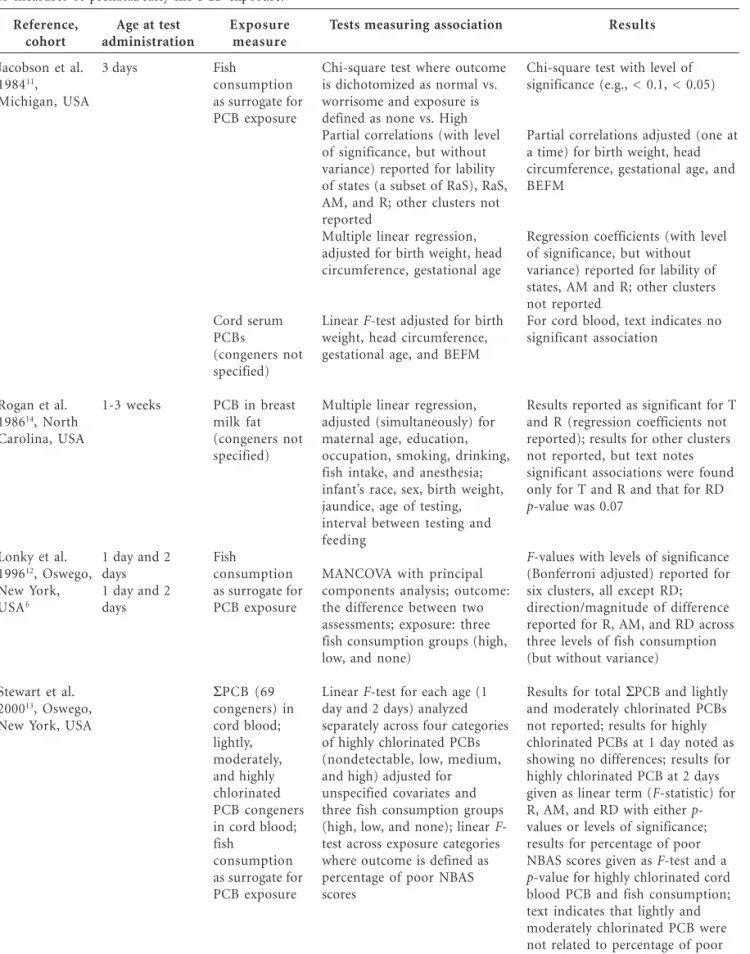
The earliest opportunity to assess consisten-cy of findings across studies in terms of partici-pants’ age was presented in the neonatal period (i.e., within 28 days postpartum). Studies con-ducted in the United States and in Europe used different types of testing to examine neurobe-havioral function in newborns. As shown in Ta-ble 1, the three U.S. studies included the Michigan cohort11, the Oswego cohort12,13, and the North
Carolina cohort14. All of the U.S. studies
admin-istered Brazelton’s Neonatal Behavioral Assess-ment Scale (NBAS), which was divided into
sev-en clusters. Six of those clusters - response decre-ment, orientation, tonicity, range of state, regu-lation of state, and autonomic maturity - are con-sidered behavioral. One cluster - reflex - is aimed at evaluating neurologic function.
The Michigan and Oswego cohorts were giv-en the NBAS test within the first 3 days of life. Both studies carried out multivariate analyses to link fish consumption (as a surrogate for expo-sure to PCBs) to NBAS score; however, the out-come definitions for the two cohorts differed from each other. Specifically, the Michigan study11
used a single NBAS result obtained on the third day of life, whereas the Oswego study12 defined
the outcome as the difference between two as-sessments conducted in the second and the first day after birth. Further, the multivariate analy-ses in the two studies [linear regression for the Michigan study and multivariate analysis of co-variance (MANCOVA) for the Oswego study] produced results that could not be compared and/or combined quantitatively. A second publi-cation based on the Oswego cohort13 examined
Figure 1. Summary of tests used in the PCB cohorts by age (for children up to 7 years of age at follow-up). Collaborative Perinatal Project, USA22; Michigan, USA11; North Carolina, USA14; Pregnancy, Infection, and Nutrition Babies Study, USA10
; Oswego, USA12
; Nunavik, Canada43
; Dusseldorf, Germany24
; Duisburg, Germany16 ; Faroe Islands 144; Faroe Islands 218; Groningen/Rotterdam, the Netherlands17; Hokkaido, Japan26. Additional testing was conducted with the Oswego cohort at 8 and 9 years of age, the Netherlands cohort at 9 years of age, and the Michigan cohort at 11 years of age.
Collaborative Perinatal Project, USA Michigan, USA North Carolina, USA Pregnancy, infection, and nutrition babies studt, USA Oswego, USA Nunavik, Canada Dusseldorf, Germany Duisburg, Germany Faroe Islands 1 Faroe Islands 2 Groninger/Rotterdam, the Netherlands Hokkaido, Japan
Age at folow-up
0-5 months
6-11 months
12-23 months
24-35 months
36-47 months
48-59 months
60-71 months
72-83 months
84-95 months
MISC
123456789 123456789 123456789
MISC
MISC KAUF KAUF
R, KAUF MCC MISC
FA
FA FA
FA NBAS NBAS
NBAS
Bayley Scales of Infant Development Stanford–Binet IQ test
Brazelton Neonatal Behavioral Assessment Scale (NBAS) Fagan Test of Infant Intelligence
McCarthy Scales of Children’s Abilities Neurologic Optimality Score (Prechtl, Hempel) Reynell Developmental Language Scales Michigan Catch the Cat
NBAS FA
Kaufman Assessment Battery for Children Multiple neuromotor tests
Mullen Scales of Early Learning; MacArthur-Bates Communicative Development Indices
Miscellaneous tests including Peabody, Beery, Kagan, Sternberg, Wide Range Achievement Test,individual subsets of Wechsler Intelligence Scale for Children (WISC), Bender Visual Motor Gestault Test, Boston Naming Test, etc.
R MCC
KAUFF
1234567 1234567 1234567
d
e C
o
le
tiv
a, 16(
7)
:3207-3220,
2011
Table 1. U.S. studies of neurologic and behavioral function among newborns using the Brazelton NBASa in relation to measures of prenatal/early-life PCB exposure.
Reference, cohort
Jacobson et al. 198411
, Michigan, USA
Rogan et al. 198614
, North Carolina, USA
Lonky et al. 199612
, Oswego, New York,
USAb
Stewart et al. 200013
, Oswego, New York, USA
Age at test administration
3 days
1-3 weeks
1 day and 2 days 1 day and 2 days
Exposure measure
Fish
consumption as surrogate for PCB exposure
Cord serum PCBs
(congeners not specified)
PCB in breast milk fat (congeners not specified)
Fish
consumption as surrogate for PCB exposure
ΣPCB (69
congeners) in cord blood; lightly, moderately, and highly chlorinated PCB congeners in cord blood; fish
consumption as surrogate for PCB exposure
Tests measuring association
Chi-square test where outcome is dichotomized as normal vs. worrisome and exposure is defined as none vs. High Partial correlations (with level of significance, but without variance) reported for lability of states (a subset of RaS), RaS, AM, and R; other clusters not reported
Multiple linear regression, adjusted for birth weight, head circumference, gestational age
Linear F-test adjusted for birth weight, head circumference, gestational age, and BEFM
Multiple linear regression, adjusted (simultaneously) for maternal age, education, occupation, smoking, drinking, fish intake, and anesthesia; infant’s race, sex, birth weight, jaundice, age of testing, interval between testing and feeding
MANCOVA with principal components analysis; outcome: the difference between two assessments; exposure: three fish consumption groups (high, low, and none)
Linear F-test for each age (1 day and 2 days) analyzed separately across four categories of highly chlorinated PCBs (nondetectable, low, medium, and high) adjusted for unspecified covariates and three fish consumption groups (high, low, and none); linear F -test across exposure categories where outcome is defined as percentage of poor NBAS scores
Results
Chi-square test with level of significance (e.g., < 0.1, < 0.05)
Partial correlations adjusted (one at a time) for birth weight, head circumference, gestational age, and BEFM
Regression coefficients (with level of significance, but without variance) reported for lability of states, AM and R; other clusters not reported
For cord blood, text indicates no significant association
Results reported as significant for T and R (regression coefficients not reported); results for other clusters not reported, but text notes significant associations were found only for T and R and that for RD
p-value was 0.07
F-values with levels of significance (Bonferroni adjusted) reported for six clusters, all except RD; direction/magnitude of difference reported for R, AM, and RD across three levels of fish consumption (but without variance)
Results for total ΣPCB and lightly and moderately chlorinated PCBs not reported; results for highly chlorinated PCBs at 1 day noted as showing no differences; results for highly chlorinated PCB at 2 days given as linear term (F-statistic) for R, AM, and RD with either p -values or levels of significance; results for percentage of poor NBAS scores given as F-test and a
p-value for highly chlorinated cord blood PCB and fish consumption; text indicates that lightly and moderately chlorinated PCB were not related to percentage of poor NBAS scores
BEFM, Ballard Examination for Fetal Maturity.
a Brazelton NBAS clusters: response decrement (RD), orientation, tonicity (T), range of state (RaS), regulation of state (ReS), autonomic maturity (AM),
and reflex (R); b
G
o
o
d
m
the association between NBAS and cord blood PCBs in addition to fish consumption, which was already assessed by Lonky et al.12. The exposure
was assessed using four metrics (total PCBs, lightly chlorinated PCBs, moderately chlorinat-ed PCBs, and highly chlorinatchlorinat-ed PCBs), and the outcomes in this study were assessed separately at each time interval (1 day and 2 days of life) both as the NBAS score for each cluster and as an overall proportion of poor scores. The data were analyzed using a test for trend statistic; how-ever, the quantitative results were reported only for the second day of life assessment and only for highly chlorinated PCBs.
The third study (the North Carolina cohort) that administered NBAS did so between the first and third week of life14. The analytic approach
(linear regression) used in the North Carolina study was similar to that of the Michigan study11,
but the exposure measures differed (PCBs mea-sured in breast milk were compared with esti-mates of PCB exposure based on fish consump-tion informaconsump-tion or cord blood levels). In
addi-tion, the results were presented in terms of p val-ues without reporting the regression coefficients. Thus, despite the consistent use of NBAS in the first week of life by these three cohorts, differenc-es in methods for differenc-estimating exposurdifferenc-es and in reporting of outcomes preclude conducting a quantitative systematic review across the cohorts. It is worth noting that even if the statistical meth-od had been consistent across studies, the differ-ences in choice of covariates would still have ren-dered it very difficult to synthesize the effect sizes across studies15.
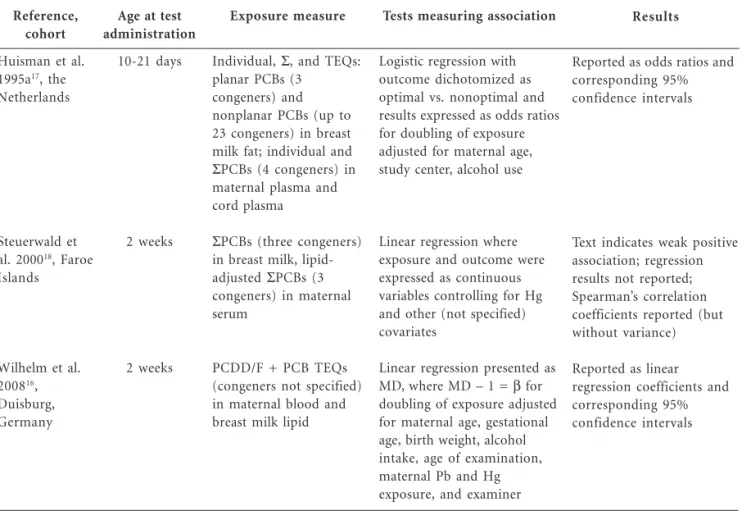
The three European studies of neonatal out-comes (Table 2) were conducted in Duisburg, Germany16, the Netherlands17, and the Faroe
Is-lands18. All three studies used the NOS, a
com-bined measure that consists of 60 components with an optimal range of results predefined for each item, with the final score calculated as the total num-ber of optimal items19.
All three of these studies conducted the NOS assessment between 1 and 3 weeks of life and in that respect are comparable to the North
Caroli-Results
Reported as odds ratios and corresponding 95% confidence intervals
Text indicates weak positive association; regression results not reported; Spearman’s correlation coefficients reported (but without variance)
Reported as linear regression coefficients and corresponding 95% confidence intervals
Abbreviations: Hg, mercury; MD, mean differences; Pb, lead.
Table 2.European studies that examined neurologic and behavioral function among newborns using the NOS in relation to measures of prenatal or early-life PCB exposure.
Reference, cohort
Huisman et al. 1995a17
, the Netherlands
Steuerwald et al. 200018
, Faroe Islands
Wilhelm et al. 200816
, Duisburg, Germany
Age at test administration
10-21 days
2 weeks
2 weeks
Exposure measure
Individual, Σ, and TEQs: planar PCBs (3
congeners) and nonplanar PCBs (up to 23 congeners) in breast milk fat; individual and
ΣPCBs (4 congeners) in
maternal plasma and cord plasma
ΣPCBs (three congeners)
in breast milk, lipid-adjusted ΣPCBs (3 congeners) in maternal serum
PCDD/F + PCB TEQs (congeners not specified) in maternal blood and breast milk lipid
Tests measuring association
Logistic regression with outcome dichotomized as optimal vs. nonoptimal and results expressed as odds ratios for doubling of exposure adjusted for maternal age, study center, alcohol use
Linear regression where exposure and outcome were expressed as continuous variables controlling for Hg and other (not specified) covariates
Linear regression presented as
MD, where MD – 1 = β for
d
e C
o
le
tiv
a, 16(
7)
:3207-3220,
2011
na cohort. Two of the three European studies -the Duisburg16 and Faroe Islands18 cohorts -
per-formed linear regression analyses to examine the relation of NOS scores at 2 weeks of life to PCB levels in both milk and maternal blood samples; however, quantitative results are given only forthe Duisburg cohort16. In addition, different analytes
were selected for exposure assessment in these two studies. Wilhelm et al.16 examined PCBs
to-gether with polychlorinated dibenzo-p-dioxins and dibenzofurans (PCDD/Fs), whereas Steuer-wald et al.18 expressed exposure as ΣPCB (the
sum of PCB congeners). the Netherlands cohort17
dichotomized the NOS using the median PCB concentration in the study population as the cut-off. For the resulting binary outcome in the lo-gistic regression analyses, the independent
vari-able of interest was the log-transformed ΣPCB and various ΣPCB subsets (e.g., planar versus nonplanar). Again, despite the availability of three studies using the same neurodevelopmental test, differences in methods for estimating exposures and in reporting of outcomes preclude conduct-ing a quantitative systematic review.
Six cohort studies used the same test BSID -to assess the cognitive function of their partici-pants between 5 and 8 months of age and thus could provide comparable data (Table 3). Three of these studies were conducted in the United States. The Michigan and the North Carolina cohort studies20,21 have been discussed
previous-ly in the context of neonatal assessment. The third U.S. study22 represents a multicenter effort - called
the Collaborative Perinatal Project - that
recruit-Results
Text indicates that no measures of exposure were related to MDI or PDI; quantitative results not provided
Both MDI and PDI results reported as regression coefficients, standard errors, and two-sided p -values
Result for MDI reported as regression coefficients, standard errors, and two-sided p-values; results for PDI not reported
Table 3. Studies using MDI and PDI (BSID) at 5–8 months of age in relation to measures of prenatal or early-life PCB exposure.
Reference, cohort
Jacobson et al. 198621, Michigan, USA
Gladen et al. 198820, North Carolina, USA
Koopman-Esseboom et al. 199625, the Netherlands
Age at test administration
5 months
6 months
7 months
Exposure measure
Fish consumption as surrogate for PCB exposure; cord blood PCBs (congeners not specified); breast milk PCBs (congeners not specified)
PCB in breast milk fat (congeners not specified) at birth used as measure of transplacental exposure; estimated cumulative exposure to PCB in breast milk (from birth to the age of test)
Prenatal exposure:
ΣPCBs (24 congeners)
in maternal blood drawn in the last month of pregnancy; postnatal exposure: ΣPCBs (4 congeners and 24 congeners) in breast milk
Tests measuring association
Linear regression and ANCOVA; details not reported
Multiple linear regression per 1 ppm, adjusted for maternal age, race, education, occupation, smoking, drinking, infant’s sex, gestational age, birth weight, head circumference, jaundice, duration of breast-feeding, number of older siblings, abnormal reflexes on NBAS age of testing, and center/ examiner
Multiple linear regression expressed per ln(ng/g) adjusted for gestational age, parity, HOME score, and duration of breast-feeding
G
o
o
d
m
ed participants from several sites (Baltimore, MD; Boston, MA; Buffalo, NY; Memphis, TN; Min-neapolis, MN; New Orleans, LA; New York, NY; Philadelphia, PA; Portland, OR; Providence, RI; Richmond, VA). Among the three European stud-ies shown in Table 3, two were carried out using the same cohort in Dusseldorf, Germany23,24, and
one was conducted using a subset of the previ-ously discussed cohort of children from the Neth-erlands25. One additional study in this category
was performed with a cohort of children from Sapporo, Japan (the Hokkaido Study on Envi-ronment and Children’s Health)26.
The versions of the BSID assessment used in these studies included two main scores: the Men-tal Development Index (MDI) and the Psycho-motor Development Index (PDI). As shown in Table 3, all studies evaluating the relation between BSID in the first year of life and PCB exposure used linear regression to estimate the effect. How-ever, the reporting and interpretation of the lin-ear regression coefficients differed across the studies. Although we identified four studies that examined the relationship between MDI and PCB concentrations in maternal or cord blood, the results in these studies represented different
mea-Results
Both MDI and PDI results for both cord blood and breast milk PCB levels reported as regression coefficients, standard errors, and one-sided p -values
For breast milk PCBs, both MDI and PDI results reported as regression coefficients, standard errors, and one-sided p -values; for cord blood PCBs, text indicates that associations were small or positive; quantitative results not provided
Both MDI and PDI results reported as regression coefficients, standard errors, and two-sided p -values
Both MDI and PDI results reported as regression coefficients and two-sided
p-values
Table 3. continuation
Reference, cohort
Winneke et al. 199824
,a
Dusseldorf, Germany
Walkowiak et al. 200123
,a
Dusseldorf, Germany
Daniels et al. 200322
, Collaborative Perinatal Project, USA
Nakajima et al. 200626
, Hokkaido, Japan
Age at test administration
7 months
7 months
8 months
6 months
Exposure measure
ΣPCBs (three congeners)
in cord blood and breast milk
ΣPCBs (three congeners)
in breast milk and cord serum
ΣPCBs (11 congeners)
in maternal blood drawn in the third trimester
ΣPCBs (total 14 congeners and by different categories of congeners) and TEQs in maternal blood drawn in the third trimester of pregnancy or after delivery
Tests measuring association
Multiple linear regression expressed per ng/g adjusted for maternal age, education, vocabulary, smoking and drinking, duration of breast-feeding, birth weight, HOME score, Apgar score, cord blood lead level, and neonatal illness
Multiple linear regression per log2(ng/g) adjusted for parity, smoking, and body mass index
Multiple linear regression per µg/L adjusted for research center, maternal education, triglycerides, cholesterol, and birth order of the child
Multiple linear regression per ln(ng/g) or per TEQ adjusted for gestational age, smoking and caffeine intake during pregnancy, and blood-sampling time
HOME, Home Observation for Measurement of the Environment.
a Two studies based on the same cohort; Winneke et al. (1998) reported BSID results at 7 months of age only, whereas Walkowiak et al.23
d
e C
o
le
tiv
a, 16(
7)
:3207-3220,
2011
sures of effect. In two of the four studies, the regression coefficients represented change in MDI per unit of PCB increase (micrograms per liter or nanograms per gram)22,24; in two other
stud-ies25,26, the corresponding coefficients
represent-ed change in MDI per natural logarithm of expo-sure. Similarly, among the three studies that re-ported the association between MDI and PCBs in breast milk, only two20,24 reported their
find-ings as comparable regression coefficients per 1 ppm or 1 ng/g of exposure; the third study21
sim-ply noted a lack of association. Another publica-tion that evaluated the relapublica-tion between breast milk PCB levels and MDI23 used the same
Ger-man cohort data as used by Winneke et al.24 but
reported linear regression coefficients per loga-rithm base 2 of exposure. The results of studies for PDI at 5-8 months of life provided even less comparable information. Among the seven pub-lications (based on six different cohort studies), only five calculated and reported regression co-efficients, and only four of those studies were based on independent data. As was the case with MDI, it was not possible to identify three inde-pendent studies that could be combined in a meta-analysis because of the variability of expo-sure characterization and/or methods of express-ing study results. Overall, even with the use of the Bayley Scales across several cohorts at similar times in life, a quantitative systematic review across cohorts was not possible.
Three cohort studies (Michigan, Oswego, and Dusseldorf) evaluated their participants at 6-7 months of age using the Fagan Test of Infant In-telligence. Although all three studies measured PCB cord blood concentrations (among other metrics), the specific congeners were different. Moreover, the association between exposure and outcome was assessed using different statistical methods: multiple linear regression that used PCB levels as a continuous variable in two studies24,27
and an F-test for trend that used a four-level cord blood PCB categorization in the third study28. All three analyses appear to have
con-trolled for different sets of confounders. Thus, the studies that administered the Fagan test were as heterogeneous as the studies that used BSID at roughly the same age.
The only remaining opportunity to assess the feasibility of conducting a meta-analysis was in a group of studies assessing cognitive function during the fifth year of life. As shown in Figure 1, three cohort studies in the United States (Michi-gan, Oswego, and North Carolina) evaluated the cognitive function of their participants between
the fourth and the fifth birthdays using McCar-thy Scales of Children’s Abilities and were con-sidered as can-didates for inclusion in a meta-analysis29-31. All three of these studies reported
the results for the General Cognitive Index (GCI) of the McCarthy Scales. Only one of these studies also presented the results separately for the Ver-bal, Quantitative, Perceptual-Performance Mem-ory, and Motor Scales30.
Table 4 summarizes results for the three stud-ies evaluating the association between perinatal PCB exposure and GCI. It is evident that despite testing the same hypothesis, the differences across the three studies were too pronounced to allow meaningful conclusions about the presence or absence of consistency in findings. Specifically, although the Michigan study30 conducted linear
regression analyses for cord blood and breast milk PCB exposures, only cord blood results were provided in their publication. The North Caroli-na study29 used breast milk concentrations to
estimate exposure, but the data were analyzed using ANCOVA procedures, and the quantita-tive results were not reported. The Oswego co-hort study31 was similar to the Michigan study in
that they both estimated exposure based on PCB concentration in cord blood. However, unlike the Michigan study, the Oswego findings were pre-sented not as regression coefficients but as linear
F-test results, which divided exposure into four ordinal categories. As with our other attempts at a systematic review across cohorts, there was in-sufficient consistency with exposure measures and outcome reporting to conduct such a review.
Discussion
de-G
o
o
d
m
creased substantially and the data became in-creasingly sparse as the cohorts became older. This likely presents a missed research opportu-nity because testing in older children may be more reliable, and perhaps more informative with re-spect to the long-term prognosis32.
As noted above, it is not the purpose of this review to weigh in on the ongoing debate over neurodevelopmental effects of PCBs, but rather to use the PCB neurodevelopmental epidemiolo-gy literature as the basis for describing generaliz-able issues related to interstudy consistency. Rep-lication of findings, often referred to as “repeat-ing a study,” is a crucial aspect of the scientific method. Ability to repeat or reproduce a result leads to generalizable inferences, rather than mere-ly to isolated and uncertain findings33. In the field
of medical research, there is consensus that rep-lication (or other substantiation) of clinical trials is a requirement for approval of drugs and
med-ical devices34. Unlike testing of drugs and devices,
most data generated by environmental research involving human subjects are observational in nature, and thus the conditions within a study are far less controlled. As noted in a recent re-view35, researchers conducting observational
stud-ies have great latitude in how exposure and out-come are measured and expressed, which meth-ods for examining associations are employed, and which analyses among the myriad typically con-ducted are reported. In this regard, the epidemi-ologic studies that rely on neurodevelopmental function test results as the end points of interest may be particularly affected by variability of study methods and reporting. This is attribut-able to the large number of availattribut-able test batter-ies, each of which can offer different combina-tions of subtests36. Even within subtests, there
are different scales and cutoff points for catego-rizing responses. If these are used and reported
Results
PCB result reported as a regression coefficient with a two-sided p-value
PCB regression; results not provided
For transplacental PCB exposure text indicates no association; quantitative results not provided; for cumulative breast milk exposure text indicates some variation but the pattern “did not suggest cause and effect”; quantitative results not provided
Result reported as a linear term without a measure of variance (all p-values marked as nonsignificant)
Table 4. Studies using the GCI of the McCarthy Scales of Children’s Abilities in the fifth year of age in relation to measures of prenatal or early-life PCB exposure.
Reference, cohort
Jacobson et al. 199030, Michigan, USA
Gladen and Rogan 199129
, North Carolina, USA
Stewart et al. 200331, Oswego, New York, USA
Age at test administration
4 years
4-5 years 4.5 years
Exposure measure
Cord blood PCBs (congeners not specified)
Breast milk PCBs (congeners not specified
PCB (congeners not specified) in breast milk fat at birth used as a measure of
transplacental exposure; estimated cumulative exposure to PCB in breast milk (from birth to the age of test)
ΣPCBs in cord blood (17
congeners)
Tests measuring association
Multiple linear regression per logx(ng/mL) +1 adjusted for maternal age, gravidity, and examinera
Details of linear regression modeling for breast milk exposure not reported
ANCOVA by dividing transplacental exposure into eight categories and cumulative breast milk exposure into five categories, adjusted for maternal age, race, education, occupation, smoking, drinking, infant’s sex, number of older siblings, feeding pattern
Linear F-test across four PCB exposure categories
(nondetectable, low, medium, and high) adjusted for various combinations of (not specified) covariates
d
e C
o
le
tiv
a, 16(
7)
:3207-3220,
2011
selectively, it can be very difficult to determine whether two different studies have demonstrat-ed similar or conflicting results or have assessdemonstrat-ed overlapping but slightly different functions37.
Although consistency in study methods and reporting is a critical prerequisite of any WOE review, it is important to stress that consistency of methods alone is not sufficient for drawing conclusions about causation. By combining sev-eral studies, meta-analyses have an inherent ability to detect relatively small statistically significant departures from null. However, these relatively precise meta-estimates may not accurately reflect the true association unless the analyses take into con-sideration potential sources of systematic error that may affect reviews of the literature. One source of error that warrants consideration in any systematic review is publication bias, which can occur because studies with statistically sig-nificant positive findings are more likely to be published than are studies with null results. Pub-lication bias has been shown to be of particular importance in observational studies38. Another
closely related concept is selective reporting bias within published studies and is defined as “selec-tion on the basis of the results of a subset of the original variables recorded for inclusion in a pub-lication”39. Consider, for instance, the
Nether-lands cohort study that administered neurologic testing and calculated the NOS at two different ages: 10-21 days and 18 months of age17,40.
Al-though the two follow-ups tested the same hy-pothesis, the two statistical analyses were mark-edly different: logistic regression at 10-21 days and linear regression at 18 months of age. Per-haps more important, the strongest inverse as-sociation (between nonplanar PCBs and NOS) observed in newborns does not seem to have been reexamined (or at least not reported) in the 18-month-olds.
The search for sources of error in any sys-tematic review inevitably leads to evaluation of individual study quality. Issues that need to be addressed usually include magnitude of nonpar-ticipation or loss to follow-up, misclassification of exposure and/or outcome, and ability to con-trol for extraneous factors, all of which may in-troduce bias. For example, an important meth-od of minimizing information bias is making sure that persons administering the test (and at a later age perhaps also subjects themselves) are unaware of the participants’ exposure status. Among studies summarized in this review (Ta-bles 1-4), many indicated that they implemented blinding; however, in two instances17,20 the
inves-tigators were unaware of the results of laborato-ry analyses but knew which children were breast-fed; this information was used in estimating PCB exposure. In addition, several studies did not mention blinding procedures in their respective meth-ods sections16,21,22,29,31.
In the absence of comparable published in-formation, one potential method for assessing the consistency of findings across studies would be to obtain the original data and then either compare the results using the same statistical methods or combine the data in a pooled analy-sis. For example, pooling of the data might be helpful in bringing together the three studies22,25,26
that examined the association between prenatal maternal blood levels of PCBs and BSID scores but focused on different sets of congeners, used different modeling approaches, and controlled for different covariates. Such pooled analyses would be possible for only some of the many associations examined to date and would, of course, require the cooperation of researchers and depend on their willingness to share data. Per-haps more important, future studies of chemical exposures and neurodevelopmental outcomes must build on previous research with the aim of facilitating WOE assessments. Repeated calls for establishing consensus standards for the conduct, analysis, and reporting of epidemiologic studies have been voiced in a variety of areas of research, including those related to the effects of neuro-toxicant exposures35.
WOE assessment is essential to interpret-ing results of epidemiology studies of neurodevel-opment and chemical exposure. Yet even for chemicals that have been studied for their neuro-toxicity for decades, there is still controversy over whether WOE is sufficient to state unequivocally that they are neurotoxicants, or to define the dose-response relationship. We used PCBs as a case study to highlight the need for improved inter- and intrastudy consistency in the selection of neurodevelopment function tests and domains to be evaluated, exposure assessment, and/or method of analyzing/reporting data.
Conclusions
G
o
o
d
m
inclusion of comparable measures will hinder our ability to conduct WOE assessments. We recom-mend that key individuals and international or-ganizations determine and establish the specific comparable measures that should be included in each study. This is not intended to be a prescrip-tive list that would limit future investigators’ novel approaches, but rather a methodologic feature that would permit future evaluations by scien-tists and regulators.
Similarly, future investigators will likely have new tools (or a favored tool) for assessing expo-sure to environmental chemicals. These include traditional exposure assessments, biomonitoring, and use of biomarkers of exposure. A standard, baseline metric of exposure should be derived that is evaluated as a minimum exposure metric for all studies (other types of exposure assessments could be conducted in addition to this baseline metric) to again allow for interstudy comparisons.
Third, although efforts are being made with-in certawith-in agencies (e.g., the National Institutes of Health) to require sharing of raw data, a broad-er effort is needed to ensure that study data are available for WOE assessments. This will not oc-cur without in-place requirements (i.e., agency-required data sharing) as part of research-fund-ing mechanisms.
In addition, selection of statistical methods for analyzing data from complex data sets has been the subject of intense and sometimes
acri-monious debate4. To this end, we recommend
that an expert panel composed of statisticians, neurologists, psychologists, psychometricians, epidemiologists, and exposure and risk assessors from academia and government who have not been part of past environmental neurodevelop-mental epidemiology studies (and can therefore bring fresh perspectives) be convened to discuss and recommend best practices.
Last, journals could facilitate progress by ei-ther accepting or requiring the archival of tables of summary statistics, such as unadjusted corre-lations, means, and standard deviations, perhaps augmented by a description of patterns of miss-ing data. Some publication manuals, style guides, and other guidelines recommend the archiving of sufficient descriptive statistics to allow inde-pendent analyses of the data41. Techniques are
available that would allow the inclusion of these summary tables in subsequent meta-analyses42,
and they also would establish a “least common denominator” of data reporting that would still represent an advance over the current fragment-ed and hard to synthesize state of the literature.
d
e C
o
le
tiv
a, 16(
7)
:3207-3220,
2011
Acknowledges
We gratefully acknowledge the input and recom-mendations regarding interstudy consistency in neurodevelopmental epidemiologic research from panel members at a neurodevelopmental function testing workshop held in Baltimore, MD, in June 2009. In addition to the authors of this review, the panel con-sisted of A.S. Carter (Uni-versity of Massachusetts, Boston), C. Einspieler (Medical University of Graz), T. Frazier II (Cleve-land Clinic Children’s Hospital), M. Gerdes (Chil-dren’s Hospital of Philadelphia), M. Hadders-Algra (University Medical Center Groningen), W.E. Kaufmann and E.M. Mahone (Kennedy Krieger Institute), S.L. Makris (U.S. Environmen-tal Protection Agency), and P. Thorsen (Rollins School of Public Health, Emory University).
This research was supported by a grant from Cefic-Long-range Research Initiative (LRI). Cefic-LRI was not involved in the design, collec-tion, management, analysis, or interpretation of the data or in the preparation or approval of the manuscript.
Mention of trade names or commercial prod-ucts does not constitute endorsement or recom-mendation for use. The findings and conclusions in this article are those of the authors and do not necessarily represent the views of Cefic-LRI or the National Institutes of Health.
J.S.L. consults to both government and in-dustry. P.H.L. was a consultant to Bristol Myers Squibb from 2008 to 2009; he has no current ac-tual or potential competing financial interests. E.Y. received travel funding from Otsuka/Bristol Myers Squibb in 2009. The other authors declare they have no actual or potential competing fi-nancial interests.
References
Weed DL. Weight of evidence: a review of concept and methods. Risk Anal 2005; 25:1545–1557. Boucher O, Muckle G, Bastien CH. Prenatal expo-sure to polychlorinated biphenyls: a
neuropsycho-logic analysis. Environ Health Perspect 2009; 117:7–
16.
Cicchetti DV, Kaufman AS, Sparrow SS. The rela-tionship between prenatal and postnatal exposure to polychlorinated biphenyls (PCBs) and cognitive, neuropsychological, and behavioral deficits: a
crit-ical appraisal. Psychol Schools 2004; 41:589–624.
Kimbrough RD, Krouskas CA. Human exposure to poly-chlorinated biphenyls and health effects: a
crit-ical synopsis. Toxicol Rev 2003; 22:217–233.
Schantz SL, Widholm JJ, Rice DC. Effects of PCB exposure on neuropsychological function in
chil-dren. Environ Health Perspect 2003; 111:357–576.
Winneke G, Boersma ER, Grandjean P, Krämer U, Steingrüber HJ, Weisglas-Kuperus N. Outcome of early developmental PCB-exposure in 42-months-old children: results from the multicentric
Europe-an cohort study: ISEE-243. Epidemiology 2003;
14:S46.
Amler RW, Barone S Jr, Belger A, Berlin CM Jr, Cox C, Frank H, et al. Hershey Medical Center Techni-cal Workshop Report: optimizing the design and interpretation of epidemiologic studies for
assess-ing neurodevelopmental effects from in utero
chem-ical exposure. Neurotoxicology 2006; 27:861–874.
Wigle DT, Arbuckle TE, Turner MC, Berube A, Yang Q, Liu S, et al. Epidemiologic evidence of relationships between reproductive and child health outcomes and environmental chemical
contami-nants. J Toxicol Environ Health B Crit Rev 2008;
11:373-517.
Treadwell JR, Tregear SJ, Reston JT, Turkelson CM. A system for rating the stability and strength of
medical evidence. BMC Med Res Methodol 2006;
6:52; doi:10.1186/1471-2288-6-52 [Online 19 Octo-ber 2006].
Pan IJ, Daniels JL, Goldman BD, Herring AH, Sie-ga-Riz AM, Rogan WJ. Lactational exposure to poly-chlorinated biphenyls, dichlorodiphenyltrichloro-ethane, and dichlo-rodiphenyldichloroethylene and infant neurodevelopment: an analysis of the
Preg-nancy, Infection, and Nutrition Babies Study.
Envi-ron Health Perspect 2009; 117:488–94.
Jacobson JL, Fein G, Schwartz PM, Dowler JK. Pre-natal exposure to an environmental toxin: a test of
the mutliple effects model. Dev Psychol 1984;
20:523-532.
Lonky E, Reihman J, Darvill T, Mather J, Daly H. Neonatal Behavioral Assessment Scale performance in humans influenced by maternal consumption of
environmentally contaminated Lake Ontario fish. J
Great Lakes Res 1996; 22:98–212.
Stewart P, Reihman J, Lonky E, Darvill T, Pagano J. Prenatal PCB exposure and Neonatal Behavioral
Assessment Scale (NBAS) performance.
Neurotoxi-col Teratol 2000; 22:21-29.
Rogan WJ, Gladen BC, McKinney JD, Carreras N, Hardy P, Thullen J, et al. Neonatal effects of
trans-placental exposure to PCBs and DDE. J Pediatr 1986;
109:335-341. 1.
2.
3.
4.
5.
6.
7.
8.
9.
10.
11.
12.
13.
G
o
o
d
m
Lipsey MW, Wilson DB. Practical Meta-Analysis.
Thousand Oaks, CA: Sage Publications; 2001. Wilhelm M, Wittsiepe J, Lemm F, Ranft U, Kramer U, Furst P, et al. The Duisburg birth cohort study: influence of the prenatal exposure to PCDD/Fs and dioxin-like PCBs on thyroid hormone status in new-borns and neurodevelopment of infants until the
age of 24 months. Mutat Res 2008; 659:83-92.
Huisman M, Koopman-Esseboom C, Fidler V, Had-ders-Algra M, van der Paauw CG, Tuinstra LG, et al. Perinatal exposure to polychlorinated biphenyls and dioxins and its effect on neonatal neurological
de-velopment. Early Hum Dev 1995; 41:111-127.
Steuerwald U, Weihe P, Jorgensen PJ, Bjerve K, Brock J, Heinzow B, et al. Maternal seafood diet, methylmercury exposure, and neonatal neurologic
function. J Pediatr 2000; 136:599-605.
Touwen BC, Huisjes HJ, Jurgens-van der Zee AD, Bierman-van Eendenburg ME, Smrkovsky M, Olin-ga AA. Obstetrical condition and neonatal neuro-logical morbidity. An analysis with the help of the
optimality concept. Early Hum Dev 1980; 4:207-228.
Gladen BC, Rogan WJ, Hardy P, Thullen J, Tingel-stad J, Tully M. Development after exposure to polychlorinated biphenyls and dichlorodiphenyl dichloroethene transplacentally and through
hu-man milk. J Pediatr 1988; 113:991-995.
Jacobson SW, Jacobson JL, Fein GG.
Environmen-tal toxins and infant development. In: Theory and
Research in Behavioral Pediatrics (Fitzgerald HE, ed).
New York: Plenum Press, 96-146; 1986.
Daniels JL, Longnecker MP, Klebanoff MA, Gray KA, Brock JW, Zhou H, et al. Prenatal exposure to low-level polychlorinated biphenyls in relation to
mental and motor development at 8 months. Am J
Epidemiol 2003; 157:485-492.
Walkowiak J, Wiener JA, Fastabend A, Heinzow B, Kramer U, Schmidt E, et al. Environmental exposure to poly-chlorinated biphenyls and quality of the home environment: effects on psychodevelopment in
ear-ly childhood. Lancet 2001; 358:1602-1607.
Winneke G, Bucholski A, Heinzow B, Kramer U, Schmidt E, Walkowiak J, et al. Developmental neu-rotoxicity of polychlorinated biphenyls (PCBs): cognitive and psychomotor functions in 7-month
old children. Toxicol Lett 1998; 102-103:423-428.
Koopman-Esseboom C, Weisglas-Kuperus N, de Rid-der MA, Van Rid-der Paauw CG, Tuinstra LG, Sauer PJ. Effects of polychlorinated biphenyl/dioxin exposure and feeding type on infants’ mental and
psychomo-tor development. Pediatrics 1996; 97:700-706.
Nakajima S, Saijo Y, Kato S, Sasaki S, Uno A, Kana-gami N, et al.. Effects of prenatal exposure to poly-chlorinated biphenyls and dioxins on mental and motor development in Japanese children at 6 months
of age. Environ Health Perspect 2006; 114:773-778.
Jacobson SW, Fein GG, Jacobson JL, Schwartz PM, Dowler JK. The effect of intrauterine PCB exposure
on visual recognition memory. Child Dev 1985; 56:
853-860.
Darvill T, Lonky E, Reihman J, Stewart P, Pagano J. Prenatal exposure to PCBs and infant performance
on the Fagan Test of Infant Intelligence.
Neurotox-icology 2000; 21:1029-1038.
15.
16.
17.
18.
19.
20.
21.
22.
23.
24.
25.
26.
27.
28.
Gladen BC, Rogan WJ. Effects of perinatal poly-chlorinated biphenyls and dichlorodiphenyl
dichlo-roethene on later development. J Pediatr 1991; 119:
58-63.
Jacobson JL, Jacobson SW, Humphrey HE. Effects of in utero exposure to polychlorinated biphenyls and related contaminants on cognitive functioning
in young children. J Pediatr 1990; 116:38-45.
Stewart PW, Reihman J, Lonky EI, Darvill TJ, Paga-no J. Cognitive development in preschool children
prenatally exposed to PCBs and MeHg.
Neurotoxi-col Teratol 2003; 25:11-22.
Sattler J. Assessment of Children: Cognitive Foun-dations, 5th ed. San Diego: J Sattler; 2008. Lindsay RM, Ehrenberg ASC. The design of
repli-cated studies. Am Stat 1993; 47:217-228.
Berlin JA, Colditz GA. The role of meta-analysis in the regulatory process for foods, drugs, and
devic-es. JAMA 1999; 281:830-834.
Bellinger DC. Interpreting epidemiologic studies of developmental neurotoxicity: conceptual and
an-alytic issues. Neurotoxicol Teratol 2009; 31:267-274.
Youngstrom E, Gutermuth Anthony L, LaKind JS, Kenworthy L, Lipkin PH, Goodman M, et al. Ad-vancing the selec-tion of neurodevelopmental mea-sures in epidemiological studies of environmental
chemical exposure and health effects. Int J Environ
Res Public Health 2010; 7:229-268.
Garabrant DH. Epidemiologic principles in the
eval-uation of suspected neurotoxic disorders. Neurol
Clin 2000; 18:631-648.
Easterbrook PJ, Berlin JA, Gopalan R, Matthews
DR. Publication bias in clinical research. Lancet
1991; 337:867-872.
Dwan K, Altman DG, Arnaiz JA, Bloom J, Chan
AW, Cronin E, et al.. Systematic review of the
empir-ical evidence of study publication bias and outcome
reporting bias. PLoS One 3:e3081; 2008.
Huisman M, Koopman-Esseboom C, Lanting CI, van der Paauw CG, Tuinstra LG, Fidler V, et al.. Neurological condition in 18-month-old children perinatally exposed to polychlorinated biphenyls
and dioxins. Early Hum Dev 1995; 43:165-176.
American Psychological Association. Publication
Manual of the American Psychological Association.
6th ed. Washington, DC: American Psychological Association; 2010.
Becker G. The meta-analysis of factor analyses: an illustration based on the cumulation of correlation
matrices. Psychol Method 1996; 1:341-353.
Després C, Beuter A, Richer F, Poitras K, Veilleux A, Ayotte P, et al. Neuromotor functions in Inuit preschool chil-dren exposed to Pb, PCBs, and Hg.
Neurotoxicol Teratol 2005; 27:245-257.
Grandjean P, Weihe P, Burse VW, Needham LL, Storr-Hansen E, Heinzow B, et al. Neurobehavioral deficits associated with PCB in 7-year-old children
prenatally exposed to seafood neurotoxicants.
Neu-rotoxicol Teratol 2001; 23:305-317.
Received 16 December 2009 Accepted 22 February 2010 29.
30.
31.
32.
33.
34.
35.
36.
37.
38.
39.
40.
41.
42.
43.