2009; 59: 1: 3-10 SCIENTIFIC ARTICLE
RESUMO
Imbelloni LE, Cordeiro JA — Mistura com Excesso Enantiomérico de 50% de Bupivacaína (S75:R25) Hiperbárica para Procedimentos Ci-rúrgicos Infra-Umbilicais. Estudo com Diferentes Volumes.
JUSTIFICATIVA E OBJETIVOS: A bupivacaína hiperbárica comer-cialmente utilizada apresenta-se como forma racêmica. No Brasil, a bupivacaína em excesso enantiomérico de 50% (S75:R25) foi lançada somente na forma isobárica. O objetivo deste estudo foi avaliar a bupivacaína S75:R25 hiperbáricaem diferentes volumes para anestesia raquídea em procedimentos cirúrgicos infra-umbi-licais.
MÉTODO: Participaram do estudo 40 pacientes com idades en-tre 20 e 60 anos, estado físico ASA I e II, programados para pro-cedimentos cirúrgicos infra-umbilicais, sob anestesia raquídea. Os pacientes foram aleatoriamente separados em quatro grupos de dez pacientes: Grupo 2,5 – recebeu 2,5 mL da solução (10 mg), Grupo 3 – 3 mL (12 mg), Grupo 4 – 4 mL (16 mg) e Grupo 5 – 5 mL (20 mg). Foram avaliados e comparados os seguintes parâmetros: la-tência, dispersão cefálica, bloqueio motor, alterações cardiovas-culares e complicações neurológicas.
RESULTADOS: A latência foi de 1:33 ± 0:26 (min:s) sem diferença significativa entre as doses utilizadas. Houve correlação entre a dispersão do bloqueio e o volume utilizado. O bloqueio motor foi dose-dependente. A incidência de bradicardia ou de hipotensão arterial foi correlacionada com o aumento da dose. Não ocorreram falhas.
CONCLUSÕES: A bupivacaína 0,4% hiperbárica em excesso enantiomérico de 50% (S75:R25) com glicose a 5% proporcionou
rápido início de instalação, com nível do bloqueio sensitivo, do blo-queio motor e da duração do bloblo-queio dose-dependente.
Unitermos: ANESTÉSICOS, Local: bupivacaína em excesso enan-tiomérico de 50%; TÉCNICAS ANESTÉSICAS, Regional: subarac-nóidea.
SUMMARY
Imbelloni LE, Cordeiro JA — 50% Enantiomeric Excess Hyperbaric Bupivacaine (S75:R25) for Infraumbilical Surgeries. A Study with Different Volumes.
BACKGROUND AND OBJECTIVES: Hyperbaric bupivacaine is commercially available in its racemic form. In Brazil, 50% enantio-meric excess bupivacaine (S75:R25) was introduced as an isobaric presentation. The objective of this study was to evaluate different volumes of hyperbaric S75:R25 bupivacaine in spinal blocks for infraumbilical surgeries.
METHODS: Forty patients, ages 20 to 60 years, physical status ASA I and II, scheduled for infraumbilical surgeries under spinal block participated in this study. Patients were randomly divided in four groups of 10 patients: Group 2.5 – received 2.5 ml of the solution (10 mg), Group 3 – 3 ml (12 mg), Group 4 – 4 ml (16 mg), and Group 5 – 5 ml (20 mg). The following parameters were evaluated and compared: latency, cephalad dispersion, motor blockade, cardio-vascular changes, and neurologic complications.
RESULTS: The study showed a latency of 1:33 ± 0:26 (min:sec) without significant differences among the different doses. Motor blockade was dose-dependent. The incidence of bradycardia or hypotension was related with the increase in the dose. Anesthetic failures were not observed.
CONCLUSIONS: 0.4% hyperbaric 50% enantiomeric excess bupivacaine (S75:R25) with D5W provided fast onset of the blockade and the level of sensitive and motor blockades as well as the duration of the blockade were dose-dependent.
Key Words: ANESTHETIC TECHNIQUES, Regional: subarachnoid; ANESTHETICS, Local: 50% enantiomeric excess bupivacaine.
INTRODUÇÃO
A bupivacaína comercialmente utilizada é uma apresentação racêmica da mistura de R(+) e S(-) enatiômeros e foi utili-zada a princípio para anestesia raquídea nas concentrações de 0,5%, 0,75% e 1%, com ou sem epinefrina 1. Em
decor-Mistura com Excesso Enantiomérico de 50% de Bupivacaína
(S75:R25) Hiperbárica para Procedimentos Cirúrgicos
Infra-Umbilicais. Estudo com Diferentes Volumes*
50% Enantiomeric Excess Hyperbaric Bupivacaine (S75:R25)
for Infraumbilical Surgeries. Study with Different Volumes
Luiz Eduardo Imbelloni, TSA1, José Antônio Cordeiro2
*Recebido do (Received from) Instituto de Anestesia Regional, Hospital de Base, São José do Rio Preto, SP
1.Diretor do Instituto de Anestesia Regional, Hospital de Base; Anestesio-logista do Hospital São Bernardo e Casa de Saúde Santa Maria, Rio de Ja-neiro, RJ
2. Professor Livre-Docente em Probabilidade e Estatística da Faculdade de Medicina de São José do Rio Preto, SP
Apresentado (Submitted) em 26 de fevereiro de 2007 Aceito (Accepted) para publicação em 21 de outubro de 2008
Endereço para correspondência (Correspondence to): Dr. Luiz Eduardo Imbelloni
Av. Epitácio Pessoa, 2.356/203 — Lagoa 22411-072 Rio de Janeiro, RJ
E-mail: [email protected]
STUDY WITH DIFFERENT VOLUMES
50% Enantiomeric Excess Hyperbaric
Bupivacaine (S75:R25) for Infraumbilical
Surgeries. Study with Different Volumes
Luiz Eduardo Imbelloni, TSA, M.D.; José Antônio Cordeiro, M.D.
INTRODUCTION
Bupivacaine is commercially available as a racemic mixture of R(+) and S(-) enantiomers and it was first used in spinal blocks in concentrations of 0.5%, 0.75%, and 1%, with or without epinephrine 1. Due to the quality of its anesthesia and
long duration of action, it still is one of the most used anes-thetics. Separation of racemic bupivacaine allows the pro-duction of the levorotatory and dextrorotatory enantiomers. Levobupivacaine can be used as the pure enantiomer 2 or in
the proportion of 25% R(+) plus 75% S(-), known as “50% enantiomeric excess mixture”. It was introduced in Brazil to be used in spinal blocks in the concentration of 0.5% and only in its isobaric form.
Spinal blocks can be achieved with low doses of local anes-thetics with a reduced risk of toxicity. Amide anesanes-thetics are regularly used in spinal blocks, and bupivacaine has fast onset and long duration of action. Pure 0.5% bupivacaine (racemic) produces sensitive and motor blockades similar to that of enantiomeric excess (S75:R25) isobaric bupivacai-ne when used in spinal blocks for orthopedic procedures 3.
The specific gravity of local anesthetics is one of the most important factors influencing their distribution in the cerebro-spinal fluid (CSF) 4. S75:R25 isobaric bupivacaine was used
in spinal blocks in adults 3 and children 5 with excellent
re-sults; however, the hyperbaric solution of S75:R25 has not been tested yet.
The objective of this study was to evaluate the quality of anal-gesia, dispersion, and regression of different volumes of 0.4% S75:R25 hyperbaric bupivacaine with D5W in spinal blocks for infraumbilical surgeries.
METHODS
After approval by the Publication Committee of the Hospi-tal and Ethics Committee of the HospiHospi-tal de Base Funfarme and signing of the informed consent, 40 patients, physical status ASA I and II, ages 20 to 60 years, weighing 60 to 80 kg, 1.60 to 1.80 m tall, of both genders, scheduled for spinal block for infraumbilical surgeries participated of this pros-pective study. Exclusion criteria were hypovolemia, coagu-lopathies, infection, and refusal to undergo this method of anesthesia. Patients did not receive pre-anesthetic medi-cation. Ringer’s lactate was administered after venoclysis with an 18G catheter for hydration, volume expansion, and administration of drugs.
Patients were randomly divided using coded envelopes pre-pared especially for the study. Enantiomeric excess (S75: R25) 4% hyperbaric bupivacaine (specific gravity of 1.0107 g.mL-1 at
37°C) with D5W was prepared using 0.5% isobaric S75:R25 bupivacaine (specific gravity of 1.0058 g.mL-1 at 37°) and 1 mL
of hypertonic glucose solution at 25%. Patients were randomly divided in four groups of 10 patients according to the dose of 0.4% hyperbaric S75:R25 bupivacaine as follows: Group 2.5 – patients received 10 mg (2.5 mL, Group 3 – 12 mg (3 mL), Group 4 – 16 mg (4 mL), and Group 5 – 20 mg (5 mL). The spinal block was initiated after sedation with fentanyl (50 to 100 µg). The skin was cleaned with alcoholic chlorhe-xedine solution and the excess was removed. After infiltra-tion of the skin with 1% lidocaine, the subarachnoid puncture was performed in the L3-L4 space, with the patient in left lateral decubitus, using the median approach, with a 27G Quincke needle (B. Braun Melsungen) without introducer. After the backflow of CSF confirmed the proper position of the needle, 2.5, 3, 4, or 5 mL of 4% hyperbaric S75:R25 bu-pivacaine were administered at a rate of 2 mL.15seg-1. After
evaluation of the parameters, patients received 1 to 2 mg of midazolam for sedation.
Quality of anesthesia was determined (loss of sensitivity with a blunted-tip needle) bilaterally for up to 15 minutes. Motor blockade of the lower limbs was determined at the same time using the Bromage scale6. The onset of the blockade
was defined as the time between the injection and loss of sensitivity in the dermatome corresponding to puncture (L3 – anterior aspect of the thigh). The time between the punc-ture and complete recovery of sensitive and motor activities was considered the duration of the blockade. In case of fai-lure, the procedure would be repeated before beginning the surgery and other anesthetic (0.5% hyperbaric bupivacaine) would be administered. In case of any intraoperative failures (insufficient level or duration), the technique would be rever-ted to general anesthesia. The presence of post-puncture headache was evaluated in all patients up to the 5th
post-operative day, as well as transitory neurologic symptoms (TNS) or other neurologic complications. Patients were follo-wed up to the 30th postoperative day.
Blood pressure, heart rate, and SpO2 were evaluated every five minutes, and the ECG was monitored continuously at CM5. Hypotension was defined as a 30% reduction in base-line systolic pressure and it was treated with vasopressor (2 mg of etilefrine). A reduction in heart rate below 50 bpm was treated with atropine. All patients received supplemental oxygen (2 to 4 L.min-1) via a Hudson mask. A urinary catheter
was not used.
Analysis of Variance was used to analyze quantitative para-meters. Mood test for medians was used to analyze the level of sensitivity and motor blockade. Demographic data, brady-cardia, hypotension, failures, and headache were analyzed by the Fisher Exact test. A level of significance α = 0.05 was
du-ration of analgesia, and using ANOVA to compare the means to a classification criteria of four levels, and a power of 0.80 to perceive this difference, it was considered that seven pa-tients per group would be required. Ten papa-tients were in-cluded in each group achieving, therefore, a posteriori power of 1.0 (type II error 0) for a maximal difference of one hour and 19 minutes and standard deviation of 15 minutes.
RESULTS
Forty patients, 30 males and 10 females, participated in this study. Groups did not differ in age, weight, and height (Table I). Complementation with general anesthesia was not ne-cessary in any patient.
The onset of analgesia was fast and comparable among the different groups (Table II). Groups did not show significant differences in the onset of sensitive blockade, which was defined as the latency (Table II). There was evidence of diffe-rences in the duration of the blockade in the different groups, demonstrated by increased duration with the increase in dose (2.5 mL ≅ 3 mL < 4 mL < 5 mL) (Table II). The development
of bradycardia or hypotension demonstrated a significant correlation with the increase in dose (p = 0.019, Fisher Exact test). The incidence of failure was not significantly different among the four groups (p = 1.0 Fisher Exact test) and the same applies to the incidence of headache (p = 1.0 Fisher Exact test) (Table II). Transitory neurologic symptoms and severe neurologic complications were not observed.
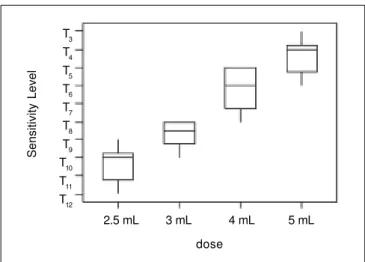
Dispersion of analgesia at 15 minutes was different among the four groups (p < 0.0005). The sensitivity level evaluated
by the Mood test for medians was lower in the 2.5 mL Group, which was lower than in the 3 mL Group, which in turn was lower than in the 4 mL Group and this one was similar to the 5 mL Group (Figure 1).
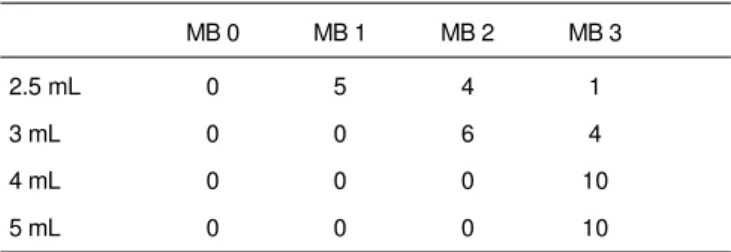
Table III shows the different degrees of motor blockade. A progressive increase in the degree of motor blockade was observed with an increase in the dose (2.5 mL < 3 mL < 4
mL ≅ 5 mL) (p < 0.0005).
The combined standard deviation for the duration of analge-sia was 15 minutes, and 1 hour and 18 minutes was the ma-ximal difference among means. With the parameters and sample used, this study had a power of 99%.
Table I – Patient Data
2.5 mL 3 mL 4 mL 5 mL
Age (years) 47.3 ± 10.9 44.2 ± 12.9 46.5 ± 10.8 45.3 ± 10.9
Weight (kg) 7.,8 ± 6.4 71.3 ± 6.3 72.5 ± 6.1 45.3 ± 10.9
Height (cm) 171.4 ± 5.2 172.5 ± 4.1 172.6 ± 5.4 170.4 ± 5.5
Gender (M/F) 8 / 2 8 / 2 7 / 3 7 / 3
Values expressed as Mean ± SD.
Table II – Parameters Evaluated
2.5 mL 3 mL 4 mL 5 mL
Latency (min:sec) 1:40 ± 0:27 1:27 ± 0:28 1:35 ± 0:26 1:35 ± 0:26
Duration (h:min) 1:26 ± 0:09 1:42 ± 0:12 2:11 ± 0:15 2:45 ± 0:19
Bradycardia 0 0 1 3
Hypotension 0 2 3 4
Failures 0 0 0 0
Headache 0 0 0 0
Figure 1 – Sensitive Level in the Different Groups
Sensitivity Level
2.5 mL 3 mL 4 mL 5 mL
dose T3
STUDY WITH DIFFERENT VOLUMES
DISCUSSION
The present study demonstrated that different volumes of 0.4% hyperbaric S75:R25 bupivacaine with D5W can be used for spinal blocks for infraumbilical surgeries with similar onset of action, and with increased duration and incidence of complications with an increase in the dose.
The choice of anesthetic solution depends on availability. Different drugs are evaluated in different countries, depen-ding on local regulations and commercial factors. Only the isobaric form of 0.5% S75:R25 bupivacaine was introduced in the market. For this reason, the study protocol associated 1 mL of 0.5% isobaric S75:R25 bupivacaine with dextrose 25% in water, resulting in a solution with a lower concen-tration (0.4%). The calculated specific gravity showed hyper-baric behavior in all patients.
Hyperbaric bupivacaine is obtained by the addition of gluco-se; the addition of D5W and D10W were tested, and the 8% concentration showed less variation in the extension of the blockade. The use of 0.75% bupivacaine in dextrose 8% in water did not show advantages over the 0.5% concentra-tion 7. Between 2 and 4 mL, the increase in volume did not
produce any change in dispersion, but produced an increase in the duration of action, which is related with the increase in the dose. In children, hyperbaric bupivacaine with 0.9% or 8% glucose in water produced similarly successful spinal block, cephalad dispersion of the blockade, recovery, and side effects 8, demonstrating that high concentrations of
glucose are not necessary to make a hyperbaric anesthetic solution. In this study with 0.4% hyperbaric S75:R25 bupi-vacaine with D5W in volumes varying from 2.5 to 5 mL, the cephalad dispersion as well as the increase in the duration of action were observed with higher doses.
There are several reasons why one should control the level of maximal sensitive blockade. The level of maximal sensitive blockade results from the injection of the local anesthetic in the subarachnoid space which is determined by the cephalad distribution of the local anesthetic in the CSF and its absorption by the nerve tissue. The dispersion of hyperbaric bupivacaine is related with age, and the level is higher in older patients 9 because age is associated with a
progressive reduction in the volume of CSF. This is one of the reasons why the study protocol with S75:R25 bupivacaine limited patient participation to those between 20 and 60
years of age. Anyway, an increase in cephalad dispersion was observed with an increase in the dose, which was not age-related.
A study comparing racemic (S50:R50) and enantiomeric ex-cess (S75:R25) bupivacaine did not detect differences in the time of onset of the sensitive blockade, which was 1.78 ± 0.73 min 3. In the present study that used different volumes of
S75:R25 bupivacaine, a difference in the time of onset of the sensitive blockade, equal to 1:33 ± 0:26 (min:sec), was not observed among the groups. The duration of the blockade with both solutions was approximately 5 hours, without significant differences 3. A significant increase in the duration
of the blockade was observed with the increase in the dose of 0.4% hyperbaric S75:R25 bupivacaine.
The motor blockade is dose-dependent and it is more fre-quent with pure aqueous solutions 10. In the present study, it
was observed that the incidence of motor blockade was lower with low doses (2.5 and 3 mL) than with high doses (4 and 5 mL), reinforcing the notion that this is a dose-dependent effect. Complete motor blockade was seen only with higher doses.
Hypotension during spinal block is correlated with the dis-persion of the sensitive blockade, prior hydration, and age of the patient. In the present study, the incidence of hypotension was higher when the dose of S75:R25 hyperbaric bupiva-caine was increased.
The addition of D5W to S75:R25 bupivacaine demonstrated, as did other authors 8, that high concentrations of glucose
are not necessary to turn local anesthetics into hyperbaric solutions. Similarly, the reduction in the concentration of S75:R25 bupivacaine to 0.4% showed the same results as those of other studies with hyperbaric bupivacaine. To con-clude, 0.4% S75:R25 hyperbaric bupivacaine with D5W showed fast onset of action and the level of the sensitive blo-ckade, motor bloblo-ckade, and duration of the blockade were dose-dependent. The present study demonstrated that S75:R25 bupivacaine with lower concentration can be pro-duced (0.4% represents a 20% savings) and the concen-tration of glucose added to local anesthetics can be reduced to 5%.
REFERÊNCIAS – REFERENCES
01. Ekblom L, Widman B — LAC-43 and tetracaine in spinal anaes-thesia. Acta Anaesthesiol Scand, 1966;23(Suppl):419-421. 02. Simonetti MPB — Manipulação da relação enantiomérica da
bupivacaína. Rev Bras Anestesiol, 1999;49:416-418.
03. Imbelloni LE, Beato L — Comparação entre bupivacaína racêmica (S50-R50) e mistura enantiomérico de bupivacaína (S75-R25), ambas isobáricas, a 0,5% em raquianestesia. Estudo em cirur-gias ortopédicas. Rev Bras Anestesiol, 2001;51:369-376. 04. Greene NM — Distribution of local anesthetic solutions within
the subaracnoid space. Anesth Analg, 1985;64:715-730. 05. Imbelloni LE, Vieira EM, Beato L et al. — Raquianestesia com a
mistura enantiomérico de bupivacaína a 0,5% isobárica (S75-R25) em crianças com idades de 1 a 5 anos para cirurgia am-bulatorial. Rev Bras Anestesiol, 2002;52:286-293.
Table III – Different Degrees of Motor Blockade (MB)
MB 0 MB 1 MB 2 MB 3
2.5 mL 0 5 4 1
3 mL 0 0 6 4
4 mL 0 0 0 10
06. Bromage PR — A comparison of the hydrochloride and carbon dioxide salts of lidocaine and prilocaine in epidural analgesia. Acta Anaesthesiol Scand, 1965;(Suppl XVI):55-69.
07. Chambers WA, Scott DB — Spinal anesthesia with hyperbaric bupivacaine: effect of added vasoconstrictors. Anesth Analg, 1982;61:49-52.
08. Kokki H, Hendolin H — No difference between bupivacaine in 0.9% and 8% glucose for spinal anaesthesia in small children. Acta Anaesthesiol Scand, 2000;44:548-551.
09. Imbelloni LE, Sobral MGC — Influência da idade na anestesia subaracnóidea com bupivacaína 0,5% hiperbárica. Rev Bras Anestesiol, 1990;40:415-419.
10. Imbelloni LE — O uso racional da raquianestesia, em: Imbelloni LE — Tratado de Anestesia Raquidiana. Curitiba, Medidática Informática, 2001;79.
RESUMEN
Imbelloni LE, Cordeiro JA — Mezcla con Exceso Enantiomérico de 50% de Bupivacaína (S75:R25) Hiperbárica para Procedimientos Quirúrgicos Infraumbilicales. Estudio con Diferentes Volúmenes.
JUSTIFICATIVA Y OBJETIVOS: La bupivacaína hiperbárica co-mercialmente utilizada se presenta como forma racémica. En Bra-sil, la bupivacaína en exceso enantiomérico de 50% (S75:R25) fue lanzada solo en forma isobárica. El objetivo de este estudio fue
evaluar la bupivacaína S75:R25 hiperbáricaen diferentes volúme-nes para la avolúme-nestesia raquídea en procedimientos quirúrgicos infraumbilicales.
MÉTODO: Participaran en el estudio 40 pacientes con edades en-tre los 20 y los 60 años, estado físico ASA I y II, programados para procedimientos quirúrgicos infraumbilicales, bajo anestesia raquí-dea. Los pacientes fueron aleatoriamente separados en cuatro gru-pos de 10 pacientes: Grupo 2,5 - recibió 2,5 mL de la solución (10 mg), Grupo 3 3 mL (12 mg), Grupo 4 4 mL (16 mg) y Grupo 5 -5 mL (20 mg). Se evaluaron y compararon los siguientes pará-metros: latencia, dispersión cefálica, bloqueo motor, alteraciones cardiovasculares y complicaciones neurológicas.
RESULTADOS: La latencia fue de 1:33 ± 0:26 minutos sin diferen-cia significativa entre las dosis utilizadas. Hubo una correlación entre la dispersión del bloqueo y el volumen utilizado. El bloqueo motor fue dosis dependiente. La incidencia de bradicardia o de hipotensión arterial fue correlacionada con el aumento de la dosis. No se registraron fallas.