Received from Instituto de Anestesia Regional, Complexo Hospitalar Mangabeira Gov. Tarcisio Burity, João Pessoa, PB, Brazil.
1. Professor of Anesthesiology, Faculdade de Medicina Nova Esperança (FAMENE), João Pessoa PB, Brazil.
2. Director, Instituto de Anestesia Regional, Complexo Hospitalar Mangabeira Gov. Tarcisio Burity, João Pessoa, PB, Brazil.
3. PhD in Medicine, Santa Casa de São Paulo; Head of the Department of Surgery, Universidade Federal de Goiás; Director of Professional Advocacy at SBA; Specialist in Intensive Care.
4. MSc, Health and Decision Models, Universidade Federal da Paraíba (UFPB), João Pessoa; Complexo Hospitalar Mangabeira Gov. Tarcisio Burity, João Pessoa.
Submitted on February 22, 2012. Approved on April 12, 2012.
Correspondence to: Luiz Eduardo Imbelloni, MD
Rua Francisco Diomedes Cantalice, 21/802 Cabo Branco
58045210 – João Pessoa, PB, Brazil. E-mail: [email protected] SCIENTIFIC ARTICLE
Reducing the Concentration to 0.4% Enantiomeric Excess
Hyperbaric Levobupivacaine (S75: R25) Provides Unilateral
Spinal Anesthesia. Study with Different Volumes
Luiz Eduardo Imbelloni, TSA
1,2, Marildo A. Gouveia, TSA
2, Antonio Fernando Carneiro, TSA
3, Renata Grigorio
4Summary: Imbelloni LE, Gouveia MA, Carneiro AF, Grigorio R – Reducing the Concentration to 4% Enantiomeric Excess Hyperbaric Levobupi-vacaine (S75: R25) Provides Unilateral Spinal Anesthesia. Study with Different Volumes.
Background and objectives:Unilateral spinal anesthesia may be obtained with hypobaric or hyperbaric solution. The objective of this study was to compare different doses of enantiomeric excess hyperbaric levobupivacaine to achieve unilateral spinal anesthesia.
Method: One hundred and twenty patients were randomized to receive 4 mg, 6 mg or 8 mg of 0.4% enantiomeric excess levobupivacaine. The solutions were administered at the L3-L4, with the patient in a lateral position and kept at this position according to dose administration for 5, 10 or 15 minutes. Sensory block (pinprick) and motor block (scale 0-3) were compared between the operated and contralateral sides.
Results: The onset of analgesia was rapid and comparable between groups. Sensory block was significantly higher in the operated than in non-operated limb at all times of evaluation. Increasing the dose by 1 mL (2 mg) corresponded to an increase of two segments in the mode for the operated side. In the operated side, motor block (MB = 3) of patients occurred in 31 (77.5%) with 4mg, 38 (95%) with 6 mg, and 40 (100%) with 8 mg. There was a positive correlation between increased dose, blockade duration, and hypotension. All patients were satisfied with the technique used.
Conclusions: Spinal anesthesia with different volumes of enantiomeric excess hyperbaric bupivacaine (S75: R25) provided a 78% incidence of unilateral spinal block, with the smallest dose used (4 mg) the most efficient.
Keywords: Anesthesia, Spinal; Orthopedics; Anesthetics; Bupivacaine/analogs & derivatives.
©2012 Elsevier Editora Ltda. All rights reserved.
INTRODUCTION
The difference in density between the cerebrospinal fluid (CSF) and local anesthetics is a factor that should be con-sidered to restrict the distribution of solutions within the suba-rachnoid space. Theoretically, unilateral spinal block could be obtained with hypobaric 1 or hyperbaric 2 solution injected into
the subarachnoid space, with the patient in lateral position, so that the anesthetic forms a layer above (hypobaric) or below (hyperbaric) the midline.
In orthopedic outpatients undergoing lower limb surgeries involving only one member, unilateral spinal anesthesia has advantages over conventional anesthesia, such as fewer hy-potension 3, faster recovery from block 1, and increased patient
satisfaction 4. There are several reasons to control the
maxi-mum level of sensory block. Lower limb surgeries require low levels of sensory block, resulting in higher cardiocirculatory stability 4. With small doses of local anesthetics, side effects
such as prolonged motor blockade, hemodynamic instability, and urinary retention may be avoided 5,6. Lateral decubitus
po-sition, low doses of local anesthetic, needle orientation, and slow injection of anesthetic have been suggested as facilita-tors for unilateral spinal anesthesia 7,8.
Levobupivacaine in proportions of 75% levorotatory and dextrorotatory 25% was obtained in 1997 9. It was marketed in
isobaric solution and used in adults 10 and children 11. In 2009,
50% enantiomeric excess bupivacaine was used in 0.4% hy-perbaric solution in different volumes with excellent results in infraumbilical procedures 12. The aim of this prospective
METHOD
The Ethics Research Committee approved the study protocol and all patients were informed and agreed to participate in the study. Exclusion criteria were hypovolemia, pre-existing neu-rological disease, coagulation disorders, thromboprophylaxis for less than eight hours, infection at the puncture site, agita-tion and delirium, and the presence of indwelling catheters.
The incidence of unilateral blockade in several studies ranges from 65% to 90%. Assuming a significance level of 5% and a power of 80%, we obtained the required number of 81 patients. We selected 120 patients to ensure against data loss.
A solution of 50% enantiomeric excess levobupivacaine at 0.4% with 5% glucose was prepared from 0.5% isobaric enantiomeric excess levobupivacaine (S75 : R25) (specific gravity at 37°C of 1.0058 g.mL-1) plus 1 mL of glucose 25% 12.
Selected patients were ASA physical status I-II, without pre-anesthetic medication, aged between 20 and 60 years, sched-uled for unilateral orthopedic surgery under spinal anesthesia. In all patients, pneumatic tourniquet was applied to the thigh and inflated to the maximum pressure of 350 mm Hg. Patients were randomly selected using coded envelopes prepared for the study and divided into three groups of 40 patients. Pa-tients in Group 1 received 4 mg (1 mL), Group 2 received 6 mg (1.5 mL), and Group 3 received 8 mg (2 mL) of enantio-meric excess levobupivacaine (S75, R25) at 0.4% with grav-ity of 1.0107 g.mL-1. Surgeries were knee videoarthroscopies,
correction of ankle fractures with or without ligament injury, and implant removal below the knee.
After sedation with intravenous fentanyl (1 µg.kg-1) and
midazolam (1 mg), skin cleansing with chlorhexidine, and excess removal, spinal puncture was performed with the pa-tient in lateral decubitus position with the involved limb down, through the median interspace L3-L4 after skin infiltration with lidocaine 1%, using a 27G Quincke needle (B. Braun Melsun-gen) without introducer. After observing CSF confirming the correct position of the needle, 4, 6 or 8 mg of 0.4% enantio-meric excess hyperbaric levobupivacaine (S75: R25) were administered at a rate of 1 mL.30s-1. Patients remained in
the lateral position according to dose used: 4 mg (5 minutes), 6 mg (10 minutes), and 8 mg (15 minutes) before being placed in a supine position for evaluation of the parameters studied and beginning of surgery.
Assessment of sensory and motor block was performed by another professional who was blinded to the patient’s group allocation. The level of sensory block, defined as the lack of pinprick sensation, was assessed bilaterally at the midclavicu-lar line, while motor block was assessed by modified Bromage scale 13: 0 = free movement of lower limbs (LL), 1 = inability
to raise the limbs extended, 2 = inability to flex knees, 3 = inability to move the ankles. Sensory and motor block were assessed in both limbs according to studied groups at 5, 10, and 15 minutes after surgery and comparison of involved and noninvolved limb was performed, as well as between groups. In case of blockade failure, another spinal anesthesia would be performed with 10 mg of 0.5% hyperbaric bupivacaine. In
case of insufficient time for the procedure, general anesthesia would be performed with a laryngeal mask. Hypotension (de-creased SBP > 30% ward pressure) was treated with intrave-nous etilefrine (2 mg) and bradycardia (heart rate < 45 bpm) was treated with intravenous atropine (0.50 mg).
Duration of analgesia was determined by the time for sen-sation return to dermatome corresponding to the puncture site. Hemodynamic parameters were evaluated with 5 min-utes interval throughout the procedure. Information regarding the blockade recovery time, surgical time, need for bladder catheterization, pain and treatment administered were re-corded by an investigator. The time to begin ambulation was guided by the surgeon, and postoperative analgesia consisted of plexus blockade with peripheral nerve stimulator of lum-bar or sacral nerve with 50 mL of 50% enantiomeric excess levobupivacaine at 0.2%, according to site of operation, and ketoprofen (100 mg) and dipyrone (3 g) administered intrave-nously. Blockade and the first analgesic dose were performed at end of surgery in the operating room. It was not part of the study to evaluate the quality of postoperative analgesia.
Upon leaving the operating room, patients were asked to record their opinion about the technique. The alternatives were optimal, satisfactory or poor. Patients were followed-up for three days postoperatively in order to gather information about headache, transient neurologic symptoms (TNS) or back pain. Headache was classified as post-dural puncture if presented with worsening at sitting position, occipital or frontal location, increased with coughing, straining or sneezing. Back pain was considered TNS if the patient experienced pain and/ or dysesthesia in the back, buttocks, and legs after recovery with resolution within 72 hours.
The three treatment means were compared by analysis of variance. Probabilities of patient’s level of satisfaction were compared by chi-square test and when it could not be used, Fisher’s exact test was used. The Median Test was used to compare the medians of the three groups. The level of signifi-cance was α = 0.05.
RESULTS
Regarding patients’ demographic data, height showed a sig-nificant difference among the three groups (Table I). Block-ades were sufficient for the procedures performed and there was no need for additional general anesthesia.
The onset of analgesia was rapid and comparable between groups. The dose used did not influence the onset of sensory block, defined as latency time (Table II). There was difference between groups receiving 4 mg and 8 mg regarding duration of surgery (p-value = 0.031) and between groups regarding duration of blockade in different groups, showing increasing duration with increased dosage (4 mg < 6 mg < 8 mg) (Ta-ble II). Development of hypotension showed significant corre-lation with increased dosage (p-value = 0.122, Fisher’s exact test) (Table II).
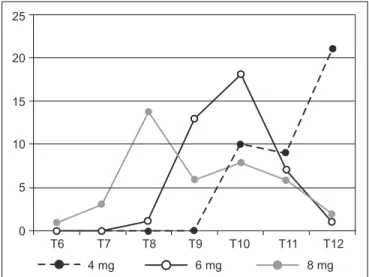
the 4 mg group, which was lower than 6 mg group, which was lower than 8 mg group (Figure 1). The mode for T12 was 4 mg,
T10 6 mg, and T8 8 mg. The 2 mg increase in dosage
cor-responded to a significant increase of two segments in mode between the three doses (Figure 1).
The time spent in lateral decubitus position according to dose reflected a selective unilateral blockade in 38 patients receiving 4 mg (95%), 32 receiving 6 mg (80%), and 24 re-ceiving 8 mg (65%). The increase in dosage corresponded to a significant decrease unilaterally (p-value = 0.001) (Table III). At the end of surgery, there was an increase in unilateral block with all doses, which was 100% with 4 mg, 85% with 6 mg, and 75% with 8 mg.
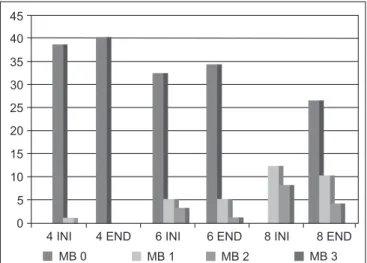
At the initial evaluation, complete motor block (grade 3) in operated limb occurred in 31 patients (77.5%) receiving 4 mg, 38 patients receiving 6 mg (95%), and 40 patients receiving 8 mg (100%) (Figure 1). There is significant difference be-tween doses (p-value < 0.001). At the end of the procedure, no patient showed grade 3 motor block with 4 mg, versus 32 patients with 6 mg and 34 with 8 mg.
In the contralateral limb, absence of motor block (grade 0) at the beginning of surgery occurred in 38 patients with 4 mg versus 32 with 6 mg and none with 8 mg (Figure 3), confirming that the lower dose results in a higher incidence of unilateral blockade. At the end of surgery, no motor block was present in all patients with 4 mg, in 34 patients with 6 mg, and in 26 patients with 8 mg.
Patients who developed hypotension (2 with 6 mg and 4 with 8 mg) required only one dose of the vasopressor. There was no bradycardia in patients of all groups. All patients had an optimal satisfaction with the technique used. No patient had post-dural puncture headache or urinary retention. There were no complaints of back pain or pain in the buttocks or legs during the three subsequent days.
Table I – Patient Data
4 mg 6 mg 8 mg p
Age (years) 40.57 (13.57) 41.22 (9.72) 38.65 (11.31) 0.591* Weight (kg) 62.82 (15.04) 68.80 (8.99) 67.50 (13.45) 0.093* Height (cm) 164.12 (6.69) 168.17 (6.19) 165.50 (8.40) 0.040*
Sex (M/F) 19/21 23/17 21/19 0.530**
Mean (SD); M: male; F: female; Height: difference between groups 4 mg and 6 mg (p = 0.038). (*) 1-Factor ANOVA, (**) X² test.
Table II – Assessed Parameters
4 mg 6 mg 8 mg p-value
Latency (min) 1:46 (0:22) 1:41 (0:17) 1:39 (0:14) 0.196* Surgery duration
(min)
54 (8) 58 (8) 59 (8) 0.036*
Block duration (min)
75 (8) 117 (9) 174 (14) < 0.001*
Hypotension 0 2 4 0.122**
(*) 1-Factor ANOVA; (**) Fisher’s Exact Test.
Table III – Incidence of Unilateral Blockade According to Dose Used in the First Evaluation and at the End of Surgery
4 mg 6 mg 8 mg p
1st Evaluation 0.001*
Yes (%) No (%)
38 (95%) 2 (5%)
32 (80%) 8 (20%)
24 (65%) 16 (35%)
End of Surgery 0.004*
Yes (%) No (%)
40 (100%) 0
34 (85%) 6 (15%)
30 (75%) 10 (25%)
(*) Fisher’s Exact Test.
4 mg 6 mg 8 mg
25
20
15
10
5
0
T6 T7 T8 T9 T10 T11 T12
Figure 1 – Cephalad Spreadon Operated Limb in the First Evalu-ation.
The modewas T12 with 4 mg, T10 with 6 mg, and T8 with 8 mg.
45 40 35 30 25 20 15 10 5 0
4 INI 4 END 6 INI 6 END 8 INI 8 END
MB 0 MB 1 MB 2 MB 3
Figure 2 – Motor Block of Operated Limb in the First Evaluation and at the End of Surgery.
DISCUSSION
In this study, appropriate levels of anesthesia were achieved for surgeries of a single lower limb, using 4 mg, 6 mg, or 8 mg of 50% enantiomeric excess levobupivacaine at 0.4% hyper-baric. The 4 mg dose (1 mL) provided only unilateral blockade in 95% of patients, 6 mg (1.5 mL) in 80%, and 8 mg (2 mL) in 65%, showing that selectivity is dependent on the mass of in-jected anesthetic into the subarachnoid space. The rapid on-set of action was no difference between doses, and duration of action was dose dependent.
Unilateral spinal anesthesia may result in sensory and mo-tor hemiblock preferably on one side. The purpose of applying spinal anesthesia restricted to one of lower limbs is to mini-mize the extent of the blockade on the side to be operated, as well as obtaining surgical anesthesia throughout the proce-dure. This goal was achieved in 78.3% of patients in the first assessment and 86.6% of patients at the end of surgery.
The drugs evaluated for use in anesthesia depend on the national pharmacopoeia regulation and commercial factors. Enantiomeric excess levobupivacaine (S75: R25) at 0.5% was marketed only in isobaric formulation. In a previous study, a protocol was designed to evaluate the drug in hyperbaric so-lution at 0.4% in 5% glucose with different volumes, showing that it can easily replace the 0.5% solution 12, a fact confirmed
in this study.
Hyperbaric bupivacaine is prepared with the addition of glucose, and additions of glucose were tested at 5% and 10%, with the 8% concentration presenting less variation in the ex-tent of blockade. The use of bupivacaine 0.75% in 8% glucose showed no advantage over the 0.5%concentration 14.
Be-tween 2 and 4 mL, the increased volume produced no change in dispersion, but produced an increase in duration of action, which is related to dose increase 14. In children, hyperbaric
bupivacaine with 0.9% or 8% glucose produced similar spinal anesthesia regarding success, cephalad spread of block,
re-covery, and side effects 15, showing that there is no need for
high doses of glucose to make the anesthetic hyperbaric. In a previous study with the same 0.4% solution with 5% glucose, and volumes ranging from 2.5 and 5 mL, there was greater cephalad spread, as well as increased duration of action with increasing dose 12. In this study, the same result was achieved
with low doses for unilateral spinal anesthesia, showing that unilateral blockade was higher with the lower dose and in-versely proportional to the dose used.
Obtaining a selective unilateral blockade depends on the anesthetic, dose, and time spent in the lateral decubitus posi-tion. High doses of bupivacaine (12-20 mg) show significant blockade migration, even after 1 hour in the lateral decubitus position 16, while small doses of bupivacaine (5-8 mg) result
in a restricted blockade after 10-15 minutes in the lateral de-cubitus position 17. The best outcome for unilateral blockade
occurred when low doses of hyperbaric or hypobaric bupica-caine were used and the patient remained in the lateral decu-bitus position for 10-20 minutes 6. In this study, the patient was
maintained in the lateral decubitus position with time depend-ing on the dose used showdepend-ing that the lowest dose (4 mg) required less time than moderate (6 mg) or high doses (8 mg). This resulted in a higher selectivity with the lowest dose (95%) compared with the higher dose (65%).
By definition, baricity is the relationship between the den-sity of injected solution and the denden-sity of CSF. Mean baricity of CSF is 1.00059 ± 0.00020 g.mL-1 18. The baricity of local
anesthetics may be increased by the addition of glucose. The baricity of 0.4% enantiomeric excess hyperbaric levobupiva-caine (S75: R25) is 1.0107 g.mL-1 at 37°C, thus hyperbaric in
all patients. This fact was confirmed when 94 of 120 patients (78.3%) had pure unilateral blockade (only in a single limb), when anesthetized in lateral decubitus position, and only 26 patients (21.7%) had some degree of blockage in the non-operated limb. Large variations in volume and concentration of local anesthetic have little role in its spread to the leptomen-ingeal channel 19 while the total amount of molecules injected
into the spinal canal has a more important role. In this study with dose ranging from 4 to 8 mg, the highest dose resulted in a greater spread of anesthesia and lower selectivity.
The duration of spinal anesthesia is not only dependent on the choice of anesthetic, but also on the dose. The use of 6, 8, and 10 mg of 0.75% hyperbaric bupivacaine and the patient remaining in the lateral decubitus position resulted in a mean duration of analgesia of 93, 123, and 147 minutes, respectively 20. The recovery time using 5 mg of 5%
hyper-baric bupivacaine was 2h30min 2, which was similar to 5 mg of
0.15% hypobaric bupivacaine (2h32min) 1 and 5 mg of 0.5%
isobaric bupivacaine (2h34min) 21. The study of different
dos-es of 0.4% enantiomeric excdos-ess levobupivacaine (S75: R25) for infraumbilical surgeries reflected in a dose-dependent du-ration of action 12. In this study with the same solution and in
the same concentration, low doses of 4, 6 and 8 mg provided recovery times of 75, 117, and 174 minutes, respectively, with positive correlation between doses.
The use of hyperbaric anesthetic at low doses (5 mg) 2
yielded only two unilateral block (without contralateral motor or sympathetic blockade), resulting in great cardiocirculatory
sta-45 40 35 30 25 20 15 10 5 0
4 INI 4 END 6 INI 6 END 8 INI 8 END
MB 0 MB 1 MB 2 MB 3
Figure 3 – Motor Block of Contralateral Limb in the First Evaluation and at the End of Surgery.
bility without hypotension and bradycardia. In the present study at doses ranging from 4 to 8 mg of 0.4% hyperbaric enantio-meric excess levobupivacaine (S75, R25), excellent cardiocir-culatory stability was seen with the onset of hypotension in two patients with 6, four with 8 mg and none with 4 mg.
The use of 0.4% enantiomeric excess hyperbaric levobupi-vacaine in different doses proved to be safe to avoid the on-set of TNS 12. In the present study, there was no case of TNS
at doses of 4-8 mg in the same concentration. Another factor that may have contributed to the non-emergence of TNS in our study was the lack of complete blockade of the lower limbs.
Similar to other study 15, the addition of 5% glucose to
enantiomeric excess levobupivacaine (S75, R25) showed that there is no need for a high concentration of glucose to make the anesthetic hyperbaric. There is much consistency in the
finding that the usual concentration of 8% glucose for hyper-baric spinal anesthesia is exaggerated, thus allowing the addi-tion of adjuvant analgesics (opioids or not) to the lower dose of local anesthetic and conservation of hyperbaricity. Thus, many other studies can be performed with hyperbaric spinal anesthe-sia in the context of multimodal analgeanesthe-sia. Likewise, the results obtained by reducing the concentration to 0.4% enantiomeric excess levobupivacaine (S75, R25) are similar to results from other studies obtained with hyperbaric bupivacaine.
REFERENCES
1. Imbelloni LE, Beato L, Gouveia MA – Baixas doses de bupivaca-ína hipobárica para raquianestesia unilateral. Rev Bras Anestesiol, 2003;53:579-585.
2. Imbelloni LE, Beato L, Cordeiro JA – Raquianestesia unilateral com baixa dose de bupivacaína 0,5% hiperbárica. Rev Bras Anestesiol, 2004;54:700-706.
3. Casati A, Fanelli G, Aldegheri G et al – Frequency of hypotension during conventional or asymetric hyperbaric spinal block. Reg Anesth Pain Med, 1999;24:214-219.
4. Imbelloni LE. O uso racional da raquianestesia. Em: Imbelloni LE, Tratado de Anestesia Raquidiana, Medidática Informática Ltda, Cu-ritiba, 2001, Capítulo 8, p. 74.
5. Pittoni G, Toffoletto F, Calcarella G et al – Spinal anesthesia in outpa-tient knee surgery: 22-gauge versus 25-gauge Sprotte needle. Anesth Analg, 1995;81:73-79.
6. Kuusniemi KS, Pihlajamäki KK, Pitkänen MT – A low dose of plain or hyperbaric bupivacaine for unilateral spinal anesthesia. Reg Anesth Pain Med, 2000;25:605-610.
7. Tanasichuk MA, Schultz EA, Matthews JH et al – Spinal hemianalge-sia: An evaluation of a method, its applicability, and influence of the incidence of hypotension. Anesthesiology, 1961;22:74-85.
8. Casati A, Fanelli G, Cappelleri G et al – Low dose hyperbaric bupiva-caine for unilateral spinal anaesthesia. Can J Anaesth, 1998;45:850-854.
9. Simonetti MPB, Valinetti EA, Ferreira FMC – Avaliação da atividade anestésica local da S(-)bupivacaína: Estudo experimental in vivo no nervo ciático de rato. Rev Bras Anestesiol, 1997; 47:425-434. 10. Imbelloni LE, Beato L – Comparação entre bupivacaína racêmica
(S50:R50) e mistura enantiomérica de bupivacaína (S75:R25), ambas isobáricas, a 0,5%, em raquianestesia. Estudo em cirurgias ortopédi-cas. Rev Bras Anestesiol, 2001;51:369-376.
11. Imbelloni LE, Vieira EM, Beato L, Sperni F – Raquianestesia com a mistura enantiomérica de bupivacaína a 0,5% isobárica (S75-R25) em crianças com idades de 1 a 5 anos para cirurgia ambulatorial. Rev Bras Anestesiol, 2002;52:286-293.
12. Imbelloni LE, Cordeiro JA – Mistura em excesso enantiomérico de 50% de bupivacaína (S75:R25) hiperbárica para procedimentos ci-rúrgicos infraumbilicais. Estudo com diferentes volumes. Rev Bras Anestesiol, 2009;59:3-10.
13. Bromage PR – A comparison of the hydrochloride and carbon dioxide salts of lidocaine and prilocaine in epidural analgesia. Acta Anaesthe-siol Scand, 1965;Suppl XVI:55-69.
14. Chambers WA, Scott DB – Spinal anesthesia with hyperbaric bupi-vacaine: effect of added vasoconstrictors. Anesth Analg, 1982;61:49-52.
15. Kokki H, Hendolin H – No difference between bupivacaine in 0.9% and 8% glucose for spinal anaesthesia in small children. Acta Anaes-thesiol Scand, 2000;44:548-551.
16. Povey HMR, Jacobsen J, Westergaard-Nielsen J – Subarachnoid an-algesia with hyperbaric 0.5% bupivacaína: Effect of 60-min period of sitting. Acta Anaesthesiol Scand, 1989;33:295-297.
17. Esmaoglu A, Boyaci A, Ersoy O et al – Unilateral spinal anesthesia with hyperbaric bupivacaine. Acta Anaesthesiol Scand, 1998;42:1083-1087.
18. Lui ACP, Polis TZ, Cicutti NJ – Densities of cerebrospinal fluid and spinal anaesthetic solutions in surgical patients at body temperature. Can J Anesth, 1998;45:297-303.
20. Kim KC, Moneta MD – Unilateral spinal anesthesia can be obtai-ned with low dose bupivacaine. Anesthesiology, 1992;77:(Suppl 3A):A803.