J C O L O P R O C T O L . 2 0 1 3 ;3 3 ( 4 ): 2 3 2 - 2 3 5
Case report
Biological therapy for pyoderma gangrenosum
Naw Ally Krüger
a,*, Jacqueline Jéssica De Marchi
a, Mardem Machado de Souza
baDepartament of General Surgery, Hospital Geral Universitário (HGU), Universidade de Cuiabá (UNIC), Cuiabá, MT, Brazil bDepartament of General Surgery and Coloproctology, HGU, UNIC, Cuiabá, MT, Brazil
a r t i c l e i n f o
Article history:
Received 11 June 2013 Accepted 13 August 2013
Keywords:
Inlammatory bowel disease
Pyoderma gangrenosum
Ulcerative colitis
a b s t r a c t
Introduction: pyoderma gangrenosum (PG) is a rare and severe neutrophilic dermatosis asso-ciated with inlammatory bowel disease (IBD) and other systemic diseases such as rheu-matoid arthritis and hematological malignancies. Diagnosis is based on clinical criteria and exclusion of other skin disorders. There is no gold standard for the treatment of PG; traditionally intravenous corticosteroids are used, but recently the use of drugs that in-hibit tumor necrosis factor alpha (TNF-alpha) has changed the management of PG, showing great effectiveness.
Case report: female patient, 23 years old, diagnosed with severe nonspeciic ulcerative colitis (UC) three years ago, undergoing treatment with oral mesalamine and azathioprine. She developed PG fourteen days after hospital discharge; hospitalization was due to worsening of intestinal disease symptoms. She was successfully treated using biological therapy after unfavorable evolution with corticosteroid therapy.
Conclusion: PG, a rare extraintestinal manifestation of IBD of dificult resolution that has signiicant impact on patient quality of life. The use of biological therapy for PG has higher eficacy in the treatment of patients decreasing wound healing time and return to daily activities.
© 2013 Elsevier Editora Ltda. All rights reserved.
* Corresponding author.
E-mail: [email protected], [email protected] (N.A. Krüger) 2237-9363/$ - see front matter. © 2013 Elsevier Editora Ltda. All rights reserved. http://dx.doi.org/10.1016/j.jcol.2013.08.010
Palavras-chave:
Doença inlamatória intestinal Pioderma gangrenoso
Retocolite ulcerativa inespecíica
r e s u m o
Terapia biológica no tratamento do pioderma gangrenoso
J C O L O P R O C T O L . 2 0 1 3 ;3 3 ( 4 ): 2 3 2 - 2 3 5
233
Introduction
Pyoderma gangrenosum (PG) is a rare neutrophilic dermatosis in which painful nodules and later pustules, due to subse-quent necrosis of the dermis, open up to form irregular and painful, with a granular base, commonly with purplish and undermined borders.1 The lesions have distinctively an exu-dative, mucopurulent content, often sterile and eventually hemorrhagic.1-2
The lesions can be single or multiple, can appear in the site of prior trauma, but generally they affect the skin surround-ing stomata and the extensor surface of the lower limbs and so they may be found in any part of the body. The anatomo-pathological analysis shows evidence of nonspeciic neutro-philic dermatosis, however it has to be performed since PG diagnosis is based on clinical criteria and exclusion of other skin disorders.1-3
This severe dermatosis appears in 1% to 2% of patients with inlammatory bowel disease (IBD) and its correlation with disease activity, although it seems to coincide with the intestinal disease exacerbation, especially in the colon, is still controversial as it also occurs independently. PG seems to be more common in ulcerative colitis (UC) than in Crohn’s disease (CD), occurring in approximately 5% of UC patients and just in 2% of those with CD.1,4-6 This dermatosis is also
described in association to other systemic diseases such as rheumatoid arthritis, hematological malignancies and solid tumors, as well as in the idiopathic form.7-8
There is no gold standard for the treatment of PG and there is no evidence that show different results of treatment effec-tiveness when it is intended for patients with or without IBD.1
In general, immunosuppression is the mainstay of PG treat-ment and intravenous corticosteroids have traditionally been the irst-line treatment.1 Recently, the use of inhibitors of
TNF-alpha has changed the management of PG in UC, show-ing signiicant effectiveness.1
In the present study we report a rare case of PG as extraint-estinal manifestation of UC, successfully treated using biolog-ical therapy after unfavorable evolution with corticosteroids.
Case report
Female patient, 23 years old, Brazilian mulatto, a resident in the city of Cuiabá, state of Mato Grosso, Brazil, diagnosed with severe UC three years ago with involvement of the
entire colon. She had been treated with oral mesalamine 4 g/day since diagnosis and had also been using azathioprine 2.5 mg/kg/day for the past year. She had a history of recurrent hospitalizations due to disease exacerbation, routinely treated with antibiotics and intravenous corticosteroids, followed by weaning and outpatient follow-up. She denied any extraintestinal manifestation of UC.
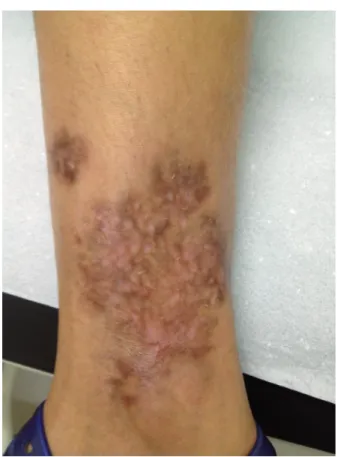
She sought treatment at the ER complaining of a non-monitored fever, malaise, myalgia and multiple painful sores all over her body when she was hospitalized. She reported at the time of hospital admission, a previous 14 days hos-pitalization due to the recent exacerbation of UC intestinal symptoms. At physical examination ulcers with undermined edges were observed with serosanguineous luid and painful purplish pustules distributed over legs, ankles, and face (Fig. 1). She denied any gastrointestinal symptoms at admission. Laboratory assessment showed: mild anemia, absence of leu-kocytosis and elevated CRP (23.1 mg/dL). The patient declared that she had noticed the presence of small pustular lesions
Relato do caso: paciente feminina, 23 anos, com diagnóstico de retocolite ulcerativa inespe-cíica (RCUI) severa há três anos, em tratamento com mesalazina oral e azatioprina. Evoluiu apresentando PG quatorze dias após alta hospitalar, por internamento devido agudização dos sintomas intestinais da doença. Foi tratada com sucesso usando terapia biológica após evolução desfavorável com corticoide.
Conclusão: PG, uma rara manifestação extraintestinal das DII, é de difícil resolução e com signiicante interferência na qualidade de vida dos pacientes. O uso de terapia biológica no PG vem mostrando melhor eicácia no tratamento desses doentes com diminuição do tempo de cicatrização das feridas e retorno às atividades diárias.
© 2013 Elsevier Editora Ltda. Todos os direitos reservados.
J C O L O P R O C T O L . 2 0 1 3 ;3 3 ( 4 ): 2 3 2 - 2 3 5
234
on the lower limbs and at previous venous puncture sites at the time of her last hospital discharge, but lent no importance to it.
After admission, therapy with hydrocortisone 300 mg/day was promptly initiated, along with intravenous analgesics, and local care of the wounds with isotonic solution. Without signiicant response and with intense pain, on the third day of hospitalization it was decided to initiate biological therapy using Inliximab (IFX) at a dose of 5 mg/kg. After the irst infu-sion, at week 0, it was noted a signiicant decrease of the local inlammatory activity and the patient also reported an im-portant decrease in localized pain. After the second infusion, at week 2, the lesions decreased in size and the epithelializa-tion process could be noticed. After the third infusion at week 6, the lesions showed almost complete re-epithelialization (Fig. 2) and after the fourth infusion at week 14, the lesions were at the advanced stages of healing with contraction of the edges (Fig. 3).
Even after completed treatment for PG, the patient con-tinued using IFX regularly, which also resulted in a great impact on intestinal symptoms. Currently, she reports 1-2 daily episodes of bowel movement without mucus, pus or blood.
Discussion
Although the etiology of PG is partially unknown, the skin
damage does seem to be immune-mediated.1,3 Neutrophil
dysfunction, together with defects in chemotaxis or hyperre-activity have been suggested as possible causes.9 The goal of
treatment is the rapid resolution of the lesions, as they may result in severe skin deformities.1
Tumor Necrosis Factor-alpha (TNF-alpha) is a potent pro-inlammatory cytokine present in patients with IBD and is reportedly expressed in skin samples from patients with PG; therefore, it is one of the key cytokines involved in this re-sponse, as it contributes to the recruitment of inlammatory cells to the skin and increase the expression of adhesion mol-ecules.10
The safety, clinical effectiveness and capacity to reduce corticosteroid usage in patients with IBD undergoing therapy with IFX has been clearly proven by pivotal studies such as ACT 1, ACT 211 and SONIC.12 However, although the
effective-ness of IFX in PG lesions rapid healing has been described in recent case reports1,13-15 studies comparing the eficacy of IFX
with other immunosuppressive drugs are still lacking.1 The
largest multicenter, randomized, placebo-controlled trial in-volving IFX in the treatment of refractory PG included 30 pa-tients, 19 of which had a diagnosis of IBD and 6 of UC. After 2 weeks, 46% of the IFX group showed improvement, in com-parison to only 6% in the placebo group.16
Fig. 2 - After the third infusion of IFX. Ulcer is at the end of granulation phase, still reddish in appearance, showing almost complete epithelialization.
J C O L O P R O C T O L . 2 0 1 3 ;3 3 ( 4 ): 2 3 2 - 2 3 5
235
Supported by the idea that the rapid and dramatic im-provement of skin lesions is caused by the crucial role that TNF-alpha plays in the pathogenesis of PG, and that biologi-cal drugs have been able to decrease the healing time of skin and mucosal lesions, thus allowing an earlier return to daily activities, it is reasoned that drugs that inhibit TNF-alpha may be a promising therapeutic strategy for PG in patients with UC, in which case they are being already used with signiicant eficacy.
Conlicts of interest
The authors declare no conlicts of interest.
R e f e r e n c e s
1. Van Assche G, Dignass A, Bokemeyer B, Danese S, Gionchetti P, Moser G, et al. Second European evidence-based consensus on the diagnosis and management of ulcerative colitis part 3: special situations. European Crohn’s and Colitis Organisation. J Crohns Colitis. 2013 Feb;7(1):1-33.
2. Callen JP. Pyodermagangrenosum. Lancet 1998; 351:581–585. 3. Regueiro M, Valentine J, Plevy S, Fleisher MR, Lichtenstein
GR. Inliximab for treatment of pyoderma gangrenosum associated with inlammatory bowel disease. Am J Gastroenterol 2003; 98: 1821–1826.
4. Veloso RV. Review article: skin complications associated with inlamatory bowel disease. Aliment Pharmacol Ther 2004; 20 (suppl. 4): 50-3.
5. Yuksel I, Basar O, Ataseven H, Ertugrul I, Arhan M, Ibis M, et al. N. Mucocutaneous manifestations in inlammatory bowel disease. Inlamm Bowel Dis; 2009; 15 (4): 546-50.
6. Mir-Madjlessi SH, Taylor JS, Farmer RG. Clinical course and evolution of erythema nodosum and pyoderma gangrenosum in chronic ulcerative colitis: A study of 42 patients. Am J Gastroenterol 1985; 80(8): 615-20.
7. Bennett ML, Jackson JM, Jorizzo JL, Fleischer AB Jr, White WL, Callen JP. Pyoderma gangrenosum: a comparison of typical and atypical forms with an emphasis on time to remission. Case review of 86 patients from 2 institutions. Medicine (Baltimore) 2000; 79:37-46.
8. Hasselmann DO, Bens G, Tilgen W, Reichrath J. Pyoderma gangrenosum: clinical presentation and outcome in 18 cases and review of the literature. J Dtsch Dermatol Ges 2007;5:560-564.
9. Su WP, Davis MD, Weening RH, Powell FC, Perry HO. Pyoderma gangrenosum: clinicopathologic correlation and proposed diagnostic criteria. Int J Dermatol 2004;43:790-800. 10. Krueger JG. The immunologic basis for the treatment of
psoriasis with new biologic agents. J Am Acad Dermatol 2002; 46:1-23.
11. Reinisch W, Sandborn WJ, Rutgeerts P, Feagan BG, Rachmilewitz D, Hanauer SB, et al. Long-term inliximab maintenance therapy for ulcerative colitis: the ACT-1 and -2 extension studies. Inlamm Bowel Dis. 2012 Feb;18(2):201-11. 12. Colombel JF, Sandborn WJ, Reinisch W, Mantzaris GJ,
Kornbluth A, Rachmilewitz D, et al. Inliximab, azathioprine, or combination therapy for Crohn’s disease. N Engl J Med 2010; 362:1383-1395.
13. Tan MH, Gordon M, Lebwohl O, George J, Lebwohl MG. Improvement of pyoderma gangrenosum and psoriasis associated with Crohn disease with anti-tumor necrosis factor monoclonal antibody. Arch Dermatol 2001;137: 930–933.
14. Baglieri F, Scuderi G. Inliximab for treatment of resistant pyoderma gangrenosum associated with ulcerative colitis and psoriasis. A case report. Dermatol Ther 2010; 23: 541–543. 15. Del Giacco SR, Firinu D, Lorrai MM, Serusi L, Meleddu R, Barca
MP, et al. Idiopathic Pyoderma Gangrenosum: Successful Resolution with Inliximab Therapy and Proinlammatory Cytokines Assessment. Acta Derm Venereol 1992.