ABSTRACT:Objective: To determine the prevalence of excessive gestational weekly weight gain and to identify its association with demographic, socioeconomic, obstetric, anthropometric, and behavioral characteristics. Methods: This cross-sectional study included 328 pregnant women attending all health units in the urban area of Vitória da Conquista, Bahia. The data were collected from May 2010 to June 2011. The weekly weight gain was evaluated according to the current recommendations of the Institute of Medicine. The association among the studied factors and the excessive weekly weight gain was observed in pregnant women in the second and third trimesters, using the Poisson regression with robust variance. Results: The prevalence rate of excessive weekly weight gain in pregnant women in the second and third trimesters was found to be 42.5%. The determinants of excessive weekly weight gain were family income < 1 minimum wage (PR: 2.65; 95%CI 1.18 – 4.83) and pregestational weight status overweight/obesity (PR: 1.33; 95%CI 1.01 – 1.75). Conclusion: The results emphasize the importance of monitoring the weight gain during pregnancy. The evaluation of the weekly weight gain enables early interventions with the goal of preventing the excessive total weight gain and its consequences for both the mother and the child.
Keywords: Pregnant Women. Weight Gain. Nutritional Status. Overweight. Obesity. Income. Prenatal Care.
Prevalence and factors associated with
excessive weight gain in pregnancy in
health units in the southwest of Bahia
Prevalência e fatores associados ao ganho de peso gestacional
excessivo em unidades de saúde do sudoeste da Bahia
Elma Izze da Silva MagalhãesI, Daniela Santana MaiaII, Carla Fabrícia Araújo BonimIII,
Michele Pereira NettoIV, Joel Alves LamounierV, Daniela da Silva RochaII
ORIGINAL ARTICLE / ARTIGO ORIGINAL
IGraduate Program in Epidemiology, Universidade Federal de Pelotas – Pelotas (RS), Brazil.
IISchool of Nutrition, Universidade Federal da Bahia, Campus Anísio Teixeira – Vitória da Conquista (BA), Brazil. IIIFaculdade Guanambi – Vitória da Conquista (BA), Brazil.
IVCourse of Nutrition,Universidade Federal de Juiz de Fora – Juiz de Fora (MG), Brazil.
VCourse of Pediatrics, Universidade Federal de Minas Gerais and Universidade Federal de São João del-Rei – São João del-Rei (MG), Brazil.
Corresponding author: Daniela da Silva Rocha. Rua Rio de Contas, 58, Quadra 17, Lote 58, CEP: 45029-094, Candeias, Vitória da Conquista, BA, Brasil. E-mail: [email protected]
INTRODUCTION
Much has been debated on the ideal weight gain during pregnancy, which has led to changes in nutritional recommendations1. The recommendations on weight gain during pregnancy established by the Institute of Medicine (IOM) are the most accepted ones and have been used as a reference standard in many studies2,3. The irst recommenda-tions regarding weight gain made by IOM were proposed in 19902, being revised later and updated in 20093.
Weight gain in pregnancy is a result of the increasing maternal storage of fat and nutri-ents, the increased maternal tissues (uterus, placenta, fat tissue, and breasts), expanding extra-cellular liquid and blood volume, and formation of amniotic liquid, besides fetal growth2,4. The variations of weight gain during pregnancy may be inluenced by nutritional, socio-demographic, obstetric, and behavioral factors5,6. Studies have shown that an excessive weight gain in pregnancy is associated with the growing number of surgical deliveries, and with the increasing risk of unfavorable perinatal results such as fetal macrosomia, cepha-lopelvic disproportion, trauma, asphyxia, and perinatal death. Besides, the occurrence of gestational diabetes mellitus, the hypertensive syndromes of pregnancy, and postpartum weight retention may increase7-11.
In this context, the evaluation of weekly weight gain and the understanding of its deter-minants are very relevant for the establishment of early interventions aiming at ensuring mother-child health. The objective of this study was to assess the factors associated with an excessive weekly weight gain of pregnant women assisted in all health units of the urban zone of a city in the southeast region of Bahia.
RESUMO:Objetivo: Determinar a prevalência do ganho de peso semanal excessivo em gestantes e veriicar a associação com fatores demográicos, socioeconômicos, obstétricos, antropométricos e comportamentais. Metodologia: Trata-se de um estudo transversal realizado com 328 gestantes assistidas em todas as unidades de saúde da zona urbana de Vitória da Conquista, Bahia. Os dados foram coletados no período de maio de 2010 a junho de 2011. O ganho de peso semanal foi avaliado de acordo com as recomendações atuais do Institute of Medicine (IOM). A associação entre os fatores em estudo e o ganho de peso semanal excessivo foi veriicada nas gestantes, no segundo e terceiro trimestres, por meio da análise de regressão de Poisson com variância robusta. Resultados: A prevalência de ganho de peso semanal excessivo nas gestantes do segundo e terceiro trimestres foi de 42,5%. Os fatores determinantes do ganho ponderal semanal excessivo foram: renda familiar < 1 salário mínimo (RP: 2,65; IC95% 1,18 – 4,83) e estado nutricional pré-gestacional sobrepeso/obesidade (RP: 1,33; IC95% 1,01 – 1,75). Conclusão: Os resultados do estudo reforçam a importância do monitoramento do ganho de peso durante a gestação. A avaliação do ganho de peso semanal possibilita a realização de intervenções precoces visando a prevenção do ganho de peso total excessivo e suas consequências para a mãe e para a criança.
METHODS
This is a cross-sectional study conducted with pregnant women assisted in all prenatal ser-vice publics from the urban zone of Vitória da Conquista. The city of Vitória da Conquista is located in the southeast region of Bahia, being the third largest in the State, with a pop-ulation of 306,866 inhabitants and human development index (HDI) of 0.67812. Regarding the health sector, the primary-care health network of Vitória da Conquista is constituted of 21 health units (15 Family Health Units – UFSs, 3 Basic Care Polyclinics, and 3 Health Centers), which ofer prenatal care to the studied population.
The software Statcalc, Epi info 6.04, was used to calculate the sample13, considering the total number of pregnant women assisted in the health units of the urban zone of Vitória da Conquista (n = 2,316) in 2010, a prevalence of excessive weight gain estimated in 32.3%14, standard error of 5%, with 95% conidence interval, plus 10% to make up for possible losses or nonresponse, resulting in a minimum sample size of 322 pregnant women.
The research project was submitted to and approved by the Research Ethics Committee at Universidade Estadual do Sudoeste da Bahia. Data collection took place from May 2010 to June 2011, during the prenatal appointments in the health units. Pregnant women were randomly invited to participate in the study, being informed about the objective of the research. They signed the Informed Consent Form if they agreed to participate.
The information was collected by a standard questionnaire, including questions regard-ing the identiication of the pregnant woman, current pregnancy, previous pregnancies, and sociodemographic and demographic data. The studied variables present diferent sample size, because some of the interviewees did not have information on the questions in the instrument.
Weight and height anthropometric measurements were taken by interns trained according to the techniques recommended by the Food and Nutritional Surveillance System (SISVAN), from the Ministry of Health15. Body weight was measured by a portable electronic digital scale Marte®, with 200 kg capacity and 50 g sensitivity. Height was measured by the porta-ble stadiometer Alturexata® (213 cm, accuracy of 0.1 cm).
Gestational age in weeks was calculated by considering the date of data collection and the date of the last period, recorded in the women’s card.
The pregestational nutritional status and the weekly weight gain were assessed accord-ing to the cutof points proposed by the IOM3. From calculating pregestational body mass index (BMI = weight (kg)/height (m)2), the pregnant women were classiied into: low weight (pregestational BMI lower than 18.5 kg/m2); normal (pregestational BMI between 18.5 and 24.9 kg/m2); overweight (pregestational BMI between 25 and 29.9 kg/m2); and obesity (pre-gestational BMI higher than 30 kg/m2)3.
gain in this study was conducted among pregnant women after the 14th week of pregnancy (second and third trimesters).
Weekly weight gain of pregnant women in the second and third trimesters was calculated by subtracting the current weight (at the time of data collection) from the weight referring to the irst trimester. This result was divided by the number of weeks counting after the second trimester. Excessive weekly weight gain was considered when being higher than the values recommended for each category of pregestational nutritional status: 0.58 kg/ week for women with low weight; 0.50 kg/week for eutrophic women; 0.33 kg/week for overweight women; and 0.27 kg/week for obese women3.
Statistical analyses were conducted with the software Stata 9.1. The population was char-acterized by calculating absolute and relative frequencies for categorical variables and by central tendency and dispersion measures in case of quantitative variables.
The association between the studied variables and excessive weekly weight gain was ver-iied by the Poisson regression with robust variance. At irst, a bivariate analysis was con-ducted to evaluate possible associations between demographic, socioeconomic, obstetric, anthropometric, and behavioral variables (independent variables), with an excessive weekly weight gain (dependent variable). The variables presenting statistical signiicance lower than 0.20 in the bivariate analysis were included in the multivariate analysis, with proba-bility lower than 5% (p < 0.05), considered as statistical signiicance for the selection in the multiple regression model.
The stepwise strategy was adopted for the selection in the inal model, with the inclusion of all of the variables selected during the bivariate analysis in decreasing order of statistical signiicance. The variables presenting p ≥ 0.05 were taken from the model, being deinitely excluded if the decrease in the explanation of the outcome is not statistically signiicant. To analyze this parameter, the model was assessed after every exclusion by using the Wald test and the partial likelihood ratio. The quality of the inal model was evaluated by calcu-lating its coeicient of determination (R2), by using the goodness-of-it test and the linktest and by analyzing the residue, mostly based on inluential points.
RESULTS
Three-hundred and twenty-eight pregnant women were assessed, mostly aged from 20 to 34 years, with a mean age of 24.0 ± 6.2 years. Regarding marital status, it was found that 86.89% were married or had a stable partner. As to family income, the monthly income of most pregnant women was equal to or higher than one minimum wage at the time of the study. The mean schooling of pregnant women and their husbands was 7.9 ± 3.0 and 7.8 ± 3.2 schooling years, respectively (Table 1).
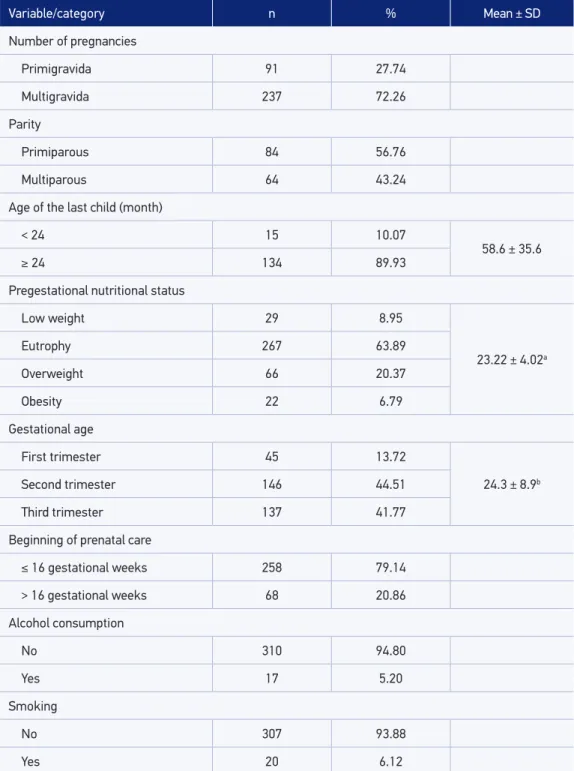
and alcohol consumption were mentioned by 6.12 and 5.20% of the women, respectively. Concerning pregestational nutritional status, it was observed that most pregnant women were eutrophic, and 27.16% presented excess weight before pregnancy (Table 2).
The prevalence of an excessive weekly weight gain among pregnant women in their second and third trimesters was 42.5%.
Variable/category n % Mean ± SD
Age of pregnant women (years)
< 20 92 28.05
24.0 ± 6.2
20 to 34 215 65.55
≥ 35 21 6.40
Marital status
Without a partner 43 13.11
With a partner 285 86.89
Schooling – pregnant women (years)
< 4 21 6.40
7.9 ± 3.0
4 to 8 156 47.56
9 to 11 143 43.60
> 11 8 2.44
Schooling – husbands (years)
< 4 19 6.93
7.8 ± 3.2
4 to 8 132 48.18
9 to 11 116 42.34
> 11 8 2.55
Family income
< 1 minimum wage 48 14.72
1.48 ± 1.07
≥ 1 minimum wage 278 85.28
Number of people in the family
≤ 4 people 238 72.56
3.7 ± 1.8
> 4 people 90 27.44
Table 1. Distribution of pregnant women assisted in health units of the urban zone, according to socioeconomic and demographic characteristics. Vitória da Conquista, Bahia, Brazil, 2011.
Variable/category n % Mean ± SD
Number of pregnancies
Primigravida 91 27.74
Multigravida 237 72.26
Parity
Primiparous 84 56.76
Multiparous 64 43.24
Age of the last child (month)
< 24 15 10.07
58.6 ± 35.6
≥ 24 134 89.93
Pregestational nutritional status
Low weight 29 8.95
23.22 ± 4.02a
Eutrophy 267 63.89
Overweight 66 20.37
Obesity 22 6.79
Gestational age
First trimester 45 13.72
24.3 ± 8.9b
Second trimester 146 44.51
Third trimester 137 41.77
Beginning of prenatal care
≤ 16 gestational weeks 258 79.14
> 16 gestational weeks 68 20.86
Alcohol consumption
No 310 94.80
Yes 17 5.20
Smoking
No 307 93.88
Yes 20 6.12
Table 2. Distribution of pregnant women assisted at health units in the urban zone, according to obstetric, anthropometric, and behavioral characteristics. Vitória da Conquista, Bahia, Brazil, 2011.
SD: standard deviation. aPregestational body mass index; bgestational weeks; crecommendation of the Prenatal and
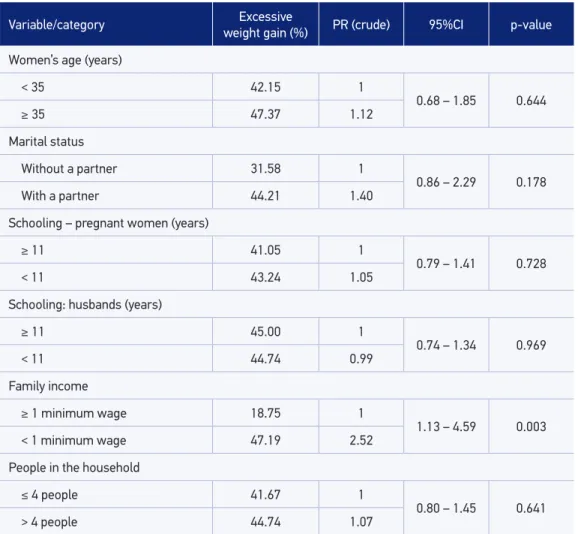
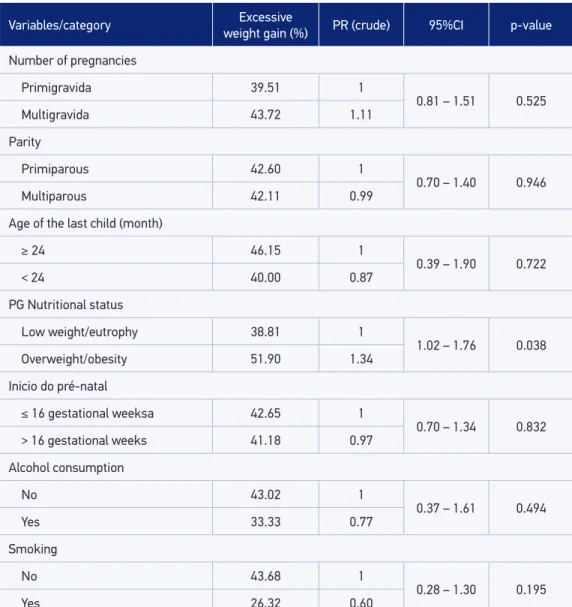
On the basis of the bivariate analysis, among the socioeconomic and demographic char-acteristics related to excessive weekly weight, the following variables were included in the multivariate analysis: marital status and family income (Table 3); and, among the obstetric, anthropometric, and behavioral analyses, the following were included: nutritional and pre-gestational statuses and smoking (p < 0.20) (Table 4).
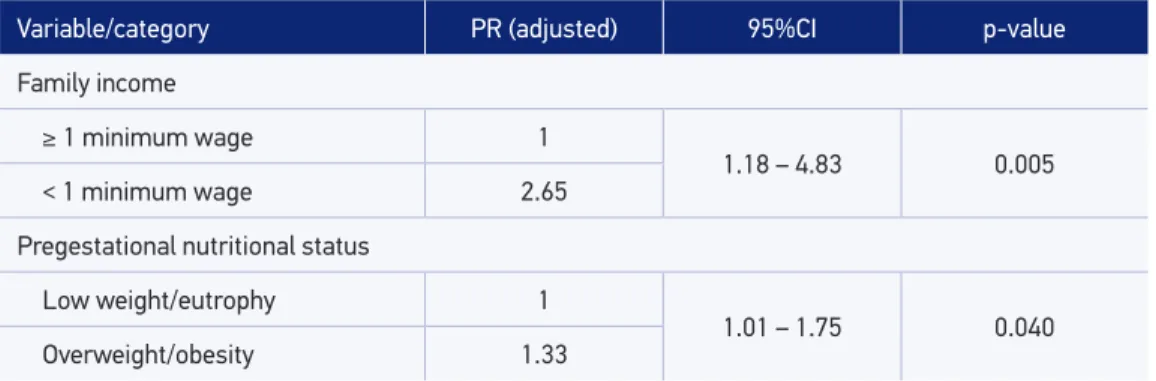
After adjusting the multiple regression model, the factors that were associated with excessive weekly weight gain were as follows: family income and pregestational nutri-tional status. A higher prevalence of excessive weekly weight gain among pregnant women who earned less than one minimum wage in comparison with the pregnant
Variable/category Excessive
weight gain (%) PR (crude) 95%CI p-value
Women’s age (years)
< 35 42.15 1
0.68 – 1.85 0.644
≥ 35 47.37 1.12
Marital status
Without a partner 31.58 1
0.86 – 2.29 0.178
With a partner 44.21 1.40
Schooling – pregnant women (years)
≥ 11 41.05 1
0.79 – 1.41 0.728
< 11 43.24 1.05
Schooling: husbands (years)
≥ 11 45.00 1
0.74 – 1.34 0.969
< 11 44.74 0.99
Family income
≥ 1 minimum wage 18.75 1
1.13 – 4.59 0.003 < 1 minimum wage 47.19 2.52
People in the household
≤ 4 people 41.67 1
0.80 – 1.45 0.641
> 4 people 44.74 1.07
Table 3. Crude prevalence ratio of excessive weekly weight gain and its 95% conidence intervals, according to socioeconomic and demographic variables among pregnant women assisted in the health units. Vitória da Conquista, Bahia, Brasil, 2011.
women who earned one minimum wage or more was observed. In addition, a higher prevalence among women who were already overweight/obese when they got preg-nant in relation to those with low pregestational nutritional status/eutrophy was recorded (Table 5).
Variables/category Excessive
weight gain (%) PR (crude) 95%CI p-value
Number of pregnancies
Primigravida 39.51 1
0.81 – 1.51 0.525
Multigravida 43.72 1.11
Parity
Primiparous 42.60 1
0.70 – 1.40 0.946
Multiparous 42.11 0.99
Age of the last child (month)
≥ 24 46.15 1
0.39 – 1.90 0.722
< 24 40.00 0.87
PG Nutritional status
Low weight/eutrophy 38.81 1
1.02 – 1.76 0.038
Overweight/obesity 51.90 1.34
Inicio do pré-natal
≤ 16 gestational weeksa 42.65 1
0.70 – 1.34 0.832 > 16 gestational weeks 41.18 0.97
Alcohol consumption
No 43.02 1
0.37 – 1.61 0.494
Yes 33.33 0.77
Smoking
No 43.68 1
0.28 – 1.30 0.195
Yes 26.32 0.60
Table 4. Prevalence, crude prevalence ratio, and 95% conidence intervals of excessive weekly weight gain, according to obstetric, anthropometric, and behavioral variables among pregnant women assisted in the health units. Vitória da Conquista, Bahia, Brazil, 2011.
PR: prevalence ratio; 95%CI: 95% conidence interval; PG: pregestational; arecommendation of the Prenatal and Birth
DISCUSSION
The prevalence of excessive weekly weight gain among pregnant women in the sec-ond and third trimesters in this study was lower to that veriied in studies csec-onducted in the country with women in the same gestational period, which showed prevalence around 45 to 50% of excessive weekly weight gain19-21.
The high prevalence of excessive weight gain during pregnancy is a matter of concern, because it not only leads to several negative obstetric and perinatal consequences7-11 but also contributes with the increasing occurrence of obesity in the future11,22. According to Siega-Riz, Evenson, and Dole22, it is estimated that, of all the cases of postpartum obesity, about 70% may be attributed to an excessive weight gain during pregnancy. In this context, excessive weight gain during pregnancy must be considered as a relevant public health issue.
In spite of that, it is important to mention that there are only a few studies on the subject, especially when it comes to evaluating weekly weight gain, which points out to the need for further studies that can identify the factors that have an inluence on excessive weekly weight gain. This would contribute with the elaboration of strategies of prevention to be carried out during prenatal care23.
In this study, the weekly weight gain of pregnant women with lower family income was higher than recommended, when compared with women with higher income; this inding had been reported in other studies24,25.
Literature has shown that a low income has an important impact on the increasing rates of excess weight among pregnant women26. The efect of income on female obesity was observed in a study conducted by Hofmann27, showing that the per capita family income was inversely proportional to the probability a woman being obese. According to Ferreira and Magalhães28, the worse life condition of Brazilian women seems to relect on an inadequate
Variable/category PR (adjusted) 95%CI p-value
Family income
≥ 1 minimum wage 1
1.18 – 4.83 0.005 < 1 minimum wage 2.65
Pregestational nutritional status
Low weight/eutrophy 1
1.01 – 1.75 0.040 Overweight/obesity 1.33
Table 5. Prevalence ratio and 95% conidence interval adjusted by the Poisson regression for excessive weekly weight gain among pregnant women assisted in health units of the urban zone. Vitória da Conquista, Bahia, Brazil, 2011.
dietary pattern from the nutritional point of view, associated with a sedentary lifestyle, and with consequent increase in body weight.
The study conducted by Claro et al.29, based on the data from the Family Budget Survey (POF), showed that higher per capita income signiicantly increases the participation of fruit, vegetables, and greens in the diet of the families. In this context, considering the limitation of resources to buy healthier food, with low energy density (such as fruits and greens), an insuicient family income leads to inadequate consumption by choosing caloric and cheaper items in order to ight hunger and lack of resources, which afect the least favored classes28.
Regarding the pregravid state, except for the study by Padilha et al.7, many other studies have also shown a signiicant association between excessive weight before pregnancy and the higher frequency of excessive weight gain during pregnancy10,20,21,30-33.
The pregestational nutritional status is known for being one of the most important deter-minants of weight gain during pregnancy21. According to Fazio et al.30, weight gain above rec-ommended, especially among pregnant women with overweight and obesity, may be a relex of the unsuccessful dietary orientation. The authors also emphasize the importance of design-ing new strategies, as well as of early intervention, to raise awareness on the importance of the adequate weight gain during pregnancy and the nutritional education of these women.
Therefore, it is important to emphasize the work of the professional from the Family Health Support Center (NASF) in the USFs. The nutritionist, in particular, provides major contributions for the mother-child health by diagnosing and monitoring the nutritional sta-tus of the family and the community, including groups that are biologically more vulner-able, such as pregnant women, and the promotion of healthy dietary habits by promoting lectures and educational groups with the Family Health team (ESF)34,35.
From a global point of view, it is possible to observe that the socioeconomic and anthro-pometric factors associated with excessive weekly weight gain among the pregnant women studied are strongly connected, thus showing the importance of considering the several aspects that may inluence weight gain during pregnancy.
The evaluation of dietary habits among pregnant women is important, even though it is not a part of this study. Further analyses are necessary to assess the inluence of diet hab-its on weight gain during pregnancy.
CONCLUSION
Considering that pregnancy is a risky period for obesity and its associated comorbidities for women at reproductive age, the indings in this study point out to the need for monitor-ing weight gain and conductmonitor-ing nutritional education programs durmonitor-ing prenatal care, espe-cially addressed to women with low income and with pregestational overweight/obesity.
1. Padilha PDC, Accioly E, Libera BD, Chagas C, Saunders C. Anthropometric assessment of nutritional status in Brazilian pregnant women. Rev Panam Salud Pub 2009; 25(2): 171-8.
2. Institute of Medicine. Nutrition during pregnancy, weight gain and nutrient supplements. Report of the Subcommitee on Nutritional Status and weight gain during Pregnancy, Subcommitee on Dietary Intake and Nutrient Supplements during Pregnancy, Committee on Nutritional Status during Pregnancy and Lactation, Food and Nutrition Board. Washington (DC): The National Academy Press; 1990.
3. Institute of Medicine. Weight Gain During Pregnancy: Reexamining the Guidelines. Washington (DC): The National Academies Press; 2009.
4. World Health Organization. Physical Status: the use and interpretation of anthropometry. Geneva: World Health Organization; 1995.
5. Stulbach TE, Benício MHD, Andreazza R, Konno S. Determinantes do ganho ponderal excessivo durante a gestação em serviço público de pré-natal de baixo risco. Rev Bras Epidemiol 2007; 10(1): 99-108.
6. Konno SC, Benicio MHD, Barros AJD. Fatores associados à evolução ponderal de gestantes: uma análise multinível. Rev Saúde Pública 2007; 41(6): 995-1002.
7. Padilha PC, Saunders C, Machado RCM, Silva CL, Bull A, Sally EOF, et al. Associação entre o estado nutricional pré-gestacional e a predição do risco de intercorrências gestacionais. Rev Bras Ginecol Obstet 2007; 29(10): 511-8.
8. Gonçalves CV, Mendoza-Sassi RA, Cesar JA, Castro NB, Bortolomedi AP. Índice demassa corporal e ganho de peso gestacional como fatores preditores de complicações e do desfecho da gravidez. Rev Bras Ginecol Obstet 2012; 34(7): 304-9.
9. Rode L, Kjærgaard H, Ottesen B, Damm P, Hegaard HK. Association between gestational weight gain according to body mass index and postpartum weight in a large cohort of Danish women. Matern Child Health J 2012; 16(2): 406-13.
10. Rodrigues AC, Tavares MV, Ramos V, Sobral E, Vasco E, Moura P. Inluência do Índice de Massa Corporal pré-concepcional e do ganho ponderal durante a gestação no desfecho obstétrico e perinatal. Acta Obstet Ginecol Port 2012; 6(1): 10-5.
11. Nast M, Oliveira A, Rauber F, Vitolo MR. Ganho de peso excessivo na gestação é fator de risco para o excesso de peso em mulheres. Rev Bras Ginecol Obstet 2013; 35(12): 536-40.
12. Instituto Brasileiro de Geograia e Estatística. Cidades@: Bahia - Vitória da Conquista - Síntese das informações. Disponível em: http://cidades.ibge.gov.br/xtras/ temas.php?lang=&codmun=293330&idtema=16&sea rch=||s%EDntese-das-informa%E7%F5es (Acessado em 10 de fevereiro de 2015).
13. Dean AG, Dean JA, Coulombier D, Brendel KA, SmithDC, Burton AH, et al. Epi Info, Version 6.04b, a word processing, database, and statistics program for public health on IBM-compatible microcomputers. Atlanta: Centers for Disease Control and Prevention; 1996.
14. Nucci LB, Duncan BB, Mengue SS, Branchtein L, Schmidt MI, Fleck ET. Assessment of weight gain during pregnancy in general prenatal care services in Brazil. Cad Saúde Publica 2001; 17(6): 1367-74.
15. Ministério da Saúde. Sistema de Vigilância Alimentar e Nutricional: orientações básicas para a coleta, o processamento, a análise de dados e a informação em serviços de saúde. Brasília: Ministério da Saúde; 2004.
16. Berezowski A, Cunha SP, Mauad Filho F, Silva-de-Sá MF, Duarte G, Freitas Junior AH. Evolução do peso durante a gestação em grávidas normais. J Bras Ginecol 1989; 99: 51-4.
17. Abrams B, Carmichael S, Selvin S. Factors associated with the pattern of maternal weight gain during pregnancy. Obstet Gynecol 1995; 86: 170-6.
18. Ministério da Saúde. Programa de Humanização do Pré-Natal e Nascimento. Brasília: Secretaria de Políticas de Saúde; 2000.
19. Andreto LM, Souza AID, Figueiroa JN, Cabral-Filho JE. Fatores associados ao ganho ponderal excessivo em gestantes atendidas em um serviço público de pré-natal na cidade de Recife, Pernambuco, Brasil. Cad Saúde Pública 2006; 22(11): 2401-9.
20. Drehmer M, Camey S, Schmidt MI, Olinto MTA, Giacomello A, Buss C, et al. Socioeconomic, demographic and nutritional factors associated with maternal weight gain in general practices in Southern Brazil. Cad Saúde Pública2010; 26(5): 1024-34.
21. Carvalhaes MA, Gomes CB, Malta MB, Papini SJ, Parada CM. Sobrepeso pré-gestacional associa-se a ganho ponderal excessivo na gestação. Rev Bras Ginecol Obstet 2013; 35(11): 523-9.
22. Siega-Riz AM, Evenson KR, Dole N. Pregnancy-related weight gain: a link to obesity? Nutr Rev 2004; 62(7 Pt 2): S105-11.
24. Job HGC, Passini Júnior R, Pereira BG. Obesidade e gravidez: avaliação de um programa assistencial. Rev Cienc Med 2005; 14(6): 503-14.
25. Kowal C, Kuk J, Tamim H. Characteristics of weight gain in pregnancy among Canadian women. Matern Child Health J 2012; 16(3): 668-76.
26. Paul KH, Graham ML, Olson CM. The web of risk factors for excessive gestational weight gain in low income women. Matern Child Health J 2013; 17(2): 344-51.
27. Hoffmann R. Condicionantes do sobrepeso e da obesidade de adultos no Brasil, 2008-2009. Seg Alim Nutr 2012; 19(2): 1-16.
28. Ferreira VA, Magalhães R. Obesidade entre os pobres no Brasil: a vulnerabilidade feminina. Ciênc Saúde Coletiva 2011; 16(4): 2279-87.
29. Claro RM, Carmo HCED, Machado FMS, Monteiro CA. Renda, preço dos alimentos e participação de frutas e hortaliças na dieta. Rev Saúde Pública 2007; 41(4): 557-64.
30. Fazio ES, Nomura RMY, Dias MCG, Zugaib M. Consumo dietético de gestantes e ganho ponderal materno após aconselhamento nutricional. Rev Bras Ginecol Obstet 2011; 33(2): 87-92.
31. Sato APS, Fujimori E. Estado nutricional e ganho de peso de gestantes. Rev Latino-Am Enfermagem 2012; 20(3): 462-8.
32. Restall A, Taylor RS, Thompson J, Flower D, Dekker GA, Kenny LC, et al. Risk factors for excessive gestational weight gain in a healthy, nulliparous cohort. J Obesity 2014; 1-9.
33. Marano D, Gama SGND, Pereira APE, Souza Junior PRBD. Adequação do ganho ponderal de gestantes em dois municípios do Estado do Rio de Janeiro (RJ), Brasil, 2008. Rev Bras Ginecol Obstet 2012; 34(8): 386-93.
34. Geus LMM, Maciel CS, Burda ICA, Daros SJ, Batistel S, Martins TCA, et al. A importância na inserção do nutricionista na Estratégia Saúde da Família. Ciênc Saúde Coletiva 2011; 16(1): 797-804.
35. Brasil. Portaria nº 154 de 24 de Janeiro de 2008. Cria os Núcleos de Apoio à Saúde da Família - NASF. Brasília: Diário Oicial da União; 2008; 25 jan.
Received on: 09/26/2014