Introduction
Coach development is assumed to be an all-encompassing term that refers to the process leading to enhanced expertise.5 In its
complex meaning, the deinition of coach development should
comprise the individual process that leads coaches to continu-ous learning, embracing the range of learning opportunities and contexts.6,7 This assumption has sustained the current coach
development literature, in which learning has been recognized as a lifelong process, exposing coaches in a constant process of becoming.1,8
In this ongoing pathway, training through certiication and
non-formal courses has been shown to have some value for the development of sports coaches, can be the coach educator to trans-mit knowledge to students.6 However, practical experiences have
been recognized by coaches as crucial learning opportunities.9,10
While training in memorization and reproduction of infor-mation assumes the main path of development of coaches11,
practices involve other learning mechanisms.12 In the case of
coaches, since new information comes from their own context, they have more meaning for them, because they involve their
own action, feelings and relection, and thus have a greater
impact on their learning.1,13,14
For Jarvis4, learning is deined as:
The combination of processes throughout a lifetime whereby the whole person - body (genetic, physical and biological) and mind (knowledge, skills, attitudes, values, emotions, meaning, beliefs and senses) - experiences social situations, the content of which is then transformed cognitively, emotively or practically (or through any combination) and integrated into the individual person’s biography resulting in a continually changing (or more experienced) person.
Learning, then, is intrinsic, but it is articulated within a social process by having symbols and meanings according to the idiosyncrasy of each one. Socialization prevails in our lifelong experiences by living in interpersonal and impersonal relationships. No person is an island, so the globalized reality reports us beyond the varied daily experiences, broadened by the media around the world. Consequently, the phenomenon of globalization leads us to interactions in a combination of cultural practices, depending on where live and on their social position, among other things. This is the nature of human experience, in which conditioned by these interactions can modify emotion, the motive of learning, our actions, and so on.1
However, there is a concern that these experiences do not ensure quality learning, because in many cases coaches may end up only reproducing the practice of other coaches based exclusively on affection, or even on common sense.15, 16 It is in
this sense that the current suggestions on the development of
sports coaches deine the combination of learning processes and
Original Article (short paper)
Football coaches’ development in Brazil: a focus on the content of learning
Alexandre Vinicius Bobato Tozetto
Núcleo de Pesquisa em Pedagogia do Esporte, Florianópolis, SC, Brazil
Larissa Rafaela Galatti Alcides José Scaglia
Universidade Estadual de Campinas, UNICAMP, Limeira, SP, Brazil
Tiago Duarte
University of Ottawa, Ottawa, ON, Canada
Michel Milistetd
Universidade Federal de Santa Catarina, UFSC, Florianópolis, SC, Brazil.
Abstract — Aim: The aim of the study was to analyze the lifelong content of learning of coaches. Methods: Eight coaches inserted in an Elite Football Club participated. Rappaport Time Line and semi-structured interviews were used to obtain the data. The coaches’ learning was organized according to the theory of Lifelong Learning.1-4Results: The coaches
presented in their personal experiences, with their families and as athletes, content of learning such as “leadership development” and “formation of values”. In professional experiences, such as in academic training, coach assistants
and even coaching, they are also reported as essential in obtaining content of learning (general and speciic knowledge, training methods, leadership development, self-control). Finally, the relexive process is considered by most coaches
as a potentiator of learning, with interference on the “coach-athlete relationship”, “activity adjustment,” among other content of learning. Conclusion: The content learned throughout the life were deined in certain episodes for presenting
different meanings in the life of the coaches, in which they related to a new experience according to their biographies. Therefore, the various episodes offer coaches new experiences, in which they can incorporate, reinforce or renew the content about the coaching process and are responsible for the development of the coach.
learning experiences in different contexts, such as in universi-ties, workshops and workplaces.17
In many countries there is no legal requirement for coaches
to be certiied to act in this area because coaching activity is
voluntary.17,18 Interestingly, this reality is not so common for
Brazilian coaches.19 In legal terms, in the country there is an
effort for the coach to be graduated in Physical Education to be a professional.20 In this sense, university preparation represents
one of the learning episodes to become a sports coach. However, the course still has gaps and a traditional teaching model.19
Considering then that learning is a constant process of becoming, in which the “learning content” can be lifelong transformed emotionally, cognitively or actively (or through combining at least two of these three) and integrated into a person’s particular biography, resulting in an ever-changing or more experienced person4, the purpose of this article is to
understand how football coaches in Brazil learn and perceive lifelong learning content.
Methods
Participants
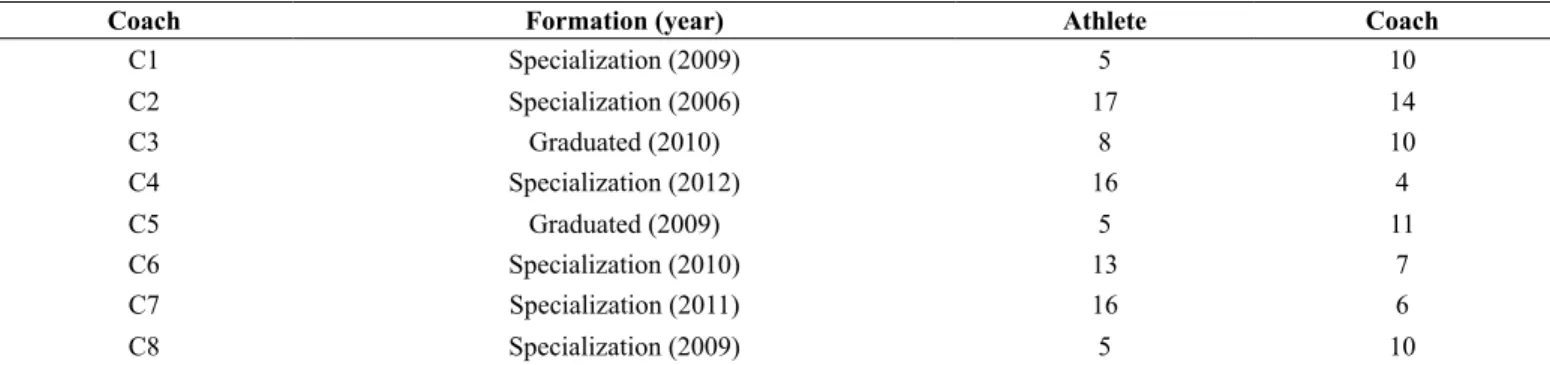
Eight coaches of young players (U10, U11, U12, U13, U14, U15, U16 and U17) participated in the study, with a mean age of 31 years. The coaches were chosen intentionally for being part of a Club that is in the Series A of the Brazilian Football Championship and that has instituted the processes of training, detection and selection of talents for professional football.21 For
more characterization, some characteristics of the coaches are presented in table 1.
Table 1 Formation, years of athletic experience and coaching.
Coach Formation (year) Athlete Coach
C1 Specialization (2009) 5 10
C2 Specialization (2006) 17 14
C3 Graduated (2010) 8 10
C4 Specialization (2012) 16 4
C5 Graduated (2009) 5 11
C6 Specialization (2010) 13 7
C7 Specialization (2011) 16 6
C8 Specialization (2009) 5 10
Regarding specialization courses, at the attendance level (at-tended by the coaches), they are offered to candidates with Physical Education degree and have a minimum duration of 360 hours.22
Instruments for data collection
The data were collected through two instruments, namely:
Rappaport Time Line (RTL) – adapted (figure 1); semi
structured interview. In short, RTL is a blank sheet of paper measuring 8.5 × 14 inches in which the words “birth” and “present” were written at opposite ends. The participants were instructed to report important events, milestones, and transi-tions in their lives, in a detailed and time-divided manner.23
In this study, it helped as a memory stimulator and to guide in-depth interviews.14 The Time Line content supported the
themes for the following interview (e.g. signiicant moments
during childhood).
In the second phase, a semi-structured interview was
con-ducted. An instrument that can generate in-depth clariication
and reveal much more about the meanings that the participants attribute to their experiences.24 To guide the responses, the
in-terviewer used a pre-established script in the interaction with the participants. In this paper, we present an interview script
that was constructed from speciic literature7,13,25-27 and improved
with a pilot study of three coaches of young players, in a process conducted by two PhD with more than 10 years of qualitative research experience, and a Master Candidate.
Procedures for data collection
The study was approved by the Human Research Ethics Committee of the Federal University of Santa Catarina
(opin-ion No.: 1.285.811/2015) and all ethical care was taken. Data
collection took place in two phases, and in both, the process
happened in a private place chose by the participants: in the irst phase, the researcher marked a moment for clariication
and realization of RTL by the sport coaches, always with the
follow-up of the irst author, with the intention to initially
explore the biography of the coaches; in the second phase, the
researcher had a digital recorder, the inished RTL and a
semi-structured interview script with open questions divided by guiding themes, detailed the data. In this second phase, RTL information was used during interviews with each coach, relat-ing the questions to the personal facts described in the sheets, in order to create proximity with the biography of each coach.
The interviews with the coaches had an average duration of
58 minutes, considering both the introductory part and clariica -tions. In the transcription of the interviews the oral discourse and the grammar were respected, in order to guarantee the pres-ervation of the semantic content of the respondents’ answers. The transcripts were imported, and the data categorization was performed through QSR N vivo 9 software.
Data analysis
The organization of the coaches’ learning episodes followed the theory of Lifelong Learning.1-4 Based on the Bardin28
con-tent analysis, three phases for analysis were conditioned. Pre-analysis, exploitation of material, data treatment, inference and
interpretation were performed as shown below: pre-analysis, phase of information organization. At this stage the interviews
were transcribed and, after a irst rigorously exhaustive read -ing, the comments that could illustrate what was intended to be discussed were separated, avoiding decontextualization; exploitation of the material, stage of application of the decisions
taken, codiication and alteration, according to pre-established
rules to understand the meanings given by the interviewees to the research object; data treatment, inference and interpretation, last step that illustrates the synthesis and selection of the results from the interpretation of the theoretical information that were
signiicant for the study with the consideration of the categories
of analysis – episodes of learning; learning content.
The conirmation of the representativeness of the categories
was established by the exhaustiveness in the analysis and the confrontation and discussion of two experts with extensive expe-rience in qualitative research, coach education and sports.29 The
validity process consisted of e-mailing the study participants, selected parts of the transcripts and interpretations made by
the authors, for the participants’ veriication and conirmation
about their statements.30
Results and Discussion
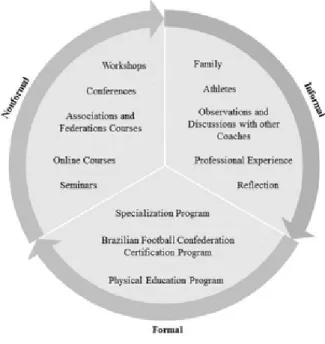
From the eight coaches’ interviews, the certiication and non-formal courses were identiied, as well as the practice and
episodes of learning (Figure 2).
Although the content of learning are presented in different contexts and episodes, we need to consider that content has
a relation and can inluence how coaches learn or what they
learn in future episodes. Some content have been reported in more than one episode of learning. The following presents and discusses the learning content.
Learning from experiences with family members
Even with a long period of time from childhood up to becoming factual coaches, three professionals still remember learning from their families. One content addressed concerns the “formation
of values” (C1, C2). This indicates the inluence of family
members involved in what coaches assume in their biographies,
speciically in sports, as right or wrong.
Family as a primary socialization represents the beginning of experiences exchange, in which children begin to acquire past learning from their parents (C1, C7), close relatives, on how to live in society.3 Concerning football, Talamoni, Oliveira, and
Hunger32 found that in these family experiences, as well as C1
and C2, the training was based on commitment, responsibility and discipline.
“[…] Principles, education, posture before society, I have no doubt that it was my father who taught me what I know today.” (C1)
In addition to the issues related to the “formation of values”, the interest of family members about a given sport, as pointed out by two coaches (C2, C7).
“When I came in to college I already had a more critical look about the training because I used to discuss a lot with my father”. (C7) The experiences of Brazilian coaches were classiied in three
learning situations (adapted from Nelson, Cushion and Potrac6),
as follows: (1) formal; learning situations in institutionalized en -vironments, structured and include long-term teaching programs
and diversiied content (sport pedagogy, physiology, emergency
aid, sports legislation), such as undergraduate and postgraduate
courses; (2) non-formal; courses organized to attend a speciic
group, e.g. football coaches. Non-formal learning situations include interventions by researchers and short courses such as mini-courses, workshops, clinics, seminars, conferences and formalized orientation programs. This learning situation may be carried out by confederations and federations, universities, private companies, among other institutions or Organizations. As well as the formal situation, it has a teacher or lecturer who will deliver a certain content to graduates as future coaches, as well as coaches and other sports professionals who already work; (3) informal; unstructured learning situations in which
learning starts from the coaches’ needs. These situations include informal orientation, internet access, experiences inside and outside the sport, as well as interactions with others (members of the coaching staff, leaders, athletes, among others).
It is important to emphasize that participants of this study
considered the relection only in the informal learning situation.
This moment of introspection is considered essential to help to understand the needs of daily issues. At this point research
suggests that relection should be worked in formal and
non-formal situations.1,12,31
Among the courses and episodes of learning, learning content
(Figure 3) were identiied, incorporated by more than one coach,
which led them to change their biographies, i.e., becoming a coach and continuing to professional development. Despite data emerged from different life episodes, we tried to present it in a rational analysis, using a chronological perspective to organize the results.
Family
Athletes
Certification Courses
Non-formal Courses
Observation and Discussion
with other Coaches
Professional Experience -Coaches
Reflection • Formation of
values
• Specific Knowledge for Football
• Coach-Athlete Relationship’s • Formation of values • Pedagogical-Didatic Knowledge
• Leadership’s Development • Culture of a Particular Sport
• General Knowledge
• Link theory to practice
• Pedagogical-Didatic Knowledge
• Concepts Consolidate
• Training
Methods • Pedagogical-Didatic Knowledge • Specific Knowledge for Football
• Leadership’s Development
• Philosophy of Building • Apply New Knowledge • Athletes of Group Management • Understanding and Environmental Management • Accuracy of Information • Self-Control • Flexibility
• Evaluation Goals, Objectives and Activities • Self-Evaluation • Coach-Athlete
Relationship’s • Activity Adjustment
Lifelong Learning
According to Ramos, Brasil, Barros, Goda and Godtsfriedt33,
the interaction with the parents can promote the insertion in the
sport, inluence along the life trajectory and in the pedagogical
decisions as coaches. Therefore, experiences with family members
may accumulate experiences that inluence the coaches’ actions.25
Learning from experiences as athletes
At the second moment in life story, coaches declare their par-ticipation as athletes, when they started practicing sports around
the age of 10 and in the speciic case of C2, he was contracted
by a professional team, even playing in Europe. During this period, coaches reported the importance of acquiring new learning content. One content has to do with the “coach-athlete relationship” (C1, C2, C4, C5) – in this case, C2 was the one who presented the longest experience as an athlete (17 years)
and described what he saw as positive in one of his coaches: “I have a very good memory of a coach. He has this ability to move a little bit more the player, on the motivational side, on the psychological side. Today when we meet, I always thank him and he ends up calling me son, it’s really cool.” (C2)
“The Pipa is a coach who appears in my timeline in three mo-ments while my coach at football school was a guy that I have this image of a very fun guy, and then while my university team coach was a guy pretty demanding”. (C4)
It is evident that it is important for a coach to know not only about training content but how to work with their athletes and how to create a strong relationship so that everyone believes in their work, and this learning process can result from training, by observing certain behaviors and ways of acting of their coaches.
In the evolutionary process of the human being, secondary socialization presents itself as the beginning of sharing and
participation in new social groups, where they learn speciic
roles, in constant change due to the experiences incorporated in different organizations, such as “sports groups”3 - C1, C2,
C4, C5. For C2, this experience with other social groups over almost two decades seems to have been decisive for his coach development, considering several learning content.
On the other side, the “formation of values” (C1 and C2) as described by C1,
“how to live in society, I think this is one of the biggest lessons I’ve had in my career that is learning to live with people, learn to respect rules and this is important for our lives, inside the game how important it is to compete, but competing in a healthy way, respect-ing opponent. So I think it is what I focus with my team today that charged me in a time that I might not understand very well”. (C1)
The “formation of values” can be understood by the fact that
the philosophy of the coaches inluences the athletes with an
impact on what they learn for life. Learning such as cooperation, responsibility, empathy, respect and self-control.34
Learning in certiication courses
In these certiication episodes (undergraduate and specialization),
“general knowledge” (C2, C3, C4, C5, C7) can be highlighted as learning content – involving various teaching content.
“[...] if you analyze it based on physiology, biomechanics, anatomy, knowledge is important, but in college you do not learn to teach football.” (C2)
“The college I graduated is very recognized in, it is famous in this ield in swimming, in physiology, but about sport high level training, in all individual and team sports, it was not enough. And in football it was especially hard, we had nothing about this in football, no big news about training process.” (C3)
However, for C3, C4, C5, C6, C7 the internship was essential to put theory into practice and generate meaningful learning in his biography because it was a learning-enhancing action and made him understand what he experienced in the classroom.
“Pipa was a coach who contributed too much for me to under-stand how a session works, the moments of beginning, middle, of end, what to do in that moment. How to behave in front of the athletes, if it is to talk to me crouch to stay on the same level, how to communicate with the children”. (C4)
“[…] learning the theory in the classroom and taking it to practice in the internship, from there I came to understand that these games are interconnected, zonal marking in handball, the transitions that basketball requires, the fast decision making in futsal and I searched to associate a lot of what we learn with football.” (C5)
These indings corroborate national and international studies,
presenting positive questions and gaps in the teaching process. For instance, a coach interviewed by Callary, Werthner and Trudel13,
who learned about safety procedures. “General knowledge” (C2, C3, C4, C5, C7) as a positive aspect of the Physical Education course also involves safety issues, when coaches learn about
certain teaching content (irst aid, among others) with concerns
care in the preparation of children and young people.19
However, in the context of certiication, it is considered
that Physical Education professionals are prepared to coach in sports of participation and not in high performance sports. The
course disciplines cover a broad ield of action and few hours are devoted to the speciic sports subjects. Moreover, the pro
-gram is not based on relexive learning.16,19 These are questions
reported by C2 and pointed out by the international literature as worrying.1,9,11,35 A relective practice could lead coaches to a
profound, motivating and enduring learning.1,12,31
In Brazil, the market needs, therefore, cannot be met as in the case of high-performance sports, even with the preference of the coaching professionalization with the Physical Education course, as proposed by Laws 865036 and 969620. This suggests
problems or generalization in the educational process. In this sense, Jarvis2 agrees that adult education has been considered
as the institutionalization of learning. However, this learning opportunity needs to be in line with employers’ demands, so
experts can meet the market needs with innovation and eficiency.
Learning in non-formal courses – workshops, congresses…
programs as follows: speciic courses and lectures on football,
seminars, workshops, congresses and online courses.
Short-term events or programs were reported by four coaches, generally as “consolidating conceptions” (C1, C2, C3, C7), without discussing innovative ideas. Sometimes these courses feature,
“[...] a general knowledge, but do not provide something new to introduce into daily training.” (C2)
“The congresses today become just a network of contacts, one or another thing that adds to you, but it is really to conirm where your ideas are going.” (C3)
“They add you knowledge, but I think it’s a bit like college, could be a bit more in-depth.” (C7)
Learning in the non-formal process can be incorporated into a continuous system of learning and education. Life transitions
are not ixed, society has become more open, they occur more
often because of the ease found in the courses (workshops, online courses, among others) presented by the coaches of this study at different times for different people. Being that each transition can be a moment of personal and professional growth and de-velopment.4 In the same way as to the indings of Christensen37,
non-formal courses can give more conidence to professionals,
even with more experienced coaches.
It is worth noting that when coaches attend certiication and
non-formal courses, they already have some experiences that shaped their ways of acting and that lead to their practice27, as
presented by six coaches (C1, C2, C3, C4, C5, C7). To profes-sors and lecturers, it is recommended to help current or future coaches to recall their past experiences to understand why they assume certain behaviors and thoughts.25
Learning from the discussions and observations of other coaches
In learning episodes with other coaches – usually with more experience –, the professionals may observe and discuss about training and how to act during a competition. A point that was well discussed in the experiences with other coaches and mentioned
by some participants of the study was “speciic knowledge” (C1,
C4, C5, C6, C7, C8) applied to football.
“I was an assistant in the categories U10, U11, U12, U14 and U15, participating in several championships, some national and other international, traveled with the coaching staff. This contributed too much for me because I learned how the environment was, how give a lecture, how the boys react, how was the lodging and feeding.” (C4)
“The greatest involvement happened in the day I arrived at the training center and saw the coaches working and from there I began to get involved and work hard. The good training is: loads of physiology, psychological aspect, competitiveness, motivation, technical-tactical understanding.” (C5)
In general, people do not live in a single society or culture, but in life-worlds that consist of interacting with other people
and a combination of cultural practices, depending on where they live, their social position, and other dimensions of personal and professional life.4 These interactions are important, even
in the case of this study with coaches who have similar stories, and the combination of experiences was considered positive by most of the coaches and where C4 was an assistant of C3.
This is due, as deined by C4, to the fact that they have less
responsibility in training and competitions and by the positive or negative example of head coaches. Negative, as we may not agree with each other and a new posture considered to be ideal is assumed.4
In this experience with mentors during the practice, studies
have conirmed that it becomes one of the main factors that
lead coaches to real learning.25,32 Scaglia38 highlights that this
does not mean copying, following or idealizing a professional, but studying in a rational and methodical way to understand his philosophy and to consider what is positive.
In our study, this issue – learning by observations and dis-cussions with other coaches – emerged in the quote of seven coaches (C1, C3, C4, C5, C6, C7, C8). The perspective of different experiences seems to lead to better professional and personal practices. The results reinforce that coaches manifest
a diversiied learning through observation.27,32 Thus,
observ-ing other coaches can be useful to verify if the trainobserv-ings are effective for the development of young athletes and become essential for the construction of professional knowledge. As described by Jarvis4, where each person, according to their life
experiences, can contribute to the growth and development of other people.
Learning from experiences as coaches
At this phase, coaches assume their current role –they are re-sponsible for training athletes and managing relationships with other professionals. Seven professionals reported establishing good part of their philosophy (C1, C3, C4, C5, C6, C7, C8), but they also mentioned that continue to analyze their practice.
“[…] gradually I was able to improve, to be a demanding coach but in a plausible way. Then I received constructive criticism to become an organized coach prepared for a new trend, a contem-porary football.” (C5)
“I think so, the challenges to get here, to stay here, to stand up, to seek to grow are very great, but from the moment you pass your values and your ideas this will give conidence to the people who are your surroundings and above all make mistakes and try to dialogue a lot so you are always trying to evolve. The experi-ence will give you more convictions, it will make you more sure of what you do.” (C6)
This probably happens because they are always searching
for a better deinition, in a context where sports, speciically
problems or potentialities of football teams. In episodic
experi-ences, as deined by Jarvis1, throughout life we can pass through
transformations and shape ourselves as a changed person. This implies new experiences for professionals so they can develop in their professional performance.
In addition to the indings of this research, such as “con -structing a philosophy” (C1, C3, C4, C5, C6, C7, C8) of each coach, Ramos, Graça, Nascimento and Silva16 veriied that for
the four professionals investigated, the experiences as coaches are important for acquisition of new learning, in the accumula-tion of experiences in the construcaccumula-tion of knowledge, in which each coach must own a “line of thought”. Moreover, the words
of C1, C4 and C8 corroborate the pillars of success deined by
John Wooden, who considers “self-control” as an important block of his successful pyramid in sports coaching.39
“We went to compete in the international championship. When we went to play with ten thousand people in the stadium I confess that it hit me different the competition knows a very cool emo-tion. We managed to win the game of turn, it was a situation that impressed me a lot, but from that you manage the next phases that you face other teams so in these championships you are much calmer and know how things work.” (C8)
Learning through relection
The relection is presented as an episode clearly seen as a learn -ing potentialize, with which the coach realizes and understand certain content. At this stage, the coach ends up shaping his biography so he can develop himself and lead his athletes to a better performance.
In the statement of ive coaches, “reassessment of goals,
objectives and activities” (C3, C4, C6, C7, C8) was highlighted as an essential practice in the course of sports preparation.
“[…] my relections concern if they have been able to evolve, reach the goal, the goal proposed for each exercise and if they had been able to develop in an adequate way everything the game requires of them”. (C3)
“I relect within the technical level on the opponents, the level of dificulty. At the end of each competition, I make a report and forward to the direction. This report includes the organization of the competition, the level of the competition, the level of the opponents, an individual analysis and a collective analysis of the athletes within what they did in relation to training.” (C6)
In this process, it is always necessary to consider the collectiv-ity and the individualcollectiv-ity of the athletes and to not accommodate, even with victory, for evolution must be a continuous process.
In addition, coaches (C1, C3, C4, C5, C7) consider
“self-evaluation” as an important component in the relective process
to assess their own coaching philosophy.
“Relection we do all the time. All the videos that have of my team I watch a lot. When the game was really bad I watch it twenty times, I watch it with everyone. When the game is good we watch it once, edit what you want and that’s it. When it does not happen what you want there you are relecting. “What happened? What did I do wrong? What do I need to improve?” There you look at
the video, talk to the coaching staff and draw your conclusions. I think this is very important.” (C1)
“[…] if the coach is convinced of certain ideas and does not change he is wrong, because football is constantly evolving.” (C3)
It is essential to relect if what they are doing and thinking
is correct, having in mind the “coach-athlete relationship” (C1, C2, C5).
“You begin to relect, you obviously begin to evolve as a coach. Start teaching some exercises, see what works, what goes wrong, go to the competitive area that there in the U10, U11 and U12 also still have a bit of a recreational character because they are very young yet. I think it’s very important to relect with the coaching staff and with my athletes, even because they need to know what I’m think-ing. They need to know the way I see what they are dothink-ing.” (C2)
Relection in action is also evident at the C7 quote in the
content on “activity adjustment” (C1, C7), in order to re-invent themselves and optimize the formation of their athletes.
“If I apply any simple work, they will not have the same motivation to carry out the work, this brings you problems during the training. Sometimes they break the rules of your training, sometimes they do not get motivated with the way you’re doing the job. So that makes you have some reactions to relect, to think, to improvise within the training itself.” (C7)
Jarvis1 explains that when we go through an experience,
we can act, relect, respond emotionally or any combination of these options. Regarding relection, Jarvis4 deines that there
can be non-relexive thinking and relective thinking. In the irst case, learning occurs by memorizing (like copying a class content) and by the senses, being considered supericial because
it has no meaning for the person, consequently does not lead to changes in society, but only reproduces it. In the second case,
it occurs by contemplating an experience, based on a relexive practice. In this way, individuals relect on, evaluate, and learn
from experiences. This can happen by giving meaning and deep understanding to each experience.
Some authors7,9,27 consider that coaches need time to think
about the training schedule and what can be modiied. This was
considered a good practice by some coaches, regarding “reassess-ment of goals, objectives and activities” (C3, C4, C6, C7, C8).
In the indings of Callary, Werthner and Trudel13, the
re-lections served for coaches to better understand what to do and maintain athletes’ conidence. This may be related to the
reports of some coaches about “self-evaluation” (C1, C3, C4, C5, C7) and the “coach-athlete relationship” (C1, C2, C5), items important for personal, professional and social development.
The concern, in the absence of a relexive practice, would be
the repetition of experiences, passed from generation to genera-tion through the coach-athlete relagenera-tionship, based on affecgenera-tion, without understanding and transforming each experience.9,12,27,38
Conclusion
mentioned several content of learning from numerous episodes in their lives. The experiences as athletes and coaches seemed to represent more meaningful leaning for the coaches, emerg-ing more categories of content of learnemerg-ing. “More learnemerg-ing” emerges from these episodes due to coaches were embedded in
speciic culture of football and the motivation and the content were related to their speciic practice as coaches.
The low connection of speciic content with the learning related to certiication courses may explain the low value at -tributed to such contexts, even after a few years of the degree achievement (graduation period and specialization performed by the coaches). This undervalue can be explained by the general-ist charactergeneral-istic of the Physical Education and specialization
courses, about which ive coaches emphasized the “general knowledge” aspect. Furthermore, indings revealed that formal
programs have a perspective focused on conceptual knowledge mastering without concern about of coaches’ learning skills de-velopment. In attempt to increase meaning for coaches, content
could be delivered stimulating relective practice and involving
the prior knowledge acquired before graduation, as reported as
signiicant for all coaches in this study (e.g. experiences with
family members while primary socialization; experiences as athletes while secondary socialization).
Another, key point that formal programs can explore is the internship period. This experience, playing the coach’s role and involved with a club and other professionals, showed impact for some participants of this study, having strong potential to
provide signiicative learning opportunity and integrate it into
the coaches’ biography.
Therefore, formal programs should organize relevant learn-ing opportunities for coaches uslearn-ing multiple teachlearn-ing strategies
to motivate students, enhancing the understanding of speciic
content and developing learning skills in order to enable coaches
to relect critically on the nature and quality of their experi -ences. The results showed the importance to coaches become
lifelong learners, mainly using relective skills, considered
essential by all participants. Thus, the coach may have been an
athlete, have attended certiication or non-formal courses, but
the coach needs to be insatiable in thinking about learning and having the open conception to consider that he can learn from his childhood coaches, peers, professionals from other areas,
while relecting critically, among other actions in a continuous
effort to improve their practice. In this way, coaches can be
encouraged to learn through critical relection and share their
experiences with other coaches, and workplaces and agencies can promote such meetings.
The study showed learning content in different episodes of coaches’ life. At this point professors, lecturers, head coaches, sport clubs directors, among other actors of the sport, can
evalu-ate the speciic contexts and amplify their actions to encourage
coaches’ learning. As these characters orient themselves and
organize their actions based on the indings of this study, they
can then develop initiatives that motivate coaches to incorporate several learning content in their biographies with a meaningful and continuous way.
The limitation of this study is the fact that secondary sources
(photos, videos, relective diaries) related to coaches’ lifetime
experiences were not used to stimulate their memories during the description in the Rappaport Time Line, which could lead to more detailed interviews and give more depth to the data. Therefore, following guidelines to prioritize more consistent data13, we opted to analyze the content reported for more than
one coach. The goal was to explore more robust, clear and meaningful data.
REFERENCES
1. Jarvis P. Towards a comprehensive theory of human learning. New York: Routledge; 2006.
2. Jarvis P. Globalization, lifelong learning and the learning society: Sociological perspectives , lifelong learning and the learning society. Abingdon: Routledge; 2007.
3. Jarvis P. Democracy, lifelong learning and the learning society: Active citizenship in a late modern age. Abingdon: Routledge; 2008.
4. Jarvis P. Learning to be a person in society. London: Routledge; 2009.
5. Mallett CJ, Trudel P, Lyle J, Rynne SB. Formal vs. informal coach education. Int J Sports Sci Coach. 2009;4(3):325-64.
6. Nelson L, Cushion CJ, Potrac P. Formal, Nonformal and Informal Coach Learning: A Holistic Conceptualisation. Int J Sports Sci Coach. 2006;1(3):247-59.
7. Werthner P, Trudel P. A new theoretical perspective for un-derstanding how coaches learn to coach. Sport Psychol. 2006;20(2):198-212.
8. Trudel P, Culver D, Richard J-P. Peter Jarvis: lifelong learning. In: Nelson L, Ryan G, Potrac P, eds. Learning in Sports Coaching: Theory and Application. Abingdon: Routledge; 2016. p. 202-14. 9. Stoszkowski J, Collins D. Sources, topics and use of knowledge
by coaches. J Sports Sci. 2016;34(9):794-802.
10. Sherwin I, Campbell MJ, MacIntyre TE. Talent development of high performance coaches in team sports in Ireland. Eur J Sport Sci. 2016;17(2):271-8.
11. Morgan K, Jones RL, Gilbourne D, Llewellyn D. Changing the face of coach education: using ethno-drama to depict lived reali -ties. Phys Educ Sport Pedagogy. 2013;18(5):520-33.
12. Gilbert W, Trudel P. Learning to coach through experience: relection in model youth sport coaches. J Teach Phys Educ. 2001;21:16-34.
13. Callary B, Werthner P, Trudel P. How meaningful episodic experi-ences inluence the process of becoming an experienced coach. Qual Research Sport Exercise Health. 2012;4(3):420-38. 14. Duarte T, Culver DM. Becoming a coach in developmental
adap-tive sailing: A lifelong learning perspecadap-tive. J Appl Sport Psychol. 2014;26(4):441-56.
15. Cushion C, Nelson L, Armour K, Lyle J, Jones R, Sandford R, et al. Coach learning and development: A review of literature. Leeds: sports coach UK. 2010.
17. International Council for Coaching Excellence (ICCE), Association of Summer Olympic International Federations (ASOIF), Leeds Metropolitan University (LMU). International Sports Coaching Framework Version 1.2. Champaign: Human Kinetics. 2013.
18. Duffy P, Hartley H, Bales J, Crespo M, Dick F, Vardhan D, et al. Sport coaching as a ‘profession’: Challenges and future directions. Int J Coach Sci. 2011;5(2):93-123.
19. Milistetd M, Trudel P, Mesquita I, do Nascimento JV. Coaching and coach education in Brazil. Int Sport Coach J. 2014;1(3):165-72. 20. Brasil. Lei nº 9.696, de 1º de setembro de 1998. Dispõe sobre a
regulamentação da Proissão de Educação Física e cria os respec -tivos Conselho Federal e Conselhos Regionais de Educação Física (It provides for the regulation of the Physical Education Profession and creates the respective Federal Council and Regional Councils of Physical Education). Diário oicial da União (Oficial journal of State). 1998. Available from: http://www.planalto.gov.br/ ccivil_03/leis/L9696.htm [Accessed 15th December 2016]. 21. Paoli PB, da Costa FR, Ferreira Neto A, Goncalves Soares AJ.
Representações identitárias no processo de seleção de talentos (Identitary Representations in the Talent Selection Process). Movimento. 2010;16(4):135-50.
22. Brasil. Resolução CNE/CES nº 1, de 8 de junho de 2007. Estabelece normas para o funcionamento de cursos de pósgradu-ação lato sensu, em nível de especializpósgradu-ação (Establishes standards for the operation of Lato Sensu Postgraduate courses at the special-ization level). Brasília: Ministério da Educação. 2007. Available from: http://portal.mec.gov.br/cne/arquivos/pdf/rces001_07.pdf [Accessed 16th December 2016].
23. Langley DJ, Knight SM. Continuity in sport participation as an adaptive strategy in the aging process: a lifespan narrative. J Aging Phys Act. 1999;7(1):32-54.
24. Sparkes AC, Smith B. Qualitative research methods in sport, ex-ercise and health: From process to product. Abingdon: Routledge; 2014.
25. Callary B, Werthner P, Trudel P. Shaping the way ive women coaches develop: Their primary and secondary socialization. J Coaching Educ. 2011;4(3):76-96.
26. Erickson K, Bruner MW, MacDonald DJ, Côté J. Gaining insight into actual and preferred sources of coaching knowledge. Int J Sports Sci Coach. 2008;3(4):527-38.
27. Jones RL, Armour KM, Potrac P. Constructing expert knowledge: A case study of a top-level professional soccer coach. Sport Educ Soc. 2003;8(2):213-29.
28. Bardin L. Content Analysis. São Paulo: Edições 70; 2011. 29. Patton MQ. Qualitative evaluation and research methods.
Newbury Park: Sage; 1990.
30. Maxwell J. Understanding and validity in qualitative research. Harv Educ Rev. 1992;62(3):279-301.
31. Knowles Z, Borrie A, Telfer H. Towards the relective sports coach: issues of context, education and application. Ergonomics. 2005;48(11-14):1711-20.
32. Talamoni GA, Oliveira FI, Hunger D. As conigurações do futebol brasileiro: análise da trajetória de um treinador (The conigurations of brazilian soccer: trajectory analysis of a coach). Movimento. 2013;19(1):73.
33. Ramos V, Brasil VZ, de Barros TE, Goda C, Godtsfriedt J. Trajetória de vida de treinadores de surfe: análise dos signiicados de prática pessoal e proissional (Life path of surf coaches: analy -sis of meanings of personal and professional practice). Pensar prát. 2014;17(3):815-34.
34. Côté J. The development of coaching knowledge. Int J Sports Sci Coach. 2006;1(3):217-22.
35. Chesterield G, Potrac P, Jones R. ‘Studentship’and ‘impression
management’in an advanced soccer coach education award. Sport Educ Soc. 2010;15(3):299-314.
36. Brasil. Lei n° 8.650, de 20 de abril de 1993. Dispõe sobre as rela -ções de trabalho do Treinador Proissional de Futebol e dá outras providências (It deals with the work relations of the professional football coach and gives other measures). Diário oicial da União (Oficial journal of State). 1993. Available from: http://www. planalto.gov.br/ccivil_03/LEIS/1989_1994/L8650.htm [Accessed 18th December 2016].
37. Christensen MK. Outlining a typology of sports coaching careers:
Paradigmatic trajectories and ideal career types among high-performance sports coaches. Sports Coach Rev. 2014;2(2):98-113. 38. Scaglia AJ. A pedagogia do esporte em José Mourinho (The sports
pedagogy in José Mourinho). R Educ Ling. 2015;4(7).
39. Perez D, Van Horn S, Otten MP. Coach John Wooden’s pyramid of success: a comparison to the sport psychology literature. Int J Sports Sci Coach. 2014;9(1):85-101.
Acknowledgements
Fundação de Apoio à Pesquisa Cientíica e Tecnológica do Estado de Santa Catari -na – FAPESC. Fundação de Amparo à Pesquisa do Estado de São Paulo – FAPESP.
Grant number 2015/01599-9, São Paulo Research Foundation. The authors thank
Espaço da Escrita – Coordenadoria Geral da Universidade - UNICAMP - for the language services provided.
Corresponding author
Alexandre Vinicius Bobato Tozetto
Center for Research on Sports Pedagogy, Federal University of Santa Catarina, Brasil.
Campus Reitor João David Ferreira Lima, s/n, Trindade, Florianópolis, SC
Centro de Desportos, Bloco IV, Laboratório de Pedagogia do Esporte
Email: [email protected]
Manuscript received on February 09, 2017
Manuscript accepted on September 14, 2017