*Correspondence: P. C. Mastroianni. Departamento de Fármacos e Medicamentos. Faculdade de Ciências Farmacêuticas – UNESP. Rod. Araraquara - Jaú, Km 1, 14801-902 - Araraquara - SP, Brazil. E-mail: [email protected]
A
vol. 52, n. 3, jul./sep., 2016 http://dx.doi.org/10.1590/S1984-82502016000300017
Analysis of extemporaneous oral liquid from commercially
available drugs in hospital
Jhohann Richard de Lima Benzi
1, Patrícia De Carvalho Mastroianni
21Faculdade de Ciências Farmacêuticas de Ribeirão Preto, USP, Universidade de São Paulo, Ribeirão Preto, Brazil, 2Faculdade de Ciências Farmacêuticas, UNESP, Universidade Estadual Paulista, Araraquara, Brazil
The objective of this study was to identify drugs that received dose adjustments (DA) and pharmaceutical alternatives (PA) that avoid DA, and calculate the economic percentage of this replacement. A descriptive, observational and cross-sectional study was performed in a second level hospital. The pharmacy and nursing services was accompanied to identify the drugs that received DA and the compounding techniques.
After identifying all the drugs that received DA, was identiied in the Brazilian market the corresponding
pharmaceutical alternative, with the Drugs Price List of Brazilian Health Regulatory Agency. For those drugs that was not available any PA, was performed a research of studies that describe compounding
techniques in international scientiic databases. Was identify 88 drugs that received DA, and these, 50 do not have any PA. Were identiied compounding techniques to 40 drugs. Although any drug has your own particularity of compounding, the compounding techniques can be grouped in ive categories. The standardization of 29 drugs can reduce in 28% the DA procedure and cost saving of 34,85%/month. We can conclude that every three drugs prescribed, one received DA and every three DA, one can be avoided by the selection of 29 PA, saving cost as well. The use and standardization of ive techniques
would attend the pharmaceutics recommendations for better dissolution, bioavailability and patient safety.
Uniterms: Pharmaceutical preparations/hospitals. Patient safety. Pharmacoeconomics. Drugs/descritive
study/ Of-Label Use.
INTRODUCTION
Dose adjustment (DA) is performed to supply a patient’s therapeutic needs when non-standard dosages
are needed (Brasil, 2007; FDA, 2013). The lack of liquid pharmaceutical forms for oral use on the market has
become a problem for the pharmacotherapy of patients that primarily uses liquid formulations, such as pediatric patients, the elderly, patients receiving drugs via probe, patients with dysphagia, and patients with dementias,
Parkinson’s, or Alzheimer’s disease (Haywood, Glass,
2013; Thombre, Berchielli, Rogers, 2014).Patients with these problems require extemporaneous oral preparations in order to ensure the patient’s therapy. DA is common in health systems; however, there are no guarantees regarding
the quality, efectiveness, and safety of drugs after DA and DA can expose the patient to adverse events (Glass,
Haywood, 2006).
With the aim of ensuring the pharmacotherapy of
the patient, contributing to the culture of patient safety, and objectively identifying drugs that underwent DA and pharmaceutical alternatives (PAs) that could avoid DA, we compared DA to the compounding techniques described in the literature and calculated the economy of PAs.
METHODS
Study design
This was a pharmaco-epidemiological, descriptive, and observational cross-sectional study based on the guideline Strengthening the Reporting of Observational studies in Epidemiology (STROBE) (Von Elm et al.,
Study site
This study was conducted at the State Hospital Américo Brasiliense (HEAB) in Américo Brasiliense, São Paulo state. The hospital assists patients from 24 cities in the region.
Study period
Patient prescriptions were monitored in July 2013.
Data collect
Patient prescriptions were monitored daily. The
nursing staff’s work was monitored to check the drug
manipulation techniques, administration, and storage after DA. The PAs and the costs were identified in the
Brazilian market with the Drugs Price List of ANVISA (ANVISA, 2015). The DAs were classiied into derivation
or subdivision of the pharmaceutical form, according to the current legislation (Brasil, 2007). For those drugs without available PAs, studies that describe compounding
techniques were studied, using the descriptors: “Drug name” – for each drug; “Drug Compounding”; “Drug Stability”; and “Pharmaceutical Preparations” in the
databases LILACS, SciELO, and PubMed.
Ethical considerations
The study was approved by the ethics committee of
the Institute Lauro de Souza Lima as the project “Proposta de implantação de um serviço de farmacovigilância no Hospital Estadual de Américo Brasiliense” under protocol
E-015/10; it was also approved by the hospital board.
RESULTS
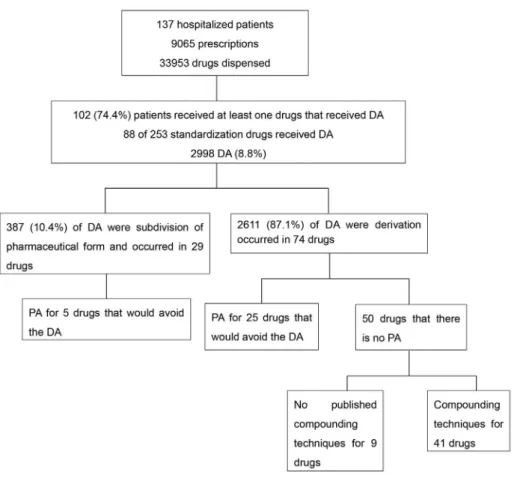
DA was identified in 88 (34.7%) different drugs
of the 253 standardized drugs in the hospital pharmacy
(Figure 1). The technique of derivation was standardized and described in the standard operating procedure as crushing the solid dosage form with the aid of a pestle, followed by immediate administration. The subdivision of the pharmaceutical form occurred in the hospital
NOTE: DA: Dose Adjustment;PA:Pharmaceutical alternatives.
FIGURE 1 - Flowchart analysis of prescriptions of hospitalized patients, identiication of dose adjustments, and pharmaceutical
pharmacy and was performed by the pharmacy team. The subdivision technique used specialized equipment for this
purpose, followed by packing and labeling with product
information, including the active ingredient, expiry date, and batch number. Subdivisions of liquid dosage forms occurred in the ward in drug handling rooms by the
nursing team. Only a portion of the ampoule contents were
administered, corresponding to the desired concentration. No DA exceeded the shelf life of 48 hours.
In the Brazilian market, 29 PAs were identiied for
the 88 drugs that received DA, possibly decreasing DAs
by 28.5% (856 / 2,998) (Table I).
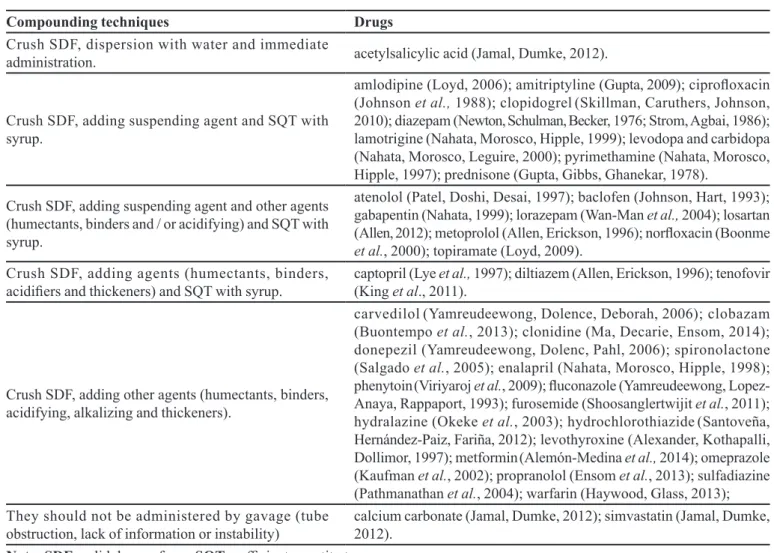
For the 50 drugs that lacked PAs, 40 had known compounding techniques (Table II); the following ten drugs
(or drug combinations) had no published compounding techniques: bisacodyl; citalopram; a combined dose of rifampicin, isoniazid, pyrazinamide, and ethambutol;
doxazosin; inasteride; isosorbide; ivermectin; paracetamol
and codeine combined; quetiapine; and sertraline.
Regarding the microbiological quality, studies show the necessity of adding parabens, such as methylparaben and propylparaben, in the extemporaneous formulations and refrigerated storage to avoid microbiological growth
(OPAS, 1997; Haywood, Glass, 2013; Alemón-Medina
et al.,, 2014).
Furthermore, the hospital spent US$ 3,458.39 on
performing DA. The economic analysis was calculated
through the diference between the sum of DA (considering
the frequency and cost for dosage form unity for each drug - for solid drugs, it was considered one tablet or capsule, and for liquid drugs, one milliliter) and the sum of the corresponding PA dosage (Table 1).
Through economic analysis, standardizing PAs
could generate a cost savings of US$ 1,205.59. Only one
drug (piperacilin + tazobactam powder for injection 4 g +
0.5 g) is responsible for US$ 1,190.41 of this cost savings.
DISCUSSION
DA is an indispensable practice in hospitals because many patients often have specific needs that require the administration of drugs in various dosage forms
(Haywood, Glass, 2013; Thombre, Berchielli, Rogers,
2014).
Generally, these patients are those who make use of catheters, have dysphagia, and/or require different
doses of commercialized drugs. Therefore, of every four hospitalized patients, three patients require at least one PA to one or more prescribed drugs; however, the standardization of 29 PAs may reduce DA practices by one-third.
Nevertheless, the Pan American Health Organization/ World Health Organization recommends preparing
reduced therapeutic forms in order to facilitate the logistics (acquisition, storage, and distribution) of drugs, promoting the drug’s rational use, avoiding duplication and saving
money by avoiding waste (OPAS, 1997).
On the other hand, ensuring the safety, efficacy,
and quality of pharmaceutical forms is given by the pre-registration of drugs through stability studies (short and long), pharmaceutical equivalence studies, such as
dissolution proiles and other pharmacopoeia analysis, and in vitro studies of bioequivalence aspects (Mastroianni, Lucchetta, 2011). These issues are no longer guaranteed after DA.
In addition, it is recommended that therapeutic forms
be updated every two years, not just for the inclusion or exclusion of drugs, but also to review the submissions to
ensure the best posology for the patient proile (OPAS,
1997).Once the drugs were available to patients in the most appropriate pharmaceutical form and without manipulation (Catalán et al., 2001; Habib et al., 2014),
patients would not be exposed to the inherent risks of DA
(Paparella, 2010); this would also decrease costs.
Therefore, the data from this study highlight the importance of continuous expansion and revision of therapeutic forms, considering not only the managerial and administrative aspects of hospital pharmacy (selection, acquisition, and distribution of drugs), but also the management of patient safety at the institution.
For those drugs that do not have available commercial alternatives, DA is often inevitable. Every DA
is considered of-label use, because it is a manipulation and formulation of extemporaneous doses from the marketed
drugs (Kairuz et al., 2007; ANVISA, 2010; EMA, 2014; Carvalho, 2016); therefore, DA should be discussed by the health team and be provided in the clinical protocols of the service.
Additionally, it was observed that derivation is standardized in the hospital and was based on the tablet dispersion technique, respecting the period of lateness (48
hours) set by ANVISA (Brasil, 2007), showing conformity (Glass, Haywood, 2006). However, studies (Allen, 2012; Alemón-Medina et al., 2014; Shoosanglertwijit
et al., 2015)demonstrate that the validity of the PA is
often greater than seven days, under certain criteria for manipulation and storage.
would be to search for a therapeutic equivalent. If there is no therapeutic equivalent with the same eicacy and
safety, the third option would be the preparation of an extemporaneous solution, according to the pharmacopoeia.
When lacking the monograph of preparation, it is recommended to research a validated formulation. Without
this, the literature should be used to ind DA techniques speciic to the drug. In a inal decision, the standardized
tablet dispersion technique should be used.
The advantage of technique standardization, as found in the literature review, is that it increases the stability of extemporaneous solutions and improves the dissolution
TABLE I - Standard drugs that received dose adjustment and their classiication and pharmaceutical alternatives available in the
Brazilian market, which would avoid the need for dose adjustments
Standardized drugs DA Available commercially alternative
amiodarone (tablet 200 mg) SPF amiodarone (tablet 100 mg)
D amiodarone (oral solution 200 mg/mL)
amoxicillin + clavulanate (tablet 500 + 125 mg) D amoxicillin + clavulanate (powder for oral solution suspension
50 mg/mL + 12.5/mL)
azithromycin (tablet 500 mg) D azithromycin (powder for oral solution suspension 40 mg/mL)
carbamazepine (tablet 200 mg) D carbamazepine (oral solution 20 mg/mL)
carvedilol (tablet de 25 mg) SPF carvedilol (tablet 12.5 mg)
clonazepam (tablet 0,5 mg) D clonazepam (oral solution 2.5 mg/mL)
clonazepam (tablet 2 mg) D clonazepam (oral solution 2.5 mg/mL)
complex B® [tablet - vitamin B1 (5mg); B2
(1mg);B3(30mg); B5 (4mg); B6 (3mg)] D Complex B® [oral solution - vitamin B1 (3 mg/mL); B2 (3 mg/mL); B3 (10 mg/mL); B5 (25 mg/mL); B6 (10 mg/mL)]
dexamethasone (tablet 4 mg) D dexamethasone (elixir 0,1 mg/mL)
digoxin (tablet 0,25 mg) SPF digoxin (tablet 0.125 mg)
D digoxin (pediratric elixir 0,5 mg/mL)
domperidone (tablet 10 mg) D domperidone (oral solution 1mg/mL)
ferrous sulphate (tablet 250 mg) D ferrous sulphate (syrup 50 mg/mL)
luoxetine (tablet 20 mg) D luoxetine (oral solution 22,4 mg/mL)
folic acid (tablet 5 mg) D folic acid (oral solution 0.2 mg/mL)
haloperidol (tablet 5 mg) D haloperidol (oral solution 2 mg/mL)
lamivudine (tablet 150 mg) D lamivudine (oral solution 10 mg/mL)
levodopa + benserazide (tablet 200 mg + 50 mg) SPF levodopa + benserazide (tablet 100 mg + 25 mg)
lopinavir + ritonavir (tablet 200 + 50 mg) D lopinavir + ritonavirr (oral solution 80 + 20 mg/mL)
loratadine (tablet 10 mg) D loratadine (oral solution 1 mg/mL)
metronidazole (tablet 400 mg) D metronidazole (oral solution 40 mg/mL)
oseltamivir (capsule 75 mg) D oseltamivir (powder for oral suspension 12 mg/mL)
piracetam (tablet 400 mg) D piracetam (oral solution 60 mg/mL)
phenobarbital (tablet 100 mg) D phenobarbital (oral solution 40 mg/mL)
piperacillin + tazobactam (powder for injection
solution 4 g + 0,5 g) SPF piperacillin + tazobactam (powder for injection solution 2 g + 0,25 g)
risperidone (coated tablet 1 mg) D risperidone (oral solution 1 mg/mL)
risperidone (coated tablet 2 mg) D risperidone (oral solution 1 mg/mL)
scopolamine (dragee 10 mg) D scopolamine (oral solution 10 mg/mL)
tramadol (capsule 50 mg) D tramadol (oral solution 100 mg/mL)
valproic acid (capsule 250 mg) D valproic acid (oral solution 50 mg/mL)
of the drugs, thereby ensuring greater bioavailability
and absorption, ensuring therapeutic efectiveness, and
preventing adverse drug events. Moreover, changes in drug dosage forms can lead to changes in the polymorphic and morphological behaviors of drugs, which may cause
therapeutic inefectiveness, because while medicines are produced and stored, they tend to seek the most stable
form, which is not always the more active and safe form
(Glass, Haywood, 2006; Capucho, Mastroianni, Cuini, 2008; Paparella, 2010; Glass, Haywood, 2013).
The techniques found for the production of extemporaneous solutions are generally characterized by choosing the most appropriate vehicle (water or simple syrup) and the addition of pharmaceutical adjuvants,
such as those used for suspending, thickening, binding, and acidifying. Other commercial alternatives, such as
galenical bases, could be used to prepare extemporaneous solutions. This option for the preparation of DA, in order to ensure the quality of freshly-prepared solution and
promote increased patient safety, will require periodic review.
A limitation of the study was the data collection time, a month, which can be a limitation for DA frequency analysis; however, the analysis period was not qualitatively limiting to identify the drugs that received DA, and other studies showed similar numbers of patients and prescriptions analyzed (Joosub et al., 2015; Mahmood
et al., 2016). We believed that many of the 88 diferent
drugs undergo DA in other hospitals, and the 40 techniques described in the literature may contribute to the stability, safety, and quality of such preparations.
Thus, data from this study suggest the need to change the selection process and standardization of drugs
and the need for cost-efectiveness and cost-beneit studies to evaluate the efectiveness and safety of DA.
These data close a gap in the literature, contributing
to our understanding of the inherent risks of DA and
identifying potential cost savings.
TABLE II - Categories of manipulation techniques available in the literature regarding the medicinal dosing adequacy for 40 drugs
Compounding techniques Drugs
Crush SDF, dispersion with water and immediate
administration. acetylsalicylic acid (Jamal, Dumke, 2012).
Crush SDF, adding suspending agent and SQT with syrup.
amlodipine (Loyd, 2006); amitriptyline (Gupta, 2009); ciproloxacin
(Johnson et al., 1988); clopidogrel(Skillman, Caruthers, Johnson,
2010); diazepam (Newton, Schulman, Becker, 1976; Strom, Agbai, 1986); lamotrigine (Nahata, Morosco, Hipple, 1999); levodopa and carbidopa (Nahata, Morosco, Leguire, 2000); pyrimethamine (Nahata, Morosco, Hipple, 1997); prednisone (Gupta, Gibbs, Ghanekar, 1978).
Crush SDF, adding suspending agent and other agents (humectants, binders and / or acidifying) and SQT with syrup.
atenolol (Patel, Doshi, Desai, 1997); baclofen (Johnson, Hart, 1993); gabapentin (Nahata, 1999); lorazepam (Wan-Man et al., 2004); losartan (Allen, 2012); metoprolol (Allen, Erickson, 1996); norloxacin (Boonme
et al., 2000); topiramate (Loyd, 2009). Crush SDF, adding agents (humectants, binders,
acidiiers and thickeners) and SQT with syrup. captopril (Lye (King et al., 2011).et al., 1997); diltiazem (Allen, Erickson, 1996); tenofovir
Crush SDF, adding other agents (humectants, binders, acidifying, alkalizing and thickeners).
carvedilol(Yamreudeewong, Dolence, Deborah, 2006); clobazam
(Buontempo et al., 2013); clonidine (Ma, Decarie, Ensom, 2014);
donepezil (Yamreudeewong, Dolenc, Pahl, 2006); spironolactone
(Salgado et al., 2005); enalapril (Nahata, Morosco, Hipple, 1998);
phenytoin(Viriyaroj et al., 2009); luconazole (Yamreudeewong,
Lopez-Anaya, Rappaport, 1993); furosemide (Shoosanglertwijit et al., 2011);
hydralazine (Okeke et al., 2003); hydrochlorothiazide(Santoveña,
Hernández-Paiz, Fariña, 2012); levothyroxine (Alexander, Kothapalli,
Dollimor, 1997); metformin(Alemón-Medina et al., 2014); omeprazole
(Kaufman et al., 2002); propranolol (Ensom et al., 2013); sulfadiazine
(Pathmanathan et al., 2004); warfarin (Haywood, Glass, 2013);
They should not be administered by gavage (tube
obstruction, lack of information or instability) calcium carbonate (Jamal, Dumke, 2012); simvastatin (Jamal, Dumke, 2012).
For every three dispensed drugs, one received DA, and three of every four patients needed at least one of their drugs to undergo DA in their drug therapy, highlighting the importance and relevance of this practice in hospitals. Furthermore, for every three DA, one could be avoided with the selection of a PA. Each drug has its peculiarities for ensuring dissolution, bioavailability, and absorption
of the drugs, consequently promoting safe and efective
pharmacotherapy.
Therefore, data from this study corroborate the need
for cost-beneit studies to evaluate the efectiveness, safety,
and economy generated by the DA process.
FINANCIAL SUPPORT
This study was supported by the Program of Support for Scientific Development at the Faculty of Pharmaceutical Sciences at the Universidade Estadual
Paulista “Júlio de Mesquita Filho” (PADC).
ACKNOWLEDGMENTS
We thank the State Hospital of Américo Brasiliense
for supporting this study.
REFERENCES
ALEMÓN-MEDINA, R.; CHÁVEZ-PACHECO, J.L.; RAMÍREZ-MENDIOLA, B.; RIVERA-ESPINOSA, L.; GARCÍA-ÁLVAREZ, R. Physicochemical stability of three
generic brands of metformin in solution. Acta Ped. México,
v.35, n.2, p.94-99, 2014.
ALEXANDER, K.S.; KOTHAPALLI, M.R.; DOLLIMOR, D. Stability of an extemporaneously formulated levothyroxine
sodium syrup compounded from commercial tablets. Int. J.
Pharm. Comp., v.1, n.1, p.60-64, 1997.
ALLEN, L.V. Losartan Potassium 2.5 mg/mL Oral Suspension. U.S. Pharm., v.37, n.9, p.46-47, 2012.
ALLEN, L.V.; ERICKSON, M.A. Stability of baclofen, captopril, diltiazem hydrochloride, dipyridamole, and lecainide acetate in extemporaneously compounded oral
liquids. Am. J. Health-Sys. Pharm., v.53, n.15,
p.2179-2184, 1996.
ALLEN, L.V.; ERICKSON, M.A. Stability of labetalol HCl, metoprolol tartrate, verapamil HCl, and spironolactone with hydrochlorothiazide in extemporaneously compounded oral
liquids. Am. J. Health-Sys. Pharm., v.37, n.9, p.2304-2309,
1996.
BOONME P, PHADOOGSOMBUT N, PHOOMBORPLUB P, VIRIYASOM S. Stability of extemporaneous norloxacin
suspension. Drug Dev. Ind. Pharm., v.26, n.7, p.777-779,
2000.
AGÊNCIA NACIONAL DE VIGILÂNCIA SANITÁRIA. ANVISA. C â m a r a d e R e g u l a ç ã o d o M e r c a d o d e Medicamentos - CMED. Secretaria Executiva. Preços Máximos de Medicamentos por Princípio Ativo. Preço Fábrica – PF (Preço para laboratórios e distribuidores), P r e ç o M á x i m o a o C o n s u m i d o r – P M C ( P r e ç o para Farmácias e Drogarias). 20 fev. 2015 Update. 2015. 993p. Available at: <http://portal.anvisa.gov. br/wps/wcm/connect/03f41f004761187bb244b297f 5c37773/LISTA+CONFORMIDADE_2015-02-20. pdf?MOD=AJPERES>. Accessed on: 05 mar. 2015.
AGÊNCIA NACIONAL DE VIGILÂNCIA SANITÁRIA.
ANVISA. Guias de Farmacovigilância para Detentores de
Registro de Medicamentos, Agência Nacional de Vigilância
Sanitária, Gerência de Farmacovigilância, Núcleo de Gestão do Sistema Nacional de Notiicação e Vigilância Sanitária. Brasília: Ministério da Saúde, 2010.
BRASIL. Resolução da Diretoria Colegiada nº 67 de 8 de outubro de 2007. Regulamento Técnico sobre Boas Práticas de Manipulação de Preparações Magistrais e Oicinais para Uso
Humano em farmácias e seus Anexos. Diário Oicial da União,
Brasília, 09 de outubro de 2007. Available at: <http://www20. anvisa.gov.br/segurancadopaciente/index.php/legislacao/ item/rdc-67-de-8-de-outubro-de-2007>. Accessed on: 05 apr. 2013.
BUONTEMPO, F.; MORETTON, M.A.; QUIROGA, E.; CHIAPPETTA, D.A. Extemporaneous clobazam suspensions for pediatric use prepared from commercially
available tablets and pure drug. Farm. Hospit., v.37, n.2,
p.103-110, 2013.
CAPUCHO, H.C.; MASTROIANNI, P.C.; CUFFINI, S. Farmacovigilância no Brasil: a relação entre polimorismo de fármaco, efetividade e segurança dos medicamentos.
CARVALHO, M.L. Challenges on of label medicine use. Rev. Paulista Ped., v.34, n.1, p.1-2, 2016.
CATALÁN, E.; PADILLA, F.; HERVÁS, F.; PÉREZ, M.A.; RUIZ, F. Fármacos orales que no deben ser triturados.
Enferm. Intens., v.12, n.3, p.146-150, 2001.
ENSOM, M.H.H.; KENDRICK, J.; RUDOLPH, S.; DECARIE, D. Stability of propranolol in extemporaneously
compounded suspensions. Can. J. Hosp. Pharm., v.66,
n.2, p.118-24, 2013.
EUROPEAN MEDICINES AGENCY. EMA. HEADS OF MEDICINES AGENCIES. Guideline on good pharmacovigilance practices (GVP) Module VI – Management and reporting of adverse reactions to medicinal products (Rev 1). 2014. Available at: <http:// www.ema.europa.eu/docs/en_GB/document_library/ Scientific_guideline/2014/09/WC500172402.pdf>. Accessed on: 05 mar. 2015.
GLASS, B.D.; HAYWOOD, A. Stability considerations in liquid dosage forms extemporaneously prepared from
commercially available products. J. Pharm. Pharmac. Sci.,
v.9, n.3, p.398-426, 2006.
GUPTA, V.D. Chemical stability of amitriptyline hydrochloride
in oral liquid dosage forms. Int. J. Pharm.. Comp., v.13,
n.5, p.445-446, 2009.
GUPTA, V.D.; GIBBS, C.W.; GHANEKAR, A.G. Stability of pediatric liquid dosage forms of ethacrynic acid, indomethacin, methyldopate hydrochloride, prednisone and
spironolactone. Am. J. Hosp. Pharm., v.35, n.11,
p.1382-1385, 1978. In: WOODS, DJ. Formulation in Pharmacy
Practice. New Zealand: Pharm Info Tech [Internet], 2001.
Available at: <http://www.pharminfotech.co.nz/manual/ Formulation/mixtures/prednisone.html>. Accessed on: 30 mar. 2015.
HABIB, W.A.; ALANIZI, A.S.; ABDELHAMID, M.M.; ALANIZI, F.K. Accuracy of tablet splitting: Comparison
study between hand splitting and tablet cutter. Saudi
Pharm.. J., v.22, n.5, p.454-459, 2014.
HAYWOOD, A.; GLASS, B.D. Liquid Dosage Forms Extemporaneously Prepared from Commercially Available
Products - Considering New Evidence on Stability. J.
Pharm. Pharm. Sci., v.16, n.3, p. 441-55, 2013.
JAMAL, Y., DUMKE, E.H. Padronização de medicamentos sólidos orais via sonda nasoenteral em um hospital de
cascavel, Paraná. Thêma et Scientia, v.2, n.2, p.91-106,
2012.
JOHNSON, C.E.; HART, S.M. Stability of an extemporaneously
compounded baclofen oral liquid. Am. J. Hosp. Pharm.,
v.50, n.11. p.2353-2345, 1993.
JOHNSON, C.E.; WONG, D.V.; HOPPE, H.L.; MEHTA-BHATT, V. Stability of ciproloxacin in an extemporaneous oral liquid dosage form. Int. J. Pharmac. Compound., v.2, n.4, p.314-317, 1988. In: WOODS, D.J. Formulation in Pharmacy Practice. New Zealand: PharmInfoTech, 2011. Available at: <http://www.pharminfotech.co.nz/manual/ Formulation/mixtures/ciproloxacin.html>. Acessed on: 30 mar. 2015.
JOOSUB, I.; GRAY, A.; CRISOSTOMO, A.; SALAM, A. Cost-minimization analysis of imipenem/cilastatin versus meropenem in moderate to severe infections at a tertiary
care hospital in Saudi Arabia. Saudi Pharm. J., v.23, n.6,
p.626-632, 2015.
KAIRUZ, T.E.; GARGIULO, D.; BUNT, C.; GARG, S. Quality, Safety and Eicacy in the “Of-Label” use of medicines. Curr. Drug Saf., v.2, n.1, p.89-95, 2007..
KAUFMAN, S.S.; LYDEN, E.T.; BROWN, C.R.; DAVIS, C.K.; ANDERSEN, D.A.; OLSEN, K.M.; et al Omeprazole therapy in pediatric patients after liver and intestinal
transplant. J. Ped. Gastroenter. Nutr., v.34, n.2, p.194-198,
2002.
KING, J.; MCMALL, M.; CANNELLA, A.; MARKIEWICZ,
M.A.; JAMES, A.; HOOD, C. B.; et al., A randomized
crossover study to determine relative bioequivalence of tenofovir, emtricitabine, and efavirenz (Atripla) ixed-dose combination tablet compared with a compounded oral liquid
formulation derived from the tablet. J. Acquir. Imm. Deic.
Syndr., v.6, n.5, p.131-132, 2011.
LOYD, V.A. Amlodipine 1-mg/mL Oral Liquid. Int. J. Pharm..
Compound., v.10, n.2, p.137, 2006.
LOYD, V.A. Topiramate 6-mg/mL Oral Suspension. Int. J.
LYE, M.Y.; YOW, K.L.; LIM, L.Y.; CHAN, S.Y.; CHAN, E.; HO, P.C. Efects of ingredients of stability of captopril in
extemporaneously prepared oral liquids. Am. J. Health-Syst.
Pharm., v.54, n.21, p.2483-2487, 1997.
MA, C.; DECARIE, D.; ENSOM, M.H. Stability of clonidine
suspension in oral plastic syringes. Am. J. Health-Syst.
Pharm., v.71, n.15, p.657-661, 2014.
MAHMOOD, A.; ELNOUR, A.A.; ALI, A.A.A.; HASSAN, N.A.G.M.; SHEHAB A.; BHAGAVATHULA, A.S. Evaluation of rational use of medicines (RUM) in four
government hospital in UAE. Saudi Pharmac. J., v.24, n.2,
p.189-196, 2016.
MASTROIANNI, P.C.; LUCCHETTA, R.C. Regulamentação
sanitária de medicamentos. Rev. Ciênc. Farm. Bás. Aplic.,
v.32, n.1, p.127-132, 2011.
NAHATA, M.C. Stability of gabapentin in extemporaneously
prepared suspensions at two temperatures. Ped. Neurol.,
v.20, n.3, p.195-197, 1999.
NAHATA, M.C.; MOROSCO, R.S.; HIPPLE, T.F. Stability of pyrimethamine in a liquid dosage formulation stored for
three months. J. Am. Pharm. Assoc., v.54, n.23,
p.2741-2746, 1997.
NAHATA, M.C.; MOROSCO, R.S.; HIPPLE, T.F. Stability of enalapril maleate in three extemporaneously prepared oral
liquids. Am. J. Health-Syst. Pharm., v.55, n.11,
p.1155-1157, 1998.
NAHATA, M.C.; MOROSCO, R.S.; HIPPLE, T.F. Stability of lamotrigine in two extemporaneously prepared oral suspensions at 4 and 25 °C. Am. J. Health-Syst. Pharm., v.56, n.3, p.681-686, 1999.
NAHATA, M.C.; MOROSCO, R.S.; LEGUIRE, L.E. Development of two stable oral suspensions of
levodopa-cargidopa for children with amblyopia. J. Ped. Ophthalm..
Strab., v.37, n.6, p.333-337, 2000.
NEWTON, D.W.; SCHULMAN, S.G.; BECKER, C.H. Limitations of compounding diazepam suspensions from tablets. Am. J. Hosp. Pharm., v.33, n.5, p.450-452, 1976. In: WOODS, D.J. Formulation in Pharmacy Practice. New Zealand: PharmInfoTech, 2011. Available at: <http://www. pharminfotech.co.nz/manual/Formulation/mixtures/diazepam. html>. Acessed on: 30 mar. 2015.
OKEKE, C.C.; MEDWICK, T.; NAIRN, G.; KHUSPE, S.; GRADY, L. T. Stability of hydralazine hydrochloride in both lavored and nonlavored extemporaneous preparations. Int. J. Pharm.. Comp., v.7, n.4, p.313-319, 2003
ORGANIZACIÓN PANAMERICANA DE LA SALUD (OPAS). División de desarollo de fstemas y serviços de
salud. Guía para el desarrollo de servicios farmacéuticos
hospitalares: selecíon y formulario de medicamentos. Washington, 1997. (Serie medicamentos Esenciales y Tecnología, 5.1).
PAPARELLA, S. Identified safety risks with splitting and
crushing oral drugs. J. Emerg. Nurs., v.36, n.2, p.156-158,
2010.
PATEL, D.; DOSHI, D.H.; DESAI, A. Short-term stability of atenolol in oral liquid formulations. Int. J. Pharmac.
Compound., v.1, n.6, p.437-439, 1997. In: WOODS,
D.J. Formulation in Pharmacy Practice. New Zealand: PharmInfoTech, 2011. Available at: <http://www. pharminfotech.co.nz/manual/Formulation/mixtures/ atenolol.html>. Acessed on: 30 mar. 2015.
PATHMANATHAN, U.; HALGRAIN, D.; CHIADMI, F.; SCHALATTER, J.; VERMERIE, N. Stability of sulfadiazine oral liquids prepared from tableys and powder.
J. Pharm. Pharm.c. Sci., v.7, n.1, p.84-87, 2004.
SALGADO, A.C.; ROSA, M.L.; DUARTE, M.A.; ALMEIDA, A.J. Stability of spironolactone in an extemporaneously p r e p a r e d a q u e o u s s u s p e n s i o n s : t h e i m p o r t a n c e of microbiological quality of compounded pediatric
formulations. Eur. J. Hosp. Pharm., v.11, n.3, p.68-73, 2005
SANTOVEÑA, A.; HERNÁNDEZ-PAIZ, Z.; FARIÑA, J.B. Design of a pediatric oral formulation with a low proportion
of hydrochlorothiazide. Int. J. Pharm.., v.423, n.2, p.360-364,
2012.
SHOOSANGLERTWIJITA, J.; KAEWNOPPARATB, S; YONGMAITREESAKULB, B.; PATTAYANANTHAVEJB, S.; KAEWNOPPARATB, N. Physical, chemical, and microbiological stability of extemporaneous furosemide
suspensions. Asian Biomed.., v.5, n.5, p.681-686, 2011.
SKILLMAN, K.I.; CARUTHERS, R.I.; JOHNSON, C.E. Stability of an extemporaneously prepared clopidogrel oral
suspension. Am. J. Health-Syst. Pharm., v.67, n.7,
STROM, J.G.; AGBAI, K.U. Formulation and stability of diazepam suspension compounded from tablets. Am.
J. Hosp. Pharm., v.43, n.6, p.1489-1491, 1986. In:
WOODS, D.J. Formulation in Pharmacy Practice. New Zealand: PharmInfoTech, 2011. Available at: <http:// www.pharminfotech.co.nz/manual/Formulation/mixtures/ diazepam.html>. Acessed on: 30 mar. 2015.
THOMBRE, A.G.; BERCHIELLI A; ROGERS J. F. Extemporaneously prepared controlled release formulations for accelerating the early phase development of drug
candidates. Drug Discov. Today, v.19, n.5, p.694-700, 2014.
FOOD AND DRUG ADMINISTRATION. FDA. Drug quality
and security act, 2013. Available at: <http://www.gpo.gov/
fdsys/pkg/BILLS-113hr3204enr/pdf/BILLS-113hr3204enr. pdf>. Accessed on: 29 mar. 2015.
VIRIYAROJ, A.; KLAPACHAN, S.; PHANPLEEWA, N.C.; VIRIYAROJ, V.; SORNCHAITHAWATWONG, C.; WIRANIDCHAPONG, C. Physicochemical and microbiological stability of phenytoin sodium
extemporaneous suspension. Thai Pharm. Health Sci. J.,
v.4, n.4, p.463-470, 2009.
VON ELM, E., ALTMAN, D.G.; EGGER, M.; POCOCK, S.J.; GØTZSCHE, P.C.; VANDERBROUCKE, J.P. STROBE Initiative. The strengthening the reporting of observational studies in epidemiology (STROBE) statement: guidelines
for reporting observational studies. J. Clin. Epidemiol., v.61,
n.4, p. 344-9, 2008.
WAN-MAN, E.L.; LUGO, R.A.; RUSHO, W.J.; MACKAY, M.; SWEELEY, J. Chemical stability of extemporaneously
prepared lorazepam suspension at two temperatures. J. Ped.
Pharmacol. Ther.., v.9, n.4, p.254-258, 2004.
YAMREUDEEWONG W.; DOLENC, E.K.; PAHL, D. Stability of donepezil in an extemporaneously prepared oral liquid.
J. Pharm. Pract., v.19, n.5, p.282-285, 2006.
YAMREUDEEWONG, W.; DOLENCE, E.K.; DEBORAH, P. Stability of two extemporaneously prepared oral metoprolol and
carvedilol liquids. Hosp. Pharm., v.41, n.3, p.254-259, 2006.
YAMREUDEEWONG, W.; LOPEZ-ANAYA, A.; RAPPAPORT, H. Stability of luconazole in an extemporaneously prepared
oral liquid. Am. J. Hosp. Pharm., v.50, n.11, p.2366-2367,
1993.
Received for publication on 06th October 2015