*Correspondence: A.-ur-Rehman. Department of Chemistry. Government College University. Lahore-54000, Pakistan. E-mail: [email protected], [email protected]
A
vol. 52, n. 3, jul./sep., 2016 http://dx.doi.org/10.1590/S1984-82502016000300013
Synthesis, spectral analysis and pharmacological study of
N’-
substituted-2-(5-((2,4-dimethylphenoxy)methyl)-1,3,4-oxadiazol-2-ylthio)acetohydrazides
Shahid Rasool
1, Aziz-ur-Rehman
1,*, Muhammad Athar Abbasi
1, Sabahat Z Siddiqui
1,
Syed Adnan Ali Shah
2,31Department of Chemistry, Government College University, Lahore, Pakistan; 2Faculty of Pharmacy, University Technology MARA, Puncak Alam Campus, 42300 Bandar Puncak Alam, Selangor Darul Ehsan, Malaysia; 3Atta-ur-Rahman Institute for Natural Products Discovery (AuRIns), Level 9, FF3, University Teknologi MARA, Puncak Alam Campus, 42300 Bandar
Puncak Alam, Selangor Darul Ehsan, Malaysia
A series of molecules bearing multiple functional groups were synthesized to study their antibiotic efect against Gram-positive and Gram-negative bacteria and lipoxygenase activity as well. 2,4-Dimethylcarbolic acid (1) was reluxed with ethyl 2-bromoacetate to synthesize ethyl 2-(2,4-dimethylphenoxy)acetate (2). Compound 2 was converted to the corresponding hydrazide 3, again on reluxing with hydrazine. The compound 5-((2,4-dimethylphenoxy)methyl)-1,3,4-oxadiazol-2-thiol (4) was synthesized by the reaction of 3 and CS2 in the presence of KOH. Compound 4 was further converted to the corresponding ester 5
and then 2-(5-((2,4-dimethylphenoxy)methyl)-1,3,4-oxadiazol-2-ylthio)acetohydrazide (6). The inal molecules N’-substituted-2-(5-((2,4-dimethylphenoxy)methyl)-1,3,4-oxadiazol-2-ylthio)acetohydrazide, 8a-m, bearing ether, 1,3,4-oxadiazole, thioether, hydrazone and azomethine functional groups were synthesized by stirring the aryl carboxaldehydes 7a-m with 6 in methanol at room temperature. The depicted structures of all synthesized molecules were corroborated by IR, 1H-NMR and EIMS spectral
data analysis. 8m and 8i showed substantial antibacterial activity and lipoxygenase inhibitory activity, respectively.
Uniterms: Acetohydrazides/ Synthesis. Acetohydrazides/Antibacterial activity/ Acetohydrazides/ Lipoxygenase/inhibition activity.
INTRODUCTION
1,3,4-Oxadiazole heterocycle and azomethine derivatives are known to be involved in a variety of biological activities, and a few examples of them are described here. Regarding 1,3,4-oxadiazole heterocycle, antibacterial activity has been found for 2-aryl-7-alkyl/ aryl-[1,3,4]-oxadiazolo[3,2-a][1,3,5]triazin-5-one/ thione (Deshmukh et al., 2011), anticonvulsant activity for 2-(2-phenoxy)phenyl-1,3,4-oxadiazole derivatives (Tabatabai et al., 2013), antitumor activity for salicylic acid-based 1,3,4-oxadiazole derivatives (Murty et al., 2014), and anticancer activity for 1-(1H-benzo[d ]imidazol-2-yl)-3-(1,3,4-oxadiazol-5-substituted derivatives-2-yl)
hydrogen bonds. Thus, this functional group would allow considerable binding with the amino acid residues at the active site of an enzyme. All these findings were also supported by Aslam et al. (2011).
All synthesized compounds were evaluated for antibacterial activity against certain strains of Gram-positive (Bacillus subtilis and Staphlyococcus aureus) and Gram-negative (Echerichia coli, S. typhi and Pseudomonas aeruginosa) bacteria. B. subtilis is believed to be harmless but produces subtilisin, which causes dermal allergic or hypersensitivity reactions with long exposure (Barbe et al., 2009), and S. aureus is pathogenic because it can adhere to the extracellular matrix and plasma proteins on biomaterials (Harris, Foster, Richards, 2002). E. coli is also thought to be harmless but causes food poisoning (Vogt, Dippold, 2005). The other strains, S. typhi and P. Aeruginosa, are associated with enteric fever (Bhattacharya, Das, Choudhury, 2011) and chronic infection (Pressler et al., 2011), respectively. The synthesized compounds were also tested for enzyme inhibitory activity against lipoxygenase. Lipoxygenases (EC 1.13.11.12) are widely distributed in animals and plants. They are involved in arachidonic acid metabolism and also generate various biologically active lipids that have a primary role in inlammation. Therefore, these are targets for drug development for the treatment of a variety of disorders such as bronchial asthma, inlammation etc. (Abbasi et al., 2005; Alitonou et al., 2006).
Focusing on the future of these moieties in drug development owing to the notable biological activities and the results of previous work by our group (Aziz-ur-Rehman et al., 2013a; Aziz-ur-Rehman et al., 2013b; Gul et al., 2013; Khalid et al., 2013), some new molecules of 1,3,4-oxadiazole-bearing azomethine derivatives were synthesized and evaluated for their antibacterial and enzyme inhibition potential. A literature review has shown these moieties to have enzyme inhibitory and antibacterial activity. Thus, the synthesized molecules were tested for lipoxygenase inhibitory activity, in search of new anti-inlammatory agents, and for antibacterial potential.
MATERIAL AND METHODS
General
The chemicals were purchased through local suppliers from Alfa Aesar, Merck and Sigma-Aldrich. Analytical grade solvents were used without further puriication. Thin layer chromatography (TLC) was the supporting tool for evaluation of purity of compounds and reaction completion, and carried out using silica gel
G-25-UV254-coated aluminum plates and solvent systems
of CH3COOC2H5 and n-C6H14 in varying proportions. The melting points of synthesized molecules were determined on a Griffin-George apparatus with an open capillary tube and were uncorrected. The spectral data included IR spectra using a Jasco-320-A spectrophotometer and KBr pellet method, 1H-NMR spectra obtained with a Bruker
spectrometer in CDCl3 at 400 MHz, and EIMS spectra determined with a JMS-HX-110 spectrometer.
Procedure for synthesis of ethyl 2-(2,4-dimethylphenoxy)acetate (2)
2,4-Dimethylcarbolic acid (1; 0.05 mol) was added to 20 mL absolute ethanol in a 100-mL round bottom (RB) flask followed by solid KOH (0.05 mol). The reaction contents were reluxed for 0.5 hour. Ethyl 2-bromoacetate (0.05 mol) was then added and further refluxed for 6 hours. The reaction was monitored by TLC. The reaction mixture was brought to room temperature and transferred to a 250-mL separatory funnel followed by 40 mL ice cold distilled water and 30 mL chloroform. The funnel was shaken vigorously and allowed to stand until there were two layers. The lower chloroform layer was separated and evaporated to afford 2. Light brown liquid; Yield: 86%; Molecular formula: C12H16O3; Molecular weight: 208 gmol-1; IR (KBr, v
max/cm-1): 3057 (Ar C-H), 1733
(ester C=O), 1583 (Ar C=C), 1121 (C-O); 1H-NMR (400
MHz, CDCl3, δ/ppm): 6.95 (s, 1H, H-3’), 6.85 (d, J = 8.0
Hz, 1H, H-5’), 6.60 (d, J = 8.0 Hz, 1H, H-6’), 4.58 (s, 2H, H-2), 4.24 (q, J = 7.2 Hz, 2H, H-1’’), 2.23 (s, 3H, CH3-4’),
2.20 (s, 3H, CH3-2’), 1.28 (t, J = 7.2 Hz, 3H, CH3-2’’); EIMS (m/z): 208 [M]+, 163 [C
10H11O2]+, 135 [C9H11O]+,
121 [C8H9O]+, 105 [C 8H9]
+, 93 [C 7H9]
+; Anal. Calcd for
C12H16O3: C 69.21, H 7.74; found C 69.11, H 7.49.
Procedure for synthesis of
2-(2,4-dimethylphenoxy)acetohydrazide (3)
The ester 2 (0.045 mol) and 80% hydrazine hydrate (0.045 mol) were added to 15 mL absolute ethanol in a 100-mL RB lask and reluxed for 4 hours. After a inal TLC check, the solvent was reduced to about 5 mL by distillation followed by the additiion of 30 mL cold distilled water. A precipitate appeared on gentle shaking and was acquired after iltration, washing and drying. Pink amorphous solid; Yield: 80%; Melting point: 164-166 oC;
Molecular formula: C10H14N2O2; Molecular weight: 194 gmol-1; IR (KBr, v
max/cm-1): 3412 (N-H), 3071 (Ar C-H),
1667 (amide C=O), 1595 (Ar C=C), 1155 (C-O); 1H-NMR
8.4 Hz, 1H, H-5’), 6.63 (d, J = 8.4 Hz, 1H, H-6’), 4.52 (s, 2H, H-2), 2.24 (s, 3H, CH3-4’), 2.21 (s, 3H, CH3-2’); EIMS (m/z): 194 [M]+, 192 [C
10H12N2O2]+, 163 [C10H11O2]+, 135
[C9H11O]+, 121 [C 8H9O]
+, 105 [C 8H9]
+, 93 [C 7H9]
+; Anal.
Calcd for C10H14N2O2: C 61.84, H 7.27, N 14.42; found C
61.63, H 7.09, N 14.25.
Procedure for synthesis of
5-((2,4-dimethylphenoxy)methyl)-1,3,4-oxadiazol-2-thiol (4)
Compound 3 (0.04 mol) was mixed with 50 mL absolute ethanol in a 250-mL RB lask. Solid KOH (0.04 mol) was added and the mixture reluxed until complete dissolution. The liquid CS2 (0.08 mol) was added strictly
at RT. Again reluxing was continued for another 6 hours along with TLC guidance. The solvent was distilled of to one-third and added to excess cold distilled water. Dilute HCl (4-5 mL) was added to adjust to pH 5-6 and allowed to stand for 15 minutes. The precipitate was iltered, washed with distilled water and dried. Cream white amorphous solid; Yield: 86%; Melting point: 104-106 oC; Molecular
formula: C11H12N2O2S; Molecular weight: 236 gmol-1; IR
(KBr, vmax/cm-1): 3231 (Ar C-H), 2553 (S-H), 1673 (C=N),
1587 (Ar C=C), 1092 (C-O); 1H-NMR (400 MHz, CDCl 3, δ/
ppm): 6.95 (d, J = 8.4 Hz, 1H, H-5’), 6.92 (d, J = 1.6 Hz, 1H, H-3’), 6.75 (d, J = 8.4 Hz, 1H, H-6’), 4.99 (s, 2H, H-7’), 2.24 (s, 3H, CH3-4’), 2.19 (s, 3H, CH3-2’); EIMS (m/z): 236 [M]+,
203 [C11H11N2O2]+, 177 [C10H11NO2]+, 163 [C10H11O2]+, 161
[C10H11NO]+, 135 [C 9H11O]
+, 121 [C 8H9O]
+, 105 [C 8H9]
+, 93
[C7H9]+; Anal. Calcd for C11H12N2O2S: C 55.91, H 5.12, N
11.86, S 13.57; found C 55.68, H 5.07, N 11.65, S 13.42.
Procedure for synthesis of ethyl
2-(5-((2,4-dimethylphenoxy)methyl)-1,3,4-oxadiazol-2-ylthio)acetate (5)
Compound 4 (0.035 mol) was dissolved in 15 mL dimethylformamide (DMF)in a 100-mL RB lask at RT followed by the addition of NaH (0.035 mol) and stirred for 30 minutes. Ethyl 2-bromoacetate (0.035 mol) was added and stirring continued for 4 hours. The reaction was checked by TLC. Excess cold distilled water was added with gentle shaking until precipitation. The precipitated product was iltered, washed with distilled water and dried. White amorphous solid; Yield: 81%; M.P.: 110-112 oC;
Mol. formula: C15H18N2O4S; Mol. mass: 322 gmol-1; IR
(KBr, vmax/cm-1): 3046 (Ar C-H), 1752 (Ester C=O), 1681
(C=N), 1596 (Ar C=C), 1119 (C-O); 1H-NMR (400 MHz,
CDCl3, δ/ppm): 6.94 (d, J = 8.0 Hz, 1H, H-5’), 6.90 (d, J = 1.2 Hz, 1H, H-3’), 6.72 (d, J = 8.0 Hz, 1H, H-6’), 4.97
(s, 2H, H-7’), 3.93 (q, J = 7.2 Hz, 2H, -OCH2CH3), 4.67
(s, 2H, H-2’’), 2.22 (s, 3H, CH3-4’), 2.18 (s, 3H, CH3-2’), 1.02 (t, J = 7.2 Hz, 3H, -OCH2CH3); EIMS (m/z): 322 [M]+,
203 [C11H11N2O2]+, 177 [C
10H11NO2]
+, 163 [C
10H11O2] +, 161
[C10H11NO]+, 135 [C9H11O]+, 121 [C8H9O]+, 105 [C8H9]+,
93 [C7H9]+, 73 [C 3H5O2]
+; Anal. Calcd for C
15H18N2O4S:
C 55.88, H 5.63, N 8.69, S 9.95; found C 55.57, H 5.49, N 8.54, S 9.82.
Procedure for synthesis of
2-(5-((2,4-dimethylphenoxy)methyl)-1,3,4-oxadiazol-2-ylthio)acetohydrazide (6)
The ethyl ester 5 (0.03 mol) and 80% hydrazine hydrate (0.03 mol) were dissolved in 30 mL methanol in a 100-mL RB lask and stirred for 3 hours strictly at RT. TLC was used to monitor the reaction. The product was acquired after addition of excess cold distilled water and separated by iltration and washed and dried. Cream white amorphous solid; Yield: 83%; M.P.: 128-130 oC;
Mol. formula: C13H16N4O3S; Mol. mass: 308 gmol-1;
IR (KBr, vmax/cm-1): 3389 (N-H), 3071 (Ar C-H), 1673
(Amide C=O), 1695 (C=N), 16041 (Ar C=C), 1115 (C-O);
1H-NMR (400 MHz, CDCl
3, δ/ppm): 9.41 (s, 1H, CONH),
8.72 (s, 2H, N-H), 6.94 (d, J = 8.4 Hz, 1H, H-5’), 6.91 (d, J = 1.2 Hz, 1H, H-3’), 6.74 (d, J = 8.4 Hz, 1H, H-6’), 4.95 (s, 2H, H-7’), 4.66 (s, 2H, H-2’’), 2.21 (s, 3H, CH3-4’), 2.19
(s, 3H, CH3-2’); EIMS (m/z): 308 [M]+, 203 [C
11H11N2O2] +,
177 [C10H11NO2]+, 163 [C10H11O2]+, 161 [C10H11NO]+, 135
[C9H11O]+, 121 [C 8H9O]
+, 105 [C 8H9]
+, 93 [C 7H9]
+; Anal.
Calcd for C13H16N4O3S: C 50.64, H 5.23, N 18.17, S 10.40;
found C 50.53, H 5.19, N 18.11, S 10.22.
General procedure for the synthesis of N’ - Substituted-2-(5-((2,4-dimethylphenoxy)methyl)-1,3,4-oxadiazol-2-ylthio)acetohydrazide (8a-m)
The hydrazide 6 (0.004 mol) was dissolved in 10 mL methanol in a 5- mL RB flask at RT. The aryl carboxaldehydes 7a-m (0.004 mol) were added and the mixture was stirred for 2 hours. The reaction was guided by TLC. Excess cold distilled water was added for precipitation. The precipitate formed was filtered, washed with distilled water and dried. All synthesized compounds were recrystallized from chloroform and tested for biological activity.
N’-Benzylidene-2-(5-((2,4-dimethylphenoxy)methyl)-1,3,4-oxadiazol-2-ylthio)acetohydrazide (8a)
Light grey amorphous solid; Yield: 81%; M.P.: 136-138 oC; Mol. formula: C
gmol-1; IR (KBr, v
max/cm-1): 3057 (Ar C-H), 1659 (C=N),
1614 (Ar C=C), 1093 (C-O); 1H-NMR (400 MHz, CDCl 3,
δ/ppm): 11.74 (s, 1H, CONH), 8.18 (s, 1H, H-7’’’), 7.74 (dd, J = 7.6, 1.2 Hz, 2H, H-2’’’ & H-6’’’), 7.47-7.43 (m, 3H, H-3’’’ to H-5’’’), 6.95 (d, J = 8.0 Hz, 1H, H-5’), 6.92 (d, J = 1.6 Hz, 1H, H-3’), 6.71 (d, J = 8.4 Hz, 1H, H-6’), 4.91 (s, 2H, H-9’), 4.65 (s, 2H, H-2’’), 2.23 (s, 3H, CH3-8’), 2.19 (s, 3H, CH3-7’); EIMS (m/z): 396 [M]+,
203 [C11H11N2O2]+, 177 [C10H11NO2]+, 163 [C10H11O2]+,
161 [C10H11NO]+, 147 [C
8H7N2O]
+, 135 [C 9H11O]
+, 121
[C8H9O]+, 119 [C7H7N2]+, 105 [C8H9]+, 105 [C7H5O]+, 93
[C7H9]+, 91 [C 7H7]
+, 77 [C 6H5]
+, 65 [C 5H5]
+, 51 [C 4H3]
+;
Anal. Calcd for C20H20N4O3S: C 60.59, H 5.08, N 14.13,
S 8.09; found C 60.41, H 5.02, N 14.05, S 8.02.
N’-(2-Methylbenzylidene)-2-(5-((2,4-dimethylphenoxy) methyl)-1,3,4-oxadiazol-2-ylthio)acetohydrazide (8b)
Dirty white amorphous solid; Yield: 81%; M.P.: 148-150 oC; Mol. formula: C
21H22N4O3S; Mol. mass: 410
gmol-1; IR (KBr, v
max/cm
-1): 3071 (Ar C-H), 1657 (C=N),
1603 (Ar C=C), 1091 (C-O); 1H-NMR (400 MHz, CDCl 3,
δ/ppm): 11.71 (s, 1H, CONH), 8.36 (s, 1H, H-7’’’), 7.70 (dd, J = 8.4, 1.2 Hz, 1H, H-6’’’), 7.37-7.33 (m, 2H, H-4’’’ & H-5’’’), 7.26 (d, J = 7.6 Hz, 1H, H-3’’’), 6.92 (d, J = 8.4 Hz, 1H, H-5’), 6.92 (d, J = 1.2 Hz, 1H, H-3’), 6.73 (d, J = 8.4 Hz, 1H, H-6’), 4.94 (s, 2H, H-9’), 4.66 (s, 2H, H-2’’), 2.44 (s, 3H, CH3-8’’’), 2.23 (s, 3H, CH3-8’), 2.21 (s, 3H,
CH3-7’); EIMS (m/z): 410 [M]+, 203 [C
11H11N2O2] +, 177
[C10H11NO2]+, 163 [C10H11O2]+, 161 [C10H11NO]+, 161
[C9H9N2O]+, 135 [C 9H11O]
+, 133 [C 8H9N2]
+, 121 [C 8H9O]
+,
119 [C7H5NO]+, 105 [C8H9]+, 93 [C7H9]+, 91 [C7H7]+; Anal.
Calcd for C21H22N4O3S: C 61.44, H 5.40, N 13.65, S 7.81; found C 61.34, H 5.31, N 13.57, S 7.67.
N’-(3-Methylbenzylidene)-2-(5-((2,4-dimethylphenoxy) methyl)-1,3,4-oxadiazol-2-ylthio)acetohydrazide (8c)
Light brown amorphous solid; Yield: 82%; M.P.: 140-142 oC; Mol. formula: C
21H22N4O3S; Mol. mass: 410
gmol-1; IR (KBr, v
max/cm-1): 3053 (Ar C-H), 1682 (C=N),
1614 (Ar C=C), 1083 (C-O); 1H-NMR (400 MHz, CDCl 3,
δ/ppm): 11.67 (s, 1H, CONH), 8.16 (s, 1H, H-7’’’), 7.41 (d, J = 8.0 Hz, 1H, H-6’’’), 7.33 (t, J = 8.0 Hz, 1H, H-5’’’), 7.27 (s, 1H, H-2’’’), 7.20 (d, J = 8.0 Hz, 1H, H-4’’’), 6.93 (d, J = 8.4 Hz, 1H, H-5’), 6.93 (d, J = 1.2 Hz, 1H, H-3’), 6.72 (d, J = 8.4 Hz, 1H, H-6’), 4.93 (s, 2H, H-9’), 4.67 (s, 2H, H-2’’), 2.32 (s, 3H, CH3-8’’’), 2.23 (s, 3H, CH3-8’), 2.21 (s, 3H, CH3-7’); EIMS (m/z): 410 [M]+,
203 [C11H11N2O2]+, 177 [C
10H11NO2]
+, 163 [C
10H11O2] +,
161 [C10H11NO]+, 161 [C9H9N2O]+, 135 [C9H11O]+, 133
[C8H9N2]+, 121 [C 8H9O]
+, 119 [C
7H5NO]
+, 105 [C 8H9]
+,
93 [C7H9]+, 91 [C7H7]+; Anal. Calcd for C21H22N4O3S: C
61.44, H 5.40, N 13.65, S 7.81; found C 61.34, H 5.31, N 13.57, S 7.67.
N’-(4-Methylbenzylidene)-2-(5-((2,4-dimethylphenoxy) methyl)-1,3,4-oxadiazol-2-ylthio)acetohydrazide (8d)
Light green amorphous solid; Yield: 84%; M.P.: 152-154 oC; Mol. formula: C
21H22N4O3S; Mol. mass: 410 gmol-1;
IR (KBr, vmax/cm-1): 3047 (Ar C-H), 1656 (C=N), 1608 (Ar
C=C), 1080 (C-O); 1H-NMR (400 MHz, CDCl
3, δ/ppm):
11.71 (s, 1H, CONH), 8.15 (s, 1H, H-7’’’), 7.61 (d, J = 8.4 Hz, 2H, H-2’’’ & H-6’’’), 7.26 (d, J = 8.4 Hz, 2H, H-3’’’ & H-5’’’), 6.91 (d, J = 8.0 Hz, 1H, H-5’), 6.88 (d, J = 1.6 Hz, 1H, H-3’), 6.72 (d, J = 8.0 Hz, 1H, H-6’), 4.93 (s, 2H, H-9’), 4.64 (s, 2H, H-2’’), 2.34 (s, 3H, CH3-8’’’), 2.23 (s, 3H, CH3-8’), 2.20 (s, 3H, CH3-7’); EIMS (m/z): 410 [M]+,
203 [C11H11N2O2]+, 177 [C
10H11NO2]
+, 163 [C
10H11O2] +,
161 [C10H11NO]+, 161 [C9H9N2O]+, 135 [C9H11O]+, 133
[C8H9N2]+, 121 [C 8H9O]
+, 119 [C
7H5NO]
+, 105 [C 8H9]
+,
93 [C7H9]+, 91 [C7H7]+; Anal. Calcd for C21H22N4O3S: C
61.44, H 5.40, N 13.65, S 7.81; found C 61.34, H 5.31, N 13.57, S 7.67.
N’-(2-Hydroxybenzylidene)-2-(5-((2,4-dimethylphenoxy)methyl)-1,3,4-oxadiazol-2-ylthio) acetohydrazide (8e)
Light yellow amorphous solid; Yield: 88%; M.P.: 158-160 oC; Mol. formula: C
20H20N4O4S; Mol. mass: 412
gmol-1; IR (KBr, v
max/cm
-1): 3069 (Ar C-H), 1677 (C=N),
1607 (Ar C=C), 1092 (C-O); 1H-NMR (400 MHz, CDCl 3,
δ/ppm): 11.73 (s, 1H, CONH), 8.26 (s, 1H, H-7’’’), 7.72 (dd, J = 8.0, 1.6 Hz, 1H, H-6’’’), 7.54 (dd, J = 8.4, 1.2 Hz, 1H, H-3’’’), 7.23 (dt, J = 8.4, 1.6 Hz, 1H, H-4’’’), 6.90 (d, J = 8.4 Hz, 1H, H-5’), 6.86 (d, J = 1.6 Hz, 1H, H-3’), 6.84 (t, J = 8.0 Hz, 1H, H-5’’’), 6.74 (d, J = 8.4 Hz, 1H, H-6’), 4.93 (s, 2H, H-9’), 4.65 (s, 2H, H-2’’), 2.21 (s, 3H, CH3-8’), 2.19 (s, 3H, CH3-7’); EIMS (m/z): 412 [M]+,
203 [C11H11N2O2]+, 177 [C10H11NO2]+, 163 [C10H11O2]+,
163 [C8H7N2O2]+, 161 [C
10H11NO]
+, 135 [C 9H11O]
+, 135
[C7H7N2O]+, 121 [C8H9O]+, 107 [C7H7O]+, 105 [C8H9]+, 93
[C7H9]+; Anal. Calcd for C
20H20N4O4S: C 58.24, H 4.89,
N 13.58, S 7.77; found C 58.11, H 4.73, N 13.41, S 7.59.
N’-(3-Hydroxybenzylidene)-2-(5-((2,4-dimethylphenoxy)methyl)-1,3,4-oxadiazol-2-ylthio) acetohydrazide (8f)
Light brown amorphous solid; Yield: 79%; M.P.: 150-152 oC; Mol. formula: C
20H20N4O4S; Mol. mass: 412
gmol-1; IR (KBr, v
max/cm
-1): 3043 (Ar C-H), 1675 (C=N),
1609 (Ar C=C), 1079 (C-O); 1H-NMR (400 MHz, CDCl 3,
J = 8.8 Hz, 1H, H-6’’’), 6.94 (d, J = 8.4 Hz, 1H, H-5’), 6.90 (d, J = 1.6 Hz, 1H, H-3’), 6.85 (dd, J = 8.4, 2.0 Hz, 1H, H-4’’’), 6.73 (d, J = 8.4 Hz, 1H, H-6’), 4.93 (s, 2H, H-9’), 4.64 (s, 2H, H-2’’), 2.20 (s, 3H, CH3-8’), 2.17 (s, 3H, CH3-7’); EIMS (m/z): 412 [M]+, 203 [C11H11N2O2]+,
177 [C10H11NO2]+, 163 [C
10H11O2]
+, 163 [C
8H7N2O2] +,
161 [C10H11NO]+, 135 [C9H11O]+, 135 [C7H7N2O]+, 121
[C8H9O]+, 107 [C 7H7O]
+, 105 [C 8H9]
+, 93 [C 7H9]
+; Anal.
Calcd for C20H20N4O4S: C 58.24, H 4.89, N 13.58, S 7.77;
found C 58.11, H 4.73, N 13.41, S 7.59.
N’-(4-Hydroxybenzylidene)-2-(5-((2,4-dimethylphenoxy)methyl)-1,3,4-oxadiazol-2-ylthio) acetohydrazide (8g)
Brown crystalline solid; Yield: 81%; M.P.: 166-168
oC; Mol. formula: C
20H20N4O4S; Mol. mass: 412 gmol -1;
IR (KBr, vmax/cm-1): 3037 (Ar C-H), 1671 (C=N), 1603 (Ar
C=C), 1095 (C-O); 1H-NMR (400 MHz, CDCl
3, δ/ppm):
11.75 (s, 1H, CONH), 8.13 (s, 1H, H-7’’’), 7.51 (d, J = 8.4 Hz, 2H, H-2’’’ & H-6’’’), 6.92 (d, J = 8.0 Hz, 1H, H-5’), 6.89 (d, J = 1.6 Hz, 1H, H-3’), 6.81 (d, J = 8.8 Hz, 2H, H-3’’’ & H-5’’’), 6.74 (d, J = 8.0 Hz, 1H, H-6’), 4.94 (s, 2H, H-9’), 4.65 (s, 2H, H-2’’), 2.24 (s, 3H, CH3-8’), 2.21
(s, 3H, CH3-7’); EIMS (m/z): 412 [M]+, 203 [C
11H11N2O2] +,
177 [C10H11NO2]+, 163 [C10H11O2]+, 163 [C8H7N2O2]+,
161 [C10H11NO]+, 135 [C 9H11O]
+, 135 [C
7H7N2O] +, 121
[C8H9O]+, 107 [C7H7O]+, 105 [C8H9]+, 93 [C7H9]+; Anal.
Calcd for C20H20N4O4S: C 58.24, H 4.89, N 13.58, S 7.77; found C 58.11, H 4.73, N 13.41, S 7.59.
N’-(2-Nitrobenzylidene)-2-(5-((2,4-dimethylphenoxy) methyl)-1,3,4-oxadiazol-2-ylthio)acetohydrazide (8h)
Yellow amorphous solid; Yield: 79%; M.P.: 146-148
oC; Mol. formula: C
20H19N5O5S; Mol. mass: 441 gmol -1;
IR (KBr, vmax/cm-1): 3089 (Ar C-H), 1677 (C=N), 1613 (Ar
C=C), 1115 (C-O); 1H-NMR (400 MHz, CDCl
3, δ/ppm):
12.01 (s, 1H, CONH), 8.35 (s, 1H, H-7’’’), 8.31 (d, J = 8.4 Hz, 1H, H-6’’’), 7.95 (dd, J = 8.4, 1.6 Hz, 1H, H-3’’’), 7.95-7.93 (m, 2H, H-4’’’ & H-5’’’), 6.91 (d, J = 8.8 Hz, 1H, H-5’), 6.88 (d, J = 2.0 Hz, 1H, H-3’), 6.76 (d, J = 8.8 Hz, 1H, H-6’), 4.93 (s, 2H, H-9’), 4.65 (s, 2H, H-2’’), 2.23 (s, 3H, CH3-8’), 2.21 (s, 3H, CH3-7’); EIMS (m/z): 441 [M]+,
203 [C11H11N2O2]+, 192 [C8H6N3O3]+, 177 [C10H11NO2]+,
164 [C7H6N3O2]+, 163 [C
10H11O2]
+, 161 [C
10H11NO] +, 136
[C7H6NO2]+, 135 [C9H11O]+, 121 [C8H9O]+, 105 [C8H9]+,
93 [C7H9]+; Anal. Calcd for C
20H19N5O5S: C 54.41, H 4.34,
N 15.86, S 7.26; found C 54.27, H 4.22, N 15.68, S 7.19.
N’-(3-Nitrobenzylidene)-2-(5-((2,4-dimethylphenoxy) methyl)-1,3,4-oxadiazol-2-ylthio)acetohydrazide (8i)
Light brown amorphous solid; Yield: 87%; M.P.:
142-144 oC; Mol. formula: C
20H19N5O5S; Mol. mass: 441
gmol-1; IR (KBr, v
max/cm
-1): 3086 (Ar C-H), 1652 (C=N),
1606 (Ar C=C), 1093 (C-O); 1H-NMR (400 MHz, CDCl 3,
δ/ppm): 12.02 (s, 1H, CONH), 8.44 (t, J = 1.6 Hz, 1H, H-2’’’), 8.38 (s, 1H, H-7’’’), 8.21 (dd, J = 8.4, 1.6 Hz, 1H, H-6’’’), 8.12 (d, J = 8.8 Hz, 1H, H-4’’’), 7.69 (t, J = 8.4 Hz, 1H, H-5’’’), 6.93 (d, J = 8.4 Hz, 1H, H-5’), 6.91 (d, J = 1.2 Hz, 1H, H-3’), 6.71 (d, J = 8.4 Hz, 1H, H-6’), 4.92 (s, 2H, H-9’), 4.65 (s, 2H, H-2’’), 2.24 (s, 3H, CH3-8’), 2.22
(s, 3H, CH3-7’); EIMS (m/z): 441 [M]+, 203 [C
11H11N2O2] +,
192 [C8H6N3O3]+, 177 [C10H11NO2]+, 164 [C7H6N3O2]+,
163 [C10H11O2]+, 161 [C
10H11NO]
+, 136 [C
7H6NO2] +, 135
[C9H11O]+, 121 [C8H9O]+, 105 [C8H9]+, 93 [C7H9]+; Anal.
Calcd for C20H19N5O5S: C 54.41, H 4.34, N 15.86, S 7.26; found C 54.27, H 4.22, N 15.68, S 7.19.
N’-(4-Nitrobenzylidene)-2-(5-((2,4-dimethylphenoxy) methyl)-1,3,4-oxadiazol-2-ylthio)acetohydrazide (8j)
Brown amorphous solid; Yield: 79%; M.P.: 154-156
oC; Mol. formula: C
20H19N5O5S; Mol. mass: 441 gmol -1;
IR (KBr, vmax/cm-1): 3087 (Ar C-H), 1665 (C=N), 1614 (Ar
C=C), 1083 (C-O); 1H-NMR (400 MHz, CDCl
3, δ/ppm):
12.03 (s, 1H, CONH), 8.43 (s, 1H, H-7’’’), 8.13 (d, J = 8.0 Hz, 2H, H-3’’’ & H-5’’’), 8.05 (d, J = 8.0 Hz, 2H, H-2’’’ & H-6’’’), 6.96 (d, J = 8.0 Hz, 1H, H-5’), 6.93 (d, J = 1.6 Hz, 1H, H-3’), 6.72 (d, J = 8.4 Hz, 1H, H-6’), 4.93 (s, 2H, H-9’), 4.62 (s, 2H, H-2’’), 2.23 (s, 3H, CH3-8’), 2.21 (s,
3H, CH3-7’); EIMS (m/z): 441 [M]+, 203 [C
11H11N2O2] +,
192 [C8H6N3O3]+, 177 [C10H11NO2]+, 164 [C7H6N3O2]+,
163 [C10H11O2]+, 161 [C
10H11NO]
+, 136 [C
7H6NO2] +, 135
[C9H11O]+, 121 [C8H9O]+, 105 [C8H9]+, 93 [C7H9]+; Anal.
Calcd for C20H19N5O5S: C 54.41, H 4.34, N 15.86, S 7.26; found C 54.27, H 4.22, N 15.68, S 7.19.
N’-(4-(Dimethylamino)benzylidene)-2-(5-((2,4-dimethylphenoxy)methyl)-1,3,4-oxadiazol-2-ylthio) acetohydrazide (8k)
Brown crystalline solid; Yield: 77%; M.P.: 178-180
oC; Mol. formula: C
22H25N5O3S; Mol. mass: 439 gmol-1;
IR (KBr, vmax/cm-1): 3061 (Ar C-H), 1654 (C=N), 1614 (Ar
C=C), 1111 (C-O); 1H-NMR (400 MHz, CDCl
3, δ/ppm):
11.47 (s, 1H, CONH), 8.04 (s, 1H, H-7’’’), 7.47 (d, J = 8.4 Hz, 2H, H-2’’’ & H-6’’’), 6.97 (d, J = 8.4 Hz, 1H, H-5’), 6.92 (d, J = 1.6 Hz, 1H, H-3’), 6.77 (d, J = 8.4 Hz, 1H, H-6’), 6.61 (d, J = 8.8 Hz, 2H, H-3’’’ & H-5’’’), 4.94 (s, 2H, H-9’), 4.56 (s, 2H, H-2’’), 2.94 (s, 6H, CH3-8’’’ & CH3 -9’’’), 2.20 (s, 3H, CH3-8’), 2.17 (s, 3H, CH3-7’); EIMS
(m/z): 439 [M]+, 203 [C
11H11N2O2]
+, 190 [C
10H12N3O] +,
177 [C10H11NO2]+, 163 [C10H11O2]+, 162 [C9H12N3]+, 161
[C10H11NO]+, 135 [C 9H11O]
+, 134 [C 9H12N]
+, 121 [C 8H9O]
+,
60.12, H 5.73, N 15.93, S 7.30; found C 60.07, H 5.66, N 15.84, S 7.16.
N’-(4-(Diethylamino)benzylidene)-2-(5-((2,4-dimethylphenoxy)methyl)-1,3,4-oxadiazol-2-ylthio) acetohydrazide (8l)
Light brown amorphous solid; Yield: 78%; M.P.: 186-188 oC; Mol. formula: C
24H29N5O3S; Mol. mass: 467
gmol-1; IR (KBr, v
max/cm-1): 3063 (Ar C-H), 1642 (C=N),
1614 (Ar C=C), 1081 (C-O); 1H-NMR (400 MHz, CDCl 3,
δ/ppm): 11.43 (s, 1H, CONH), 8.04 (s, 1H, H-7’’’), 7.41 (d, J = 8.4 Hz, 2H, H-2’’’ & H-6’’’), 6.93 (d, J = 8.0 Hz, 1H, H-5’), 6.91 (d, J = 2.0 Hz, 1H, H-3’), 6.75 (d, J = 8.0 Hz, 1H, H-6’), 6.63 (d, J = 8.4 Hz, 2H, H-3’’’ & H-5’’’), 4.91 (s, 2H, H-9’), 4.61 (s, 2H, H-2’’), 2.63 (q, J = 7.6 Hz, 4H, H-8’’’ & H-10’’’), 2.19 (s, 3H, CH3-8’), 2.17 (s, 3H, CH3-7’), 1.05 (t, J = 7.6 Hz, 6H, CH3-9’’’ &
CH3-11’’’); EIMS (m/z): 467 [M]+, 218 [C
12H16N3O] +,
203 [C11H11N2O2]+, 190 [C11H16N3]+, 177 [C10H11NO2]+,
163 [C10H11O2]+, 162 [C 11H16N]
+, 161 [C
10H11NO] +, 135
[C9H11O]+, 121 [C8H9O]+, 105 [C8H9]+, 93 [C7H9]+; Anal.
Calcd for C24H29N5O3S: C 61.65, H 6.25, N 14.98, S 6.86; found C 61.52, H 6.12, N 14.84, S 6.71.
N’-(4-Methoxybenzylidene)-2-(5-((2,4-dimethylphenoxy)methyl)-1,3,4-oxadiazol-2-ylthio) acetohydrazide (8m)
Light green amorphous solid; Yield: 79%; M.P.: 164-166 oC; Mol. formula: C
21H22N4O4S; Mol. mass: 426
gmol-1; IR (KBr, v
max/cm
-1): 3066 (Ar C-H), 1646 (C=N),
1610 (Ar C=C), 1084 (C-O); 1H-NMR (400 MHz, CDCl 3,
δ/ppm): 11.41 (s, 1H, CONH), 8.15 (s, 1H, H-7’’’), 7.82 (d, J = 8.4 Hz, 2H, H-2’’’ & H-6’’’), 6.94 (d, J = 8.4 Hz, 1H, H-5’), 6.91 (d, J = 1.6 Hz, 1H, H-3’), 6.74 (d, J = 8.4 Hz, 1H, H-6’), 6.55 (d, J = 8.4 Hz, 2H, H-3’’’ & H-5’’’), 4.92 (s, 2H, H-9’), 4.63 (s, 2H, H-2’’), 3.83 (s,3H, CH3O-8’’’), 2.23 (s, 3H, CH3-8’), 2.20 (s, 3H, CH3-7’); EIMS (m/z): 426 [M]+,
203 [C11H11N2O2]+, 177 [C
10H11NO2]
+, 177 [C
9H9N2O2] +,
163 [C10H11O2]+, 161 [C10H11NO]+, 149 [C8H9N2O]+, 135
[C9H11O]+, 121 [C 8H9O]
+, 107 [C 7H7O]
+, 105 [C 8H9]
+, 93
[C7H9]+; Anal. Calcd for C21H22N4O4S: C 59.14, H 5.20, N
13.14, S 7.52; found C 59.03, H 5.11, N 13.01, S 7.41.
BIOLOGICAL ACTIVITY ASSAYS
Antibacterial activity assay
Antibacterial activity was assayed as reported elsewhere, with minor modiications (Aziz-ur-Rehman
et al., 2013c; Kaspady et al., 2009; Yang et al., 2006). The assay was performed in sterile 96-well microplates under aseptic conditions. The method is based on the
principle that microbial cell number increases during log phase growth, resulting in increased absorbance of broth medium. The microorganisms used in this study included three Gram-negative bacteria, namely Salmonella typhi, Escherichia coli and Pseudomonas aeruginosa, and two Gram-positive bacteria, namely Bacillus subtilis and Staphylococcus aureus. The strains used were grown on
stock agar culture medium. The test samples were diluted in suitable solvents and 20 µL of each sample was pipetted into every well. Fresh bacterial culture grown overnight was suitably diluted with fresh nutrient broth and 180 µL of this bacterial culture were added to every well. The starting absorbance of the culture at 540 nm was strictly maintained at 0.12-0.19. The total volume in each well was 200 µL. These microplates were incubated for 16-24 hours at 37°C. Before and after incubation, the absorbance was measured at 540 nm using a microplate reader. Bacterial growth rate was determined by the diference in absorbance before and after incubation. The formula for calculating the percentage inhibition was:
where X = absorbance in control, containing bacterial culture without test sample; Y = absorbance of bacterial culture with test sample.
Results are given as the mean of three sets of test samples (n = 3, ± SEM). The reference standard used was ciproloxacin. Suitable dilutions ranging from 5-30 µg/well were used to measure the minimum inhibitory concentration (MIC).
Enzyme inhibition activity assay
Lipoxygenase enzyme inhibition activity was determined by a previously reported method, with minor modiications (Abbasi et al., 2005; Alitonou et al., 2006). A 200-µL reaction mix consisted of 150 µL 100 mM sodium phosphate bufer (pH 8.0), 10 µL test compound and 15 µL puriied lipoxygenase enzyme (600 units well-1).
where Control is the absorbance in the presence of reference and Test is the absorbance in the presence of the test compound.
Statistical analysis
The results are presented as mean ± SEM for triplicate calculations after statistical analysis executed by MS Excel 2010. Minimum inhibitory concentration (MIC) for antibacterial activity and IC50 (concentration
with 50% inhibition) for enzyme inhibition was computed with suitable dilutions of each sample, and the results were obtained using EZ-Fit software (Perrella Scientiic Inc, Amherst, USA).
RESULTS AND DISCUSSION
The N-substituted derivatives 8a-m were synthesized by the protocol given in Figure 1 and substituents in Table I. The multiple functional groups were synthesized to evaluate the combined efect of these moities against some strains of Gram-nagative and Gram-positive bacteria and against lipoxygenase activity.
Chemistry
The synthesis of ethyl 2-(2,4-dimethylphenoxy) acetate (2) was carried out with reflux in the presence of a strong base. The harsh conditions were applied
because of low acidity of 2,4-dimethylcarbolic acid (1) owing to two electron-donating methyl groups. 2-(2,4-dimethylphenoxy)acetohydrazide (3) was also synthesized with relux, because of the low electrophilic character of carbonyl carbon; otherwise, most of such reactions were performed with stirring. After synthesis of 5-((2,4-dimethylphenoxy)methyl)-1,3,4-oxadiazol-2-thiol (4) with relux in basic medium, it was iltered out from slightly acidic medium (pH 5-6). Such low pH is necessary to get maximum yield. The yield is much lower on iltration in basic medium or strong acidic medium because of salt formation. Molecule 4 possessed a more acidic proton as a thiol, so ethyl 2-(5-((2,4-dimethylphenoxy) methyl)-1,3,4-oxadiazol-2-ylthio)acetate (5) was prepared simply by stirring in the presence of a weak base. 2-(5-((2,4-Dimethylphenoxy)methyl)-1,3,4-oxadiazol-2-ylthio)acetohydrazide (6) was also obtained with stirring at RT. The target molecules 8a-m were synthesized by stirring compound 6 with the aryl carboxaldehydes 7a-m in methanol. Although this step has reasonable speed, it can be catalyzed by a few drops of glacial acetic acid. All the protocols with necessary conditions are explained in the experimental section.
Compound 8a was a light grey amorphous solid with a melting point of 136-138oC. Its molecular
formula, C20H20N4O3S, was established with the aid of
1H-NMR and EIMS spectra. The prominent peaks in the
FIGURE 1 - Synthesis of N’-substituted-2-(5-((2,4-dimethylphenoxy)methyl)-1,3,4-oxadiazol-2-ylthio)acetohydrazide(8a-m).
Results and Conditions: (I) Ethyl 2-bromoacetate (EBA), KOH, EtOH, Relux, 6 hours (II) 80% N2H4.H2O, EtOH, Relux, 4
hours (III) CS2, KOH, EtOH, Relux, 6 hours (IV) EBA, NaH, DMF, Stir, 4 hours (V) 80% N2H4.H2O, MeOH, Stir, 3 hours (VI)
EIMS spectrum were at m/z 396 (molecular ion), 203 (5-((2,4-dimethylphenoxy)methyl)-1,3,4-oxadiazol-2-thio cation) and 147 (N’-benzylidenehydrazinocarbonyl cation). The mass fragmentation pattern of 8a is elaborated in Figure 2. The major absorptions in the IR spectrum appeared at (cm-1) 3057 (Ar C-H), 1659 (C=N), 1614 (Ar
C=C) and 1093 (C-O). The three aromatic protons of the phenoxy group showed three doublets, two with ortho coupling and one with meta coupling, resonating at δ 6.95 (d, J = 8.0 Hz, 1H, H-5’), 6.92 (d, J = 1.6 Hz, 1H, H-3’) and 6.71 (d, J = 8.4 Hz, 1H, H-6’). The six protons of two methyl groups resonated at δ 2.23 (s, 3H, CH3-4’) and 2.19 (s, 3H, CH3-2’). The ive aromatic and one methine
protons of the benzylidene moiety were conirmed by one singlet, one double doublet and one multiplet at δ 8.18 (s, 1H, H-7’’’), 7.74 (dd, J = 7.6, 1.2 Hz, 2H, H-2’’’ & H-6’’’) and 7.47-7.43 (m, 3H, H-3’’’ to H-5’’’). The other three resonating peaks at δ 11.74 (s, 1H, CONH), 4.91 (s, 2H, H-7’) and 4.65 (s, 2H, H-2’’) were allocated to one carbamoyl proton and two methylene groups. The above structural demonstration justiied 8a as N’- benzylidene- 2-(5-((2,4-dimethylphenoxy)methyl)-1,3,4-oxadiazol-2-ylthio)acetohydrazide. The other compounds were likewise corroborated.
Biological activities
Subtle structural changes in molecules are known to have a great inluence on the pharmacological behavior (Liu et al., 2012). Therefore, a series of compounds were synthesized that varied in nature and position of the substitutent present on the phenyl ring attached to the methine carbon of the azomethine moiety.
Antibacterial activity (in vitro)
The antibacterial activity results of the synthesized compounds are presented as % inhibition and minimum inhibitory concentration (MIC) values in Table II and Table III, respectively.
Overall, the whole series exhibited moderate a n t i b a c t e r i a l a c t i v i t y w i t h I C5 0 c o m p a r a b l e t o
ciproloxacin, the reference drug. The bacterial strains E. coli, P. aeruginosa and S. aureus were inhibited by all the synthesized compounds but some were inactive against S. typhi and B. subtilis. Half of the series was moderately active against all the bacterial strains. Against S. typhi, compounds 8g, 8k and 8l were inactive at all dilutions and the rest were moderate inhibitors. All compounds showed moderate activity against E. coli, where 8g and 8m were the most efective against this strain bearing an O-substituted group at the 4th position of the phenyl ring of the benzylidene moiety, p-hydroxyphenyl and p-methoxyphenyl, respectively. P. aeruginosa was moderately inhibited by all compounds. Although ive compounds were inactive against B. subtilis, the others displayed substantial activity, except 8g. Moderate to high inhibitory effect was exerted by all synthesized compounds against S. aureus, but 8m was the best. The un-substituted benzylidene-bearing molecule, 8a, was moderately effective against all strains, but the substituted ones exhibited notable variation in their antibacterial activity. Among the o- and m-substituted ones, molecules bearing methyl/nitro-substituted benzylidene moieties (8b, 8h, 8c and 8i) were better than those bearing hydroxyl-substituted benzylidene moieties (8e and 8f). The molecules bearing p-substituted benzylidene moieties showed considerable variation in their activity. Compound 8m demonstrated a prominent activity against all strains except B. subtilis and most probably because of the para methoxy substitutent on benzylidene. The low MIC values (µg/mL) shown by 8m were 9.48 ± 0.00 (S. typhi), 7.37 ± 0.23 (E. coli), 13.69 ± 1.66 (P. aeruginosa) and 10.88±1.21 (S. aureus), compared to MIC of ciproloxacin, 7.83 ± 0.78, 8.01 ± 0.12, 7.98 ± 0.89 and 7.00 ± 0.54 respectively. E. coli was best inhibited by 8g, also bearing a para hydroxy benzylidene, with MIC of 10.78 ± 1.21 µg/mL relative to 8.01 ± 0.12 µg/mL. After 8m, the molecule 8j bearing p-nitrobenzylidene also exhibited notable activity against all strains. Overall, the nitro-substituted benzylidenes exerted greater inhibitory effect against all bacterial strains relative to the other substituted benzylidenes. The TABLE I - Diferent aryl groups
Comp -R Comp -R Comp -R
8a Phenyl 8f 3-Hydroxyphenyl 8k 4-Dimethylaminophenyl
8b 2-Methylphenyl 8g 4-Hydroxyphenyl 8l 4-Diethylaminophenyl
8c 3-Methylphenyl 8h 2-Nitrophenyl 8m 4-Methoxyphenyl
8d 4-Methylphenyl 8i 3-Nitrophenyl
hydroxy-substituted benzylidenes were the least active. Compounds 8k and 8l showed no activity at all or weakly moderate activity.
Enzyme inhibition activity (in vitro)
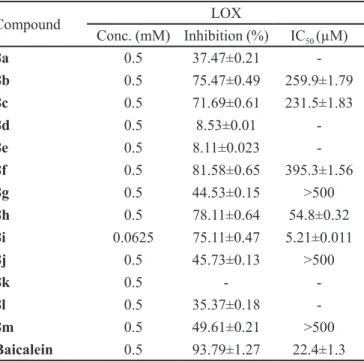
The results of screening the compounds against lipoxygenase activity are given as % inhibition and concentration for 50% inhibition (IC50) values in Table
IV.
More than half of the synthesized molecules were inactive at all dilutions, and only ive compounds, 8b, 8c, 8f, 8h and 8i,showed inhibitory potential varying from high to moderate. The lower activity of these molecules migh have been attributed to the large molecular size,
resulting in hindrance to binding with the active site of the enzyme. But unexpectedly, molecule, 8i, bearing a 3-nitrobenzylidene moiety, exerted the highest inhibitory efect with IC50 value of 5.21 ± 0.011 µM with respect to
that of baicalein, 22.4 ± 1.3 µM, the reference standard. This better inhibitory efect could be ascribed to some additional interaction modes shown by this molecule with the amino acid residues at the active site of the enzyme. Overall, the results demonstrated that the molecules bearing p-substituted benzylidenes were inactive at all dilutions. The ortho and meta substituted benzylidenes were more efective. The nitro-substituted benzylidenes (ortho and meta) were the most active ones among all molecules.
CONCLUSION
A series of molecules bearing 1,3,4-oxadiazole and azomethine moieties were synthesized with good yields. The structures were corroborated using spectral data, and these molecules were screened for their antibacterial and lipoxygenase inhibitory potentials. High to moderate
antibacterial activity was demonstrated against certain strains of Gram-positive and Gram-negative bacteria. These molecules were found to be weak enzyme inhibitors except 8i, which showed remarkable inhibition of lipoxygenase, as evidenced by its low IC50 value. The
molecule 8m showed high antibacterial activity might be due to p-methoxybenzylidene moiety. This study could be TABLE II - The % inhibition of antimicrobial activity of the synthesized compounds
Compound
% Inhibition
Gram negative bacteria Gram positive bacteria
S. typhi E. coli P. aeruginosa B. subtilis S. aureus
8a 78.75±0.75 76.80±0.68 77.55±0.25 72.50±1.21 77.33±1.11
8b 76.25±1.22 67.05±1.37 80.25±1.59 79.29±0.57 70.61±1.43
8c 66.75±0.72 63.90±1.23 59.90±0.58 63.00±1.60 69.83±0.84
8d 68.85±1.22 56.45±1.73 61.10±0.20 60.71±1.30 67.11±0.53
8e 58.85±0.28 61.50±2.17 52.20±0.30 43.21±1.31 71.33±1.00
8f 57.25±0.85 65.30±1.38 52.30±0.59 43.57±1.25 75.28±1.37
8g 47.95±0.72 73.45±1.27 77.50±1.30 66.36±1.67 75.00±0.63
8h 75.90±1.67 76.95±1.14 78.45±0.48 73.43±0.50 77.11±0.61
8i 75.56±1.37 75.05±1.56 71.38±1.87 72.15±1.78 76.89±1.03
8j 75.30±1.89 75.85±1.55 54.65±0.80 70.43±1.42 79.50±0.28
8k 46.75±1.57 60.95±0.78 55.95±0.20 45.72±1.05 71.56±1.58
8l 47.80±1.62 66.55±1.03 54.06±1.35 41.71±0.65 75.06±1.09
8m 80.65±0.94 84.45±0.48 82.35±0.60 81.21±0.90 83.28±1.02
Ciproloxacin 91.54±0.39 90.98±0.83 91.04±0.65 91.93±0.78 92.20±0.49
TABLE III - The MIC values of antimicrobial activity of the synthesized compounds
Compound
MIC ( µg/ mL)
Gram negative bacteria Gram positive bacteria
S. typhi E. coli P. aeruginosa B. subtilis S. aureus
8a 12.62±0.11 13.32±0.68 12.83±1.11 10.20±0.05 12.85±0.51
8b 13.26±0.90 15.01±0.10 14.43±0.78 10.01±0.55 13.59±1.03
8c 14.53±1.21 16.19±1.30 16.63±1.44 10.51±0.82 13.78±0.19
8d 14.66±0.44 17.34±0.80 16.68±0.11 11.37±0.40 14.69±1.05
8e 17.02±1.22 16.04±0.45 19.13±1.00 - 14.05±0.62
8f 17.42±0.22 16.33±0.60 18.26±0.67 - 13.43±0.54
8g - 10.78±1.21 13.02±0.45 16.44±1.65 13.87±2.34
8h 13.30±1.33 14.33±0.80 12.88±1.33 10.87±0.09 12.70±1.68
8i 13.25±1.67 14.42±0.46 13.18±1.29 10.54±1.54 12.98±2.08
8j 13.22±0.48 14.57±0.07 14.42±0.76 10.08±0.91 12.55±0.05
8k - 15.49±0.70 17.87±1.67 - 14.13±0.92
8l - 15.98±1.10 18.42±0.88 - 13.21±0.98
8m 9.48±0.00 7.37±0.23 13.69±1.66 - 10.88±1.21
Ciproloxacin 7.83±0.78 8.01±0.12 7.98±0.89 7.22±0.67 7.00±0.54
NOTE: Minimum inhibitory concentration (MIC) was measured with suitable dilutions (5-30 µg/well) and results were calculated
extended to synthesize more derivatives with variation in substituted benzylidenes for better results to advance our drug discovery programs.
ACKNOWLEDGEMENT
The authors acknowledge the Higher Education Commission (HEC) of Pakistan for inancial assistance in support of this project. Dr. A. Leyva provided English editing of the manuscript.
REFERENCES
ABBASI, M.A.; AHMAD, V.U.; ZUBAIR, M.; RASHID, M.A.; FAROOQ, U.; NAWAZ, S.A.; LODHI, M.A.;
MAKHMOOR, T.; CHOUDHARY, M.I.;
ATTA-UR-RAHMAN. Benzoylsalireposide an antioxidant, lipoxygenase and chymotrypsin inhibitor. Proc. Pak. Acad. Sci., v.42, p.121-124, 2005.
ALITONOU, G.A.; AVLESSI, F.; SOHOUNHLOUE, D.K.; AGNANIET, H.; BESSIERE, J.M.; MENUT, C.
Investigations on the essential oil of Cymbopogon giganteus
from benin for its potential use as an anti inflammatory agent. Int. J. Aromather., v.16, p.37-41, 2006.
ASLAM, M.A.S.; MAHMOOD, S.; SHAHID, M.; SAEED, A.; IQBAL, J. Synthesis, biological assay in vitro and
molecular docking studies of new Schif base derivatives
as potential urease inhibitors. Eur. J. Med. Chem., v.46, p.5473-5479, 2011.
AZIZ-UR-REHMAN; FATIMA, A.; ABBAS, N.; ABBASI,
M.A.; KHAN, K.M.; ASHRAF, M.; AHMAD, I.; EJAZ, S.A. Synthesis, characterization and biological screening of 5-substituted-1,3,4-oxadiazole-2yl-N -(2-methoxy-5-chlorophenyl)-2-sulfanyl acetamide. Pak. J. Pharm. Sci., v.26, p.345-352, 2013a.
AZIZ-UR-REHMAN; FATIMA, A.; ABBASI, M.A.; RASOOL,
S.; MALIK, A.; ASHRAF, M.; AHMAD, I.; EJAZ, S.A. Synthesis of new N -(5-Chloro-2-methoxyphenyl)-4-(5-substituted-1,3,4-oxadiazol-2-ylthio)butanamide derivatives as suitable lipoxygenase inhibitors. J. Saudi Chem. Soc., 2013b. DOI: <http://dx.doi.org/10.1016/j. jscs.2013.02.006>. [In Press].
AZIZ-UR-REHMAN; NAFEESA, K.; ABBASI, M.A.; KASHFA, H.; RASOOL, S.; AHMAD, I.; ARSHAD, S. Synthesis, characterization and biological screening of various S-substituted derivatives of 5-(3-nitrophenyl)-1,3,4-oxadiazole-2-thiol. Pak. J. Chem., v.3, p.1-8, 2013c.
BARBE, V.; CRUVEILLER, S.; KUNST, F.; LENOBLE, P.; MEURICE, G.; SEKOWSKA, A.; VALLENET, D.; WANG, T.; MOSZER, I.; MEDIGUE, C.; DANCHIN,
A. From a consortium sequence to a unified sequence: the Bacillus subtilis 168 reference genome a decade later.
Microbiol., v.155, p.1758-1775, 2009.
BHATTACHARYA, S.S.; DAS, U.; CHOUDHURY, B.K.
Occurrence & antibiogram of Salmonella typhi & S. paratyphi A isolated from Rourkela, Orissa. Indian J. Med. Res., v.133, p.431-433, 2011.
DESHMUKH, R.; JHA, A.K.; THAKUR, A.S.; DEWANGAN,
D . S y n t h e s i s a n d a n t i b a c t e r i a l a c t i v i t y o f s o m e 1,3,4-oxadiazole derivatives and their thione analogues.
Int. J. Res. Pharm. Biomed. Sci., v.2, p.215-219, 2011.
GUL, S.; AZIZ-UR-REHMAN; ABBASI, M.A.; NAFEESA,
K.; MALIK, A.; ASHRAF, M.; ISLMAIL, T.; AHMAD, I.
Synthesis, characterization and pharmacological evaluation of N-substituted derivatives of 5-(4-nitrophenyl)-1,3,4-oxadiazole-2yl-2-sulfanyl acetamide. Asian J. Chem., v.25, p.6231-6236, 2013.
TABLE IV - The IC50 values of enzyme inhibition activity of the
synthesized compounds
Compound LOX
Conc. (mM) Inhibition (%) IC50 (µM)
8a 0.5 37.47±0.21
-8b 0.5 75.47±0.49 259.9±1.79
8c 0.5 71.69±0.61 231.5±1.83
8d 0.5 8.53±0.01
-8e 0.5 8.11±0.023
-8f 0.5 81.58±0.65 395.3±1.56
8g 0.5 44.53±0.15 >500
8h 0.5 78.11±0.64 54.8±0.32
8i 0.0625 75.11±0.47 5.21±0.011
8j 0.5 45.73±0.13 >500
8k 0.5 -
-8l 0.5 35.37±0.18
-8m 0.5 49.61±0.21 >500
Baicalein 0.5 93.79±1.27 22.4±1.3
NOTE: LOX = Lipoxygenase. IC50 values (concentration for
HARRIS, L.G.; FOSTER, S.J.; RICHARDS, R.G. An
introduction to Staphylococcus aureus, and techniques for identifying and quantifying S. aureus adhesins in relation to adhesion to biomaterials: review. Eur. Cells Mater., v.4, p.39-60, 2002.
KAMEL, M.M.; ALI, H.I.; ANWAR, M.M.; MOHAMEDA, N.A.; SOLIMAN, A.M. Synthesis, antitumor activity and molecular docking study of novel
sulfonamide-Schif’s bases, thiazolidinones, benzothiazinones and their
C-nucleoside derivatives. Eur. J. Med. Chem., v.45, p.572-580, 2010.
KASPADY, M.; NARAYANASWAMY, V.K.; RAJU, M.; RAO, G.K. Synthesis, antibacterial activity of 2,4-disubstituted oxazoles and thiazoles as bioesters. Lett. Drug Des. Discov., v.6, p.21-28, 2009.
KHALID, H.; AZIZ-UR-REHMAN; ABBASI, M.A.; MALIK, A.; RASOOL, S.; NAFEESA, K.; AHMAD, I.; AFZAL, S. Synthesis, spectral analysis and anti-bacterial study of N-substituted derivatives of 2-(5-(1-(phenylsulfonyl) piperidin-4-yl)-1,3,4-oxadiazol-2-ylthio)acetamide. J. Saudi Chem. Soc., 2013. DOI: <http://dx.doi.org/10.1016/j. jscs.2013.05.001>. [In Press].
LIU, J.; WU, F.; CHEN, L.; ZHAO, L.; ZHAO, Z.; WANG, M.; LEI, S. Biological evaluation of coumarin derivatives as mushroom tyrosinase inhibitors. Food Chem., v.135, p.2872-2878, 2012.
MURTY, M.S.R.; PENTHALA, R.; NATH, L.R.; ANTO,
R.J. Synthesis of salicylic acid-based 1,3,4-oxadiazole derivatives coupledwith chiral oxazolidinones: novel hybrid heterocycles as antitumoragents. Lett. Drug Des. Discov., v.11, p.1133-1142, 2014.
NARAYAN, R.; POTOWSKI, M.; JIA, Z.; ANTONCHICK,
A.P.; WALDMANN, H.; Catalytic enantioselective 1,3-dipolar cycloadditions of azomethine ylides for biology-oriented synthesis. Acc. Chem. Res., v.47, p.1296-1310, 2014.
NARSIBHAI, B.D.; MISHRA, D.; VYAVAHARE, L.V.;
SINGH, A. Thiazolidinone: synthesis and biological
studies. Arch. Appl. Sci. Res., v.4, p.1816-1820, 2012.
PRESSLER, T.; BOHMOVA, C.; CONWAY, S.; DUMCIUS, S.; HJELTE, L.; HØIBY, N.; KOLLBERG, H.; TÜMMLER,
B.; VAVROVA, V. Chronic Pseudomonas aeruginosa
infection deinition: EuroCareCF Working Group report.
J. Cyst. Fibros., v.10, p.S75-S78, 2011.
RASHID, M.; HUSAIN, A.; MISHRA, R. Synthesis of benzimidazoles bearing oxadiazole nucleus as anticancer agents. Eur. J. Med. Chem., v.54, p.855-866, 2012.
SALMAN, H.H. Synthesis of new azomethine-N-oxide compounds and study of their antifungal and antioxidant activities. J. Basrah Res. (Sci.), v.39, p.91-99, 2013.
SOMANI, R.R.; AGRAWAL, A.G.; KALANTRI, P.P.;
GAVARKAR, P.S.; CLERCQ, E.D. Investigation of
1,3,4-oxadiazole scafold as potentially active compounds.
Int. J. Drug Des. Discov., v.2, p.353-360, 2011.
TABATABAI, S.A.; LASHKARI, S.B.; ZARRINDAST,
M.R.; GHOLIBEIKIAN, M.; SHAFIEE, A. Design, synthesis and anticonvulsant activity of 2-(2-phenoxy) phenyl- 1,3,4-oxadiazole derivatives. Iran. J. Pharm. Res., v.12, Suppl, p.105-111, 2013.
VOGT, R.L.; DIPPOLD, L. Escherichia coli O157:H7 outbreak
associated with consumption of ground beef, June-July 2002. Public Health Rep., v.120, p.174-178, 2005.
YANG, C.R.; ZANG, Y.; JACOB, M.R.; KHAN, S.I.; ZHANG, Y.J.; LI, X.C. Antifungal activity of C-27 steroidal saponins.
Antimicrob. Agents Ch., v.50, p.1710-1714, 2006.
ZHANG, X.; QIU, M.; SUN, J.; ZHANG, Y.; YANG Y.; WANG,
X.; TANG, J.; ZHU, H. Synthesis, biological evaluation and
molecular docking studies of 1,3,4-oxadiazole derivatives possessing 1,4-benzodioxan moiety as potential anticancer agents. Bioorg. Med. Chem., v.19, p.6518-6524, 2011.
Received for publication on 23th October 2014