BrazJOtorhinolaryngol.2017;83(2):235---238
www.bjorl.org
Brazilian
Journal
of
OTORHINOLARYNGOLOGY
CASE
REPORT
Oculopharyngeal
muscular
dystrophy
or
oculopharyngeal
distal
myopathy:
case
report
夽
Distrofia
muscular
oculofaríngea
ou
miopatia
oculofaríngea
distal:
relato
de
caso
Marilia
Yuri
Maeda
a,∗,
Tais
Yuri
Hashimoto
b,
Isabella
Christina
Oliveira
Neto
c,
Luciano
Rodrigues
Neves
d,eaUniversidadeFederaldeSãoPaulo(UNIFESP),FellowshipemOtorrinolaringologiaPediátrica,SãoPaulo,SP,Brazil bUniversidadeFederaldeSãoPaulo(UNIFESP),FellowshipemLaringologia,SãoPaulo,SP,Brazil
cUniversidadeFederaldeSãoPaulo(UNIFESP),DepartamentodeFonoaudiologia,SãoPaulo,SP,Brazil dUniversidadeFederaldeSãoPaulo(UNIFESP),DepartamentodeORL-CCP,SãoPaulo,SP,Brazil eUniversidadeNovedeJulho(UNINOVE),SãoPaulo,SP,Brazil
Received23June2015;accepted16July2015 Availableonline5November2015
Introduction
Oculopharyngeal muscular dystrophy (OPMD) is a genetic diseasewithapredominantlyautosomaldominantpattern, linkedtothePABPN1gene.OPMDprogresseswithaclinical picture of progressive ptosis,dysphagia, and weaknessof theproximalmusclesofthelimbs.1
The diseaseusually begins in the fifth or sixthdecade oflife.Initsrecessiveform,symptomshavealateronset areusuallymild;inthesecasesthediagnosisbecomesmore difficult,andtheremaybeconfusionwithsymptomsofother diseasesassociatedwithaging.2
夽
Please citethisarticleas:Maeda MY,Hashimoto TY, Oliveira Neto IC, Neves LR. Oculopharyngeal muscular dystrophy or ocu-lopharyngealdistalmyopathy:casereport.BrazJOtorhinolaryngol. 2017;83:235---8.
∗Correspondingauthor.
E-mail:[email protected](M.Y.Maeda). PeerReviewundertheresponsibilityofAssociac¸ãoBrasileirade OtorrinolaringologiaeCirurgiaCérvico-Facial.
ACanadianstudyestimatedtheprevalenceof OPMDat 1:1000.3Mostcasesreportedintheliteraturepresenta
fam-ilyhistoryofneuromusculardisease,buttherearerarecases whereitwasnotpossibletoestablishthisassociation,and theappropriateexplanationistheoccurrenceofmutation.1
The literature describes oculopharyngeal distal myopathy (OPDM)asacontroversialentity:it isconsidered bysome asadistinctdisorderfromOPMD,andbyothersasavariant ofthisdisease.4
Thevathasan etal. report that early-onset ophthalmo-paresisisa frequent findingin OPDM. The involvementof limb muscles initially occurs distally, and tibialis anterior muscle and intrinsic muscles of the hands are the most commonlyaffected.Luetal.addthat,inOPMD,the sympto-matologybeginsmostofteninyoungadults,withasevere facialmuscleweakness.
To carry out a proper investigation of OPMD and its differentiation from a variety of differential diagnoses (mitochondrial disorders, Nonaka myopathy, and OPDM, amongothers),it iscriticaltoperformtestssuchas anti-body anti-acetylcholine receptor dosage, serum lactate curve,electromyography,musclebiopsy,andgenetictesting evaluation.4
http://dx.doi.org/10.1016/j.bjorl.2015.07.019
236 MaedaMYetal.
Thehistopathologicalfindingsofbothdiseases(OPMDand OPDM)includenonspecificdystrophicmyopathic abnormal-itiesandthepresenceofvacuolesandtubular-filamentous intramuscularnuclearinclusions;thelatterislargerincases ofOPDM(>8nm).5
Genetic tests showed that in patients with OPDM, a repeatingpattern of base pairs (‘‘GCG’’) in PABPN1 gene doesnotoccur---afindingpresentincasesofOPMD.4
Among the musclechanges detected, dysphagia is the mostconcerningsymptom,becauseitevidencesa progres-siveweakeningoftheesophagealandpharyngealmuscles, which are responsible for the swallowing process. The degreeofdysphagiapresentedbythepatientisanimportant prognosticfactorofthedisease,asthesepatientsprogress tomalnutrition.6
Thecurative treatmentofOPMDis stillunknown. How-ever,medicalorsurgical treatmentscanbecarriedoutin ordertoimprovethepatient’squalityoflife.
In the case of dysphagia, it is feasible to intro-duce changes in food consistency, as well as facilitating maneuversand speech therapy for swallowing. When the establishedtherapynolongerappearstobeeffective,orin faceofasignificantweightlossorrecurrentaspiration pneu-monia,theremaybeanindicationfor surgicaltreatment, e.g.,cricopharyngealmyotomyorevengastrostomy.6
This study aimedto reporta clinical case of a patient withsignificantmuscledisorderandwithadeltoidmuscle biopsycompatiblewithOPMD.However,despite the diag-nosticefforts,itwasnotpossibletodistinguishthisdisease fromOPDM.
Case
report
ARS,62-yearsoldretiredmale,wasassessedatthisservice becauseofcomplaintsoflong-timeprogressivedysphagia.
The patientreportedtheonsetofprogressive symmet-ricalptosisat theageof36years.Hewasthen evaluated anddiagnosedwithneuromusculardiseasecompatiblewith OPMDorOPDM(presenceofrimmedvacuolesatthedeltoid musclebiopsymaterial).
ThepatientwasreferredtotheDepartmentof Ophthal-mologyforsurgery,aimingatafrontalsuspensionofhiseyes, inordertofacilitatethevision.
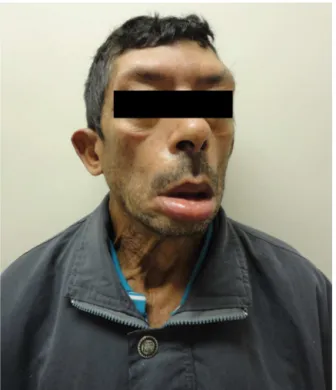
At52yearsofage,thepatientreportedtheonsetof dys-phagia(chokingonsolidfoods,needtoclearhisthroat,and fluidintakeafterfoodintake).Healsomentioned increas-ing difficulty in speaking and moving the muscles of the faceandeyes, andreportedthe progressionofsymptoms (Figs.1and2).
Atage57years,thepatienthadtroubleraisinghisright armandalsoopeninghisrighthand,whichwasina‘‘claw’’ position,inadditiontoageneralweaknessofhislegsthat resultedinseveralfalls(Fig.3).
Atthattime,thepatientsaidthathislipsbeganto‘‘fall’’ (sic),alongwithpossibleepisodesofurinaryincontinence.
Since the onset of symptoms, the patient reported a weightlossofaround13kgandtwoepisodesofpneumonia. Familyhistoryrevealed that thepatienthasseven sib-lings, two of whom have bilateral ptosis (one sister with onsetofptosisatage69yearsandonebrotherwithonset
Figure1 Patient’sfrontview.
atage74years).Oneofhisfourchildrenhasbilateralptosis, whichbeganatage37years.
Thepatient wasassessed regardinghisdysphagia com-plaints.
Swallowingendoscopywiththeuseofvariousfoodtypes andamounts(liquid,paste,andsolid)detectedamoderate oropharyngeal dysphagia with no visualization of pene-tration or food aspiration. Drooling caused by difficulty swallowingwasalsonoted.
Oculopharyngealmusculardystrophyoroculopharyngealdistalmyopathy:casereport 237
Figure3 Clawhand.
Thepatientwastreatedwithspeechtherapyfor degluti-tion,andbotulinumtoxinwasappliedinhissalivaryglands toreducesalivaproduction.
Discussion
Despitecontroversiesintheliterature,vanderSluijsetal. reportedintheirarticlethemainclinicalfeaturesofOPMD7:
aslowlyprogressivebilateralptosis,weaknessofproximal limbs,andprogressivedysphagia.
These authorsreportthattheabovementioned findings have alateonset;while in OPDM, theonsetof symptoms occursearlier (between 15 and20 yearsof age), withan initial manifestation of tibialis anteriormuscle weakness, orofbilateralptosis.7
Theyalsoreportthat,inthesepatients,anintense hypo-toniaofthemusclesofthefaceandoftheextrinsicmuscles oftheeyesisnoteworthy,whichresultsinptosisand limi-tationofocularandfacialmovements,withamoresevere andearlieroccurrencethanincasesofOPMD.7
Minami et al.8 discussed case reports of OPMD with
involvement of distal muscles in the literature; these authorsreportedthatitwouldbeextremelydifficultto dis-tinguishOPMD fromOPDMby simplyanalyzing theclinical features.
In that study,afteran evaluation of PABPN1gene, the authorsobtainedresultsregarding thepresenceof repeti-tionsofthebasepairs‘GCG’presentinOPMD.8
In the clinical picture discussed in the present study, ptosis started at a young age (at 36 years of age). Fur-thermore, the patient showed muscle alterations in the face,extrinsicmusclesof theeyes,righthand, andlower limbs.
Togetherwithdysphagia,thesesignsandsymptoms indi-cate apossible diagnosisof OPDM. However,theproximal muscles(scapularandpelvicgirdles)wereaffected,which makesthediagnosisofOPMDpossible.
A deltoid muscle biopsy allowed detection of atrophic polygonal muscle fibers and of intrasarcoplasmic rimmed vacuoles.The presenceofrimmedvacuolesis characteris-ticofbothdiseases;thus,itisnotpossibletodifferentiate betweenOPMDandOPDM(Figs.4and5).
Figure4 Rimmedvacuolesatthedeltoidmusclebiopsy (mod-ifiedGomoristain,350×).
Unfortunately,genetictesting toaid indiagnosis isnot available at this service. As already foreseen by Minami etal.,8 it wasnot possibletodifferentiate thesetwo
dis-eases(OPMD andOPDM) basedontheclinical information available.
Progressive dysphagia is seen in both diseases, and it maybecomesevereandcausefrequentaspiration pneumo-nia.Becausethispatientexhibitedmoderateoropharyngeal dysphagia with drooling, the authors enacted a clinical management protocol that included: speech therapy for deglutition;exercisestoimproveoralmotorskills;changein foodconsistency;andchemicalxerostomiawithbotulinum toxinapplication.
To date,thereisnotreatment for bothdiseases; thus, therapyshouldfocusonthecorrectionofanydeficits pre-sented,aimingatabetterqualityoflife.
Inadditiontoimprovingthedynamicsofdeglutition,the introductionofspeechtherapyfordeglutitionaimedto cor-rectunwantedpostures.Boththeretroflexionofthehead and frontal muscle contraction are known compensatory mechanismsfor correctionofptosis,whichhasa negative effectonswallowing,worseningapre-existingdysphagia.A slightbendingofthe headcanimprovetheoropharyngeal
238 MaedaMYetal.
phaseof swallowing, reducing themeal time,the waste, andtheriskofaspiration.9
Theuseofbotulinumtoxininthispatient’ssalivaryglands aimedtodecreasesalivaproduction,resultinginlessvolume forswallowing.Todate,thispatientisstillbeing followed-upforhisdysphagia.
Conclusion
Inthisstudy,theauthorspresentedanddescribedacaseof arareneuromusculardisease,withanimportantimpacton theswallowingprocess.
Conflicts
of
interest
Theauthorsdeclarenoconflictsofinterest.
References
1.Tremolizzo L, GalbusseraA, Tagliabue E,FermiS, BruttiniM, Lamperti C,et al. An apparently sporadic case of oculopha-ryngealmusculardystrophy:thefirstItalianreport.NeurolSci. 2007;28:339---41.
2.HebbarS,WebberleyMJ,LuntP,RobinsonDO.Siblingswith reces-siveoculopharyngealmuscular dystrophy.NeuromusculDisord. 2007;17:254---7.
3.CodereF,BraisB,RouleauG,LafontaineE.Oculopharyngeal mus-culardystrophy:what’snew?Orbit.2001:259---66.
4.LuH,Luan X,YuanY,DongM,SunW,YanC.Theclinicaland myopathological features of oculopharyngodistal myopathy in Chinesefamily.Neuropathology.2008;28:599---603.
5.Thevathasan E, Squier W, MacIver DH, Hilton DA, Fathers E, Hilton-Jones D. Oculopharyngodistal myopathy --- a pos-sible association with cardiomyopathy. Neuromuscul Disord. 2011;21:121---5.
6.Pellerin HG, NicoTrépanier CA, Lessard MR. Postoperative complicationsinpatientswithoculopharyngealmuscular dystro-phy:aretrospectivestudy.CanJAnesth.2007;54:361---5.
7.vanderSluijsBM,terLaakHJ,SchefferH,vanderMaarelSM,van EngelenBGM.Autosomalrecessiveoculopharyngodistal myopa-thy:adistinctphenotypical,histological,andgeneticentity.J NeurolNeurosurgPsychiatry.2004;75:1499---501.
8.MinamiN,IkezoeK,KurodaH,NakabayahiH,SatoyoshiE, Non-akaI.Oculopharyngealmyopathy isgeneticallyheterogeneous andmostcasesaredistinctfromoculopharyngealmuscular dys-trophy.NeuromusculDisord.2001;11:699---702.