Microbiological composition associated
with vitamin D receptor gene
polymorphism in chronic periodontitis
Abstract: The aim of this cross-sectional study was to examine the re-lationship between the composition of the subgingival microbiota and the vitamin D receptor (VDR) gene polymorphism in Brazilian adults with chronic periodontitis. The clinical parameters of probing depth, clinical attachment level, bleeding on probing, plaque accumulation and suppuration were measured in 60 Caucasian adults who were divided into two groups: 30 healthy individuals (control) and 30 with chronic periodontitis (ChP). Subgingival plaque samples were collected from 6 sites per subject and analyzed for 38 bacterial species using the Checker-board DNA-DNA Hybridization. DNA was obtained from the subjects’ epithelial cells by scraping the buccal mucosa and using a mouthwash containing 3% of glucose. Polymorphism in the VDR gene was ana-lyzed by the polymerase chain reaction (PCR), followed by Taql diges-tion (RFLP). The healthy subjects presented signiicantly lower levels (0.3 × 10⁷± 0.7 × 10⁷) of total microbial counts in comparison with sub-jects with chronic periodontitis (4.5 × 10⁷± 2.9 × 10⁷). Regarding the oc-currence of VDR polymorphism, it was observed that the Tt genotype was more prevalent in the Periodontitis group (60%) than in the Healthy group (30%), while the prevalences of the TT genotype were 23.3% and 53.3%, respectively (Chi-square test, p < 0.05). No difference was found in the composition of subgingival microbiota among the VDR genotypes evaluated for the Healthy and Periodontitis groups. In conclusion, the Tt genotype was associated with periodontal disease; however, no associa-tion with the subgingival microbiota was observed.
Descriptors: Microbiology; Genetic polymorphism; Molecular biology; Vitamin D.
Maria Angélica Toniato Borges(a)
Luciene Cristina de Figueiredo(b)
Rui Barbosa de Brito Jr(c)
Marcelo Faveri(b)
Magda Feres(b)
(a) MSc; (b)PhD – Department of
Periodontology, Dental Research Division, Guarulhos University, Guarulhos, SP, Brazil.
(c) PhD, Department of Molecular Biology, São
Leopoldo Mandic Dental Research Institute, Campinas, SP, Brazil.
Corresponding author:
Magda Feres
Universidade Guarulhos
Rua Dr. Nilo Peçanha, 81, Prédio U, 6º Andar
Guarulhos - SP - Brazil CEP: 07011-040 E-mail: [email protected]
Introduction
Periodontitis is an infectious disease of the peri-odontium in which the presence of speciic bacteria is required for disease initiation and progression.1 A number of factors have been suggested as playing a role in governing the microbial composition of sub-gingival plaque at a site including environmental and genetic factors. Subject-to-subject differences in the microbial proiles of subgingival plaque samples may indicate that differences in the genetic background of the host may inluence the composition of the sub-gingival microbiota. However, the effects of the gen-otype of an individual on the composition of subgin-gival microbiota have been dificult to demonstrate.2 Recently, many studies have evaluated potential gene polymorphisms that could inluence the oral microbiota of subjects with periodontal diseases. 2-7 Since progressive bone loss is the ultimate result of periodontal disease, some association studies involving the vitamin D receptor (VDR),8-17 mostly evaluating the association between the TaqI poly-morphism and periodontal disease, have been con-ducted in different populations.Vitamin D has spe-cial roles in regulating the metabolisms of calcium and phosphorus, and in the immunosystem. The biologic function of vitamin D must be associated with its receptor.10,11 At the moment, the associa-tion between VDR polymorphism and the risk of periodontal disease has not been conirmed. To our knowledge, only one investigation studied the as-sociation between VDR polymorphism and oral microbiota, but only three bacteria species were analyzed (Aggregatibacter actinomycetemcomitans, Porphyromonas gingivalis and Tannerella forsyth-ensis) by culture and their identities conirmed by the polymerase chain reaction in persons with gen-eralized aggressive periodontitis.6
Thus, the purpose of the present investigation was to examine the relationship between the compo-sition of subgingival microbiota and the vitamin D receptor gene polymorphism, designed by the TaqI, in Brazilian adults with chronic periodontitis.
Material and Methods
Subject populationSixty Caucasian subjects were selected for two
clinical groups: Chronic periodontitis - ChP (n = 30) and periodontally healthy - Control (n = 30). The patients were selected from the population referred to the periodontal clinic, Guarulhos University (Guarulhos, SP, Brazil). The sample size calcula-tion determined that 30 subjects per group would provide an 80% power to detect a true difference between the ChP and control groups using the mean proportion of red complex as the primary outcome variable. A complete periodontal examination was performed, including taking the medical and dental history, an intra-oral examination and full-mouth periodontal probing. Periodontal diagnosis was made, and the subjects who fulilled the inclusion/ exclusion criteria were invited to participate in the study. If accepted, they were informed of the nature of study participation and their written consent was obtained. The study was approved by the Institu-tional Committee of Ethics in Clinical Research, Guarulhos University.
Inclusion and exclusion criteria
Subjects with ChP were > 30 years old and ex-hibited at least 6 sites with pocket depth and clini-cal attachment level measurements ≥ 5 mm. These sites should be located in different teeth and distrib-uted among the four quadrants. The periodontally healthy subjects were at least 30 years old, had no pocket depth or clinical attachment level measure-ments > 3 mm and had < 10% sites exhibiting gingi-val redness. All subjects had at least 15 natural teeth excluding 3rd molars. The inclusion criteria were based on Armitage18 (1999).
Exclusion criteria included previous periodontal therapy, pregnancy, nursing, smoking, any systemic condition that could affect the progression of peri-odontal disease or that required antibiotic coverage for routine dental therapy and antibiotic therapy in the previous 6 months.
Clinical evaluation
and measures of pocket depth (PD, mm) and clini-cal attachment level (CAL, mm) were determined at the baseline visit at 6 sites per tooth (mesiobuccal, buccal, distobuccal, distolingual, lingual and mesio-lingual) in all teeth excluding the third molars. PD and CAL measurements were recorded to the near-est millimeter using a North Carolina periodontal probe (Hu-Friedy, Chicago, IL, USA).
Microbiological assessment
Sample collection
Subgingival plaque samples were collected from six non-contiguous interproximal sites per subject. Sites with PD and CAL ≥ 5 mm in the ChP group and sites with PD < 3 mm in the control group were collected. The selected sites were randomized in dif-ferent quadrants. After the clinical parameters had been recorded, the supragingival plaque was re-moved and the samples were taken with individual sterile Gracey curettes and immediately placed in separate Eppendorf tubes containing 0.15 ml TE (10 mM Tris-HCl, 1 mM EDTA, pH 7.6). 0.10 ml of 0.5 M NaOH was added to each tube and the samples were dispersed using a vortex mixer.
Checkerboard DNA-DNA hybridization
Counts of 38 bacterial species were determined in each sample, using the Checkerboard DNA-DNA hybridization technique1 as previously described by Faveri et al.20 (2006). The assay sensitivity was adjusted to permit detection of 104 cells of a given species by adjusting the concentration of each DNA probe.
Determination of VDR genotype
Sample collection and DNA extraction
Cells were obtained through mouthwash with 3% glucose solution and scrapings of the buccal mucosa with a sterile wood spatula. DNA was ex-tracted from buccal epithelial cells with sequential phenol/chloroform.21,22
Analysis of VDR-TaqI site polymorphism
A VDR region of 340 pb was ampliied by the polymerase chain reaction (PCR) utilizing speciic oligonucleotide primers (F-5’ CAG AGC ATG GAC
AGG GAG CAA G 3’ and exon 9 R-5’ GGA TGT ACG TCT GCA GTG TG 3’).10 Reaction conditions and cycling parameters were set as previously de-scribed by Brito Jr. et al.9 (2004) and the resulting fragments were separated by 10% polyacrylamide gel electrophoresis. The gel was stained by the rapid silver staining method.23 The restriction fragment length polymorphism is formed by a single base transition (T → C) at codon 352 in exon 9 of the VDR gene that creates a TaqI restriction site. The alleles that result from this change are designated t (TaqI site present, with two fragments: 260 bp and 80 bp) or T (TaqI site absent: 340 bp).
Data analysis
The clinical and microbiological data were ana-lyzed by the Mann-Whitney U Test. The signiicance of the differences in the observed frequencies of each polymorphism in the control and ChP groups was assessed by the Chi-square test (χ2). The risk associated with individual alleles or genotypes was calculated as the odds ratio with 95% conidence in-tervals (CI). Differences were considered signiicant when p < 0.05.
Results
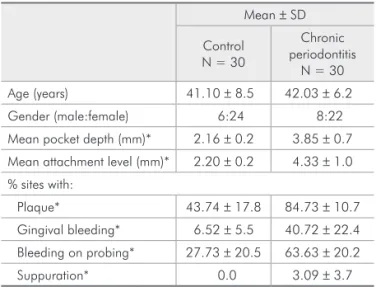
The clinical and demographic characteristics of the patients are presented in Table 1. The ChP group displayed signiicantly higher means (p < 0.05) for
Table 1 - Baseline clinical and demographic parameters of the subject population.
Mean ± SD
Control N = 30
Chronic periodontitis
N = 30
Age (years) 41.10 ± 8.5 42.03 ± 6.2
Gender (male:female) 6:24 8:22
Mean pocket depth (mm)* 2.16 ± 0.2 3.85 ± 0.7 Mean attachment level (mm)* 2.20 ± 0.2 4.33 ± 1.0
% sites with:
Plaque* 43.74 ± 17.8 84.73 ± 10.7
Gingival bleeding* 6.52 ± 5.5 40.72 ± 22.4
Bleeding on probing* 27.73 ± 20.5 63.63 ± 20.2
Suppuration* 0.0 3.09 ± 3.7
all the clinical measurements compared with the control group.
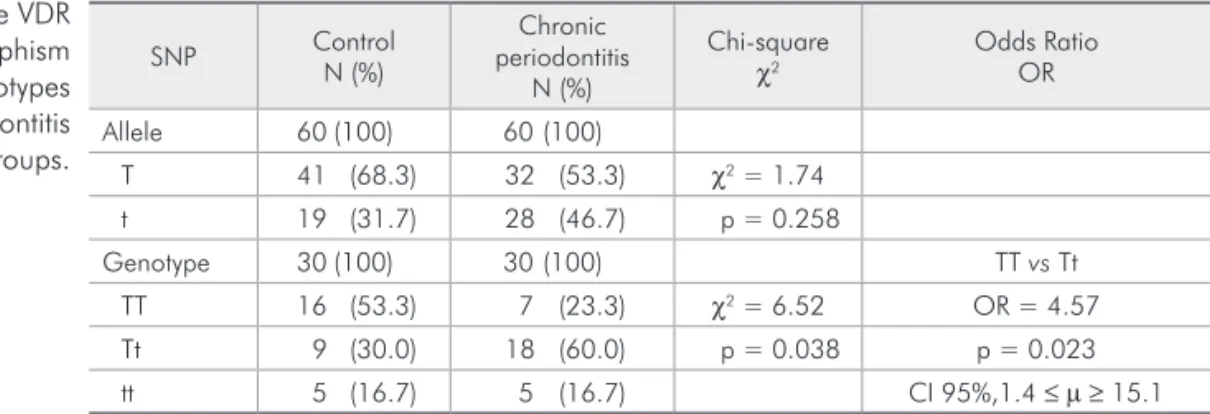
The frequencies of the alleles and genotypes are presented in Table 2. While analyzing alleles and genotypes, a signiicant difference between the con-trol and ChP groups was found for the VDR TaqI genotype (p = 0.038). Calculating the odds ratio (OR), it was revealed that the individuals with the Tt genotype were 4.57 times more susceptible to peri-odontal disease. The genotype distributions were consistent with the assumption of the Hardy-Wein-berg equilibrium in the control group. There was no statistical difference in the distribution of the allelic (T, t) frequencies between the ChP and healthy con-trol groups (p > 0.05).
No statistically signiicant differences were ob-served in the percentage of DNA probe counts among the genotypes TT, Tt and tt in the healthy and chronic periodontitis groups (Graph 1). Addi-tionally, the proportions of the different complexes did not differ among the genotype groups. For ex-ample, the pathogenic species (red and orange com-plexes) represented 67.1%, 65.9% and 59.9% of the total microbiota taken from the chronic periodonti-tis group in the TT, Tt and tt genotypes, respectively; and 24.6%, 31.2% and 29.4% of the total microbio-ta microbio-taken from healthy subjects (damicrobio-ta not presented).
Discussion
The hypothesis that host genotype may affect the colonization pattern of subgingival species has been extensively discussed in the past few years. The difi-culty in conirming or refuting this association is re-lated to two major points. The irst one is the lack of speciic host genetic factors that are likely to affect
the subgingival microbiota and the second point is the dificulty in comprehensively examining the sub-gingival microbiota. This last impediment was over-come by the development of more rapid microbio-logical techniques such as checkerboard DNA-DNA hybridization.1 Thus, the purpose of the present in-vestigation was to examine the relationship between the composition of subgingival microbiota and the vitamin D receptor gene polymorphism, designed by the TaqI, in Brazilian adults with chronic periodon-titis. It is worth mentioning that the Brazilian popu-lation is highly heterogeneous, with Native Ameri-can, AfriAmeri-can, and European ancestry. Europeans are the predominant ancestry in the Brazilian southern region,25 and that fact was consistent with the oc-currence of Caucasoid individuals in our sample.
Several studies have identiied clinical evidence that subjects who are carriers of a speciic IL-1 gene polymorphism have signiicantly higher counts of bacteria linked to chronic periodontitis2-5 or aggres-sive periodontitis.12 However, considering the VDR gene polymorphism, the data of the present inves-tigation are in accordance with the indings of Ni-bali et al.6 (2007), who did not support the notion that differences in host VDR genotype inluence the composition of subgingival microbiota.
In the periodontal literature, VDR gene poly-morphism was reported to be associated with the in-cidence of early-onset periodontitis,14,15,17 localized early-onset periodontitis10 and generalized aggres-sive periodontitis.13
In this study, we found a signiicant association between the TaqI polymorphism in the VDR gene and the incidence of ChP. The Tt genotype was found to be associated with periodontitis. These data for a
SNP Control
N (%)
Chronic periodontitis
N (%)
Chi-square χ2
Odds Ratio OR
Allele 60 (100) 60 (100)
T 41 (68.3) 32 (53.3) χ2 = 1.74
t 19 (31.7) 28 (46.7) p = 0.258
Genotype 30 (100) 30 (100) TT vs Tt
TT 16 (53.3) 7 (23.3) χ2 = 6.52 OR = 4.57
Tt 9 (30.0) 18 (60.0) p = 0.038 p = 0.023
tt 5 (16.7) 5 (16.7) CI 95%,1.4 ≤µ≥ 15.1
Table 2 - Distribution of the VDR Single Nucleotide Polymorphism
(SNP) TaqI alleles and genotypes
group of chronic periodontal disease versus healthy individuals were similar to the indings presented by Brito Jr et al.9 (2004). Those authors were the irst to demonstrate an association between VDR gene polymorphism and ChP in the Brazilian population.
Our indings were contradicted by other studies that analyzed the TaqI polymorphism in the VDR gene in different populations. The results of these studies showed an association between ChP and genotype TT or the allele T.15,16 Racial differences and the limitations of a small sample size in our
study might be the main reason for these different results. Additionally, there is still no deinitive con-clusion about the functional mechanism of the TaqI VDR gene, and, therefore, more studies are needed to address these aspects.
Conclusion
In conclusion, the Tt genotype was associated with periodontal disease; however, no association with the subgingival microbiota was observed.
Graph 1 - Plots of the mean percentage of the total DNA probe count in subgingival plaque samples taken from 30 periodontally healthy subjects and 30 subjects with chronic periodontitis for the genotypes TT, Tt and tt. The microbial profiles represent the mean values. Mean values for each species were computed by averaging 6 samples in each subject, and then averaging across subjects in the two clinical groups. The species were ordered and grouped according to the complexes described by Socransky
et al.24 (1998). The significance of
the differences among groups was sought using Mann-Whitney U Test, p > 0.05.
% DNA probe counts
A. gerencseriae A. israelii A. naeslundii 1
V. parvula
S. mitis
A. actinomycetemcomitans C. gingivalis
C. sputigena C. ochracea S. sanguinis S. oralis
E. corrodens
C. rectus C. showae
F. periodonticum P. micros P. intermedia C. gracilis
F. nucleatum ssp. nucleatum F. nucleatum ssp. polymorphum F. nucleatum ssp. vincentii E. nodatum
P. nigrescens S. constellatus
E. saburreum G. morbillorum L. buccalis
S. anginosus S. noxia T. socranskii P. melaninogenica P. acnes T. denticola P. gingivalis T. forsythia S. intermedius S. gordonii A. odontolyticus
Actinos
Purple
Yellow
Green
Orange
Red
Others CHRONIC PERIODONTITIS HEALTHY
0 10 20 30 0 10 20 30
TT Tt tt
References
1. Socransky SS, Smith C, Martin L, Paster JB, Dewhirst FE, Levin AE. Checkerboard DNA-DNA Hybridization. Biotech-niques. 1994;17(4):788-92.
periodontitis patients. J Clin Periodontol. 2000;27(11):810-8.
3. Agerbaek MR, Lang NP, Persson R. Microbiological com-position associated with interleukin-1 gene polymorphism in subjects undergoing supportive periodontal therapy. J Peri-odontol. 2006;77(8):1397-402.
4. Kowaslki J, Górska R, Dragan M, Kozak I. Clinical state of the patients with periodontitis, IL-1 polymorphism and patho-gens in periodontal pocket – is there a link? (An introductory report). Adv Med Sci. 2006;51 Suppl 1:9-12.
5. Laine ML, Farré MA, García-González MA, van Dijk LJ, Ham AJ, Winkel EG et al. Polymorphisms of the Interleukin-1 gene family, oral microbial pathogens, and smoking in adult periodontitis. J Dent Res. 2001;80(8):1695-9.
6. Nibali L, Ready DR, Parkar M, Brett PM, Wilson M, Tonetti MS et al. Gene polymorphisms and the prevalence of key periodontal pathogens. J Dent Res. 2007;86(5):416-20. 7. Trevilatto PC, Tramontina VA, Machado MAN, Gonçalves
RB, Sallum AW, Line SRP. Clinical, genetic and microbiologi-cal findings in a Brazilian family with aggressive periodontitis. J Clin Periodontol. 2002;29(3):233-9.
8. Brett PM, Zygogianni P, Griffiths GS, Tomaz M, Parkar M, D’Aiuto F et al. Functional gene polymorphisms in aggres-sive and chronic periodontitis. J Dent Res. 2005;84(12):1149-53.
9. Brito Jr RB, Scarel-Caminaga RM, Trevilatto PC, Souza AP, Barros SP. Polymorphisms in the vitamin D receptor gene are associated with periodontal disease. J Periodontol. 2004;75(8):1090-5.
10. Hennig BJW, Parkhill JM, Chapple ILC, Heasman PA, Taylor JJ. Association of vitamin D receptor gene polymorphism with localized early-onset periodontal diseases. J Periodontol. 1999;70(9):1032-8.
11. Inagaki K, Krall EA, Fleet JC, Garcia RI. Vitamin D receptor alleles, periodontal disease progression, and tooth loss in the VA Dental Longitudinal Study. J Periodontol. 2003;74(2):161-7.
12. Naito M, Miyaki K, Naito T, Zhang L, Hoshi K, Hara A et al. Association between vitamin D receptor gene haplotypes and chronic periodontitis among Japanese men. Int J Med Sci. 2007;4(4):216-22.
13. Park KS, Nam JH, Choi J. The short vitamin D receptor is associated with increased risk for generalized aggressive peri-odontitis. J Clin Periodontol. 2006;33(8):524-8.
14. Sun JL, Meng HX, Cao CF, Tachi Y, Shinohara M, Ueda M
et al. Relationship between vitamin D receptor gene polymor-phism and periodontitis. J Periodontal Res. 2002;37(4):263-7.
15. Tachi Y, Shimpuku H, Nosaka Y, Kawamura T, Shinohara M, Ueda M et al. Association of vitamin D receptor gene poly-morphism with periodontal diseases in Japanese and Chinese. Nucleic Acids Res Suppl. 2001;(1):111-2.
16. Tachi Y, Shimpuku H, Nosaka Y, Kawamura T, Shinohara M, Ueda M et al. Vitamin D receptor gene polymorphism is asso-ciated with chronic periodontitis. Life Sci. 2003;73(26):3313-21.
17. Yoshihara A, Sugita N, Yamamoto K, Kobayashi T, Miyazaki H, Yoshi H. Analysis of vitamin D and FCgamma receptor polymorphisms in Japanese patients with generalized early-onset periodontitis. J Dent Res. 2001;80(12):2051-4. 18. Armitage GC. Development of a classification system for
periodontal diseases and conditions. Ann Periodontol. 1999;4(1):1-6.
19. Araujo MW, Hovey KM, Benedek JR, Grossi SG, Dorn J, Wactawshi-Wende J et al. Reproducibility of probing depth measurement using a constant-force electronic probe: anal-ysis of inter- and intraexaminer variability. J Periodontol. 2003;74(12):1736-40.
20. Faveri M, Feres M, Shibli JA, Hayacibara RF, Hayacibara MM, de Figueiredo LC. Microbiota of the dorsum of the tongue after plaque accumulation: an experimental study in humans. J Periodontol. 2006;77(9):1539-46.
21. Haussler MR, Whitfied GK, Haussler CA, Hsieh JC, Thomp-son PD, Selznick SH et al. The nuclear vitamin D receptor: biological and molecular regulatory properties revealed. J Bone Miner Res. 1998;13(3):325-49.
22. Trevilatto PC, Line SRP. Use of buccal epithelial cells for PCR amplification of large DNA fragment. J Forensic Odontosto-matol. 2000;18(1):6-9.
23. Sanguinetti CJ, Dias Neto E, Simpson AJG. Rapid silver stain-ing and recovery of PCR products separated on polyacryl-amide gels. Biotechniques. 1994;17(5):914-21.
24. Socransky SS, Haffajee AD, Cugini MA, Smith C, Kent RL Jr. Microbial complexes in subgingival plaque. J Clin Periodontol. 1998;25(2):134-44.