R
EVIEW
A
RTICLE
Revista Brasileira de FisioterapiaMuscle-based perception: theory, research
and implications for rehabilitation
Percepção baseada nos músculos: teoria, pesquisa e implicações na reabilitação
Carello C, Silva PL, Kinsella-Shaw JM, Turvey MT
Abstract
Background: Muscle-based perception of the spatial properties of limbs constrains the patterning, timing and magnitude of muscle
forces while performing motor activities. The centrality of muscle-based perception to both ordinary and skilled actions warrants attention from the rehabilitation community, since defi cits in its functioning would be related to important functional limitations. In this overview, we summarize a body of research that may be used to guide the development of effective assessment tools and rehabilitation programs that are specifi cally directed towards such defi cits. Objectives: There were four specifi c aims: fi rst, to present an information-based approach to information-based perception that is grounded in physical laws; second to identify central principles underlying muscle-based perception that have been revealed and supported by empirical work; third, to summarize reports that have investigated whether the principles identifi ed can be generalized to muscle-based perception in individuals with sensory-motor impairments; and fourth to provide a preliminary discussion of the potential implications of the research presented here for issues relating to rehabilitation.
Key words: perception; ecological psychology; stroke, neuropathy.
Resumo
Introdução: A percepção muscular das propriedades espaciais dos membros restringe o padrão, período e magnitude das forças
exercidas durante a execução de atividades motoras. A importância central da percepção muscular, tanto para ações rotineiras quanto para ações especializadas, merece atenção da comunidade envolvida na área de reabilitação, uma vez que alterações em suas funções podem estar relacionadas a importantes limitações funcionais. Nesta revisão, os autores apresentam um resumo da pesquisa que pode ser utilizada para guiar o desenvolvimento de ferramentas de avaliação efi cazes bem como programas de reabilitação que sejam especifi camente direcionados para estas disfunções. Objetivos: Quatro pontos específi cos foram incluídos: primeiro, a apresentação da abordagem com base em informações relativas à percepção muscular de acordo com as leis da física; segundo, a identifi cação dos princípios centrais determinantes da percepção muscular que vem sendo revelada e apoiada por trabalhos empíricos; terceiro, um resumo dos relatos que investigaram e se os princípios identifi cados poderiam ser generalizados para a percepção muscular dos indivíduos com alterações motoras e sensitivas; e quarto, uma discussão preliminar sobre as implicações potenciais da pesquisa aqui apresentada, no tocante aos assuntos relacionados à reabilitação.
Palavras-chave: percepção; psicologia ecológica; acidente vascular cerebral; neuropatia.
Received: 08/07/2008 – Revised: 09/07/2008 – Accpeted: 11/07/2008
Center for the Ecological Study of Perception and Action, University of Connecticut, Storrs (CT), United States
Correspondence to: Claudia Carello, Department of Psychology, University of Connecticut, 406, Babbidge Road, Unit 1020, 06269-1020, Storrs (CT), United States, e-mail: [email protected]
Introduction
Haptic perception is dei ned as the awareness of the body and the environment by means of the body, that is, by means of mechanical contact1. Such mechanical contact is made
possible by at least three dif erent forms of touch: cutaneous, haptic and dynamic touch1. Typically, references to touch are
references to the i rst two types: experiences obtained when objects contact the skin (cutaneous touch) or when the hands are moved over surfaces (haptic touch). h e third type, dynamic touch, refers to the awareness of magnitudes and directions of implements and limbs by means of muscular ef ort. Arguably, this last category is the most common form of touch, albeit the least apparent2.
Dynamic touch (variously referred to as ef ortful touch, kin-esthetic touch or muscle-based perception) is operating when-ever one takes hold of something and moves it in some fashion, for example, when one lifts a cup, carries a book, or wields a baton. It is also active when tools or implements are used to act upon or explore the environment. Additionally, it functions in a more continuous way in the assembling, transforming and maintaining of posture3. Hence, muscle-based perception
un-derlies our ability to achieve and maintain orientation of the body, limbs, and implements while visually attending to some-thing else. h is ability is relevant to the performance of count-less everyday tasks, including tasks embedded within other tasks (e.g., carrying a cup of cof ee while walking through clut-tered surroundings, swinging a hammer while visually focused on the nail, and maintaining posture while talking to a friend). Such ubiquity suggests that dei cits in muscle-based percep-tion may well result in important funcpercep-tional limitapercep-tions.
Despite the immersion of muscle-based perception in ac-tivity, clinical evaluations of dei cits in touch typically do not rel ect a functional context. Evaluations are generally restricted to more passive abilities such as perceiving and replicating joint angles in the absence of vision. Given the broad range of functional tasks involving muscle-based perception, such an assessment tool can, at best, only partially inform about the nature of that system’s (diminished) involvement. Ef orts to evaluate functional capacities have, perhaps incidentally, led to the development of tasks with a dynamic touch component such as a pick-up test4-6 or variants that require, in addition,
placing or tossing the object7,8. h ese tasks emphasize manual
dexterity, however, and do not address larger scale transport-ing and maneuvertransport-ing of objects (cups, books, briefcases) and implements (spatulas, hammers, brooms). Interestingly, some clinical tests do, in fact, require transporting and maneuvering objects in functional contexts (e.g., Action research arm test9
and Wolf motor function test10. Although intact dynamic touch
could facilitate or even ensure success, these tests are designed
to assess functional dei cits arising from pathological changes in tone and recruitment. Guided by that goal, therefore, the tests provide indices only of upper extremity motor l uency (e.g., movement execution time, error rate). For the most part, the kinds of changes in muscle-based perception that accom-pany sensory and motor impairments are largely unknown and far from obvious.
It might be argued that the centrality of muscle-based per-ception to actions both mundane and skilled warrants more attention from the rehabilitation community. Pointedly, it is not even known whether or not sensory and motor impair-ments result in dei cits in dynamic touch. h e development of ef ective assessment tools – let alone rehabilitation programs specii cally directed at such dei cits – requires a sound theory of the functioning of dynamic touch. In this overview, we summarize a body of research that provides the groundwork for needed theorizing on the muscle-based capabilities of the haptic perceptual system. h ere are four specii c aims: i rst, to present an information-based approach to muscle-based per-ception that is grounded in physical law; second, to identify central principles underlying muscle-based perception that have been revealed and supported by empirical work; third, to summarize reports investigating whether the identii ed princi-ples generalize to muscle-based perception in individuals with sensory-motor impairments; and fourth, to provide a prelimi-nary discussion of the potential implications of the presented research for issues in rehabilitation.
Informational basis for dynamic
touch
It has been suggested that dynamic touch exploits the physics of rotation and extracts mechanical invariants specii c to hand-held objects in order to perceive their relevant proper-ties11. More specii cally, whenever a person wields a grasped
object, the hand movements, together with the physical prop-erties of the object, produce torques, angular motions, and muscle deformations that change over time. Importantly, there are invariant parameters that relate these variable torques and motions, namely, the moments of the object’s mass distribu-tion. Such parameters are specii c to the object’s inertial prop-erties and, hence, constitute viable informational variables underlying perception of its unchanging dimensions.
One can develop intuitions about an object’s mass moments by imagining a hammer cut into innumerable small pieces that are left arranged so as to preserve its original shape (Figure 1). Mass, the zeroth moment, is calculated by simply adding up the masses of all those pieces. h e calculation of i rst and second moments (static moment and moment of inertia, respectively)
requires choosing an axis, say, through the end of the handle. h e i rst moment is calculated by measuring how far a given piece is from the axis, multiplying that distance by the mass of the piece, and summing all those mass x distance products. Calculation of the second moment is similar, except that distance is squared before multiplication. For a hammer that is grasped by its handle, the force required to hold it vertically is proportional to mass; the force required to hold it horizontally is proportional to i rst mo-ment. h e second moment or moment of inertia relates to the forces required to rotate the object in dif erent directions. Hence, a single number cannot capture its general form. Its expression requires a tensor, commonly referred to as the inertia tensor.
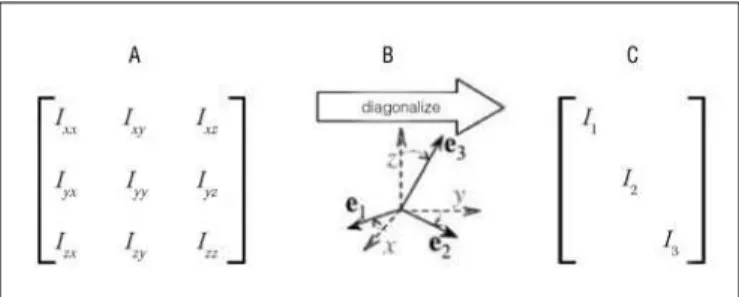
h e inertia tensor (Iij) quantii es an object’s resistance to
rota-tion in dif erent direcrota-tions. It is represented mathematically by a symmetric 3×3 matrix: h e diagonal terms (moments of inertia) capture the object’s rotational inertia (resistance to rotational acceleration) with respect to three orthogonal axes centered at a point of reference O; the of -diagonal terms (products of iner-tia) capture the object’s rotational inertia in directions perpen-dicular to the axial rotations (Figure 2A). h e products of inertia rel ect asymmetries of the object’s mass distribution about axes dei ned at O. A particular set of orthogonal axes can be chosen such that the object’s resistance to rotational acceleration about O is evenly distributed (Figure 2B); with these so-called symme-try axes, the products of inertia disappear, thereby rendering the inertia tensor in its diagonal form (Figure 2C)12. h e diagonalized
tensor comprises the symmetry axes or eigenvectors e1, e2, and e3,
and the principal moments of inertia or eigenvalues I1, I2, and I3,
which quantify resistances to rotational acceleration about those axes (where the subscripts one, two, and three identify largest, intermediate and smallest resistances, respectively). Hence, the eigenvectors constitute a non-arbitrary coordinate system de-i ned by the object de-itself – specde-ide-i cally by how the object’s mass de-is distributed relative to the rotation point2. h e implication is that
both the eigenvalues and eigenvectors are relevant mechanical
invariants specii c to and, hence, potentially informative about an object’s persistent properties.
h e typical paradigm investigating the inertial dependency of muscle-based perception involves wielding an object to discern (non-visually) one or more of its properties. More than 20 years of research using this paradigm suggests, i rst, that the nonvisual perceptions of a wielded object’s spatial and other properties are based on the moments of the object’s mass distribution. h e moments are invariant over the variations in the forces brought to bear on the objects and on the body’s tissues during wielding (Figure 1). Second, special design and analysis procedures have demonstrated that a wide variety of object properties of a wielded object are not only perceivable but are perceived independently of one another13-15. h ird, perception of distinct properties of an
ob-ject is constrained by distinct parameterizations of the moments. An elaboration of these general i ndings permits a framework for considering dynamic touch in clinical populations.
h e properties perceived by dynamic touch include the whole length of a rod, partial lengths fore and aft of the hand, center of percussion, orientation (of the branch of an L) rela-tive to the hand, position of the grasping hand relarela-tive to the rod, and heaviness of the rod. Instructed to perceive property Pi the participant seemingly assembles the haptic system into
a specii c subsystem hi such that Pi=hi(moments). Collectively,
mechanoreceptors, the network of soft tissues in which they are embedded, and the attendant neural nets seemingly imple-ment (softly assemble) distinct functions hi of the moments
that deliver distinct intended perceptions of Pi 16,17.
For most of the research to date on dynamic touch, the second moment in the form of the inertia tensor has been the primary mechanical variable of interest. It does not necessarily act alone, however, in constraining the perception of the prop-erties of grasped objects and the perception of limb orienta-tion. h e zero and i rst moments can also enter into hi either
in conjunction with the inertia tensor or separately depending Figure 1. (A) An object grasped fi rmly in one hand is referred to an xyz
coordinate system with an origin O (the point of rotation in the wrist); (B) the object can be characterized as an number of masses mi each at a distance ri from O, thereby allowing calculation of the moments of the mass distribution; (C) moments of the mass distribution are invariants linking motions and torques.
Figure 2. (A) An inertia tensor defi ned as a 3×3 matrix. On the diagonal are the resistances to rotational acceleration about the x, y, and z-axes. Off the diagonal are resistances perpendicular to these (infl uenced by how asymmetrically the mass is distributed; (B) any xyz-coordinate system can be referred to the symmetry axes ek, termed the eigenvectors; (C) this transform renders the off-diagonal components equal to zero and leaves the principal moments of inertia or eigenvalues.
upon experimental circumstances18-20. For compactness,
Pi=hi(moments) in the present article will be examined through
the experimental data that have identii ed hi in terms of the
inertia tensor. For example, whereas whole length perception can be expressed as a power function of eigenvalues of the iner-tia tensor21, and perception of how the object is oriented in the
hand is a function of an eigenvector22, perception of the partial
length in front of the hand can be expressed as a function of an eigenvalue and an eigenvector23,24.
h e understanding of dynamic touch summarized above applies not only to how one perceives objects and implements, but also to the traditional concern of how one perceives the spatial orientation of the body and its limbs. h e mass distribu-tion of the body, its limbs, and its limb segments are describable through inertia tensors, dei ned about the respective rotation points in the joints. A number of studies have suggested that perception of limb orientation may be constrained by the direc-tions of the eigenvectors25-27. For example, the mass distribution
of participants’ arms can be manipulated by attaching splints with weights positioned to reorient eigenvectors of the limb-plus-splint up, down or not at all. Participants asked to match the position of the two forearms align the eigenvectors and not the geometrical axis of the arms27. Such a i nding supports the
view that the position sense is based on inertial eigenvectors (or the i rst moment vector; see van de Langenberg, Kingma and Beek 20) and not on joint angles as is traditionally supposed.
h e aforementioned experimental i ndings indicate that mechanical quantities that do not vary with the act of wielding an object or moving a limb constitute the informational basis for muscle-based perception. How does the haptic subsystem of dynamic touch detect such mechanical quantities? During wielding, the torques and motions of the limb-plus-object sys-tem generate a structured array of deformation of the muscles and connective tissues of the body. We suppose, i rst, that invariants of deformation patterns stand in lawful correspon-dence to the previously described mechanical invariants of the limb-plus-object dynamics (Solomon and Turvey28) and,
second, that the invariants of tissue deformation are extracted by mechanoreceptors embedded in muscles and connective tissue yielding perception of the intended object properties.
General principles underlie perception
by dynamic touch
h e simple experimental methodology typically used to investigate muscle-based perception allows the expression of a general principle: muscle-based perception relies on physical invariants that are extracted from the time-varying deformation
patterns in the musculoskeletal system. An implication of this principle is that in order to perceive a certain object property (e.g., length), perceivers must simply establish a dynamic rela-tion to the object that reveals the invariant mass moments (e.g., I1) specifying that property. h e details of the interaction
do not matter as long as it leaves invariant the relevant me-chanical quantities. Two important predictions follow from this assertion: i rst, muscle-based perception of object proper-ties should not be dependent on the specii c parts of the body or on the specii c movement patterns used to interact with the object; second, muscle-based perception should not rely on sensations arising from local skin contact with the object.
Evidence supporting prediction ( i rst) comes from several sources. Perceiving object length is unaf ected by variation in the neuromuscular patterning associated with an overhand or underhand grip12, a pinch grip or full hand grasp29. Participants
asked to judge the length of hand-held objects by wielding them about the wrist, elbow or shoulder are constrained by the largest principal moment of inertia dei ned at the wrist, regard-less of the joint used for wielding30. Even more dramatically,
perception of object length is equivalent whether that object is moved about the wrist joint or the ankle joint despite marked neural, anatomical and experiential dif erences between upper and lower extremities31,32. In all these cases, the perceptual
out-come is related to the objects’ mass moments. h ese i ndings suggest that muscle-based perception requires that the per-ceiver-plus-object dynamics reveal the invariant mechanical quantities specii c to the to-be-perceived property. In support of prediction ( i rst), the perceptual outcome does not seem to be a function of which part of the anatomy is used or which space-time trajectories are used to generate such dynamics.
Evidence for prediction (second) comes from studies showing that individuals are able to perceive the properties of objects that are not directly in contact with their body33.
For example, probing and wielding a rod with one hand, two hands, hand+knee, hand+axle or with a stick+axle result in the same perceptual outcome, namely, perceived length is a single-valued function of mass moments33,34. h ere is no neural
substrate in the stick, of course, hence, no sensations arising from local contact with the to-be-perceived rod. As suggested by prediction (second), therefore, muscle-based perception does not seem to depend on local sensations. h is i nding indi-cates that what qualii es as a receptive surface is not necessar-ily the neural substrate but simply susceptibility to the kinds of interactions needed to reveal the invariant mass moments relevant to the perceptual task. h e types of interactions that a stick undergoes while contacting and wielding another rod are comparable to those of a hand, knee or foot undergoing the same dynamics. h e tissue deformation consequences of such dynamics do not need to be extracted locally, that is, at
the point of contact. Muscle-based perception seems to take advantage of the global deformation i eld of the body. How might the haptic substrate be characterized so as to allow the non-local perceptual achievements of dynamic touch implied by predictions one and two?
The architecture of the haptic
substrate
h e classical characterization of haptic perception focuses on signals transmitted linearly from mechanoreceptors to spi-nal neurons to somatosensory areas in the brain. h ese signals refer to stresses and strains of individual muscles, ligaments, joint capsules and fascia. However, deformations of individual tissues bear no reliable relation to those properties that the haptic system perceives reliably (i.e., macroscopic properties of objects and limbs relevant to the control of action). For ex-ample, dif erent deformation patterns of an individual muscle will result from wielding a given object in dif erent ways. Analo-gously, the same deformation pattern may result from interac-tion with dif erent objects. Hence, if mechanoreceptors only inform about the state of individual structures, the nervous system is left with the intractable job of registering individual inputs, combining them, and inferring their most probable cause (e.g., the most likely object that could lead to a particular pattern of mechanoreceptor input). Such explanations of the achievements of dynamic touch necessarily ascribe to the nervous system knowledge about the world and the body – without heed to how such knowledge is obtained (Pagano and Turvey35).
It has been argued, however, that individual anatomical structures do not represent the proper architectural unit for un-derstanding the organization of mechanoreptors and, hence, do not constitute the best characterization of the haptic substrate. An alternative, functional architectural unit for understanding the distribution of the mechanoreceptors points to connective tissue (more specii cally, the fascia) and muscle tissue organized in series36. h e functional architectural unit for
mechanorecep-tor distribution suggests a necessarily more cooperative and molar take on the organization of the haptic substrate.
A number of anatomical studies provide evidence that the musculoskeletal system is constituted by a nesting of intercon-nected tissues that could support the cooperative and molar or-ganization of the haptic substrate implicated in the preceding. For example, dissection studies of Van Mameren and Drukker (cited by Van Der Wal36) have shown connectivity of soft tissues
(muscular and passive) in the lateral cubital region. Perhaps surprisingly, it appears that only a few colagenous and muscle i bers run from bone to bone; more generally, the apparatus is
complex, consisting of layers of muscular and other soft tissues (e.g., ligaments and capsules), interconnected by fascia tissue. Moreover, such coherence is seen not only within but also across dif erent regions of the body37,38. h ese i ndings suggest
that the haptic substrate should be seen as an integrated whole, in which a local mechanical event (e.g., wielding of a hand-held object) generates an array of tissue deformation at the level of the entire musculoskeletal system specii c to that event.
In many respects, such a characterization of the haptic substrate is consistent with what has been referred to as the biotensegrity model of the musculoskeletal system39.
Tenseg-rity structures are unique mechanical systems that derive their support function and mechanical stability from continuous tension and local intermittent compression. Considering the musculoskeletal system, the bones can be thought of as the compression members, which are embedded in a network of tightly interconnected soft tissue (muscles, ligaments, and fas-cia) that constitute the tension-bearing structures.
A tensegrity structure is constantly in balance with its ex-ternal and inex-ternal force environments. Such force balance is guaranteed by a baseline level of tension, or pre-stress, estab-lished over the tension-bearing elements. Pre-stress removes any slack in the system and makes it immediately responsive to mechanical stress; consequently, a force applied locally can potentially be sensed globally40. As a result of pre-stress, local
activities occurring at multiple parts of the structure naturally coordinate to re-establish force balance should it be disturbed by mechanical forces within and adjacent to the system. h anks to this force-balance constraint, the global deformations of a tensegrity structure are lawfully related to such mechanical forces and, hence, informative about them. Of relevance for present purposes, recall that muscle-based perception of ob-ject properties results from the detection, by the haptic system, of invariants of global deformations generated by active inter-actions with objects. Although multiple mechanoreceptors are active at multiple locations during such interactions, rapid integration to a few degrees of freedom would be possible with the force-balance property allowed by a biotensegrity architec-tural organization41,42. In support of this conjecture, the
force-balance property of tensegrity structures has been shown to be the basis for mechanosensation in the cell43,44.
h e hypothesized architectural organization of the muscu-loskeletal system suggests, therefore, that the basis of haptic perception of object properties is not activity at the level of individual receptors or at the point of contact with the object. Instead, it is the pattern of mechanoreceptor activity at the level of the whole system that constitutes the substrate for haptic perception, the level at which the force balance is estab-lished. h e conjectured registration of deformation patterns at a scale encompassing the proprioceptive substrate as a whole
is consistent with the non-local perceptual achievements of dynamic touch, namely, successful perception of object prop-erties with non-neural implements and stability of perceptual outcomes over variations in the style of interaction with the objects and in the ef ectors used in such interactions.
Sensory and motor challenges to
perception by dynamic touch
A number of conditions compromise the body’s ability to register stimulation or to execute movements so as to obtain stimulation. h ese can be gradual, as with the normal conse-quences of aging, or sudden, as with the aftermath of a spinal cord injury. In either case, the substrate has been altered. What becomes of its ability to extract invariants from the tissue de-formation that accompanies interacting with objects?
If the non-local perceptual achievements of dynamic touch, consistent with the tensegrity characterization of the haptic substrate, generalize to individuals with sensory and/or mo-tor impairments, dei cits in muscle-based perception in these populations might be far from obvious. For example, individu-als presenting motor dei cits might interact with objects in al-ternative ways (i.e., using dif erent parts of the body or dif erent kinematics) and still be able to detect the relevant information for muscle-based perception of objects’ properties. Perhaps more dramatically, individuals who cannot feel an object where it contacts their skin might still be able to wield it and
successfully perceive its inertia-based geometric properties to the extent that the global deformation i eld is structured law-fully by their movements. In other words, muscle-based per-ception is expected to be more resistant to sensory and motor challenges than other forms of haptic perception. We turn to a summary of research on dynamic touch by individuals with compromised sensory and motor systems that gives empirical support to this hypothesis.
The general methodology for dynamic
touch
Muscle-based perception has been evaluated in individuals with dif erent sensory and/or motor dei cits, both implied (e.g., age-related) and diagnosed (e.g., neuropathies, stroke, spinal cord injury). In the general methodology, the task of partici-pants is to wield objects (e.g., wooden rods, rods with attached masses, or common objects such as tennis rackets) hidden from view and indicate their length by magnitude production (Figure 3). If the participant is able, he or she manipulates a pulley to adjust the position of a visible marker to indicate per-ceived extent. Alternatively, the participant may instruct one of the experimenters to adjust the marker. Objects dif er in length and, typically, mass distribution. h e latter can be manipulated by gripping the object at dif erent locations along its length or by attaching metal disks at dif erent distances from the proxi-mal end. Such manipulations produce sets of rods that have equal length and mass but dif erent mass moments.
h e success of perception (e.g., by impaired and unimpaired limbs) can be compared in several ways. Average deviation (AD%) provides a measure of reliability of responses expressed as a percentage of mean LP. Averaged across all rods, AD% yields a measure of consistency for a limb. Mean root square error (MRS%) provides a parallel measure of accuracy, this time expressed relative to actual length. (MRS is the standard RMS coni gured in the form of a Weber fraction to facilitate a comparison of values across dif erent settings. See Hajnal et al.32).
Higher values of AD% and MRS% indicate lower levels of reliability and accuracy, respectively.
An additional comparison index is made possible by the manipulation of the mass distribution. As noted, in typical ex-periments using such objects, perceived length is related to the second moment of mass distribution by a power function. h e particular form of the power function is Lp ∝ I11/321. h erefore,
both the fact of an inertial dependency and the form of that dependency can be evaluated for participants presenting sen-sory-motor dei cits. In summary, the employed methodology Figure 3. Experimental set-up for the participants of the four case
studies: (A) motor challenge to dynamic touch: atypical kinematics due to stroke; (B) sensory challenge to dynamic touch: an insensate arm; (C) sensory challenge to dynamic touch: insensate feet; (d) sensory and motor challenges to dynamic touch: insensate limb and loss of motor control due to spinal cord injury.
A
B
C
D
allows a rich evaluation of participants’ muscle-based ability to perceive linear extent.
Aging and dynamic touch
Declines in visual and auditory systems with aging are well-recognized consequences of aging. A parallel decline in touch should not be surprising. Physically, it is the case that the mor-phology of mechanoreceptors changes and their distribution density decrease45,46. Average muscle mass and strength decline
(e.g., Aniansson et al.47). And there are, indeed, sensory
conse-quences: spatial acuity (e.g., h ornbury e Mistretta48) and
vibra-tory sensitivity (e.g., Kenshalo49 and Schaumberg, Spencer and
Ochoa50) decline with age. But are such changes manifested in
perception by dynamic touch?
Community-dwelling, healthy active adults ranging from 62 to 89 years old (with an average age of 70) were recruited from a pool of people who regularly participated in the social ac-tivities of a Senior Center. Eight individuals grasped occluded rods (length L=60, 90, or 120cm) at positions intermediate (1/4L, 1/2L, or 3/4L) between the ends of the rods. h e ques-tion posed on a trial was either “How far could you reach with the rod portion in front of the hand?” or “How far could you reach with the whole rod if you were to hold it at its end?”51.
h e predicted pattern is rationalized by inertial considerations: Whereas LPARTIAL is ef ectively constrained by moment of inertia
in front of the hand, LWHOLE is constrained by moment of inertia
of the whole rod. Consequently, LPARTIAL should increase from ¼
to ½ to ¾ (i.e., as the grip gets farther from the front), but L
WHOLE
should be equal for ¼ and ¾ grips both of which should be larger than the ½ grip. h e predicted pattern is typically found for young adults (e.g., Carello, Santana and Burton24) and was replicated
with older adults. Moreover, the distinct tensorial dependen-cies for perceived whole length and perceived partial length was replicated as well. Namely, whereas perceived partial length depends on both Ixx and Iyz, per ceived whole length depends only on Ixx. Participants from the same demographic evaluated dif erent objects in terms of the questions “How long is the object?” or “Where on the object would you like to hit a ball?” Whether the objects were tennis rackets (ranging in length from 53 to 73cm) or wooden rods (44, 60, and 75cm) with attached metal rings (at 1/3 or 2/3L), perceived sweet spot (center of percussion) was distinguished from perceived length. Both rods and rackets showed the familiar 1/3 scaling of perceived length to Ixx albeit with a lower intercept than was found for young participants52. Reliabilities of 7% and MRS
of 23% are comparable to those found under the same circum-stances for young adults53. h e foregoing results suggest that
perception of object properties by dynamic touch is equivalent
in young and older adults despite the dif erences in the number and morphology of mechanoreceptors supporting the control of exploratory movements.
A motor challenge to muscle-based
perception: case study of atypical
kinematics due to stroke
h e LW, a 64-year old male who was three years post Ce-rebral Vascular Accident (stroke), presented minimal active movements of the wrist. He was able to move his arm using the shoulder joint, albeit with signii cant restrictions of l exion, ab-duction and external rotation. He had no neuropathic impair-ments (e.g., two-point discrimination, detection and location of light touch were intact). Hence, even though LW could feel objects that were placed in his hand, he did not have at his dis-posal all the mechanical degrees of freedom that are typically available to healthy individuals to move those objects.
Due to signii cant movement restriction, LW was able nei-ther to grasp the rods tightly in his af ected hand nor to wield about the wrist (as in the standard methodology). Instead, a rod was secured to his hand with an elastic band and wield-ing was performed primarily through shoulder movements. Experimenters requested that LW use a similar wielding style with the unimpaired limb, although he was able to grasp the rod i rmly in that case. A horizontal occlusion screen held by one of the experimenters blocked his view of the rods (3A).
h e mean perceived lengths with the af ected and unaf-fected hands were 36, 53, and 73cm and 35, 49, and 63cm, respectively, for the 45, 60, and 75cm rods. Values of AD% (ap-proximately 8%) and MRS% (ap(ap-proximately 20%) did not dif er between af ected and unaf ected limb54 and compare
favor-ably to those obtained with young adults without movement disorders55. h ese i ndings indicate that LW’s muscle-based
capability to perceive the lengths of objects was generally pre-served, regardless of the signii cant movement restrictions of the upper limb. h e successful perception of object length by healthy adults using a variety of movement styles provides a context for this result.
For both LW’s impaired and unimpaired limbs, a power function related perceived length (LP) to the maximal principle moment of inertia (I1): LP=a(I1)b. h e slopes of the functions
were similar for the af ected and unaf ected limbs. Together with the signii cant dif erence between AD% and MRS%, these i ndings suggest that, for LW too, perception is not based on metrical length but on a higher-order invariant of the wielding dynamics specii c to length. In addition, it suggests that the principles underlying muscle-based perception in the presence
of motor impairment are the same as the ones previously iden-tii ed in individuals without motor dysfunction.
A sensory challenge to dynamic touch:
case study of an insensate arm
h e participant was AA, a 40-year old female, presenting pe-ripheral neuropathy secondary to lesions to the lower cervical and upper thoracic segments on the left of the dorsal column system. At the time of the experiment, AA experienced insen-sitivity in the left arm, extending from the hand to the elbow with some involvement of the shoulder. As a result, she could not identify an object contacting her hand, nor tell whether an object was in the hand even when manipulating it. (A stereog-nosis test with 3-dimensional numbers yielded a score of zero with the af ected limb and a score of 100% with the unaf ected limb55). h ese two inabilities are strong indicators of
compro-mised cutaneous and haptic touch within the dorsal column system. Despite her sensory dei cits, she was able to grasp the rods i rmly when requested and wield them from the wrist, fol-lowing the typical methodology. However, because she was un-able to manipulate the pulley with her af ected arm, one of the experimenters did so at her behest (Figure 3B). Performance with both limbs was evaluated.
For the 45, 60 and 80cm rods, the right (unaf ected) hand yielded meanLPof 48, 56 and 79cm; the left (af ected) hand yielded mean LP of 35, 48 and 60cm. Reliability and accuracy of AA’s reports were lower for the impaired limb. h e observed dif erence does not seem to be a function of sensory dei cits in the af ected limb but, rather, a result of an unusually high performance of the unaf ected limb55. h e values of mean AD%
and MRS% for the unimpaired limb are considerably smaller than those obtained for most unimpaired participants. AD% and MRS% of the insensate limb compares favorably to those obtained with young adults without movement disorders. Hence, even though AA could not feel the objects in her hand, she was able to get accurate and reliable impressions of the length of the objects by wielding.
For both AA’s insensate and intact limbs, length judgments varied systematically with changes in the rotational inertia of the objects about the wrist. h e slopes in double logarithmic coordinates were the same (0.35) for the two hands, and in close agreement with the value expected from dimensional analysis and standard experimental observation. h ese i nd-ings indicate that the informational support for the task is the same and relatively indif erent to complete loss of cutaneous and haptic touch of the hand in direct contact with the rod. h is result suggests that wielding deforms the tissues of the
body, not just those around the hand, due to the intercon-nected nature of the musculoskeletal system36. In other words,
wielding induces a deformation i eld invariantly related to the properties of the rod, which may be exploited by the preserved i eld-like structure of mechanoreceptors. Interestingly, the in-tercept for the two hands dif ered, with that for the insensate limb being lower than for the unaf ected limb. h is echoes the direction of dif erence between older and younger participants for perceived length and sweet spot52 where it might be
as-sumed that older participants have begun to lose cutaneous sensitivity in the extremities.
A sensory challenge to dynamic touch:
case study of insensate feet
h e participant was a 72-year old male, WP, presenting peripheral neuropathy secondary to diabetes. At the time of the experiment, he presented complete insensitivity from foot to midcalf, bilaterally: cutaneous touch and haptic touch were profoundly af ected. In order to evaluate the muscle-based capa-bility of WP’s dominant lower limb, a handle was attached i rmly to the foot (by sheathing the individual’s foot and shoe in plas-tic and taping the handles l ush with the heel). h e rods were slipped into the handle and the participant was asked to wield them using his ankle (Figure 3C). Estimates of rod length were provided by moving a marker on the report apparatus. W could not feel when a rod had been attached to his foot, so experiment-ers would tell him, on every trial, when to start wielding. Previous studies have shown that the muscle-based perceptual capabili-ties of hand and foot are comparable in unimpaired individuals. Hence, dynamic touch capability of W’s intact dominant upper limb was also assessed for comparison.
For the 60, 80 and 100cm rods, the right hand yielded mean LPof 66, 74 and 78cm; the right foot yielded mean LP of 52, 65 and 78cm. h e values of AD% were similar for hand and foot (6.57 and 7.15%, respectively). h ese values are similar to those demonstrated by unimpaired individuals31. MRS% was smaller
for the hand (10.49%) when compared to foot (19.72%). Such a dif erence is most likely not related to the neuropathy given that the values of MRS% obtained for the foot were lower than those previously observed for unimpaired individuals perform-ing the same task31. Clearly, W was able to perceive the length of
objects by wielding with the foot, despite his sensory dei cits. We observed systematic variations of the length judgments with changes in the rotational inertia of the objects about the wrist and ankle. h e slopes in log-log plots are dif erent for the hand and foot, but both are in the range commonly observed in previous research (0.33 and 0.22 for foot and hand, respectively).
h ese i ndings indicate that loss of sensitivity to touch on the foot and lower leg does not prevent sensitivity to the inertial properties of objects. Once again, however, the intercept of the regression is lower for the insensate limb.
Sensory and motor challenges to
dynamic touch: insensate limb and
loss of motor control due to spinal
cord injury
h e muscle-based perceptual capability of individuals with combined sensory and motor dei cits has also been investi-gated56. Six individuals with cervical spinal cord injury (ranging
from C4 to C6) were diagnosed with quadriplegia. h ey pre-sented loss of cutaneous sensitivity and signii cant impairment in motor coordination such that they could not feel the objects in their hand and had only very limited motor capabilities to explore those objects’ properties (primarily by thrashing move-ments; Koike 2007, personal communication, July). Due to the signii cant movement restriction, participants were not able to hold and wield the rods against gravity. Instead, a rod was se-cured to each individual’s right hand with an elastic band and a curtain was used to hide the object from view (Figure 3D). Two dif erent wielding styles were used: two-joint (elbow and wrist) or three-joint (shoulder, elbow and wrist) rotations. h e move-ment styles were dif erentiated by the degree to which the limb was strapped to the individual’s wheelchair.
h e mean LP for the 50, 65 and 90cm rods were 65, 78, and 97cm. Even though the authors did not report reliability and ac-curacy measures, the judgments were in the ballpark of actual length as commonly observed in previous studies with unim-paired participants. h ese i ndings indicate that the muscle-based capability to perceive the length of objects was generally preserved in the six participants, regardless of the pronounced sensory and motor impairments of the upper limb. A system-atic variation of the length judgments with changes in the ro-tational inertia of the objects was also observed for both styles of wielding. h e slopes in log-log plots were similar for the two-joint (0.28) and three-two-joint condition (0.21) for the two hands, indicating that the kinematics of wielding did not af ect LPor its informational basis. h ese i ndings indicate that the sensory and motor impairments presented by the participants did not prevent attunement to the invariants of the wielding dynamics, specii c to the to-be-perceived property. h e present case study lends further support to the idea that muscle-based perception is not a local process – the participants’ very restricted i eld of preserved mechanoreceptors and attendant neural and fascia nets were sui cient to support its basic functioning.
h e foregoing research indicates that the fundamental muscle-based perceptual capabilities of insensate limbs are generally preserved. It has been argued that perception via neuropathic limbs may be considered analogous to perception via non-neural attachments including hand-held implements and prosthetic devices57. h e results just presented are
con-sistent with such an argument. h e mechanism supporting perception with intact, insensate limbs or non-neural imple-ments seems to be one and the same: detection of movement-produced mechanical invariants.
h e clinical samples and case studies suggest that muscle-based perception is robust enough to overcome not only mo-tor but also substantial sensory challenges. h e i ndings from these studies indicate that muscle-based perception might be the most fundamental form of haptic perception. Such an as-sertion is not surprising in light of the basic functional capabili-ties it underlies and the devastating consequences of its loss.
Implications for rehabilitation
A general conclusion of our summary of a variety of clini-cal case studies of dynamic touch is that this subsystem of the haptic perceptual system is not markedly impaired by either sensory or motor challenges. While initially surprising, there are enough suggestions in the literature on healthy adults that foretold such robustness. As noted, the perceptual capabilities of foot/ankle are comparable to those of hand/wrist despite pronounced physiological, morphological, and experiential dif erences between those appendages31,32,55. Considering lower
extremity relative to upper extremity, mechanoreceptors are fewer, skin is thicker, muscles are larger, and dexterous ma-nipulations are not a typical activity. Nonetheless, accuracy, reliability, and inertial dependencies are the same. h e com-monalities reported for any two-point stabilization of a rod34
makes a similar point: h e specii c deformed tissue in not important, the deformation is. Certainly the rarity in the medi-cal literature of complete haptic loss is telling. h e dozen or so documented cases – in contrast to the millions of cases of total visual or hearing loss – speaks to the robustness of the haptic substrate. As long as something is preserved, invariants can be extracted.
What possible implications are there, then for rehabilita-tion? Are we actually considering a system not in need of remediation? Certainly functional capabilities of dynamic touch are generally preserved whether or not individuals are aware of their preservation. Keep in mind that most of our participants were quite surprised at their success. Par-ticipants are forced to respond in a situation for which there is no consequence of a wrong answer. But they clearly lack
the confidence or inclination to control actions with objects that might break or with an awkwardness that would prove embarrassing socially. In addition, the smaller intercept demonstrated by elderly individuals and the ones with sen-sory deficits indicate that muscle-based sensitivity, even though generally preserved, might be decreased in these populations. Hence, one could imagine rehabilitation efforts directed at heightening both awareness of and sensitivity to the distributed deformation field that allows perception of object and limb properties relevant for the control of action. Below we will suggest possible intervention strategies that, although grounded in the theory of muscle-based percep-tion just reviewed, are speculative and in need of scientific scrutiny.
An ecological approach to rehabilitation of individuals with sensory and motor deficits would focus not only on the organism but also on the environment that supports his or her actions. One avenue for rehabilitation, directed at the organism side of the organism-environment system, is to help individuals use their preserved sensitivity to the iner-tial properties of objects functionally. Training individuals to explore and use objects with varied mass distributions may increase their awareness of the opportunities that dif-ferent objects provide for patterning muscular forces in the context of different task requirements. What makes certain objects unwieldy (or unwieldy for particular purposes) seems to be constrained by their inertia tensors58. Attuning
individuals to movement-based constraints on dynamic touch may allow more coordinated and efficient movement patterns to emerge.
Increased sensitivity of the haptic subsystem of dy-namic touch may result from interventions focusing on the mechanical responsiveness of the deformation field to stress. There is evidence that spindle afferent discharges are related to changes in the elastic properties of the tis-sues in which they are embedded59. Specifically, it has been
reported that stiffer muscle-tendon elements ensure that the muscle spindles are more sensitive to imposed external forces60. Strength training has been shown to increase the
stiffness not only of muscular but also of connective tissues surrounding the targeted joint61,62. Hence, such intervention
(targeting muscles of the whole body, not only of the injured limb) could possibly lead to increased responsiveness of the distributed deformation field and, consequently, to better attunement to the inertial properties of objects and limbs relevant to the control of action. Supporting this conjecture is evidence that greater muscle strength is related to better muscle-based proprioception both in unimpaired popula-tions63 and in populations of individuals with ligament
injury64.
As noted, the interventions suggested in the preceding ad-dress the organism side of the organism-environment system. A complementary tack would focus on the environment side. Just as athletes benei t from movement-centered redesign of their implements (e.g., hockey sticks fashioned to reduce I so as to increase stick speed; e.g., Haas and Mollner65) so, too, can
clinical populations benei t from movement-centered redesign of ordinary implements. Namely, so design objects and tools as to maximize tissue deformation relevant to controlling objects. Crudely, bottom heavy objects are not only more stable but also deform tissue in a way that points to upright. One might conjecture that easily orientable objects are easier to control. For example, a glass may be weighted more at the bottom so that its vertical position is more readily revealed, which might prevent the liquid from being spilled when the glass is being carried around.
There is evidence that healthy individuals can perceive the suitableness of an implement for the performance of different functional activities (e.g., hammering versus pok-ing) by detecting its mass distribution by dynamic touch. Hence, in order to facilitate their functional use, objects can be built such that their mass distributions better support the control of the desired action. For instance, a cylindri-cal rod with mass concentrated close to the hand seems to be adequate for precision tasks, such as poking66. On the
other hand, an object of the same shape and size, with mass concentrated far from the hand, facilitates transfer of mo-mentum from the hand to the environment, constituting a suitable tool with which to strike objects. In fact, it has been demonstrated that children produce more stable movement trajectories when striking a target with objects having this sort of mass distribution (Fitzpatrick P 2008, oral communi-cation, February). Hence, it is possible that the movement trajectories of individuals with sensory and motor deficits might be improved if the mass distributions of objects spec-ify more distinctly the patterns of forces necessary to move them in the desired way.
In summary, an implication of the research on dynamic touch summarized in this paper, along with the theoretical approach that motivated the research, is that rehabilitation of individuals with sensory dei cits should go beyond the locally impaired sensory apparatus. h e fact that an insensate limb can be used to explore and perceive the properties of objects it contacts indicates that muscle-based perception exploits the body structure of mechanoreceptor support and does not rely solely on the stimulation arising from local movement and tissue contact. h ese strategies involve not only address-ing and optimizaddress-ing global capabilities of the haptic system but also manipulating properties of the environments (e.g., tools and prosthetic devices) to which the globally preserved
1. Gibson JJ. The senses considered as perceptual systems. Boston: Houghton Miffl in; 1966.
2. Turvey MT. Dynamic touch. Am Psychol. 1996;51(11):1134-52.
3. Turvey MT. Dynamics of effortful touch and interlimb coordination. J Biomech. 1998;31(10):873-82.
4. Dellon AL. Evaluation of sensibility and re-education of sensation in the hand. Baltimore, MD: Williams and Wilkins; 1981.
5. Dellon AL, Kallman C. Evaluation of functional sensation in the hand. J Hand Surg [Am]. 1983,8(6):865-70.
6. Moberg E. Objective methods for determining the functional value of sensibility in the hand. J Bone Joint Surg. 1958,40-B(3):454-76.
7. Brink EE, Mackel R. Sensorimotor performance of the hand during peripheral nerve regeneration. J Neurol Sci. 1987;77(2-3):249-66.
8. Sundholm LK, Eliasson AC, Forssberg H. Obstetric brachial plexus injuries: assessment protocol and functional outcome at age 5 years. Dev Med Child Neurol. 1998;40(1):4-11.
9. Yozbatiran N, Der-Yeghiaian L, Cramer SC. A standardized approach to performing the action research arm test. Neurorehabil Neural Repair. 2008;22(1):78-90.
10. Wolf S, Catlin PA, Ellis M, Archer AL, Morgan B, Piacentino A. Assessing Wolf motor function test as outcome measure for research in patients after stroke. Stroke. 2001;32(7):1635-9.
11. Carello C, Turvey MT. Physics and psychology of the muscle sense. Curr Dir Psychol Sci. 2004;13:25-8.
12. Solomon HY, Turvey MT, Burton G. Perceiving extents rod extents by wielding: haptic diagonalization and decomposition of the inertia tensor. J Exp Psychol Hum Percept Perform. 1989;15(1):58-68.
13. Amazeen EL. Perceptual independence of size and weight by dynamic touch. J Exp Psychol Hum Percept Perform. 1999;25(1):102-19.
14. Cooper MM, Carello C, Turvey MT. Further evidence of perceptual independence (specifi city) in dynamic touch. Ecol Psychol. 1999;11(4): 269-81.
15. Cooper MM, Carello C, Turvey MT. Perceptual independence of whole length, partial length, and hand position in wielding a rod. J Exp Psychol Hum Percept Perform. 2000;26(1):74-85.
16. Turvey MT. Simplicity from complexity: Archetypal action regimes and smart perceptual instruments as execution-driven phenomena. In: Kelso JAS, Mandel AJ, Shlesinger MF, editors. Dynamic patterns in complex systems. Singapore: World Scientifi c; 1988.
17. Turvey MT. Action and perception at the level of synergies. Hum Mov Sci. 2007;26(4):657-97.
18. Kingma I, van de Langenberg R, Beek PJ. Which mechanical invariants are associated with the perception of length and heaviness of a nonvisible handheld rod? Testing the inertia tensor hypothesis. J Exp Psychol Hum Percept Perform. 2004;30(2):346-54.
19. van de Langenberg R, Kingma I, Beek PJ. Mechanical invariants are implicated in dynamic touch as a function of their salience in the stimulus fl ow. J Exp Psychol Hum Percept Perform. 2006;32(5):1093-106.
20. van de Langenberg R, Kingma I, Beek PJ. The perception of limb orientation depends on the center of mass. J Exp Psychol Hum Percept Perform. 2008;34(3):624-39.
21. Fitzpatrick P, Carello C, Turvey MT. Eigenvalues of the inertia tensor and exteroception by the “muscular sense”. Neuroscience. 1994;60(2):551-68.
22. Turvey MT, Burton G, Pagano CC, Solomon HY, Runeson S. Role of the inertia tensor in perceiving object orientation by dynamic touch. J Exp Psychol Hum Percept Perform. 1992;18(3):714-27.
23. Turvey MT, Carello C, Fitzpatrick P, Pagano CC, Kadar E. Spinors and selective dynamic touch. J Exp Psychol Hum Percept Perform. 1996;22:1113-26.
24. Carello C, Santana MV, Burton G. Selective perception by dynamic touch. Percept Psychophys. 1996;58(8):1177-90.
25. Garrett S, Pagano C, Austin G, Turvey MT. Spatial and physical frames of reference in positioning a limb. Percept Psychophys. 1998;60(7):1206-15.
26. Pagano CC, Turvey MT. The inertia tensor as a basis for the perception of limb orientation. J Exp Psychol Hum Percept Perform. 1995;21(5): 1070-87.
27. Pagano C, Garrett S, Turvey MT. Is limb proprioception a function of the limbs’ inertial eigenvectors? Ecol Psychol. 1996;8:43-69.
28. Solomon HY, Turvey MT. Haptically perceiving the distances reachable with hand-held objects. J Exp Psychol Hum Percept Perform. 1988;14(3): 404-27.
29. Pagano CC, Kinsella-Shaw JM, Cassidy PE, Turvey MT. Role of the inertia tensor in haptically perceiving where an object is grasped. J Exp Psychol Hum Percept Perform. 1994;20(2):276-85.
30. Pagano CC, Fitzpatrick P, Turvey MT. Tensorial basis to the constancy of perceived object extent over variations of dynamic touch. Percept Psychophys. 1993;54(1):43-54.
31. Hajnal A, Fonseca S, Harrison S, Kinsella-Shaw J, Carello C. Comparison of dynamic (effortful) touch by hand and foot. J Mot Behav. 2007;39(2):82-8.
mechanoreceptor support is sensitive. Future research ef orts may seek to evaluate whether these types of interventions can, in fact, promote improvements in muscle-based perception and coordination of action.
Acknowledgments
Preparation of this manuscript was supported by a grant from the Provost’s Oi ce at the University of Connecticut.
32. Hajnal A, Fonseca S, Kinsella-Shaw JM, Silva P, Carello C, Turvey MT. Haptic selective attention by foot and by hand. Neurosci Lett. 2007;419(1):5-9.
33. Peck A, Jeffers RG, Carello C, Turvey MT. Haptically perceiving the length of one rod by means of another. Ecol Psychol. 1996;8:237-58.
34. Carello C, Fitzpatrick P, Domaniewicz I, Chan TC, Turvey MT. Effortful touch with minimal movement. J Exp Psychol Hum Percept Perform. 1992;18:290-302.
35. Pagano C, Turvey MT. Eigenvectors of the inertia tensor and perceiving the orientations of limbs and objects. J Appl Biomech. 1998;14:331-59.
36. Van Der Wal JC. The organization of the substrate of proprioception in the elbow region of rat [Thesis]. Maastricht, The Netherlands: University of Limburg; 1998.
37. Huijing PA. Intra-, extra-, and intermuscular myofascial force transmission of synergists and antagonists: effects of muscle length as well as relative position. Int J Mech Med Biol. 2002;2:1-15.
38. Huijing PA. Muscular force transmission necessitates a multilevel integrative approach to the analysis of function of skeletal muscle. Exerc Sport Sci Rev. 2003;31(4):167-75.
39. Levin SN. The tensegrity-truss as a model for spine mechanics: Biotensegrity. J Mech Med Biol. 2002;2:375-88.
40. Ingber DE. Cellular mechanotransduction: putting all the pieces together again. FASEB J. 2006;20(7):811-27.
41. Fonseca ST, Turvey MT. Biotensegrity perceptual hypothesis: A medium of haptic perception. Paper presented at the North America Meeting of the International Society for Ecological Psychology. Cincinnati, Ohio, June 22-24; 2006.
42. Turvey MT, Fonseca ST. Nature of motor control: Perspectives and issues. In: Sternad D, editor. Progress in motor control: A multidisciplinary perspective. New York: Springer Verlag; 2008. p. 93-123.
43. Ingber DE. Tensegrity I. Cell structure and hierarchical systems biology. J Cell Sci. 2003;116(Pt 7):1157-73.
44. Ingber DE. Tensegrity II. How structural networks infl uence cellular information processing networks. J Cell Sci. 2003;116(pt 8):1397-408.
45. Bolton CF, Winkelmann RK, Dyck PJ. A quantitative study of Meissner’s corpuscles in man. Neurol. 1966;16(1):1-9.
46. Cauna N. The effects of aging on the receptor organs of the human dermis. In: Montagna W, editor. Advances in biology of skin: Aging (vol. 6). New York: Pergamon; 1965.
47. Aniansson A, Sperling L, Rundgren A, Lehnberg E. Muscle function in 75-year-old men and women. A longitudinal study. Scand J Rehab Med Suppl. 1983;9:92-102.
48. Thornbury JM, Mistretta CM. Tactile sensitivity as a function of age. J Gerontol. 1981;36(1):34-9.
49. Kenshalo DR Sr. Somesthetic sensitivity in young and elderly humans. J Gerontol. 1986;41(6):732-42.
50. Schaumberg HH, Spencer PS, Ochoa J. The aging human peripheral nervous system. In: Katzman R, Terry R, editors. The neurology of aging. Philadelphia: F.A. Davis Co; 1983. p. 111-22.
51. Carello C, Thuot S, Turvey MT. Aging and perception by dynamic touch. In: Grealy M, Thomson I. Studies in perception and action V. Mahwah, NJ: Erlbaum; 1999. p. 5-88.
52. Carello C, Thuot S, Turvey MT. Aging and perception of a racket’s sweet spot. Hum Mov Sci. 2000;19:1-20.
53. Carello C, Thuot S, Andersen KL, Turvey MT. Perceiving the sweet spot. Perception. 1999;28(3):307-20.
54. Silva P, Hajnal A, Harrison S, Kinsella-Shaw JM, Bubela D, Carello C. Perceiving object length by dynamic touch after a stroke: a case study. In: Cummins-Sebree S, Riley M, Shockley K, editors. Studies in Perception & Action IX. Mahwah, NJ: Erlbaum; 2007. p. 147-50.
55. Carello C, Kinsella-Shaw J, Amazeen EL, Turvey MT. Peripheral neuropathy and object length perception by effortful (dynamic) touch: a case study. Neurosci Lett. 2006;405(3):159-63.
56. Koike T, Miyamoto E, Tamagaki T. Dynamic touch in patients with cervical spinal cord injury. In: Cummins-Sebree S, Riley M, Shockley K, editors. Studies in Perception & Action IX. Mahwah, NJ: Erlbaum; 2007. p. 151-4.
57. Pagano CC. The role of the inertia tensor in kinesthesis. Crit Rev Biomed Eng. 2000;28(1-2):231-6.
58. Carello C, Wagman JB. Mutuality in the perception of affordances and the control of movement. In: Sternad D, editor. Progress in motor control. New York: Springer Verlag; 2008. p. 271-89.
59. Rosant C, Pérot C. An index of spindle effi cacy obtained by measuring electroneurographic activity and passive tension in the rat soleus muscle. J Neurosci Meth. 2006;150(2):272-8.
60. Rack PM, Ross HF, Thilmann AF, Walters DK. Refl ex responses at the human ankle: the importance of tendon compliance. J Physiol. 1983;344:503-24.
61. Kubo K, Kanehisa H, Fukunaga T. Effects of resistance and stretching training programmes on the viscoelastic properties of human tendon structures in vivo. J Physiol. 2002;538(Pt 1):219-26.
62. Reeves ND, Narici MV, Maganaris CN. Strength training alters the viscoelastic properties of tendons in elderly humans. Muscle Nerve. 2003;28(1):74-81.
63. Goodman M, Marks R. The association between knee proprioception and isotonic quadriceps femoris strength. Physiother Can. 1998;50:53-7.
64. Fonseca ST, Ocarino JM, Silva PL, Guimarães RB, Oliveira MC, Lage CA. Proprioception in individuals with ACL-defi cient knee and good Muscular and functional performance. Res Sports Med. 2005;13(1): 47-61.
65. Haas N, Mollner B. Method of forming a one piece hockey stick. U. S. Patent #6,893,596. 2005.
66. Wagman J, Carello C. Haptically creating affordances: the user-tool interface. J Exp Psychol Appl. 2003;9(3):175-86.