Original Article
Artigo Original
Relationship between perception of tongue
position and measures of tongue force on
the teeth
Relação entre a percepção da posição de
língua pelo indivíduo e medidas de força da
língua nos dentes
Amanda Freitas Valentim1
Renata Maria Moreira Moraes Furlan2
Tatiana Vargas de Castro Perilo3
Andréa Rodrigues Motta2
Estevam Barbosa de Las Casas2
Keywords
Muscle Strength Tongue Tooth Swallowing Bioengineering
Descritores
Força Muscular Língua Dente Deglutição Bioengenharia
Correspondence address:
Amanda Freitas Valentim
Escola de Engenharia, Universidade Federal de Minas Gerais – UFMG Avenida Antônio Carlos, 6627, Bloco I, sala 4205, Pampulha, Belo Horizonte (MG), Brazil, CEP: 31270-901. E-mail: [email protected]
Received: October 09, 2015
Accepted: March 05, 2016 Study carried out at the Programa de Pós-graduação em Engenharia Mecânica, Universidade Federal de Minas
Gerais – UFMG - Belo Horizonte (MG), Brazil.
1 Prefeitura Municipal de Nova Lima - Nova Lima (MG), Brazil.
2 Universidade Federal de Minas Gerais – UFMG - Belo Horizonte (MG), Brazil. 3 Instituto Metodista Izabela Hendrix - Belo Horizonte (MG), Brazil.
Financial support: Coordenação de Aperfeiçoamento de Pessoal de Nível Superior (CAPES).
Conlict of interests: nothing to declare.
ABSTRACT
Purpose: To verify whether there are differences of tongue force on the teeth at rest and during swallowing between individuals who report appropriate tongue position and those who report tongue thrust. Methods: Tongue forces on the teeth were evaluated in 28 participants aged 19 to 31 years. To this end, a Flexiforce resistive
sensor was ixed to the palatal surface of the maxillary right central incisor (tooth 8) and was connected to an ampliier circuit, a data acquisition board, and a computer. Measurements were taken at rest and during saliva swallowing. Participants were asked about their habitual tongue position and where the apex of tongue touched when they swallowed. The Mann Whitney test was used for statistical analysis at 5% signiicance level. Results: At habitual position, tongue force on the teeth was 0.00 N both for participants that reported tongue touch and for those who did not. At directed swallowing, tongue force was 0.34 N for the group of individuals whose tongues touch the teeth and 0.08 N for the group of individuals whose tongues do not touch the teeth. This difference
was signiicant. Conclusion: No signiicant difference was found between the tongue forces of participants of
both groups at habitual position. However, participants with tongue thrust during directed swallowing presented
greater force than those whose tongues do not touch the teeth during this task.
RESUMO
Objetivo: Veriicar se existe diferença nos valores de pressão da língua nos dentes entre participantes que percebem a posição de língua adequada e alterada, tanto em repouso como em deglutição. Métodos: Avaliou-se a força da língua sobre o dente de 28 participantes hígidos com idades de 19 a 31 anos. Para tal, um sensor resistivo Flexiforce foi ixado na face palatina do dente incisivo central superior direito e conectado a um circuito
ampliicador, a uma placa de aquisição de dados e a um computador. Foram realizadas medições em posição habitual e deglutição de saliva. Além disso, o participante foi questionado sobre qual era sua posição habitual de
língua e onde o ápice da língua tocava durante a deglutição. Utilizou-se o teste Mann Whitney ao nível de 5% para análise estatística. Resultados: Durante a posição habitual, a força da língua no dente foi de 0,00 N, tanto
para os participantes que relataram toque da língua nos dentes como para os sem toque. Na deglutição dirigida, a força foi de 0,34 N para o grupo com língua tocando os dentes nesta tarefa e 0,08 N para o grupo sem toque, sendo a diferença signiicante. Conclusão: Não houve diferença nos valores de força de língua sobre os dentes
INTRODUCTION
Inappropriate positioning of the tongue is a major cause of occurrence of poor oral occlusion relapse(1,2). At rest, pressure
from the tongue is slight but long lasting and, therefore, can move the teeth(3).
In contrast, a recent literature review found that atypical swallowing can cause occlusion alterations, but that the opposite also occurs, that is, malocclusion can cause atypical swallowing - considered adapted(4), which demonstrates the close relationship
between morphology and function.
Habitual tongue position, which is usually perceptibly assessed, is an important aspect to be analyzed. The speech-language pathologist observes the position of the tongue in the oral cavity of patients and asks them where the apex touches when they are at rest; therefore, the result depends on the patients’ perception(5,6). This hinders the evaluation because perception of
tongue position by individuals is information of low reliability(7).
One of the techniques used to assist in the assessment of tongue position is the teleradiography with barium sulfate contrast(5,8). However, this test cannot evaluate tongue position
during the dynamic process of swallowing.
A possible way to evaluate swallowing is to request the patient to put a sip of water in the mouth and not to swallow it; after that, the examiner positions the index inger under the patient’s chin and places the thumb under the patient’s lower lip; the examiner then asks the patient to swallow the water. When the examiner perceives the movement of the tongue with the index inger, they pull the patient’s lower lip downwards to observe the position of the tongue. Finally, the patient is asked to describe how they perceive the tongue position(9).
Regarding the quantiication of forces, the literature addresses issues related to maximum tongue strength(10-13); however, the
method herein developed aimed to assess issues more closely associated with the functionality of the stomatognathic system.
With the same purpose, in an attempt to quantify the forces exerted by the orofacial structures on the teeth or palate, researchers from various countries have developed instruments composed of sensors or force/pressure transducers to evaluate the lips(14), the tongue(15-19), or both(20-22).
One of these studies associated force and position of the tongue with the posterior teeth. The authors measured the pressure of the tongue and cheeks on the maxillary second molars (teeth 2 and 18) and found that individuals at cervical (neck) hyperextension showed lower tongue pressure on these teeth compared with that of individuals at natural head position, suggesting that neck position is a predictor of tongue position in relation to the maxillary arch(23).
The Biomechanical Engineering Group of the Federal University of Minas Gerais, which had already developed and tested instruments for measuring maximum strength of the tongue(24)and lips(25), proposed a method(26) that would enable
similar research in Brazil, given that the instruments used in most studies are not yet marketed and are available only for research.
There are no studies in the literature associating the perception of participants on tongue position with quantitative data measured by these instruments. Thus this study investigates how much force the tongue exerts on the teeth and how it relates to the position perceived by individuals at rest and during swallowing.
As the perceptual evaluation of tongue position is one of the few low-cost resources available in speech-language pathology treatment, it is important to investigate whether participants realize that their atypical tongue position actually exert more force on the teeth compared with those who consider having appropriate tongue position. Therefore, the objective of this study is to verify whether there are differences in the values of tongue pressure on the teeth, at rest and during swallowing, between participants who report appropriate tongue position and those who report tongue thrust.
METHODS
This study was approved by the Ethics Research Committee of the Federal University of Minas Gerais under process number 0253/11. The sample was composed of 28 individuals (10 men and 18 women) aged 19-31 years (mean age 23.2 ± 2.9 years). Inclusion criteria were as follows: being older than 18 years and having signed the Informed Consent Form agreeing to participate in the research. Exclusion criteria included presence of glossectomy, paralysis or paresis of tongue and/or lips, cognitive impairment, use of orthodontic braces or having concluded orthodontic treatment less than two years before the assessment, use of dental contention in the maxillary arch, be under speech-language pathology therapy, or present nasal obstruction at the time of examination. These data were obtained using patient information and/or observed during the assessment.
First, the participants had to answer two questions: 1) Where do you perceive the apex of your tongue when at rest? 2) Where does the apex of tongue touch during swallowing? Prior to responding to the second question, participants were asked to swallow saliva and observe their swallowing.
The participants replied by pointing the spot or saying what they perceived. Regarding the irst question, individuals who reported tongue thrust or tongue touch on the maxillary teeth at rest were considered as “tongue touch on the teeth”, whereas the others were regarded as “without touch”. As for the second question, individuals who reported tongue thrust or tongue touch on the maxillary teeth during function were considered as “tongue thrust”, whereas the others were reckoned as “typical”.
Subsequently, tongue forces on the teeth were assessed. To this end, a Flexiforce Tekscan resistive sensor was sanitized
with 70% alcohol, coated with PVC ilm (polyvinyl chloride), and ixed with dental adhesive (Corega) to the palatal surface
After ixing the sensors, a time interval of 30 seconds was observed for the sensors to accommodate in the oral cavity. Next, participants were instructed to swallow saliva (irst test); this performance was recorded. Swallowing also served to guide the examiner with respect to the proile of forces in the swallowing of each individual, so that these forces could be identiied throughout the next measurement. After that, a new measurement was conducted, requesting the participants to remain with the tongue and lips at the habitual position, swallowing when they felt like (second test). During this time, the individuals participated in a hearing distractive activity, in which they listened to a recorded text and had to mentally count how many times a particular word was mentioned. This distraction activity was designed to draw the participants’ attention away from their tongue habitual position, so that it was as natural as possible. This test lasted approximately 1 minute and 30 seconds. When participants showed no visible spontaneous swallowing during the second test, they were requested to perform directed swallowing two extra times until the end of the measurement (third test). Therefore, all participants performed deglutition at least three times.
For assessment at rest, three rest periods of 10 seconds each were selected during the second test - one at the beginning, one in the middle, and one at the end of the measurement. Mean and maximum tongue forces on the teeth were evaluated. Mean tongue force was obtained by calculating the average of the 700 force values collected in each rest period; after that, the average of the three sections was obtained, which was considered as the mean of each participant. Maximum tongue force was calculated using the average of the greatest forces obtained in the three sections. Maximum tongue force was assessed with respect to directed swallowing (irst and third tests) and spontaneous swallowing (second test). When the participant showed no evident peak of tongue force during directed swallowing,
the maximum force value was considered as the maximum value found in this measurement task (maximum value of the irst test). Thus these participants presented only one tongue force value during deglutition (regardless of how many times they swallowed) and were excluded from the evaluation of spontaneous swallowing.
The nonparametric Mann-Whitney test, which assumes dependent observations, was used to verify whether there were differences between the forces according to the perceptual classiication of tongue position at rest (replies to the irst question) and during swallowing (replies to the second question). Values smaller than 5% were considered statistically signiicant (p<0.05).
RESULTS
The responses to the questions asked at the beginning of the assessment were used to divide the participants into groups. Regarding the irst question, 11 individuals reported tongue touch on the teeth at habitual position and 17 individuals did not. With respect to the second question, 16 participants presented tongue thrust and 12 participants showed appropriate tongue position during swallowing. In relation to spontaneous deglutition, 11 participants showed no spontaneous swallowing with visible peak of tongue force, which precluded the calculation of force and, consequently, excluded them from this analysis.
Table 1 shows the correlation between participant perception of habitual tongue position and values of tongue force on the teeth. Table 2 shows the correlation between the perceptual analyses of participants regarding the tongue position during swallowing with values of tongue force on the teeth.
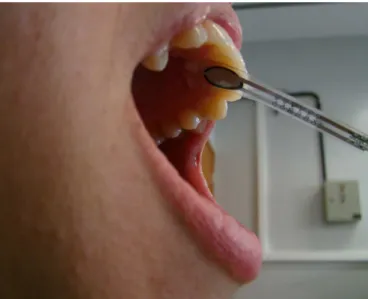
Figure 1. Resistive sensor fixed to the palatal surface of the maxillary right central incisor
Table 2. Comparison of tongue force during swallowing (in Newtons)
Force
analyzed Group n Minimum Maximum Median p value
1
Directed swallowing
Typical 12 0.02 0.96 0.08
0.004 Tongue
thrust 16 0.02 1.67 0.34
Spontaneous swallowing
Typical 6 0.08 0.87 0.13
0.960 Tongue
thrust 11 0.02 3.12 0.12
Caption: n = number of individuals; 1 = nonparametric Mann-Whitney test Table 1. Comparison of tongue force at rest (in Newtons)
Force
analyzed Group n Minimum Maximum Median p value
1
Mean force
Without
touch 17 0.00 0.01 0.00
0.576 Tongue
touch on the teeth
11 0.00 0.01 0.00
Maximum force
Without
touch 17 0.01 0.08 0.03
0.327 Tongue
touch on the teeth
11 0.00 0.04 0.02
DISCUSSION
The present study aimed to analyze tongue position only with regard to the maxillary teeth. Due to technical dificulties, it was not possible to ix a resistive sensor on the mandibular teeth because the cable would have to bypass the lower lip and it could be parted.
Regarding the assessment at rest, the results of tongue force on the teeth corroborate those of other studies which reported forces of 0.0005 N(21) and 0 N(27).
In the correlation of these forces with the perceptual analysis of participants, contrary to expectations, individuals who reported tongue touch on the maxillary teeth at rest showed no difference in mean and maximum forces compared with participants who presented habitual position without touch. A possible explanation for this fact is that the resistive sensor may have been recognized as a foreign body in the oral cavity, which might have altered the habitual tongue position of participants. When an instrument is inserted into the mouth, it is possible that the usual physiological activity be altered by its presence(28). The tongue may avoid touching the resistive sensor,
especially if it causes some discomfort(29). Another possibility
is that participants may not have correctly perceived the place of their habitual tongue position, considering that, as already veriied in other studies(7), this information presents low reliability.
There is also the possibility that the forces may have been so small that the resistive sensor could not detect them, considering that it is subject to errors such as hysteresis and of reproducibility, which may have been greater than the value of the measured force. However, no other commercially available resistive sensor was found with similar characteristics of size, lexibility and atoxicity, or with better precision within the operation range. Furthermore, this very sensor has been used in a similar study found in the literature(14).
With regard to deglutition, the values found in function were lower than those observed by other authors for the anterior palate(18) and greater than those found in other studies, e.g.,
0.025 N(21), 0.0168 N(22), 0.0075 N(17), and 0.008 N(27). These
variations in force among studies are expected because of methodological differences, especially regarding the ixing of sensors (one study used sensors on the palate(18)), material
swallowed (two studies used water(17,22)), and characteristics of
study sample (two studies assessed children(21,27)).
Another noteworthy aspect is the individual variability in the measures collected, which has also been reported by other authors(18,22).
Participants with tongue thrust during deglutition presented greater force values than those with typical tongue position, but only for directed swallowing. It is believed that the presence of correlation between perceptual analysis and tongue force measures during deglutition may suggest that participants have better perception of their tongue position during function than at rest, considering that swallowing is a dynamic process that involves a movement of the tongue. Another possibility is that the swallowing function is less likely to be modiied by
the presence of a foreign body than the habitual position and, thereby, was less altered with the ixing of the resistive sensor.
This statistical difference was not observed in spontaneous swallowing. It was possible to evaluate this type of deglutition in only 17 of the 28 participants, as already reported in the results section. The smaller sample size may have inluenced the signiicance in this analysis; signiicance would possibly be manifested if the sample were larger.
This study shows that other resources should be sought to assist in the diagnosis of habitual position of the tongue in clinical practice, considering that no correlation can be found between participant perceptual analysis and tongue force measurements. In addition, forces in directed and spontaneous deglutition were slightly different, which shows the importance of evaluating them in both. We suggest that further studies use larger samples and conduct stimulation and training on perceptual analysis of tongue position. We also suggest the use of sensor that could be ixed to the mandibular teeth as well, so that intraoral forces could be mapped and tongue position could be better establish.
CONCLUSION
No statistically signiicant difference was found for values of tongue force between participants who reported tongue touch on the teeth at habitual position and those who did not. However, participants with tongue thrust during directed swallowing presented greater force than those whose tongues do not touch the maxillary teeth during this task.
REFERENCES
1. Cheng CF, Peng CL, Chiou HY, Tsai CY. Dentofacial morphology and tongue function during swallowing. Am J Orthod Dentofacial Orthop. 2002;122(5):491-9. http://dx.doi.org/10.1067/mod.2002.128865. PMid:12439477.
2. Mendes ACS, Costa AA, Nemr K. O papel da Fonoaudiologia na Ortodontia e na Odontopediatria: avaliação do conhecimento dos odontólogos especialistas. Rev Cefac. 2005;7(1):60-7.
3. Proffit WR, Fields HW Jr, Sarver DM. A Etiologia dos problemas ortodônticos. In: Proffit WR, Fields HW Jr, Sarver DM. Ortodontia contemporânea. 4. ed. Rio de Janeiro: Elsevier; 2007. p. 121-53.
4. Maspero C, Prevedello C, Giannini L, Galbiati G, Farronato G. Atypical swallowing: a review. Minerva Stomatol. 2014;63(6):217-27. PMid:25267151.
5. Tessitore A, Crespo AN. Análise radiográfica da posição habitual de repouso da língua. Pro Fono. 2002;14(1):7-16.
6. Junqueira P. Avaliação miofuncional. In: Marchesan IQ, organizador. Fundamentos em Fonoaudiologia: aspectos clínicos na motricidade oral. 2. ed. Rio de Janeiro: Guanabara Koogan, 2005. p. 13-21.
7. Cardoso AFR, Bommarito S, Chiari BM, Motta AR. A confiabilidade da informação fornecida pelo indivíduo a respeito de seu posicionamento habitual de língua. Rev Cefac. 2011;13(2):236-44. http://dx.doi.org/10.1590/ S1516-18462010005000125.
9. Marchesan IQ. Como avalio e trato as alterações da deglutição. In: Marchesan IQ, organizador. Tratamento da deglutição: a atuação do fonoaudiólogo em diferentes países. São José dos Campos: Pulso, 2005. p. 149-98.
10. Hewitt A, Hind J, Kays S, Nicosia M, Doyle J, Tompkins W, et al. Standardized instrument for lingual pressure measurement. Dysphagia. 2008;23(1):16-25. http://dx.doi.org/10.1007/s00455-007-9089-0. PMid:17602265.
11. Vitorino J. Effect of age on tongue strength and endurance scores of healthy
portuguese speakers. Int J Speech-Language Pathol. 2010;12(3):237-43.
http://dx.doi.org/10.3109/17549501003746160. PMid:20433342.
12. Trawitzki LVV, Borges CGP, Giglio LD, Silva JB. Tongue strength of healthy young adults. J Oral Rehabil. 2011;38(7):482-6. http://dx.doi. org/10.1111/j.1365-2842.2010.02182.x. PMid:21143618.
13. Magalhães HV Jr, Tavares JC, Magalhães AAB, Galvão HC, Ferreira MAF. Caracterização da pressão da língua em idosos. Audiol Commun Res. 2014;19(4):375-9. http://dx.doi.org/10.1590/S2317-64312014000400001401.
14. Di Fazio D, Lombardo L, Gracco A, D’Amico P, Siciliani G. Lip pressure at rest and during function in 2 groups of patients with different occlusions. Am J Orthod Dentofacial Orthop. 2011;139(1):e1-6. http://dx.doi.org/10.1016/j. ajodo.2010.02.030. PMid:21195253.
15. Takahashi S, Ono T, Ishiwata Y, Kuroda T. Effect of changes in the breathing mode and body position on tongue pressure with respiratory-related oscillations. Am J Orthod Dentofacial Orthop. 1999;115(3):239-46. http://dx.doi.org/10.1016/S0889-5406(99)70324-0. PMid:10066970.
16. Taslan S, Biren S, Ceylanoglu C. Tongue pressure changes before, during and after crib appliance therapy. Angle Orthod. 2010;80(3):533-9. http:// dx.doi.org/10.2319/070209-370.1. PMid:20050749.
17. Frohlich K, Thuer U, Ingervall B. Pressure from the tongue on the teeth in young adults. Angle Orthod. 1990;61(1):17-24. PMid:2012318.
18. Ono T, Hori K, Nokubi T. Pattern of tongue pressure on hard palate during swallowing. Dysphagia. 2004;19(4):259-64. http://dx.doi.org/10.1007/ s00455-004-0010-9. PMid:15667061.
19. Hori K, Ono T, Iwata H, Nokubi T, Kumakura I. Tongue pressure against
hard palate during swallowing in post-stroke patients. Gerodontology.
2005;22(4):227-33. http://dx.doi.org/10.1111/j.1741-2358.2005.00089.x. PMid:16329231.
20. Kydd WL, Akamine JS, Mendel RA, Kraus BS. Tongue and lip forces exerted during deglutition in subjects with and without an anterior open
bite. J Dent Res. 1963;42(3): 858-866. http://dx.doi.org/10.1177/002203 45630420031801. PMid:13927772.
21. Ruan W, Chen M, Gu Z, Lu Y, Su J, Guo Q. Muscular forces exerted on the normal deciduous dentition. Angle Orthod. 2005;75(5):785-90. PMid:16279824.
22. Kieser J, Singh B, Swain M, Ichim I, Waddell JN, Kennedy D, et al. Measuring intraoral pressure: adaptation of a dental appliance allows measurement during function. Dysphagia. 2008;23(3):237-43. http://dx.doi. org/10.1007/s00455-007-9126-z. PMid:18004622.
23. Tsuiki S, Handa S, Ohyama K. A simple method for evaluation of tongue position. J Oral Rehabil. 2007;34(4):304-10. http://dx.doi.org/10.1111/j.1365-2842.2006.01708.x. PMid:17371569.
24. Furlan RMMM, Motta AR, Valentim AF, Barroso MFS, Costa CG, Casas EB. Protrusive tongue strength in people with severely weak tongues. Int J Speech-Language Pathol. 2013;15(5):503-10. http://dx.doi.org/10.3109 /17549507.2012.752863. PMid:23336828.
25. Barbosa AM, Barroso M F S, Nepomuceno EG, Perilo TVC, Casas EB. Automation of the process for accessing lip forces. J Braz Soc Mech Sci Eng. 2015;37(2):533-40. http://dx.doi.org/10.1007/s40430-014-0180-9.
26. Valentim AF, Furlan RM, Perilo TV, Berbert MC, Motta AR, Casas EB. Evaluation of the force applied by the tongue and lip on the maxillary central incisor tooth. CoDAS. 2014;26(3):235-40. http://dx.doi.org/10.1590/2317-1782/201420130077. PMid:25118921.
27. Ruan WH, Su JM, Ye XW. Pressure from the lips and the tongue in children with class III malocclusion. J Zhejiang Univ Sci B. 2007;8(5):296-301. http://dx.doi.org/10.1631/jzus.2007.B0296. PMid:17542055.
28. Fry DL. Physiologic recording by modern instruments with particular reference to pressure recording. Physiol Rev. 1960;40(4):753-88. PMid:13702320.
29. Proffit WR. Muscle pressures and tooth position: north american whites and australian aborigines. Angle Orthod. 1975;45(1):1-11. PMid:1054929.
Author contributions