Binding Energies of Isoscalar and Isovector Ground
States of
N
=
Z
Nuclei in the Interacting Boson Model
E. Baldini-Neto,
Departamento de F´ısica, Instituto Tecnol´ogico da Aeron´autica,
Centro T´ecnico Aeroespacial,12228-900, S˜ao Jos´e dos Campos, S˜ao Paulo, Brazil
C. L. Lima,
Nuclear Theory and Elementary Particle Phenomenology Group,
Instituto de F´ısica, Universidade de S˜ao Paulo, C.P. 66318, 05315-970 S˜ao Paulo, S˜ao Paulo, Brazil
and P. Van Isacker
Grand Acc´el´erateur National d’Ions Lourds,
BP 55027, F-14076 Caen Cedex 5, France
Received on 30 October, 2002
An algebraic model is developed to calculate theT = 0andT = 1ground-state binding energies ofN =Z
nuclei in the 28-50 shell which is currently the object of many experimental studies.
I
Introduction
Nuclei at the proton (neutron) driplines constitute nowadays the most active research area of nuclear structure physics. With the advent of new radioactive beam facilities it is now possible to produce exotic nuclei that may have occurred naturally in the interior of exploding supernovas [1].
There are several theoretical approaches that reproduce the systematics of masses of nuclei and it is worthwhile to mention here two of them. The Extended Thomas-Fermi plus Strutinsky Integral [3] (ETFSI) is a high-speed approx-imation to the Hartree-Fock (HF) method with pairing cor-relations taken into account through BCS theory. In ear-lier versions a Wigner term was not included and this has been claimed to be the reason for the systematic calculated underbinding by about 2 MeV for even-evenN = Z nu-clei [4]. This effect persists forN = Z odd-odd systems and forN = Z±1odd-mass nuclei but with less promi-nence. The mass formula based on the Finite Range Droplet Model (FRDM) [5] starts from a sophisticated liquid drop mass formula to which microscopic corrections due to shell effects are added. Both approaches have comparable num-bers of parameters (about 15) and make reliable predictions with impressive success. In the FRDM and also in a recent ETFSI calculation [6] a Wigner (correction) term is included that specifically deals with the peculiar behavior of binding energies ofN ≈Znuclei and has a cusp-like behavior for
N =Z. This treatment is effective for known masses but, as the correction isad hoc, it has the drawback that an extrap-olation to unknown nuclei can be dangerous. It is therefore of interest to develop models based on simple physical prin-ciples that can account for the behavior of nuclear masses at theN ≈Zline.
Many models have been used over the past years to investigate the structure of heavier N ≈ Z. We men-tion in particular recent applicamen-tions of the Hartee-Fock-Bogolyubov (HFB) method that includes proton-neutron pairing correlations [7]. This approach is tailor-made for the treatment of N ≈ Z nuclei but has the drawback of the lack of particle-number projection. Shell-model calcu-lations [8] are generally extremely successful in reproduc-ing spectroscopic nuclear data but require large configura-tion space diagonalizaconfigura-tions. This makes the shell model less appropriate when a calculation of many masses is required. An algebraic approach [9], which has affinities with the one presented here, utilizes the concept of dynamical supersym-metry for the calculation of the binding energies in the sd shell but does not go beyond it.
con-tains terms with an intuitively understandable significance. A particular ingredient is its treatment of the competition between isoscalar and isovector pairing.
II
An IBM-4 “mass formula”
The Interacting Boson Model in its original version (IBM-1) [11] successfully describes collective aspects of nuclei through the use ofsanddbosons which are thought to ap-proximate pairs of valence nucleons coupled to angular mo-mentum 0 and 2. No distinction is made between neutron and proton bosons. Whenever the difference between the neutron and proton fluids plays a role, one is forced to use more elaborate versions of the IBM. The neutron-proton in-teracting boson model, or IBM-2, was introduced mainly to provide a microscopic foundation to the model [12]. It uses as building blocks s and d bosons constructed from neutron-neutron (nn) and proton-proton (pp) pairs solely. In the third and fourth versions of IBM, IBM-3 and IBM-4, the isospin quantum number is introduced in a natural way. In IBM-3 the entire isospin triplet T = 1 is included, lead-ing to nn, np, and pp pairs withTz = +1,0,−1[13]. The IBM-4 considers bothT = 0andT = 1pairs; theT = 1
bosons are assigned an intrinsic spin S = 0whileT = 0
bosons carry an intrinsic spinS = 1[14]. A justification of this choice is that the two-particle isospin-spin combina-tions(T S) = (10)and(T S) = (01)are lowest in energy and that they give rise to an SU(4) algebra which is the bo-son equivalent of Wigner’s supermultiplet algebra [15].
Recently, the IBM-4 was applied to the spectroscopy of exotic N ≈ Z nuclei in thepf5/2g9/2 shell [16]. In this
approach the IBM-4 Hamiltonian is derived from a realistic shell-model Hamiltonian through a mapping carried out for A = 58and 60 nuclei. The boson energies and the boson-boson interactions are thus derived microscopically and no parameter enters the calculation (since the shell-model in-teraction is considered as an input). This microscopically derived Hamiltonian gives good results in62Ga (when com-pared to the shell model) and predicts the energy spectra of heavierN =Znuclei (such66As and70Br). The approach is reasonably successful in obtaining a spectroscopy of low-spin states in N ≈ Z nuclei. It makes use, however, of a complicated Hamiltonian and, moreover, calculations be-yond70Br seem difficult.
Prompted by these considerations, in particular the need for reliable binding energy predictions at the N = Z line and the existence of a microscopically derived IBM-4 Hamiltonian, we propose here a simple calculation of these binding energies in the context of IBM-4. The calculation requires the diagonalization of matrices of very low dimen-sion (of the order of half the number of bosons). Although it is not a mass formula as such (it is not a closed formula), the calculation can be readily carried out for any nucleus.
In previous work [17] one of us introduced an algebraic Hamiltonian (which can be regarded as thes-boson channel of the general IBM-4 Hamiltonian of Ref. [16]) with the
spe-cific aim to study the competition between the isovector and isoscalar pairing modes in self-conjugate nuclei. The model is formulated in terms of bosons which do not have an or-bital structure but carry spin-isospin(ts) = (01)or (10) and which will be denoted ass†ts. They give rise to the sym-metric representation of the spin-isopin algebra U(6). As an approximation to the full IBM-4 which includessand dbosons, this can be justified for even-even and odd-odd N = Z nuclei (the only ones considered here) where the favored U(6) representation is indeed symmetric [14]. It is also justifiable inN 6= Z nuclei when they are even-even but not when they are odd-odd since in that case the favored U(6) representation of the full IBM-4 is non-symmetric [14]. The previous studies [16, 17] suggest that the relevant terms in a simple IBM-4 Hamiltonian must be taken from two different symmetry classifications:
U(6)⊃ ½
SU(4) UT(3)⊗US(3)
¾
⊃SOT(3)⊗SOS(3). (1)
A detailed analysis of the chains (1) is given in Ref. [18] where the definition of all Casimir operators can be found. The ones of interest for the calculation of binding energies ofN = Z nuclei are the following. First, the linear and quadratic Casimir operators of U(6) are included. The sym-metric representations of U(6) is labeled by the total number of bosons,N; as a result, the U(6) Casimir operators take account of the bulk properties of the nucleus and lead to a smooth variation of the mass with particle number. The next two terms to be included are the quadratic Casimir operator of SU(4) and the linear Casimir operator ofUS(3). They are defined in Ref. [18]
ˆ
C2[SU(4)] = 3( ˆY ×Yˆ)(00)+ ˆS2+ ˆT2,
ˆ
C1[US(3)] = nˆ01, (2)
with
ˆ
Yµν = (s†01×s˜10+s†10×s˜01)(11)µν ,
ˆ
Tµ = √2(s†10×s˜10)(10)µ0 ,
ˆ
Sµ = √2(s†01×s˜01)(01)0µ ,
ˆ
n10 = (s†10×s˜10)(00)00 ,
ˆ
n01 = (s†01×s˜01)(00)00 , (3)
where the coupling is in spin and isospin,Yµνˆ is a Gamow-Teller-like operator which is a vector in spin and isospin,
ˆ
Tµ andSµˆ are the total isospin and spin operators, andnˆ01
andˆn10 are the number operators that count the isoscalar
and isovector(st) = (10)and(01)bosons. The operator
ˆ
C2[SU(4)] implies equal T = 0 and T = 1 interaction
strengths whileCˆ1[US(3)] splits states with different spin S. In Ref. [17] thequadraticCasimir operator ofSUS(3)is considered while here thelinearCasimir operator ofUS(3) is preferred. This choice is guided by a mapping argu-ment: In Ref. [19] it is shown that the one-body spin-orbit termvso¯l·¯sof the nuclear mean-field potential is converted
ˆ
n10= ˆN−nˆ01with coefficients that depend onvso2. Also,
an eventual asymmetry between theT = 0andT = 1 pair-ing interaction can be represented in this way [19]. These important structural effects, i.e., the spin-orbit term and the difference between the isoscalar and isovector pairing in-teractions, can thus be represented algebraically. The fi-nal term to be included is the quadratic Casimir operator
ˆ
C2[SOT(3)] = ˆT2which is known to represent the nuclear symmetry and Wigner energies.
In summary, the following Hamiltonian is taken:
ˆ
H = BE0+αCˆ1[U(6)] +βCˆ2[U(6)] +γCˆ2[SU(4)]
+ξCˆ1[US(3)] +ηCˆ2[SOT(3)], (4) whereBE0is the binding energy of the doubly magic core,
specific for a given mass region. Note the absence from (4) of operators associated withUT(3)andSOS(3); these are not needed because, in the context of the simple model dis-cussed here, their effect is equivalent to the corresponding operators ofUS(3)andSOT(3).
All operators in (4) mutually commute, except for
ˆ
C2[SU(4)]andCˆ1[US(3)]and hence the solution ofHˆ in-volves a numerical diagonalization which is most conve-niently done in the second basis in (1), labeled as|[N]λTT×
λSSi. These states are simultaneous eigenstates ofnˆ10and
ˆ
n01with eigenvaluesλT andλS, respectively, which are the
numbers of isovector and isoscalar bosons. The allowed val-ues ofλT andλS follow from theU(6)⊃UT(3)×US(3) branching rule. For a symmetric U(6) representation [N]
the allowed values are all those that satisfyλT +λS =N. Finally, the allowed values of T and S follow from the
SU(3)⊃SO(3)branching rule [20]:T =λT, λT−2, . . . ,1
or 0 andS=λS, λS−2, . . . ,1or 0.
The matrix elements ofCˆ2[SU(4)]in this basis can be
calculated analytically [17] and closed expressions for the eigenvalues of the Hamiltonian (4) can be found in Ref. [22].
Summarizing our procedure for finding the binding en-ergyof the lowestT = 0andT = 1states in an N = Z nucleus:
1. Determine the number of bosonsNoutside the closed shell.
2. Construct the Hamiltonian matrix in the basis
|[N]λTT×λSSiwithλT =T, T+2, . . . ,(N−S−1)
or(N−S)andλS=N−λT. for different values of S. The dimension of this matrix is⌊(N−S−T)/2⌋+ 1where⌊x⌋is the largest integer smaller than or equal tox.
3. Diagonalize the Hamiltonian matrix. The largest eigenvalue gives the binding energy.
We have found that forT = 0,1states inN =Znuclei the largest binding energy is obtained forS =T in even-even and forS =T −1in odd-odd nuclei.
III
Results
A first application concerned to N = Z nuclei in the sd shell, from16O to40Ca, where the experimental masses are well known [21], and can be found in Ref. [22]. Since re-liable results were obtained we present here the calculations to the28−50shell which is currently under experimental focus since there are few experimental data available up to now. Before carry on the calculations in the28− −50shell we sould remark that the fitting procedure is essentially the same as in thesdshell. Two fits for each half of the shell are need in order to avoid mid-shell effects and a Coulomb cor-rection calculation is performed according to the prescrip-tion of Ref. [5].
We begin with a discussion of the first half of the 28– 50 shell, for nuclei ranging from58Cu to78Y. The ground state of all these self-conjugate nuclei hasJπ = 0+, with
either T = 0in even-even or T = 1 in odd-odd nuclei, with the exception of58Cu which has a(Jπ, T) = (1+,0)
ground state. Up to64Ge the masses are well known and can be taken from the compilation of Audi and Wapstra [21]. Of the heavier N = Z nuclei, also the masses of 72Kr and74Rb are listed by Audi and Wapstra. The masses of
66As and68Se are available from a recent measurement [24]
and that of76Sr from Ref. [25]. The latter experiment also gives a mass for 68Se but since it is far off the systemat-ics of Audi and Wapstra, the result from [24] is used. The mass of70Br is not known experimentally but as it is in the middle of a region of nuclei with measured masses close to the extrapolations of Audi and Wapstra, we have adopted their extrapolated value for70Br. The mass of78Y is not known and not included in the fit. The binding energies of the lowestT = 1states in even-evenN =Znuclei are de-rived from those of the isobaric analogues (also taken from Ref. [21]) after an appropriate Coulomb correction. The evolution of the splitting between(Jπ, T) = (0+,1) and
(Jπ, T) = (1+,0)states in odd-odd nuclei is of particular
interest as regards the question ofT = 0andT = 1pairing and is currently the object of several experimental studies. The(0+,1)state in58Cu lies 0.202 MeV above the(1+,0)
ground state [26]. This order is reversed in 62Ga where the (1+,0) state is 0.571 MeV above the (0+,1) ground
state [27]. TheBE(0+,1)−BE(1+,0)splitting then
con-tinues to rise to 0.837 MeV in 66As [28]. A very recent experiment on 70Br [29] has not observed a(1+,0) level;
the lowest observedT = 0level (withJπ = 3+) is at an ex-citation energy of 1.337 MeV. Similarly, the lowestT = 0
state in74Rb measured by Rudolphet al.[30] at an excita-tion energy of 1.006 MeV hasJ = 3and the energy of the Jπ= 1+state is unknown. With these data as input, the
obtained which gives confidence in the energy splittings of 0.847, 1.037, and 1.214 MeV predicted in 70Br,74Rb, and
78Y, respectively. As already mentioned, the energy
differ-enceBE(0+,1)−BE(1+,0)is not known experimentally
in these isotopes. In the former two, 70Br and 74Rb, the energy difference with the lowest (known)T = 0state is shown in Fig. 1.
Table 1. Core binding energies and parameters (in MeV) for the 28–50 shell.
Shell BE0 α β γ ξ η
56Ni to78Y 607.2890 22.8140 0.1175 −0.0672 −1.9584 −0.9020 78Y to100Sn 1172.9697
−28.4637 0.1183 −0.1877 −1.0450 −1.0248
28 30 32 34 36 38 40
N=Z −2
0 2 4 6 8
BE(T=0)−BE(T=1) (MeV)
Expt IBM−4 (L=0) Macchiavelli et al.
Figure 1. Calculated binding energy differencesBE(T = 0)−
BE(T = 1)inN=Znuclei between58Cu to78Y for the param-eters given in Table , compared with the experimental differences and those of Macchiavelliet al.[23].
To emphasize the point that these energy splittings result from a calculation of total binding energies, the odd-odd re-sults are represented in a different way in Fig. 2. Note that this plot implies a comparison ofabsolutebinding energies: for representation purposes the measured binding energy of the ground state of a particular nucleus is drawn at zero and other levels of that nucleus are given relative to that ground-state energy.
For the second half of the 28–50 shell the situation is more complicated since there are no data available. The core is 100Sn with a ground-state mass measured in Ref. [31]. Since so little is known experimentally, we use the extrapo-lations from Audi and Wapstra [21] for the masses of even-even and odd-odd nuclei, complemented with the results for
78Y from the fit to the first half of the 28–50 shell. The
resulting parameters are shown in the line labeled ‘78Y to
100Sn’ of Table . The predictions for the splitting between
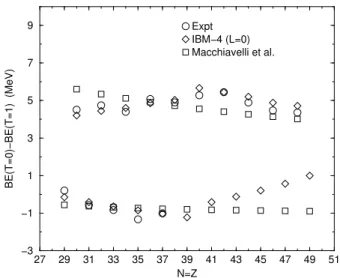
T = 1and T = 0 states for the entire 28–50 shell are shown in Fig. 3. One notes a satisfactory agreement with the data, when available. The use of extrapolated data, how-ever, should weaken the confidence in the predictions for the BE(0+,1)−BE(1+,0)splitting in odd-odd nuclei.
−2 −1 0 1 2 3
Energy (MeV)
Expt IBM−4 (L=0)
58
Cu 62Ga 66As 70Br 74Rb 78
Y 3 +
3
Figure 2. Experimental and calculated energies of(1+
, T = 0)
and(0+
, T = 1)levels in odd-oddN =Z from58
Cu to78
Y. In
70
Br,74Rb, and78Y the(1+
, T = 0)levels are not known exper-imentally and in the former two nuclei the angular momentum of the lowest (known)T = 0state is indicated.
27 29 31 33 35 37 39 41 43 45 47 49 51 N=Z
−3 −1 1 3 5 7 9
BE(T=0)−BE(T=1) (MeV)
Expt IBM−4 (L=0) Macchiavelli et al.
Figure 3. Binding energy differencesBE(T = 0)−BE(T = 1)
for the entire 28–50 shell with parameters fitted separately for each half (see text for details). In the first half (up to78
IV
Conclusions
A simple approach based on IBM-4 has been proposed to calculate the binding energies of the lowest T = 0 and T = 1 states of self-conjugate nuclei. It has linear and quadratic terms in the boson number that account for the smooth variation of the mass with particle number, supple-mented with three contributions that have a clear physical meaning: an SU(4), a spin-orbit and aTˆ2term. It can be
considered as a local “mass formula” that gives predictions of a specific interest to current experiments at theN = Z line. As an application we considered nuclei from56Ni to
78Y where predictions could be made for some of the
heav-ier isotopes currently under study. Also the second half of the 28–50 shell was considered although there predic-tions are more questionable due to the lack of reliable data. The advantage with respect to previous IBM-4 work [16] is that the Hamiltonian used is much simpler and that only the L= 0channel is considered. The numerical diagonalization then becomes trivial and the calculations can be performed, without much effort, for arbitrary numbers of bosons. This is much harder to achieve with the full version of IBM-4. On the down side it should be noted that, for odd-odd nuclei, this approach is restricted toN = Z since odd-odd nuclei withN 6= Z have a dominant non-symmetric U(6) repre-sentation which cannot be constructed fromsbosons only. Also, deformation effects which are present with sand d bosons and which must be included through orbital opera-tors are outside the scope of the simple approach presented here.
Acknowledgments
EBN would like to thank FAPESP for financial support.
References
[1] W. Mittig, A. L´epine-Szily, and N.A. Orr, Ann. Rev. Nucl. Sci.47, 27 (1997).
[2] A. O. Macchiavelli, P. Fallon, R. M. Clark, M. Cromaz, M. A. Deleplanque, R. M. Diamond, G. J. Lane, I. Y. Lee, F. S. Stephens, C. E. Svensson, K. Vetter, and D. Ward, Phys. Rev. C61, 041303 (2000).
[3] F. Tondeur, M. Brack, M. Farine, and J. M. Pearson, Nucl. Phys. A420, 297 (1984).
[4] Y. Aboussir, J. M. Pearson, A. K. Dutta and F. Tondeur, Nucl. Phys. A549, 155 (1992).
[5] P. M¨oller, J. R. Nix, W. D. Myers, and W. J. Swiatecki, Atomic Data and Nuclear Data Tables59185, (1995). [6] S. Goriely, F. Tondeur, and J. M. Pearson, preprint.
[7] A. L. Goodman, Phys. Rev. C60, 014311 (1999).
[8] A. Poves and G. Martinez-Pinedo, Phys. Lett. B 430, 203 (1998).
[9] L. Pr´ochniak, S. Szpikowski, and W. Berej, J. Phys. G23, 705 (1997).
[10] F. Iachello and A. Arima, The Interacting Boson Model, (Cambridge University Press, Cambridge 1987).
[11] A. Arima and F. Iachello, Phys. Rev. Lett.35, 1069 (1975). [12] T. Otsuka, A. Arima, F. Iachello, and I. Talmi, Phys. Lett. B
76, 139 (1978).
[13] J. P. Elliott and A. P. White, Phys. Lett. B97, 169 (1980). [14] J. P. Elliott and J. A. Evans, Phys. Lett. B101, 216 (1981). [15] E. P. Wigner, Phys. Rev.51, 106 (1937).
[16] O. Juillet, P. Van Isacker, and D. D. Warner, Phys. Rev. C63, 054312 (2001).
[17] P. Van Isacker and D. D. Warner, Phys. Rev. Lett.78, 3266 (1997).
[18] P. Van Isacker, J. Dukelsky, S. Pittel, and O. Juillet, J. Phys. G24, 1261 (1998).
[19] O. Juillet and S. Josse, Eur. Phys. J. A8, 291 (2000). [20] J. P. Elliott, Proc. Roy. Soc. A245, 128 (1958).
[21] G. Audi and A. H. Wapstra, Nucl. Phys. A595, 409 (1995). [22] E. Baldini-Neto, C. L. Lima, P. Van Isacker, Phys. Rev. C65,
064303 (2002).
[23] A. O. Macchiavelli, P. Fallon, R. M. Clark, M. Cromaz, M. A. Deleplanque, R. M. Diamond, G. J. Lane, I. Y. Lee, F. S. Stephens, C. E. Svensson, K. Vetter and D. Ward,PINGST 2000, Selected topics onN =Znuclei, 156 (2000). [24] A. L´epine-Szily and G.F. Lima, private communication.
[25] A.S. Lalleman, G. Auger, W. Mittig, M. Chabert, M. Chartier, J. Ferme, A. Gillibert, A. Lepine-Szily, M. Lewitowicz, M. H. Moscatello, N. A. Orr, G. Politi, F. Sarazin, H. Savajols, P. Van Isacker and A. C. C. Villari, Hyperfine Interactions132, 315 (2001).
[26] B. Singh, Nuclear Data Sheets87, 177 (1999).
[27] S. M. Vincent, P. H. Regan, D. D. Warner, R. A. Bark, D. Blu-menthal, M. P. Carpenter, C. N. Davids, W. Gelletly, R. V. F. Janssens, C. D. O’Leary, C. J. Lister, J. Simpson, D. Sew-eryniak, T. Saitoh, J. Schwartz, f, S. T¨orm˜onen, O. Juillet, F. Nowacki and P. Van Isacker, Phys. Lett. B437, 264 (1998). [28] R. Grzywacz, S. Andriamon, B. Blank, F. Bou´e, S.
Cza-jkowski, F. Davi, R. Del Moral, C. Donzaud, J. P. Dufour, A. Fleury, H. Grawe, A. Grewe, A. Heinz, Z. Janas, A. R. Jung-hans, M. Karny, M. Lewitowicz, A. Musquebre, M. Pftzner, M. -G. Porquet, M. S. Pravikoff, J. -E. Sauvestre and K. Sm-merer, Phys. Lett. B429, 247 (1998).
[29] D. G. Jenkins, N. S. Kelsall, C. J. Lister, D. P. Balamuth, M. P. Carpenter, T. A. Sienko, S. M. Fischer, R. M. Clark, P. Fallon, A. G¨orgen, A. O. Macchiavelli, C. E. Svensson, R. Wadsworth, W. Reviol, D. G. Sarantites, G. C. Ball, J. Rikovska Stone, O. Juillet, P. Van Isacker, A. V. Afanasjev and S. Frauendorf, Phys. Rev. C65, 064307 (2002). [30] D. Rudolph, C. J. Gross, J. A. Sheikh, D. D. Warner, I. G.
Bearden, R. A. Cunningham, D. Foltescu, W. Gelletly, F. Hannachi, A. Harder, T. D. Johnson, A. Jungclaus, M. K. Kabadiyski, D. Kast, K. P. Lieb, H. A. Roth, T. Shizuma, J. Simpson, I. Skeppstedt, B. J. Varley, and M. Weiszflog, Phys. Rev. Lett.76, 376 (1996).