850 Brazilian Journal of Physics, vol. 34, no. 3A, September, 2004
Beta Decay and Structure of Exotic Nuclei in the Mass
Regions N=Z, A
≃
70 and Near the N=20 Closed Shell
S. Courtin
1, P. Baumann
1, Ph. Dessagne
1, F. Mar´echal
1, Ch. Mieh´e
1,
F. Perrot
1, E. Poirier
1, M. Ramdhane
1, and the ISOLDE collaboration
1
Institut de Recherches Subatomiques, BP 28 F-67037 Strasbourg Cedex 2, France
Received on 30 September, 2003
This paper describes two beta decay experiments performed at the CERN/ISOLDE mass separator. The struc-ture of74Kr has been studied using a total absorptionγ spectrometer (TAgS). The measured Gamow-Teller strength is presented and compared to HFBCS+QRPA calculations. The33
Na decay is also presented. The structure of the33Mg daughter nucleus is compared to shell-model calculations, showing for the first time an inversion of states in the A≃35 mass region.
1
Introduction
The study of beta decay gives informations on theβ-decay process itself as well as on nuclear masses and on the prop-erties and structure of the nuclear states populated in the de-cay.
In allowed cases, the beta decay process is governed by simple operators,σ.τ for a Gamow-Teller transition andσ
for a Fermi transition. In the case of Gamow-Teller tran-sitions, a good description of the ground state of the par-ent nucleus and the states populated in the daughter nu-cleus should provide a good value of the beta Gamow-teller strength,BGT. This strength can be expressed as follows:
BGT =
g2
A
g2
V
|< f||σ.τ||i >|2
wheregA and gV are the weak interaction coupling con-stants. The experimental determination of this force is not straightforward, its value being the difference between the intensity of a transition populating a state and the intensity of the transition which depopultates it. Germanium detec-tors are commonly used to measure these intensities but the beta feeding at high excitation energy is often fragmented over many states and the deexcitation of these states often proceeds via high energyγ-rays. This leads to large system-atic errors in the determination ofBGT. Thus we have de-cided to use a total absorption gamma spectrometer (TAgS), resulting from a collaboration between the CERN (Switzer-land), the IReS (France), the university of Madrid (Spain), Valencia (Spain) and Surrey (UK). This detector consists of a NaI(Tl) monocristal (38X38 cm), manufactured by St Gobain Crystals and detectors. Its resolution is 5.5 % at 1.33 MeV and its efficiency is close to 90 % over the whole QECwindow open in our studied decay.
In this paper, we also present results on neutron-rich nu-clei in the island of inversion. For this study we have used
high resolutionγ detectors as well as a set of low energy neutron counters.
2
Krypton isotopes in the N=Z, A
≃
70
region
The N=Z, A≃ 70 mass region has been the object of nu-merous studies, concerning nuclear deformations, shape co-existence and pairing. Theoretical calcultations show that, in this region, near the proton drip-line, a large part of the Gamow-Teller resonance may be located below the ground state of the parent nucleus. Thus, it is interesting to study theβ-decay of nuclei in this region, since an oblate-prolate shape transition is predicted [1]. Hartree-Fock + QRPA cal-culations show for 74Kr a strong dependance of B(GT) on multiparticle-multihole excitations. Following the study of the76Sr
β decay by Mieh´e et al. [2] showing a strong in-dication for a prolate deformation in the ground state, we have decided to the investigate72−76Kr
β-decay using the TAgS spectrometer. The Kr isotopes have been produced at the CERN/ISOLDE mass separator using a 1.4 GeV proton beam on a 43 g.cm−2Nb target. Spallation products were
ionized using a cold plasma ion source. The production rate obtained was typically from 104to 105atoms per second. A
S. Courtinet al. 851
Gamow-Teller strength in the studied nuclei. Details about the detection system as well as a complete description of the analysis method can be found in E. Poirier et al. [3]. Fig. 1
0.025 0.05 0.075 0.1 0.125 0.15 0.175 0.2 0.225 0.25
theory (oblate)
experiment
B(GT) (g
2 A
/4
π
)
0.025 0.05 0.075 0.1 0.125 0.15 0.175 0.2 0.225 0.25
500 1000 1500 2000 2500 3000
theory (prolate)
experiment
E (keV)
B(GT) (g
2 A
/4
π
)
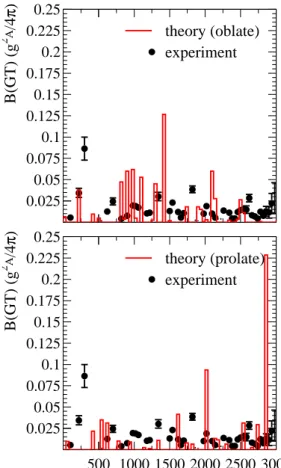
Figure 1. Experimental Gamow-Teller strength distribution in74Kr and the corresponding HF+BCS+QRPA calculations.
Figure 2. Accumulated GT strength in74Kr as a function of the excitation energy of the daughter nucleus. The dotted and dashed lines correspond respectively to oblate and prolate solutions of the HF calculations [3].
shows the Gamow-Teller strength in 74
Kr and the corre-sponding HF+BCS+QRPA calculations and Fig. 2. shows the accumulated experimental Gamow-Teller strength [3] compared to HF calculations. These results may indicate a mixing of configurations in this isotope.
3
The island of inversion at N
≃
21,
A
≃
33
Indications for an inversion of the shell-model states at N=21 have been observed for the first time by Thibault at al. [4] in neutron-rich isotopes near A=32. Hartree-Fock calculations as well as Shell-Model investigations success-fully describe binding energies in nuclei of this region if they suppose deformed nuclei in their ground states. In this mass region we have studied the structure of33Mg populated by the33
Naβ-decay. The studied isotopes have been produced at the CERN/ISOLDE mass separator using a 1.4 GeV pro-ton beem impinging on a 46 g.cm−2 UC
2 target. The
re-sulting atoms were ionized on a tungsten surface ionization source. The target and source system was optimized to ob-serve short-lived species (t1/233Na≃8ms). The production
yield for 33Na was 2 atoms per second. The activity was put on an aluminized mylar tape and a tape transport system allowed to move periodically the tape to avoid long lived daughter nuclei accumulation. In this experiment, we have used a plastic scintillator (Ω= 70%) for the detection ofβ particles at the collection point, two large volume germa-nium detectors allowing to recordβ−γandβ−γ−γ coin-cidences, and low-energy neutron counters (ǫint= 15%) for β−nandβ−γ−ncoincidences.
In this experiment, we have measured the33
Na period, t1/2= 8,0(3) ms, which is in very good agreement with
pre-vious studies [5]. The first decay scheme of this nucleus has been built. Absolute intensities ofγtransitions and the neu-tron emission probabilities have been measured in order to obtain theβbranching ratios of33Na→33
Mg and the corre-sponding logft values [6]. Theβfeeding of the ground state of33Mg (allowed transition) indicates that its spin-parity is Jπis 3/2+
. These results have been compared to F. Nowacki shell-model calculations showing that this ground state is built on a 1 particle - 1 hole excitation.
This study shows the first observation of an inversion of states in this region.
References
[1] Hammamoto and H. Sagawa, Phys. Rev. C48, 2960 (1993); P. Sarriguren et al., Nucl. Phys. A635, 55 (1998).
[2] Ch. Mieh´e et al., to be published.
[3] E. Poirier, PhD Thesis, Universit´e Louis Pasteur, Strasbourg, IReS report 03-01/4174, E. Poirier et al., Phys. Rev. C69, 034307 (2004).
[4] C. Thibault et al., Phys. Rev. C 12, 644 (1975).
[5] D. Guillemaud et al., Nucl. Phys. A426, 37 (1984).