Brazilian Journal of Physics, vol. 34, no. 1A, March, 2004 283
Antihyperon Polarization in Inclusive Processes at High Energies
C. C. Barros, Jr. and Y. Hama
Instituto de F´ısica, Universidade de S˜ao Paulo, C.P. 66318, 05315-970, S˜ao Paulo, SP, Brazil
Received on 15 August, 2003.
We propose a model that we believe is the main source of the antihyperon polarization in high-energy proton-nucleus inclusive reactions. The polarization is originated by the final-state interactions between the antihyper-ons and other produced particles in these collisiantihyper-ons (predominantly piantihyper-ons). The model is based on two elements: the low-energy pion-hyperon interaction (described by chiral effective Lagrangians) and the statistical fluctua-tions plus expansion of the background matter.
In 1976, Bunce and collaborators [1], studying theΛ in-clusive production
p+Be→Λ +X , (1) with 200 GeV protons, whereXrepresents the not observed particles, verified that theΛ polarization was significantly different from zero (and negative, reaching values close to 20%). These results were totally unexpected [2], because there were indications that polarization effects should van-ish at high energies and hadron polarization was believed to be a low energy phenomenon.
Since then, many similar experiments have been per-formed [3]-[6], that confirmed these results and have shown also that both hyperons and antihyperons produced are po-larized in this kind of reaction. However, the variety of be-havior of the polarizations has caused many problems to the theoretical understanding of the experimental data ([7]-[9] for example), specially in the antihyperon case. Since these models are based in direct mechanisms for hyperon produc-tion (the initial proton becomes a hyperon, by some mech-anism, such as quark recombination [7], for example) the final antihyperon polarization practically vanishes.
The first model that was able to produce polarized an-tihyperons, was the one proposed by Y. Hama and T. Ko-dama [10] and it was based in the hydrodynamical model. The hyperon is produced inside a medium composed of hot hadronic matter (produced in the collision process) and in-teracts with it. This interaction was represented by an optic potential. With this model, the antihyperon data were quite well reproduced. Nevertheless, the model left some ques-tions in open, such as the need of different potentials for different hyperons and their interpretations.
Aiming to study these questions, a new model was de-veloped, [11], based in [10]. The hyperon was considered to be produced unpolarized (as an average effect) in the in-terior of a hot hadronic matter, now considered as a fluid composed of particles (predominantly pions). The hyperon (or antihyperon) interacts with the other hadrons (instead of considering a potential as it was done in [10]), and becomes polarized due to these final state interactions. The remain-der of this work will be devoted to the presentation of the
main features of this model, and the results of theΛandΞ+
polarizations (the calculations to theΣ− polarization are in progress).
To build a model with the cited characteristics, two el-ements must be considered: the microscopic interactions, that happen inside the hadronic matter, and the calculation of averages, considering the fluid in expansion. A brief de-scription of these elements will be made below.
Currently, it is well known that models based on chi-ral Lagrangians describe very accurately many low energy hadronic processes, as for example theπNinteractions [12]. Thus, this seems to be the most reliable treatment to be fol-lowed in studying the low energyπY interactions [13].
The most important processes in the πΛ, πΣ andπΞ
interactions (at low energies) are shown in the Figs. 1, 2 and 3. The expressions resulting from the calculations of the diagrams (and a review of the formalism) may be found in [13], where the sigma term was introduced simply as a parametrization. In recent studies [12], [14], it was shown that theσterm may be understood in terms of loops of pi-ons, and then, in the calculation of the diagrams 1c, 2c and 3c, the expressions from [15], [16] have been used.
π π π π π π
Λ Σ Λ Λ Λ Λ Λ
Σ(1385)* σ
a) b) c)
Figure 1.πΛinteraction.
π π π π π π
σ
π π π π
Λ
Σ Σ Σ Σ Σ
Λ(1405)
ρ Σ
Σ Σ Σ Σ Σ
*
a) b) c)
d) e)
284 C.C. Barros, Jr. and Y. Hamaet al.
π π π π
σ Ξ
Ξ Ξ(1530) Ξ
Ξ Ξ Ξ Ξ
π π
ρ
Ξ Ξ
π π
*
b) c) d)
a)
Figure 3.πΞinteraction.
Calculating the diagrams of the Figs. 1-3, we obtain a scattering matrix of the form [13]
Mba
I =
Tba I
8π√s =fI(θ) +~σ.ngˆ I(θ) , (2)
from which we can calculate the polarizations and the angu-lar distributions with
dσ dΩ =
1
k2
©
|f|2+|g|2ª
, (3)
~
P=−2 Im(f∗g)
|f|2+|g|2ˆn . (4)
Now, let us turn our attention to the second element of the model, that is to determine the average effect of the el-ementary interactions in high energy processes, using a hy-drodynamical treatment. In fact, there are two averages to be made. The first one is in relation to a fluid element. The particles, produced thermally inside a fluid element interact, then become polarized. The second average is necessary due to the fact that the fluid is in expansion, so, their el-ements have different velocities. The transverse expansion effect [17], [18] will also be considered, because, as it is well known, it is an important characteristic of a hydrodynamical description of high energy hadronic collisions.
For this purpose, the idea is to suppose that in addition to the longitudinal expansion, that will obey a rapidity dis-tributiondN/dα(whereαis the longitudinal rapidity of the fluid element), the fluid has also a transverse expansion with a rapidityαtof this element, that obeys another distribution,
dN/dαt.
Consequently, the average polarization may be calcu-lated by the expression
hP~i=
R ½
³
~ Pdσ
dt
´
R1
+...+³P~dσ dt
´
RN
¾ Gdτ
Rn¡dσ dt
¢
R1+...+
¡dσ dt
¢
RN
o
Gdτ , (5)
where theRi reactions, elastic and with charge exchange,
are considered, in the interactions of the hyperons with
π+, π− and π0 (the considered reactions are listed in
[13]). These particles are produced with initial momenta~π′
0
(pions) and ~Λ′
0 (hyperons) obeying statistical distributions
(Fermi-Dirac and Bose-Einstein). The hyperon emerges with final momentum~Λ′ and the energies are respectively
E′
π0,E ′
0eE′. Then, the factorGcan be written as
G= (d
2N/dα dα t)
³
exp³Eπ′0
T
´
−1´ ³exp³E0′
T
´
+ 1´Λ
′2 0π0′2
×δ
µ
E′
0+Eπ′0−E
′−
q
m2
π+ (~π′0+~Λ′0−~Λ′)2

,
(6)
−8 −6 −4 −2 0 2 4 6 8 y (cm)
0 0.2 0.4 0.6 0.8 1
dN/dy
Data (1) (2) pL=491 GeV
−8 −6 −4 −2 0 2 4 6 8 y (cm)
0 0.2 0.4 0.6 0.8 1
dN/dy
Data (1) (2) pL=1030 GeV
Figure 4. Parametrization ofdσ/dαcompared with the data from [19]. (1) is calculated with the text parameters, and (2), withβ=5.
and the integration element is
dτ =dα dαtd~Λ′0d~π′0 . (7)
In order to calculate the average polarization (5), we must know the forms of the rapidity distributions of the fluid elements. It is possible to obtain these distributions, by con-sidering the pion rapidity distribution
dσ dy =
Z dσ
dα(α) dσ
dy′(y−α)dα , (8)
as a convolution of the rest-frame rapidity distribution
dσ/dy′, and the fluid rapidity distribution,dσ/dα(that we
want to know).
The momentum distribution with respect to the fluid el-ement (considering the thermal production of pions) is
dσ d~pπ
= 1
Eπ
dσ dy′d~pt =
1
eEπT −1
(9)
that after some manipulations [11] gives
dσ dy′ ∼Ce
−β′y′
Brazilian Journal of Physics, vol. 34, no. 1A, March, 2004 285
0 1 2 3
pt (GeV) −0.2
−0.1 0 0.1 0.2
P
10 mrad 12 mrad 20 mrad 7.5 mrad 7.5 mrad (1) 20 mrad (2)
Λ_
0 1 2
pt (GeV) −0.2
−0.15 −0.1 −0.05 0 0.05
P
β=3 β=5 Ξ∗(1620) , β=3 Ξ∗(1620) , β=5
+ _ Ξ
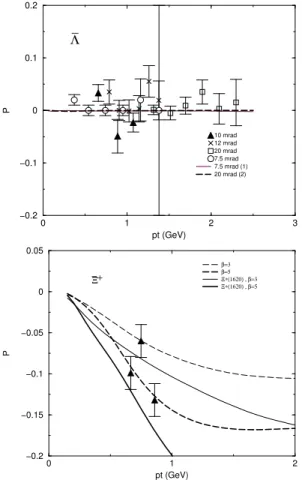
Figure 5.ΛandΞpolarizations, with variations of theβparameter (fluid rapidity distribution) and verifying the effect of the resonance
Ξ∗(1620).
withβ′ ∼0.62.
Supposing that dσ/dα may be described by a sum of gaussian functions
dσ dα =A[e
−β(α−α0) 2
+e−β(α+α0) 2
] , (11)
inserting this expression in (8), integrating and fitting the pa-rametersA,β andα0, we can compare the results with the
experimental data from ISR [19] . The results are shown in Fig. 4.
We obtained the parameters for 491 GeV (A = 1.03,
α0= 1.0andβ= 1.0) and 1030 GeV (A= 0.85,α0= 1.0
andβ = 0.7) incident protons. Our real interest is for a 800 GeV beam, so, we must interpolate the results. The obtained values wereA= 0.93,α0 = 1.0andβ = 0.85, and these
values will be used in the average polarization calculation. The transverse rapidity distribution dσ/dαtwill be
as-sumed to be [17],
1 chαtshαt
dσ dαt
=Ae−βtα 2
t , (12)
withβt= 6.6.
The numerical results from the calculation of the aver-age polarization, from Eq (5), to Λ andΞ+ are shown in Fig. 5.
We can observe that forΛthe fit was very good (fact that is independent ofβ). ForΞ+we verified the effect of the pa-rameterβ and included the next resonance,Ξ∗(1620), that provided a good accord with the experimental data. Calcula-tions of theΣ−polarization are in progress, and preliminary results show that the next resonance,Λ∗(1520)is not so im-portant.
References
[1] G. Bunceet al., Phys. Rev. Lett.36, 1113 (1976).
[2] G. Giacomelli,Phys. Rep.23, 123 (1976).
[3] B. Lundberget al., Phys. Rev. D40, 3557 (1978).
[4] R. Ramerikaet al., Phys. Rev. D33, 3172 (1986).
[5] P.M. Hoet al., Phys. Rev. D44, 3402 (1991).
[6] A. Moreloset al.,Phys. Rev. Lett.71, 2172 (1993).
[7] T. A. DeGrand and H. I. Miettinen,et al., Phys. Rev. D24, 2419 (1981).
[8] J. Soffer and N. A. T¨ornqvist, Phys. Rev. Lett. 68, 907 (1992).
[9] S. M. Troshin and N. E. Tyurin, Phys. Rev. D55, 1265 (1997).
[10] Y. Hama and T. Kodama, Phys. Rev. D48, 3116 (1993).
[11] C. C. Barros Jr.Doctor thesis, IFUSP (2001).
[12] T. Becher and H. Leutwyler, hep-ph/0103263; Eur. Jour. Phys. C9, 643 (1999).
[13] C. C. Barros Jr. and Y. Hama, Phys. Rev. C63, 065203 (2001).
[14] M. R. Robilotta, Phys. Rev. C63, 0340 (2000).
[15] C. C. Barros Jr. and M. R. Robilotta,hep-ph/0209213.
[16] C. C. Barros Jr., Phys. Rev. D68, 034006 (2003).
[17] Y. Hama and F. S. Navarra, Z. Phys. C53, 501 (1992).
[18] Y. Hama, Nuovo Cim. A46, 569 (1978).
![Figure 4. Parametrization of dσ/dα compared with the data from [19]. (1) is calculated with the text parameters, and (2), with β=5.](https://thumb-eu.123doks.com/thumbv2/123dok_br/18981018.457019/2.892.502.799.116.615/figure-parametrization-dσ-compared-data-calculated-text-parameters.webp)