Article
0103 - 5053 $6.00+0.00*e-mail: [email protected]
Inluence of Fruit Biotypes on the Chemical Composition and Antifungal Activity of
the Essential Oils of
Eugenia unilora
Leaves
Deomar P. Costa,a Elenilson G. Alves Filho,a Lorena M. A. Silva,a Suzana C. Santos,a
Xisto S. Passos,b,d Maria do Rosário R. Silva,b José C. Seraphinc and Pedro H. Ferri∗,a
aInstituto de Química, bInstituto de Patologia Tropical e Saúde Pública and cInstituto de Matemática
e Estatística, Universidade Federal de Goiás, CP 131, 74001-970 Goiânia-GO, Brazil
dInstituto de Ciências da Saúde, Universidade Paulista, 74845-090 Goiânia-GO, Brazil
A análise multivariada da composição química dos óleos essenciais das folhas de Eugenia unilora com diferentes cores de fruto indicou a presença de três grupos de óleos em relação ao biótipo do fruto das amostras. O primeiro grupo incluiu amostras de frutos amarelos, vermelhos escuros e roxos contendo altas percentagens de germacreno B (11,1-30,7%), germacrona (9,8-54%) e atractilona (0-19,9%). No grupo II, com amostras de frutos vermelhos claro, os constituintes majoritários foram o curzereno (42,0-43,2%), germacreno D (8,7-9,0%) e germacreno A (5,9-8,9%), enquanto que o grupo III incluiu amostras com frutos vermelho-alaranjado, caracterizadas por um alto conteúdo de 8-ona (40,3-55,4%) e epóxido de selina-1,3,7(11)-trien-8-ona (12,7-24,4%). Os óleos essenciais foram investigados frente ao fungo Paracoccidioides brasiliensis pela técnica de macrodiluição em caldo. O resultado mais signiicativo foi obtido com o óleo do grupo II, com a forma leveduriforme de P. brasiliensis sendo inibida completamente na concentração de 62,5 µg mL−1.
The multivariate chemical analysis of essential oils of Eugenia unilora leaves with different fruit colours indicated the presence of three oil clusters regarding sample biotypes. The irst cluster included yellowish, dark red and purple fruits with high percentages of germacrene B (11.1-30.7%), germacrone (9.8-54%) and atractylone (0-19.9%). In cluster II, with bright red fruit samples, the major constituents were curzerene (42.0-43.2%), germacrene D (8.7-9.0%) and germacrene A (5.9-8.9%), whereas cluster III included red-orange fruit samples containing high contents of selina-1,3,7(11)-trien-8-one (40.3-55.4%) and selina-1,3,7(11)-trien-8-one epoxide (12.7-24.4%). The clustered oils were investigated against the systemic fungus Paracoccidioides brasiliensis via the broth macrodilution method. The oil from cluster II revealed the most signiicant result. The yeast form of P. brasiliensis was completely inhibited at a concentration of 62.5 µg mL−1.
Keywords: Eugenia uniflora, essential oil, chemical variability, antifungal activity,
Paracoccidioides brasiliensis
Introduction
Fungal infections are common in tropical countries and may have a major impact on public health. Whereas the dermatophyte fungi group is of common occurrence,1 the incidence of systemic infections due to Paracoccidioides
brasiliensis (Splendore) Almeida has increased in the last two decades.2 P. brasiliensis is an etiological agent of paracoccidioidomycosis, the most prevalent human
A previous phytochemical study of Eugenia unilora L. (Myrtaceae) leaves has identiied that macrocyclic ellagitannin dimmer oenothein B is responsible for the inhibition of HSP60 and (1,3)-β-glucan synthase (Pbfks1) transcript of
P. brasiliensis.6 In addition, the yeast phase was inhibited by non-polar fractions of the leaf ethanolic extract constituted by terpenoids, mainly oxygenated sesquiterpenes.7 Curzerene (isofuranegermacrene), germacrene B and atractylone were the major constituents, all previously identiied in the essential oils of E. unilora and probably responsible for the antifungal activity.8-12E. unilora leaves have been used in folk medicine for the treatment of diarrhoea,13 hyperglycemia, hyperlipidemia and hypertension.14 Furthermore, they have been used as an antimalarial and spasmolytic agent as well as enzyme inhibitors.15-17 Antimicrobial activities have also been reported for leaf essential oils against bacterial and dermatophyte isolates.18
The aim of this study was to investigate the chemical constituents of the essential oils from E. unilora leaves with different fruit colour biotypes, in order to provide evidence for the existence of varieties of this species and to investigate whether these biotypes/chemotypes express a similar antifungal activity against P. brasiliensis. Essential oils from mature leaves of representative populations with yellowish, red (bright red, red-orange and dark red) and purple fruit colours were analyzed by GC-MS. To study chemical variability, chemical constituents were submitted to multivariate analysis to detect the pattern distribution of samples and to identify which constituents are able to distinguish between these groups of individuals. Representative clustered oils were submitted to an antifungal susceptibility assay with the yeast form of P. brasiliensis
via the standard broth macrodilution method, according to the National Committee for Clinical Laboratory Standard.
Results and Discussion
Fruit colour variations are well known in E. unilora, although varieties according to fruit colour biotypes are not easily deinable.19 Previous studies have mainly focused on the essential oils of leaves and only a few have investigated oils extracted from fruits.8-12,20-22 The description of the colour of sampled fruits is frequently excluded from these studies.11 According to a recent study, the essential oil of two fruit colour biotypes from both leaves and fruits of E. brasiliensis
Lam. may indicate the presence of the two chemotypes of this species.23
In this study, E. unilora leaf essential oils were obtained from species with three main fruit colour biotypes: yellowish, red (bright red, red-orange and dark red) and purple.24 A total of 36 compounds were identiied, accounting for
91.3-94.6% of volatile constituents (Table 1). The essential oils predominantly contained a sesquiterpene hydrocarbon composition, even though the oxygenated sesquiterpene content for some samples was over 75.5%. Essential oils from
E. unilora have showed that, although the main constituent may vary, sesquiterpenes are usually the dominant class.8-12,22 Nevertheless, leaf oils from plants growing in Argentina whose main constituents were the monoterpenes pulegone, carvone and limonene and the sesquiterpene nerolidol have been described.20
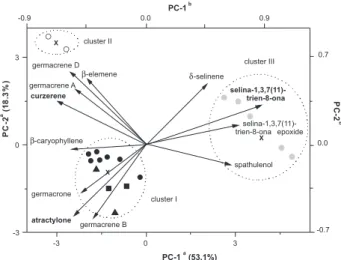
Results obtained from PCA (18 samples × 12 variables = 216 data) and nearest neighbour complete linkage cluster analysis using Ward’s technique revealed high chemical variability between leaf essential oil biotypes. Figure 1 shows the relative position of the individuals to an axial system originated in the PCA. The irst PC accounts for 53.1% of total variance and discriminates well above the 99% conidence level the oxygenated sesquiterpenes of red-orange fruit colour samples from other biotypes. The second PC discriminates (p < 0.0001) bright red fruit samples by their high sesquiterpene hydrocarbon content.
Therefore, three types of leaf essential oils were found: cluster I (samples with yellowish, dark red and purple fruit colours) was characterised (p < 0.015) by a high percentage of germacrene B (21.6 ± 7.2%), atractylone (11.7 ± 5.3%), germacrone (17.3 ± 13.2%) and β-caryophyllene (8.7 ±
3.7%); cluster II (samples with bright red fruit colour) had curzerene (42.6 ± 0.9%), germacrene D (8.8 ± 0.1%),
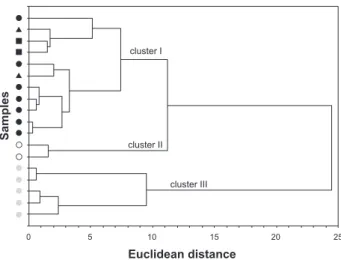
germacrene A (7.4 ± 1.5%) and β-elemene (4.4 ± 0.1%) as principal constituents (p < 0.003); and cluster III (samples with red-orange fruit biotypes) contained high amounts (p < 0.029) of selina-1,3,7(11)-trien-8-one (48.2 ± 5.7%), selina-1,3,7(11)-trien-8-one epoxide (19.3 ± 4.3%), spathulenol (4.1 ± 5.0%) and δ-selinene (3.3 ± 2.9%). Single Ion Monitoring (SIM) GC-MS analysis indicated that samples from clusters I and II did not show selina-1,3,7(11)-trien-8-one or their epoxide derivative, whereas samples from cluster III detected curzerene, germacrene B and atractylone. The latter was also veriied in cluster II samples by the CG-MS-SIM technique. All similarities between sampled oil constituents are shown in the dendrogram of Figure 2.
In order to assimilate the overall trend in volatile leaf oils and to reduce the uncontrolled factors affecting quantitative variations, the constituent data were also coded as independent single characters (either present or absent), as recommended by Sneath and Sokal.25 Multiple Correspondence Analyses revealed a similar chemical
Table 1. Percentagesa, yields and retention indexes in volatiles of clustered leaf oils from E. unilora with different fruit colour biotypes collected in the Central Brazilian Cerrado
Constituent Rl Cluster I Cluster II Cluster III
Myrcene 990 0.1 − −
α-Phellandrene 1002 t − −
α-Terpinene 1017 0.1 − −
(Z)-β-Ocimene 1037 0.1 − −
(E)-β-Ocimene 1050 0.3 − −
γ-Terpinene 1059 t − −
ρ-Mentha-2,4(8)-diene 1088 t − −
Linalool 1096 0.1a − 0.3a
Presilphiperfol-7-ene 1336 t − −
δ-Elemene 1338 0.5a 1.1b 0.1c
β-Elemeneb 1390 2.5a 4.4b 1.7a
β-Caryophylleneb 1419 8.7a 7.0 2.2b
γ-Elemene 1436 0.4a 0.3ab 0.1b
α-Humulene 1454 0.4a − 0.1b
allo-Aromadendrene 1460 0.3a 0.6a −
Germacrene Db 1485 4.4a 8.8 1.6b
β-Selinene 1490 0.3a 0.4 0.1b
δ-Selineneb 1492 0.1a 0.6 3.3a
Curzereneb 1499 20.5 42.6 −*
Germacrene Ab 1509 3.4a 7.4b 1.2c
δ-Amorphene 1512 0.3a 1.1 0.1a
Germacrene Bb 1561 21.6a 3.4 5.9b
Spathulenolb 1578 1.0a − 4.1a
aBased on original data. bConstituents selected for PCA (see Experimental section). c25 °C, 590 nm. R
l = Retention Index; t = trace (< 0.1%); *detected by GC-MS-SIM. Means followed by the same letter in the rows did not share signiicant differences at 5% probability by Tukey’s test. – = not detected
Constituent Rl Cluster I Cluster II Cluster III
Caryophyllene oxide 1583 0.5a − 1.3a
Thujopsan-2α-ol 1587 0.1a − 0.3a
Selina-1,3,7(11)-trien-8-oneb 1634 − − 48.2
Selina-3,11-dien-6α-ol 1644 − − 0.3
Pogostol (guai-11-en-10-ol) 1653 − − 0.1
Atractyloneb 1658 −* −* 11.7
14-hydroxy-9-epi-β -Caryophyllene
1669 − − 0.4
Occidenol 1677 − − 0.3
Germacra-4(15),5,10(14)-trien-1α-ol
1686 − − 0.1
Germacroneb 1693 17.3a 13.5 0.8b
Nootkatol 1715 − − 0.2
Selina-1,3,7(11)-trien-8-one epoxideb
1748 − − 19.3
2α -hydroxy-Amorpha-4,7(11)-diene
1776 − − 0.1
Monoterpene hydrocarbons 0.5 − −
Oxygenated monoterpenes 0.1a − 0.3a
Sesquiterpene hydrocarbons 63.5a 77.8b 16.5c
Oxygenated sesquiterpenes 30.6a 13.5b 75.5c
Total identiied 94.6a 91.3a 92.3a
Oil yield (%) 0.26a 0.25a 0.22a
Refractive indexc 1.5156a 1.5257a 1.5203a
Figure 2. Dendrogram representing chemical composition similarity
distinction between the biotypes sampled.26 Clusters I and II were clustered and cluster III was split based on up and down samples in relation to the second PC origin, as shown in Figure 1 (data not shown).
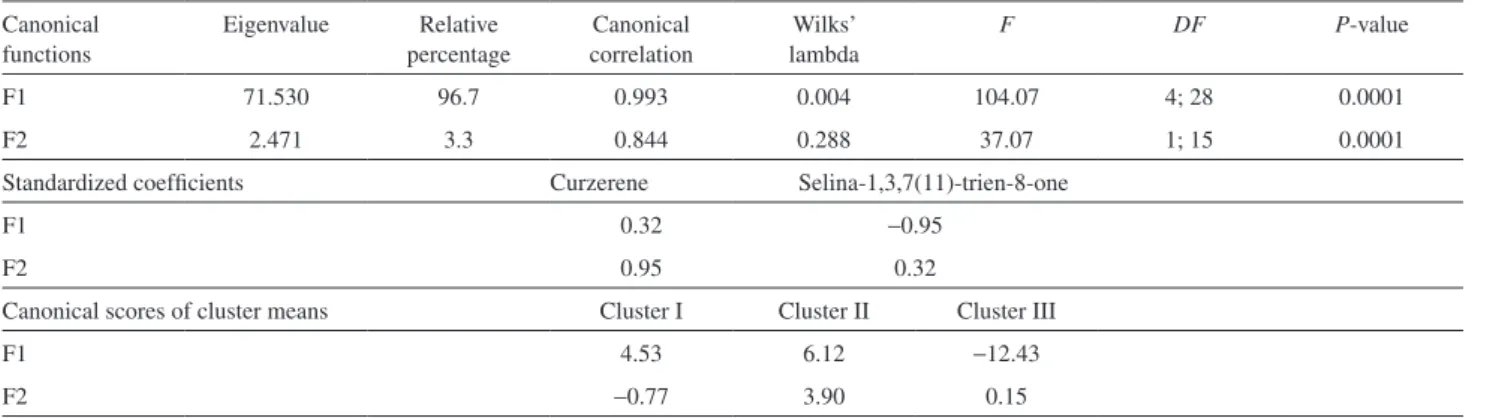
The canonical discriminant analysis (CDA) conirmed the clustering as a priori groupings. Furthermore, an axial system that originated in the CDA discriminated well above the 99% conidence level the three types of essential oils based only on the contents of curzerene and selina-1,3,7(11)-trien-8-one as predictor variables (Table 2). The irst discriminant function (F1) accounts for ca. 97% of total variability and separates cluster III from clusters I/II (F-test value = 104.07; degrees of freedom, DF = 4 and 28;
p < 0.0001), due to the high content of selina-1,3,7(11)-trien-8-one. On the other hand, the second discriminant function (F2) distinguishes cluster II from I as a result of the high content of curzerene (F = 37.07; DF = 1 and 15; p < 0.0001). In addition, the two discriminant functions allow an accurate prediction of total well-classiication in the original clusters via cross-validation or Jackknife approaches. These approaches consider a slightly reduced number of samples from the parent data set, estimate parameters for each of these modiied data sets, and then calculate the accuracy of the predictions for the samples previously removed by the resulting models.27
Similarly to a previous study which analyzed essential leaf oils of purple and yellow fruitsof E. brasiliensis,23 our results may conirm the presence of varieties/chemotypes for E. unilora due to the remarkable difference in chemical composition according to fruit colour biotypes. In fact, the literature combined with our indings led us to deduce that the chemotype growing in the Brazilian Northeast and in Nigeria, which exhibited selina-1,3,7(11)-trien-8-one and selina-1,3,7(11)-trien-8-one epoxide (cluster III), is probably the most common orange-red fruit biotype in this region.9,11 In recent study,28 the chemical polymorphism in leaf oils of this
chemotype revealed to be environmentally determined by a clear seasonal inluence. Two other essential oil chemotypes of the plant have been reported: the chemotype growing in the south of Brazil, which contained α- and β-selinene and nerolidol,21 and the chemotype growing in Argentina, whose main constituents were monoterpenes and the sesquiterpene nerolidol.20 These chemical data could be conirmed by genetic studies based on nuclear and chloroplastic DNA markers. These studies indicate that a more restricted gene low may exist between E. unilora populations from the Brazilian South, Northeast and Southeast.29
The chemical oil composition from the Brazilian Northern sampling site is similar to that of cluster II,10 although the content of germacrene B was higher than that of our samples. In addition, the abundance of curzerene (20.5%), germacrene B (21.6%), atractylone (11.7%) and germacrone (17.3%) in our samples (cluster I) showed a marked deviation from previous leaf oil investigations, despite the fact that this study has described higher contents of curzerene (50.2%);12 curzerene (19.7%), atractylone (16.9%) and selina-1,3,7(11)-trien-8-one (17.8%);11 curzerene (30%), germacrene B (15.6%) and germacrone (32.8%);10 curzerene (24%), selina-1,3,7(11)-trien-8-one (17%), selina-selina-1,3,7(11)-trien-8-one epoxide (14%),8 and selina-1,3,7(11)-trien-8-one (48.5%).30 Furthermore, oil constituents such as pulegone, carvone,
α-selinene and nerolidol, typical in other studies, were not detected in our oil samples.20 This variation pattern in the leaf essential oil suggests that the observed chemical variations may be a result of the existence of new chemotypes for E. unilora associated to yellowish, dark red and purple fruit colour biotypes.
Representative clustered oils were investigated against a P. brasiliensis reference strain (ATCC 90659) and three clinical isolates (Pb65, Pb1578 and Pb8334) via the standard broth macrodilution method, following NCCL M27-A2 guidelines with modiications.31 Based on MIC and MFC
Table 2. Canonical discriminant analysis summary of E. unilora leaf oils
Canonical functions Eigenvalue Relative percentage Canonical correlation Wilks’ lambda
F DF P-value
F1 71.530 96.7 0.993 0.004 104.07 4; 28 0.0001
F2 2.471 3.3 0.844 0.288 37.07 1; 15 0.0001
Standardized coeficients Curzerene Selina-1,3,7(11)-trien-8-one
F1 0.32 −0.95
F2 0.95 0.32
Canonical scores of cluster means Cluster I Cluster II Cluster III
F1 4.53 6.12 −12.43
F2 −0.77 3.90 0.15
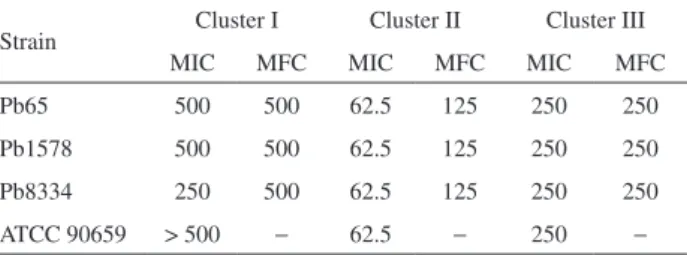
values (Table 3), the most signiicant inding was obtained with the oil from cluster II. The yeast form of P. brasiliensis was completely inhibited at a concentration of 62.5 µg mL-1, whereas oils from clusters III and I exhibited MIC values of 250 and 500 µg mL-1, respectively. MIC values were similar against various isolates and in relation to those non-polar fractions of the previously reported leaf ethanolic extract.7 All three oils readily killed P. brasiliensis isolates, although the oil from cluster II had the lowest MFC. These results may be associated to curzerene and germacrone in cluster II. On the other hand, the inhibitions and fungicidal activities of oils from clusters III and I may be related to selinatrienone derivatives and curzerene, respectively. Curzerene is structurally related to atractylone, which has shown an antiproliferative effect on tumour cell lines.32 Its derivative, atractylenolide III, inhibited the synthesis of mammal heat shock proteins HSP60 and HSP27 kDa family and enhances the effect of chemotherapy.33 Germacrone and curzerene have been described as active phytoconstituents in rizhome oils from Curcuma zedoaria (Berg.) Rosc. (Zingiberaceae).34
Conclusions
The essential oil from E. unilora leaves grown in the Central Brazilian Cerrado revealed a high polymorphism which might be influenced by fruit colour biotypes. Therefore, caution is required in all chemical and biological investigations of Eugenia oils because of such inluence. In addition, E. unilora essential oils showed very promising results in the antifungal assay against the systemic fungus
P. brasiliensis and warrant further study.
Experimental
Plant materialE. unilora leaves in the vegetative phenophase were collected in June 2002 and 2003 and from June to August 2007 in the vicinities of Goiânia (S 16° 35’ 14”; W 49° 17’
40”; 736 m; four red fruit specimens), Santo Antônio de Goiás (S 16° 30’; W 49° 19’; 773 m; two yellowish and two purple specimens), Nova Veneza (S 16° 21’ 44”; W 49° 18’ 39”; 773 m; eight red fruit specimens) and Anápolis (S 16°
20’ 13”; W 48° 56’ 19”; 1034 m; two red fruit specimens), Goiás State, Brazil. Leaves from red fruit specimens were also separated in bright red (two samples), red-orange (ive samples) and dark red (seven samples) biotypes. Fruit colour biotypes were based when the fruits were completely ripe. Specimens were identiied by Professor Heleno Dias Ferreira of the Department of Biology of Universidade Federal de Goiás (UFG), Goiás State, Brazil. A voucher specimen is deposited at UFG’s herbarium (code number 25477).
To assess the chemical oil composition, the leaves were dried at room temperature for 7 days at 30 °C until constant weight. After having been powdered, the dried phytomass (10-50 g) of each sample was submitted to hydrodistillation (2 h) using a modiied Clevenger-type apparatus. At the end of each distillation the oils were collected and dried with anhydrous Na2SO4, transferred to glass lasks and kept at a temperature of −18 °C. Oil yields (%) were based on the dried weight of plant samples.
Chemical analysis
Oil sample analyses were performed on a GC-MS Shimadzu QP5050A instrument under the following conditions: a CBP-5 (Shimadzu) fused silica capillary column (30 m × 0.25 mm i.d., 0.25 µm ilm thickness) connected to a quadrupole detector operating in the EI mode at 70 eV with a scan mass range of 40-400 m/z at a sampling rate of 1.0 scan s−1; carrier gas: He (1 mL min−1); injector and interface temperatures of 220 °C and 240 °C, respectively, with a split ratio of 1:20. The injection volume was 0.4 µL (20% in hexane) and the oven temperature was raised from 60 to 246 °C, with an increase of 3 °C min−1, then of 10 °C min−1 to 270 °C, holding the inal temperature for 5 min. Selected Ion Monitoring (SIM) was performed in the same conditions of the scan analyses. Individual components were identiied by comparing their linear retention indexes (Rl),35 by co-injection with a C
8-C32n-alkanes series, 36 mass spectra with those of the literature,35 and computerised MS-database using NIST libraries.35
Chemical variability
Principal component analysis (PCA) was applied to examine the interrelationships between populations and their essential oil constituents, via Système Portable d’Analyse des Données-SPAD software package, version 5.5, Centre International de Statistique et d’Informatique Appliquées,
Table 3. MIC (µg mL−1) and MFC (µg mL−1) values of representative clustered oils from E. unilora leaves against P. brasiliensis strains via standard broth macrodilution method
Strain Cluster I Cluster II Cluster III
MIC MFC MIC MFC MIC MFC
Pb65 500 500 62.5 125 250 250
Pb1578 500 500 62.5 125 250 250
Pb8334 250 500 62.5 125 250 250
ATCC 90659 > 500 − 62.5 − 250 −
France (2002). Cluster analysis was also applied to the study of sample similarity on the basis of essential oil constituent distribution. Nearest neighbour complete linkage technique by Benzécri algorithm was used as an index of similarity and hierarchical clustering was performed according to Ward’s variance minimizing method.37,38 For the variable selection, the threshold of residual eigenvalues (≤ 0.70) in the original data matrix (18 samples × 36 variables = 648 data) was used to establish the maximum number of variables which could be removed. Effectively eliminated variables expressed the highest loadings in the lowest residual eigenvalues and also contributed ≤ 0.7% to the chemical proiles (average values).
Canonical Discriminant analysis via SAS CANDISC procedure (Statistical Analysis System, SAS Institute Inc., Cary, NC, 1996) was used to differentiate samples and clusters on the basis of oil composition. The predictive ability of canonical discriminant functions was evaluated by cross-validation and Jackknife approaches as implemented in SAS statistical package. Prior to the multivariate analysis, the data was preprocessed by auto-scaling and mean centering.
Average multiple comparisons were established by univariate variance analysis (ANOVA) using SAS GLM analyses. All data were checked for homoscedasticity with Hartley’s test. This test revealed signiicant deviation from the basic assumption for the oil components caryophyllene oxide (Table 1), allo-aromadendrene, δ-selinene, germacrene A, spathulenol, germacrone and sesquiterpene hydrocarbons, which were arcsine and rank-transformed, respectively. Whenever a difference was established, a post-hoc Tukey test was performed. Results are shown as mean values and are joined by the standard deviation of independent measurements in some cases. P-values below 0.05 were regarded as signiicant.
Microorganisms
Yeast cells of a reference strain (ATCC 90659) and of three clinical isolates of P. brasiliensis recovered from patients with paracoccidioidomycosis were subcultured every seven days on agar Sabouraud medium (1% peptone, 0.5% yeast extract, 0.1% brain heart infusion; 4% glucose and 0.8% agar, pH 7.2) at 36 ± 1 °C prior to the susceptibility testing.
Antifungal susceptibility test
Susceptibility testing was performed following the standard broth dilution method according to NCCLS-CLSI M27-A2 guidelines with modiications.31 Briely,
for the inhibition assays, yeast cells in their exponential growth phase were kept on solid RPMI 1640 with glutamine and phenol red, supplemented with 0.2% glucose and buffered to a pH 7.0 with 0.165 mol L−1 3-morpholinepropanesulfonic acid (MOPS; Sigma, St. Louis) for seven days at 36 ± 1 °C. Sterile stock solutions of representative clustered oils from E. unilora
leaves were freshly prepared in DMSO. Serial twofold dilutions from stock solutions were prepared with sterile RPMI 1640 medium as the diluent to yield inal essential oil concentrations ranging from 62.5 to 500 µg mL−1. Essential oils-free controls tubes were included. Inocula concentrations were determined spectrophotometrically
via a yeast suspension in sterile 0.85% NaCl adjusted to 85% transmittance at 520 nm. The mixture was vortexed to disperse aggregated cells density. Aliquots of 0.1 mL of this suspension were added to 2.4 mL of broth RPMI 1640 containing the essential oil dilutions. This mixture was incubated at 36 °C in shaker at 120 rpm for 14 days and the transmittance was measured at 520 nm every 48 h. The minimal inhibition concentration (MIC) was spectrophotometrically determined after the wells had been thoroughly mixed to produce a homogeneous suspension. MIC was deined as the lowest concentration at which the optical density (OD) was reduced to ≤ 50% of the OD of the growth control well after 8-10 days of incubation.39 Subsequently, the minimal fungicide concentration (MFC) was determined by the reinoculum of cultures in RPMI 1640 agar medium. MFC was deined as the lowest oil concentration which completely inhibited yeast growth after 10 days of incubation at 36 °C. Duplicates were maintained for each concentration.
Supplementary Information
GC-MS chromatograms of representative clustered oils from E. unilora leaves with different fruit colour biotypes are available free of charge at http://jbcs.sbq.org.br as PDF ile.
Acknowledgments
References
1. Lupi, O.; Tyring, S. K.; McGinnis, M. R.; J. Am. Acad.
Dermatol.2005,53, 931.
2. Marques, S. A.; Robles, A. M.; Tortorano, A. M.; Tuculet, M. A.; Negroni, R.; Mendes, R. P.; Med. Mycol.2000, 38, 269; Santo A. H.; Rev. Panam. Salud Publica2008, 23, 313. 3. Restrepo, A. In Principles and Practice of Infectious Diseases;
Mandel, G. I.; Bennet, J. F.; Dolin, R., eds.; Philadelphia: Churchill Livingstone, 2000.
4. Nicola, A. M.; Andrade, R. V.; Silva-Pereira, I.; Genet. Mol. Res.2005, 4, 346.
5. Neckers, L.; Tatu, U.; Cell Host Microbe2008,4, 519. 6. Lima, M. M.; MSc Dissertation, Universidade Federal de
Goiás, Brazil, 2001; Santos, G. D.; Ferri, P. H.; Santos, S. C.; Bao, S. B.; Soares, C. M. A.; Pereira, M.; Med. Mycol.2007,
45, 609.
7. Santos, S. C.; Ferri, P. H.; Ribeiro, J. P; Guimarães, D. O.; Silva, M. O.; Garcia, A. C. F.; Pires, J. S.; Castro, A. C. M.; Silva, M. R. R.; Paula, J. R.; Rev. Bras. Pl. Med.2004, 7, 30.
8. Weyerstahl, P.; Marschall-Weyerstahl, H.; Christiansen, C.; Oguntimien, B. O.; Adeoye, A. O.; Planta Med.1988,54, 546.
9. Morais, S. M.; Craveiro, A. A.; Machado, M. I. L.; Alencar, J. W.; Mattos, F. J. A.; J. Essent. Oil Res.1996, 8, 449.
10. Maia, J. G. S.; Andrade, M. H. L.; Silva, M. H. L.; Zoghbi, M. G. B.; J. Essent. Oil Res.1999, 11, 727.
11. Ogunwande, I. A.; Olawore, N. O.; Ekundayo, O.; Walker, T. M.; Schmidt, J. M.; Setzer, W. N.; Int. J. Aromath.2005, 15, 147.
12. Melo, R. M.; Corrêa, V. F. S.; Amorim, A. C. L.; Miranda, A. L. P.; Rezende, C. M.; J. Braz. Chem. Soc.2007, 18, 179. 13. Schapoval, E. E. S.; Silveira, S. M.; Miranda, M. L.; Alice, C.
B.; Henriques, A. T.; J. Ethnopharmacol.1994, 44, 137. 14. Almeida, C. E.; Karnikowski, M. G. O.; Foleto, R.;
Baldisserotto, B.; Rev. Saude Publica1995, 29, 428; Ferro, E.; Schinini, A.; Maldonado, M.; Rosner, J.; Hirschmann, G. S.;
J. Ethnopharmacol. 1988, 24, 321.
15. Arai, J.; Amagaya, S.; Komatsu, Y.; Okuda, M.; Mayashi, T.; Kasai, M.; Arisawa, M.; Momose, Y.; J. Ethnopharmacol.
1999, 68, 307; Matsumura, T.; Kasai, M.; Hayashi, T.; Arisawa, M.; Momose, Y.; Arai, I.; Amagaya, S.; Omatsu, Y.; Pharm.
Biol.2000, 38, 302; Morioka, K.; Nojima, H.; Kurosaki, F.;
Arisawa, M.; Kuraishi, Y.; Momose, Y.; Phytomedicine2000,
7, 99.
16. Agbedahunsi, J. M.; Aladesanmi, A. J.; Fitoterapia1993,
64, 174; Consolini, A. E.; Baldini, O. A. N.; Amat, A. G.;
J. Ethnopharmacol.1999, 66, 33.
17. Wazlawik, E.; Silva, M. A.; Peters, R. R.; Correia, J. F. G.; Farias, M. R.; Calixto, J. B.; Ribeiro do Valle, R. M.; J. Pharm.
Pharmacol.1997, 49, 433.
18. Adebajo A. C.; Oloke K. J.; Aladesanmi A. J.; Fitoterapia1989,
60, 451; Fadeyi, M. O.; Akpan, U. E.; Phytother. Res.1989,3, 154; Lima, E. O.; Gompertz, O. F.; Giesbrecht, A. M.; Paulo, M. Q.; Mycoses 1993,36, 333; Lee, M.-H.; Nishimoto, S.; Yang, L.-L.; Yen, K.-Y.; Hatano, T.; Yoshida, T.; Okuda, T.;
Phytochemistry1997, 44, 1343; Souza, L. K. H.; Oliveira, C. M.
A.; Ferri, P. H.; Santos, S. C.; Oliveira Júnior, G. G.; Miranda, A. T. B.; Lião, L. M.; Silva, M. R. R.; Braz. J. Microbiol. 2002,
33, 247.
19. Lima, V. L. A. G.; Mélo, E. A.; Lima, D. E. S.; Sci. Agric.2002,
59, 447; Sanchotene, M. C. C.; Frutíferas Nativas Úteis à Fauna
na Arborização Urbana, 2ª ed., Sagra: Porto Alegre, 1989;
Lederman, I. E.; Bezerra, J. E. F.; Calado, G.; A Pitangueira em
Pernambuco, Secretaria de Agricultura, Empresa Pernambucana
de Pesquisa Agropecuária: Recife, 1992; Franzon, R. C.; MSc
Dissertation, Universidade Federal de Pelotas, 2004.
20. Viana, M. E. L.; Retamar, J. A.; An. Soc. Cient. Argent.1971,
192, 111; Ubiergo, G.; Taher, H. A.; Talenti, E. C.; An. Asoc.
Quim. Argent.1987, 75, 377.
21. Henriques, A. T.; Sobral, M. E.; Cauduro, A. D.; Schapoval, E. E. S.; Bassini, V. L.; Lamaty, G.; Menut, C.; Bessière, J. M.;
J. Essent. Oil Res.1993, 5, 501.
22. Rücker, G.; Brasil e Silva, G. A.; Bauer, L.; Schikarski, M.;
Plant Med.1977, 31, 322; Pino, J. A.; Bello, A.; Urquiola, A.;
Aguero, J.; Marbot, R.; J. Essent. Oil Res.2003, 15, 70; Oliveira, A. L.; Lopes, R. B.; Cabral, F. A.; Eberlin, M. N.; Food Chem.
2006, 99, 1.
23. Moreno, P. R. H.; Lima, M. E. L.; Sobral, M.; Young, M. C. M.; Cordeiro, I.; Apel, M. A.; Limberger, R. P.; Henriques, A.
T.; Sci. Agric.2007, 64, 428.
24. Bezerra, J. E. F.; Silva Júnior, J. F.; Lenderman, I. E.;
Pitanga (Eugenia unilora L.), Série Frutas Nativas 1, Funep:
Jaboticabal, 2000; Núcleo de Estudo em Fruticultura no Cerrado, http://www.fruticultura.iciag.ufu.br/pitangueira. html, acessed in March, 2009; Raseira, M. C. B.; Raseira, A.
In Documentos 171;Antunes, L. E. C.; Raseira, M. C. B., eds.,
Embrapa Clima Temperado: Pelotas, 2006.
25. Sneath, P. H.; Sokal, R. R.; Principles of Numerical
Taxonomy. A series of Books in Biology, W.H. Freeman:
San Francisco, 1963.
26. Lebart, L.; Morineau, A.; Warwick, K. M.; Multivariate Descriptive Statistical Analysis. Correspondence Analysis and
Related Techiniques for Large Matrices, John Wiley & Sons:
New York, NY, 1984, ch. 4.
27. Wold, A.; Eriksson, L. In Chemometric Methods in Molecular
Design, vol. 2; Waterbeemd, H., ed.; VCH: Weinheim, 1995,
ch. 5.
28. Costa, D. P.; Santos, S. C.; Seraphin, J. C.; Ferri, P. H.; J. Braz.
Chem. Soc.2009, 20, 1287.
30. El-Shabrawy A. O.; Bull. Fac. Pharm. Cairo Univ.1995, 33, 17.
31. National Committee for Clinical Laboratory Standards;
Reference Method for Broth Dilution Antifungal Susceptibility
Testing of Yeasts. Approved Standard, 2nd ed., M27-A2.
32. Wang, C. C.; Chen, L. G.; Yang, L. L.; Planta Med.2002, 68, 204.
33. Yoichi, S.; Tomoko, T.; Toshimi, S.; Masayoshi, M.; Chikao,
Y.; Kureha Chem., JP 10045585-A, 1998.
34. Lobo, R.; Prabhua, K. S.; Shirwaikar, A.; Shirwaikar, A.;
J. Pharm. Pharmacol.2009, 61, 13.
35. Adams, R. P.; Identiication of Essential Oil Components by
Gas Chromatography/Mass Spectrometry, 4th ed., Allured:
Illinois, 2007; National Institute of Standards and Technology;
PC version of the NIST/EPA/NIH Mass Spectral Database, U.S.
Department of Commerce: Gaithersburg, 1998.
36. Van Den Dool, H.; Kratz, P. D. J. A.; J. Chromatogr. 1963, 11, 463.
37. Benzécri, J. -P.; L´Analyse des Données: la Taxinomie, Tome 1, Dunod: Paris, 1980.
38. Ward, J. H.; J. Am. Stat. Assoc.1963, 58, 238.
39. Stevens, A. A.; Aristizabal, B. H.; Diagn. Microbiol. Infect. Dis.
1997, 29, 103.
Supplementary Information
0103 - 5053 $6.00+0.00
*e-mail: [email protected]
Inluence of Fruit Biotypes on the Chemical Composition and Antifungal Activity of
the Essential Oils of
Eugenia unilora
Leaves
Deomar P. Costa,a Elenilson G. Alves Filho,a Lorena M. A. Silva,a Suzana C. Santos,a
Xisto S. Passos,b,d Maria do Rosário R. Silva,b José C. Seraphinc and Pedro H. Ferri∗,a
aInstituto de Química, bInstituto de Patologia Tropical e Saúde Pública and cInstituto de Matemática
e Estatística, Universidade Federal de Goiás, CP 131, 74001-970 Goiânia-GO, Brazil
dInstituto de Ciências da Saúde, Universidade Paulista, 74845-090 Goiânia-GO, Brazil
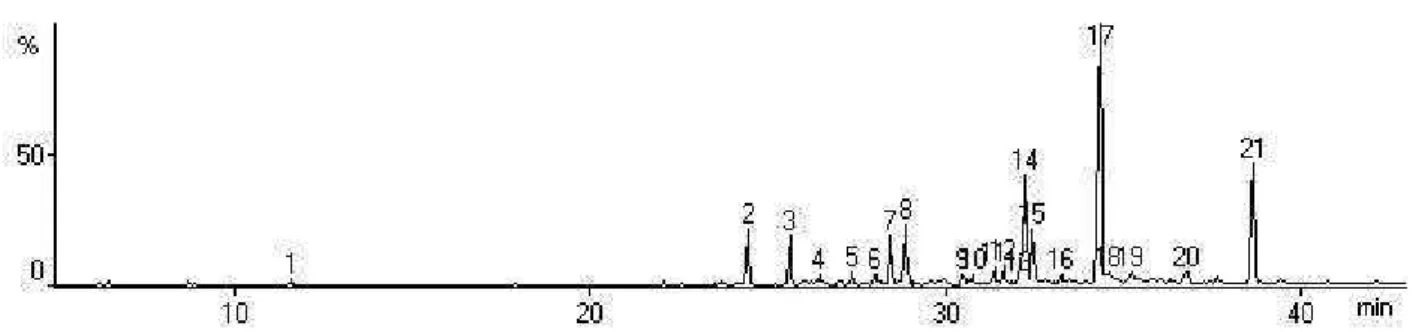
Figure S1. Total ion chromatogram (TIC) of the essential oil from E. unilora leaves (cluster I).
Figure S3. Total ion chromatogram (TIC) of the essential oil from E. unilora leaves (cluster III).
Figure S4. Mass spectrum of β-caryophyllene.
Figure S5. Mass spectrum of germacrene D.
Figure S7. Mass spectrum of germacrene A.
Figure S8. Mass spectrum of germacrene B.
Figure S9. Mass spectrum of selina-1,3,7(11)-trien-8-one.
Figure S11. Mass spectrum of germacrone.