ABSTRACT: Processes regulating pesticide fate in the environment are influenced by the physico-chemical properties of pesticides and soils. Sorption and desorption are important processes as they regulate the movement of pesticides in soil. Although sorption-desorption is widely studied for herbicides, studies involving their metabolites in soil are scarce. Sorption and desorption of indaziflam metabolites (indaziflam-triazinediamine (FDAT), indaziflam-triazine-indanone (ITI) and indaziflam-carboxilic acid (ICA)) were investigated in six Brazilian (BRA) soils and three United States (USA) soils with different physicochemical properties. The Freundlich equation described sorption of the metabolites for all soils (R2 > 0.98; 1/n ~ 1). Sorption order (K
f) was ITI > ICA > FDAT. Mean values of Kf,oc were 453, 289, and 81 (BRA) and 444, 48, and 48 (USA) for metabolites ITI, ICA, and FDAT respectively. Desorption was hysteretic for all metabolites in all soils. These results suggest that these metabolites fall in the classification range of mobile to moderately mobile in soils.
Keywords: adsorption, hysteresis, metabolites, soil properties
vironmental degradation of indaziflam are: indaziflam-triazine-indanone (ITI), indaziflam-carboxilic acid (ICA), indaziflam-hydroxyethyl, indaziflam-olefin, fluoroethyl-diaminotriazine (FDAT), and fluoroethyltriazinanedione. Indaziflam, ITI and ICA are cleaved at the N bond to form FDAT (from the triazine portion) and unidentified minor compounds (from the indazyl portion). Residues are ultimately converted into bound residues and CO2 (Figure 1) (USEPA, 2010).
This study aimed to characterize sorption and de-sorption coefficients of three of the main metabolites of indaziflam (ITI, ICA and FDAT), for which there current-ly is no published information. Considering the diversity among the physicochemical properties of soils that can influence sorption-desorption, this study was carried out on a selection of tropical soils from Brazil (Oxisols) and glacial soils from the United States (Mollisols).
Materials and Methods
Soils
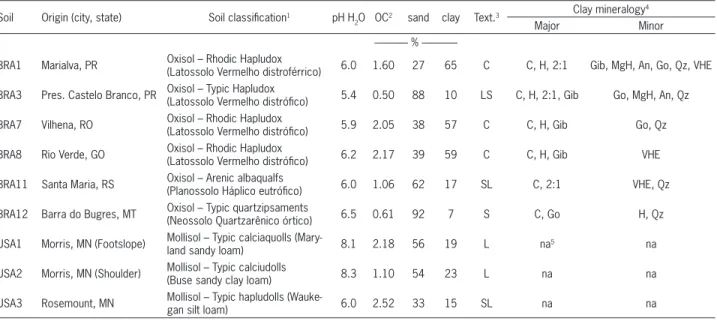
Nine various soils previously untreated with in-daziflam were selected for this study: six Brazilian Oxi-sols and three United States MolliOxi-sols. Samples were col-lected from a depth of 0 to 10 cm depth, air-dried, and passed through a 2-mm sieve. Selected physicochemical properties of the soils appear in Table 1. The hydrometer method was used to determine sand and clay contents and soil pH was measured in a 1:2 soil/deionized water mixture. The soil organic carbon (OC) content was ascer-tained by loss on ignition (Nelson and Sommers, 1982). 1State University of Maringá/Center for Advanced Studies in
Weed Research (NAPD) − Agronomy Dept., Av. Colombo, 579 − 87020-900 − Maringá, PR – Brazil.
2U.S. Department of Agriculture/Agricultural Research Service, 439 Borlaug Hall, 1991 Upper Buford Circle – 55108 – St. Paul, MN – USA.
3University of Minnesota – Dept. of Soil, Water & Climate, 439 Borlaug Hall, 1991 Upper Buford Circle – 55108 – St. Paul, MN – USA.
4Bayer Crop Science LP, Environmental Fate and Exposure Assessment, RTP, 2 TW Alexander Drive – 27709 – Research Triangle Park, NC, USA.
*Corresponding author <[email protected]>
Edited by: Silvia del Carmen Imhoff
Sorption and desorption of indaziflam degradates in several agricultural soils
Diego Gonçalves Alonso1, Rubem Silvério de Oliveira Jr.1*, William Charles Koskinen2, Kathleen Hall3, Jamil Constantin1, Suresh
Mislankar4
Received March 13, 2015 Accepted July 20, 2015
Introduction
The fate and distribution of agrochemicals in the soil water environment are largely determined by sorp-tion-desorption processes. Previous herbicide research has focused predominantly on the interaction of the par-ent compound with soil, while studies involving their me-tabolites are in short supply. Because data are unavailable for model input, it is often assumed that the metabolite sorption coefficient is equal to that of the parent com-pound. Studies on the metabolites of imidacloprid have demonstrated that this assumption can be inaccurate (Papiernik et al., 2006). For example, of three imidaclo-prid metabolites evaluated, two showed sorption higher than the parent compound and one lower (Cox et al., 1997; Papiernik et al., 2006).Alternatively, the idea that as a compound degrades, its byproducts are smaller and more polar, and, therefore, more mobile is also riddled with exceptions. The hydroxylated metabolites of atra-zine (Clay and Koskinen, 1990) and florasulam (Krieger et al., 2000) show greater adsorption to soil than the par-ent compound. Experimpar-ental metabolite sorption data is, therefore, imperative for performing environmental assessments of herbicides. While information regarding herbicide metabolite behavior in soil is scarce overall, no data exist for the relatively new herbicide, indaziflam.
en-Chemicals
Pure analytical standards of indaziflam-tri-azinediamine (FDAT) (6-[(1R )-1-fluoroethyl]-1,3,5-tri-azine-2,4-diamine), indaziflam-triazine-indanone (ITI) (N-[(1R,2S)-2,3-Dihydro-2,6-dimethyl-3-oxo-1H -inden-i-yl]-1,3,5-triazine-2,4-diamine) and indaziflam-carboxylic acid (ICA) (2S,3R)-3-[[4-amino-6-[(1R )-1-fluoroethyl]-1,3,5-triazin-2-yl]-amino]-2,3-dihydro-2-methyl-1H -indene-5-carboxylic acid, and respective radioactive analytical standards, 14C-labeled (triazine-2,4-14C) FDAT,
14C-labeled (indane-1-14C) ITI, and 14C-labeled
(carboxyl-14C) ICA were graciously provided by Bayer Crop
Sci-ence (Wuppertal, Germany). Solutions were prepared in CaCl2 (0.01 N) to concentrations of 0.06, 0.19, 0.64, and 1.91 µmol L−1 (FDAT), 0.03, 0.09, 0.3, and 0.95 µmol L−1
(ITI), and 0.03, 0.09, 0.31, and 0.92 µmol L−1 (ICA) with
nonradioactive analytical standards. Radioactive analyti-cal standards were added to provide ~83 Bq mL−1 of
radioactivity to solutions. Final solutions contained less than 0.4 % methanol and were stored in foil-covered flasks in the dark at 4 oC.
Sorption
Sorption studies were performed in triplicate us-ing the batch equilibration method. Preliminary studies (Alonso et al., 2011) showed that to sorb 20-80 % of the initial chemical in solution on the soil (for greater analyti-cal accuracy), a ratio of 4 g soil to 10 mL (4:10) solution was acceptable for the ITI metabolite, whereas for FDAT and ICA, the soil:solution ratio was 10 g to 10 mL (1:1) for each sample. Glass centrifuge tubes (35-mL) with Teflon lined caps containing soil and radioactive solutions were mixed using a vortex mixer (30 s) and shaken for 24 h on a tabletop shaker (20 ± 2 oC) in the dark. Preliminary
ki-netic studies (Alonso et al., 2011) showed that equilibrium was reached in < 24 hrs. Sample tubes were then cen-trifuged (20 min at 370 g) and 3-mL of supernatant was removed from each sample for analysis. A 1-mL aliquot of the removed supernatant was mixed with 5 mL of a scintil-lation cocktail (EcoLite, cocktail, ICN Biomedicals, Costa Mesa, CA) and the concentration of 14C of each metabolite
in solution was determined by liquid scintillation count-ing with a Packard 1500 counter (Packard Instruments, Downer Grove, IL). The amount of chemical sorbed to the soil was calculated as the difference between the initial solution concentration and the supernatant concentration Table 1 − Physicochemical properties of soils.
Soil Origin (city, state) Soil classification1 pH H 2O OC
2 sand clay Text.3 Clay mineralogy 4
Major Minor
--- %
---BRA1 Marialva, PR Oxisol – Rhodic Hapludox
(Latossolo Vermelho distroférrico) 6.0 1.60 27 65 C C, H, 2:1 Gib, MgH, An, Go, Qz, VHE
BRA3 Pres. Castelo Branco, PR Oxisol – Typic Hapludox (Latossolo Vermelho distrófico) 5.4 0.50 88 10 LS C, H, 2:1, Gib Go, MgH, An, Qz
BRA7 Vilhena, RO Oxisol – Rhodic Hapludox (Latossolo Vermelho distrófico) 5.9 2.05 38 57 C C, H, Gib Go, Qz
BRA8 Rio Verde, GO Oxisol – Rhodic Hapludox
(Latossolo Vermelho distrófico) 6.2 2.17 39 59 C C, H, Gib VHE
BRA11 Santa Maria, RS Oxisol – Arenic albaqualfs
(Planossolo Háplico eutrófico) 6.0 1.06 62 17 SL C, 2:1 VHE, Qz
BRA12 Barra do Bugres, MT Oxisol – Typic quartzipsaments (Neossolo Quartzarênico órtico) 6.5 0.61 92 7 S C, Go H, Qz
USA1 Morris, MN (Footslope) Mollisol – Typic calciaquolls (Mary-land sandy loam) 8.1 2.18 56 19 L na5 na
USA2 Morris, MN (Shoulder) Mollisol – Typic calciudolls
(Buse sandy clay loam) 8.3 1.10 54 23 L na na
USA3 Rosemount, MN Mollisol – Typic hapludolls
(Wauke-gan silt loam) 6.0 2.52 33 15 SL na na
after equilibration. In preliminary studies, degradation of the chemical during equilibration was not observed, neither was sorption in blank tubes containing solution without soil. Data were fit to the Freundlich equation to obtain sorption coefficients.
Desorption
Immediately following the sorption experiments, desorption experiments were performed for each me-tabolite at the lowest and highest initial concentrations: 0.06 and 1.91 µmol L−1 for FDAT, 0.03 and 0.95 µmol
L−1 for ITI, and 0.03 and 0.92 µmol L−1 for ICA on all
nine soils. Desorption was determined by replacing the 3-mL aliquot of removed supernatant for sorption analy-sis with 3 mL of 0.01 N CaCl2. The soils were then re-suspended using a vortex mixer, shaken for 24 h, and centrifuged. The supernatants were analyzed as previ-ously described and again replaced with CaCl2. This was repeated for a total of three desorption steps. All studies were done in triplicate.
Sorption and Desorption Model
Sorption coefficients Kf and 1/n were calculat-ed from the slope and intercept of the log form of the Freundlich equation: Log [Cs] = log Kf + 1/n log [Ce]; where [Cs] is the concentration (µmol kg−1) of the
metab-olite sorbed onto soil after equilibration and [Ce] is the metabolite concentration (µmol L−1) after equilibration.
Sorption coefficients were normalized to soil OC con-tents to give Kf-oc(L kg−1), where K
f-oc = (Kd / % OC)*100.
The hysteresis coefficient, H, for the sorption-desorption isotherms was determined using the formula H = (1/
ndesorption)/(1/nsorption), where 1/nsorption and 1/ndesorption are the Freundlich slopes from the sorption and desorption iso-therms, respectively (Barriuso et al., 1994).
Sorption distribution coefficients Kd(L kg−1), where
Kd = [Cs] / [Ce], were also calculated for the lowest and highest initial solution concentrations and normalized to soil OC contents to give Koc(L kg−1), where K
oc = (Kd /
% OC)*100. Kd and Koc values were used to compare sorption between soils at initial solution concentrations with sorption calculated after the third desorption step. The concentration of metabolite remaining in the 0.01 N CaCl2 solution after the third desorption step was taken as [Ce], and the concentration of metabolite sorbed, [Cs], was assumed to equal the initial concentration minus the amount remaining in the solution and the amount removed in the previous desorption steps.
Statistical Analysis
For each metabolite, Pearson Product Moment Correlation analyses were performed charting the sorp-tion coefficients against selected soil physicochemical properties using the SigmaPlot (SysStat© for Windows,
Version 10). For all correlation analyses, soils were di-vided into two groups, tropical soils (BRA) and glacial soils (USA). Linear regression analyses were performed using the same software package.
Results and Discussion
Sorption
The empirical Freundlich equation described the sorption behavior of the metabolites FDAT (Table 2, Fig-ure 2), ITI (Table 3, FigFig-ure 3), and ICA (Table 4, FigFig-ure 4) for all soils (R2 > 0.98). Average 1/n values were 0.99
for FDAT, and 0.95 for ITI and ICA indicating sorption was minimally dependent on initial solution concentra-tion. As 1/n values did not differ significantly from one another, Kf values were used for comparisons. In gen-eral, the order of sorption magnitude for the indaziflam metabolites in the present study was FDAT < ICA < ITI.
Kf values for FDAT, the least sorbed metabolite, were 0.14 to 3.0 in Oxisols and 0.63 to 0.85 in Mollisols. ICA
Kf values of Oxisols ranged from 0.51 to 13.1, whereas
Figure 2 − Freundlich isotherm fit to describe sorption (solid symbols) and desorption (open symbols) of indaziflam-triazinediamine (FDAT) at concentrations of 0.06 and 1.91 µmol L−1for soils BRA3, BRA11, USA2, and USA3.
responding soil (Alonso et al., 2011), which supports the general observation that degradates are more polar and soluble than parent chemicals, and subsequently less sorbed.
Kf values for Mollisols ranged from 0.43 to 1.56. ITI Kf
values in Oxisols ranged from 1.96 to 14.5 and from 4.72 to 12.1 in Mollisols. All metabolites showed much lower sorption than the parent compound in the
cor-Table 2 − Freundlich sorption parameters for indaziflam-triazinediamine (FDAT) metabolite of indaziflam for soils studied.
Soil Kf Kf,oc 1/n sorption R
2 Init. Conc. Desorption 1/n desorption H K d des3/Kd --- µmol (1-1/n) L1/n kg−1 --- µmol L−1
BRA 1 (0.93-0.94)0.93 §
58
(58-59) 0.99 ± 0.0 1.0 1.91 0.41 0.42 1.54
0.06 0.44 0.49 1.48
BRA 3 (0.13-0.15)0.14 (26-30)28 1.0 ± 0.04 0.9963 1.91 0.12 0.12 2.38
0.06 0.26 0.27 2.08
BRA 7 (1.16-1.19)1.18 (57-58)57 0.97 ± 0.01 0.9999 1.91 0.26 0.26 1.66
0.06 0.39 0.40 1.39
BRA 8 0.5
(0.47-0.54)
23
(22-25) 1.0 ± 0.04 0.9975 1.91 0.44 0.44 1.62
0.06 0.44 0.44 1.57
BRA 11 3.0 (2.64-3.41) 283
(249-322) 1.0 ± 0.05 0.9957 1.91 0.67 0.67 1.05
0.06 0.46 0.46 1.25
BRA 12 (0.21-0.22)0.21 (34-36)35 1.02 ± 0.02 0.9996 1.91 0.29 0.28 2.05
0.06 0.29 0.28 2.05
USA 1 (0.61-0.65)0.63 (28-30)29 0.98 ± 0.01 0.9997 1.91 0.44 0.45 1.54
0.06 0.45 0.46 1.52
USA 2 0.90
(0.88-0.92)
82
(80-83) 0.99 ± 0.01 0.9998 1.91 0.48 0.49 1.51
0.06 0.56 0.56 1.42
USA 3 0.85
(0.84-0.86)
34
(33-34) 0.95 ± 0.01 0.9999 1.91 0.44 0.46 1.48
0.06 0.45 0.47 1.43
§Numbers in parentheses are confidence intervals (K
f, Kf,oc) or standard deviations of the means (1/n).
Table 3 − Freundlich sorption parameters for indaziflam-triazine-indanone (ITI) metabolite of indaziflam for soils studied.
Soil Kf Kf,oc 1/n sorption R
2 Init. Conc. desorption 1/n desorption H K d des3/Kd --- µmol (1-1/n) L1/n kg−1 --- µmol L−1
BRA 1 10.0
(7.34-13.61) §
625
(459-851) 0.95 ± 0.08 0.9853 0.95 0.05 0.06 1.97
0.03 0.02 0.02 2.29
BRA 3 (1.79-2.14)1.96 (358-428)392 0.92 ± 0.03 0.9976 0.95 0.31 0.33 1.66
0.03 0.26 0.28 1.72
BRA 7 14.46
(13.22-15.83)
706
(645-772) 1.02 ± 0.02 0.9989 0.95 0.18 0.18 1.42
0.03 0.15 0.15 1.51
BRA 8 (4.02-4.52)4.26 (185-208)196 0.98 ± 0.02 0.9992 0.95 0.26 0.26 1.59
0.03 0.14 0.14 1.87
BRA 11 4.24
(4.13-4.35)
400
(390-410) 0.94 ± 0.01 0.9998 0.95 0.50 0.53 1.24
0.03 0.44 0.46 1.17
BRA 12 2.46
(2.32-2.60)
403
(381-425) 0.92 ± 0.02 0.9991 0.95 0.24 0.26 0.70
0.03 0.17 0.19 1.89
USA 1 (8.25-10.24)9.19 (378-470)422 0.94 ± 0.03 0.9990 0.95 0.07 0.08 1.85
0.03 0.03 0.03 2.10
USA 2 4.72
(4.48-4.96)
429
(408-451) 0.93 ± 0.02 0.9994 0.95 0.22 0.24 1.62
0.03 0.18 0.19 1.60
USA 3 12.14
(12.60-12.71)
482
(460-504) 0.91 ± 0.01 0.9997 0.95 0.16 0.18 1.45
0.03 0.13 0.14 1.38
§Numbers in parentheses are confidence intervals (K
between Kf and OC, the normalization of Kf for organic carbon (% OC) reduced the variability of sorption coef-ficients. Variation range in Kf,oc was ~12x in contrast to the ~21x variation for Kf.
The ICA Kf values of Oxisols had significant posi-tive correlation (p < 0.05) with % OC (r = 0.76**), and an equation describing Kf as a function of % OC was cal-culated where Kf = -2.1738 + 5.0867 % OC (R2 = 0.57).
ICA sorption was not correlated with clay content or pH of these soils. In the Mollisols, significant negative corre-lations (p < 0.05) were observed for ICA Kf values with pH (r = -0.93**) and clay content (r = -0.99**). Linear equations describing Kf as a function of soil pH (Kf = 4.0454 – 0.411 pH, R2 = 0.87), clay contents (K
f = 3.6604
– 0.1413 % Clay, R2 = 0.99), and % OC (K
f = – 0.4103 +
0.7174 % OC, R2 = 0.88) were calculated. Although not
significant, the normalization of Kf or Kd for organic car-bon content reduced sorption variability between soils by approximately half, from ~30 to ~16. The low ICA sorption is presumably related to the anionic character of the metabolite at the pH of the suspensions. The an-ionic acid group is repelled by the negative charge of Oxisols, or weakly retained as the molecular species by most soil and sediment components in glacial soils (FAO, 2000). According to calculations, pKa varied from 3.70 to 4.36, depending on the group, triazine ring or the acid group (Chemaxon, 2014).
ITI Kf was positively correlated (p < 0.05) with organic carbon (% OC) (r = 0.68**) and with clay con-tent (% Clay) (r = 0.74**) of the Oxisols. Linear equa-tions describing Kf as a function of carbon content (Kf
Sorption of FDAT was lower as compared to in-daziflam, presumably due to differences in hydrophobic interactions. Using a theoretical pKa for FDAT of 4.10 (Chemaxon, 2014), a higher %age of cationic molecules would be expected as compared to indaziflam (pKa = 3.5), and greater sorption. However, the pKa is not the only factor that affects sorption. There was no correla-tion (p < 0.05) between low FDAT Kf values and the physicochemical properties (ie. pH and %age clay) of the soils. Although there was no significant correlation Figure 4 − Freundlich isotherms fit to describe sorption (solid symbols) and desorption (open symbols) of indaziflam-carboxylic acid (ICA) at concentrations of 0.03 and 0.92 µmol L−1 for soils BRA3, BRA7, USA2, and USA3.
Table 4 − Freundlich sorption parameters for indaziflam-carboxilic acid (ICA) metabolite of indaziflam for soils studied.
Soil Kf Kf,oc 1/n sorption R
2 Init. Conc. desorption 1/n desorption H K d des3/Kd --- µmol (1-1/n) L1/n kg−1 --- µmol L−1
BRA 1 (1.44-2.20)1.78 §
111
(90-137) 0.83 ± 0.08 0.9831 0.92 0.13 0.15 1.89
0.03 0.16 0.20 1.69
BRA 3 (0.49-0.53)0.51 (97-107)102 0.96 ± 0.02 0.9993 0.92 0.40 0.41 1.63
0.03 0.03 0.36 1.65
BRA 7 13.08
(12.89-13.27)
638
(629-648) 0.99 ± 0.00 1.0 0.92 0.09 0.09 1.44
0.03 0.09 0.10 1.39
BRA 8 6.51
(6.18-6.85)
300
(285-316) 1.02 ± 0.02 0.9995 0.92 0.27 0.26 1.03
0.03 0.23 0.22 1.02
BRA 11 (5.04-5.16)5.10 (476-487)481 1.01 ± 0.00 1.0 0.92 0.21 0.21 1.14
0.03 0.44 0.44 1.06
BRA 12 0.62
(0.57-0.67)
101
(93-110) 0.93 ± 0.04 0.9962 0.92 0.37 0.40 1.65
0.03 0.67 0.72 1.21
USA 1 0.94
(0.92-0.96)
43
(42-44) 0.93 ± 0.01 0.9998 0.92 0.13 0.13 1.99
0.03 0.13 0.14 1.91
USA 2 0.43
(0.41-0.46)
39
(38-41) 0.93 ± 0.02 0.9992 0.92 0.21 0.23 2.00
0.03 0.24 0.25 1.95
USA 3 (1.47-1.66)1.56 (58-66)62 0.98 ± 0.02 0.9991 0.92 0.31 0.31 1.55
0.03 0.20 0.20 1.74
§Numbers in parentheses are confidence intervals (K
= - 0.0171 + 4.6889 % OC, R2 = 0.46) and K
f as a
func-tion of clay content (Kf = 1.4215 + 0.1342 % Clay, R2
= 0.54) were calculated. The poor fit observed for both cases is directly related to low sorption by soil BRA8. Although its physicochemical characteristics are similar to soil BRA7, its Kf was ~3 times lower. Similar behavior was observed for the sorption of the parent compound (indaziflam) for the same soil (Alonso et al., 2011). It is surprising that there was no correlation between sorp-tion and pH. The theoretical pKa for triazine indanone is 4.10 (Chemaxon, 2014), and the %age cationic molecules at a given pH would be expected to contribute to sorp-tion. However, as was mentioned above, the pKa is not the only factor that affects the sorption.
For the three Mollisols studied, there were signifi-cant incidences of correlation between the ITI Freun-dlich sorption coefficients and soil pH, % OC and % clay. The pH (r = -0.85**) and clay content (r = -0.99**) were negatively correlated with Kf, whereas the organic car-bon content correlated positively with the Kf for these soils (r = 0.98**). Linear equations describing Kf as a function of soil pH (Kf = 27.2005 – 2.48 pH, R2 = 0.72),
clay contents (Kf = 26.3058 – 0.9275 % Clay, R2 = 0.99),
and % OC (Kf = -0.9101 + 4.9621 % OC, R2 = 0.97) were
significant. The negative correlation observed between
Kf and clay content is possibly a result of the positive correlation between Kf and the organic carbon content of these soils overshadowing the contribution of the clay. The normalization of both Kf and Kd for % OC (Kf,oc) re-duced the coefficients’ range of variability from ~7.5x to ~4x.
When the sorption of metabolites is very low, such as is the case with FDAT, the chemical properties of the soil will bear little or no relation to the mobility of the compound. On the other hand, when the metabolite presents higher sorption, the main chemical property contributing to increased sorption is the carbon content, which showed significant correlation with the sorption of these compounds in most cases. This correlation is reiterated by the fact that the normalization of Kf and Kd
to carbon contents Kf,oc and Koc, respectively, reduced the variability between the coefficients.
The main soil variable that was negatively cor-related with the sorption of metabolites was pH. The inverse relationship between pH and sorption suggests that the compounds may be partially ionized in the soil solution. ITI and FDAT have N-groups, which may be protonated at low pH, while ICA may be dissociated at high pH. On the other hand, compounds that are not ionized in the soil tend not to show any correlation be-tween sorption and pH.
The inconsistent effects of clay content on the sorption of metabolites, showing both positive (Oxisols) and negative correlation (Mollisols), suggests that the in-fluence of the organic fraction and pH of these soils are the main characteristics affecting sorption. In Mollisols organic carbon was inversely related to clay contents and pH. Therefore, sorption increased with the increase
in % OC and the decrease in pH, which resulted in ap-parent negative correlation between Kf and the clay frac-tion of these soils. Negative correlafrac-tion between Kf and the clay fraction of these soils was also observed for the parent compound (indaziflam) (Alonso et al., 2011).
Desorption
Desorption of the three metabolites was found to be hysteretic for all soils studied, 1/ndesorption< 1/nsorption
(Tables 2, 3 and 4). Figures 2, 3 and 4 show representa-tive desorption isotherms of the metabolites in four soils at the lowest and the highest initial concentrations used in the study. Hysteresis coefficients, H, ranged from 0.27 to 0.49 (in 0.06 µmol L−1) and from 0.12 to 0.67 (in 1.91
µmol L−1) for Oxisols, and from 0.46 to 0.56 (in 0.06
µmol L−1) and from 0.45 to 0.49 (in 1.91 µmol L−1) for
Mollisols (Table 2).
It is difficult to ascribe the degree of hysteresis to a particular soil property. Although H showed a significant positive correlation (p < 0.05) with Oxisol Kf values (r = 0.71**) (described by the equation H = 0.2784 – 0.0998
Kf, R2 = 0.50), no correlation was found between H and
the physicochemical characteristics of the Oxisols in this study. In contrast, in the Mollisols negative correlation was observed between H and % OC (r = -0.78**) and positive correlation between H and % Clay (r = 0.66**) and between H and Kf (r = 0.61**). Multiple correlation was described by the following linear equations: H = 0.5739 – 0.0477 % OC, R2 = 0.60; H = 0.3392 + 0.0075
% Clay, R2 = 0.43; and H = 0.3272 + 0.1947 K f, R
2 =
0.38. No correlation was found between H and pH of the Mollisols.
ITI hysteresis coefficients (H) for Oxisols ranged from 0.02 to 0.46 (in 0.03 µmol L−1) and from 0.06 to
0.53 (in 0.95 µmol L−1). For Mollisols, H ranged from
0.03 to 0.13 (in 0.03 µmol L−1) and from 0.08 to 0.24
(in 0.95 µmol L−1) (Table 2). There was significant
nega-tive correlation (p < 0.05) between H and Oxisol clay contents (r = -0.67**), described by the equation H = 0.3782 – 0.0039 % Clay, R2 = 0.45. No correlation was
found between H and Kf, or between H and the other reported characteristics of the soils.
ICA hysteresis coefficients, H, ranged from 0.10 to 0.72 (in 0.03 µmol L−1) and from 0.09 to 0.41 (in 0.92 µmol
L−1) for Oxisols and from 0.14 to 0.25 (in 0.03 µmol L−1)
and 0.13 to 0.31 (in 0.92 µmol L−1) for Mollisols. There
was significant negative correlation (p < 0.05) between H
and % OC (r = -0.74**), % Clay (r = -0.76**), and Kf (r = -0.63**) for Oxisols, described by the following equa-tions: H = 0.5537 – 0.1930 % OC, R2 = 0.54; H = 0.4865
– 0.0053 % Clay, R2 = 0.58; and H = 0.4102 – 0.0247 K f, R 2 = 0.40. No correlation was found between H and Oxisol
pHs, nor was correlation found between H and the physi-cochemical characteristics or Kf of Mollisols.
Potential Mobility
it is expected that their mobility will be higher than in-daziflam. Based on the criteria established by the Food and Agriculture Organization of the United Nations (FAO) (FAO, 2000), FDAT Kf-oc variation found in this study (Table 2), from 23 to 283 L kg−1 for tropical Oxisols
and from 29 to 82 L kg−1 for glacial Mollisols, would be
classified as FDAT as mobile in all soils studied except BRA11, in which it is considered moderately mobile. Based on Kf-oc values (Table 3), ITI would be classified as moderately mobile in Oxisols (Kf-oc= 196-706 L kg−1)
and Mollisols (Kf-oc= 422-482 L kg−1). ICA K
f-ocvalues for
Oxisols ranged from 101 to 638 L kg−1 and from 39 to 62
L kg−1 for Mollisols (Table 3). Thus, the metabolite ICA
would be classified as mobile to moderately mobile in Oxisols, and considered mobile in Mollisols (FAO, 2000).
Although sorption initially regulates soil-pesticide interactions, desorption also influences the potential mo-bility of these molecules and the risk of environmental contamination. Desorption represents the magnitude of the sorbed fraction that can return to the solution by reaching a new equilibrium. This typically occurs when a portion of the chemical initially present in solution is shifted in the soil profile or removed by adsorption, deg-radation, leaching, or volatilization. Therefore, to fully understand compound availability as a function of time, it is necessary to account for the desorbed fraction re-entering the solution.
Desorption of the three metabolites is hysteretic, which means it does not occur to the same degree as sorption, 1/nsorption>> 1/ndesorption, and a large portion of sorbed metabolites is not easily desorbed or is desorbed slowly. Desorption hysteresis is caused by a variety of mechanisms for a large number of herbicide-soil sys-tems (Wauchope et al., 2002). Weber et al.(1998)suggest that hysteresis can most likely be attributed to slow de-sorption and retention of sorbed molecules within high-ly condensed organic matrices. The highest coefficients of hysteresis were found for FDAT, indicating that along with being the least sorbed, this metabolite also has the highest desorption potential among those studied as a re-sult of being partially protonated in the soil solution. The FAO mobility classification system (FAO, 2000) does not take this desorption hysteresis into account. Because the hysteretic behavior of chemicals reduces their mobility, the potential of contamination is likely overestimated.
A variety of transport models have been used to predict the potential leaching depth of a chemical in soil. The sorption coefficient, Kd, is the most commonly used retardation factor and the depth of leaching is directly proportional to the magnitude of Kd. This coefficient does not take into account hysteresis, if it occurs dur-ing desorption. For FDAT, use of the sorption Kd would overpredict the depth of leaching by a factor of 1.5 to 2 as compared to using the sorption coefficients for the third desorption equilibration (Kd-des3) as indicated by the
Kd-des3/ Kd ratio (Table 2). Similarly, depending on the soil, potential depth of leaching could be overestimated by a factor of 2 for both ITI and ICA.
The evaluation of the potential leaching of these metabolites to ground water may vary according to en-vironmental conditions, particularly with regard to their persistence in the soil. The more persistent these chemi-cals are, the greater the likelihood of them becoming ma-jor contaminants. Thus, complementary studies to deter-mine the half-life of these compounds in the soil should be carried out with the aim of fully understanding their potential to become contaminants.
In summary, the three metabolites showed distinct behavior in terms of sorption in the soil, which suggests that they should be treated as isolated molecules. The three compounds are less sorbed than the parent com-pound, which indicates that they have a higher leaching potential in the soil, especially in those with low car-bon content and high pH. Hysteresis was observed in desorption experiments indicating an imbalance in the sorption-desorption process, which may signify the pres-ence of strongly sorbed fractions and the formation of bound residues.
Acknowledgments
We thank CNPq and CAPES (Brazil) for financial support for this research. We also thank Bayer for sup-plying the analytical and radioactive materials; Luis Ávi-la (UFPel, RS), Hugo Dan (FESURV, GO), and Miriam Inoue (UNEMAT, MT) for their help in collecting soil samples.
References
Alonso, D.G.; Koskinen, W.C.; Oliveira Jr., R.S.; Constantin, J.; Mislankar, S. 2011. Sorption–desorption of indaziflam in selected agricultural soils. Journal of Agricultural and Food Chemistry 59: 13096-13101.
Barriuso, E.; Laird, D.A.; Koskinen, W.C.; Dowdy, R.H. 1994. Atrazine desorption from smectites. Soil Science Society of America Journal 58: 1632-1638.
ChemAxon. Physico-chemical property predictors. Available at: https://www.chemaxon.com/products/calculator-plugins/ property-predictors/ [Accessed Mar. 6, 2015]
Clay, S.; Koskinen, W.C. 1990. Adsorption and desorption of atrazine, hydroxyatrazine, and S-glutathione atrazine on two soils.Weed Science38: 262-266.
Cox, L.; Koskinen, W.C.; Yen, P.Y. 1997. Sorption-desorption of imidacloprid and its metabolites in soils. Journal of Agricultural and Food Chemistry 45: 1468-1472.
Food and Agriculture Organization [FAO]. 2000. Assessing Soil Contamination: A Reference Manual. FAO, Rome, Italy. Krieger, M.; Pillar, F.; Ostrander, J. 2000. Effect of temperature
and moisture on the degradation and sorption of florasulam and 5-hydroxyflorasulam in soil. Journal of Agricultural and Food Chemistry48: 4757-4766.
Papiernik, S.K.; Koskinen, W.C.; Cox, L.; Rice, P.J.; Clay, S.A.; Werdin-Pfisterer, N.R.; Norberg, K.A. 2006. Sorption-desorption of imidacloprid and its metabolites in soil and vadose zone materials. Journal of Agricultural and Food Chemistry 54: 8163-8170.
United States Environmental Protection Agency [USEPA]. 2010. Environmental Fate and Ecological Risk Assessment for the Registration of Indaziflam. USEPA, Washington, DC, USA. Wauchope, R.D.; Yeh, S.; Linders, J.B.H.J.; Kloskowski, R.; Tanaka,
K.; Rubin, B.; Katayama, A.; Kördel, W.; Gerstl, Z.; Lane, M.; Unsworth, J.B. 2002. Pesticide soil sorption parameters: theory, measurement, uses, limitations and reliability. Pest Management Science 58: 419-445.